I am glad to report progress in our part of the field. There is a good interest in all the places where our workers are, and other calls are still coming in. The prefecto, with the mayor and head school director, paid us a visit the other day, and stayed overnight. More than one thousand Indians met them, and the prefecto was very much surprised to see so many clean Indians. He remarked over and over that had he not seen it, he could not have believed it.
The visit of the prefecto will do our mission much good. He told us to go on with the good work, and that he would do all he could for us. He was much impressed with the school work, and said that he was glad that we had started a work in Peninsula. He wrote each of our four teachers there a card of encouragement.
He told us to make a town here at Plateria, for it would be a help to other people to see a town run on the Christian plan. The people of the towns about us do not know what to think of this visit of the prefecto, and the Indians all about have taken a great deal of courage from this visit. They are now saying among themselves that even the authorities are favoring this work. I tell them that the head authorities do favor Indians' leaving off their drunkenness, and vices.
I had quite an experience at one of the largest towns a few weeks ago. I received a call to attend a very sick man one night about midnight. Horses had been sent for me to use. I felt impressed to go at once. We made the eighteen miles in three hours and a half. As I entered the door of the patient's house, I was met by a man who told me that it was the vicario, the head priest, who was very ill, and he hoped that I would not refuse to help him.
I told him I should gladly do all I could for the sick man. I was introduced to him, and I must confess that I was surprised, for I recognized in him a priest who had tried to do our work much damage, only a few weeks before having incited the Indians to kill us.
I went to work at once, however, to relieve him, and by the blessing of God had him out of pain in a short time. I then advised him to go to Arequipa for surgical attention. He and his friends were rather surprised at this, but said if it was necessary he would go. I told them that it was necessary, and that delay would be fatal. They at once sent out men to gather about thirty Indians, as the priest would have to be carried thirty-eight miles to Puno, the nearest railway station.
While they were making preparations, I was very busy treating others, and I cared for over twenty-five. I was sent for by the best people of the place, and went from house to house as they called for me.
In the last house, where I was called to treat a very sick woman, I received another surprise. As the servant opened the door, a man approached me and asked if I remembered him. I confessed that he had the best of me, that I did not remember ever having met him before. “Well,” he said, “I am Mr. ——. Five years ago I was subprefecto in Puno, and you and another man called on me.” I did remember him then, but he had greatly changed in looks as well as in actions. He was the man who shook his fist in the face of Elder Westphal and myself about five years ago. We had called on this man in the interests of our Indian work, and he became very angry and told us that he would do all he could to hinder our work for the Indians. I had lost sight of him all these years, as he was removed from his post shortly after our visit with him. When he told me who he was, I was very much surprised, and told him so.
He said further, “I am the man who refused you help at that time and got out petitions against you and your work.” I nodded, for I remembered well. He went on and told me a great many things that I did not even suspect he was guilty of. Finally he said, “Now I know better. In fact, for a long time I have wanted to tell you how sorry I am, and have wanted to visit you, but each time my courage has failed me, and I have gone by your house.” He finished by hoping that we would not entertain hard feelings toward him, as he was our friend now, and had been for some years. I assured him that I was glad to meet him as a friend. I told him that naturally at the time I felt sad, but God had prospered our cause, and now I was glad to find in him a good friend. He then told me how very ill his wife was, and asked me to help her. I left medicines and an outline of treatments to be followed, and have since heard that the woman is better.
As I returned to the house of the sick priest, I gave thanks to God for his loving-kindness in thus turning the hearts of the people to help his work. The priest asked me to do him the special favor of accompanying him on his journey to the railway station, adding that he would pay me well. I told him I would help him and go with him to see him safe on the train, but that I was not after his money. “O well,” he said, “that is all right, but it is no more than right that I should pay!” We made seventeen miles the first day, the Indians carrying him on their shoulders.
The next day we stopped at our mission, as we had to pass by it. He spoke to all our workers and wished us success. After a little rest we went on, arriving late, having made the journey of thirty-eight miles over the rough roads in less than two days. As we passed through the villages on our way, the people stared at us in open-mouthed astonishment, to see the hated evangelist with the vicario, and even riding his horse. They could not understand it, and some wondered whether I was the prisoner of the priest, or whether the priest was my prisoner.
As I helped the priest into the train, I heard people remarking what a wonderful thing it was that the evangelist was helping the priest. I afterward received a letter from this man, saying that he was better and had arrived just in time to receive help, and that the doctors had verified my diagnosis.
These experiences are encouraging to us, and we are thankful that the Lord is turning all to the advancement of his work.
Colombia, South America
By B. E. CONNERLY
B. E. CONNERLY
While I cannot give much of a report of what has been accomplished here, I rejoice that the Lord has held right on to us, and that we are not discouraged. The work looms high before us, but we believe that the Lord has sent us here to begin it, and he will not allow us to fail. Our confidence is in the Lord, not in what we can do.
This is the most delightful and the hardest field in which I have ever worked. Medellin is the second city in the republic,—one of the most neglected towns, in the most neglected province, in the most neglected country of the Neglected Continent, in point of Protestant effort. It is a clean, cool, pleasant town, populated by 70,000 of the most fanatical Catholics I have ever seen; but in spite of their fanaticism they are a genial, polite, delightful people to meet, and I am pleased with the field, and only anxious to know how to get the work started. Rent and living expenses are extremely high, and as I am trying to make our way by selling books, it is more discouraging than many imagine. I have had some experiences which have perplexed me to the uttermost at times.
I am glad that we are here, and can pray for this dear people, and love them. I can truly say that I am glad for the trials that have brought me on my knees again and again to inquire of the Lord the reason of things, and I have found always that it is that he may give more grace to help us bear our trials.
I am of good courage, and believe that God has a great work to be done here, in which I shall have a part.
The Reward of Greater Service
‘In the kingdom of God the reward of a great service is the opportunity to render a still greater service.—Lyman Abbott.
The Joy of Service
By R. A. Caldwell
R. A. CALDWELL
Passing through the rice fields on a recent Sunday, within sight of the mountainous province of Benguet, P. I., I decided once again to contribute to your thirst-quenching columns; for “as cold waters to a thirsty soul, so is good news from a far country.”
I found myself singing, “O, there’ll be joy when the work is done!” and the thought came to me, “Yes, and there’s joy in doing it.”
In my provincial work, I have many times been accommodated by American teachers, who are, on the whole, very pleasant persons, and some are of a serious mind. I informed one of them of the recent arrival in China of forty-two missionaries for our work. He thought that there was much to do in the needy home field in preference. I remarked that in privileged countries the majority have heard the gospel more than once, and almost all have had it in printed form; but here were multitudes without such opportunities, some of whom would probably accept it when presented. I said, “If I had a hundred lives. I would gladly spend them all here.”
One case I met on this trip was encouraging. A purchaser of “Patriarcas” of five years ago, remembered me at sight when I introduced “Conflicto de los Siglos” (The Great Controversy). He asked concerning my faith. On my replying, he said, “Oh, Sabbatista.” He indorsed all I said on the question, and quoted Matt. 5:17. He is also convinced of the unconscious state of the dead. I feel thankful for the privilege of service in disseminating such literature.
One municipal president told me we were correct, but he said he was the only one in town of that opinion. I told him to stand alone, like Luther.
Before reaching my journey’s end on this September morning, I was singing “One more day’s work for Jesus.” It is just twelve years since I first left Australia for the Orient, and they have been strenuous years; yet it is still my constant prayer and desire for more opportunities—always one day more. It is a fact that there is no drudgery in God’s service.
In the Cantonese Field
By B. L. ANDERSON
B. L. ANDERSON
THE annual meeting for the Cantonese field was held in Canton, May 31 to June 4. From the beginning the attendance was large, and a good interest continued to the close, though every day was crowded full of meetings of one kind or another. All departments of our work received attention, and nearly every one present had a part on the program. Besides the regular Bible studies and preaching services, time was given to the hearing of reports from the different stations. The evangelists rendered very encouraging reports, and the general tone was one of progress and courage.
Several hours were devoted to the consideration of the educational work. Brother P. V. Thomas gave a good talk on the subject in Chinese. The native teachers in the Boys' Training School gave short interesting talks on important topics. Bethel Girls' School was also well represented. Not only did Sisters Wilbur and Thomas give some interesting studies that were supplemented by the native teachers and the Bible women, but the students also rendered special music and gave recitals in concert. Judging by the large exhibit on the last day of the meeting, it is evident that the girls in Bethel School are receiving a training of the hand as well as of the heart and mind. Weaving cloth, sewing, and embroidery have been introduced as industrial work. Already the cloth woven by the girls is on the market, and orders for garments made from the same are being received.
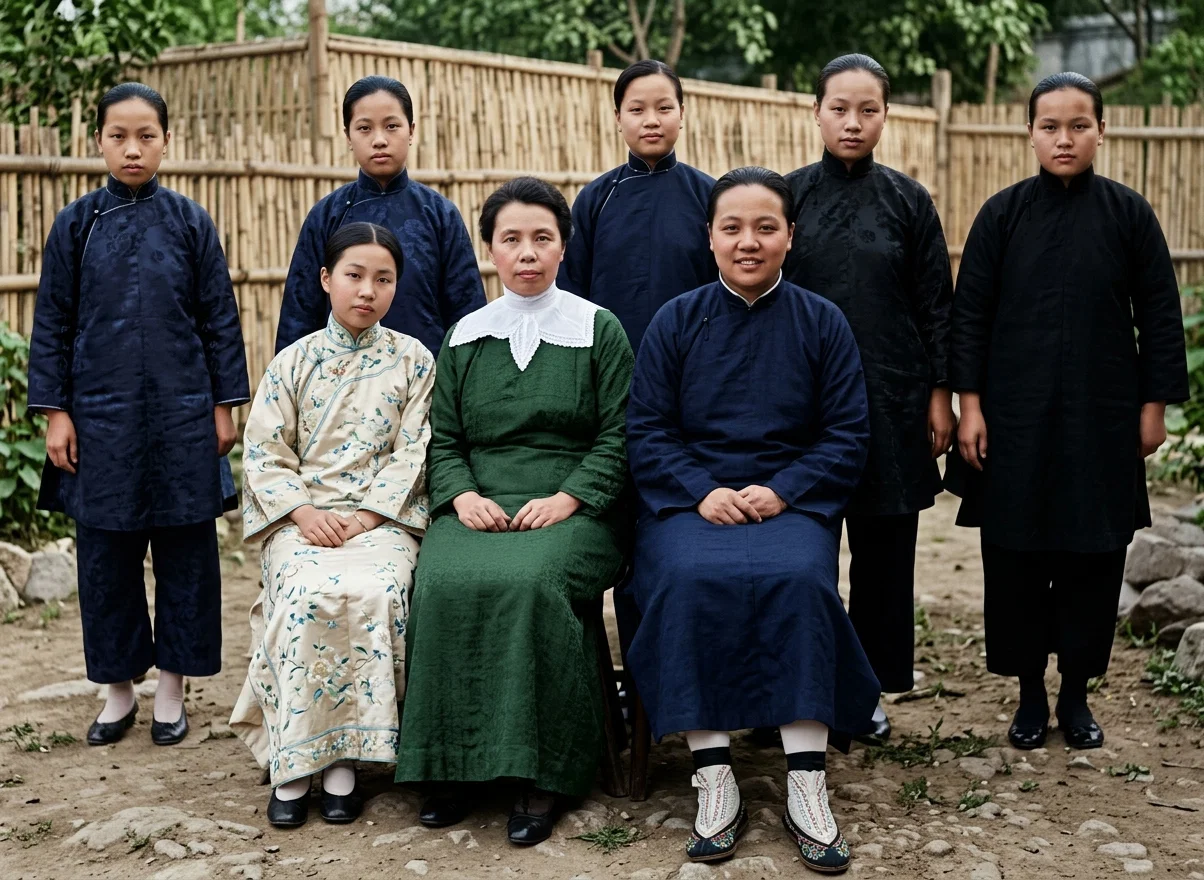
GRADUATING CLASS IN GIRLS' SCHOOL AT CANTON, CHINA
All were interested in listening to six of the more advanced students in the Boys' Training School deliver short talks on important Bible subjects. It was evident that they have some ability, and had received careful training supplemented by experience. The students in this school have an excellent opportunity for development in practical missionary work in the large city of Canton, under the instruction and direction of their Bible teachers, while carrying forward their literary training.
Brother A. Mountain was present, and gave special instruction to those who are engaged in the sale of our literature.
Good progress is being made in this branch of the Lord's work in the Cantonese field.
Sabbath, June 3, was observed as rally day. Sister B. A. Meeker gave an interesting talk on the progress that is being made, giving comparisons in the different fields from year to year, and holding before the people the importance and aims of the Sabbath school. Dr. Law Keem, who was present throughout the meeting, not only rendered good help at the church services, but also gave special help in the Sabbath school work, in which he is much interested. For the study of the lesson the school was divided into a score of classes, and when the offering had been taken, tellers counted the money and announced that $27 had been received.
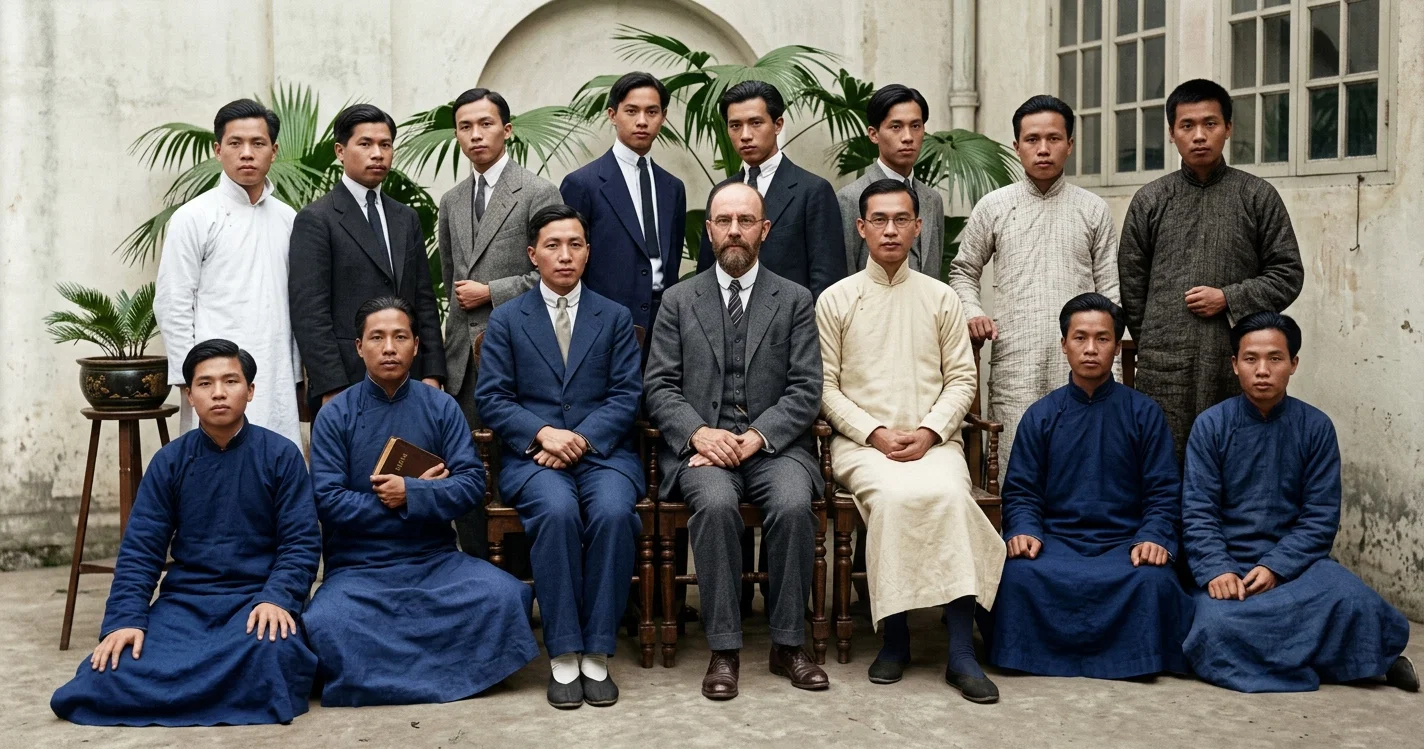
CLASS OF YOUNG MEN IN TRAINING FOR WORKERS IN THE CANTONESE FIELD
On the last day of the meeting, after a sermon in Chinese by Elder Meeker, eighteen believers were received into the church by baptism. There were fifteen others who desired to be baptized, but as they had only recently come to a hearing knowledge of the gospel, it was thought best that they wait, and in the meantime continue the study of the Word.
There was a spirit of love, peace, and harmony, and the Lord added his blessing to the efforts put forth by Elder A. L. Ham and his associates in the preparation and conducting of this meeting. At the close all felt that this was one of the best meetings which they had ever attended.
Missionary Needs in Southern China
Writing of the joy felt in southern China in welcoming several new missionaries, Elder B. L. Anderson reports also the urgent need in some parts still unsupplied. “Our people in the Swatow field,” he says, “shed tears because they received no foreign worker at this time.”
Music in the Home
By Clemen Hamer
CLEMEN HAMER
Music may be made a great blessing in the home, as well as a pleasure, or it may become just the opposite. It all depends on whether it is regarded as a gift from God, to be used to his glory, or merely as a means for the gratification of self.
Fathers and mothers, should you see in your child the gift of music, do not deny him the privilege of cultivating it as far as possible, lest by so doing you may be held accountable for burying a talent. But all the time seek to impress upon the young mind that this gift comes from God, and show how it may be used in his work.
There is always need in God's service for consecrated musical talent, and it will be available if the right standard is held up before the youth in our homes.
Let us keep the standard of our music high. We are careful to choose the purest, most elevating literature for our homes. Shall we not be just as careful to have in them only such music as will elevate and refine, and lead to purer, nobler thoughts and better lives? The cheap, commonplace sheet music, the sentimental and often vulgar songs that many sing for a little while and that then drop into the oblivion they deserve, should find no place in the Christian home. The greater part of the popular music of the present day is to pure music what the yellow-backed novel is to good literature.
Music may be the means of binding the hearts of the members of the home together, of helping to make it the most attractive place on earth. Father, do not lose patience if your daughter sings or plays when you, perhaps, have come home tired, and desire to rest. How thankful you should be that she is with you, and that she is light-hearted enough to sing!
How much happier is the home that echoes the voice of song than the one where strife and contention are heard! What pleasanter picture can be imagined than a comfortable home, with father, mother, sons, and daughters gathered to welcome the Sabbath, lifting their voices not only in prayer, but also in songs of praise to their Maker. Though the boy you love so well may sometime wander away for a time from such a home, and from the God you serve, the memory and influence of the prayers and songs which went up from your family altar will never leave him.
Let us make music one means of binding the home together, and of drawing us nearer to God, who gave us voices with which to praise him.
Her Daughter’s Music
By Goldie Robertson Funk
I HAVE often wondered at the patient unselfishness of fathers in regard to their daughters’ music.
When little Margery is eight years old, a mother says, “It’s time we had a piano. I don’t see how we’re going to get it while we’re still paying for the place, though; but if she’s ever going to learn to play, it’s time to begin.”
The very next time father comes home from work, he says, “I stopped in at Westermann’s on my way home. We can get a piano for ten dollars down and ten a month. I guess we’d better try it.”
Mother’s fear of debt comes to the front when she faces the possibility of undertaking a few hundreds more. “But I don’t see where it’s coming from. We’re living pretty close right now.”
Father fears debt, too, but his love for his little woman-child makes him determine to go without some new tools he needs, to work over hours for more pay, and to wear his old overcoat another winter.
That is how our American daughters mostly come by their pianos.
Father, who knows dozens of tunes, looks forward to the day when Margery will play for him evenings as he toasts his feet before the fire.
The stumbling little “pieces” and the endless scale work, the phrasings and the strivings after expression, the ceaseless din of practice, the constant strain of reminding Margery of practice time, are all in the background, against which stands out the day when Margery will play and sing for him. That playing and singing by his little girl becomes his secretly cherished dream.
As she advances, music costs more; lessons cost more, his pay remains the same, and the old overcoat sees another winter’s service.
Margery’s friends begin to come in evenings. Other girls play amazing pieces; they play duets with Margery; sometimes they sing; but the songs are not the songs he knows. His fifteen-year-old Margery and her friends flutter through a lot of “modern” music that makes her mother look uneasy and that he dislikes.
If he ventures to interrupt his daughter with, “Margie, play ‘Marching Through Georgia,’” or, “Margie, sing ‘Jerusalem the Golden,’” Margie blushes and looks uneasy for fear her friends will notice how old-fashioned father is.
I know a mother who kept it before her little girl from the time she began to take lessons that she was to learn to play to please and comfort her father. The father was not musical, but the mother knew he counted on his daughter’s playing and singing for him some day. He didn’t dream it could be otherwise, and the mother couldn’t bear to see him disappointed. She led him to make pleased comments about the child’s work, and then reported them to the little girl for her encouragement.
All through her young ladyhood this girl played and sang to her father. She hunted songs to please him. He liked march music, and though she preferred a beautiful study, she hunted up splendid marches for him. He liked old hymn tunes, and from the time she could play her first pieces, her mother had the teacher give her a hymn for each lesson in addition to her other work.
The father is a trembling old man now, and often through my window at night I hear the daughter break off from some exquisite study, and play a march for her father, or lift her voice in some old-fashioned hymn. She has never resented entertaining him with her music, or blushed before her friends because of her father’s choice of music. She was trained to respect his wish for her comforting music, and to respect his choice.
Sometimes she and her young friends take turns playing their favorites, and then the loyal daughter exclaims, “Now, daddy, this is for you. Listen, girls!” And a heavy cane keeps solemn time to Smith’s March. I have even known this girl, after an evening with her boy and14girl friends about the piano, to throw up the window and play a march for her father, who was resting on the porch.
It is all in the training. If mothers, who know the sacrifices fathers make to give their daughters an education in music, will quietly but persistently keep it before them that father must find pleasure and comfort in their music, it will be the natural thing to consider father rather than to accept his sacrifices and ignore his taste in music or be ashamed because it differs from the carefully educated taste of themselves or of their friends. Their own respect for their father will compel that of young friends who might perhaps think father’s choice “queer.”—Goldie Robertson Funk, in American Motherhood.
Sing
By Mrs. I. H. E.
THERE are cares and woes a plenty
In all lands beneath the sun,
Trials to bear and loads to carry,
Ere the victor’s crown is won;
But the day is always brighter,
And the clouds are lined with gold,
When there’s music round the fireside,
Songs of cheer from young and old.
Much— ah, much!— will be forgotten,
Toll to the consuming years,
Admonition and instruction,
Disappointment, bitter tears;
But the songs you sing at nightfall,
With the children gathered near,
To life’s end will be remembered
By the ones you hold so dear.
Silence is the law for prisons
And the dark and dismal tomb,
Not for souls who know the sunlight,
All earth’s fragrance and its bloom.
Sing! for you should go rejoicing
Through the swiftly passing day;
Sing! and others, hearing, heeding,
Will be cheered along the way.
MRS. I. H. E.
Conducted by Mrs. I. H. Evans, Takoma Park, Washington, D. C
By Mrs. I. H. Evans; Miss Lora E. Clement
Assisted by Miss Lora E. Clement
Through the columns of this department, hints will be given on all matters pertaining to the home life. Short articles and letters are solicited from home makers, telling of their everyday experiences,—their joys and sorrows, their failures and successes.
Mother Problems
By MRS. I. H. E.
The Practice Hour
“I AM puzzled to know how to help the children get the most good from their practice periods,” says a busy mother, who is making a real sacrifice to spare the money for her daughters’ lessons. “Agnes has some taste for music, and is very anxious to study it. She is willing to practice — in anticipation — but far from zealous in performance. Many and trivial are the things that constantly interrupt the study hour, and occasionally cancel it entirely. Often she spends more than half the time playing anything and everything except the lesson assigned. Her sister, from the very first, has frankly rebelled against practicing, and never touches the piano for her own pleasure. Getting her through the practice hour — broken into four parts to save her nerves, but adding much strain to mine — is a daily contest. Is it worth while? How can the ordinary mother in the ordinary home so arrange matters as to have the children gain the maximum benefit from the daily practice hour?”
A father and mother who have given a good deal of thought to the questions propounded in the foregoing paragraph, and who have met with a fair measure of success, have kindly written out the following suggestions, embodying the general plan followed in their home:—
The children are required to practice one hour each day during the school year, and two hours during vacation.
Not more than one hour is required at any one period.
The practice hour occupies a definite period each day — as definite as the dinner hour.
It is arranged for as early in the day as possible, and at a time when the room is quiet, so that the child will not be disturbed or tempted to waste time.
It does not come at the time of proper work hours; for it is not a proper education for the child to have the mother do his work while he is practicing.
It is used only for the regular lesson. Other playing is done outside the practice period.
It does not come at a natural play or visiting hour, which would be unnecessarily unpleasant to the child.
Practicing is never required as a punishment, or as a means of keeping a restless child “in hand” or employed.
It is not, and should not be, required of children who are sickly or nervous, or who for any reason might be injured by it.
When, after a fair trial, a child shows no interest in getting his music lesson, the privilege might be withdrawn for a time. By the exercise of tact, the mother may sometimes lead the child to see the benefits and happiness that come through music, and to be willing to make the effort necessary to become proficient in it.
MRS. I. H. E.
The Bible as Literature for Your Child
By Mrs. Walton C. John
MRS. WALTON C. JOHN
PATRICK HENRY, that noted Virginian orator, statesman, and patriot, the one-time governor of his State, said, just before his death, when found by a friend reading the Bible: “Here is a book worth more than all other books which were ever printed, yet it is my misfortune never to have, till lately, found time to read it with proper attention and feeling.”
The Bible may well be called the mother of books. It has been the source of inspiration for many books, poems, dramas, and lyrics.
The strong, forceful, picturesque style of the English Bible has kept our language vigorous. The books that have been printed about the Bible, as explanatory texts, as illustrating gems of thought, and as reference books, added to the many thousands of copies of the Bible printed every year, make it the most widely published book in the world.
The love of the child for God’s Word is as important as the regard of the keenest Bible student; yet in many homes the Bible is robbed of the love that children should have for its perusal. Being compelled to learn some portion of it as a penance, forced to spend time daily in the preparation of the school Bible lesson, perhaps listening while it is read through from cover to cover,—a breathless passage through history, genealogy, lamentations, and admonitions,—the child may receive the idea that the Book of books is a means of punishment in the hands of father and mother, a lesson that must be daily learned, something that must be listened to every day. The beauty of the Bible passes him by. He sees nothing beautiful in it; to him it represents only a task.
There is much in this Book that is grand and noble, and that reaches the splendid heights of eloquence and pathos; but in enforcing the moral truths, the sublimity of the Bible and its power to grip the imagination are often lost sight of. It is a book containing some of the highest flights of imagery, as a study of the writings of the prophets will show. Beauty is revealed through the Gospels especially. The flowers and fields and birds, the splendor and steadfastness of the mountains, the placidity of lake and sea, bring before our eyes vistas of loveliness. ‘He hath made everything beautiful,’ and surely that includes the words that came from his own lips.
For the smaller children, the story of Joseph, of Ruth, of Moses, of David, Samuel, or Elijah should be read as biography, and connectedly. This will impress the narrative upon the young mind as a disconnected perusal can never do. The story of the Shunammite’s son, of the raising of Jairus’s daughter, of the little serving maid, of Esther, and many others are of unfailing interest to children. These stories, read and illustrated, if you can obtain copies of the paintings made of these different subjects, will impress the children, and awaken in them sympathy and understanding.
For the older children there are some magnificent odes that should deepen their love for God’s Word, and will surely arouse their enthusiasm. Note the songs of Moses and Miriam (Exodus 15), the song of Deborah (Judges 5), and the song of David (Psalm 18). These, read through by the teacher at school or by the parents at home, unmarred by comments, will leave a lasting impression of the power and beauty of the Bible.
After the reading, the music of the sentences, the onward sweep of the rhetoric, and the splendor of the imagery may be pointed out; also the many hidden beauties to be found not only in the portions referred to, but in many other parts of the Bible.
The Old-Fashioned Nap
It is an interesting fact that quite one half of the naughtiness of children is due to fatigue—practically all cases of fretfulness, very nearly all quarrels, almost every fit of sulks. This being the case, it would seem that mothers would almost instinctively see to it that their children are provided with longer rest periods. Why is this not done?
I think one reason is that the nap, except for babies, has so largely gone out of fashion. Time was when every child under six years of age took a nap regularly every afternoon, and occasionally in the morning also. At the present time, when so many children over three years old attend kindergarten, all small children seem, as one of my friends recently said, “older than children of that age used to seem.” The result is that the nap has been given up. It might well be resumed. The result would be happier, healthier, and better-behaved children.
But children are not the only persons for whom naps have gone out of fashion. Mothers take naps less regularly than was once the case. The consequences are as serious as in the case of children, and, if one may say so, very much the same. Many a mother falls a victim to these consequences; she may escape them almost entirely by taking regular naps. Why should she not revive the nap for her children and incidentally for herself?—Home Progress.
The “Review” for 1917
By Editor
WE have many good things planned for the readers of the REVIEW during the coming year. We cannot enumerate all of these, but will give a little idea of some of the things which will be presented during the next twelve months:—
1. Articles from the pen of Mrs. E. G. White. Some of the most soul-stirring articles ever written by Sister White were published in the REVIEW AND HERALD about twenty years ago, back in the eighties and nineties. We shall reprint some of these excellent articles in the REVIEW during 1917. We shall also reprint a number of articles from Sister White which some of our readers have especially requested.
2. Elders A. G. Daniells, W. T. Knox, N. Z. Town, and F. Griggs will furnish us with articles regarding the development of the work in the great Asiatic Division. Some of these brethren are visiting this field for the first time, and they will have many new impressions to give us as to the character of the work which is being done. Elder Daniells’s articles will be illustrated by photographs of our institutions and workers. These brethren will also send us reports of the important meetings which will be held in that field, together with the report of the general meeting of the Division in Shanghai next spring.
3. We are receiving every week reports from our missionaries throughout the world-wide field. These relate many thrilling incidents of the manner in which the Lord is going before our workers and opening to them doors for the entrance of the truth. These reports will constitute a regular weekly feature of our paper.
4. It will be our aim to cover during the year the principal doctrines constituting the message for this day and generation. Some of our best Bible writers have prepared studies on these topics. These studies will embrace a series of articles on each of the following topics: The second advent, the prophecies, the law and the Sabbath, the sanctuary, religious liberty, the nature of man, temperance, church relationship, and the home. These studies will be found particularly helpful to those who desire to obtain a knowledge of present truth. They should be studied regularly in every Seventh-day Adventist home.
5. Some of our ablest Bible students and pioneers in the message and leading workers will contribute regularly to the columns of the REVIEW, in general articles, in reports of labor, etc.
6. The excellent instruction which has been given in the Home department will be continued next year, making this department of value to every member of the family.
7. The departmental secretaries of the General Conference — the Publishing, Medical, Educational, Religious Liberty, Missionary Volunteer, and Home Missionary — will tell of the progress of the work of which they have the oversight.
8. The editors of the REVIEW will endeavor to keep in touch with the great world field, pointing out the dangers which threaten us, and the opportunities afforded us in passing on to others a knowledge of the times in which we live.
These and other features too numerous to mention will serve to make the general church paper for 1917 one of the most valuable volumes we have ever issued. Let us not be content with reading our church paper by ourselves alone, but let us see to it that every member of our church has access to this great newspaper of the denomination.
The Value of the “Review”
By George I. Butler
THE REVIEW is worthy of the utmost confidence of our people. It is doing a grand work, and fills a position in the denomination that no other paper can fill. Its subject matter covers a vast field, and its circulation is world wide.
We always await the coming of the REVIEW with great interest. We love to read it on the blessed Sabbath. In it we find an account of what is being done in every one of our mission stations all over the world. It also covers the vast home field. All the important meetings held and all the important business done in our glorious cause are chronicled in its pages. Here the deaths of our church members are recorded. Here are inspiring articles from the most earnest believers and some of our best writers. In the REVIEW just what is going on in this cause is found week by week. Many of the greatest events happening in the world are here mentioned. The great dangers which threaten our prosperity are brought to our attention, and every hopeful and encouraging omen, circumstance, or event is narrated for our edification. The REVIEW AND HERALD uncovers to us all, week by week, the very heart and body and life of our work.
The servant of the Lord has spoken in regard to the importance of reading the REVIEW, plainly saying that every Seventh-day Adventist able to do so ought to take it. And not only that, but where members are too poor to take it, those better off should make up a fund and furnish the deserving poor with the paper free. We feel very certain that such a move would be praiseworthy, and meet the mind of the Spirit of God. Every Seventh-day Adventist ought to have the REVIEW, and read it too.
Dear brethren and sisters everywhere, don't fail to take our oldest denominational paper, which for all the time of our existence as a people has faithfully given us its warnings, counsels, admonitions, cheering messages, and heavenly, spiritual, soul-inspiring calls for better service and nobler aspirations. We can't afford to be without it.
GEO. I. BUTLER.
A Mirror of the Lord's Workings
By William Ambrose Spicer
THE REVIEW is the church paper that keeps us in touch with the advent movement throughout the world. It is the only eminence I know of from which really to catch a glimpse of the advent people marching through this world to the borders of Canaan. If, in traveling, I miss the REVIEW for a month or six weeks, I feel out of touch with the16world-wide work until I have found the back numbers and caught up with the reports of progress. Continually it mirrors before us what the Lord is doing in finishing his work in these momentous days, and the progress of his work is the most definite sign of the nearness of the end.
"Whoso is wise, and will observe these things, even they shall understand the loving-kindness of the Lord." Ps. 107: 43.
W. A. SPICER,
Secretary General Conference.
"Review" Week
ALL Seventh-day Adventists should read the denominational paper, the REVIEW AND HERALD. All do not, however. Dec. 16-23, 1916, has been set apart as REVIEW week, when every lover of the "good old REVIEW" will be asked to do his little to help increase its influence. Do you know a Seventh-day Adventist who does not take the REVIEW? Will you show him a copy? Will you tell him the good you receive from its weekly visits? Will you do your best to secure one or more subscriptions to the REVIEW during REVIEW week?
The present is an especially opportune time to subscribe to the REVIEW. Those who begin their subscriptions now will get the beginning of that splendid series of articles running through the year 1917, setting forth clearly the doctrinal points of our faith. Those who subscribe before Jan. 1, 1917, will save money, as on that date the rates will be increased.
The subscription blank found in this issue may be convenient to use. Get as many subscriptions as possible, and send them promptly to your conference tract society.