[The following letter, says the New York Sun, was written by a Russian Nihilist to a friend in New York. To escape the vigilance of the police, it had to be taken to the frontier to be posted. The translation is by Countess Norraikow:—]
St. Petersburg, May 14, 1889.
My Dear Friend: The greatest excitement prevails in our beautiful city, and a cloud blacker than the blackness of midnight hangs over our heads. No one is sure of his life, for at any moment the storm of autocratic thunder may descend and sweep thousands, the innocent as well as the guilty, into the whirlwind of its tremendous wrath. That some terrible event is about to happen we are well aware, and the people, convulsed with the agonies of suspense, are awaiting its fulfilment—not with patience, but with a nameless terror. No one knows the moment he will be rudely torn from the arms of loving friends, and, after being hustled into the black-painted conveyance for criminals, will in a short time find himself within the confines of the Petropavlovsk Fortress. These black keretas have rattled through the streets during the long hours of the otherwise silent night, sending terror to the stoutest heart. Even your friend Ivan, “stout of heart,” as you always call me, quailed before the tempest, when the gendarmery sounded the alarm before my house during the night. But it was not I they wanted; it was another member of the household, a visitor. But my time will also come—it cannot be much longer delayed. As the black carriage passes on the way to the fortress, the people, in tones of sympathy, whisper, “God, have mercy!” It is impossible to estimate the number of arrests, or to learn the names of the accused, except in occasional instances; but that their number is legion, we have not the slightest doubt.
No one dares openly to question the cause of this sudden activity on the part of the despotic police, nor the reason for their continued acts of brutality toward unoffending people. The press is alike silent as the grave. Not a word has appeared in print in regard to the attempt made on the life of the czar in the garden yesterday. Rumor says that the czar was shot at twice by an officer of the Izmailovski Regiment, that he was wounded in the left arm, and that afterward the officer shot himself in the temple, and was taken away by the police, in an unconscious condition. His name is believed to be Izioloo Pavlovitch Nazimoff, one of forty men selected by lot from different circles of the national secret society, “Ziemla Voila,” to assassinate our despot at the first convenient opportunity.
It is known that at least 180 officers of the army are confined in the fortress, suspected of complicity in the plot. The victims selected for incarceration are from all ranks of life, but people high in society are known to contribute the greatest number of suspects.
A large number of bombs have been found in the possession of persons of whom the police had previously not the slightest suspicion. Many ladies of high social position have been found in the ranks of the Nihilists, and placed under arrest. All last night the work of raiding houses went on, and the gendarmery were the reverse of gentle in their treatment of prisoners. People wrapped in slumber were, without a moment’s warning, dragged from their beds, and in the name of the czar ordered to enter the black kareta. Men, women, even children, all received the same treatment. Fifty-three persons were taken from the house of Povloff, thirty-five Bolsky Morskay. Among them was a beautiful princess, Anna Narishking, sixteen years old. Her brother, a young man of eighteen, maddened by the brutal way the police were treating her, rushed, sword in hand, to protect his sister, when he, too, was beaten into insensibility, and carried off in the black kareta. It is feared the shock will upset their poor mother’s reason.
The story of these terrible scenes is told in whispers and only among friends. Most persons maintain silence, fearing to speak lest it be to an enemy, and almost every face bears a look of deepest sadness. Members of the secret police are the only persons whom the gift of speech seems not to have forsaken, and they infest the hotels and public places, openly expressing their feelings, apparently with all sincerity. Their talk is but a snare to allure their victims. Yet our people (the Nihilists), as you are aware, are always on their guard, and refrain from giving utterance to their thoughts. We work in the silent hours of the night, and in the unthought-of places of the great city. The poor peasant from the inland parts of the empire, is the one most easily led into the trap.
The czar has lost all control of himself, and acts more like an infuriated madman than a being possessing reasoning powers; and the officers of his court tremble for the safety of their lives, and fear to approach him. His orders are more than ever despotic, as if his tyranny would crush the feeling out of our people. The czarina is completely prostrated, and has gone to the Yar-Skoyesela (czar’s village). The czar, after attending a mass in Isaak Cathedral (most likely to offer prayers for his safe deliverance), took an express train, and also retired into seclusion at the same place.
The issuing of foreign passports is, for the present, suspended by order of the czar, and all letters to and from foreign countries are opened and read without the least ceremony. All foreign residents are under police supervision. Among the arrests made from our circle last night, may be mentioned Semen Aphanasevitch Orloff, Viera Strelmkoff, Tasielewski Ostroff, and Dr. Stephan Ivanovitch, together with many others. Our circle is particularly grieved about the Doctor’s arrest, as he gave up an extensive and lucrative practice to engage in the work of the Brotherhood. Among the ladies of our circle who were arrested, was Ellena Isakoff.
She was dragged from bed, and, with nothing but her night-dress, and an old blanket which a gentleman threw around her to protect her from the chilly night air, was carried to the black kareta, and cast inside with several other prisoners.
We are, as you know, a brave lot; but the thought of separation from our loved ones saddens us. Then everything is so uncertain. No one knows whose turn will come next. It is possible that before my letter reaches you, I, too, may be numbered with the victims of our cruel tyrant. It is blood, nothing but blood, everywhere. But we are prepared for the worst. The Nihilist has but one aim and object in life—freedom. For that he willingly sacrifices his life. His freedom means death, but to coming generations it will possess a deeper, a more significant meaning—peace!
During the present crisis, guilty and innocent suffer alike. The police apparently have but one thought, and that is to test the capacity of the prisoners to the fullest extent. The officers of the army are thoroughly aroused, and loudly condemn the brutalities practiced by the police on many of their comrades. The wholesale arrest of officers last night has engendered among their comrades a feeling of the bitterest hatred. St. Petersburg is not alone in her sorrow over her captive children, for Moscow, Saratof, Samara, Nijni Novgorod, and Kieff have put on sackcloth and ashes, and mourn with their greater sister. In all these places the prisons are full of suspects.
There is a terrible tragedy in the air we breathe, and do not be surprised if you hear of strange events in the near future. It cannot be otherwise when the czar, on his golden throne, is surrounded by spies, treacherous gendarmery, and corrupt Tchinovniks. What security is there for his life? Even now the muttering of thunder is heard in the distance, and the despot trembles. In his eagerness to crush out the life of our people, he but adds fuel to the flame, which rapidly increases daily. His acts of brutality drive recruits into our camp in their thirst to avenge the unjust treatment of their loved ones. Those officials who remain loyal to their sovereign (they are few) are in a dazed, stupefied condition, and do not know whether to turn for sympathy and advice. Now that the soldiers, the pillars of the throne, have risen in their righteous anger and passed judgment, the collapse of autocracy is but a matter of time.
To appreciate the better part of life, we must first pass through the evils; and already, my dear friends, I see through the darkness, ignorance, corruption, brutality, misery, and bloodshed the dawn of a new era in the life of the Russian people. Our beloved fatherland will yet be purged of its uncleanness, and the fairest country the sun ever shone upon will take her place among the nations of the earth, waving aloft banners inscribed with the name of Liberty instead of Siberia.
Faithfully yours,
Ivan Smirnoff.
Catholic Federal Funds for Indian Schools Rise
—It will doubtless be a surprise to most of our readers to learn what immense sums the Roman Catholics have been drawing from the National Government for their Indian schools. The whole amount received by the Congregationalists for their schools among the Indians the past year, was about $23,000. But the following figures, taken from the Dakota Catholic, show how much the Roman Catholics have received since 1884: 1884, $65,220; 1885, $113,614; 1886, $148,744; 1887, $214,760; 1888, $244,677; 1889, $344,545; and this coming year they expect to draw $431,930.—Chicago Advance.
Jewish Congregation's Gift to Sacramento Catholic Poor
At the dedication of the Catholic cathedral at Sacramento on June 30, a check for $178 was received from the B'nai Israel synagogue, as an offering to the Catholic poor. And here is a sermon for Saturday and Sunday.—Jewish Messenger.
A REMARKABLE CAREER.
In the Review of Aug. 13, we gave a notice of the death of Eld. J. Crossett, of China, on the authority of a letter sent us by sister Crumb, from her daughter residing there. Our readers will be interested in the following further particulars, which we find in Public Opinion of Aug. 31, 1889. Under the heading, “Remarkable Career of an American Missionary,” it says:—
The Department of State has received from the legation at Pekin, China, under date of July 3d, an account of the death and extraordinary life-work of the Rev. J. Crossett, an independent American missionary in China. He died on the steamer “El Dorado,” en route from Shanghai to Tientsin, on June 21st. He leaves a widow, living at Schuylersville, N. Y. In speaking of Mr. Crossett, Minister Denby couples his name with that of Father Damien, and says: “Mr. Crossett’s life was devoted to doing good to the poorest classes of Chinese. He had charge of a winter refuge for the poor at Pekin during several winters. He would go out in the streets on the coldest nights, pick up destitute beggars and convey them to the refuge, where he provided them with food. He also buried them at his own expense. He visited all the prisons, and often procured the privilege of removing the sick to his refuge. The officials had implicit confidence in him, and allowed him to visit at pleasure all the prisons and charitable institutions. He was known by the Chinese as the ‘Christian Buddha.’ He was attached to no organization of men; he was a missionary pure and simple, devoted rather to charity than to proselytism. He literally took Christ as his exemplar. He traveled all over China and the East. He took no care for his expenses. Food and lodging were voluntarily furnished him; innkeepers would take no pay from him, and private persons were glad to entertain him. It must be said that his wants were few. He wore the Chinese dress, had no regular meals, drank only water, and lived on fruit with a little rice or milk. He aimed at translating his ideal Christ into reality. He wore long auburn hair, parted in the middle, so as to resemble the pictures of Christ. Charitable people furnished him money for his refuge, and he never seemed to want for funds. He slept on a board or on the floor. Even in his last hours, being a deck passenger on the ‘El Dorado,’ he refused to be transferred to the cabin; but the kindly captain, some hours before his death, removed him to a berth.”
TIME ON A ROUND WORLD.
(Continued.)
It is evident that there must be some fixed point, or line, where days have a beginning and ending, or where, if it may be so described, the ends of two days abut together, so that crossing that line, in either direction, we pass from one day into another. Locally, of course, the day has, everywhere upon the earth, a beginning and ending marked by the setting of the sun. But the idea now intended is, that there must be some place, not traveling around the globe like the sunset line, but permanently located upon the globe, and moving around with it, where days have a beginning and ending, or, to speak more accurately, where days are divided one from the other. That such a line would be established inevitably in the natural order of things, will be apparent if we follow in imagination the migrations of the human family, as in the course of ages they spread abroad east and west over the surface of the earth. When God said, “Let there be light,” one half of the globe was instantly lighted up, and the other half was immersed in shadow. That body of light evidently acted the same part which on the fourth day was assigned to our sun; for as the earth revolved through the light and shadow, there was evening and morning, or the light and dark part of the day, the same as now. There was therefore midnight, morning, noon, and sunset all at once; but day was counted as beginning at that point where the light, the equivalent of the sun, could have been seen as just sinking below the horizon. From that point there followed a period of twelve hours of darkness and twelve of light; and then one day was complete. “The evening and the morning were the first day.” And days have followed each other around the world in regular succession from that time to the present hour. When man was created, the day began with him, when “the sun did set” at the point where he was located; and as the human family multiplied and spread abroad upon the face of the earth, they would take the day with them as established at the point of departure, beginning it earlier or later, according as they journeyed east or west.
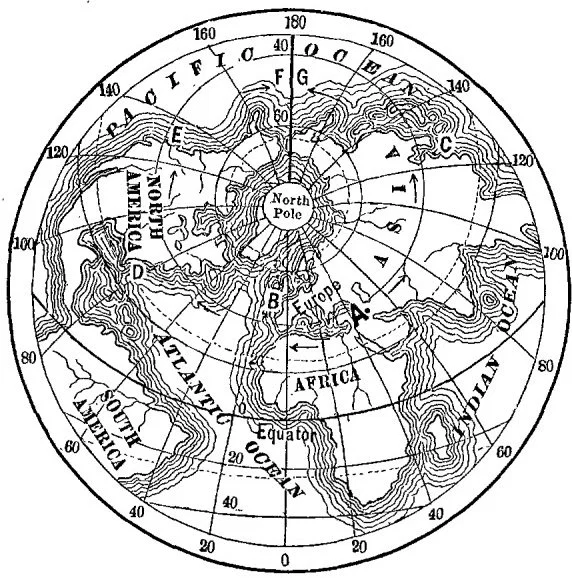
In the accompanying map, as the cradle of the human family is supposed to have been in the vicinity of the valley of the Euphrates, let “A” represent the spot. From that point they migrated, as numbers increased, east and west, as indicated by the arrows. Those going eastward finally reached the eastern coast of Asia at “C,” carrying with them the reckoning of the day as brought from “A,” beginning it earlier the farther east they went.
On the other hand, those who went westward reached, in time, the western coast of Europe and Africa at “B,” taking with them the same day as computed from “A,” only beginning it later and later the farther west they went.
For ages the broad Atlantic stayed the westward tide of civilization, at “B.” But at length the current of emigration broke the barrier, crossed the ocean, and reached the eastern coast of America at “D.” Crossing the continent, it carried the day on to the western coast at “E,” where it reached the Pacific. There they had the day as computed from “A,” only beginning it later and later the farther west they went.
That this so far is a correct view, is proved by the fact that a person may start eastward from “E,” and pass across America, the Atlantic Ocean, Europe, and Asia, around to “C,” computing his time all the way by the sun, and he will find that his reckoning agrees exactly with the time at all the places he passes in his journey. And so he may reverse his course, and, starting at “C,” go westward through Asia, Europe, across the Atlantic and America, back to “E,” and his count of days, going that way, will also agree with that of all the inhabitants along the entire route.
INTERNATIONAL DATE (OR DAY) LINE.
(From Schedler's Manual. Published by E. Steiger, New York.)
But now suppose two persons stationed at “C” and “E” to start toward each other by way of the Pacific Ocean, the one at “E” going westward toward “F,” and the one at “C” going eastward toward “G.” When they come together on the line between “F” and “G,” they find themselves twenty-four hours apart in their computation of time. But as there are but twenty-four hours in a day, they have now reached the point where some adjustment of the calendar must be made to conform to the operations of nature. In other words, they have reached the point where the days divide, and the time just west of the line is twenty-four hours earlier than that just east of it.
The conclusion, then, which we reach is this: The dividing line between days must come where the two tides of emigration starting out from “A,” the cradle of the race, one going eastward and the other westward, would come together in their progress around the world.
As a matter of fact, in the peopling of our earth, the two tides of emigration have come together in the Pacific Ocean, as represented on the map. For America was discovered from the east, and the time was brought from the Eastern Hemisphere westward to the Pacific, placing the line of division in the mid-Pacific, where the circuit of the earth was completed; or where persons from “C” and “E,” continuing their progress eastward and westward, would come together.
That this division line falls where it does, is altogether accidental, or perhaps better to say, circumstantial. It is all owing to the circumstance, or fact, that America was discovered from the east, and the reckoning of the day was brought from that direction, instead of being discovered from the west, bringing the day from that source. If some Chinese or Japanese Christopher Columbus had sailed eastward, from “C” to “E,” and this country had been peopled from that direction, bringing the time from “A” eastward, by way of “C” and “E,” to the Atlantic at “D,” then the two tides of emigration would have come together in the mid-Atlantic, and the day line, or dividing line between the days, would have been there instead of in the mid-Pacific.
It may perhaps be regarded as in a measure, at least, providential that circumstances have placed the line in the Pacific Ocean where a meridian may be drawn from the North pole to the South pole, without encountering any considerable body of land, and where the tide of travel is much less dense than it is across the Atlantic between Europe and America.
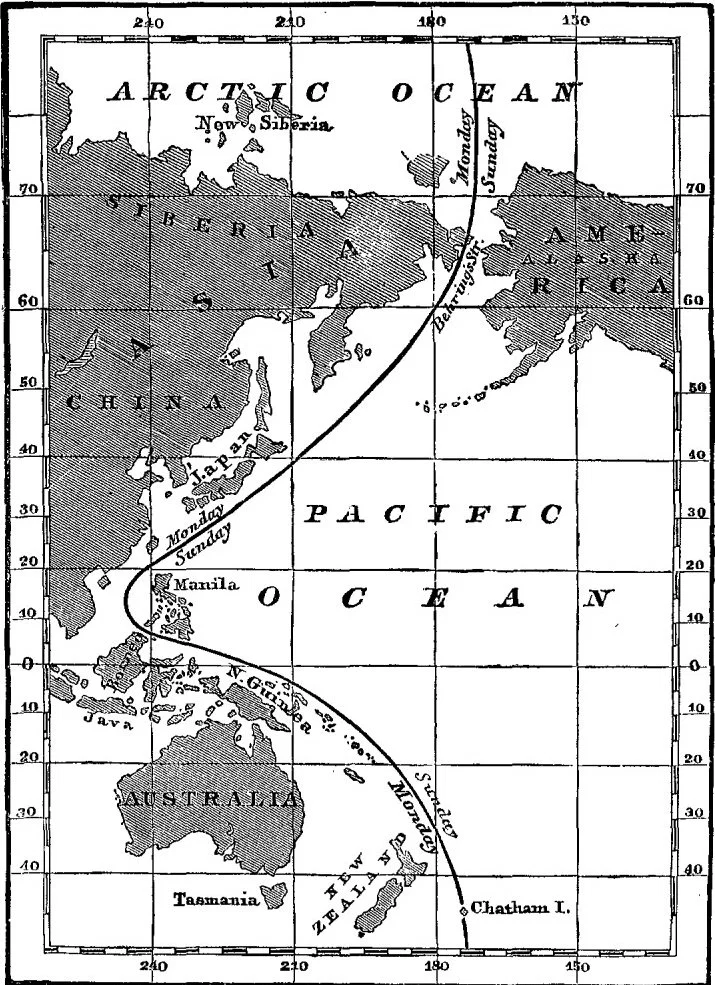
Having now found where the days divide, and why they divide there, we are prepared to understand why the day line, or, as it is called, the international date line, in actual practice, varies from this theoretical view of the subject, as we have it illustrated in the accompanying diagram.
Theoretically, the day line is a line running from the North pole to the South pole, through Behring’s Strait and the Pacific Ocean, near the 180th meridian of longitude east or west from Greenwich, England. But the first navigators westward across the Pacific, carried the time from the east far west of that meridian, even to the Philippine Islands, that group shown on the map, of which Manila is the capital. To other points in the Pacific, as Borneo, Australia, New Zealand, etc., the time was brought, not from the east by way of America, but from points west of them, by way of Asia and the Indian Ocean. And thus it came to pass that of various localities in the Pacific Ocean situated far east and west of each other, the eastern points have time one day in advance of the western. Thus at New Zealand, though situated many degrees east of the Philippine Islands and Manila, the time is one day in advance of what it is at the latter place. And these dates having become established, the date line has been run in accordance therewith. So running through Behring’s Strait, which is correct, the line bears away southwestward till it circles the Philippine Islands, to correspond to the dates of that locality, and then curves southeastward till it reaches a point a little east of the 180th meridian, but directly south of Behring’s Strait. Had time been brought to the Philippine Islands, and on to the mid-Pacific eastward by way of Asia, instead of westward by way of America, the line would have run straight north and south instead of curving as it does.
These facts also enable us to solve the problem of the difference of time as found in Alaska. The Alaskans coming from Asia across Behring’s Strait, brought the time of Asia over upon the American Continent, and were found reckoning their time one day in advance of that which had been brought617from the east, and established upon all other portions of the continent. So in their matter of Sabbath-keeping they intended to keep the first day of the week, but took for that purpose, from their western reckoning, the day which has been established on this continent as the seventh. The day which they called Sunday, was here, east of the day line, Saturday. So they were literally doing what Seventh-day Adventists are falsely accused of doing; that is, “keeping Saturday for Sunday.” What ought they to have done? When they crossed Behring’s Strait, thus crossing the day line, they should have dropped the reckoning of their time back one day. As they did not, it remained to do it afterward. They needed not to change the day they were observing as the Sabbath; they had the right day; but they should change the reckoning of it, calling it the seventh, as it really is, not the first. The reason why their day should correspond to ours is apparent. For the American Continent, having received its day from the east and not from the west, except this small fraction of it, this should conform to the rest of the country, and let the dividing line run here as in all other localities, not through any portion of the country, but through the ocean between the two continents of America and Asia.
(To be continued.)
A HARMONIOUS FAITH.
By G. I. R.
In things of religion, the heart requires something stable. It reaches out after that which is reasonable, consistent, and enduring, upon which to found an abiding faith. Religion pertains to eternal things. The temporal rapidly passes into oblivion. The eternal endures forevermore. Hence the necessity, if the wants of our hearts are met, of some firm foundation upon which our hopes, joys, aspirations, and faith can rest, and we can feel settled and sure that we are right. There is too much at stake, when we consider the possibilities of the future state, to justify us in remaining in a doubting posture. What if, at last, we find ourselves lost when we might have been saved, and all for the lack of using a little judgment and good sense, which we often use in other things of less importance, in settling down upon saving truths which the mind can feel are reliable and consistent.
Truth will always be in harmony with itself. We may be sure that if one portion of our doctrinal belief contradicts some other portion, there is a fallacy—a falsehood—somewhere involved. Error is contradictory and multiform in its various efforts to adapt itself to varying shades of belief. Hence one important question in deciding whether a certain system is true or not, is, Does it harmonize with itself? Seventh-day Adventists have great reason for thankfulness to God for the harmony of doctrine which has been revealed to them. One potent reason why many questioning minds reject the Christian religion, and become chronic doubters, is the lack of harmony in the theology of the orthodox churches. They cannot harmonize the justice and mercy of God with the doctrine of eternal torment. They cannot see why, if the tenet of the soul’s immortality be true, and our departed friends are all around us and hovering over us and interested in us, as they ever were in life,—why they do not, in some way, communicate with us. Hence the many converts to Spiritualism. They cannot understand, if the righteous and wicked go immediately upon their demise to their respective rewards in heaven or hell, the need of a future judgment day; or why, if the faithful go at once to heaven, Christ needs to come to earth after them in a second advent. They can see no good sense in the change of the Sabbath rest from the day the Almighty appointed it to another day. If the latter was better, why not have selected it at first? We might proceed to multiply inconsistencies in orthodox belief, but we forbear.
We can regard it little short of the miraculous that the system of doctrine held by S. D. Adventists was so soon developed into its present completeness after the great disappointment of 1844. It was brought about through the agency of persons then unknown to fame,—humble, earnest, devoted souls, who loved the appearing of Jesus. They were poor in this world, but rich in faith. They studied with wonderful intensity the book of God, for light in that dark hour of disappointment and sorrow, and it came to their minds, bringing great relief, and joy unspeakable. Oh! how precious did the truth seem as the beautiful system which we denominate “present truth” unfolded before their minds, the fog of tradition clearing away, and the firm pillars of eternal truth appearing, securely resting upon the living rock of God’s holy word. It is certainly remarkable that thus far we have not had to change a single position decidedly taken after faithful investigation. Every one stands firmly after more than forty years of opposition from bitter opponents, growing more and more bright as these gems of truth are rubbed and scoured in the conflict.
Let us consider briefly some of the truths held by this people, as parts of their religious system of doctrine. They believe in the general truths of inspiration held by Christian denominations in all parts of the world; such as, the existence, sovereignty, holiness, and perfection of God the great Creator, and the pre-existence and glory of his Son Jesus Christ, by whom the worlds were created before man had an existence on this earth; man’s creation by that Saviour; man’s subsequent fall, and the introduction of the plan of salvation, an essential part of which was the Saviour’s giving himself to die a sacrifice for sinners; and that our only hope of salvation is through our acceptance of him as our great Substitute. They believe in the law of God, introduced, in substance, as soon as man was created, and formally delivered from Mount Sinai by the voice of God, and written on the tables of stone, teaching love to God and love to man, embracing all the great principles of right which God required, the transgression of which constitutes sin, the penalty of which is death, the gospel of Christ presenting the only means of pardon; and that this law is eternal and unchangeable, and condemns the whole race for transgression. They believe the fourth precept of this law, requiring the observance of the seventh-day Sabbath, has long been transgressed, and that another day, the first day of the week, has been received by professed Christians in its stead, which has no divine sanction whatever, but stands on the authority of tradition and Catholic corruption alone.
They believe that we have reached that age of the world in which, the sure word of prophecy teaches, Christ is to come again, to gather his people and destroy his enemies. A multitude of testimonies from Holy Writ demonstrates the truthfulness of this doctrine. They believe that the great Advent proclamation of 1836–44 and since, which stirred the world mightily, was in the order of God, and a fulfillment of prophecy, and that it has been, and still is, accomplishing an important and needful work among mankind, calling their attention to the close proximity of the day of God’s wrath, introducing three important particulars most necessary for the last generation of mankind to know; viz., the progress of judgment in heaven above, preparatory to Christ’s coming to execute its sentence upon the righteous and the wicked; the condition of professed Christianity after the proclamation had been given, because of the rejection of light; and, finally, the great movement of reform concerning God’s holy law, and the restoration of the ancient Sabbath of the Lord to its proper place in the affections and observance of those preparing for Christ’s coming. This threefold message of Rev. 14:6–12, must be one of the most important of all revelation.
They believe the subject of the sanctuary as revealed in the Bible in its connection with the priesthood of Christ, his ministry therein, and its position in connection with the judgment work just before his second coming, to be one of the most important in all Scripture, shedding, as it does, a flood of light upon the whole scheme of human redemption. They see in the general movement, in all directions, in behalf of Sunday, a wonderful evidence of the certain fulfillment of the predictions of the third angel’s message of Rev. 14:9–12, relative to the enforcement of that peculiar “mark” of the Catholic power, the Sunday Sabbath. They recognize the impending conflict on this question as the grand, final struggle between the power of truth in the hands of God’s people, and the work of tradition as upheld by the popular churches of Christendom.
This great reform concerning the law and the Sabbath embraces also the “faith of Jesus,” which must indicate important truths lost sight of in the practice of the popular churches. How reasonable to believe that Christ, when he comes, will find a people thoroughly entrenched in all the truths he left for his people to practice! Seventh-day Adventists feel certain, from the plain declarations of the word of God, that there will be great spiritual illumination in connection with the closing work of the gospel. It will not close up in obscurity, but will blaze with a clear and powerful light. The gifts of spiritual power, lost in the darkness and mist of Babylon, will be restored to the church. Special light from the spirit of prophecy will shine upon the last work of the true church, encouraging, reproving, and illuminating the minds of the honest and humble. They are sure such light has shone out from heavenly visions all along their pathway. In short, they believe that those engaged in this last work will be a body of Bible believers in all things, living up to the principles of all genuine reforms, temperate in all things, caring for the body—the temple of the Holy Spirit—as well as for the eternal interests of the soul, being true health and temperance reformers, discarding hurtful stimulants, and living sensibly and purely.
This conclusion naturally follows, not only from the teaching of Scripture, but from their belief in the nature of man. The body is more, in their view, than a mere tenement for an immaterial soul which is supposed to do all the thinking, feeling, willing, suffering, loving, and enjoying. When the body dies, and all the fine machinery of heart, lungs, brain, and nervous system stops, man becomes unconscious till again set in order and motion by the Lifegiver at the resurrection. The lapse of time is but an instant to him, as consciousness and life must go together. It seems to him that he gets his reward just as soon as if he received it at death. This great truth gives harmony to Bible doctrine, giving place for the judgment, making the coming of Christ and the resurrection as important as the Bible everywhere makes them, tumbling the whole structure of immortal-soulism into ruins, with its heathenism, necromancy, witchcraft, transmigration of souls, purgatory, deification of heroes, saint-worship, Spiritualism, Universalism, and eternal torment. It brings out in glorious relief the fact of eternal life through Christ alone, the necessity of his second advent, the vast importance of the resurrection, and the certainty of a clean universe, with sin and sinners and Satan (the great sinner above all others) utterly destroyed out of it. The falsity of Satan’s great lie, “Thou shalt not surely die,” will then be fully demonstrated. The great scheme of human salvation, worked out through the infinite sacrifice of Christ, our glorious Lord, will then have been consummated. The new earth, freed from all sin, will then appear. All sin will have received its merited doom, its proper reward. Glorious ages of bliss and eternal joy will be experienced by the truly good.
These truths are firmly believed by S. D. Adventists. They are harmonious, consistent, involving no contradiction of positions, and perfectly in agreement with God’s word. Here we have the rock of truth to build upon. These doctrines we have held successfully against all opposition. They have sustained the souls of believers in sickness or in health, in prosperity or adversity, in popular favor or persecution, in peril, in darkness, or in the icy clasp of death itself. They afford a clear explanation of most difficult texts of Scripture, and will stand the closest scrutiny. Why should we not all take a firm, undoubting stand upon them, and rest upon the word of God.
G. I. R.
THE VIRGINIA CAMP-MEETING.
By R. M. Kilgore
The railroad connections between the North Carolina meeting and this one being so faulty, I was unable to reach Luray before Thursday. Here, in company with Eld. J. W. Bagby, I found Eld. J. E. Robinson at work, with a fair attendance of our own people, and a good outside interest.619
Bro. L. C. Chadwick, who had come to give instruction during the workers' meeting, had returned. So few being present the first days allotted to the workers' meeting, they left the grounds and visited an adjoining church a few miles distant, and taught there. Thus much of the benefit to be derived from this workers' meeting was lost because the workers and others failed to take advantage of the privileges offered them, and to avail themselves of the instruction which the brethren had been sent to impart. Not only was this a loss to the workers, but it was felt during the camp-meeting proper. There is nothing which adds so greatly to the good of all during a camp-meeting, as that influence which is created in a good, spiritual workers' meeting. Some of the brethren and sisters did not arrive till late in the week, and their loss cannot well be computed; but those who came early could more fully appreciate what the tardy ones lost, but would not wish to share in that loss. The outside interest was a surprise to the brethren, and as they saw the large tent filled every night, and the crowds which came on Sabbath and Sunday, they regretted that the meetings had not begun earlier in the week before, and could not continue longer.
On the Sabbath, when the special effort was made to work for those encamped on the ground, we found them so scattered and crowded back by the large audience which had come in and filled the tent, that we were unable to separate the few and labor for them as we desired. The Lord gave good liberty as the truths for this time were presented. His sweet, tender Spirit was manifestly present. The brethren and sisters were greatly encouraged, and returned to their homes and fields of labor with a solemn purpose to move forward and consecrate themselves to the work of God. We shall look and hope for good results in this Conference the coming year.
The business meetings of the different departments passed off harmoniously. On account of there being so few churches in the State, and the low condition of their finances, the burden of the leading office in each of the different branches of the cause was laid upon one individual. Other changes, also, were made, which we trust will give relief and add to the results in the execution of plans for the future. The efforts which were made to help the brethren see the necessity of working to build up the cause in their own territory, and spread the truth in foreign fields, and the importance of standing by, and supporting those whom they send forth to labor in the Master's vineyard, seemed to be appreciated by all. Solemn vows were made to be more strict and prompt in the payment of tithes and offerings.
When the subject of Religious Liberty was presented, and the objects of the National Religious Liberty Association were set before them, more than twenty of those present readily united with it, and paid their membership fee. Bro. Robinson accompanied me to the West Virginia meeting, and on our way we stopped at Harper's Ferry, where we were kindly entertained, and had the privilege of visiting and seeing its historic places and important relics of the war. R. M. KILGORE.