The Youth’s Instructor, Vol. 37, No. 16.

LEBANON

The Youth’s Instructor

Apr 17, 1889

S. D. A. Publishing Association · Battle Creek, Mich. · Apr 17, 1889

LEBANON
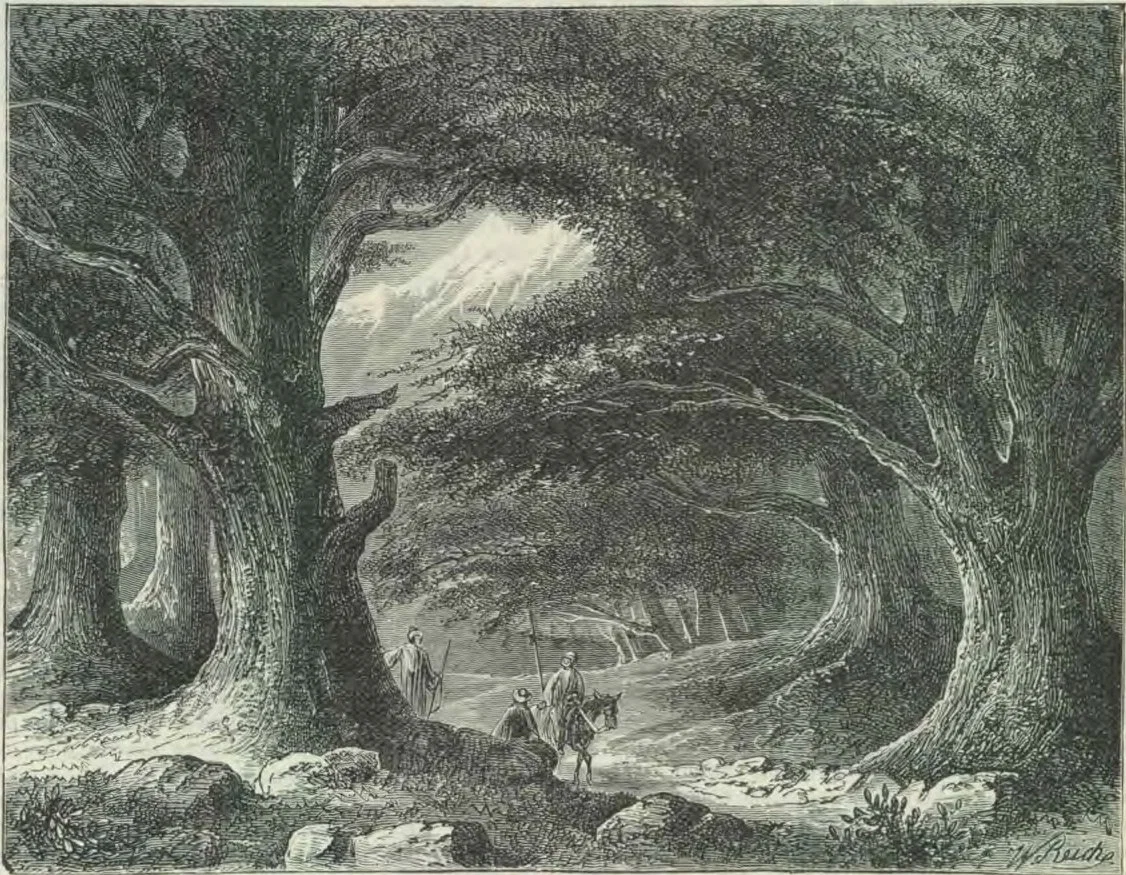
FORMING the northern boundary of Palestine, is the region of territory known as Lebanon. It was given to the Israelites to possess, but was never completely conquered by them. It consists of the celebrated mountain ranges of Lebanon and Anti-Lebanon, the former extending along the coast of the Mediterranean Sea from the Litany River (anciently called Leontes), on the south, to the Nahr el-Kebir on the north. Running parallel with this chain, a few miles farther to the east, is the Anti-Lebanon range, meaning the range opposite Lebanon proper.
In Scripture, the eastern range as well as the western is sometimes called by the general name, Lebanon, and once is called “Lebanon toward the sun-rising.”
The original word for Lebanon means “to be white,” and was given these mountains either from the whiteness of the snow which lay upon their summits several months during the year, or else from the white color of the limestone cliffs and peaks. Good authors tell us that the highest mountains nearly always have a name meaning white; as for instance, Mt. Blanc, which means snowy; Ben Nevis, snowden; Alps, from alb, white, etc.
In hight, these mountains range from 6,000 to 8,000 feet, the highest peak, however, being over 10,000 feet. Of the Anti-Lebanon Mountains, the celebrated Mt. Hermon is the highest peak.
Both these mountain ranges run from southwest to northeast, a distance of some eighty or ninety miles, and are separated by a deep, fertile valley, from five to eight miles wide, through which flow rivers, at some points forming the most magnificent scenery.
The central ridge of Lebanon is nearly barren, showing its limestone formation, from which jut now and then white points of rock of various shapes. Farther down, on a line of 6,000 feet, cultivation begins and although the surface of the soil is so broken by rugged and perpendicular rocks that the “tillage is carried on chiefly by means of terraces, built up with great labor, and covered above with soil,” its cultivation is truly marvelous, every available space being put to the best use.
“When one looks upward from below, vegetation on these terraces is not seen, so that the whole mountain side appears as if composed of immense rugged masses of naked, whitish rock, severed by deep, wild ravines, running down precipitously to the plain.” Some portions of the mountains are “covered with naked limestone, which time and the elements have chiseled into fantastic shapes.”
Here the vine, the fig and olive trees, find nestling places, and by their luxuriance, add beauty and enchantment. “Villages are built amid labyrinths of rocks, and in some places cling like swallows’ nests to the sides of the cliffs.”
I have space to notice but a few of Lebanon’s interesting features, yet must not pass by its forests of cedar, which were anciently its glory. So far as can be ascertained at the present time, this tree is confined to the valley of the Kedisha River, which enters the sea at the port of Tripoli; and although two or three centuries ago there could be counted 400 trees, the number is now reduced to less than a dozen. It is thought from the “size and general appearance of those that remain, that they existed in Biblical times.” If this tree constituted Lebanon’s chief glory, surely it is passing away.
The cedar is mentioned in many Scripture texts, but reference is not always to the cedar of Lebanon, which is esteemed above all others for its great durability, its commanding hight, and a breadth many times even greater than its hight, thus indicating great depth of root. And thus it is that the Scriptures so frequently compare the righteous to the cedar of Lebanon,—they are “fixed as the hills in strength.”
The great durability of this wood adapts it to building purposes, and so it was sought for by men of wealth in all the adjacent countries. Sometimes, too, it was conveyed long distances by water. You remember that it was from these forests that King Solomon obtained cedar for his palaces, as also cedar and stones for the temple. Please read the entertaining description of the building of the temple in Kings and Chronicles.
The glory of Lebanon has departed. And the holy and beautiful house, builded of its stones and cedars, with its worshipers—where are they? Let the Saviour answer.—“Behold your house is left unto you desolate.” Matt. 3:28. And again, as he viewed the temple in company with his disciples, he said, “Verily, I say unto you, There shall not be left here one stone upon another, that shall not be thrown down.” Matt. 24:2.
May we learn wisdom from the things others have suffered, lest we be left to grope our way in darkness.
M. J. C.

LAURA BRIDGMAN.

SOME weeks ago we spoke of a little boy who said “Oh, dear!” every time anything went wrong with him; and now we want the children who say “I can’t” to read what we now write. In the other article the name of Laura Bridgman was mentioned as an instance of what disabled persons can accomplish by patience and perseverance. We will now tell you something about her.
When Charles Dickens came to America, he happened to ramble into the vicinity of Harmony, New Hampshire, and there saw Laura, and learned her history. She was then about five years old. On his return to England, he wrote a book about our country, naming it “American Notes.” In it he so touchingly told the history of Laura Bridgman that many good people became interested in her. Among these were Mr. Longfellow, the poet, and Dr. S. G. Howe, the director of the Perkins Institution and Massachusetts School for the Blind. These, in company with others, visited Mr. and Mrs. Bridgman, and finally persuaded them to give the child into Dr. Howe’s care, who carried her to the Institution. She was then eight years old.
Laura was born Dec. 21, 1829, and is now, therefore, about 60 years of age. She was a delicate child, subject to convulsions; but when eighteen months old, she grew stronger, and remained so for about seven months. Then all the children of the family were stricken down with scarlet fever. All died but Laura. As the result of this terrible fever, she lost her sight and hearing; and as though that was not enough, the sense of taste and smell forsook her. The poor little baby was left with only a wasted body and a wide-awake brain, and with none of the ordinary means of outward communication with the world. Almost any one would have believed it better for such a child to die, as she could be nothing but a burden upon others as long as she should live. The result has proved otherwise, however.
At five years of age her health had been restored, but she had but one sense left,—that of touch; and clinging always to her mother, resting her hand lightly on the hand of this devoted parent, she learned to detect all that it was desired she should do. In this way she learned to sew, knit, and braid. Pushing she learned meant “go;” pulling, “come;” a pat on the head, approval, on the elbow, error, and on the back, disapproval. This was her condition when she entered the Perkins Institute.
“The first lessons this child received were very interesting. Dr. Howe had the names of common household objects, such as ‘knife,’ ‘spoon,’ ‘fork,’ ‘chair,’ ‘table,’ etc., printed in raised letters, such as are used for the blind. Then he had the objects also labeled with the same names. First he gave her the word ‘knife,’ and made her feel it as the blind feel letters in reading. Then he gave her a knife, and let her feel the word labeled upon it. This he did with all the other articles, until he thought she knew the difference. Then, taking the labels from off all the articles, he would give her a label, and get her to put it on the article it designated, or, giving her the article, would get her to put it on the table. Then he would give her the word ‘table.’ He would let her work around until she would understand to put it on the table. In this way he taught her that objects had names, and how to apply them.
“When proficient in this practice, he had type made, and taught her to spell and form the words she had learned with them. She learned it readily and eagerly, and it was a great step in advancement. Yet Dr. Howe said that all this Laura learned as a dog learns tricks from his master. It was imitation without understanding. They undertook then to teach her the manual alphabet—commonly called the deaf-and-dumb alphabet. The teacher formed each letter, which Laura now knew from her type, with the fingers, but of one hand only. By resting her hand easily on the teacher’s, Laura caught the movements, and so learned to use them herself. When she did right, they patted her head; when she did wrong, they knocked her elbow.
“Dr. Howe said he knew the very moment that Laura first understood, when being taught the manual alphabet, that by this means she could communicate with the world. He said the knowledge of understanding came in an instant, and her face filled with an unspeakable radiance that he could never forget. I think that look of—yes, heavenly happiness, repaid him for all his tender patience with his protégée. Can one imagine the delight Laura Bridgman must have felt when, in her sealed casket, she found by the movements of her fingers she could communicate with the world; that she could express the thoughts and ask the questions which had gathered there unanswered since her birth? Is it surprising that this hungry soul would eagerly grasp every new word and never forget it; and that she never tired of conversation? Her progress was marvelous, and she was soon able to read books for the blind and to write letters to her parents, whom she could not see or hear. Think what a pleasure it is to us to communicate with our friends who are very far away. Think, then, if we were among them and unable to see or hear or speak, what would be our rapture when we could communicate with them from a distance more terrible than all the miles we could count.”
Laura is now almost sixty years of age. She is delicate and fragile, but enjoys perfect health. She always dresses herself, and with exquisite neatness. She has the primness of a dear little old maid. All the noted people who come to the White Mountains call upon her; even the Crown Prince of England did so, and many other distinguished foreigners. She makes a great deal of lace. A lady visitor describes some she made for a customer who sent from California for it:—
“I took the lace from her outstretched hand, and examined it curiously. It was probably four inches deep, and made of No. 80 white cotton. The pattern was very difficult and pretty, and was done—as is all Laura’s work—perfectly. It would require a very skillful woman, even with perfect sight, to make such lace.
“If she drops a stitch, and the matron puts it on, Laura can tell instantly if the thread is on right or wrong. What is hardly perceptible to the sight is very plain to her dainty touch.
“I expressed a desire to obtain a sample of her work, which was told her. She caught her breath with a little happy sound, and told the matron that she had none now, all having been sold, even this she was making. She makes samples of lace, which visitors are eager to buy as mementos of her skill. She has a great desire to be useful, and delights in the idea of earning money and accumulating it. She always gives her autograph with every mat she sells, with the price marked on it. To feel that, with her indescribable afflictions, she is useful and capable, is bliss to her.
“She sells her photographs to visitors, and asked if I cared to have one. I had hardly said ‘yes,’ when she went to get them, and trustfully handed me a package to select from. Thirty cents, she said, was the price. I gave her thirty-five cents. She felt the money, then with a little hurried noise informed the matron that I had given her five cents too much. She can tell money from the touch as quickly as I can by sight.
“Another rush from the room and upstairs. This time she had gone to her purse, and returned with the right change. She now offered to write her autograph for me, and for the purpose she brought from the next room a sheet of note paper and a covered pad. The pad she placed on her knee, and with a lead pencil wrote her name and ‘a motto,’ as she said. This pad has slight grooves in it, which keep her lines straight. She places two fingers on the groove and quickly makes the letters, pushing her fingers close to the pencil, so that she will not run one letter on to another. It did not require any more time for her to write her autograph than it does for any one else. After it was written, she tore the paper across, and gave me the part written on, which is here reproduced.
“Her duties at the institution are not few, because she is desirous to be useful. She is never idle, though lacking little of sixty years. She rises early, when the others do. She does all the dusting in the Fisher cottage, where she is living this year. Every year she is changed from one cottage to another, so that the responsibility of those in charge—who must be her tongue—is equal. The matron says no one could dust better, and that Laura never knocks down any little bits of china which decorate the room, or any photographs. She attends to her wardrobe, knits lace, crochets mats and all sorts of such work. It is also her duty to assist in the workroom where the blind pupils are taught to sew. Her duty is to thread all the needles and to examine the work, which she does very carefully with her all-seeing fingers; and what one with sight would probably pass as ‘pretty good’ she carefully undoes, and makes the worker do it over until perfect. She threads the needles by placing the eye on her tongue and deftly rolling the thread into it.
“She is well educated, and is constantly thirsty for a knowledge of the doings of the world which she is in and yet so far removed from. She spends much of her time in reading the Bible and a dictionary, and likes to have books and magazines and newspapers read to her. Any subject that it is thought might bring her sadness by realizing her isolation, is carefully avoided. They all say that Laura does not realize what she has missed in life. She is always cheerful, happy, and affectionate to her nearest friends.
“Laura Bridgman’s diary and all her writings, which are considered very valuable from a scientific point of view, are kept in the archives of the institution. Those who are interested in such studies as the human mind may be pleased to know that it is proven by Laura Bridgman’s case—her now-told recollections of her early childhood—that she thought before conversation was possible. Another interesting fact was proven—that she had no innate idea of a God or a Supreme Being. She has dreams the same as any one else, but she never dreams that she can see or hear or speak. If restless at night, she will talk in her sleep with her fingers.”
Now, children, whenever tempted to say “I can’t,” stop; think of Laura Bridgman, and how she educated herself, became happy and useful, with but one out of the seven senses. Then say, “I’ll try.”
W. S. C.

"YE ARE THE TEMPLE OF GOD."

WHEN the beautiful temple was builded, No sound of the hammer was there, For the timbers and stones were made ready In the Lebanon mountains afar.
There were pillars of strength and of beauty, Foundations of grandeur untold; There were towers that shone in the sunlight, And ceilings o'erlaid with pure gold.
But in silence the structure was builded; No sound of the hammer was made, Till with shoutings of "Grace, grace unto it," In triumph its capstone was laid.
Do you know that the heavenly temple In perfect proportions shall rise? That each stone must be fitted and polished To blaze from its niche in the skies?
Do you know that each lover of Jesus A place in that temple shall share? That the humblest and weakest disciple Unspeakable glory shall wear?
But the process of grace must prepare us, In secret, in silence, below, Till, "made perfect through suffering" and sorrow, To shine in that temple we go.
In that palace of heavenly beauty No change nor decay shall we see; For God is its light and its glory, "Its Builder and Maker" is he.
Then we'll joyfully wait for his coming, Each one in our own lowly place, Redeemed by his perfect atonement, Made faultless and fair by his grace.
—Christian Weekly.

EXPERIENCE

We aim, we hope, we strive, and then we fail,— When, lo! the way to win we clearly see; Why should we, then, our overthrow bewail? Defeat gives us the key to victory! When comes another chance, to-day, next year, Shall we, successful, count experience dear? —Youth’s Companion.

THOSE THREE PENNIES.

A CLERGYMAN told this story about himself the other day, and it is true from beginning to end.
He said that when he was a little fellow, he was playing one winter day with some of his boy friends, when three pennies, belonging to one of them, suddenly disappeared in the snow. Try as they would, they could not find them, and the boys finally gave up the search, much to the disappointment of the one who owned them.
“The next day,” said the clergyman who was telling us the story, “I happened to be going by the spot, when suddenly I spied the three coins we had been looking for. The snow which had covered them the day before had melted, and there they lay in full view. I seized them, and put them into my pocket. I thought of the candy I could buy with them; and when conscience would not keep still, but insisted on telling me what it thought of me, and above all what God thought of me, I just told it to be quiet, and tried to satisfy it by saying that Charlie R— had given up thinking about his three pennies by this time, and that the one who found them had the right to them.”
“Well, to make my long story short, I spent the money, ate my candy, and thought that was the end of the whole matter. But I was never more mistaken. Years passed on. I grew from a boy into a man, but every now and then those three pennies would come into my mind. I couldn’t get rid of them. They would come. However, in spite of them, I had all along a strong desire to be a good boy, and to grow up to be a good man—a Christian man. This desire grew stronger and stronger, for God never left me; and so I gave myself to him, and finally, when I grew up, became a clergyman. Now perhaps you may think my trouble was over. But no; every now and then ‘those three pennies’ would come into my mind as before. Especially when I would try to get nearer to God, there were ‘those three pennies’ right in the way.”
“At last I saw what God had all along been trying to make me see—that I must tell Charlie R— that I had taken them! To be sure, he was a man by this time, and so was I; but no matter. God told me, as plainly as I am telling you now, that till I had done this, he could not bless me. So, then and there, I sat down and wrote to Charlie, inclosing in my note a shilling—the three pennies with interest. Since then I have had peace, and God has blessed me.”
Boys and girls, a very little may come between you and God. What are your “three pennies”? God will show you, if he has not already. Never let any sin, however small, come between you and him. Confess it right away, and he will make you clean. You should try so to live that you may be always sure of the smile of Jesus. Then you will be happy, and then you can be blessed.—S. S. Advocate.

A WISE CHOICE.

A CHILD in Burmah was permitted by his parents to go to a mission school because they wished him to learn to read. By and by, they found he was losing faith in the idols. This made them feel very bad. So the father took him to one of the gayest of the temples, and showed him the idol covered with gold and silver ornaments, surrounded by flowers and candles and fragrant incense. “Here, said the father, ‘is a god you can see, but the Christians cannot show you their God.’”
“Yes,” said the child, “we can see your god, but he cannot see us. We cannot see the Christian’s God, but he sees us all the time.”—Selected.

Living a Holy Life Rather Than Talking About It

It is a great deal better to live a holy life than to talk about it. Light-houses do not ring bells and fire cannons to call attention to their shining—they just shine.

Spring Secrets: A Verse Invitation to Search
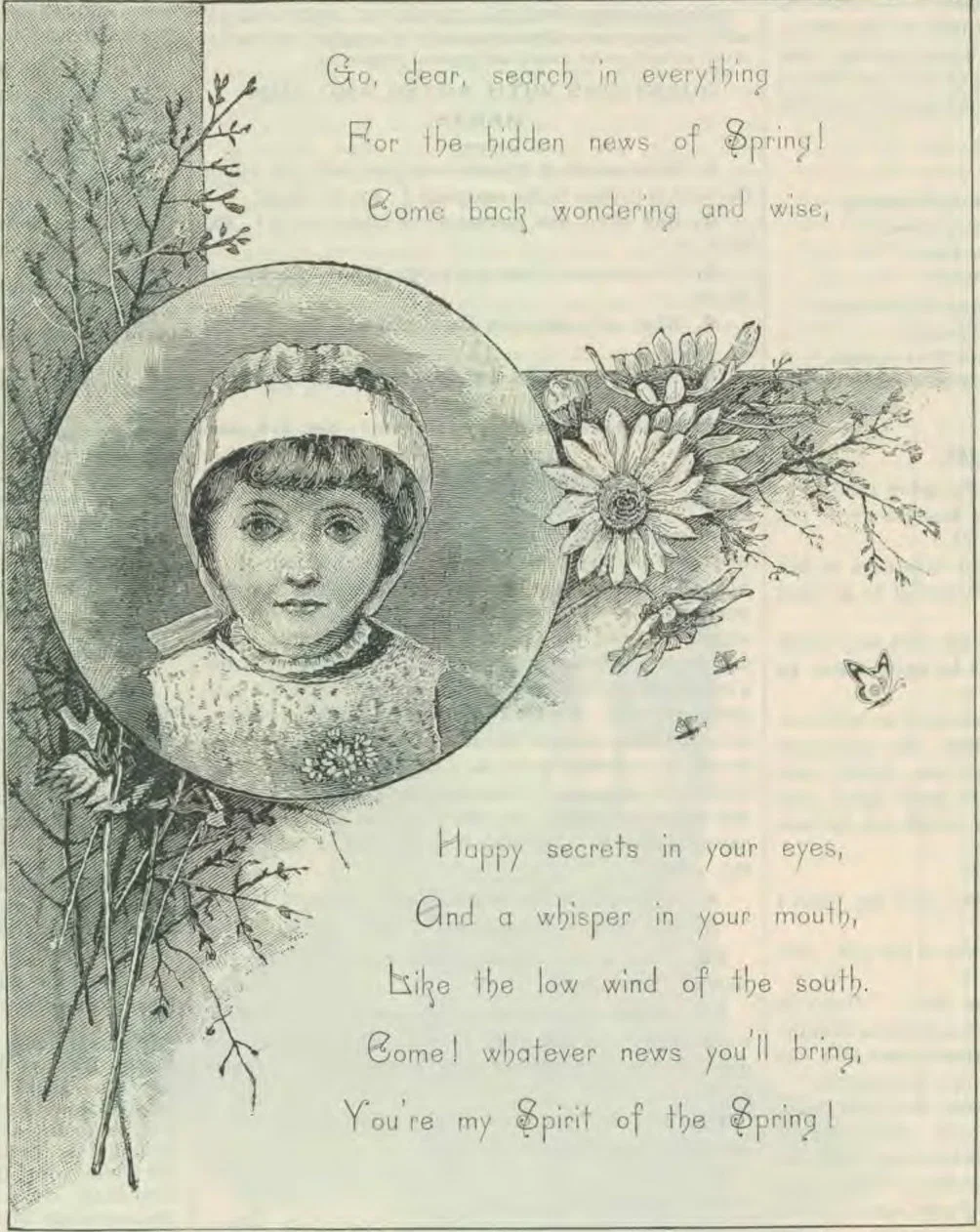
Go, dear, search in everything For the hidden news of Spring! Come back wondering and wise, Happy secrets in your eyes, And a whisper in your mouth, Like the low wind of the south. Come! whatever news you'll bring, You're my Spirit of the Spring!

TO MY PET.

[In the Country in April.]
Though the south wind roves about, In the woods all warm and wet, And the sun shines on my doubt, I remember winter yet; I'm too tired to go out, You go for us both, my pet.
There's one growing in the wood With a message of spring hope: Go and find it! a pink bud Growing on a southern slope, All the winds of May would miss it, If you plucked it for my sake; Stoop down softly, dear, and kiss it, Like a babe you would not wake! Kiss it! you'll bring home, I think, On your lips the May-flower's pink.
If a wee white violet, In the edge of some gray thicket, Smiles a timid smile, my Pet. Smile again, but do not pick it, Pass on then, and after-while When you bring me such a smile, Timid, wistful, guileless, tender, I shall know who was the sender.
If you find a starry bluet, Brave with looking at the sky, With a mad March wind to woo it, And a rock to shelter by, Just nod blithely, boldly to it, As you're passing by the place, Just nod frank as if you knew it; It will laugh up in your face.
Follow where the little rills Run down slanting from the hills; In their glistening footprints follow Down into the wooded hollow. In some silent, sheltered place, If you find a shadowy grace, Like the ghost of last year's flower, Come to haunt an April hour With its starry, spirit face, Leave the wind-flower's fragile gem Trembling on its slender stem, Pause and look, and leave it gleaming; Pass by softly, not too near it; I shall know by your still seeming You have seen a Blossom's spirit.
Go, dear, search in every thing For the hidden news of spring! Come back wondering and wise, Happy secrets in your eyes, And a whisper in your mouth, Like the low wind of the south. Come! whatever news you bring, You're my Spirit of the Spring!
—St. Nicholas for April.

WATER-CRESSES

“Will you buy some water-cresses, please?”
Aunt Rachel put on her spectacles and took a good look at the little peddler on her doorstep.
“Why, Teddy Armstrong!” she exclaimed, in astonishment.
“Yes, ma’am,” said Teddy, soberly.
“Why are you peddling cresses, Ted?”
“Well, I broke a pane of glass because I played ball when mother had forbidden me, and I’ve got to earn the money to pay for it. That’s the fiftieth time I’ve told it. Everybody says, ‘Why, Teddy Armstrong!’ and won’t buy a cress till I tell ’em about it.”
Aunt Rachel glanced sympathetically at the boy’s downcast, rosy face.
“Come in, Ted. I’ll take two quarts every day of you. I can’t help thinking your mother is a wise woman. Have a cookie? They’re fresh from the oven.”
Ted was staring eagerly in the direction of a panful of crisp cookies.
“Why, yes, Aunt Rachel, thank you; but I was looking at those crutches. I didn’t know you had crutches!”
Aunt Rachel picked up a pair of crutches which stood in a corner, and stroked the velvet arm-pads tenderly.
“My Jem’s,” she said. “Dead this twelve years.”
“And they’re just the right length, with spring bottoms and everything! You see, Aunt Rachel, I know a fellow who lives out where I go for cresses, and he’s lame. He has a pair of wooden crutches just like two poles; but he’s outgrown ’em, and his mother can’t get money enough to buy him a pair like those, and if you don’t want them, why, you know, he might have them.”
Aunt Rachel surveyed the crutches thoughtfully.
“I’ll sell ’em to you for a dollar, Ted,” she said, at length. Ted looked at her with a touch of scorn on his frank face.
“But he’s such a poor fellow, Aunt Rachel,” he began.
“Yes,” replied Aunt Rachel, “so I thought you would be pleased to give him these crutches. Isn’t your cress business good?”
“Oh, I see!” said Ted, a little shamefacedly. “Indeed I would! I’ll pay you a dollar for them, and call to get them to-morrow.”
Poor Phil Austin found the new crutches almost like a new life to him. They were so soft to lean upon and jarred him so little. He could get about in the warm, sweet, spring sunshine for hours every day.
And Ted peddled cresses manfully till he had paid for the glass and the crutches, besides interesting half the town in Phil Austin. The girls carried books and candy to him, and the boys invited him to all their games, where he was always an enthusiastic spectator.
Miss Netta Armstrong took him for a charming phaeton ride, and the butcher whose glass had been broken sent him three live chickens, for whom Ted and his friends built a wonderful chicken-house.
When Aunt Rachel was paid for the crutches, she put the dollar into her pocket, and took it straight down to Phil as a donation for his chicken business.
“I wouldn’t keep it for the world,” she said, briskly. “I only wanted to teach that careless boy a lesson.”
“And you have,” laughed Ted, popping from behind a tree. “I’ve worn out a whole pair of shoes peddling cresses, besides finding out what a good fellow Phil is, aren’t you, Phil?” affectionately throwing his arm across Phil’s shoulder.
“I want you to come to tea to my house soon, both of you,” said Aunt Rachel, kindly. “It puts me so in mind of my Jem.”—Youth’s Companion.

HOW SHE MADE HIM DO IT.

HARRY was standing in the road, on the way home from school. There had been a heavy shower an hour before, and there was a large puddle in the road. He had a switch, and was switching the water from side to side.
Nettie came along, and looked very cross at Harry.
“You stop that!” she said.
Harry did not like the way she spoke, nor the look on her face.
“Say ‘please,’ and I will,” he said.
“I’m not going to say ‘please!’”
“Then I shall do it as long as I like.”
“I can’t get by till you stop.”
“Yes, you can. I’m not hindering you.”
“You are. I shall get all splashed.”
“Then stay where you are. You can’t make me stop if you do want to.”
Now, the truth was that Harry did not care a bit about switching the water any longer. If Nettie had spoken pleasantly, he would have stopped at once. But now he felt as if he would stay there all day just to spite her.
“I shall tell your mother, you mean boy, if you don’t stop,” went on Nettie.
Harry laughed louder as Nettie tried to run by. He gave a harder switch and laughed more loudly than ever as he saw Nettie’s white apron spotted with mud. She scowled back at him as she went on.
Nettie had just turned a corner when Ruthie came up. Harry looked at her a little sourly, for he did not feel half so pleasant as he had before Nettie came.
Do you wonder why? Was it because Nettie had been cross? Partly so; for no one can speak or look cross without leaving a shadow behind. But Harry felt that he had been wrong, too, and that is worse than to suffer wrong from others.
“Stop a minute, and let me get by, Harry,” said Ruthie.
“I don’t have to stop,” growled Harry.
“But I can’t get home till you let me pass.”
“I don’t care. You can’t make me stop.”
“Oh, yes, I can,” said Ruthie, with a laugh.
“I should like to see you try,” said Harry, holding his switch tighter than before, while he looked at Ruthie. “You’re as big as I am; but who cares for that?”
“I can, though,” said Ruthie.
How do you think she did it?
She came nearer, still smiling, and said:—
“Harry, please let me pass. You wouldn’t be ugly to me, I know.”
Harry had never thought of an attack of kind words. If Ruthie had tried to take away his stick, or to push him out of her way, he would have made a good fight; but what could he do now?
He gave a little laugh as he stood back to let her pass, saying:—
“Well, if that’s the way you’re going to make me, I guess I’ll have to give up.”
Try it, little children. You have all seen how one angry word or look will bring another, and how little good they do, and how much harm. Try how much power there is in a gentle word and a smile.—Sydney Dayre.

BABY ELEPHANTS.

WILD elephants live in large herds. Seeing a herd go by, we should at first think there were no young ones among them. Looking closer, we might see the babies trotting along between their mothers' fore-legs.
These strong beasts, that can kill a horse by a blow of their trunks, are very gentle and kind to their young. If a little one cries, the whole herd is excited; if one is tired, the herd halts a few hours, that it may rest.
Elephants are almost always on the march, not stopping for hills and rivers. The mothers and babies go before, the fathers come after, and are on the watch for danger. At the first alarm, they throw up their great tusks, and rush forward to protect the weaker ones, and drive off enemies.
When the marching elephants have to cross rocky or hilly places, the mothers lift or push the little ones, helping them up carefully. It is when they come to rivers that they need most attention. Though the water may be deep and swift, the babies plunge in with the old ones, and are not afraid.
They would be swept down stream if left alone. But their mothers and fathers are there. Those too young to swim well climb on the backs of the old ones and ride. Sometimes two are seen sitting astride one old fellow, whose back is all under water out of sight. The little ones look as if they were walking on the water.
The very youngest elephants neither swim nor ride. They are carried across, some grasped in the trunk of the mother, some borne on the tusks of the father, and held above the surface of the water, so they cannot drown. Travelers in India see all this; we believe them when they tell us it is a curious sight.—Our Little Ones.

Revenge Complete Through Forgiveness

THERE is no revenge so complete as forgiveness.— H. M. Shaw.

DICK AND HIS BLIND FRIEND.

Dumb animals sometimes set us good examples. I will tell you a true story of two horses.
In the town of Cærnford there was a blind horse which one day last summer wandered into the river, and did not know how to get back to dry land.
Now, grazing near by, was a good horse, which the boys called Dick. He saw the blind horse swimming round in a circle in the river, and trying in vain to find the shore.
Dick must have thought to himself, “That poor horse can’t see, or he would not act in that way. I will call to him; perhaps he will mind my voice.”
So Dick began to neigh as loudly as he could, but still the blind horse did not know which way to turn. Perhaps he was deaf as well as blind; for though Dick would neigh quite loudly, the poor blind horse still could not find his way out of the river.
Then Dick must have thought, “That poor horse will get tired by and by, and sink and drown, if I do not help him.”
Then Dick went down to the river, and swam out to where the blind horse was, and touched noses, as much as to say, “Follow me;” and then guided the blind horse safely to the shore.
This kind act was seen by a great many people on the shore, and they cheered loudly as Dick came up on the bank with the blind horse behind him.
I hope you will be as ready to help a friend in need as poor Dick was. We must learn to be kind to one another, for kind acts and kindly feelings will make us happy.—Selected.

TRUANTS

When the sun was tired and slipped behind a cloud, All the little rain-drops gathered in a crowd, Whispering together, “He will never know, Let us take a holiday. Let us fall below.”
When the sun was rested and wandered out, he found All the little rain-drops fallen to the ground, “Well,” he thought, “I’m sorry; but I’ll try to smile, That will bring them back again in a little while.”
—Companion.
Continue reading: AUNT PATTY'S DAISY