On the other hand, the "Neo-Lamarckians" argued that the influence of environment and the effects of use and disuse "must be true factors [to use Le Conte's words] because there was a time when there were no others."—"Evolution and Religious Thought," p. 94. And this insuperable difficulty occurs and recurs in the case of every separate organ of every organic type.
I quote a fuller statement of this argument from this same author:
But not only does not natural selection explain the origin of varieties, but neither can it explain the first steps of advance toward usefulness. An organ must be already useful before natural selection can take hold of it to improve it. It can not make it useful, but only more useful. For example, if fins commenced as buds from the trunk, it is difficult to see how they could be of any use, and therefore how they could be improved by natural selection until they were of considerable size, and especially until muscles were developed to move them. Until that time they would seem to be a hindrance to be removed by natural selection, instead of a use to be preserved and improved.—Ib. pp. 270, 271.
But we may ask what single organ of a single species is there that did not thus appear long before it was wanted?
Untenable in Either Case.
The reader should, however, note that both sides always quietly assume that the higher forms have somehow been actually produced from the lower. The one side say that since numerous examples can be shown of complicated types having been evolved where the effects of use and disuse were not possibly of any avail, therefore Darwin's private patent of natural selection is the one and only factor in the process of organic evolution. The other side as strongly insist that the "Lamarckian factors" must be very important; for in the case of every organ of every distinct type "there was a time when there were no others."
But between the two parties, what is there left of Darwin's doctrine?
If an individual positively can not transmit to his offspring what he has acquired in his lifetime, how can he transmit what he has not even got himself, and what none of his ancestors ever had?
Or, if natural selection can not start a single organ of a single type, what is the use of talking about its supposed ability to improve them after the machinery is all built?
No wonder Sir Wm. Dawson could say in 1891 that "Darwinism seems to have entered on
A Process of Disintegration,"
or that a German author more recently could say that "Darwinism, for scientific circles, at least, is at its last gasp." Still more recently the veteran Virchow, shortly before his death, declared before a convention of scientists at Vienna:
The attempt to find the transition from animal to man has ended in a total failure. The middle link has not been found, and will not be found. Man is not descended from the ape. It has been proved beyond a doubt that during the past five thousand years there has been no noticeable change in mankind [except in the direction of degeneration].
More recently yet we have the following summary of this modern scientific civil war, as given in an article in a German magazine by Professor Hartmann, entitled, "The passing of Darwinism:"
In the sixties of the past century the opposition of the older group of savants to the Darwinian hypothesis was still supreme. In the seventies, the new idea began to gain ground rapidly in all cultured countries. In the eighties, Darwin's influence was at its height, and exercised an almost absolute control over technical research. In the nineties, for the first time, a few timid expressions of doubt and opposition were heard, and these gradually swelled into a great chorus of voices, aiming at the overthrow of the Darwinian theory. In the first decade of the twentieth century it has become apparent that the days of Darwinism are numbered.
The Basis of the Theory.
I conclude this article with another statement which puts the matter just about as we have been saying these many years with our open Bibles before us. The statement was made by Professor Fleischman, at the close of a series of lectures on "The Darwinian Theory:"
The Darwinian theory of descent has not a single fact to confirm it in the realm of nature. It is not the result of scientific research, but purely the product of the imagination.
[The title of Mr. Price's next paper is, "Geology the Mother of Darwinism."]
THE GREAT SALVATION.
By H. A. St. John
BY H. A. ST. JOHN.
THE salvation so freely proffered to the children of men through Jesus our Lord, is so great that we can only begin to see and sense its greatness, in this life. And yet that measure of that great salvation which we may know and have, even now, is so satisfying, is so good and so glorious, that when really and consciously possessed, may justly and truly cause the soul to rejoice with exceeding great joy, and spread the glad tidings of great joy to all men everywhere. Can it be possible that a soul possessing even the first-fruits of this great salvation, should need to be urged, exhorted, or even asked, to tell it out with gladness? Will they not rather, like the psalmist, be calling to all around, "Come and hear what He . . . hath done for my soul." In considering this great salvation, it may properly be divided into three instalments.
1. Salvation from sin. "All have sinned, and come short of the glory of God." Thus saith the inspired Word of God. The first instalment of the great salvation provided, is pardon full and free for all of our transgressions, upon condition of repentance. "Thou shalt call His name Jesus; for He shall save His people from their sins." There comes with this pardon, or salvation, the witness of membership into our heavenly Father's family. Truly such a soul may be excused for singing aloud, "Redeemed, how I love to proclaim it; redeemed by the blood of the Lamb." An heir of God, a joint-heir with Jesus Christ, who is heir of all things, is surely enough to fill the soul with rejoicing, and yet this is only the beginning of God's good work for us, only the first instalment of the great salvation.
2. Salvation from sinning. Upon the condition of entire consecration, the yielding of the body as a living sacrifice, the soul receives another uplift, another instalment of salvation, whereby the soul is enabled to show what is that good and acceptable and perfect will of God. Sanctification, or entire conformity to the will of God, is a state of perfect love, wherein the soul walks with God, as did Enoch of old. This is the high prerogative of every child that is born of God. Being filled with the Spirit, baptized of the Holy Ghost, sanctified wholly, body, soul, and spirit, is a glorious uplift in the great salvation in which the soul may be preserved blameless, unto the coming of our Lord Jesus Christ.
3. Salvation from the results of sin. This third and last instalment of the great salvation provided will be bestowed when Jesus comes in glory, and changes our vile bodies, and fashions them like unto His glorious body. Then all the results of sin in the redeemed, and in all things they shall ever behold, or with which they will ever have to do, will be forever removed. "There will be no more curse." O, the soul can never praise God enough for the great salvation which begins to be enjoyed in this life, and will be forever unfolding in the life to come. With joy the saints may draw and drink from the wells of salvation now. But when they shall come to Zion with songs and everlasting joy upon their heads, it will be not only wells of salvation, but perennial fountains, and streams, and rivers, and fields, and fruits, and flowers—in short, everything in the better world, in and around, above and beneath, will be praising God for the great salvation.
"Salvation!—let the echo fly
The spacious earth around;
While all the armies of the sky
Conspire to raise the sound."
THE SPIRIT'S VOICE.
By E. V. Shackelford
BY E. V. SHACKELFORD.
HARK, ye pilgrims on life's journey,
As ye march from day to day,
Do you hear a sweet voice calling
As you falter by the way?
Calling softly, pleading gently
When your footsteps turn aside,
Turn you, turn you, erring traveler;
In the royal path abide.
Follow in the path of duty.
In the way of life and light.
"I will guide thee" saith the Spirit.
Turn not to the left or right.
Los Angeles, Cal.
WORDS FOR DOUBTERS.
DR. ARCHIBALD ALEXANDER had a large experience in dealing with doubters, and his counsel was marked by a thorough common sense and great familiarity with the ways of the Spirit. A theological student once called on him in great distress of mind, doubting whether he had ever been converted. The old doctor encouraged him to open his mind to him. After he was through, the aged disciple, laying his hand on his head, said:
"My young brother, you know what repentance is—what faith is. You think you once repented and once believed. Now don't fight your doubts; go it all over again, repent now, believe in Christ now; that is the way to have a consciousness of acceptance with God. I have to do both very often. Go to your room and give yourself to Christ in a moment, and let your doubts go. If you have not been His disciple, be one now. Don't fight the devil on his own ground. Choose the ground of Christ's righteousness and atonement, and then fight him."—Selected.
Cultivate the Habit of Truth
By J. F. Carson
CULTIVATE the habit of truth. Let it become the very genius of your life. It will strike all hypocrisy out of your life, it will strike all compromise with evil out of your life, it will inspire in all men confidence in you when they come to know that at all times and under all circumstances you will be as your custom is.—J. F. Carson.
THE SABBATH
By L. A. Phippeny
BY L. A. PHIPPENY
THE COVENANT-TESTAMENT.
THE foundations of the everlasting covenant are discovered in creation; for the very fact of creation is a promise on the part of the Creator to accomplish His purposes in the creation.
It is only in creation that God is revealed to His intelligent creatures. The bringing into existence of intelligent beings in His image and in His likeness, and perpetuating them in life and its enjoyments, is the highest thought of their Creator-Father. Beautiful worlds might be spoken into existence, and embellished with infinite skill, yet if there were no intelligences, aside from the Creator, to behold and enjoy and appreciate these beauties, God could not be revealed. Their creation would be in vain. It requires intelligent creatures before there can be a revelation.
The Triumph of His Purpose Assured.
And so the word is spoken concerning our own world: "Thus saith the Lord that created the heavens; God Himself that formed the earth and made it, He hath established it, He created it not in vain, He formed it to be inhabited." Adam was made to have dominion, and to him was given the earth for an everlasting possession, an eternal inheritance. He and his children were to constitute a righteous family, and abide forever in their beautiful home. In creating them, God became responsible for their existence. And inasmuch as He is a holy, wise, and just Father, the very fact of their existence was the divine surety that the purpose of their creation would be fulfilled. It was the Creator's promise to do them good, to surely keep them in life, and give them its blessings forever. This was His part of a covenant. Their part was to live in harmony with His provisions.
That promise was the Lord's covenant with every intelligent being created, not alone in this dominion, but in every dominion established for the everlasting home of the family placed upon and in it. The establishment of righteousness, and the revelation of the character of the Father in His children, was the object of felicity for the whole creation, and to this end
The Creator Pledged Every Resource
of divinity,—and the final resource was Himself. This revelation of divinity was in itself the mightiest promise ever made, because it was based on Omnipotence for its fulfilment. It was the Lord's universal covenant; it was His ultimate will and testament in all places of His vast domain. And then when a danger arose, threatening to frustrate the divine purpose—no matter when or where—the process of eliminating the evil thing began and was worked out. And it took every available resource to make the testament-covenant sure. It took His life. And this was also in the eternal law of things: "Where a testament is, there must also of necessity be the death of the testator." In which is the mystery of godliness.
No Surprises in the Divine Plan.
Then when Adam broke the covenant, failed to adhere to its provisions, that was sin; and sin meant death; and death passed upon the whole dominion. That was the result of the danger that threatened. But Divinity was ready. Since creation's dawn, and in eternity, Jesus, the Creator, was pledged on His life to establish everlasting righteousness. And then when the dominion was lost by Adam, the powers latent for the redemption began to be revealed. The Redeemer was promised through the flesh. The words were spoken that the seed of the woman should bruise the serpent's head.
The Two Adams.
The Redeemer was called the second Adam.
“He Died Because of Sin.”
The first Adam failed to keep the covenant, and lost the dominion. The second Adam, in establishing and making sure the divine purpose, undertook to do the work Adam failed to do. One man sinned, and his children, after the flesh, were and are born sinful. One Man lived without sin, and His children, born of the Spirit, were and are without sin. The first man Adam was the son of God by direct creation in this dominion. The second man Adam was the only-begotten Son of God through the mystery of the incarnation. One man, created
holy, sinned, and involved all in sin; one Man, born of sinful flesh, lived a holy life, so that all might have righteousness by living as He lived, if they would. The sin of the first man Adam brought death to himself, and to all the world. The sinful flesh of the second Man Adam brought death to Himself also; but He did not deserve it, and He lived again. He died because of sin—for all sin—and lived as the Head of a new creation. He opened the way through the grave, for all who have ever believed in Him, and who will believe on Him with a belief that puts sin to death. He died to redeem—and did redeem—the lost dominion.
Sealing the New Testament.
"For a testament [will] is of force after men are dead; otherwise it is of no strength at all while the testator liveth." Its provisions may be published before the death of the testator, and the beneficiaries may base their plans upon its known provisions, but it is established, made sure, only when the maker dies, not before. The everlasting covenant—the universal testament—was made everlastingly and ultimately sure for the universe when Jesus, the Maker of it, died, and not before. And His death accomplished the purpose—it established the covenant forever. For righteousness is always and forever stronger than sin.
What the Covenant Means to Man.
From the foregoing a glimpse may be had of the dimensions and meaning of God's everlasting covenant, and it becomes clear why the utmost care is exercised in the Lord's specifications regarding it. It represents God's character. It reveals Him in all His good purposes for His creatures. It meant all that to Adam and Eve before the fall; its added revelations in the operation of divine Providence for the establishment of the covenant meant that to them after the fall; and their hope of restoration and salvation was based on the fulfilment of the eternal purpose. They looked forward to the redeemed and renewed creation, and manifested their belief in the forgiving and redemptive power of their Creator, by shedding the blood of a firstling of the flock, typifying the death of the testator, who was to die for them.
It meant all of this to every faithful soul of their posterity. The glad day of redemption was held before Noah and his sons, and the good news was passed on. It meant all of that to Abraham, with a peculiar emphasis by reason of his special mission in the earth. He recognized that he was a stranger in the land of Canaan, and he looked for a heavenly country, the dominion restored. Its significance was clearly understood by Isaac and Jacob, and its terms and provisions and object were most wonderfully taught to Israel, the nation. Its deep spiritual meaning and ultimate blessings were emphasized in its summarized statement as the new covenant with spiritual Israel. To David, it meant the establishment of his throne forever by the One who should finally reign upon it forever. And in the great invitation given through Isaiah, it is based in the Gospel upon the same foundation as with David—sure mercies. It rested not upon human promises, but upon the promises of Jesus, the Testator, and upon Omnipotence.
Abhor That Which Is Evil
"Abhor that which is evil," says the divine command; no man is safe unless he does.
A RELIGION NOT OF GOD.
By E. L. Neff
BY E. L. NEFF.
What Spiritualists Teach.
RECENTLY the Spiritualists held a state convention in San Antonio, Texas. Among other resolutions passed we note one especially, which reads as follows:
Resolved, That the spiritual world is a natural world surrounding this earth, and is more beautiful than can be described, and is the inheritance of freed human souls. The lower realms are the homes of those who have not formed their lives for good; in the higher realms human souls evolve to a greater magnificence of wisdom, love, and power than can be conceived of here, ministering hosts return to earth to watch over and teach mortals a better mode of life.
As we read this resolution we could not help thinking how directly this was opposed to the teaching of God's Word. We read in God's Word that "In death there is no remembrance of thee; in the grave who shall give thee thanks." Ps. 6:5. And again we find that "The dead know not anything, neither have they any more a reward; for the memory of them is forgotten. Also their love, and their hatred, and their envy, is now perished; neither have they any more a portion forever in anything that is done under the sun."
"Whatsoever thy hand findeth to do, do it with thy might; for there is no work, nor device, nor knowledge, nor wisdom, in the grave, whither thou goest." Eccl. 9:5, 6, 10.
It would seem from the resolution that the "departed souls" know more than those who are living, yet it is plainly declared by the Lord that their memory is forgotten. It is only a choice between the teaching of God and man.
The statement was also made in one of their lectures that "Spiritualism has always been in existence." I do not know as it has always been in existence, but we do know that it is quite old; for we know that it was working in the days of Saul, a record of which is found in 1 Samuel 28, when he went to the witch who lived at Endor to have her bring up Samuel. We also know that it was not from God, for God had forsaken Saul, and he turned to this woman because God refused to answer him.
It is always safe for us to follow the teachings of God's Word, whether the teachings of men agree with it or not. We can see that the work which is to be done from this source is rapidly being accomplished. Our only safety is in staying close to God.
San Antonio, Texas.
THOUGHTS ON GOD'S LAW.
By A. H. Darrow
BY A. H. DARROW.
THERE is only one definition of the common Biblical expression, "the law of God," that will stand the test of criticism from every quarter, and that is the definition which every one naturally, and almost instinctively, applies to the same expression when used in reference to "the law" of our own or any other country; viz., the whole body or code of legally-enacted and unrepealed laws. In other words that law which remains on the statute book, which is enforceable, and for the violation of which men become liable to punishment.
In the Mosaic dispensation, "the law" meant, first, the constitution of God's government as epitomized in the Ten Commandments, these in turn summarized in the expression, "Thou shalt love the Lord thy God with all thy heart," and "thy neighbor as thyself;" and second, all the subsidiary statutes growing out of the principles of the Decalogue, or shadowing forth the sacrifice and work of Christ. When type met antitype there was necessarily a termination of some of these subsidiary statutes; but the great constitution of God's government did not and could not pass away with them.
The statement that the "apostles did not go to the Sinaitic law to convince men of sin," is contradicted by the apostle Paul, who said, "I had not known sin, but by the law; for I had not known lust, except the law had said, Thou shalt not covet." Rom. 7:7. This same scripture also refutes the subsequent affirmation of the same writer, that "Paul was not convicted by the law, but by the faith of Jesus." How can faith convict one of sin if there is no standard of righteousness?
Again, the declaration that, "Neither is the Decalogue needed for justification or righteousness," is condemned by the very fact that the righteousness of the Christian, is and must be attested or "witnessed by the law and the prophets." Rom. 3:21.
Said one to me, "I admit that the law still exists in the world as a standard, but the Christian is above the law, not subject to it."
I answered: "Why, then, are you content to live below the standard while teaching others to live above it?"
"O," said he, "nobody does or can live up to that standard except Christ. He kept the law for me."
But the Bible says, "He that saith, I know Him, and keepeth not His commandments, is a liar, and the truth is not in him." 1 John 2:4. "He that saith he abideth in Him ought himself also so to walk, even as He walked." Verse 6.
Again it is asserted that "When man is immortalized in glory, with all sexual instincts obliterated, it is difficult to see what need of a prohibition of adultery there can be." The principles of God's law are broad enough to cover every contingency in every part of His universe. The word adultery has much the same meaning as adulteration, and there will be always need of a reminder against adulterating the pure with the impure.
A law is a rule of action, and God's law is the rule by which He acts. Consequently, unless our God is a changeable God, His law, method, principle, or rule of action can never change. He saves people now by sacrifice, by blood-atonement, the same as He did under the old or Mosaic dispensation. The ceremonies and ordinances, have changed from animal sacrifices, etc., to baptism and the Lord's Supper, because what the types pointed forward to is now completed and must be pointed back to. But there has been no change in the law.
Christ came to magnify or enlarge the law. To magnify is to reveal more of the article in question. This Jesus did. He enlarged the scope of the Ten Commandments in the minds of men, and showed what they implied; that to want to kill is the same as to kill, that to want to commit adultery is the same as to commit it, so far at least as the sinful thought and act affect the character and the destiny of the transgressor.
Prescott, Arizona.
IMPORTANT AND TRUE.
By Dr. Forsyth
THERE are many gospels which men are preaching to-day. There is the gospel of intellectualism, making its appeal to the intellect. There is the gospel of moralism, making its appeal to the ethical nature. There is the gospel of estheticism, making its appeal to the artistic nature. There is the gospel of symbolism, making its appeal to the imagination. In their extreme forms each of these gospels exaggerates a part of man's nature which can not be dominant without disaster; and even in the less extreme and more admirable forms they attempt to minister to the spiritual nature of man through some subordinate faculty, with a foreordination to failure. Man needs God. Dying man needs the living Christ. The intellect can bring us only to thoughts about God, not to God. Morals can bring us only to determinations for God, not to God. Esthetics can bring us only to representations of God, not to God. Symbolism, however exquisite and suitable, can bring us only to symbols, and not to the Deity symbolized. The Gospel of Jesus brings us to Jesus. In the central realm of spirit, the living Christ comes to us, demonstrates Himself to us. Therefore, let the first thing be first. Christ within, and thoughts, feelings, volitions, thenceforth spring from a new life, while intellectualism, moralism, estheticism, and symbolism, cease to be dangerous.—Dr. Forsyth.
THE PALM TREE.
THE Arabs have a saying about the palm tree, that it stands with its feet in salt water and its head in the sun. They often can not drink of the brackish water found in the oasis where the palm grows; but they tap the tree and drink the sweet palm wine. The palm tree, by the magic of its inner life, can so change the elements found in the unkindly soil around it that they minister to its growth and strength and fruit-bearing. So we in our earthly life must often have our feet in the mire and bitterness of sin around us; and upon our heads will often beat the fierce heat of temptation. But, in spite of these things, we shall be able to grow, and grow strong, if within us there is the making of a new life through Jesus Christ.—Selected.
AMOY, CHINA.
By Edwin Himes Wilbur
BY EDWIN HIMES WILBUR.
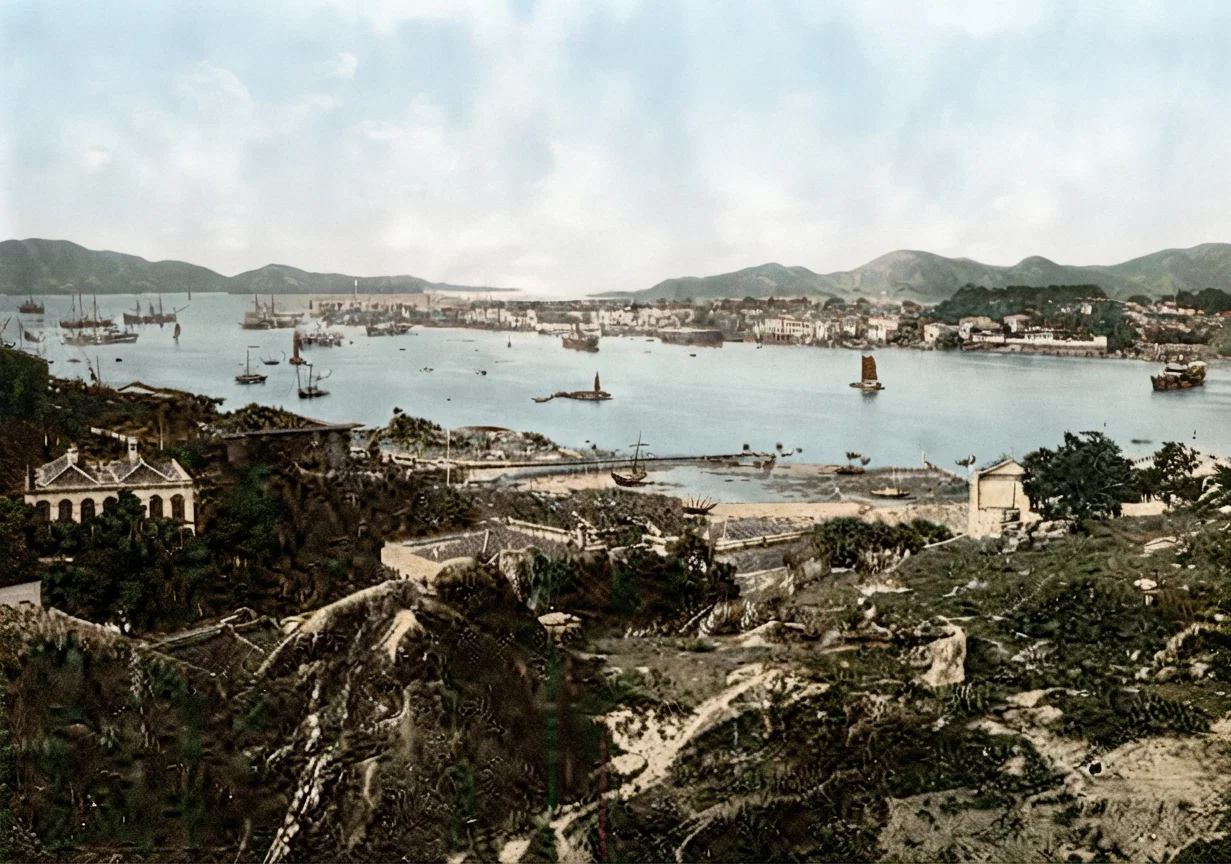
LAST October Brother J. N. Anderson and I visited Amoy. This is one of the most important seaports between Hongkong and Shanghai, and has a population of about 300,000. It is the commercial outlet of a thickly-populated and fertile country in the province of Fukien, as well as for the large island of Formosa, belonging to Japan. Five or six steamers leave Amoy each week for Hongkong, while others go direct to Shanghai, Manila and Singapore. Now at regular intervals some of the Pacific mail steamers, en route to San Francisco, stop at this port.
Many Chinese from this section have located in Singapore and Penang, so a considerable commerce is carried on with these cities. Rice is the principal article of export. Some fruits are also sent out, the most important of which is the pumalo. This fruit somewhat resembles the pear in shape, tho it is very much larger, usually weighing two or three pounds. It has a rind similar to that of the orange, tho much thicker. On the inside it is arranged in layers, also like the orange. The Amoy pumalo is famous for its juiciness and good flavor. The russet pears of this section also grow very large. They are not soft, when ripe, as our American pears, but when stewed are very palatable. Bananas, oranges, and many other kinds of fruit also grow here.
As in other cities of China, the streets of Amoy are very narrow, some of them not more than four feet wide. The bulk of the business is carried on through thousands of small shops, and the cash (a copper piece worth less than one-twentieth of an American cent) is the common medium of exchange. The buildings are of brick, most of them only one story high. However, fronting on the harbor, there are quite a number of two-story and three-story buildings, occupied as offices and go-downs (storehouses) for shipping firms, and for agents of foreign business enterprises. One of these buildings is occupied by the London Mission as a publishing house, from which a Chinese daily paper and a tri-monthly magazine are issued. On the hill, at one side of the city, is the Anglo-Chinese College, a very neat building constructed by Chinese capital.
Harbor of Amoy, China
Across the harbor, less than one-half mile from Amoy, is the picturesque island of Kulangsu, where the missionaries and most of the other foreign residents live. Here are located the large Chinese schools of the American and English Presbyterians, and the London Mission; also the Talmage Memorial School, for teaching English to Chinese boys. The latter is a fine, large structure, built by a wealthy native, but is under the supervision of the Presbyterian Mission. There is also a commodious church where the Europeans hold their union service. These union meetings in Amoy, as in Canton and some other ports, are attended chiefly by missionaries and their families.
Brother Anderson and I went to Amoy by invitation of a native pastor, who kindly entertained us at his home. This man had first heard of the true Sabbath through Brother Timothy Tay, a young Chinese Seventh-day Adventist preacher from Sumatra. These two brethren came to Canton in August and spent about two weeks studying the Bible with us. At that time he was baptized.
After his return to Amoy he resigned his position as pastor and teacher. His former associates soon learned of his change, and many came to inquire the reasons of his faith. This gave him an opportunity to open the Bible and present the truth to them. The Sabbath question was naturally the most prominent point of inquiry, and this led our brother to write out in Chinese an able defense of God's holy day. This has now been printed in tract form.
While in Amoy and vicinity we met many young men who are eagerly seeking for more light. We ought to establish a strong mission station at once, but where are the laborers? An appeal has been sent to our Mission Board for an ordained minister to be sent out as soon as possible to fill this opening. A man of experience is required for such a place, as the language is quite different from that spoken in other provinces. There is a great interest to hear the truth, and now is the time to work. Truly, the King's business requires haste. See 1 Sam. 21: 8.
British P. O., Canton, China.
THE WAITING BLIND.
By L. N. Muck, Editor
For more than half a century the Gospel message has been sounded throughout the United States. It has gone to the remotest parts of Christendom, and yet many hungry souls have been passed by. The blind are waiting, patiently waiting, for the Gospel. They are ready to welcome the name of Jesus; they are ready to hear the story of the cross.
The condition of the blind in this country is appalling. They are not permitted to enjoy literature as are the millions of seeing people who live in America, where the Gospel is held so dear. Thousands upon thousands of books, magazines, newspapers, and every kind of literature have been provided, that the seeing may gain a knowledge of the Bible truths, but in man's effort to provide for all13classes, he has overlooked the thousands of blind men and women who are among us.
We believe that Christian people everywhere should consider the needs of this class of people. At present there are only six periodicals printed in this country for the blind. One is a Catholic paper, three are newspapers, and they are quite inferior to our magazine, the Christian Record, so we learn from intelligent blind readers of the United States. The fifth is the Sunday-school Weekly, printed at the school for the blind at Louisville, Ky., but it contains only the Sunday-school lessons. The sixth magazine is the Christian Record. This periodical contains the Gospel message of these last days.
Those who read this journal will not only learn that Jesus is soon coming, but they can learn enough of the Third Angel's Message to fit them for the great event which is about to take place. O that I had language to express the condition of this unfortunate people! I know by experience that their condition is a sad one.
We not only have a paper for the blind, but we publish a number of tracts treating on the different phases of the message.
The subscription price of the paper, considering the cost of such a magazine, is very reasonable, only $2.00 a year. Are you not willing to subscribe, in behalf of the thousands who are appealing to us for something to read, and yet many of them can not pay one cent?
We invite your attention to our Scripture motto advertisement. We have taken up this enterprise to aid us in carrying forward this publishing work for the blind. Buy our mottoes, and thus enable us to push the work with greater force.
L. N. MUCK, Editor.
PRAY WITHOUT CEASING.
By Mrs. F. G. Burroughs
UNANSWERED yet, the prayer your lips have pleaded
In agony of heart, these many years?
Does faith begin to fail, is hope declining,
And think you all in vain those falling tears?
Say not the Father has not heard your prayer,
You shall have your desire, sometime, somewhere!
Unanswered yet? Tho when you first presented
This one petition at the Father’s throne,
It seemed you could not wait the time of asking,
So anxious was your heart to have it done;
If years have passed since then, do not despair,
For God will answer you sometime, somewhere.
Unanswered yet? But you are not unheeded;
The promises of God forever stand;
To Him our days and years alike are equal.
“Have faith in God!” It is your Lord’s command.
Hold on to Jacob’s Angel, and your prayer
Shall bring a blessing down sometime, somewhere.
Unanswered yet? Nay, do not say unanswered;
Perhaps your part is not yet wholly done.
The work began when first your prayer was uttered,
And God will finish what He has begun.
Keep incense burning at the shrine of prayer,
And glory shall descend, sometime, somewhere.
Unanswered yet? Faith can not be unanswered;
Her feet are firmly planted on the Rock.
Amid the wildest storm she stands undaunted,
Nor quails before the loudest thunder shock.
She knows Omnipotence has heard her prayer,
And cries, “It shall be done, sometime, somewhere.”
—Mrs. F. G. Burroughs.
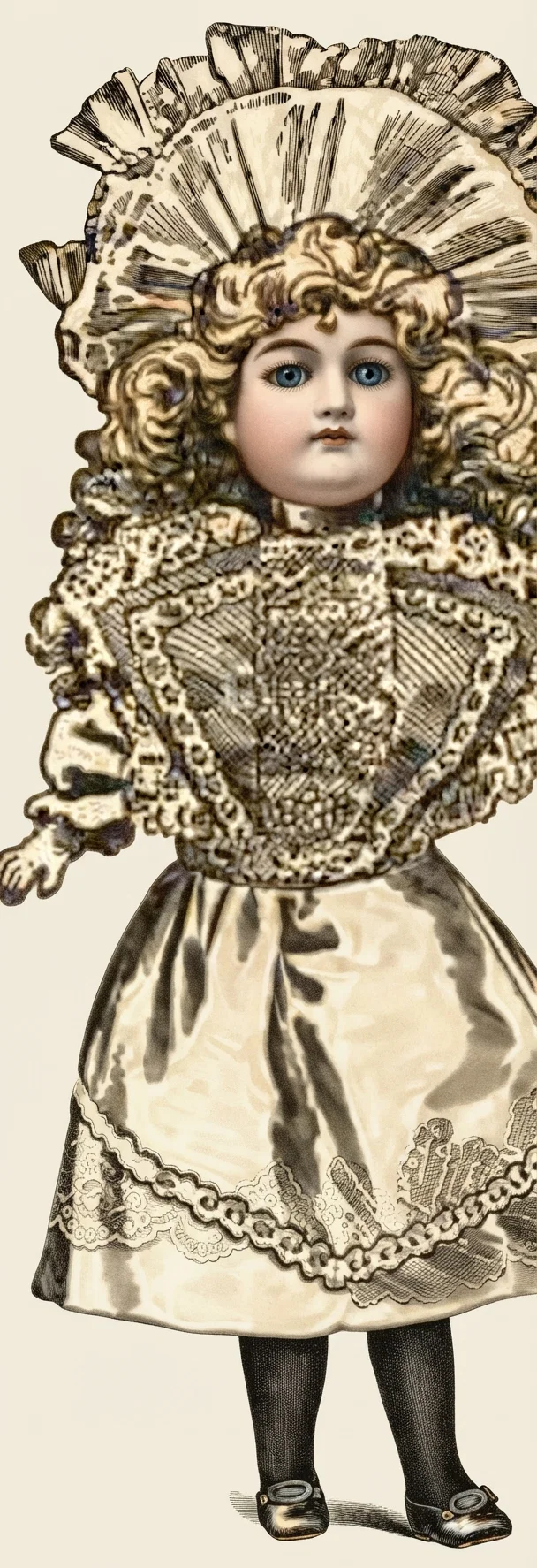
HANDSOME BISQUE DOLL FREE
Together with a Gold Finished Necklace & Turquoise Pendant
This is a Jointed-Body Doll, nearly half a yard tall, dressed in satin and lace, and looks like the picture shown here; a perfect beauty, with a turning Bisque head, lovely curly hair, pearly teeth, large natural sleeping eyes, trimmed underclothing, real slippers and stockings that can be taken off, completely dressed from head to foot.
Understand that this is not a rag doll or a cheap plaster of Paris doll, but a real
Sleeping Bisque Doll.
We will send this beautiful Doll FREE, together with a Gold Finished Necklace thirteen inches long, and Turquoise Pendant, all express charges paid by us, when you have sold for us twenty-four packages of BLUINE at 10 cents each and have returned our $2.40. We trust you with the BLUINE, the best washing bluing made. Send us your name and address.
Bluine Manufacturing Co., 170 Mill St., Concord Jct., Mass. (The Old Reliable Firm.)