The Youth’s Instructor, Vol. 66, No. 1.

My New Year's Resolve

The Youth’s Instructor

Jan 1, 1918

Review and Herald Publishing Assn. · Takoma Park Station, Washington, D. C. · Jan 1, 1918

My New Year's Resolve

Resolved, That I will this year endeavor, by God’s help, to live a simple, sincere, and active Christian life; repelling promptly every thought of discontent, discouragement, impurity, and self-seeking; cultivating cheerfulness, magnanimity, charity, and the habit of holy silence; exercising economy in expenditure, carefulness in conversation, diligence in appointed service, fidelity to every trust, and a childlike trust in God. I will make an earnest effort every day to spend some time in Bible study and prayer, and at least once a week will make some personal effort to encourage or draw some one nearer to Christ.—The Morning Watch.

Miscellaneous News Items of 1917

The per cent of illiteracy is higher among the whites of the United States than among the colored.
Two million women can now vote in New York City, as a result of the suffrage triumph in the last election.
Five Vice-Presidents of the United States have succeeded to the higher office upon the death of the President.
For the ten months beginning with January, 1917, there was an average of one automobile stolen every four hours in New York City.
King George is said to be the most approachable monarch that ever held the English throne. He pays his own railroad fare when traveling.
The Food Administration has estimated that a saving of six cents a day per person in the United States will amount to $2,000,000,000 a year.
Finger prints as a means of identifying criminals, it is now claimed on good authority, were used by the Chinese and Japanese at least a thousand years ago.
Even the blind have a part in serving the nation. They are employed at the electrical works in Ampere, New Jersey, to wind wire for armatures and to do other insulating.
The second of November, 1917, the new law raising letter postage to three cents an ounce went into effect. In 1885, thirty-two years ago, the rate was lowered from three to two cents.
Judge Hyland, the Tammany candidate, won the mayorship of New York City with a plurality of 148,000. Mayor Mitchell came second, with only a little lead over Morris Hillquit, the Socialist.
All ships flying the American flag have been ordered into Government service. Every vessel of any size under construction in private yards on the Atlantic and Pacific coasts and on the Great Lakes has been commandeered.
Mental efficiency tests will be given the 160,000 enlisted men in the four national army camps. Men who are found to be mentally incompetent will be recommended for discharge, while all others will be rated for promotion according to efficiency.
In 1789 when the United States Supreme Court was organized, the Chief Justice received a salary of $4,000 and the associate justices $3,500 each. These salaries have been increased from time to time until now the Chief Justice receives $15,000 a year and the associate justices $14,500.
Separate collars for men's shirts were first made about 1825 by the wife of a blacksmith in Troy, New York. Rev. Ebenezer Brown, a retired Methodist minister, took up the idea and advertised such shirts and collars in 1829. Eighty per cent of the collars made in the country in 1909 were made in Troy.
A motor truck line connects Boston, Massachusetts, and Akron, Ohio. One week is consumed in making the round trip. Five large trucks are in the service. Rubber tires are carried on the eastern trip and general supplies coming back. The rubber concern that operates the line has found the method more economical than the transportation by rail.
Paper pipes as conduits for water, oil, and gas have recently been invented, owing to the shortage of iron and lead in Germany. They are made by rolling sheets of paper with an adhesive substance, around a mandrel of the desired dimensions until the required thickness is obtained. They weigh from one sixth to one tenth less than the iron or lead pipes, and resist three or four times as much pressure for a given thickness. The one drawback in the extensive use of these pipes is their lack of elasticity.
Mrs. Theodore Roosevelt, Jr., is serving as head waitress in the Richmond Hotel, maintained in Paris by the Y. M. C. A. for American officers. Mrs. Roosevelt is assisted by American women of high social standing. The work is regarded as a kind of relief work, the object being to offer the very best physical accommodations to American officers on a sojourn in Paris or waiting assignments. Other institutions offer similar accommodations for enlisted men.
Representative Kahn of California, the Republican who led the administration forces in the House when the Army Draft Law was passed, said that a new draft act would have to be passed at the next session of Congress to affect the many young men who have become twenty-one years of age since May 18, 1917, and that it would probably amend the existing law so as to register youth from sixteen to seventeen to become automatically subject to call on reaching twenty-one.
Officers of the American soldier units in training here have asked the Associated Press to inform the American people that the soldiers lack reading material. The comparatively small quantity of magazines and newspapers which has been arriving is eagerly read by the men. Some of the publications have passed through dozens of readers’ hands until the pages are in fragments.
The first wooden ship to be launched under war rush plans for the federal merchant fleet, took the water Dec. 1, 1917. The vessel was constructed in 120 days, said to be a world record for ships of this size. The ship was named by Mrs. Woodrow Wilson, wife of the President, and was christened by the daughter of a banker. The ship is 4,000 tons’ deadweight, and 290 feet in length.
The use of lead as a fertilizer has been found to exercise a stimulating effect on a majority of agricultural plants, provided too much is not used. The lead nitrate was made into a fine powder and mixed with potash salt or sodium nitrate, used as a fertilizer. Good results were secured with rye, wheat, oats, barley, maize, peas, and beets, but not with potatoes.
A complete military bakery, mounted on a motor truck and operated by a crew of five men, capable of turning out 6,000 loaves of bread an hour, has been invented by James and J. H. Garvey. This equipment will do the work of more than one hundred bakers working in the old way.

The Well of Remembrance

KENYON ALEXANDER PALMER
“The Lamb with his fair army doth on Mount Zion stand, And glory, glory dwelleth in Immanuel’s land.”
The echo of the chimes was fading in the distance as Grandpa Fowler, leaning heavily upon his cane, walked down the center aisle to his pew in front of the pulpit. Like the apostle of old, Grandpa Fowler had fought a good fight.
His threescore seven and ten well-spent years were incontrovertible proof of the verity of the religion which had sustained him all the way, and as he bowed his head for a moment of silent prayer, it seemed as if the inspired writer must have had him in mind when he wrote:
“The hoary head is a crown of glory, if it be found in the way of righteousness.”
Having come West when a young man just out of college, he had grown old in the city of his adoption, and to that city’s business, social, and religious life he had added tremendous force. Success had followed his efforts from the start, until he was known as the city’s merchant prince; but no suspicion of taint was attached to a dollar that passed through his hands.
Honors without number had been bestowed upon him, but greater than any of these was the silent adoration of some fond mother, who would press her infant son closer to her breast as he passed by, thereby expressing the unspoken prayer that her little one might some day be as good a man as Grandpa Fowler.
The minister arose and announced his text:
“David longed, and said, Oh that one would give me drink of the water of the well of Bethlehem, which is by the gate!”
Then, as was his custom after reading his text, he advanced to the front of the platform, and extending his hand heavenward, said, “Let us pray. Dear Lord, we ask that every man and woman in thy presence may this morning go back to the scenes of their childhood, and there drink from the Wells of Remembrance. “Go thou with us, dear Lord, and as we find refreshment for our bodies, give us to drink of the Fountain of Living Water, that our souls also may be refreshed. Amen.”
At the first invitation to drink from the Well of Remembrance, Grandpa Fowler was a barefoot boy again, laughing and shouting among the hills of Vermont.
How delightfully familiar the old farmhouse looked, and his attic bedroom, with the sloping roof, seemed as homelike as if he had slept there the night before. He thought of how the snow used to sift through those very rafters during the night, until the bedclothes were white when he awoke, and he chuckled to think of how quickly he jumped into his clothes those cold winter mornings.
And then a tear rolled down the withered cheek as he caught sight of the calico dress with the little pink rosebuds, which he bought for his mother with the first money he ever earned, and her voice, though stilled these many years, was speaking once more those loving words which he had never forgotten: “It’s the bonniest gown, laddie, that your mother ever owned.”
Even the rod of correction hung in its accustomed corner, but the water from the Well of Remembrance was sweet this morning, and he knew that while the chastenings had seemed at the time not joyous, but grievous, yet they, like the cold and the snow and the early privations, had afterward yielded their peaceable fruit of righteousness.
There, too, was the little country schoolhouse. Oh, how he longed to tell his favorite teacher how much her efforts had meant to him during all these years! He was too young to appreciate them at the time, but afterward, and especially in later years, he had realized the strength and beauty of her character.
Once more the scene was changed, and he was now a student again at Williams College. Beating time with his cane on the floor, he hummed softly to himself:
“The mountains! the mountains! we greet you with a song.”
Dear Mark Hopkins, asleep these many years; who could measure the debt of gratitude that he owed that good man? And even if his love for his old teacher had prompted him to name one of his sons for him, how little that seemed to do for one who had done so much for him. Were not he and his children and his children’s children enjoying the fruit of that great teacher’s planting?
During his reverie the old man’s head had bowed lower and lower until it now rested upon the pew in front of him.
It seemed to him that he could hear singing far away in the distance, and he listened attentively to distinguish the words.
Why, that was his mother’s favorite hymn they were singing, just as they had sung it at her funeral, but how far away it sounded: fainter and fainter grew those dear familiar lines:
“He is faithful that has promised, an’ he’ll surely come again, He’ll keep his tryst wi’ me, at what hour I dinna ken; But he bids me still to wait, an’ ready aye to be, To gang at any moment to my ain countrie.”
The sermon was ended; the benediction was pronounced; the congregation was dismissed. Coming down from the pulpit, the minister touched the old man gently on the arm, but there was no response.
Stooping over, he spoke lovingly in his ear, but he heard him not, for Grandpa Fowler had fallen asleep by the Well of Remembrance.

The New Year

B. F. M. SOURS
The day is dead, The west is red, The evening birds are singing; From O how far The silver star Its placid light is bringing!
The autumn came With leaves aflame, And all the mountains’ glory; And chestnut burs And joy were hers Who rambled as in story.
The months have fled, The year is dead, And all its garb is tattered; And high and low The wild winds blow And crimson leaves are scattered.
Good-by! Good-by! Old Year, the sky With newer light is breaking; We somehow seem, As in a dream, To hear the bird songs waking.
Now hail! Now hail! The gust and gale Have blown away December; And for it stands With jeweled hands, A friend we will remember.
Ah hail! Ah hail! On gust and gale The happy news is riding, And, if you hear, Into your ear Is holy joy confiding.
Has come to stay— This New Year’s Day? No, but twelve months caressing The hearts of men, Will raise again Her wings, so onward pressing.
Then, New Year, come And touch my home With all the joy you gather; For Christ to me Will make you be A blessing from the Father.

The Perfect Number, or the Significance of Seven

Of all the numbers in our scale, seven stands forth with peculiar significance. It is true that thirteen is known to all as the unlucky number, that nine enters most remarkably into certain mathematical relations and classical allusions, and that twenty-three has come into slang usage with a certain meaning, but the strange and mystical significance of the figure seven has been marked in all religions, and from the very earliest times. Seven is contrasted with thirteen as an especially lucky number. It is called also the “perfect number.”
There were seven days in creation, and particular emphasis is laid repeatedly upon the seventh. Writers speak of seven graces, seven cardinal virtues, and seven deadly sins. There are seven divisions of the Lord’s Prayer, and seven gifts of the Holy Ghost. Curiously enough, the great sacred books of the world are seven in number. They are the Bible, the Eddas of the Scandinavians, the Chinese “Five Kings,” the Koran of the Mohammedans, the Tripitika of the Buddhists, the Vedas of the Hindus, and the Zend-Avesta of the Parsees. Buddhism has its seven gods of happiness. John Ruskin wrote “The Seven Lamps of Architecture,” and it will be remembered that the golden candlestick in Solomon’s temple had seven lamps. In legend we have seven champions of Christendom: St. George of England, St. Anthony of Italy, St. James of Spain, St. Patrick of Ireland, St. Dionysius of France, St. Andrew of Scotland, and St. David of Wales.
Ancient Greece had seven wise men, while the liberal arts and sciences also number seven. The seven wonders of both the ancient and modern worlds, the seven planets associated with our earth, and the famous seven hills of Rome are other noteworthy examples of the prominence of seven, far exceeding that of any other number.
Physicians and surgeons frequently speak of a patient being out of danger in a certain number of days, and these periods are largely composed of seven and its multiples, as, for instance, the seven-day fever. Seven has been called the medical number, and the more usual climacterics seem to have been septennial, perhaps for astrological reasons, but more particularly because within such periods man’s body and mind were supposed to undergo some remarkable changes with respect to health, life, or fortune. Indeed, it was believed that the constitution of man changed every seven years, and that during every septime the whole of the solids and fluids of the body were periodically renewed,—the old cast off and new matter formed. Infancy without teeth was said to last seven months, and at seven years a child had left infancy; at twice seven, or fourteen, he had attained puberty, and at three times seven, or twenty-one, he had reached manhood. With us that is the legal and voting age. At five times seven, or thirty-five, a man was considered to be at the height of his physical and bodily strength. Our Constitution makes that the minimum age limit of a President of the United States. At seven times seven, or forty-nine, a man was considered at the height of his mental strength or intellectual powers, and at nine times seven, or sixty-three, he was said to have arrived at the grand climacteric. The seventieth year was considered the ordinary limit of human life, as the psalmist wrote, “The days of our years are threescore years and ten,” while the poet Shakespeare speaks of the seven ages of man.
But greater importance is to be attached to a Scriptural consideration of the number. Since the seventh day was to be commemorated as the memorial of God’s creation, it might be expected that the number would be holy unto the Lord. The most exalted title of the Creator is Jehovah. It contains seven letters. The same is true of the words “Sabbath” and “seventh.” The ceremonial law was full of reminders of the number. The priest was to sprinkle the bullock’s blood seven times. Lev. 4:17. The consecration of Aaron and his sons continued seven days. Again seven days and fourteen days were the periods of purification in the twelfth and fifteenth chapters of Leviticus. A leper was shut up seven days, or periods of seven, before examinations; the priest sprinkled for leprosy seven times, and afterward he that was cleansed was to “tarry abroad out of his tent seven days.” In Numbers 12, such was the treatment of Miriam. After the Passover on the fourteenth day, there was to be “an offering made by fire unto the Lord seven days,” and there were seven sabbaths until a new meat offering. In the seventh month a feast of tabernacles was appointed by the Lord for seven days and also a feast for seven days after the fruit of the land had been gathered. Again the Lord commanded in Lev. 25:8, 9, “Thou shalt number seven sabbaths of years unto thee, seven times seven years; and the space of the seven sabbaths of years shall be unto thee forty and nine years. Then shalt thou cause the trumpet of the jubilee to sound on the tenth day of the seventh month.” In Lev. 26:28, the Lord says, “I, even I, will chastise you seven times for your sins.”
The foregoing illustrations are taken from only one book of the Old Testament. Other examples of the sacred character of the number are readily found. Enoch, the seventh from Adam, walked with God and looked forward to the second advent. God in directing Noah concerning the ark said, “Of every clean beast thou shalt take to thee by sevens,” and again, “For yet seven days, and I will cause it to rain upon the earth.” In Joshua 6, before the fall of Jericho, the Lord commanded, “Seven priests shall bear before the ark seven trumpets of rams’ horns: and the seventh day ye shall compass the city seven times.” Joseph interpreted Pharaoh’s dream of the seven fat kine and the seven lean kine, the seven good ears and the seven poor ears. Elisha bade Naaman “go and wash in Jordan seven times.” In Prov. 24:16, we read, “A just man falleth seven times, and riseth up again.” The psalmist says, “Wisdom hath builded her house, she hath hewn out her seven pillars.” The prophet declares in Isa. 30:26, “The light of the sun shall be sevenfold, as the light of seven days.” In Gen. 4:15 the Lord said unto Cain, “Therefore whosoever slayeth Cain, vengeance shall be taken on him sevenfold.” Our Master declared, “If he trespass against thee seven times in a day, and seven times in a day turn again to thee, saying, I repent; thou shalt forgive him.” When asked by Peter, “Lord, how oft shall my brother sin against me, and I forgive him? till seven times?” Jesus answered, “I say not unto thee, Until seven times: but, Until seventy times seven.”
If any one considers these examples appropriate only to a former covenant, let him turn to the book of Revelation and it will be found that the sacred character of the number seven is more prominent than before. John’s salutation in the last book of the Bible is “to the seven churches which are in Asia.” There are mentioned seven stars, seven golden candlesticks, seven lamps of fire, the seven Spirits, seven seals, seven thunders, and seven angels with seven trumpets. “In the midst of the elders, stood a Lamb . . . having seven horns and seven eyes.” Rev. 5:6. Seven thousand men were slain in the great earthquake. Both the great red dragon and the beast which rose out of the sea in the twelfth and thirteenth chapters had seven heads. There are mentioned also seven golden vials full of the wrath of God, the seven last plagues, and seven kings.
LAWRENCE D. RHOADS.

Vegetable Ivory Palm and the Origin of Muskmelons

Along the coast of South America from Peru to Panama there grows a palm having large pods in which are seeds resembling real ivory. These seeds are collected by shippers, who export them to Europe and the United States, where they are used in making buttons, umbrella handles, poker chips, and other articles made from what is known as dentine ivory.
The muskmelon first grew in Armenia. Later its seeds were planted in Cantalupo, Italy, from which comes the name “cantalupo.”

By the Rivers of Babylon

ABOUT all that is now known of ancient Babylon has been gleaned from the writings of Herodotus, a Persian subject, who was born, as near as can be conjectured, about 484 B. C. When quite a young man he set out to explore the country of the great East, covering Asia Minor, European Greece, Palestine, Egypt, Susa, and Babylon, with many other smaller portions.
In describing Babylon he tells that it was an immense city, through which flowed the great river Euphrates. Along both banks of this river within the city were breastworks, or low walls, with openings where the street terminals touched the river banks, and led down to the water by flights of steps. These openings were secured by gates of brass, and when closed would prevent an enemy from gaining access to the city from the river.
The country about Babylon, on each side of the river, for a long distance, was generally low and level, and therefore subject to periodical inundations. In view of this, one early sovereign, Queen Nitocris by name, had caused to be constructed an immense lake, not far from the city, in which to receive the superfluous water in time of flood, and thus prevent an overflow in the city channel of the main river.
She also opened a large number of dikes, or canals, across country where natural surface conditions afforded facilities, and for a double purpose. First of all, ample provision was desired for the disposition of a large flow of water in the flood season. It was further planned in building these laterals, to have the system so intricate as to screen the navigation of the main river, and thus guard against the sudden approach of an enemy upon the city.
When the Jewish people were driven into Babylonian captivity, it is said that they sat down by the rivers of Babylon and wept, while their musical harps hung on the willow branches that skirted these streams. Ps. 137: 1-3. These bondage wailings must have been expressed on the banks of these inland rivers, rather than by the flowing Euphrates which wended its way through the city of Babylon.
But strange as it may seem, these lateral streams, which were designed to protect the city of Babylon against enemy attacks, were made the very means of its overthrow. When Cyrus, the Persian general, drew near the place, and saw the exact situation, his mind at once settled on how he would accomplish his mission thither. Having employed a strong force of men to widen and deepen these rivers above the city, and also to open new channels, he appointed a certain night when he knew that great revelry would occupy the attention of the Babylonians, and stationed a large detachment of troops near where the main river entered the city, and another where it issued forth, with orders to rush into the city by the bed of the river, as soon as they should observe the water to have subsided.
Then at a given signal the water was turned from the great river into the cross-country channels, when it soon ceased to flow through the city. With a vast number of ladders the two detachments of soldiers marched in over the bed of the river, and quickly scale the inner walls of the city, which at once fell into the hands of the invaders, and Belshazzar, the king of Babylon, was slain. Dan. 5: 30.
J. O. CORLISS.

The Morning Watch

AWAKING in the morning is both a symbol and a promise of the resurrection. In a certain true sense the Christian has “asleep in Jesus” during the night. To him the breaking of a new dawn is a call to walk in newness of life for another day. The heavenly Watcher greets him, bids him be true, warns him that the day may bring forth a little sharper conflict with the tempter than yesterday. It is as if life were beginning all over again, bright with promise of retrieving past losses, shunning the bypath that led astray in an unwary moment forever flown, and treading for today the narrow path of truth, honesty, and virtue. Who would not linger with God a few transcendent moments while the crystal rays of eternal day warm his heart, brighten his path, and reflect the dawning glory of the first resurrection?
W. E. HOWELL.

A Visit to the Lepers

D. D. FITCH
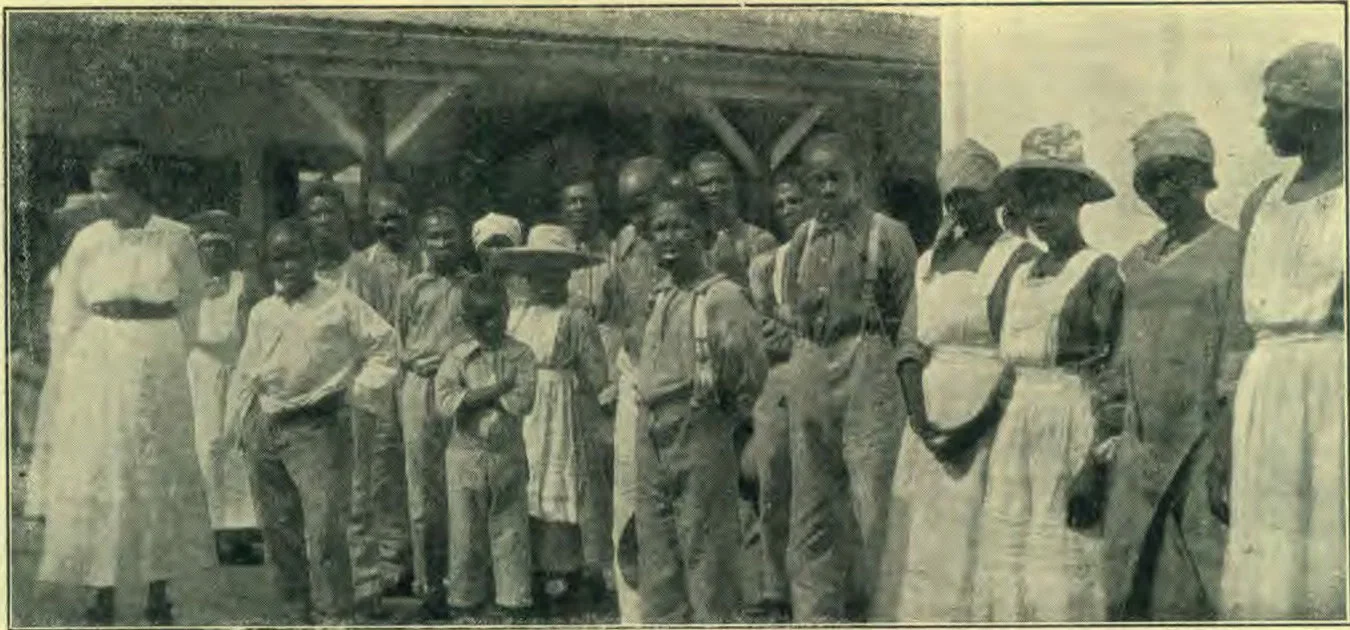
LEPERS OF THE ST. CROIX CAMP
As a nurse I had become somewhat accustomed to contagious and infectious diseases, but had never fully decided to visit a leper camp if the opportunity presented itself. But having heard about an especially interesting penal camp on the island of St. Croix, one of the recently purchased Virgin Islands, I decided to improve my trip to that island by visiting the colony and preaching to the prisoners. Mr. Hansen, the man in charge, received us very kindly and invited us to inspect the grounds and buildings. From the jail he took us to the institution for the insane, and then through the prison farm. Without asking us if it was our wish to do so, he directed the way to the leper camp where are confined fifty-six inmates, twenty-five men and thirty-one women. The camp was soon astir because of our visit. My heart went out in love and sympathy for them, but still I had no desire to greet them in the usual manner of hand-shaking. Some had only recently come to the camp, but it was easy to see that they realized the barrier existing and the meaning of the word “unclean.”
As I had planned to speak to the prisoners at the jail before returning to the city for dinner, and as the afternoon was well advanced, I was in somewhat of a hurry. I wished, however, to get a picture of this interesting company as proof of my visit, so I invited such as cared to, to gather for this purpose. Before I could accomplish my plan I had to learn the truth of the saying that “every cloud has its silver lining.” While the lepers were gathering, He who rules above and told us that “all things work together for good,” was working out plans of his own by gathering clouds to obscure the sun’s rays to the extent that I could not get a good picture. The relationship of one taking a picture of a group of people is so similar to that relationship to which I have become accustomed in preaching, that while waiting for the clouds to pass I could not resist the suggestion of the small voice which said to me, “Here is an opportunity to present the message to a more needy and worthy people than the ones to whom you came to preach,” so without any further ceremony I began to present to them the hope as it is in Jesus, the one who came to seek and save that which was lost, and who healed the lepers. Occasionally casting my eyes toward the beclouded sky I continued to talk to them of the soon-coming Saviour and the consequent relief from their affliction.
Closing with a word of prayer, we left, having been successful in getting the accompanying picture. You will notice that most of them have their hands hidden, because in them the disease seems to have made the greatest progress.
Here is an opportunity for some Missionary Volunteer Society with a good degree of continuity to furnish literature to some very needy English readers. Such should be addressed to Elder Frank Hall, Christiansted, St. Croix, Virgin Islands, U. S. A. Note that domestic postage is in use in that island, and that it costs no more to send papers there than to your nearest post office in the States.

Observing the Morning Watch

I WANT our young people to observe the Morning Watch with us — Because they need it as a guide in their daily devotional studies; Because it provides a good thought for the foundation of the day’s thinking; Because the thought of God in the morning is a tower of strength for the day; Because its daily use leads to constancy in Bible study, to a relish for, and a belief in, the Word of God; Because it leads to prayer and the love of God; Because it aids in supplying the essential, daily spiritual food for Christian growth, vigor, and strength.
D. W. REAVIS.

Armless Boy Rescues Drowning Child in Lake Michigan

RECENTLY a lad of eight years was playing with his younger brother on the breakwater in Chicago, when he fell into Lake Michigan. His brother ran screaming to a crowd of boys playing near by, and Johnnie Curran, a boy of seventeen, who had lost both his arms, rushed to the place where the boy fell, and dived into the water. He had learned to swim without his arms, and, as the drowning boy came up for the last time not far from him, he swam to him, caught the garments of the boy with his teeth, and swam back with him to the pier. Efforts to resuscitate the little fellow thus rescued were unavailing, and he died before the ambulance arrived. There are few braver acts recorded than that of Johnnie Curran, the armless boy.—Selected.
Continue reading: ANCIENT SABBATH PROPHECIES