ON a recent date the Teachers' Association of Pittsburg held a peace day observance in Carnegie Music Hall. Hundreds of teachers were in attendance; and Mr. Carnegie, who could not be present, sent the following letter, which was read before the association:
It gives me great pleasure to congratulate the Teachers' Association upon its celebration of peace day. There is a great deal to be said for counting your chickens before they are hatched, because if you do not you might miss the chance of ever counting them at all; but you do well to celebrate peace day for another reason — it is bound to come, and I believe it is going to come so soon that we will be surprised.
Men no longer eat each other; they no longer kill prisoners, nor sack cities, nor poison wells; and men of civilized countries no longer buy and sell each other. It is sure that there will be many who hear these words who will also hear before they take their departure that the civilized nations of the world have banished the killing of man by man as a means of settling international disputes.
The splendid optimism that causes the expressions of such strong hopes that we will yet have universal peace, is without doubt doing its full share of holding back the winds of war. Strong and influential men like Mr. Carnegie are saying much against war and in favor of settling all disputes by arbitration. This is all good. The more of this kind of talk we can have, the better it is for the world.
But while expressing such strong peace sentiments, we must not lose sight of incontestable facts. For instance, we must not allow the rosy prospects of a universal peace just ahead of us to shut out from our vision the indisputable fact that no small portion of Mr. Carnegie's multi-millions was earned by building armor-plate with which to protect the sides of the great battle-ships that the nations are building with such feverish haste. It may be that men do not poison wells in these times; but it has been only a few days since the news items told of some sticks of dynamite that had been placed in a rock crusher, and it was by the merest accident that it was discovered just as the machine was about to start — one of many like instances. Men may no longer buy and sell one another; but they have the far worse face of stealing and selling innocent young maidens into the "white slave" life, and there is scarcely a large city that is free from this awful crime — a crime that is as much worse than ordinary slavery as the cesspools of iniquity are worse than the fair cotton fields of the erstwhile Southern slave plantation.
Men may not sell one another into ordinary slavery; but the "sweat-shop" is in evidence; and who would compare the slavery of the "sweated toilers," with no possible hope for release, with no one to care for them when sickness or loss of employment overtakes them, with the slave who has a master that would at least see that he was cared for when sick and that he was properly fed?
But there is no need to continue the list to tell of the discontent that is causing the bomb to wreck buildings, and the rioter to spread terror before him; there is no need to enumerate the cities in which "grafting" is debauching everything in the way of a public office, and the evil thing refuses to be suppressed; there is no need to make mention of the fact that everything in the shape of vice and crime is protected by these "grafters," great and small; there is no need of giving the detail of the recent meeting in which prominent men expressed their fears and sounded a warning note because of the incontrovertible fact that crime is without mistake on the increase; there is no need of giving the list of the nations that are increasing their war and navy appropriations every year in order to prepare for a war that all feel must come. All these facts are before us in the world, and the list is only begun. We must keep actual conditions before our minds, else we might find ourselves looking in the wrong direction for peace. We must not dream; we must think soberly.
The Prince of Peace has promised peace to all the world. But it is not coming in the way in which men are looking for it. He has said that just before the close of time the nations would be "angry." They would be in a fury of war preparation. He has also said that in that same time there would be the strongest talk that there would be no war, but that everything would be peace. He has shown in His Word that these two conflicting sentiments — war and peace — would keep right on side by side until the time when the people would say "peace and safety;" and when that time is reached, He says that "sudden destruction" will come upon those who are thus saying "peace and safety." They say "peace and safety" when everything shows that the world has gone war-mad. Men say "peace and safety" when they are making untold millions out of building war equipment. And they will continue saying "peace and safety" until the war-crazed demons, portrayed with apocalyptic vividness, drive the nations of earth on to the great war plains of Armageddon.
How marvelous, how appalling, is the war preparation of this time! And how extensively and how vehemently are the peace assurances made right in the face of the great "Dreadnoughts" that are so rapidly built and of the awful guns that are forged to arm them! How inconsistent and how contradictory are these opposing activities and sentiments! And how absurd it is for man to turn hurriedly away from helping to forge a great cannon of unprecedented power, and rush off to give a speech before a "peace society," only to turn back with a rush to take up his work again on the gun! These things seem too incongruous to be true. One would hardly expect such inconsistencies among sane men. But nevertheless they are the most striking facts in the world at the present time. Two thousand years ago the Word of God pictured this thing plainly, and told us what it would signify.
The picture of universal peace that Mr. Carnegie is so untiringly keeping before the world, is certainly a beautiful one; but it has no comparison to the beauty of that which the Word of God presents that will soon be realized by those who are ready to receive it. The great event of all the ages is just before the world. That Man of Nazareth, and of Gethsemane, and of Calvary, is about to return to the earth. And when He comes He is the Prince of Peace. And the brightness of His righteous glory when He appears as King of Kings and Lord of Lords will destroy every one in whose heart there is burning the fire of cruel war.
Let us be consistent, and look at matters as they are in reality, and be ready for that glorious day when the Prince of Peace shall come.
The Law and God’s Character
God is one and unchangeable. His Law, ever the same, is the reflection of His own character. As spoken amid the awful glories of Sinai, it prohibits every sin. But to him who accepts it in the faith and love of Christ Jesus, each prohibition becomes an enabling act, full of power to work out the righteousness which the Law demands.
The Peace Propaganda
By George W. Rine
By George W. Rine
A Momentous Movement
We of to-day are confronted with perhaps the strangest phenomenon of all history. Throughout the civilized world unprecedented preparations for war are paralleled by unprecedented agitations for peace. The mightiest peace propaganda in the annals of man is now in full swing. In every nation many of the most eminent publicists and scholars demand that the nation shall at once enter upon a program for disarmament, while others of equal distinction are relentless in their demands that the nation shall arm herself to the limit of her taxing and borrowing power. The former class contend that disarmament is the only guaranty of international and internecine peace; while, strange to say, many of the advocates of ultra-militarism are equally insistent that the only way to insure peace is to be prepared for war, and that the prodigious outlay of money involved in the militaristic policy is the premium that the nations must pay to insure against war.
The Peace Propaganda
As the managing editor of the New York "Independent," Mr. Hamilton Holt, has said, it will surprise most people to learn how many societies and individuals throughout the world are now engaged in promoting the cause of international peace. The first OFFICIAL step to organize the world for peace was taken in 1888, when J. B. McCreary succeeded in having a bill passed by the Federal Congress establishing the Pan-American Conferences. The conferences are now the legislative branch of the Pan-American Federation of Republics. Already they have met four times — at Washington, Mexico City, Rio de Janeiro, and at Buenos Aires. They maintain a bureau at Washington, now called the Pan-American Union. The union is housed in a million dollar palace, the gift of Andrew Carnegie. It is the first building of its kind ever erected.
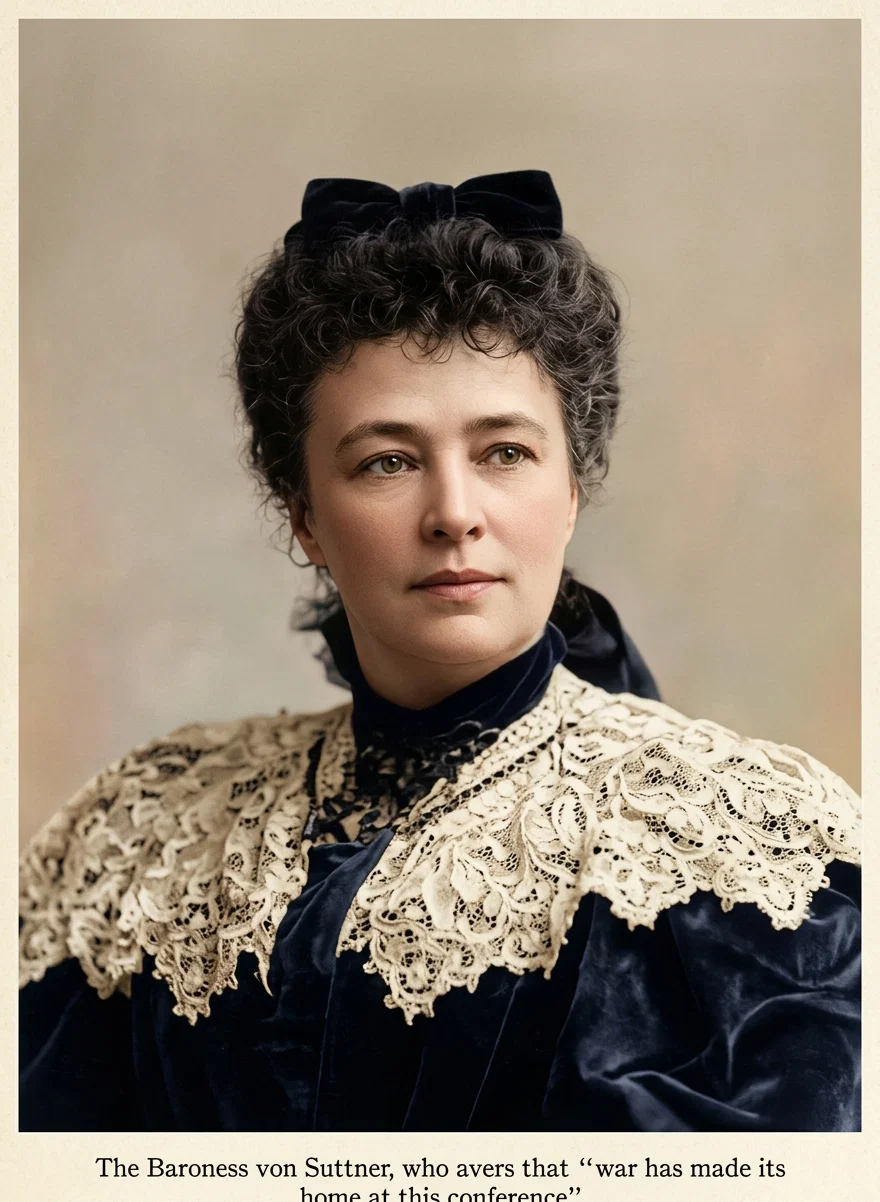
The establishment of the Hague Conferences — out of which grew the Hague Court — is regarded as by far the most important step yet taken to insure peace through world organization. Two conferences have already been held, in 1899 and in 1907; the third will be held in 1915. The work of the two conferences has been wholly of a negative character. "It assumed that war was to continue to be a legal method of self-redress for years to come, and simply attempted to ameliorate the conditions under which it occurs." The second Hague Conference, we are told, was the first time in history when ALL THE NATIONS came together to discuss questions common to all. In reference to this conference, the "Independence Belge" said, "To tell the truth, the conference has been called together with the avowed intention of more strictly regulating war." The Baroness von Suttner, who was present at the conference, avers that "war has made its home at this conference; nine tenths of its labors was devoted to the consideration of war rather than how to insure peace." We see, then, that the Hague Court has so far not lifted a finger to bring about world peace.
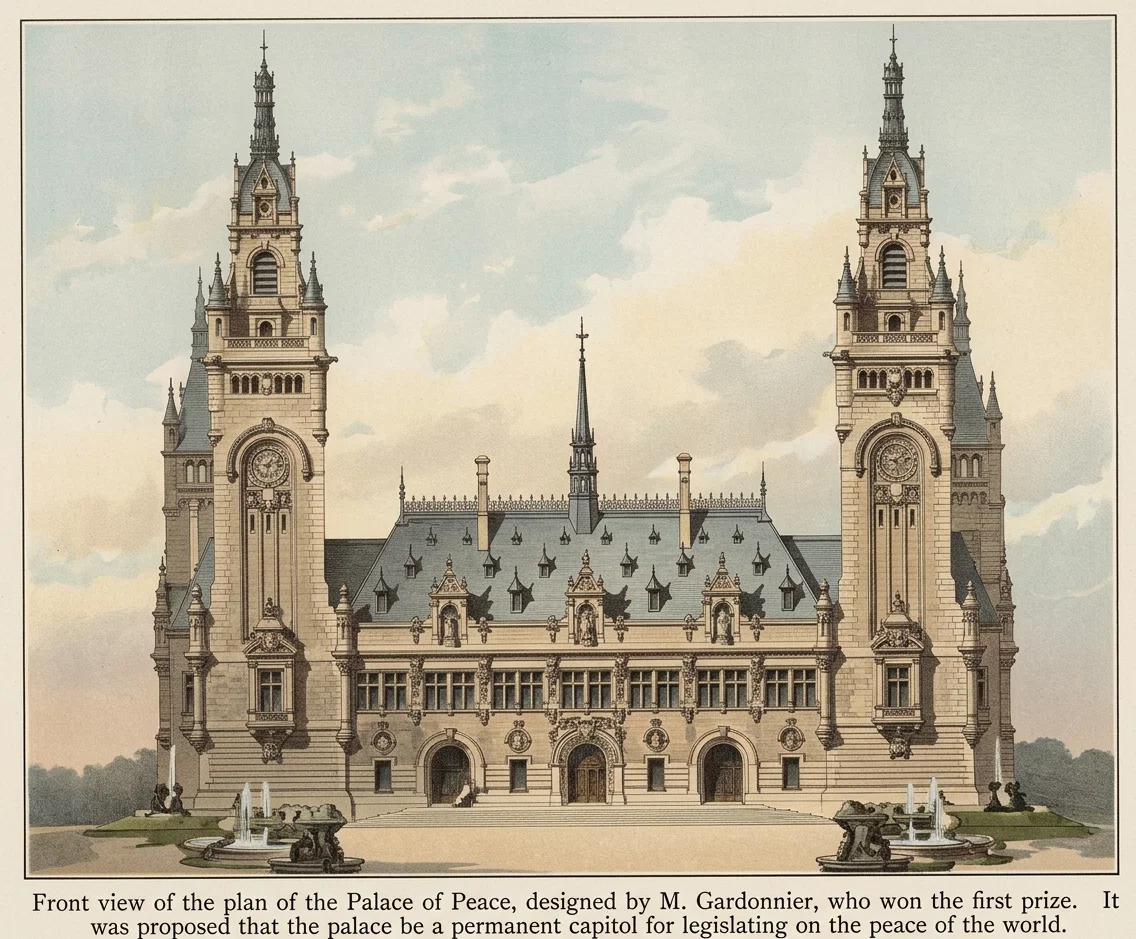
Front view of the plan of the Palace of Peace, designed by M. Gardonnier, who won the first prize. It was proposed that the palace be a permanent capitol for legislating on the peace of the world.
To Develop an International Legislature
The advocates of peace are now working to develop the Hague Court into an international legislative assembly, with jurisdiction over forty-six nations, similar to that exercised by our Congress over the forty-six States. They are sanguine, too, that the Hague Conference of 1915 will carry through an international treaty of compulsory arbitration. Since the first Hague Conference there have been negotiated 133 treaties of arbitration; but there is a fly in the ointment, as in all these treaties "honor and vital interests" are RESERVED FOR THE ARBITRAMENT OF WAR. The reader is probably aware that the peace champions of the world are aiming at nothing short of the establishing of an international government, with a united nations congress, a supreme court of the world, modeled after the Supreme Court of the United States, and a president of the united nations of the world, modeled after the executive department of the Government of the United States — all this to abolish war and so to insure permanent and universal peace. In this connection it must not be forgotten that Mr. Carnegie has given $1,500,000 for the erection of a peace palace at the Hague. The palace is expected to be ready for occupancy when the third conference meets in 1915.
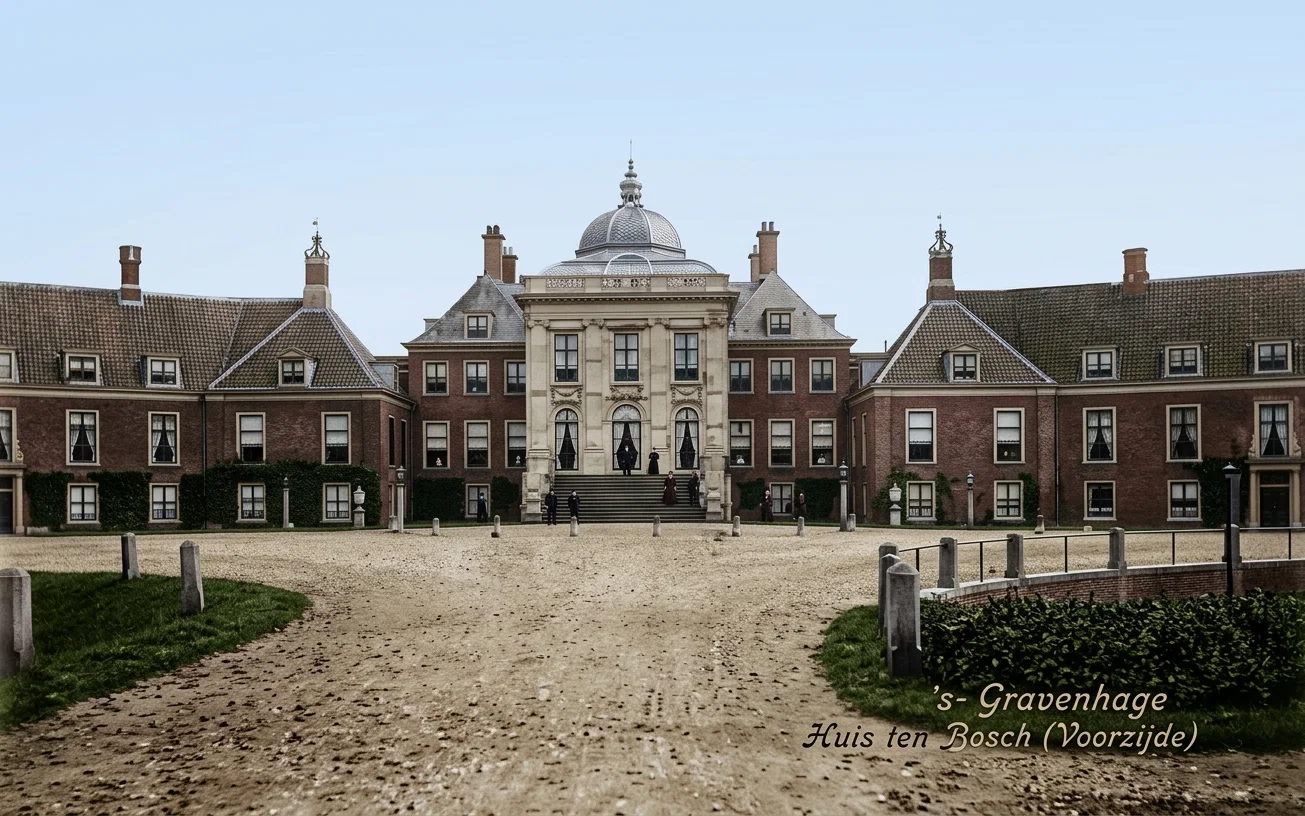
"House in the Woods," the building in which the 1899 Hague Conference was held
The Baroness von Suttner, who avers that "war has made its home at this conference"
United States Commission to Limit Armaments
Last June our Congress passed a bill authorizing the President to appoint a commission of five members "to consider the expediency of utilizing existing international agencies for the purpose of limiting the armaments of the nations of the world by international agreement, and of constituting the combined navies of the world an international force for the preservation of universal peace."
The commission is to make its report within two years, and a sum of $10,000 was voted for its expenses. The "Independent" says jubilantly, "This bill is nothing short of a ways and means measure to bring about a world federation, LIMITED TO THE MAINTENANCE OF PEACE." (Capitals ours.)
Secretary Knox on Peace
"The Spirit and Purposes of American Diplomacy" is the title of an address delivered by Secretary of State Knox, at the commencement of the University of Pennsylvania, last June. Mr. Knox concluded with what the "Independent" styles "this far-visioned peroration":
We have reached a point when it is evident that the future holds in store a time when wars shall cease; when the nations of the world shall realize a federation as real and vital as that now subsisting between the component parts of a single State; when by deliberate international conjunction the strong shall universally help the weak, and when the corporate righteousness of the world shall compel unrighteousness to disappear and shall destroy the habitations of cruelty still lingering in the dark places of the earth. This is the spirit of the wide world brooding on things to come. That day will be the millennium, of course; but in some sense and degree it will surely be realized in this dispensation of mortal time.11"This is the first time," continues the "Independent," "that a responsible minister of foreign affairs of a great world power has ever prophesied while in office the coming of the 'federation of the world' and its corollary, the reign of universal peace. . . . It contains the true and final philosophy of the peace movement — interdependence for independence, organization for chaos, law for war." The same writer hastens to character Mr. Knox as the greatest "peace" secretary this country has yet produced. The most potent semiofficial agency engaged in furthering peace is the Interparliamentary Union founded in 1888 in England. It is open to all persons who have been members of national parliaments. It now has a membership of more than 3,000. More than 200 members of the United States Congress are now represented in this union. In the words of the "Independent": "Should the union grow anywhere near so fast in the future as it has grown in the past, it will not be a very long time before the nations can, IF THEY DESIRE, actually "VOTE peace on earth."
Numerous Societies Working for Peace
Mr. Holt tells us that there are now nearly 600 unofficial peace societies throughout the world. There are 175 in France, 85 in Germany, 70 in England, 50 in Sweden, 35 in Italy, and 63 in the United States. Of those in the United States, the American Peace Society (with headquarters in Boston) is the oldest and best known. It publishes the "Advocate of Peace," the most influential peace journal in the world. This society is engaged in organizing branches, and has at present fifteen scattered over the country. Some of the other societies in this country are: the Annual Mohonk Conference on International Arbitration, the Intercollegiate Peace Society, the American Society of International Law, the World Federation League, of New York, and the Arbitration and Peace League. In addition to the peace societies of the world, there is an International Peace Congress that meets every year. Its eighteenth session was held last year at Christiania, Norway. Nearly every country of Christendom has its national peace congress, which meets annually.
Vast Sums Donated for Peace
In 1910 Mr. Edwin Ginn, the famous Boston publisher, gave $1,000,000 to the cause of the peace movement; Mr. Carnegie soon followed with a princely donation of $10,000,000. "As long as capital bears interest," says Mr. Holt, "this fund will yield its $500,000 a year; and when war ceases, as war inevitably must when the nations learn the better way, it will be needed to abolish the next greatest 'scourge of mankind.'"
July 6, 1910, the San Francisco "Examiner" said editorially:
Governments and emperors and kings and presidents are discussing peace as the great practical policy of all nations. The great cause of universal peace is marching on. Of all the great causes and developments of the century nothing is moving now more swiftly to its glorious end. . . . The President that is and the President that was have spoken bravely into the records of the new year their vigorous advocacy of arbitration and disarmament. The Secretary of State, on behalf of the Government, has forwarded an appeal to forty-eight nations of the world to join in the effort to enlarge the powers of the Hague Tribunal and its Prize Court to a Court of Arbitral Justice to harmonize international strife. The Congress of the United States has passed a resolution for a millennial commission to sound the parliaments of the world upon an agreement for the disbanding of armies and the disarmament of navies. Another resolution — the best of all — only waits the next Congress to invite the parliaments of all nations to assemble in common deliberation in some great American city to give essential legislative force and sanction to the agreement for universal peace. The dead King of England died with the song of universal peace upon his lips. The new King of England catches the refrain from the silent lips of his ancestor and gives it volume for the new day of his reign. The martial Emperor of Germany goes from the funeral pomp of the English Edward to breathe the spirit of peace. The peace societies of America and the interparliamentary unions of Europe are unfurling every banner and unloosening every song that pulses the practical suggestion of peace. . . . The Hague Conference is approaching another wonderful session, which will report the organization of the united nations of the world, with a capital, a constitution, and a flag devoted exclusively to the great cause of universal peace. The spirit of universal peace is in the sentiments of thinkers, in the pockets of taxpayers burdened with the staggering cost of armaments, in the intelligence of nations, in the air, and in the hearts of men.
This editorial closes with these roseately optimistic words: "The future is radiant with promise. The cause [of peace] of causes is marching on."
The noted New York clergyman, Dr. C. H. Parkhurst, July 13, 1910, contributed to the Hearst newspapers a stirring appeal to the nations to disarm, and by so doing make the "world's peace sure." He declares that if either England or the United States had the self-assurance to set the pace in a movement toward disarmament, the other nations would instantly follow suit.
Near the close of his article, under the title, "The Dawn of the World's Peace," published in "The World's Work" for March, 1911, Mr. Hamilton Holt indulges himself in this sanguine hope respecting the advent of world peace: "The future, indeed, is bright with promise, for all things work together for peace." He says finally, "Let us add to the Declaration of Independence the declaration of interdependence."
Similar citations might be given indefinitely from the pens and lips of thinking men and women of all nations, but space will not permit. We have given enough to show how colossal in magnitude and how ubiquitous is the "peace propaganda" of to-day. Will it succeed? What is the outlook? The realization of permanent, world-wide peace is certainly a "consummation devoutly to be wished."
We have nothing but praise for the estimable men and women who are devoting their money and their lives to so sacred a cause. We should all work for peace. The great mistake that these good people are making is that they are confidently predicting that the movement will be crowned with success, in the very face of the verdict of inspired prophecy to the contrary, as we shall abundantly show in the next number of this journal.
——
LETTERS TO A YOUNG MAN
BY A YOUNG MAN
IV. Recreation—The Right View-Point—Fresh Air—Diet
MY DEAR ROBERT,—
I am not surprised that you should think my last week's letter just a little narrow. To take the ground that amusement as such has no place in the life of the young man of the highest ideals, seems on the face of it to proceed from narrowness and bigotry; but this is so only because life itself is viewed from a wrong standpoint. The young man of to-day is too intent on "having a good time." He needs to be reminded of the Scripture saying, "It is good for a man that he bear the yoke in his youth." There is too much pleasure seeking, too little earnest putting on of the armor to fight the battles of the Lord. The intense joy which springs from cheerful, efficient buckling down to one's daily tasks, and doing them with an eye to perfection, is the lot of comparatively few.
You say that I omitted to speak of outdoor games, such as tennis, baseball, football, and the like, which in your opinion are not only harmless, but decidedly beneficial, so that they ought to be encouraged as suitable amusements for young men. I willingly grant that wholesome physical exercise can be obtained from the playing of these games; but I fail to see that much is gained from watching other people play them, and yet that is what the vast majority of young men who have left school do with the two last-mentioned games. Moreover the gambling spirit very often creeps in, and helps to give its demoralizing touch to this form of amusement. Even the actual playing of the games is not always conducive to the best results. The spirit of rivalry may easily get the overhand, and the good to be derived from the open-air exercise be largely offset by the excitement of the game. And even if match games are not played to any great extent, it is very possible for the game to become so absorbing as to crowd out more important things.
Let me in a word make my position clear. I am not denying that outdoor games afford exercise which may be of the highest importance in maintaining the body in a fit condition. I willingly acknowledge as much, and grant, too, that it is better for a young man to play games than not to take exercise at all. The muscles need to be used. Good digestion, a good nervous poise, mental quickness, and all-round power to do things, depend very largely on rational muscle culture, especially that which is taken out in the open air. But to yourself and other young men like you who have passed boyhood days, who have only limited leisure, and are accustomed to reach after high ideals in everything, I feel like showing the more excellent way. Games are good, but there is something better than games. You may indulge in them, perhaps, without loss; but if you want something that will be not a loss, but great gain, seek out some widow who may have wood to split, or try to find any other useful outdoor work to do, and put into the doing of it, if possible, the same keen interest that others take in their sports. While the world remains so full of sorrow, and poverty, and disease, while there are so many thousands of labor-worn men and women, who scarcely know what it is to be fully rested, or to have a really full, satisfying meal; in other words, while there is so much highly useful work that needs to be done every day of our lives,—it seems a pity that rational men and women should let their muscular energy go to waste.
You may say, and with some truth, that the various forms of useful work are not as well adapted to build up the muscles, and secure a graceful carriage and all-round physical efficiency, as are the games. This is only partially true, however; and in most cases almost any sort of useful outdoor work will prove highly invigorating if care is taken to keep an erect, vigorous carriage of the body, and to breathe deeply. A cramped position of the chest is not only ungraceful, but necessarily involves poor circulation, consequent imperfect aeration of the blood, and poor work, mental or physical. On the other hand, an erect carriage, with free action of the lungs, has a pronounced beneficent action upon all the bodily organs, and not least upon the brain. If, in addition to maintaining an upright carriage of the body, you will further offset the downward tendencies of sedentary life by a few moments given to chest expansion exercises morning and evening, it will help to keep you in trim for good work. Deep, full breathing lies at the foundation of good health, and should always have first consideration in planning for the efficient physical life.
To be sure, the quality of the air breathed is also a matter of importance. Cultivate the fresh air conscience. Be particular as to the kind of food you give your lungs even if thereby you get the reputation of being something of a crank. Consumption, which causes something like one seventh of the total number of deaths, is a foul air disease. I am a firm believer in open-air sleeping, by means of a sleeping porch, or a tent open at both ends, for the man who is obliged to spend his working hours indoors. House air and office air are always more or less impoverished; but when one gets out in the free, wholesome air of the fields and the woods, it is like being in a new world; there is fresh tone in such air for the overwrought nerves, and for the stomach and liver, and, not least, the lungs. It is a perfect godsend to the sedentary man to be able to spend his nights under the stars.
Open air sleeping is absolutely necessary to comfort in the summer. On hot days the sun beats upon the bedroom all day long, till toward night it is something like an oven and obviously unfit for sleeping purposes. But the air outside is fairly cool. Then why not sleep on the porch? Not till sleeping porches have become as common as bathrooms, can we boast of having applied scientific principles to our household economy.
You ask my opinion in reference to diet. It is an old subject, and of late years has come to be something of a fad with many persons. I have for myself adopted a few common sense rules which I endeavor to carry out with judgment. I reject in the first place those articles of food which science and experience unite in showing to be harmful, whether they seem to be specially injurious to me or not. Under this head I should include all stimulants and narcotics, such as tea, coffee, alcohol, and also those food articles, as flesh meats, that seem in some degree at least to partake of the character of stimulants. From the large variety of foods remaining I reject those which I have found do not agree with my stomach, or for any reason do not suit my needs. In general I prefer the plain things, and only two or three varieties at a meal. "Many dishes," wrote Pliny, "bring many diseases." Pie and cake are not among life's necessaries. It is pitiable how much labor is sometimes spent in making some complicated dish, and then equally pitiable that the stomach must labor so hard to extract the nourishment from that same dish. Learn to chew a piece of dry bread till it tastes delicious, and never sit down to eat a meal without having sufficient hunger to relish such a morsel. The chewing fad, known as Fletcherizing, is without doubt the usefulest fad that has entered the field of scientific feeding for a hundred years. It possesses the rare advantage of being workable everywhere and under all circumstances. It tends to diminish the quantity of food taken into the system, and to improve its quality, and to increase the thoroughness with which it is refined and appropriated to the needs of the system.
The longer I live, the more I am inclined to attach increased importance to the manner and spirit of eating as compared to the selection of the food. Mere vegetarianism, it seems to me, is in itself a small thing. A man can feed grossly without ever tasting of meat. For the sedentary man, a hearty meal of beans is about as likely to interfere with clear thinking as is one made up of beefsteak and plum pudding. To eat to satiety of almost any food is detrimental to fine brain work. There is an attitude toward the food question which is best summed up in the admonition of Paul: "Whether therefore ye eat, or drink, or whatsoever ye do, do all to the glory of God." It is shadowed also in the record of the apostles after the resurrection: They "did eat their meat with gladness and singleness of heart."13If we can but carry spirituality to the table with us, and keep it in view as it were all through the meal, then we are likely also to take it away with us, and the result will be that we shall always enjoy that lightness of spirits, that keenness of intellectual faculties, and that vigor of body, which in combination make up the thoroly efficient man.
I believe this is enough on diet. Your letter has raised other questions, which I shall write about after I have somewhat pondered them.
Ever yours,
L. P.
A True Man
By James Russell Lowell
[Lowell, on Wendell Phillips]
HE stood upon the world's broad threshold;
wide
The din of battle and of slaughter rose;
He saw God stand upon the weaker side,
That sank in seeming loss before its foes.
Many there were who made great haste and
sold
Unto the cunning enemy their swords;
He scorned their gifts of fame, and power,
and gold,
And, underneath their soft and flowery
words,
Heard the cold serpent hiss; therefore he
went
And humbly joined him to the weaker part,
Fanatic named, and fool, yet well content
So he could be the nearer to God's heart,
And feel its solemn pulses sending blood
Through all the wide-spread veins of endless
good.
Our Little Folks' Bible Nature
By Ella King Sanders
By Ella King Sanders
Our great world is one expression of the wonderful thoughts of God, and to study nature is to better understand these thoughts.
This new child's book gives simple graded lessons on Bible nature, beginning with Light, without which life would soon become extinct.
By easy steps the beginner is given an acquaintance with the wonderful works of God as seen in nature. An excellent book for the home training of children or as a help in the school.
One hundred and forty-four pages, illustrated with new drawings especially made for this book and with thirteen colored plates. Beautifully bound. Board covers, 25 cents; cloth, 50 cents.
---
Pacific Press Publishing Assn.
Mountain View, California
Portland, Ore. Kansas City, Mo.
Story of Pitcairn Island
Told by a Native Daughter
THIS fascinating story begins with the mutiny on the sloop-of-war Bounty in 1789, when Captain Bligh was dragged from his bed and cast adrift in an open boat with eighteen unfortunate companions.
From murderous mutineers to peaceable Christians, faithfully observing the commandments of God, is the wonderful history of the settlement of Pitcairn Island by the Bounty's mutinous crew.
In simple but beautiful language the writer of this tale, Miss Rosa Young, a native daughter, unfolds the story of love and hate, crime and its punishment, and the development of a happy race of islanders.
266 pages, tastily bound in cloth. Price, postpaid, $1.00
A clear, tho brief, setting forth of the Bible types and symbols, the services in connection with the earthly sanctuary, the effectual sacrifice and priesthood of our Lord, to which all these types pointed, and the great prophetic period of Dan. 8:14.
CHRIST OUR ADVOCATE
Contains 112 pages and is illustrated. Price ten cents.