“Christian Endeavor” and the “New England Sabbath.”
The “Christian Endeavor” and “Epworth League” forces of Worcester, Mass., have arisen to the rescue of the “New England Sabbath.” Not by the power of the divine Word, however, do they propose to accomplish this object; not by lifting up Jesus Christ, as all true Christian endeavor is supposed to do; but by the power of the police force of the city of Worcester.
They have drawn up and forwarded to the chief of police of that city, the following petition:—
“To James M. Drennan, Chief of Police of the city of Worcester, Massachusetts—
“The undersigned individuals, members of the good citizenship committee of the Worcester local union of Christian Endeavor, having a membership of 2,500 members, hereby respectfully and earnestly represent to you: First, that the laws of this State (chap. 434, sec. 2, Acts of 1895, ‘An Act to regulate the observance of the Lord’s Day’), are in common repute so notoriously and habitually violated in our city by shopkeepers, druggists, newsdealers, tobacconists, and others as to convince us that this lawlessness, if allowed to continue, will imperil the morals of the youth, and also the moral standard of our city; and, second, therefore, we respectfully appeal for the enforcement of this law, and also to use your power as the chief executive of this department of the Worcester city government, by proclamation or otherwise, through the officers under your direction, to secure to us and our imperiled city, the protection to which these neglected laws entitle us as citizens of this city.
“(Signed) Joseph William Allen, William E. Oakley, Hiram G. Geary.”
“The above petition was indorsed by a unanimous vote of the Worcester local union of Christian Endeavor and the Worcester Epworth league circuit, representing a total membership of 3,500 members, at a union meeting held in Park Congregational Church, on Monday evening, Feb. 8, 1897.
“(Attest) George E. Copeland, Pres. Worcester local union of ‘C. E.’ “Burton C. Priest, Pres. Worcester circuit of Epworth leagues.”
The section of the State Sunday law to which the petition refers, is as follows:—
“SECTION 2. Whoever on the Lord’s day keeps open his shop, warehouse or workhouse, or does any manner of labor, business, or work, except works of necessity and charity, or takes part in any sport, game or play, or public diversion, except a concert of sacred music, or an entertainment given by a religious or charitable society, the proceeds of which, if any, are137to be devoted exclusively to a charitable or religious purpose, shall be punished by fine not less than $50 and not exceeding $500 for each offense; but nothing in this section shall be held to prohibit the manufacture and distribution of steam, gas or electricity for illuminating purposes, heat or motive power, nor the distribution of water for fire or domestic purposes; nor the use of the telegraph or the telephone, nor the retail sale of drugs and medicines, nor articles ordered by the prescription of a physician, nor mechanical appliances used by physicians or surgeons, nor the letting of horses and carriages, nor the letting of yachts and boats, nor the running of steam ferry boats on established routes, or of street railway cars, nor the preparation, printing and publishing of newspapers, nor the sale and delivery of newspapers, nor the wholesale or retail sale and delivery of milk, nor the transportation of milk, nor the making of butter and cheese, nor the keeping open of public bathhouses, nor the making or selling by bakers or their employés of bread or other food usually dealt in by them, before 10 o’clock in the morning, and between the hours of 4 o’clock and half-past 6 o’clock in the evening. Whoever conscientiously believes that the seventh day of the week ought to be observed as the Sabbath, and actually refrains from secular business and labor on that day, shall not be liable to the penalties of this section, for performing secular business and labor on the Lord’s day, if he disturbs no other person.
It will be noticed that of the four classes of individuals specified in the petition as conspicuous violators of the law, two—druggists and newsdealers—are among those whose business the law permits. The explanation of this is not difficult. The object of the Endeavorers is to stop Sunday desecration, of which open drug stores and news depots are, in their view, as real examples as any to be found. What the law may specify as permissible on Sunday is with them a minor consideration. Their object is not to enforce the law, as it is, but to stop Sunday business by means of the law; and they will have it amended or construed, if possible, to suit their purpose.
Zeal for Sunday is wont to clothe itself in the guise of zeal for law.
The Worcester Daily Telegram of the 13th ult., reports that Chief Drennan, of the Worcester police, has caused the petition and Sunday law to be published, with this notice to the citizens:—
DEPARTMENT OF POLICE.
Worcester, February 11.
The following petition has this day been received at these headquarters. An abstract of the same was published in the newspapers a few days ago, and I have already taken action on the same. Any inroads on the sacredness of the New England sabbath in violation of law cannot be permitted. Ignorance of the provisions of law is no justification for its violation; in order, however, that all may be familiar with the law regarding observance of the Lord’s day, I have caused chapter 434 of the Acts of 1895 to be published in the daily papers.
James M. Drennan, Chief of Police.
It will be seen from this that Chief Drennan considers it to be the duty of the police to “guard the sacredness of the New England sabbath.” He views the “sacredness” of that institution as being of a kind that can be guarded by the police. There will be “inroads” made upon it if certain kinds of business are allowed to proceed on that day. But these “inroads,” according to the petition, have been going on for a long time already. Yet this notice is put forth on the assumption that its “sacredness” is still intact.
It is also assumed that the “New England Sabbath” is the “Lord’s day.” This of course is a theological question, and due allowance must be made for a police officer when he undertakes to handle such subjects. But it seems too bad that the Christian Endeavorers should force city officials not appointed to office with any reference to their theological qualifications, to make a show of themselves in this direction.
To a reporter for the Telegram, the chairman of the “good citizenship committee,” by whom the petition was drawn up, said: “We are waiting to see if Chief of Police Drennan does anything about the matter, and if not we will take up the cudgels and with the assistance of our attorney will bring cases into court ourselves.”
And all this is done—ostensibly—in the name of Him who never invoked the civil arm or made use of earthly power to advance his cause. Would it not be well for those Christian Endeavorers and Epworth Leaguers to become better acquainted with Jesus Christ?
Investigating the Trusts.
The Court of Inquiry which State Senator Lexow has been conducting against some of the Trusts doing business in New York City, discloses the desperate and doubtful nature of the contest which the people have begun for a curtailment of these baneful institutions. From the result of this attempt, it would seem that little if anything is to be expected from the State in this direction. The Trusts simply bade defiance to the State, and the State could not force them to do otherwise. Their representatives declined to produce the books which the State desired to inspect, and did not hesitate to “disremember” such facts and figures as the Trusts had determined to keep from public view.
In connection with this it is interesting to note that a recent decision of the Federal District Court has pronounced the Texas Anti-Trust law to be unconstitutional. This was a measure which prohibited all combinations to raise or lower prices, except of agricultural products and labor. The decision—which was rendered by Judge Swayne—very properly points out that such a measure denies the constitutional guaranty of the equal rights of citizens before the law, forbidding to twenty per cent. of the population what it allows to eighty per cent. Thus it falls under condemnation as class legislation. And it is difficult to see how a law against Trusts could be framed which would not be liable to condemnation in the courts upon similar grounds.
When the victims of the Trusts become convinced that no relief is to be hoped for through the regular methods of governmental procedure, they will have recourse to methods of their own which are now contemplated in the theory of republican government. Only as men become more willing to deal with their fellows by the principle of the Golden Rule, will there be any substantial relief from the evils which threaten the disruption of the Government.
Public Money and Sectarian Schools
The question whether public money shall be appropriated by Congress for sectarian schools is again before the National Legislature. The simple truth concerning this is that no public money can be rightfully taken for a sectarian use, and that when the people's money is thus misapplied in one case, it does not mend the matter to repeat the act in a number of other cases. No extension of wrong can ever make wrong right.
Sunday Labor Not Compulsory.
In a letter to the Golden Rule for January 28, Rev. W. F. Crafts, one of the foremost champions of Sunday laws, objects to the idea that Christians might be “compelled to work on the Sabbath,” and says that “when Christians count it a sufficient excuse for not doing right that it would cost something, and a sufficient reason for doing wrong that it will pay, we cannot expect victories.”
True; and that is just the reason the cause of Christianity cannot be advanced by legislation. “We cannot expect victories” so long as “Christians” have not principle enough to do what they believe to be right, without having laws to make it easy for them to do so. Mr. Crafts adds:—
“But it would seem that in our day God does not intend that those who keep his day shall even suffer financial loss. I have searched the world over to find one who has lost by bravely refusing to do Sunday work. I have found many who gained, but only one case of serious loss, even from an earthly standpoint.”
Well, then, what is the use of all this talk that is heard about the necessity of Sunday laws to give the poor workingman a chance to obey God? If he is not to suffer even financial loss by keeping Sunday as a matter of religious principle, what more can be asked for him? Why not let every Christian act from principle, and settle the question in that way? Is it not better138that men should act from principle than from some selfish motive?
There is no possible reason why any Christian should want legislation on the subject of obedience to one of God’s commands. Who is it that provides for him and for all men, whether living in obedience to God or not? Does he believe that it is God who does this? Then, if he believes this, can he not have faith enough in his God to believe that He who cared for him in his disobedience, will also care for him when he becomes obedient?
What is the standard of Christianity that is to be set up in this land? Is it that which says Christians must have the arm of the State to lean on in their journey to the celestial realm, and must have things made pleasant and convenient for them by civil enactments? The Seventh-day Adventists have pursued their way without the aid of any law in favor of the day they keep except the fourth commandment of the Decalogue. They have done this, and prospered, from the first, not only without such aid, but often in the face of legal opposition, and of all the inconvenience that can be caused by differing in belief and practice from the majority around them. They neither ask nor desire any aid from the civil power, but are entirely willing to do as they believe God commands, and leave the results with Him. Is not this the standard of Christianity that ought to be maintained?
Obedience to God from principle, simply as the result of faith in His Word, is Christianity. Anything less than this is not Christianity at all. Hence there can be no human law in favor of religion which is not contrary to Christianity. And therefore no such law ought ever to be enacted.
A Great Discovery Versus the Bible and History
A “Great Discovery” vs. the Bible and History.
“Chicago Israelite,” January 9, 1897.
ONE of the funniest theological discoveries is reported in the Chicago Tribune (December 28) as coming from one S. W. Gamble, a reverend gentleman of the South Kansas Conference of the Methodist Episcopal Church. This gentleman discovered that the “Jewish Sabbath” was not Saturday, but was a changeable day and that “Remember the Sabbath day to keep it holy” never referred to Saturday. The gentleman did not notice that next to this commandment it is ordained, “six days shalt thou labor and do all thy work, and the seventh day shall be the Sabbath to the Lord thy God;” hence it could not mean a changeable day. Then he admits that from the Exodus to the crucifixion the Jews did observe this self-same seventh-day Sabbath. There is some confusion of ideas in Mr. Gamble’s mind, as indeed what Sabbath day was kept before the exode he cannot know, and that the Jews after the crucifixion always kept that very seventh-day Sabbath—there never was a difference of opinion among the Jews on this point, although they lived thousands of miles from one another, and for long centuries without intercommunication. The Falashees of Abyssinia and the Jews in the Rhenish cities and in Ratisbon, all claim to have been there respectively long before the crucifixion and yet they keep the same seventh day Sabbath as they did in Jerusalem, Antioch, Alexandria, and Rome in the time of the Cæsars, as you can see from the Latin classics.
According to the Tribune Mr. Gamble’s argument runs thus:—
“The Sabbath of the Jews, from the Exodus until at least after the crucifixion, occurred on fixed dates—that is, on the fifteenth day of Abib, or Nisan, each year, because it commemorated their freedom from Egyptian slavery on that date. It occurred the same day of the week with the fifteenth day of Abib until the day of Pentecost. The week including Pentecost contained six work days and two Sabbaths. The six work days followed the day of Pentecost Sabbath, which would bring the next Sabbath after Pentecost on the next day of the week to what it had been preceding that time in the year, making a change of the Sabbath day at Pentecost to the next day in the week each year.”
“The same law holds good in the count of the Sabbath years and the year of jubilee. Each jubilee period was a perfect cycle in itself. The last week of years in each jubilee period contained six work years and two Sabbath years.”
If the reporter of the Tribune invented this argument, he is guilty of murder with intent, malice, and forethought; it is a wicked satire on good Mr. Gamble. If the said reporter pleads not guilty, then the fallacy and folly of this argument are suicidal to Mr. Gamble’s theology. The Passover has no connection whatever with the weekly Sabbath, although like every other feast ordained by Moses it is called a Sabbath, or a “time of rest.” In the second place, Pentecost being on the fiftieth day after the first of Passover, came at the beginning of the eighth week, and there can be no weekly Sabbath at the beginning of a week, as said in the Decalogue,—Six days thou shalt labor and the seventh day shall be Sabbath. No Mosaic law can go against the Decalogue.
Aside from all this, the Pentecost and the Passover have no connection whatever with the Sabbath. The year of release was every seventh year exactly as the Sabbath was every seventh day. The jubilee year was added to the seven times seven years to make the era year in round numbers of fifty in place of the century, as we count now. The whole argument of Mr. Gamble is a theological fiction versus historical fact, futile and worthless.
Sunday Rest Is Not an American Institution
ONE of the assumptions upon which Sunday laws are sought to be upheld, is that Sunday as a rest day is an “American institution.” It seems incredible that any intelligent person could regard this plea as anything more than an assumption, and an exceedingly poor one at that. An American institution is something the origin of which can be traced back to some event or series of events in the history of the American nation. But as every person knows, the Sunday rest can be traced back139for ages before the American nation came into being. And if it were, as claimed, an American institution, that fact would entirely destroy its claim to rest upon an authority higher than that of man. But in the matter of commanding and enforcing religious observances, man has no authority whatever.
By way of making this claim more plausible, however, it is asserted that the Sabbath is “an American institution on the civil side of it.” This was said by a prominent speaker at the recent Sabbath Observance convention at Pittsburg, Pa. But was the Sabbath instituted by the Creator with one side of it lacking, which it was to be left for man to supply? Was not the Sabbath a perfect institution when it came from the hand of the Creator? Did the Creator ever make anything that was imperfect?
These questions answer themselves, and entirely sweep away the idea of a “civil side” to the Sabbath. The Sabbath came to man in Eden, before there was any civil government on earth; it was a complete institution then, and it was the same then that it is to-day.
Religious Coercion is Antichristian.
“Present Truth,” London, England.
WHY is it that those who have passed under the name of Christian, and whom the world at large counts as representative of Christianity, have, so universally, sought temporal power?
He who is really Christian follows in the footsteps of Christ, does he not? But Christ avoided even the slightest assumption of temporal authority. He even refused to be an arbitrator in a simple dispute as to the division of property, saying to the one who sought the intervention, “Man, who made me a judge or a divider over you?”
The persistent and fatal error with which so many of His personal followers were possessed was that He was about to set up an earthly kingdom. But Christ combated this error continually, taking every occasion of reproving them for their worldly ambitions, and of setting before them the contrast between the futility of all earthly things and the eternal stability of the mansions of that kingdom eternal in the heavens, which he went to prepare.
The follower of Christ must follow Him in truth, or else he is not a disciple and a follower, but a pretender and a traitor. Christ sought no temporal authority over men. He strenuously refused even the smallest opportunity for the exercise of such power. Is it then consistent with the life and example of the Master, for those who claim to be his disciples, to seek to dominate over their fellow-men?
If the example of Christ is followed, those who carry His gospel will use no authority in religious things, other than the persuasion of the Word. Christ judges no man. He Himself said so. He permits all men to judge themselves, to choose that which they will, whether it be life or death. This being so, it is impossible for men who claim to speak for Christ, and exercise authority from him, to coerce men into accepting and receiving eternal life. Spiritual coercion is futile. It even goes beyond futility, it defeats itself, and becomes an active agent in the opposite direction to that in which it purports to work.
The fact that this is so marks the origin of this great deception, and its masterly development to the present hour, as coming from the arch-enemy of God and mankind. When the teachings of the Word of God, and the example of Christ, are so plain, and the evidences of the destructive working of Satan’s deceptions so evidently seen, it is indeed a “mystery of iniquity” that men should choose the antichristian way and call it Christian.
Carnal Methods.
By A. Smith
BY A. SMITH.
NATIONAL Reformers, so called, are not only determined that existing State Sunday laws shall be enforced, but that national laws of that character shall be framed and put into effect against those who do not believe that day to be the Sabbath, and those who treat it with indifference as such.
Such laws are carnal weapons, used to coerce unbelievers. Such methods are not Christlike. Says Paul, “The weapons of our warfare are not carnal.” 2 Cor. 10:4. None but carnal minds will use carnal weapons in defense of religious dogmas; and Paul says, “The carnal mind is enmity against God.” Rom. 8:7.
Mahomet used carnal weapons to enforce his religion, and National Reformers and their numerous allies have entered upon a like career of coercion. The object to be gained and the method employed may be different in force, but the controlling spirit is the same. What difference does it make in principle whether one is compelled to observe a single religious dogma, or all the dogmas composing a given system of religion? There is none except in degree.
If the compulsory observance of Sunday as the weekly Sabbath is better, socially and morally, for unbelievers and the community in which they dwell, why not carry the principle further and compel everybody to profess religion? For, is not true religion a good thing for any community? At revival efforts people are urged in some way to make a public avowal of their purpose to serve the Lord; but many hesitate, and others sneer and oppose. Now would it not be a good National Reform scheme to cause a law to be framed to punish with fine or imprisonment those who refuse such earnest persuasion? Romanism and Mohammedanism furnish excellent examples of such methods.
Some of the State Sunday laws contain exemption clauses in favor of those who observe the seventh day140as the Sabbath; but the law of God contains no exemption clause. It is morally wrong for anybody in the world to use the seventh day as secular time, for God has declared it to be holy.
Sunday, as a sabbath, is a man-made institution; and the same power that embodied exemption clauses in the laws compelling its observance can abrogate such clauses at will whenever public sentiment may demand it. Are lovers of liberty willing to supinely surrender their God-given right to freedom of choice in matters of faith and attendant practices to any man or class of men who assume the place of God in dictating and enforcing morals? The greatest danger on this point lies in the fact that the people generally do not know their danger, and probably will not until this God-given boon shall have been forever lost.
Religious Views of the Sabbath Commandment Examined
In the annual report of the “New England Sabbath Protective League” for 1896, reference is made to the Sabbath as “that institution which underlies all morality and true religion.” Yet there is no other commandment in the Decalogue which religious people treat so loosely. Any one of the other nine is assumed to mean what it says, and is taken as binding upon mankind just as it reads. No one seems to see any room for question about them. But when we come to the Sabbath commandment, which is no less plain, and specifies “the seventh day” as the Sabbath for all mankind, we are told that it does not mean the keeping of any particular day; but merely of “one day in seven.” And some say that it is not binding at all, having somehow been dropped out of the Decalogue at the crucifixion of Christ. How can it be expected that any moral reformation will take place while religious teachers hold such views of “that institution which underlies all morality and true religion.”?
Capitol Fire Read as Judgment on Sunday Laws
THE Pennsylvania State Sabbath Observance Association, recently in session at Pittsburg, did not let slip the occasion to point to the destruction of the State Capitol by fire as a manifest judgment of God upon the State for “Sabbath breaking.” At least, as expressed by the editor of the Christian Statesman, it looked much as if such were the significance of the occurrence. Inasmuch, however, as Pennsylvania has more stringent Sunday laws, and enforces them more rigorously than almost any other State, the query cannot well be avoided, why she should be singled out from her more wicked sister States as the mark of divine retribution. If the event carries any such significance, it may well be that the judgment came on account of the antichristian attitude of the State which finds expression in the enactment and enforcing of her Sunday statutes.
Senator Ahearn's Bill on Corporate Meeting Times
STATE SENATOR AHEARN, of New York, has undertaken to provide a remedy for corporations against the decisions of religiously-minded judges, of which an illustration was recently furnished by Judge Pryor. He has introduced a bill in the New York legislature to eliminate from the law governing corporate bodies, that provision which requires such associations to declare their times of meeting in the articles of incorporation.
Women's Christian Temperance Union Calls for Prayer on Lord's Day
A “CALL for united prayer for the Lord’s day” is to be issued by the Women’s Christian Temperance Union and the “Sabbath Associations” in the different States, setting apart April 3–12 as a period of seeking “for a deeper love and a better observance of the Lord’s day, and for the preservation of the civil laws by which its holy rest and quiet have been preserved in most parts of our country.”
This call, in so far as it relates to “a deeper love and better observance of the Lord’s day,” is timely; especially in view of the fact that the members of these organizations are laboring under the impression that God’s words “the seventh day is the Sabbath” mean that the first day is the Sabbath; that the day which God calls “My holy day” (Isa. 58:13) is the first day of the week; and that Jesus Christ, in affirming his Lordship of the Sabbath (Mark 2:28), answered the objections of the Pharisees by a reference to the first day of the week. We trust that during this designated season of prayer some of these individuals may become convinced that the Lord really means what He says.
Carson's Welcome for the Prize Fight
THE citizens of Carson, Nevada, are reported to be so well pleased with the partial revival of business and increased circulation of money that have followed the arrival in their midst of the two noted “heroes” of the prize ring, that all opposition among them to the coming “battle,” has died out, and it even has the indorsement of the local clergy. In this we have an illustration of the fact that it is not morality, but money, that controls affairs in this world; and the men who control the monetary situation of the world, as it is to-day, are more responsible than any others for its wickedness and crime.
Catholic Writer Compares Papacy to American Constitution
In an effort to point out a similarity between the American Constitution and the religious system of the Papacy, a writer in the Catholic Standard and Times, of January 23, says that “According to the Constitution every citizen is eligible to the highest position in the gift of the people, and we all know that the highest post in the hierarchy is open to the humblest son of the church. In Church and State fitness and availability and not pedigree is the paramount claim to office.”
This is probably the reason why Italy has been made to furnish nine tenths of the cardinals and popes.
Press Seeks Papal Views on Arbitration Treaty
SPEAKING of the zeal displayed by the press in England and America to obtain and publish the sentiments of the “holy father” at the Vatican respecting the proposed Anglo-American arbitration treaty, a prominent Catholic journal says: “There is much significance of the changed spirit of the times in secular newspapers thus seeking the view held on great public questions by the head of the Catholic Church.”
Yes; the “spirit of the times” is giving marked evidence of deterioration from the sturdy independence which characterized the days of our fathers.
Manitoba Government Appeals St. Boniface Election Over Church Intimidation
A DISPATCH from Winnipeg, Manitoba, gives the information that “The battle between the Catholic Church and the Laurier and Greenway governments is to be renewed in the law courts. The government will appeal to the courts to declare the St. Boniface election void on the ground that Archbishop Langevin intimidated his parishioners by threats of excommunication if they did not vote for the church candidate.” This election was carried by the Catholics, but by so slight a majority that it is regarded as a practical victory for the government.
Catholic Journal on Historians and Anti-Catholic Bias
The following from a prominent Catholic journal of Philadelphia is very significant:—
“An encouraging sign of the times is the way in which the historians who have been most popular with the great masses of the people in this country are being written out of favor in the secular press. Apropos of the death of Joel T. Headley, not only is he classed in the American school of romantic historians, but Irving, Prescott and Abbott are classed with him. And may they and all who have given an anti-Catholic bias to their works have no successors!”
New England Sabbath Protective League Elects Senator Hoar President
THE “New England Sabbath Protective League,” at its second annual session, held last January, chose as its president U. S. Senator George F. Hoar, of Worcester, Mass. The latter was written a letter of acceptance of the office, in which he says: “I believe thoroughly in a day of rest, which shall be largely devoted to the contemplation of divine themes and to the worship of God and teaching His law, and in protecting the observance against disturbance by secular labor, or other discords, by law.”
Millionaire Mortgages Brother's Property for Fifty-Dollar Loan
A WELL-KNOWN millionaire of this city, who condemned the extravagance of the late fancy dress ball, is reported as having recently taken a mortgage on the property of his own brother, who is in straitened circumstances, as security for a fifty-dollar loan. This furnishes an illustration of the most useless sort of individual a community can contain. The millionaire hoarder of wealth is far more to be condemned than the most reckless fortune squanderer that lives. See James 5:3.
Dixon's Cooper Union Sermon on a Better Country
In a report of a sermon preached in Cooper Union, New York City, February 22, Rev. A. C. Dixon is quoted as saying: “I am not going to make a patriotic address—though I’d like to. God pity the man who has no better country than this. It’s the best country in this world; but there’s a better country where Jesus Christ is King.” We commend these words to the Christian Endeavorers, who have set out to “enthrone Christ on Capitol Hill.”
Present-Day Teaching on Sabbath Observance and Sunday
A LARGE part of the present-day teaching in regard to Sabbath observance simmers down to this: “It isn’t the keeping of a particular day that is enjoined in the Sabbath commandment; that is a point that is not essential, provided you keep Sunday. You needn’t be particular so far as the Lord is concerned; but if you don’t keep Sunday, we’ll get our Sunday law into operation and make you wish you had kept that particular day!”
Sunday Defenders and the Sabbath Question
“It is to be hoped,” says the February Christian Endeavorer, “that we will hear no more of the foolish . . . saying: ‘It makes no difference what day of the week we observe as Sabbath, so that we observe one.’” Sunday defenders, take notice.
Christian Endeavor Annual Convention to Meet in San Francisco
THE United Society of Christian Endeavor announces that the next annual convention of the organization will be held in San Francisco, July 7–12.
TO OUR PATRONS:
By Editor
Write names plainly.
Remit by P. O. Money Order, or Express Order, or by Bank Draft on New York. Personal checks are not desired.
Make all Orders and Drafts payable to Pacific Press Publishing Co., not to the editor or any other individual.
We will receive Postage Stamp in small quantities and any kind of good money. Defaced coins will not be taken. If paper money or coin is sent, register the letter.
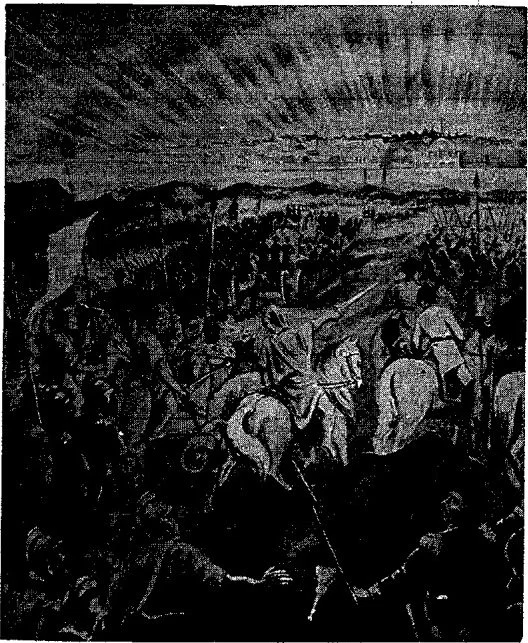
Fighting Against God
Is the title of a sixteen-page tract just issued as No. 41 of the Religious Liberty Library, in which PICTURE, POETRY, and PROSE unite in teaching Christian principles of freedom of conscience.
7 FINE HALF-TONE ILLUSTRATIONS 7
The pages shown below are reduced facsimiles of pages 6 and 7 of this tract.
Wilt thou rally thy legions to battle,
And march on the City of Light,
Whence angels excelling in power
Were hurled to the regions of night?
Wilt thou compass the city eternal,
Its towers and battlements raze,
And train thy batteries brazen
On the throne of the Ancient of Days?
FIGHTING AGAINST GOD.
CAN NATIONS CONTEND WITH GOD?
“At his wrath the earth shall tremble, and the nations shall not be able to abide his indignation.”
For a nation to compel a subject to disobey the laws of a foreign nation, when it knows it is powerless to protect him in so doing, is but to murder its citizen in cold blood, and merit international contempt.
Will the government attempt to protect its citizens against the wrath of an offended God? Will it declare war on the King of kings? Can it marshal its hosts and hurl its serried columns against the Eternal City?
“WE OUGHT TO OBEY GOD RATHER THAN MEN.”
“WHEN they went from nation to nation, and from one kingdom to another people; he suffered no man to do them wrong: . . . saying, Touch not mine anointed, and do my prophets no harm.”
If God had intended that his children should submit to governments in matters of conscience, he would not have protected Daniel in the lions’ den, the three Hebrews in the fiery furnace, nor have delivered Peter and John, Paul and Silas, from their prison cells, where they were placed for disobeying human enactments.
GOD AND THE POWERS THAT BE.
“RENDER therefore unto Caesar the things that are Cæsar’s; and unto God the things that are God’s.”
God has ordained that governments should exist among men. To these governments he has commanded his people to render tribute, honor, and respect. He has commanded them to be obedient to every ordinance of man, not for fear of punishment, but for the Lord’s sake. So long as a government enforces ordinances of men,—such laws only as are necessary for the protection of men in the enjoyment of their equal, natural rights,—they will not come in conflict with the Christian.
Something Neat New and Novel
Price 3c each
Usual discounts in quantities
Printed on highly-finished paper
Its attractiveness will insure perusal by the
Most prejudiced or indifferent reader
Address, Pacific Press Publishing Co.,
39 Bond St., New York.
Kansas City, Mo.
Oakland, Cal.
Invaluable to Bible and History Students
By Alonzo T. Jones
THE EMPIRES OF THE BIBLE
FROM THE TIME OF THE FLOOD TO THE BABYLONIAN CAPTIVITY.
By ALONZO T. JONES.
Recent research in Babylon and Egypt has brought to light many valuable historical records that were inscribed in stone by the very men living in those ancient times. These records and the Bible history of the same time are woven together in one connected story. Another important feature of the book is the tracing in a series of twenty-one maps, the course of those empires. The design of the book is unique, and every student either of Bible or history will find it invaluable.
410 Pages. Cloth, Post-paid, $1.50.
PACIFIC PRESS PUBLISHING COMPANY,
39 Bond Street, New York City, N. Y.
Kansas City, Mo. Oakland, Cal.
Political Speeches and Debates
—OF—
ABRAHAM LINCOLN and STEPHEN A. DOUGLAS,
Containing all the important speeches of “The Giants” from 1854 to 1861, giving a fair and FULL HISTORY OF THE SLAVERY QUESTION, and the great constitutional questions involved therein, from the beginning of the nation to the outbreak of the Civil War. An attack was then being made upon the Declaration of Independence and the National Constitution. To-day another attack is being made upon the same charters of our liberties. The history made just previous to the Civil War forms a most vital part of the national annals, and should, in itself, warrant the study of those times. But in view of the present attack upon the Constitution, this subject becomes one of the greatest importance to every thinking individual. The work contains 555 pages, printed from new, clear type, with numerous full-page half-tone illustrations, including portraits of Lincoln and Douglas.
Bound in Buckram, price, — $1.75.“ “ “ gilt edges, price, 2.25.
PACIFIC PRESS PUBLISHING CO.,
39 BOND STREET, NEW YORK.
Kansas City, Mo. Oakland, Cal.,
The Rights of the People, or Civil Government and Religion.
By Alonzo T. Jones
By ALONZO T. JONES.
_THIS IS ONE OF THE VERY BEST BOOKS THAT HAS EVER BEEN WRITTEN ON THE RELATION OF THE CIVIL GOVERNMENT AND RELIGION._
It shows how Christianity advanced in the Roman Empire, not only without the aid of the State, but in the face of the bitterest opposition from the State; it discusses what the Christian should render to God, and what to the State, and how the powers that be are ordained of God. The book then takes up the history and principles of the movement so active now in the United States, looking toward having the Church try to regulate and cleanse politics, and shows what will be the certain results of following the policy advocated by some of these church men. No matter what your views upon this question, you cannot afford to miss reading this book.