In the Constructive Quarterly, to which reference was made last week, Archbishop Platon, of the Russian (Greek Catholic) church, set forth the attitude of his church toward the idea and the movement for which that journal stands—the confederation of Christendom. He says:—
I greet with my whole heart your intention. I also warmly admire the very idea of your Quarterly, because I am quite sure that if it is seriously carried out, it will enable members of various religious confessions to become acquainted with the peculiarities of the latter, which will lead to mutual understanding, to intimate intercourse, and thus, God helping, will create a common ground, or conditions, under which or out of which will arise the possibility for all of us to talk about union in a serious way. . . .
There are some among us who pray for the union, yet do not believe in it, do not think it possible.
Yet there are people of a different kind, with whom you are acquainted, with whom you have conversed, whose opinions on this subject you know. These people, I am convinced, will give a warm greeting to the appearance of your Quarterly, as they will see in it the realization of a step toward the practical solution of the question of the union of the churches, the greatest of all the great questions of the world.
It is not natural for good Christians to be indifferent as to who among them believes and how they believe in Christ. You know what is the attitude of the Roman Catholics toward this question.
As to the Orthodox [his church], I may tell you that their overwhelming majority feel perfectly sure that all those who believe in Christ are bound to believe in him in the Orthodox way.
It is very evident that this archbishop of the Russian church is a firm believer in the idea that the church in power has the right to compel all to believe in Christ “in the Orthodox way.” His suggestion as to the attitude of the Roman Catholic toward the question of who believe and how they believe is an indication of the attitude of his own church and of what he approves in such matters. He would make no allowance for conscientious belief on the part of the individual; he would leave no way open for the exercise of individual faith according to the dictates of individual conscience; but “all those who believe in Christ are bound to believe in him in the Orthodox way.” The spirit of oppression of conscience to bring about uniformity of religion permeates the entire utterance of the archbishop. Uniformity of religious expression, and force to bring it about, are far more important in the estimation of the advocate of the union of religion and the state than is the formation of true Christian character in individuals. The union or confederacy of Christendom upon such a basis would be a calamity of the most serious nature to the individual, the church, and the government that became parties to the arrangement.
A Lutheran correspondent of the Constructive Quarterly, Herr Friederich Loofs, professor of church history in the University of Halle, attempts to bridge the gulf between Lutheranism and Catholicism. Referring to Luther’s proposition that we are justified by faith alone, sola fide, he asks: “Must we Lutherans give it up or modify it in order to be comprehensible to other Christians?” He answers: “By no means. We must make it comprehensible.” He then endeavors to show that what is called justificari sola fide (being justified by faith alone) was a doctrine that could easily find its basis in Catholic teaching in the days of Thomas Aquinas and Francis of Assisi, the founder of the Franciscan order. He hopes to be able to bring Catholic and Protestant together through the teachings of such recognized saints of the Catholic Church on the matter of justification by faith. He says: “There has long been evidence that true Protestant piety, resting upon sola fide, can feel at home in high-thinking Catholic piety. The converse has also happened.”
This is the bridge thrown over the chasm. Which will cross to the other? Speaking of the religious experience of St. Francis of Assisi, the writer says: “We evangelicals find in all this evidences of a piety which is allied to evangelical piety. Should it be impossible for a Catholic to pass similar judgment [as to evangelicals]?” It will not be Catholicism that will cross over the chasm to unite with Protestantism. Says Dr. Adrian Fortescue, the Catholic priest of St. Hugh’s, Letchworth, England, in the London Daily Express of Feb. 19, 1913: “We do not hope for a compromising adjustment between different faiths; we do not desire an external resumption of friendly relations between sects which agree to differ. We have but one solution—that the people who left us should come back.” This agrees perfectly with the editorial declaration quoted from the Western Watchman (Catholic) last week, to the effect that “peace, with the Catholic Church, postulates absolute submission.”
Much more might be quoted from the Constructive Quarterly to show that the federation of Christendom will come only by professed Protestantism turning away from Protestant principles and acknowledging, in some manner, the leadership of Rome; that it will never come by Romanism accommodating her teachings and dogmas and ritualism to the desires or plans of evangelical Protestantism.
But the one-sidedness of this movement toward the federation of Christendom is no more striking than is the attitude of the Constructive Quarterly (and the movement for which it stands) toward the Word of God. Dr. Shailer Matthews, the president of the Federal Council of the Churches of Christ in America, may be regarded as in a position to speak the dominant sentiment of the organization. In his article in the Constructive Quarterly he takes the position that American Protestantism, through the inner changes brought about by the higher criticism, holds the strategic position here “for performing those functions which are most loudly demanded of organized religion,” and declares that in our day “the real content of the gospel is being rethought in the terms and under the influence of evolution and democracy.”
The reconstruction of Biblical teachings along the line of evolution and the higher criticism seems to him of far greater importance than the Reformation. He denominates the Reformation as merely “the refurbishing of Latin theology,” and declares its work “almost trifling” as compared with what evolution and the higher criticism have accomplished for religion. None can deny that the higher critics have accomplished much; but that what they have accomplished is in the interest of the Redeemer’s kingdom is impossible of demonstration. The Protestantism of the Reformation stood for the Word of God and for justification by faith alone; but Dr. Matthews says:—
American Protestantism, in its constructive tendencies, is abandoning the formal legalistic principle of Protestantism as organized in the seventeenth century.
It can not be wondered at, therefore, that the delegates to the last Federal Council so quickly and so enthusiastically expunged the word Protestant from the440report of their committee. American Protestantism, as represented by the Federal Council, does not stand for the Bible, and the Bible only, as its rule of faith and practise. It has dethroned the Bible, so far as its own belief is concerned, and has bowed down to its own wisdom as its sufficient guide.
Dr. Matthews considers evolution as a necessary concomitant of this remodeled gospel. He says: “A man may now be known as an evolutionist without running the risk of being branded by his peers as an infidel.” But the truth is that this remodeled gospel is the most subtle form of infidelity. The livery of the true gospel has been purloined by its enemies to serve the purposes of the great adversary. That which destroys faith in the Word of God can lay no just claim to being God’s agent, and has no right to set itself forth as the true guide to the eternal inheritance. Dr. Matthews takes it for granted that practically all Protestantism has cast aside the Genesis record of creation. Thus he disposes of the divine record of that event:—
One seldom hears any discussion regarding the seven creative days. Protestants are coming to feel that, whatever interpretation may be placed upon the opening chapters of Genesis, the final word as to the origin of our solar system will not be uttered by the theologian, but by the astronomer, the physicist, and the chemist. . . . American Protestantism finds itself freed from many of those anxieties which disturbed it a half-century ago, when Mr. Ingersoll could be regarded as a veritable Antichrist.
The Bible being the Word of God, why may not the theologian utter the final word as to the origin of the solar system? May we not credit the divine Author of the Bible with having a definite knowledge of how the solar system came into existence? And if he has such knowledge and communicates it to man in his Word, may we not depend upon that as “the final word” in the matter? Or shall we say that God, who knows all about creation from being the Creator, has given us a version of creation which is undependable and must be revised by “the astronomer, the physicist, and the chemist”? In other words, must we, in order to be “American Protestants,” accuse God of deliberate and premeditated falsehood, and choose for ourselves human guides, better informed than God or more truthful, to lead us out of the wilderness of doubt and uncertainty and ignorance into which they thus charge God with having led us? There is no escaping that dilemma once we have accepted the hypothesis of the higher critic in reference to creation.
Another statement of Dr. Matthews deserves notice. He affirms that “the new type of theological instruction [higher criticism] in pulpit and Sunday-school is steadily shifting interest from metaphysics to psychology.” And psychology, as taught in the higher institutions of learning to-day, is but the ante-room to Spiritualism. This statement of Dr. Matthews is no doubt correct. The higher criticism, having captured the federated churches, Spiritualism will reap one side of the field while Roman Catholicism reaps the other.
Another element that enters very largely into this remodeled gospel for which the federated churches stand is the social and political work of the church. Concerning this Dr. Matthews says:—
This new social interest of Protestant Christianity in America, as in Great Britain, is radically different from that of charity. It cares less for good Samaritans than it does for good policemen. It wants to save men into heaven by embodying the principles of the kingdom of heaven in the state. It is less concerned in rescuing people than in educating them to keep out of danger.
But the great Author of the gospel is the one who gave us the lesson of the good Samaritan. He gave it for a purpose. He gave it as an example for us in Christian kindness, love, and tenderness toward those in need or in distress or in affliction. Is the higher critic wiser than Christ? Is the gospel as remodeled by evolution and the higher criticism an improvement upon the gospel as set forth in the teachings and the life of Jesus Christ? The higher critic considers it so; and still we pin our faith to that gospel as Christ gave it and lived it. What is this substitute gospel of the higher critic and the evolutionist but another effort to exalt the human above the divine, to put man in the place of God, to do for man what Satan promised to do for him when he taught man that he could become like God by disobeying God. Higher criticism discredits the Word of God, creates a substitute for the gospel of God, and, in so doing, stamps itself indelibly as the enemy of God.
Where Dr. Matthews and his fellows stand in reference to the gospel work of soul-saving is readily discerned from these words:—
Men filled with this new social passion will have little patience with a Protestantism that waits to throw out life-lines. They will choose a new ship and a new crew and a captain that knows his course.
It is difficult to detect in this excerpt any sympathy with the work done by Jesus and his disciples in their day, or by the true soul-winners of the gospel in our day. Such a movement is not a promulgation of the gospel, but an attack upon the gospel, and is the more dangerous because it professes to be Christian.
With Dr. Matthews at the head of the Federal Council of the Churches, we must conclude that the Federal Council stands for the principles Dr. Matthews advocates. His principles are the platform of that body. They chose him because of his principles, and, in so doing, took those principles as the guiding star of their organization.
This movement, which has remodeled the gospel and set aside the original as obsolete, does not profess to be seeking the oneness of the Spirit or oneness in belief, but to be working for the social and political betterment of men. It expects to be able to throw the weight of all Christendom into the political scales of the nations to force men and nations into compliance with its mandates. When that union in endeavor has been accomplished, we may expect to see a repetition of the tyranny of the dark ages, and not in one or two nations only, but in all the nations of the world. The warning of the American Congress ought to be sounded in the ears of every advocate of those principles: “Extensive religious combinations to effect a political object are, in the opinion of the committee, always dangerous. . . . All religious despotism commences by combination and influence; and when that influence begins to operate upon the political institutions of a country, the civil power soon bends under it; and the catastrophe of other nations furnishes an awful warning of the consequence.”
Such a combination under such a leadership, with such an object in view, creates the most dangerous situation that has ever faced the church or the world.
C. M. S.
The Lord’s Return — No. 4
By F. M. W.
“Cast not away therefore your confidence, which hath great recompense of reward. For ye have need of patience, that, after ye have done the will of God, ye might receive the promise. For yet a little while, and he that shall come will come, and will not tarry. Now the just shall live by faith: but if any man draw back, my soul shall have no pleasure in him. But we are not of them who draw back unto perdition; but of them that believe to the saving of the soul.” Heb. 10: 35-39.
In considering the proposed visit of some dear friend, it is not enough that we know the manner of his coming, nor the particular object he may have in view in making the journey, but above these considerations is the precise time when the visit will be made.
This is the great objective point, and these are the feelings of all true disciples as they contemplate the return of the Lord to this earth. We know he will come to take his children home, to destroy sin, to bring this earth back to441its original purity and beauty, and to establish thereon his glorious and everlasting kingdom. The Scriptures of Truth also clearly reveal to us the manner of his coming. The same Jesus who once lived on this earth will come in like manner as he went away, openly and visibly, in all the glory and majesty of celestial royalty, escorted by tens of thousands of the angelic host. But this is not enough. Beyond this the cry of every longing Christian heart is, When will he come? How long before faith shall be swallowed up in sight? How long before the weary uplooking eyes of the children of God shall be refreshed with the sight of the one they have learned to love?
Divine revelation is not silent on this phase of the subject. The exact time we may not know. No man by the prophetic periods can figure out the hour, the day, or the year of the Master’s coming. But we may know when his coming is nigh, even at the doors, and we may know it as assuredly as we know that summer is nigh when the trees begin to put forth their leaves. Certain things must transpire in the world’s history. Certain signs and indications must take place, and when these are seen, it is our privilege to recognize them as harbingers of the coming King. And these heralds of the morning are to be seen and recognized in every department and feature of earth’s history. God would leave the world without excuse, so in the heavens above; in the earth beneath; in wind and wave and ocean’s roar; in the physical, social, industrial, religious, and political worlds; in the false religious movements of the last day; in the great prophetic forecast of the history of nations; in many and varied ways do the Scriptures predict that the time of the Lord’s return is near.
Thirty-three years ago, when the writer embraced this message, it seemed to him that the certainty of the Lord’s soon return was established beyond a doubt. But as he reviews the events of the last three decades, it appears that where one evidence existed thirty years ago there may be found one hundred evidences to-day. The signs are multiplying on every hand.
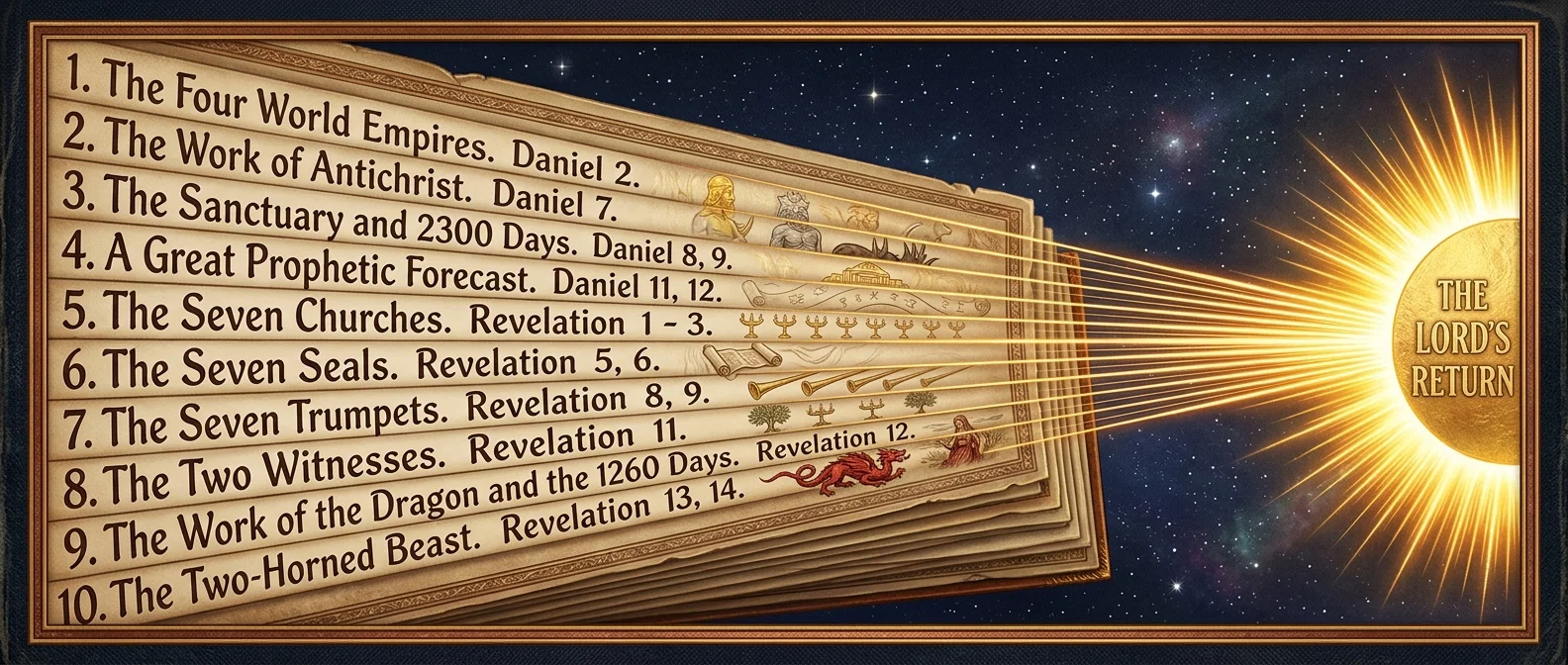
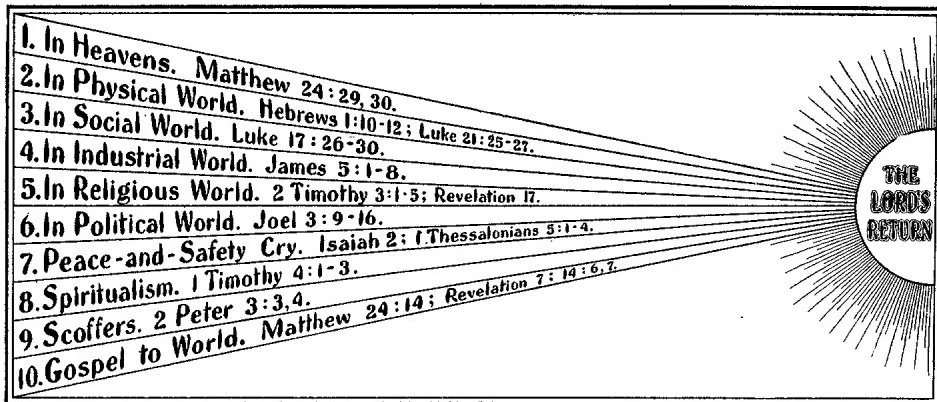
Consider the evidences as indicated in the two diagrams accompanying this article. The first diagram presents what we have designated for convenience the Time Prophecies of the Lord’s return. Here are ten great prophetic forecasts of a series of events which were to take place among the nations of men and in connection with the church of God. Some of these forecasts were made far back in the days of the Babylonian and Medo-Persian kingdoms. Some were given two thousand years ago through the apostle John. Every prophecy cited points to the same focal point, and that is the return to this earth of the Lord Jesus Christ. History verifies their fulfilment. We can trace every prophecy down step by step, age by age. The events have for the most part been fulfilled. They all indicate that we are living down in the little space just preceding the coming of the Lord, and that the next great event to take place marks the complete fulfilment of the prophetic period,—the return of Christ in the clouds of heaven.
The second outline presents what we have termed the Sign Prophecies of the Lord’s return. These sign prophecies do not embrace long prophetic periods. Rather they are prophecies of conditions which would exist in the world just preceding the second coming of Christ. There would be seen signs in the heaven; the earth would wax old; there would be conditions in the social world which would be comparable to those that existed in the days of Noah and that characterized Sodom and Gomorrah; in the industrial world there would exist a great conflict between capital and labor; the great professed Christian church would lose its first love and become worldly and apostate; the nations of earth would be preparing for the last great battle of Armageddon; in the face of these war preparations there would be raised a peace and safety cry, lulling the people into carnal security; spiritualism would perform its terrible work of delusion; scoffers would arise reviling the logic of evidence and the fulfilment of these conditions as signs of the day of the Lord; and in the midst of these untoward conditions God would send to the world a warning message of the speedy establishment of his kingdom, and a call to repent and escape the wrath so soon to be visited upon a guilty world. These are the conditions which the Scriptures say would be found in the world just before the coming of the Lord, and these would be recognized as the heralds of that coming.
That these conditions exist we do not need to argue. Every reader knows that these signs are in process of fulfilment to-day. They speak with one voice. To the student of the Word they proclaim one message, “The coming of the Lord draweth nigh.” Truly we may say with the apostle Peter, “We have not followed cunningly devised fables, when we made known unto you the power and coming of our Lord Jesus Christ.” Our faith is not based upon vain assumption or idle speculation. It is not founded upon one or two isolated scriptures. It does not rest alone upon one prophetic prediction or upon one line of prophecy. The prophecies cited in the diagram by no means exhaust the Bible record. Other prophecies and other signs might be mentioned, did space permit. The signs have been multiplied. Evidence upon evidence is furnished. God would leave the nations of men without excuse.
We may indeed lift up our heads and rejoice that our redemption draweth442nigh, that the deliverance from sin is soon to be consummated. And yet, notwithstanding these striking evidences that the Word presents, the Scriptures also indicate that this above all other times is a time of danger to the church of God; that in this period when everything about us indicates the near approach of a divine Lord, the church stands in greater danger than at any time in its history. Of this we shall speak more particularly next week.
F. M. W.
To Suppress White Slavery
A school is to be started in the city of Washington, D. C., for the purpose of educating men and women in the best methods of working against the white slave traffic and in reclaiming girls and women who have been caught in the trap of that great evil. The school will begin in May, and it is expected that similar schools will be started in other centers. This work will have the active support of officials of the United States government. At a meeting held in the Foundry M. E. Church, of Washington, Mr. Stanley M. Finch, special commissioner of the Department of Justice for the suppression of the white slave traffic, stated that within the past five years the department had secured the conviction of over 500 white-slavers, who had been given sentences to penal institutions aggregating 800 years. He also stated that there are no less than 25,000 men and women in the United States who are making a business of buying and selling girls and women for immoral purposes, and that in this country alone there are more than 250,000 women and girls in disorderly houses. It is proposed to establish, as an auxiliary to this educational institution, a National White Cross Society, whose members would pledge themselves to proper living and modesty in dress. Mr. Finch traced directly to the door of immodest dress a great deal of the vice and lewdness prevalent throughout the world. It is a terrible arraignment of modern society that in one country alone, and that a country of education and enlightenment and many churches, a quarter of a million women are turned aside from all that womanhood ought to stand for, and are thrown into the hopper of the monster vice mill that their bodies and souls may be turned into money for some one. There is no more heinous transaction than the selling of virtue for a price; and there is no crime that deserves more condign punishment than the crime of selling another against his will for such a business. If Sodom and Gomorrah deserved their punishment from the Almighty for their wicked lewdness, surely the Lord will not hide his anger forever against the nations and the cities that tolerate such a traffic.
A Difficult Problem
THE purpose of the California Legislature to pass legislation prohibiting the holding of land by Japanese and Chinese in that State is raising a question that is causing much concern to both Japan and the United States. The protests of the Japanese government and the likelihood of serious differences between the two governments should such legislation pass, caused the administration to decide upon the unusual course of sending the Secretary of State to California for the purpose of retarding or preventing such legislation as that proposed. Although other States have laws similar to that which California proposes to enact, yet the small number of Japanese in those States makes such laws of comparative unimportance to Japan. In California, however, the situation is very different. The Japanese holdings are considerable, and Japan feels that it would be an injury to her dignity if such legislation should pass. Reports from Japan indicate that the proposed legislation has stirred up considerable intensity of feeling there, and that there have been undisguised hints of war. On the other hand, California feels that she has the same right to pass legislation against the holding of property by aliens that the other States have. American missionary societies in Japan have sent to the home country earnest protests against the proposed legislation.
Scriptural Divorce
By Editor
WE believe that the principle stated in the following question and answer, which we clip from the Word and Way of April 17, would be applicable not alone to Baptist ministers, but to Seventh-day Adventists as well: —
“Is it right,” asks one of our readers, “for a Baptist minister to marry a couple, one being divorced?” Back of this is the question, “Should divorced persons marry?” We think they may if they have been Scripturally divorced. Any Scripturally divorced person may remarry. But the Scriptures know only one ground of divorce. Divorce on any other ground is unscriptural. We do not believe that it is right for a Baptist minister or any one else to officiate at the marriage of persons not Scripturally divorced.
A Good Example
THE example set by Secretary of State Bryan in excluding liquor from the table at the dinner given to the envoys of the nations in Washington is one that deserves the hearty approval of all right-thinking men and women. He had no precedent for a wineless dinner, but with the courage of his convictions in the matter of temperance, the Secretary made a precedent that it is to be hoped many others will follow. He explained to the assembled guests that he and Mrs. Bryan had been teetotalers from their childhood, as had their parents before them, and had never served liquor at their table. His remarks, instead of being resented by the foreign envoys, were heartily applauded. The temperance forces of the United States owe the Secretary of State a unanimous vote of thanks for his example in this matter.
The Balkan Tangle
By C. M. S.
THE situation in the Balkans seems now to be in a more complicated condition than at any previous time. The greater powers have not moved with the speed that Austria desired in the matter of compelling Montenegro to evacuate Scutari, and Austria is now moving troops toward the Montenegrin frontier and preparing to transport a division of her force into southern Albania by water. Montenegro on her part is moving her troops toward her northern frontier to meet the Austrian army, and according to reports Servia is acting with Montenegro against Austria in harmony with arrangements entered into before the outbreak of the Balkan war. The commander of Scutari, who surrendered to the Montenegrins on condition that he be permitted to march out with his troops and war equipments, has proclaimed himself king of Albania. This is out of harmony with the plans of the powers, who intended to put a prince of their own choosing on the Albanian throne. It is reported that this commander, who has a strong force under his direction, has entered into an agreement with the king of Montenegro to oppose the plans of the powers in reference to his country, and that he will help Montenegro and Servia against Austria. Another tangle has been put in the skein of complications by the disagreement that has arisen between the allies themselves over the spoils of the war. Bulgaria seems determined to take possession of the lion’s share of the captured territory, and it is reported that serious engagements have already taken place between the Bulgarians and the Greeks and between the Bulgarians and the Servians. Bulgaria seeking to dispossess both these nations of territory which they have captured from Turkey. This trouble among the allies themselves makes it almost certain that the greater powers will be drawn into the difficulty before many days. C. M. S.
Experiences in British East Africa
By L. R. CONRADI
L. R. CONRADI
NATIVE TEACHERS AT GENDIA, BRITISH EAST AFRICA
AFTER our good meeting at Majita, we left on the night of Dec. 29, 1912, on the mission boat “Herold,” reaching Shirati late the following night. Here the “Kavirondo,” with Brother Sparks, was awaiting us. On the afternoon of December 31 we again reached Karungu, and our missionaries here informed us that there is a favorable outlook for a good attendance at the school. Brethren Lane, Sparks, and Philipps, with their boys, joined us, and we spent New-year’s night on the lake.
A fair wind brought us to the island of Rusinga, by noon of January 1. We here called on the chief, who lives in a village about a mile inland, and he informed us that all the chief inhabitants had unanimously agreed for us to open a mission school on his island. Quite a good site on a prominent hill has been chosen, where the station can easily be seen by the steamers as they pass on the lake.
From Rusinga we had an excellent wind, but within an hour’s sail from Gendia a storm and contrary winds came up, and we had to anchor for the night so near our destination. When we entered Kavirondo Bay the next morning, we enjoyed an interesting sight: hippopotamusses were popping up their heads all about us. One of them had to pay the penalty with his life for his extreme curiosity, and in the afternoon the natives enjoyed the great feast, dividing the meat of the monster among themselves. We found all our missionaries in good health, and they were all glad to hear the good news of the German field to the south.
Brother Carscallen and the brethren had a number of meetings with the candidates for baptism, and on Friday afternoon he buried sixteen with the Lord. Half of these were from Gendia, the other half from Wire Hill,—fourteen young men and two women. Not only did a large crowd of natives attend this baptism, but also some Hindus from Asia. As there are many thousands of Hindus in both German and British East Africa, we hope that some day something also may be done for them.
On Sabbath evening we celebrated the ordinances, and the Lord came very near to us by his Spirit. As the time was too short for a social meeting, such a meeting was held early Sabbath morning. Not only did all the baptized Christians take part, but many others who had offered themselves for baptism. Some offered themselves anew for baptism during these meetings. Our total membership in the two British East African churches is now sixty-five.
We had a good meeting Sabbath forenoon. Brethren Kotz and Dail remained at Gendia for a week, but I went on to meet an appointment with the governor at Nairobi, where I arrived January 6. The hotels at this growing capital were so crowded that it was with difficulty that I obtained a room with three other persons. Nairobi is about five thousand five hundred feet high, and is a very healthful location. There is no malaria whatever here. To the east of Nairobi are the large game reservations, while to the west there are about one million Kikuyus people. There is considerable building going on, very substantial shops and hotels being put up. The natives live mostly in villages outside the town limits, while there are about ten thousand Indians and Goanese, who do chiefly the native trading. There are seven hundred Europeans, mostly English, in the town and immediate surroundings.
His Excellency received me very kindly, and we had an interesting conversation of about thirty-five minutes, during which he assured me that he would do everything he could for us, the same as for any other mission, while on his part he expected us to cooperate with the government. He laid special stress on the necessity of our living harmoniously with the other missions, and preserving the native characteristics of government so far as consistent with the gospel. He thought that in the near future the way might open for us to receive a suitable location for a health station. As to pushing our work toward the Abyssinian border, he stated that matters are still so unsettled that for the present it would be impossible for us to locate in that direction. He then invited me to have a conversation with his wife, and I stayed there over an hour, being only invited to tea. This is the third governor I have been able to visit since June, and I find that they all show a deep interest in our mission endeavors, and also in the peculiar truths we profess.
On the thirteenth I joined Brethren Dail and Kotz, and we had the good fortune to secure next day a German steamer of the Bombay line, for Tanga. We were very glad indeed that the outlook is so bright for extending our work in British East Africa, and that we shall be able during the present year to double our mission stations there. The Kavirondos are one of the most promising tribes, and we have already secured a number of bright young men to assist our English missionaries as native teachers.
We are also progressing well in securing literature in the Kavirondo. As Brother Carscallen will be with us in Europe, we expect that some of the needed books can be printed during his stay. Let us remember the Kavirondo mission in our prayers, that we may see still greater results in the near future.