MAPLE street was the first street to be paved in the pretty little town where Robbin and Ruby live. As it happened, Sunflower Cottage stands right at the top of the hill up which Maple street climbs bravely; so the twins could watch the work from the very beginning. First the men put in a curbing of dressed stone on each side of the street; then other men brought brick and lime and tools; and still others plowed up the hard road, “just as if they were going to make a garden,” Robbin said. And then what a time there was smoothing it all off level, and mixing mortar for the road-bed, and covering it with soft, clean sand, such as children love to play in, before the bricks themselves could be set side by side to make a smooth path for the horses’ feet.
But months before the bricks were stacked in great piles on the walks, or the plow had been pushed and dragged through the hard, packed clay and gravel, several barrels of a curious, hard, black substance were left at one side of the street. There were no heads in the barrels—evidently water would not hurt the stuff; it was so hard, too, that Robbin could not break off even a small lump, though he tried with the little hammer that Uncle Robert had given him at Christmas.
But by and by something happened. The days grew warmer; and the sun shining on the barrels and their contents, softened the black substance so that it began to flow out in a great, heavy mass. The children on Maple street dipped long sticks into it, and to their delight it stuck—“just like ‘taffy’ on a stick,” Ruby declared, with a flourish.
“Wonder what ’tis, anyway, and where it came from,” said Robbin, who likes to know things. He was sitting on the shady porch, mopping his hot little face with a very soiled handkerchief.
“It’s my opinion Janet would rather know how to get rid of it than where it came from,” volunteered Sister, from her hammock.
“Where’s Trinidad, Robbin?” asked Uncle Robert, with a twinkle in his eye. Geography is not Robbin’s strong point.
“Why—it’s—it’s in the Pacific Ocean somewhere, I guess,” stammered Robbin, his face redder than before.
HAPPY SUMMER DAYS
“Trinidad is one of the British West Indies,—don’t you remember, Robbin?—and is situated on the northern coast of Venezuela, at the mouth of the Orinoco River,” spoke up Ruby, with the ready memory that is the pride of her teachers and the despair of her schoolmates.
“Well done, Jewel!” said Uncle Robert, approvingly, and continued: “When I was in Trinidad last year, I visited a strange lake in the southern peninsula of the island. This lake is not filled with water, but with pitch, or asphalt, as it is often called. For miles around this curious lake the ground is all pitch, with only a little soil on top, though where there is even a thin layer of earth, things grow wonderfully in that tropical climate. But of course nothing can grow on the pitch itself.
“When I went out on the lake, I could feel it tremble and move under my weight as I ran along, or jumped across the little streams that formed in hollow places from the rains. It gave me a ‘shaky’ feeling, you may well believe; but there is really no danger, if one keeps moving about.
“In different places, men are at work day after day digging the stuff out in great, black, shining blocks, which are carried down to the harbor in strong iron baskets hung on wire cables. There it is put on board ships, and carried to New York City; and from there it is sent out all over the world.”
“I should think they’d get to the bottom sometime,” said Ruby.
“Yes, one would think so, especially after seeing how much is taken away in one day,” replied Uncle Robert, “but the fact is that the lake is even higher now than it was when the men first began to take the pitch away. One old ‘pitch-digger’ told me that he had been working for months in the very place where he stood when I saw him, and even then the hole was not more than two feet deep. By morning it would be all level with the rest of the lake.
“Near where the man was working there was a large root that he had dug up that day. Already it was half sunken in the pitch, and by the next day, he said, it would be out of sight. One time the men left a valuable piece of iron lying on the lake at night; and though they knew just where it was laid, and several of them dug246very fast for it the next morning, they could not find it. In one place the pitch is so soft that it will not hold a person’s weight. The men have set a pole here with a flag on it; every day or two the pole sinks out of sight, and they have to put up a new one.”
“Well, I’d like to see that lake,” said Robbin, thoughtfully, “and I’d like to know what they’re going to do with the stuff here,” he added.
“If you watch, you will see the men melt the pitch in a big tank, draw it into funnels, and pour it carefully in the space between the bricks after they are laid, to make the pavement even,” said Uncle Robert.
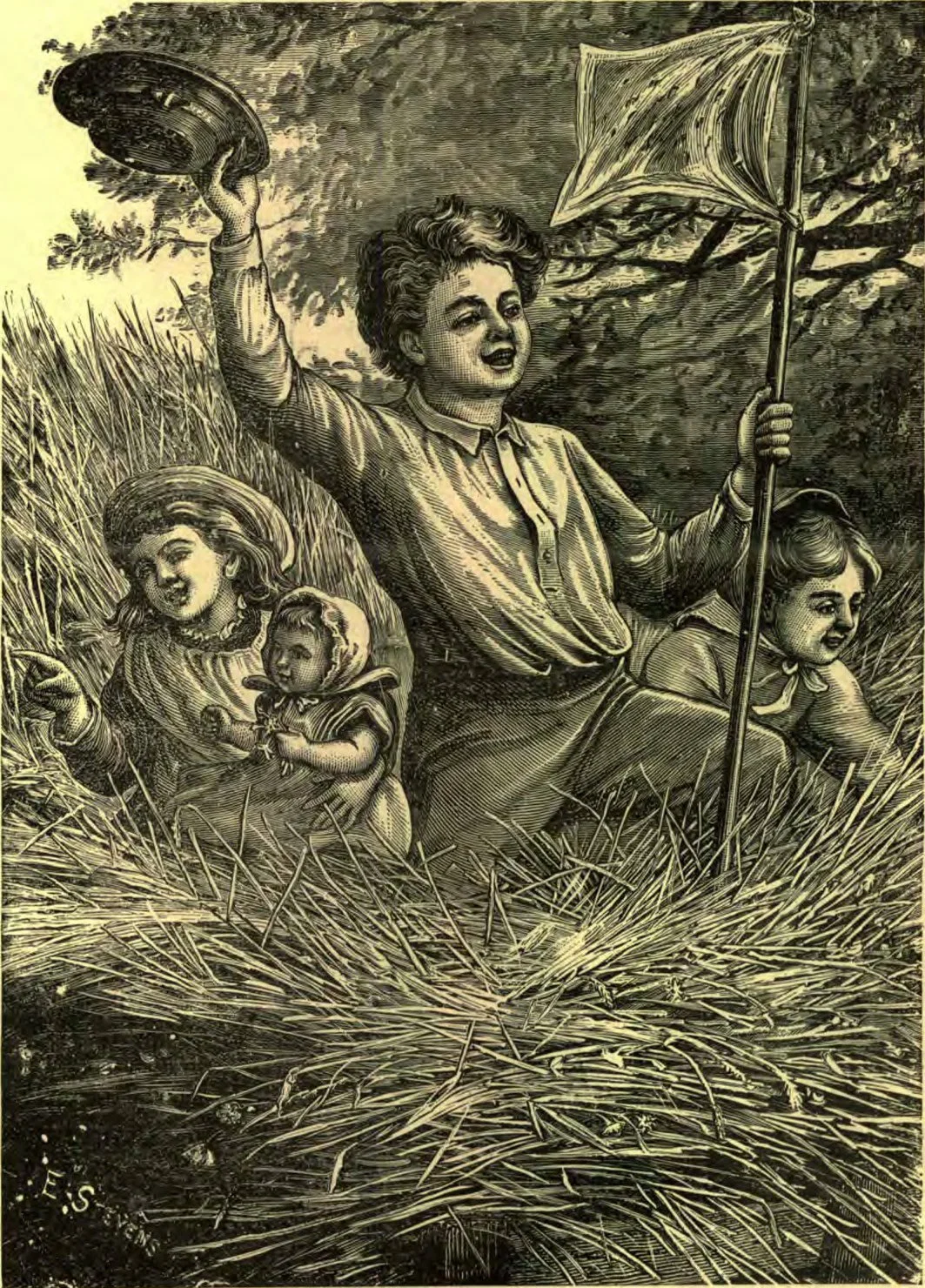
“Let’s go tell Ted about the pitch lake,” said Ruby, catching sight of a playmate standing at the gate; and away ran the twins, waving their pitchy sticks.
The Fingers Say So
By John T. Roberts
Is the little girl good? How can we tell?
Just see what tiny fingers spell:
G-o-o-d, good.
That one is right; now the other hand.
It's as true as if it had all been planned:
G-i-r-l, girl.
The hands spell right; but what they do
Will make their story false or true:
Good girl.
— John T. Roberts.
Dick's Flower
THE teacher asked, one soft spring day,
When slowly drag the study hours,
And healthy children long for play,
“My dears, what are your favorite flowers?”
Said Marion, slowly, “I suppose
My favorite flower is the rose.”
“Mine is the lily,” answered Sue.
“I love,” said Bess, “the violet blue.”
“And I,” laughed Jim, “the hollyhock.”
But Dick replied, with roguish look,
Tossing aside his slate and book,
“Give me the four-o’clock.”
— S. S. Times.
A “Live” Map
HAVING the whooping-cough was bad enough — as if! — but having to say your lessons at home and whoop, too, and having to be certain sure somebody else was up to the head of your geography class —
“It’s very hard!” lamented Jeffy. “Very hard! I s’pose I shall stand it, but it hurts me to. And I was going to get the map prize, too.”
“What prize was that, Jeff?” Uncle Martin asked, looking over the top of his paper. Uncle Martin was just home from Alaska.
“The one the teacher was going to give for the best map of the United States. I was going to get it, but now —” Jeffy’s sigh was very breezy indeed.
“Were you quite sure of getting it, Jeff?”
“Pretty quite,” modestly. “You see, I’m the best drawist in our g’ography class — the teacher says so. I can make maps like anything!”
“Can’t Rebecca and Will-o’-Wisp, too?” Uncle Martin asked.
“M-m—oh—well, Becky can, some, but she isn’t a drawist, you know.”
Uncle Martin did not know.
“And Will-o’-Wisp?”
“Willy!” Jeff laughed till he whooped. You would know Uncle Martin had just got home from Alaska by that! Willy a drawist!
“I’ll tell you what I’ll do!” Uncle Martin cried, cheerily. “I’ll offer a map prize — for the very best map of — Alaska!”
“You’re the goodest uncle!” little Will-o’-Wisp piped.
“Two prizes — I’ll offer two. The first for the very best map, and the second for the one that tries hardest. Run off now and go to work!”
“There’s only three of us — somebody’s going to get left,” laughed Jeffy. But he knew it wouldn’t be — well, somebody that was the best drawist in the geography class. He felt sorry ahead for Becky or Will-o’-Wisp.
For almost an hour Jeffy worked. So did little Will-o’-Wisp. Becky was out in the yard, playing — lazybones! She couldn’t have spent more than twenty minutes over her geography and five over her paper and pencil. Then she had given a little, long sigh and gone away. Jeffy wasn’t sorry any more for Becky. If you wished to be a lazybones —
“Hi-hum, I’m tired!” groaned Jeffy, softly. “I wish Uncle Martin had just come home from the United — well from somewhere else besides Alaska. I hate Alaska! And anyway, I’m not going to work any longer when there isn’t a speck o’ need. It’s good enough. Becky’s given up, and Willy — h’m!” He glanced at toiling little Will-o’-Wisp, and smiled in his sleeve — the sleeve farthest away. “There’s no use working and working when you don’t need to. Of course I could make it better, but I’m tired, and what’s the use?” Jeffy yawned, and stretched his short arms out as long as possible. Then he put up his map, and went to reading stories.
Will-o’-Wisp worked on and on, breathing very hard indeed. His little freckly brown face grew quite red. It was such hard work, but he tried — how little Will-o’-Wisp did try!
Out in the sunny yard little Lazybones knelt on the bank of the brook half the afternoon — till her shoulders ached, and her knees, too.
At tea-time Uncle Martin said he was ready to “judge” maps. Jeffy brought out his promptly. Then Will-o’-Wisp got his.
“M-m-m!” Uncle Martin was non-committal. “Now, Rebecca?”
“Mine’s out-o’-doors,” shyly, and Becky led the way to it. Where do you think it was? Marked out on the ground on both sides of the brook! It was very carefully “drawn” indeed.
“The brook is the Yukon River,” explained Becky, quietly, “an’ those humps are the ’Laskan mountains — that one’s Mount Logan. That’s Cape Prince of Wales there.” She pointed out all the features of her Alaska with earnest little face. The map was neatly outlined with little stones. It had taken a good while to “draw” it, and a good deal of skill.
“An’—an’ there’s gold in the ground,” she added, softly. “Truly gold. I planted my two rings an’ my five-dollar gold piece. It wouldn’t be like Alaska without any gold, you know; I knew I could dig ’em up again.”
“Mine ’em,” corrected Jeffy. His eyes were big with wonder over the beautiful “live” map of Alaska. And he had thought it wasn’t worth while to spend very much time on his map!
“I award Miss Rebecca Plummer the first prize for the very best map,” the judge was saying, gravely. “And Will-o’-Wisp Plummer the second prize for trying hardest. The other contestant —”
“Don’t, Uncle Martin! I’m ’shamed of the other contester — honest, I am!” cried Jeffy. “I’m going to make him draw another map to-morrow, just to show you. It won’t be a prize map, but —”
“But it will be a good one — needn’t tell me!” interrupted Uncle Martin’s big, kind voice, which was full of sympathy. “I expect to give it ‘honorable mention,’ anyhow!” — Selected.
Black and White Figures
By J. Edgar Ross
If you will notice the threads in weaving, you will observe that each time one is used, it is brought toward you a distance equal to its own diameter, while it is carried forward twice that distance plus the diameter of the warp. Each thread of the woof, then, instead of running parallel with the base, follows a spiral line around it. Where threads of only one color are used, it will be quite impossible to follow it in the finished work; but if the woof is composed of black and white threads, the woven article will have stripes that run around it, like those on a stick of candy, except that the spiral curvature will not be so acute.
It is not advisable to use black and white threads alternately. Where an equal number of threads of each color are used, they should at least be placed in pairs, and on large work a more pleasing result will be obtained by putting from three to five threads in each stripe. It will not, however, be necessary to use an equal number of black and white threads. Of course a “hit-and-miss” pattern would not be very pleasing, but results that are both artistic and symmetrical may be obtained by varying the proportions of black and white as much as six or eight to one. A very pretty pattern for large work (large in diameter) is made by using eight threads of black hair, one of white, another black, and a second white one. This arrangement is repeated all around the base. Nine threads of black are used in this pattern to two of white; but if you want black stripes on a white ground, the proportion of black and white should be reversed.
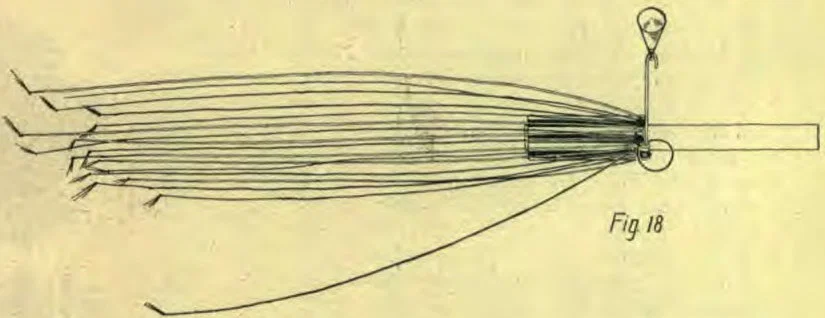
Fig 18
In any pattern that is made by repeating a variation of arrangement, the entire pattern must necessarily contain a number of threads that is divisible by the number contained in each repetition. In the pattern I have just given, for example, the number of threads in the woof must be divisible by eleven.
A woof that contains just the right number of threads can always spare a few without exposing the warp, or bear the addition of a few without overcrowding. It is best to err on the side of abundance; for if the warp is not well covered, it will leave a very noticeable defect. This is especially true where the warp and woof are of different colors. In weaving with black and white threads, it is well to use white warp. Then if the warp is left exposed on the white stripes, it will not be noticed except when the work is closely examined. If it shows on a black stripe, it may be dyed with black ink.
Spiral stripes are as easy to make as a solid color, and with a very little additional work the stripes can be made to run parallel with the base, or to zigzag back and forth. In either case the work is prepared in the usual manner, except where the stripes are to be straight; then one of them must contain one thread more than the others. Suppose that there are to be three threads in each stripe. Then one stripe in the pattern will require four. Begin the weaving by taking the second thread in that stripe, and passing it under the warp. There it is left to be used when needed. Skip the next thread altogether, and take the first regular stitch with the last thread in that stripe. Now finish one circle of stitches in the regular manner, ending with the first thread of the stripe where the work was begun; which, though it contains four threads, will have but two used in the regular manner. Next pass the thread that was skipped at first under the warp, and bring up the one that was put under at first. Neither of these threads is woven into the work; but they are used alternately to conceal the change from the regular to the forward stitch. Make the second circle of stitches by simply passing the threads of woof around the warp, as shown in Fig. 18, and drawing them taut. Weave each alternate circle with the regular and the forward stitch; but use the concealing threads (putting one under and the other over the warp) only when changing from the regular to the forward stitch. In making a zigzag the changes will be made so seldom that the extra thread will not be needed.
J. EDGAR ROSS.
(To be continued)
THE INTERMEDIATE LESSON
VI — The Tower of Babel
(August 9)
LESSON SCRIPTURE: Genesis II.
MEMORY VERSE: “Whosoever exalteth himself shall be abased.” Luke 14: 11.
(The chapter given as the Lesson Scripture is the lesson to be studied. Read this every day, and think over it until you know just what it teaches. Then the following notes, which should be read several times, will help to a fuller understanding of the lesson. Lastly, go over the questions carefully, and be sure that you can answer each in the words of Scripture.)
“And the whole earth was of one language, and of one speech” — the pure language of Eden that God himself gave to Adam. So all the people in the world were able to understand one another.
When God gave Adam and Eve a garden for their home, he showed that he wanted men to live among the beautiful scenes of nature, where they could see his works. But after the fall, they began to build cities to live in, and to take pride in the works of their own hands, instead of studying the works of God.
In planning to build a strong tower that would reach up to heaven, they thought they would find out what caused the flood, and have a safe refuge in case another one should sweep the earth. This was an act of defiance of God who had sent the flood, and it showed that they did not believe his promise that there should never be another. They also wanted to glorify themselves, and make their name known in the earth in all coming generations.
God saw that so long as men were all united, it would be much easier for them to carry out their evil intentions. So he said that he would “confound their language.”
Of course the people could not work together any longer, when they could not understand one another. Everything was confusion; so the tower was called “Babel,” a word meaning “confusion,” and the people left off to build the tower.
Then those who could understand one another went off together in little companies, and settled in different parts of the earth. This is how the different languages and the different nations of the earth had their beginning, and the pure language of the new earth was lost.
It was sin, pride of heart, and rebellion against God, that made it necessary for him to divide the children of men in this way. But God says that by and by, when all sin is wiped away, and Eden is restored, and all the people of earth do the will of God instead of their own will, then he will “turn to the people a pure language, that they may all call upon the name of the Lord, to serve him with one consent.” Then we shall all speak the language of Eden, and the whole earth will be “of one language and of one speech,” as it was in the beginning.
But there is still one language that may be heard and read and understood by every nation, and kindred, and tongue, and people,—the testimony of all creation to God’s power and divinity. The heavens declare the glory of God to the ends of the earth, and there is no speech nor language where their voice may not be heard telling of him who made them, to all who will listen.
The work of the Babel-builders in trying to build up a way from earth to heaven, was exactly the opposite to God’s plan. It is not possible for us to work ourselves up to heaven; but God has let down a way from heaven to earth, that all who will may mount up and dwell with him. Jesus said, “I am the Way.” Through him alone we can come to God and be saved from death. Enoch found this Way, and by it passed into the heavens, and every one who seeks Jesus will find him; for he is not far from every one of us.
“Thou art the Way, by thee alone,
From sin and death we flee;
And he who would the Father seek,
Must seek him, Lord, by thee.”
Questions
1. How long was there only one language in the earth?
2. Where did God place man in the beginning? Gen. 2: 8. By placing him in a garden, what did God show?
3. Who built the first city? Gen. 4: 16, 17. What sort of man was Cain?
4. What do we see in cities instead of the works of God?
5. When men had begun to make bricks, what did they plan to build? Chap. 11: 4.
6. What were their reasons for building this tower?
7. How did God stop the work? Verse 7.
8. By confounding men’s language, what did God do? Verse 8.
9. Will the earth ever again be of one language? Zeph. 3: 9.
10. Is there now any language that can be understood by all nations? Ps. 19: 1–4.
11. How high did the Babel-builders expect to climb? Verse 4.
12. Can we work ourselves up to heaven? Is there then no way for us to get there? John 14: 3.
MEMORY VERSE: “As for these four children, God gave them knowledge and skill in all learning and wisdom.”
Questions
1. What did God give the four children who were faithful to his requirements?
2. What special understanding did he give to Daniel?
3. Who, then, had a special care for their education while in the king’s court?
4. At the end of their course of study, before whom were they brought?
5. Who else came before the king at this time?
6. When these youth were brought in, what did Nebuchadnezzar do?
7. With what honors did Daniel and his companions pass their examination?
8. What position was assigned them?
9. How thoroughly did Nebuchadnezzar test Daniel and his companions in practical work?
10. How did they rank with the best educated men in his kingdom?
11. How long did Daniel stay in the province of Babylon?
12. Read Eze. 28: 3. What does it show concerning Daniel’s wisdom that he should be chosen as one with whom Satan is compared?
13. Was Daniel wiser than the king of Babylon or not?
14. At the time of the examination before the king, how far only could Nebuchadnezzar test Daniel’s wisdom? See note 2.
15. How old was Daniel at this time? (Compare his length of time in Nebuchadnezzar’s court with his age when taken captive.)
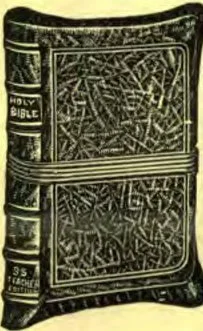
THE INSTRUCTOR PREMIUM BIBLE.
A Self-Pronouncing Teachers’ Reference Bible, containing the celebrated Teachers’ Helps, and comprising nearly 400 pages. Also a complete series of 15 new maps.
This beautiful book is bound in Imperial Seal Binding, Tuck Edges, known as
“Divinity Circuit,” Rounded Corners, Full Red under Gilt Edges.
We offer this Bible, postpaid, for only six new yearly subscriptions at 75 cents; or twelve new six-months’ subscriptions at 40 cents.
We will also send it, postpaid, with the INSTRUCTOR one year for $2.25. For 20 cents extra we will stamp your name in gold upon the cover. Address—
THE YOUTH’S INSTRUCTOR,
BATTLE CREEK, - - - MICHIGAN.
Henry Drummond on the Need for Kindness
By Henry Drummond
I WONDER why it is that we are not all kinder than we are. How much the world needs it! How easily it is done! How instantaneously it acts! How infallibly it is remembered! How superabundantly it pays itself back!—Henry Drummond.
Erratum: Misattributed Poem in the Instructor
Erratum
By error the little poem on page 229 of the INSTRUCTOR, written by Fanny Crosby, is wrongly credited.
Keep at Work
Do not stop work to become an expert stenographer. We successfully teach by correspondence the Graham System of Shorthand by a new method, which enables the stenographer more quickly to attain practical speed than by any former method. Easy to learn, easy to retain. Highly recommended by oldest official court reporters. Complete course for beginners. Special course for advanced writers who desire to become expert. Write to-day for full particulars to the—
FIRESIDE CORRESPONDENCE SCHOOL,
Battle Creek, Mich.
SOLID THROUGH TRAINS OF
WIDE VESTIBULE COACHES and PULLMAN SLEEPING CARS BETWEEN
Battle Creek and Chicago, Buffalo, New York, Philadelphia, Toronto, Montreal, Boston
For time-tables, descriptive matter, and information, apply to any representative of the company.
How Big Is a Bushel?
By Albert B. Carner
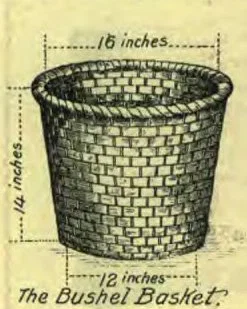
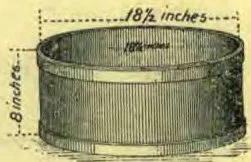
LET us answer the question at once. The United States standard must contain 2150.42 cubic inches. This is its exact shape (see lower illustration), drawn to the scale of one-eighth. The measures given are, of course, inside measures, and capacity is accurate down to the size of a peppermint. Or, if you prefer a basket, let it be of this shape and these dimensions, which will be a trifle large, to the extent, perhaps, of a piece of lump sugar; but we will throw that in.
The Bushel Basket.
The cut first given, the United States standard, is known as the Winchester bushel, and dates away back to Anglo-Saxon times. Winchester, within seventy miles of London, was not only the place for the crowning of English kings, but also for the crowding of English traders, and wise King Henry the Seventh quieted their market clamor, and laid down the law that the standard for corn, wheat, etc., should be the Winchester bushel of 2150.42 cubic inches. According to Dr. Brooks, this original bushel is still preserved in the Winchester museum, along with the same king’s original yard. The English colonists naturally used the measures of the mother country, the Winchester with the rest; so that when we became independent, it still prevailed with us.
The Winchester Bushel
In 1826 Great Britain changed her standards, and took a larger measure (2218.192 cubic inches), which she called the imperial bushel. We did not follow her, and thereby doubtless added mightily to the confusion, especially where we encountered her in the custom-houses. On the contrary, in 1830, our government reaffirmed its choice of the Winchester bushel and all the rest, and by way of soothing the feelings of the distracted officials, Uncle Sam sent to all the State governors, and to the custom-houses, beautiful complete sets of the standard weights and measures as then adopted. In 1881 he was even more generous; for he supplied them to all the State agricultural colleges that had grants of land, at a cost of two hundred dollars a set. That may seem a large price to pay for a lot of yardsticks and market and grocers’ measures, but the committee did not think so; for they claimed to have done the best they could “under the limitation of cost imposed.”
But standards can not always secure immediate uniformity. There is still diversity in this great country of ours as to bushels. For example, the good sixty bushels of potatoes which a farmer might send from Pennsylvania over into Ohio would count for only fifty-six bushels there. In 1878, according to a report sent to Congress, the bushel had one hundred and thirty different sizes in this country, and none of them were the same as the bushel of England, our largest trader. Vermont has a law, which was in force as late as 1896, at least, “that one bushel and three quarters of a peck shall be deemed a bushel.”
Taking the bushel as a type of capacity measures, another unit comes into question. What is the size of a gallon? The United States has its own very definite notions here, too, and says that a gallon shall contain just two hundred and thirty-one cubic inches. Now we see why we have two sorts of quarts and two sorts of pints. A quart of beans or peas or of any other “dry” thing is, or should be, the 1-32 of a bushel—some 67.2 cubic inches; but a quart of milk or kerosene or any other liquid, agreeable or otherwise, should be one quarter of a gallon, or 57.75 cubic inches,—not quite so large, you see.
The government has now two highly exact systems of weights and measures, and runs them side by side. For it has not only supplied itself and all the States with complete sets of the English, or “customary,” standards; but also, as we have seen, it has taken immeasurable pains to secure for itself and for its immense family, sets of the French, or “metric,” system, all of them instruments of precision as fine and accurate as it is possible for modern wisdom and skill to construct. Furthermore, it publishes for the use of its officers in custom-houses, the navy, the army, the post-office, and all other places where measurement is needed, tables giving the equivalents of each system in terms of the other, so that kilograms can be put into pounds, or liters into bushels, etc., at a glance.
Let the boys and girls take heart; for the good time is coming when there will be no need to burden the wits with pounds, ounces, scruples, troy, avoirdupois, furlongs, quarts, bushels, and all the rest of it; but the metric system will make everything easy, and will save the time and nerves of all of us for something better.—Prof. Albert B. Carner, in Well Spring.
An Interesting Pastime
A new “pastime,” which has at least the virtue of being a sort of “brain exercise,” is described in the Young People’s Weekly. It consists in making the numbers from one to one hundred by employing in every case four times the figure four. Any arithmetical or algebraic signs may be used, but never less nor more than the four fours. Thus:—
So far it is simple, but the art consists in employing the different formulae to get the higher numbers. The writer got all up to twenty-eight, and about half the rest up to one hundred.