AMONG the learned men who came to America in the eighteenth century was George Berkeley, afterward bishop of Cloyne, Ireland. He went to Newport, Rhode Island, to found a university, afterward giving his American estate and several hundred volumes of his library to Yale College. It was while interested in America that he wrote his poem containing the oft-quoted stanza:
"Westward the course of empire takes its way,
The first four acts already past;
The fifth shall close the drama with the day;
Time's noblest offspring is the last."
The stanza has been quoted as prophetic. As a matter of fact, it is founded on Bible prophecy. The first four acts of the great world drama are the history and life of the empires of Babylon, Medo-Persia, Grecia, and Rome. Three of these, as world powers, had, for almost two millenniums, passed away. Rome has been for centuries in a divided state. But, when Bishop Berkeley wrote his poem, a new star had risen in the horizon. A new world was opening before the nations. A new flag was about to be unfurled to the breezes of heaven.
All this God had foretold in prophecy. The great Church-and-State system of government, which, in different forms, has cursed and will curse the world, from Nimrod, the founder of Babylon, to the second coming of Christ, earth's lawful King, is represented in Revelation 13 by a composite beast with seven heads and ten horns. It includes in its symbolism the great persecutors of the church for conscience' sake in the great sad history of earth's past, and this in a two-fold sense, in both body and successive heads.
It possesses the mouth of a lion (Babylon, Dan. 7:4; Jer. 4:7, 13), the feet of a bear (Medo-Persia, Dan. 7:5), the body of a leopard (Grecia, Dan. 7:6), and ten horns of Rome (Dan. 7:7), and it is inspired and upheld by the dragon (the devil, Rev. 12:9). The heads represent the same powers, being successive (Rev. 17:9, 10), not contemporaneous, like the horns.
The animus comes from the seat of the mind, the head. The head controls the beast, and makes the beast what he is while the head exists.
The beginning of this persecuting régime, this great abnormal system, was Babylon, that power which has made all the kingdoms of the earth drunken. The first head is Babylon, represented as a lion in its civil aspect, as a gorgeously-arrayed harlot in its religious aspect. The second head is Medo-Persia, continuing the same Babylonian system in another form. The third is Grecia. The fourth is Pagan Rome thru which the dragon, Satan, wrought to destroy Christ. Rev. 12:4. The fifth, the head dominant during the "forty and two months" of Rev. 13:5 (see also Dan. 7:25; Rev. 11:3; 12:6, 14), is generally known by the designation of the Papacy.
A Symbol of the New World System.
Just at the time when the papal head is wounded to death (Rev. 13:3, 10), beginning7with the Reformation, and culminating in 1798, John sees another power, symbolized by a beast, rising up out of the earth, having two horns like a lamb, yet speaking like a dragon. Rev. 13:11.
Note that this beast must symbolize a power rising in prominence about 1798; it comes up, not out of the "sea" (denoting peoples, nations, Rev. 13:1; 17:1, 15), but out of the earth, a hitherto unoccupied region by the historic nations; its growth is rapid, its progress in coming up is visible; it has two horns like a lamb; it speaks as a dragon, and the latter part of the chapter is the development of this dragon spirit.
Two Horns Like a Lamb.
Note also that in this beast is combined two prominent apocalyptic symbols. (1) It has two horns like a lamb. In type and prophetic symbol a lamb stands for Jesus our Saviour. He is represented in Rev. 5:6 as "a Lamb having seven horns." A horn is an emblem of power, exaltation, strength. Seven would denote perfection in all things which would make the Lamb truly exalted and powerful. A beast with two horns like a lamb would denote a power professing to possess, holding in prominence, two Christian principles or characteristics, principles which, applied to civil government, would make that government characteristic, or distinguished from all other governments, even as they distinguished Christianity from all other religions. (2) A dragon is the symbol of Satan, operating thru earthly governments, inducing them to persecute the children of God. "The dragon . . . persecuted the woman." Rev. 12:13.
Here, then, are the prominent characteristics or specifications concerning the power symbolized by the two-horned beast:
1. It must be rising to prominence in the world's affairs about A.D. 1800.
2. Its rise would be rapid and marvelous.
3. It must arise, not among the great nations of history,—the sea,—but in hitherto ungoverned, undeveloped regions, "the earth."
4. It will possess as characteristics of strength and prominence, two principles, peculiar to Christianity alone among religions, and peculiar to itself alone among nations.
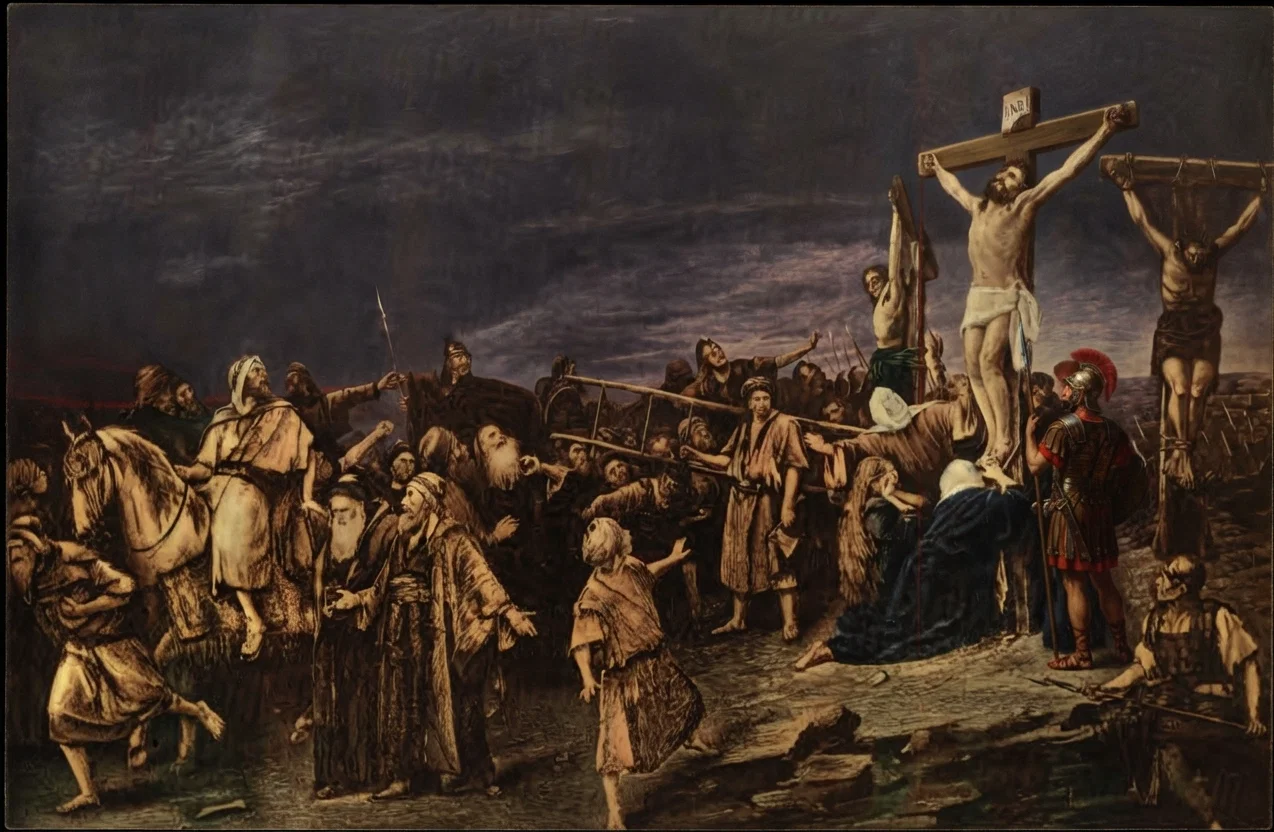
The Crucifixion of Jesus.
5. Nevertheless, it would speak as a dragon, or promulgate persecuting laws.
Search thru all the centuries and tomes of history, and but one power, one nation, one government, alone, of all earth's governments, can be found in which these specifications are fulfilled, and they are all fulfilled or fulfilling in that one.
That nation is our nation.
That government is these United States of America.
1. In 1798, when the papal beast went into captivity, this nation was just rising to power. July 4, 1776, its independence was declared. Then followed eight long, cruel, depleting years of war, not for conquest, but for liberty, for a principle. In 1789 its glorious Constitution was adopted. And at the time the prophetic vision applied, it was the one great young power in the world.
2. Its rise since its birth has been rapid and marvelous, a fact familiar to all observers and students and citizens.
3. It came not up in the Old World, the theater of the great drama enacted in its several parts by Babylon, Medo-Persia, Grecia, and Rome, but from a New World, a new continent, amid untrodden solitudes and virgin forests.
4. It possessed in its making two principles only dreamed of by the most sanguine statesmen who may have loved them in the past. In this nation they were crystallized into its charters of existence.
The first of these was the equality of man. This is preeminently the teaching of Christianity, but of no other religion which the world has ever known. It was Christ who said: "One is your Master, even Christ; and all ye are brethren." Matt. 23:8. It was Christ's apostle who said: "There is no respect of persons with God." "God that made the world and all things therein, hath made of one blood all nations of men for8to dwell on all the face of the earth." Rom. 2:11; Acts 17:24-26.
The second great principle vouchsafed to men by Christian ethics, so far as interference of man is concerned, is the right and privilege of every man to worship God, or not to worship, how or when he will, providing he does not interfere with the equal rights of his fellow men.
This principle may be termed religious liberty. The Gospel of Christ compels no one. It is not, "Thou shalt," or "Thou shalt not." Its language is, "Whosoever will" "let him come." Rev. 22:17. Listen to a chosen servant of the King of Heaven: "Now then we are ambassadors for Christ, as tho God did beseech you by us; we pray you in Christ's stead, be ye reconciled to God." "Knowing therefore the terror of the Lord, we persuade men." 2 Cor. 5:20, 11.
And Jesus Himself said: "If any man hear My words, and believe not, I judge him not; for I came not to judge the world, but to save the world." John 12:47.
And that resolute apostle who was once so ready to use carnal weapons, writes: "Dearly beloved, I beseech you as strangers and pilgrims, abstain from fleshly lusts." "Neither as being lords over God's heritage." 1 Peter 2:11; 5:3. "Not for that we have dominion [lordship] over your faith," says Paul, "but are helpers of your joy; for by faith ye stand." 2 Cor. 1:24. How different are the words of the apostles from the practises of those "lords spiritual" who now claim to be their direct successors! "If ye were Abraham's children, ye would do the works of Abraham." John 8:39.
Look over all the religions of the past—pagan or perverted Christian—and in not one do we find these two particulars. The curse of caste, the creation of offices and positions, a haughty, imperious, and ambitious hierarchy, religious dogmas enforced by royal edict or legislative enactment, one or all are present in all the religions of earth save that of Christ. They are present in all forms of perverted Christianity.
Both of these divine principles of equality and liberty are embodied in the charters of our freedom in this country, so far as they can be embodied in earthly government. In other words, the United States Government embodied the Christian idea of civil government, or, is in principle what a civil government ought to be. The first principle, equality of all men, is found in that document which sounded the birth-note of America's freedom, and which made Americans free men:
We hold these truths to be self-evident, that all men are created equal; that they are endowed by their Creator with certain unalienable rights; that among these are life, liberty, and the pursuit of happiness. That to secure these rights, governments are instituted among men, deriving their just powers from the consent of the governed.—Declaration of Independence.
The second principle—religious liberty—is embodied in this; but is guarded above question in the Constitution, the fundamental law of our government. The First Amendment reads:
Congress shall make no law respecting an establishment of religion, or prohibiting the free exercise thereof, or abridging the freedom of speech or of the press.
No other government of any note in the world holds these two principles. There are republics, like Switzerland and France, but they have their State religions, supported by many to whom they are intolerable burdens. The United States Government stands unique in this respect; and these principles have been the magnetic power which has drawn to our shores from the autocratic and intolerant, priest-ridden nations of the Old World the persecuted and oppressed millions. They found here the privilege, the right, to worship (or not to worship) God according to their own consciences and understanding of His will.
The identity of these Christian principles in this government, and the fulfilment of the divine prophecy, are well set forth by America's great historian, George Bancroft:
The Constitution establishes nothing that interferes with equality or individuality. It knows nothing of differences by descent, or opinions, or favored classes, or legalized religion, or the political power of property. It leaves the individual alongside the individual. . . . Vindicating the right of individuality even in religion, and in religion above all, the new nation dared to set the example of accepting in its relations to God the principle first divinely ordained in Judea.—"History of the Constitution of the United States," book 5, chapter 1.
More than this, the influence of this government has ameliorated the Old World conditions, so that dungeon and rack have slunk into night and obscurity, and the martyr's pyre is extinguished.
Later on, the shackels of slavery were broken from the feet of the slave, and the principle of liberty and equality again crystallized into fundamental law the following:
No State shall make or enforce any law which shall abridge the privileges or immunities of citizens of the United States; nor shall any State deprive any person of life, liberty, or property, without due process of law, nor deny to any person within its jurisdiction the equal protection of the laws.—Fourteenth Amendment, Sec. 1.
Grand and noble sentiments and principles! Would God they might continue in the government and nation forever. They made the best civil government upon which the sun ever shone; and, if held in the hearts of the people, would continue such a government.
But alas, the beast with the lamblike horns speaks with a dragon voice; it becomes a persecutor. It makes an image to the ten-horned beast; that is, it unites Church and State. It enforces the mark of the beast, the sign-manual of Church and State power, the Sunday-enforced-by-law. So declares the prophecy. So demand the devotees of Sunday. It enforces, under penalties of legal boycott and even under death, the image and the mark.
Is this possible?—Nay, it is probable. Note in proof of it the departure of this country from her basic principles as manifest in public life. What means the religious legislation of the last few years, and the demand for more? What mean the many court-made laws? and prosecutions for conscience' sake?
God forewarned us of these things eighteen centuries ago. Who will heed this warning? Who will place his affections upon the heavenly land, whose inhabitants know no blight, no sorrow, no death; but glorious life forevermore?
TRUE FREEDOM.
By James Russell Lowell
Is true freedom but to break
Fetters for our own dear sake,
And, with leathern hearts, forget
That we owe mankind a debt?
No! true freedom is to share
All the chains our brothers wear,
And, with heart and hand, to be
Earnest to make others free.
They are slaves who dare not speak
For the fallen and the weak;
They are slaves who will not choose
Hatred, scoffing, and abuse,
Rather than in silence shrink
From the truth they needs must think;
They are slaves who dare not be
In the right with two or three.
—James Russell Lowell.
Persecution Under Government’s Law
Among all the religious persecutions with which almost every page of modern history is stained, no victim ever suffered but for the violation of what government denominated the law of God.—United States Senate Report, 1829.
THE MAN, THE PERSON, THE INDIVIDUAL.
By Editor
(Reprinted from 1905.)
THE most priceless thing in all this world is character in humanity—righteous, noble, free character. In order that such character may be developed, there must be free choice. No enforced righteousness is true righteousness. No enforced semblance of gentility, no inherited nor conferred titles of honor, can make a man truly noble. Only as the soul is untrammeled in its rights and free in its choice, and so chooses the best, can the highest character be developed.
This choice and development demand equal rights. This thought is well expressed in that noble utterance of the Declaration of Independence: "We hold these truths to be self-evident: That all men are created equal, that they are endowed by their Creator with certain unalienable rights, that among these are life, liberty, and the pursuit of happiness; and that to secure these rights, governments are instituted among men." The "equality" does not consist in physical, mental, or moral qualities or capacities, but in the absolute freedom of choice, in the equal exercise of the same rights.9The right to life, the right to liberty, the right to seek happiness, so as not to interfere with the equal rights of his fellows, belong to every man; he may not voluntarily surrender them and become a slave. No government can of right deprive him of them. They belong to him as a man, a person, an individual.
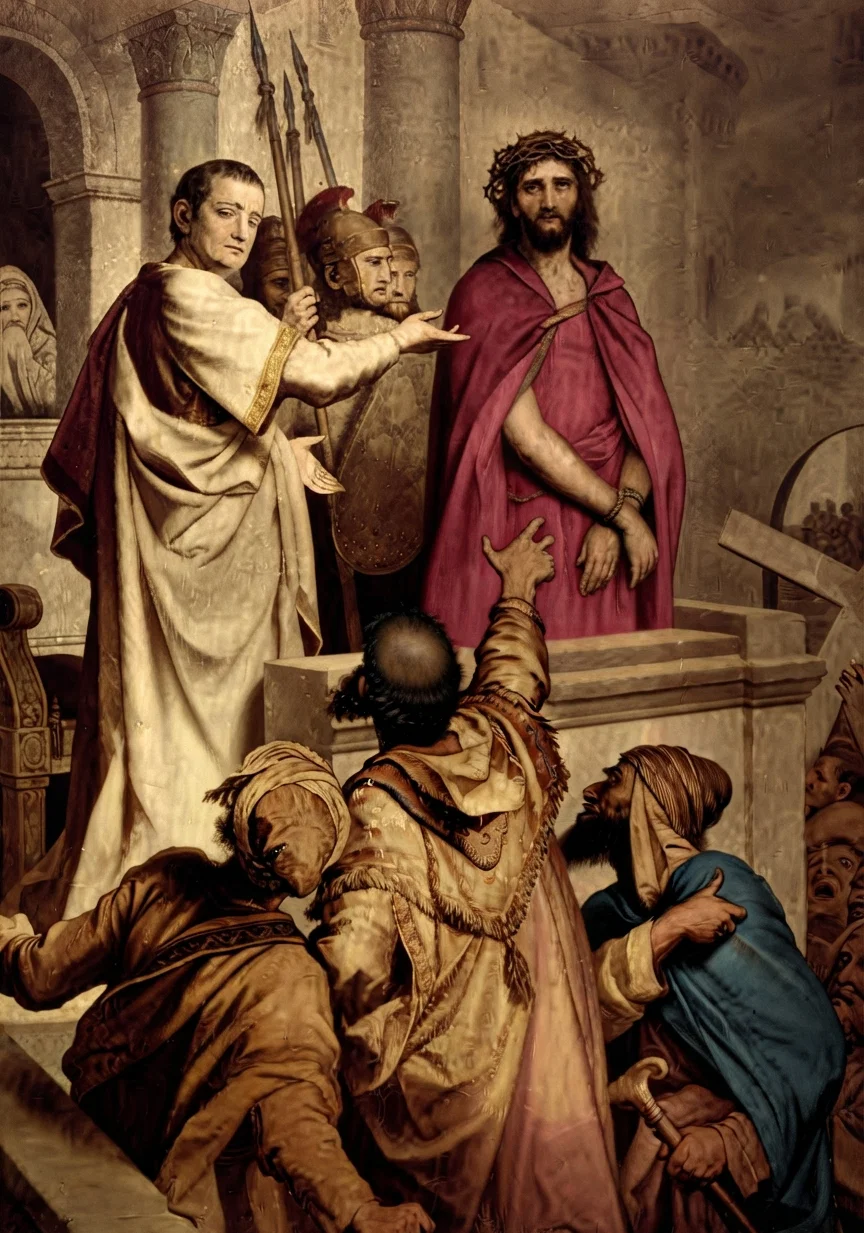
Hofmann.
For the advocacy of these rights the SIGNS OF THE TIMES stands. And for these rights as pertaining not to the German individual, the French, the Italian, the Russian, or the Anglo-Saxon individual, but the individual of every nation and people and tongue and tribe. And for this equality Christianity stands, stands preeminent, unique, alone, among all the religions of earth. Listen to the words of its Chief: “Be ye not called Rabbi; for One is your Teacher, and all ye are brethren. . . . Neither be ye called masters; for One is your Master, even the Christ.” Matt. 23:8-10. And listen to this from the chiefest of the apostles: “The God that made the world . . . hath made of one blood all nations of men to dwell on all the face of the earth.” Acts 17:24-26. Before God all have equal rights.
Among the things which many men find essential to their happiness is religion. But as regards this, the preferences of mankind are many. Yet each one has the unalienable right to choose his own religion or reject all. And this is the teaching of the Master: “If any man hear My words, and believe not, I judge him not, for I came not to judge the world, but to save the world.” John 12:47. There is where Jesus Christ stood; there is where His followers ought to stand. By no compulsion or coercion can a man be a true follower of a worthy religion. If there is not that in the religion itself which by its merits, its beauties, its qualities, its inherent worth, compel his choice, he has the right to reject it. And every follower of Christ ought to stand for the same thing; the right of the individual, whoever he be, to choose his own religion.
Therefore the SIGNS OF THE TIMES as a Christian journal stands not for the rights of the Protestant man, the Roman Catholic man, the Jew or the Gentile man, the Christian or infidel man, but for the rights, the equal rights of the man, whatsoever religion he espouses, or whether he holds to none. The right of the infidel to choose is as sacred as that of the Christian, and none should be so free, so anxious to concede those rights as the Christian. The government, therefore, which regards the rights of its subjects will not exalt the institution, religious or social, above the man, but the man above the institution. The institution may be honored if men will, but its observance will never be compulsory.
All the Catholics in a community may with bared and bowed heads “adore the Host,” as it is carried by in solemn procession; but no Protestant is to be forced to bow his head or even to remove his hat. All the Protestants of the community may with reverent air remove the hat and bow the head when the solemn rite of baptism is performed at some beautiful lakeside; but no Catholic should be compelled to show reverence. No one may encroach upon the equal rights of any, but as none can compel him to be religious, none are to compel him to act religiously.
A true government will not subject the individual to the arbitrary demands of the multitude. Man surrenders no inalienable right to society or government. If the government be a true government, it conserves the right to guard the rights of each one and each one in his rights. When, therefore, each one is protected in his rights, all are protected in their rights. And as long as each individual is protected in his rights, so long can no class suffer from the infringement of their rights. The thing to be exalted, therefore, in a just and permanent government, by true citizens, by Christians, is the inalienable rights—common to all men—of the individual man, whether he be pagan or Jew, infidel or believer, Catholic or Protestant; for in this only are the rights of all conserved. This is equity, justice, and Christianity.
LIBERTY VERSUS TYRANNY.
By George A. Snyder
LIBERTY! O, ancient hero
Of the world-wide battle-field!
On thy head shines Hope's bright helmet,
In thy hand Faith's ample shield.
On thy brow I see imprinted
Many deep and lasting scars,
Made thru Time's succeeding ages,
In thy foes' unholy wars.
Tyranny, thy pale oppressor,
Tho of later birth than thou,
Ever watches thee for evil
With a frown upon his brow.
Strong art thou with constant struggling
'Gainst thy unrelenting foe,
Who with subtlety hath ever
Compassed thee with pain and wo.
Thou must keep eternal vigil
To escape the oppressor's ire,
As he hurls at thee his javelins
Forged in Envy's raging fire.
Thou must often be derided,
While a cruel crown of thorns,
Shaped by Tyranny's devising,
Thy pale, bleeding brow adorns.
But the day is fast approaching
When thy wounded form shall rise
Over Tyranny triumphant,
And be carried to the skies.
Then shalt thou thru times eternal
From all strife at last be free.
Gladly will we share thy struggles
In this path to victory.
GEO. A. SNYDER.
Legal Enactment and Moral Suasion
Where legal enactment begins, moral suasion ends.—Christian Union.
WHOSE IS THE IMAGE AND SUPERSCRIPTION?
THIS is the test of authorship. There is a letter or a note. Whose is it? And the answer to the question is determined by the signature, the stamp, the superscription. By this principle Jesus Christ settled a great question and escaped a subtle snare laid to entrap Him and nullify His work.
Master, said the shrewd ensnarers, Is it lawful for us Jews, God's children, sons of10Abraham, to give tribute to the despised Gentile, Cæsar? Shall we, the chosen people, yield to this? If Jesus should reply, "No, we should give no tribute to Cæsar," His questioners would have accused Him before the Roman court of fostering sedition and rebellion. If Jesus said, "Yes, pay tribute," they would accuse Him of being opposed to the dearest hopes of His nation, and so cut off His influence with His people. How wisely He replied: "Show Me the tribute money [the Roman denarius, or penny]. Whose image and superscription hath it?"
They answered and said, Cæsar's.
And He said, "Render therefore unto Cæsar the things which be Cæsar's, and unto God the things which be God's."
How all Church and State questions would clarify in the light of this principle! Take the Sabbath question, for instance: Is it a proper subject for legislation? "Whose image and superscription hath it?" The answer can only truthfully be, God's. He gave the Sabbath. It bears His stamp. It came from Him. "It is holy unto the Lord." Render it to Him; it belongs not to Cæsar.
Separation of Church and State
By Ulysses S. Grant
"Leave the matter of religion to the family altar, the church, and the private school, supported entirely by private contribution. Keep the State and the Church forever separate."
EQUALITY OF RIGHTS.
No man acquires any additional rights as a man by joining any society, association, or organization. The true civil government has no right to recognize any segregation or association of this kind.
John Smith is a man and a citizen. As a man and citizen under any just government he has equal rights with every other man and citizen. He may join the Methodist Church or the Catholic Church, or any other religious denomination; but his church affiliations have given him no added right of recognition by the government; they have bestowed upon him no rights to which his fellow citizens outside of all church folds are not entitled. He may combine his business with the coal trust, beef trust, or any other trust; he is entitled to no consideration from the government because of this. He may join every labor union in America, every lodge,—social, beneficiary, or otherwise—any political party; but these add not one iota to his rights as a citizen and as a man. The right to life, liberty, and the pursuit of happiness is still his equally, and only so, with all other citizens.
He may feel that his labor union is working for the uplifting of the laboring men, and that opposition to it is against the good of the laboring men, but his fellow citizens have the equal right to think and labor to the contrary. Whatever may be his belief—even tho it be wholly right—he has no right to impose it upon others without their free and full consent in profession and practise. And the converse of all this is true. The demonstration of these theories must be left to time, and their acceptance to the free will of the convinced citizen.
The right to believe and practise, or not to believe, the right to buy and sell, to labor for what and for whom and when one will, vests in every citizen equally. So long as he does not contravene the equal rights of his neighbor he is free to believe, or not to believe, to teach, to practise, but not to compel.
Trades-unionists assume that he who opposes labor unions, or he who maintains an absolutely neutral position, are foes to labor and mankind. Let them hold it as a theory if they will, but they have no right to seek to enforce their theory upon others.
Other men may believe, and some doubtless do believe, that unionism as at present exploited is the most evil thing for the laboring men that ever found standing among them. They have the right to believe this and teach it as they will, but no right even to seek to enforce it upon others.
The devout, consistent Roman Catholic believes that all hope of salvation lies within the fold of the Roman Catholic Church, and that to reject that church is to abandon all hope. Some have believed this so consistently, supremely and unwisely that they have sought to compel acquiescence in others; and the result has been untold persecution. The Roman Catholics have the right to believe as they do, even tho their belief be wrong, but they have no right to enforce their belief, or to seek to enforce it upon others, be the others Protestant or heathen. The same is equally true of any religionist, or no religionist.
These propositions seem so self-evident that their mere statement is superfluous, and yet almost everywhere are they ignored—by Capital and Labor, in Church and Society. And yet they are vital. On the maintenance of them in their integrity rests the stability and perpetuation of the republic. Their destruction in the hearts of men, and their consequent elimination in public life presages the utter ruin of this government, this nation, this world. And thus has the "more sure word of prophecy" spoken. When things, institutions, mere materials, or the schemes, plans, or theories of men, are counted superior to men, wo betide. God has ordained civil government to protect men from men who can not control themselves. God has placed His church here to save thru Christ Jesus men who can not save themselves. But when the governments of earth refuse to do the one and the church rejects the other, both State and Church must be set aside, and Christ must come to render justice and judgment; and upon those who have ignored or rejected His way will fall the destruction they have invited; they will reap the fruit of their own sowing. But those who trust in Him shall be saved.
SOME OBSERVATIONS ON THE STATE AND THE INDIVIDUAL.
The Object of the State.
THE State exists because of sin. It is necessary to restrain men who can not control themselves. It is set above all things to guard the rights, not of the mighty or of the majority; for even in feudalism and barbarism such can care for themselves. But the State—the ideal State—exists for the purpose of conserving and defending the individual, even the weakest, in his equal rights with all others. Jean Richter has truly said: "Individuality is everywhere to be guarded and honored as the root of all good."
A Wrong Conception.
"The greatest good of the greatest number" is often used by good men in an utterly meaningless or pernicious way. It is an end sought, an object aimed at; and in this way it is wholly selfish. There has not been an oppressive system under the sun but what its devotees hoped sometime to have the greatest number, and for their own they have sought the greatest good.
The only true seeking in the State is the jealous guarding of the rights of the minority, of the poorest, of the weakest. The conservation of the rights of the one means the conservation of the rights of all, and its inevitable fruitage—result, outworking—is the greatest good to the greatest number.
He only knows true liberty, he only works for the permanent conservation of his own liberties, who grants to the other man—be he his most bitter and relentless religious or political opposer—the rights he asks for himself.
True civil government is not set to bestow these rights, to uphold or promote certain systems or doctrines apart from men, but to protect man in the rights which his Maker has given him. This is the very fundamental principle on which the Declaration of Independence is based:
"We hold these truths to be self-evident, that all men are created equal; that they are endowed by their Creator with certain unalienable rights; that among these are life, liberty, and the pursuit of happiness; that to secure these rights, governments are instituted among men, deriving their just powers from the consent of the governed; that when any form of government becomes destructive of these ends, it is the right of the people to alter or to abolish it, and to institute new government, laying its foundation on such principles and organizing its powers in such form, as to them shall seem most likely to effect their safety and happiness."
The great object of the founders of this Government was the protection of each person in his rights, which God gave to every one equally. In so protecting the individual, incivility and violence on the part of those who disregard others' rights are restrained; and the result is the greatest good to the greatest number.
Happy Results.
Under such a government there can be no legal oppression of the poor, no overriding of the rights of the few or the weak, no class legislation, no State fetish of a system or an organization upheld in any way by government support or promoted in any way11by government act, no religious legislation, or the State-fostering of religious institutions, and hence the elevation of the class who honor the institutions. "Man is more than constitutions," and we may add, than institutions; and if constitution or institution fetter or hinder the exercise of the God-given rights of the man, let the institution die and the man live.
"Man is more than constitutions;
Better rot beneath the sod
Than be true to Church and State,
While we're doubly false to God.
"We owe allegiance to the State,
But deeper, truer, more
To the sympathies that God has set
Within our spirit's core.
"Our country claims our fealty,
We grant it so, but then,
Before man made us citizens,
Great Nature made us men."
Thus wrote the grand American, James Russell Lowell, and such sentiment needs to thrill hearts again to-day to meet the fearful trend and tide which is sweeping the individual from all his rights and subjecting him to the worst forms of tyranny the world has ever known.
HEROES WANTED.
By J. G. Holland
THE age wants heroes—heroes who shall dare
To struggle in the solid ranks of truth;
To clutch the monster error by the throat;
To bear opinion to a loftier seat;
To blot the era of oppression out,
And lead a universal freedom in.
—J. G. Holland.
Religious Violence and Persecution
By Thomas Clarke
There are many who do not seem to be sensible that all violence in religion is irreligious, and that, whoever is wrong, the persecutor can not be right.—Thomas Clarke.
A FAITHFUL WARNING.
By Editor
It would naturally seem in the light of what God has said in His word—"Surely the Lord God will do nothing, but He revealeth His secret unto His servants the prophets," and that the "more sure word of prophecy" is "a light that shineth in a dark place, until the day dawn"—that He would give faithful warning to the world concerning the evils of this Church-and-State movement which is now sweeping over all the earth, threatening the liberties of all; and He has done this, in Rev. 14: 6-14. The first part of that message brings to us the everlasting Gospel, inviting men to fear God and give Him glory and serve Him; the second, that "Babylon," by which is meant all the various human institutions which would substitute their own ways of salvation for that of God's, is fallen; and the third is a warning to all souls everywhere not to worship the beast or his image, or receive its mark.
The beast power is symbolical in the word of God of Church-and-State government, whether Catholic or Protestant. For ages this has ravaged and cursed the world until the rising star of the great Republic of the West and the influence of a free and unfettered Christianity swept back the darkness and enlightened the world. But failing to appreciate the liberty,—God-given,—men are turning back to the old order of things, are making an image to the beast power, in the very nation which led the world from its darkness, and are demanding its worship and the reception of its mark.
Note also that God does not give this last warning for the salvation of His people. Nor is this issue of this paper published in the interests of those who will be persecuted. They have their rights, and those rights are worth pleading for; but the worst sufferers after all, those upon whom utter ruin will at last come, are those that will give themselves to this order of things, and mold their characters after the persecuting elements which are involved in it. Honest-hearted men who may differ from the law will suffer, but if they suffer for God they need not be ashamed; even so suffered their Master. Beyond the suffering, if faithful, lies eternal triumph; but those who cause the suffering enslave themselves. That we may at least lift a kindly warning voice to save them from this, this paper is published. But we entreat all who wish to know what God has to say in regard to all phases of the question to study His great threefold message in all its fulness of meaning.