The Youth’s Instructor, Vol. 31, No. 19.

THE PYRAMIDS

The Youth’s Instructor

May 9, 1883

S. D. A. Publishing Association · Battle Creek, Mich. · May 9, 1883

THE PYRAMIDS.

Here were at one time over seventy pyramids in the valley of the Nile; but many of these are entirely destroyed, and others partly torn down. The largest and most noted of them are on the western bank of the Nile, opposite the old city of Cairo, and about eight miles from it. These stand a short distance back from the river, and tower grandly above the level plain.
It seems to be true that, as one traveler remarks, “the grandest architectural achievements of man are usually found in level countries, where they can display their vastness and majesty without fear of rivalry from the mightier works of God.”
The approach to the pyramids, by one traveling westward from Cairo and the banks of the Nile, is at first a rich green plain, and then the desert. They are at the beginning of the desert, on a ridge that lifts them above the valley of the Nile. Dean Stanley says: “It is impossible not to feel a thrill as one finds one’s self drawing nearer to the greatest and most ancient monuments in the world, to see them coming out stone by stone into view, and the dark head of the Sphinx peering over the lower sand-hills. Yet the usual accounts are correct, which represent this nearer sight as not impressive; their size diminishes, and the clearness with which you see their several stones strips them of their awful and mysterious character. It is not till you are close under the Great Pyramid, and look up at the huge blocks rising above you into the sky, that the consciousness is forced upon you that this is the nearest approach to a mountain that the art of man has produced.”
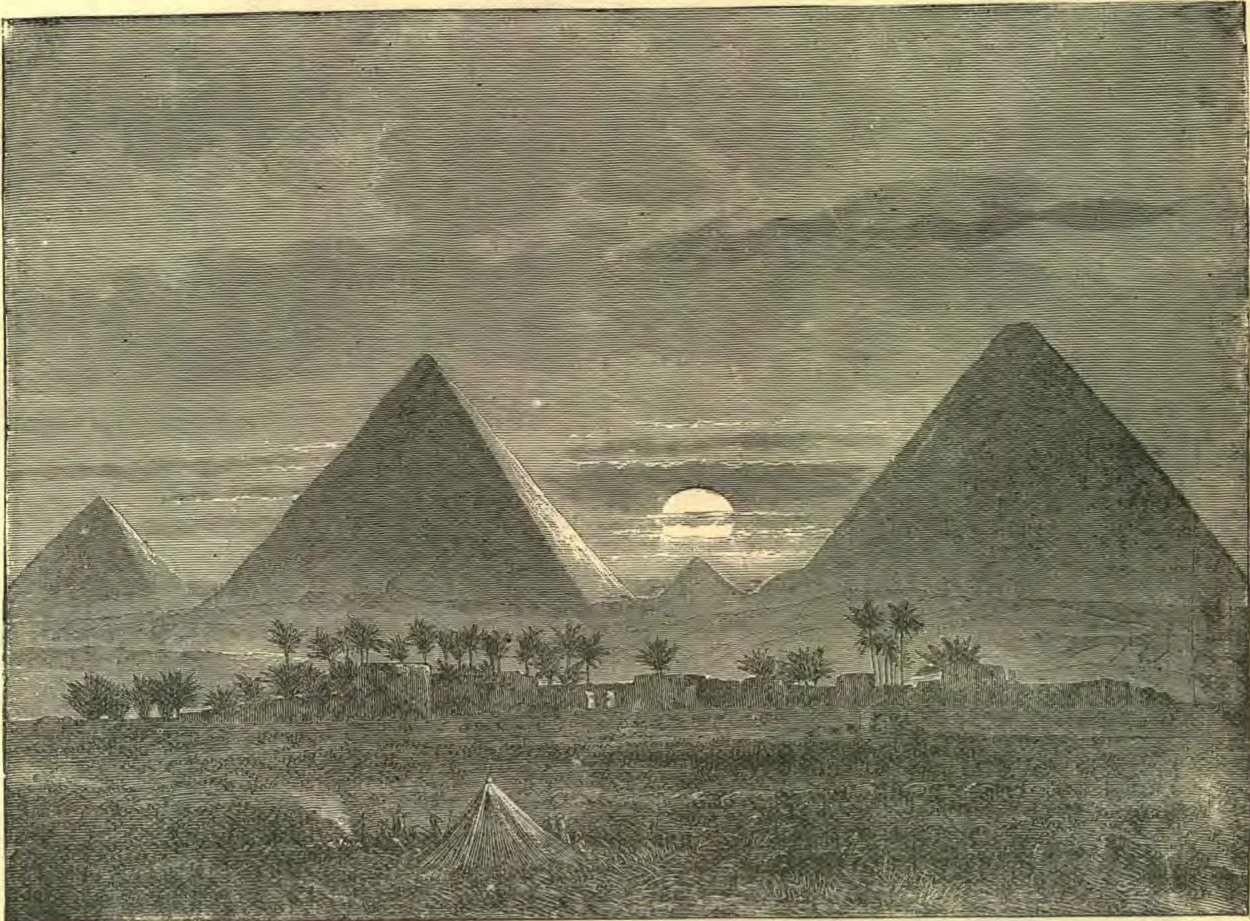
In the picture is a good representation of the three largest ones near Cairo. They stand perfectly square, with the sides facing the cardinal points, and the entrance is toward the north. Judging from the accuracy with which these monuments are placed, the ancient Egyptians must have had some knowledge of astronomy. These were in all probability built by the earliest Egyptian kings. The largest of them is known as Cheops, the second as Chephren, and the third, which is made of choicer materials than the others, as Mycerinus; and from inscriptions found on them, it is thought that these pyramids were built by the kings whose names they bear.
The Sphinx is a large idol built close by the Great Pyramid. It has the head of a man, with the body and paws of a lion. It is cut out of solid rock. The face is mutilated, and the nose gone. It was worshiped as a god, and between its paws was an altar for offerings.
The pyramids are all constructed on the same plan, and so a description of the largest will answer for them all. It covers nearly thirteen acres, and stands on a base of native rock, which raises it above the inundation of the Nile. It is built of layers of huge rocks, rising one above another in the form of steps. The stones of the Great Pyramid vary from four and one-half feet to two feet in thickness, with a breadth of six and one-half feet. The steps were filled with blocks of stone, and the whole was covered with a smooth coating of casing-stones.
Inside the pyramid are three chambers,—one in the foundation rock; one farther up, in the masonry, known as the “Queen’s Chamber,” which is lined with polished stone; and another, near the center, called the “King’s Chamber,” lined with polished granite. In this chamber has been found a sarcophagus, or stone coffin.
It is said that the Great Pyramid was thirty years in building; the first ten years were taken up in constructing a causeway for bringing from the quarries in the southern part of Egypt the huge masses of rock used, and the remaining twenty years were taken up in building the vast monument. An ancient historian says that there were one hundred thousand men employed at the same time on the work, and at the end of three months their places were supplied by another gang. On these monuments are inscriptions telling of the amount of onions, radishes, and garlic doled out to these workingmen. They were compelled to work very hard, in bondage not less bitter than that of the Israelites.
Some of these monuments were built two or three thousand years before Christ. Perhaps Abraham passed them when he went down into Egypt in the time of famine; Joseph may have been familiar with them; and later still, Moses or the children of Israel may have beheld them daily; and their hard bondage in mortar and brick may have resulted in the erection of some of these monuments; for several of the smaller ones are built of brick, and covered with stone.
There are many conjectures as to the purposes for which these monuments were built. They were probably intended for the tombs of the royal families. In some of them have been found sarcophagi, or stone coffins, inside of which were placed the wooden coffins with the embalmed bodies of the dead. As soon as the king ascended his throne, he began to build his monument and his tomb. The work was carried on through his life, and at death his body was embalmed, and placed in the stone coffin in the chamber of the tomb. The pyramid was then topped off, and the narrow passage-way leading to the chamber closed. Why so much labor should be put upon one tomb may perhaps be accounted for from their religious belief. The Egyptians thought that at death the soul of the person would pass into the body of some animal born at that moment, and from that would pass through the bodies of all the animals, when it would again pass into the human frame and be born anew. The time which was allotted to this process was three thousand years. So they took great care to preserve the body, and placed it in rock-hewn tombs that it might be ready, after the flight of three thousand years, to receive the soul.
The present inhabitants of Egypt have little respect for the embalmed bodies of their ancestors, for they use these mummies for fire-wood. This but furnishes another example of the unchangeableness of the Divine sentence, “Dust thou art, and unto dust shalt thou return.” In the words of one of England’s early poets,—
“In vain do earthly princes, then, in vain Seek with pyramids, to heaven aspired, Or huge colosses, built with costly pain, Or brazen pillars, never to be fired, Or shrines, made of the metal most desired, To make their memories forever live: For how can mortal immortality give?”
W. E. L.

FIRSTLINGS OF SPRING.

Pretty, golden dandelions, With your seeds of feather, Starring all the country-side In the sunny weather;
Violets filled with dew-drops, Delicate and sweet, Giving out your fragrance, Underneath our feet;
Daisies in the meadow With your silver frills; Roses by the wayside, Kingcups on the hills;
Star-flowers and innocence, Windy, cloud-swept clover,— Lovely little blossoms All the wide world over,
When I see you crowding, I know that summer comes; Soon, I know, the bird sings; Soon the wild bee hums.
When I see you blooming, All the honeyed crew, Into songs of gladness My heart blossoms too!
—G. Hall, in Our Continent.

INTEREST

“O Uncle James! what will the interest be on my dollar for a year?”
“Six cents, my boy.”
“Only that! well, never mind; it is better than nothing. Come, uncle, let’s go to the bank. I’ve got business there,” said Charlie, trying to look as tall as possible.
“What are you going to do with yours, Johnnie?”
“Spend it for—”
“Spend it?” interrupted Charlie, “foolish! then it will be gone; better put it in the bank where it will be safe.”
“Don’t quarrel about it, boys,” said Uncle James; “I told you to do just what you pleased with your dollars, and I should see which understood the true use of money; so get your hats, and we’ll go to the bank and put in Charlie’s dollar before it ‘burns a hole in his pocket,’ as my father used to say; and Johnnie shall do as he pleases.”
“All ready; come on,” said Charlie. A grateful look, which only Uncle James saw, was John’s reply.
“Uncle James,” or “James King,” as the door-plate read, lived in one of our large cities, where his two nephews, Charles and John Stetson, shared his home while attending school.
The gold dollars had been given to the boys as rewards for a long example in “compound interest,” worked out correctly.
At the bank, Charlie received a little book certifying the bank to be his debtor for one dollar; and buttoning his coat closely over his treasure, he said to John, “Come, John, down with your cash; best way, no risk, interest sure.”
“I’m going to get interest, too,” was the reply. “How? I’d like to know.”
John replied by a shake of the head. After dinner he was missing; and we will follow him to a back room of a miserable broken tenement, where a woman sat sewing busily, and by his mother’s side, studying his Sabbath-school lesson for the next day, sat Henry White, the object of the visit. John slipped something into his hand, and whispering, “Buy shoes,” hastened to the door, and stopping only to say “Good afternoon,” he was gone.
Week after week, Charlie would imagine the mills adding themselves to make up his interest, and Sabbath after Sabbath, as the weather grew colder, John would meet on the church steps a poor but neatly clad boy with a stout pair of shoes, whose grateful look was worth much more than six cents interest.
Which understood the true use of money?—Selected.

THE BIRDS ARE TELLING ONE ANOTHER.

The birds are telling one another, “The May is here, the May is here!” The merry thrush ’bove every other Shakes all the boughs with piping clear;
His eager voice seems calling after The giddy brook that in its flow Oft lingers for a moment’s laughter, Among the stepping-stones below.
The birds are telling one another, On every bough in cadence clear, With note of love, can be no other, “The May is here; the May is here!” —F. Enoch.

“CHRIST IS MY REST STONE.”

“Ah, Sahib! Christ is all my hope; Christ is my Rest Stone.”
So said one of the native Christians at Travancore to an English gentleman who lived among them, and took a great interest in them. The words expressed very beautifully the man’s sense of the comfort and blessing he had in his Saviour.
In India, where burdens are carried on men’s heads and on their backs, and not in carts and wagons and barrows, as with us, it is customary to provide resting-places for them along the roads. Stones are set up by the side of the hot, dusty, sandy way, just the right height for a man to rest his burden on. There he can stand and rest, till, relieved and refreshed, he is able to go on his way.
So this native Christian, who had many a time gladly used the rest stones by the road-side, called the Lord Jesus Christ his Rest Stone. He had learned to know the burden of sin, and to feel its weight; but finding it too heavy for him to bear, and coming to the Saviour with it, had laid it upon him, and found rest.

Matthew Henry's Dying Words on a Life of Service

Matthew Henry, a little before his death, said to a friend, “You have been used to take notice of the sayings of dying men; this is mine: “That a life spent in the service of God, and communion with him, is the most comfortable and pleasant life that any one can live in this world.”

THE EMBROIDERED SKIRT.

I WISH you could see what a beautiful skirt Delia Aikin is working, Aunt Eva. The pattern is two fingers deep, and there is such a pretty vine running all through. How I wish I could be as industrious as she is, and embroider as nicely. She has been at work on it all winter, and it will take her a month longer to finish it. She takes it to school and works during recess, and at home she scarcely does anything else. Her mother says she shall be glad when it is done.”
“What a pity so much industry and perseverance were not put to a better use, Katy. How many destitute families might have been clothed by half the stitches she is putting on a useless ornament. How her feeble mother’s cares might have been lightened if she had devoted a part of her time out of school to assisting her. How many useful lessons she might have given to her little brothers this winter. I am afraid she will have a sad account to render of the hours wasted in such employment.”
“Aunt Eva, I thought you were very particular about your clothing, and liked to see everything nice.”
“So I do, Katy; but I think a neat hem is the nicest finish a skirt can have. An acquaintance of mine wore one of these beautifully worked skirts to a picnic party on the shores of our lovely lake. The little points and eyelets were constantly catching bits of brush and sticks, giving its owner constant trouble and mortification. I presume it was quite ruined, and her temper was sadly ruffled. The same lady spent six months in embroidering a collar, and after all, it was not as tasteful or even as stylish as those pretty linen ones your mother wears. Anything overloaded with ornament is never in good taste. Neatness is the cardinal point about a lady’s dress. Without it her appearance can never be pleasing, though she be clothed in satin and sparkles with diamonds. You know who has said, ‘Whose adorning let it not be that outward adorning of plaiting the hair, and wearing of gold, and putting on of apparel; but let it be the hidden man of the heart, in that which is not corruptible, even the ornament of a meek and quiet spirit, which is in the sight of God of great price.’”
“I should not care much about learning this accomplishment of embroidery, Katy. The time spent in studying some useful work, as Natural History for example, would be much more profitable, and give you far more pleasure, I do not doubt, and that a far higher kind of pleasure too. There is something narrowing and cramping to the mind in keeping it confined for hours over tiny spots on a bit of cambric. I never knew a young lady who devoted a great deal of time to such pursuits very intelligent in other respects. God has not given us a minute of time to waste. We should improve it all in cultivating the powers he has given us, and especially in learning all we can of his glorious character in his word and works. How would you like to learn a lesson in Natural History every day while I am here? I have a finely illustrated book in my room. There is no study which has oftener caused me to exclaim, ‘O Lord, how manifold are thy works; in wisdom hast thou made them all.’”
Katy was delighted with the proposal, and set about the study that evening. The knowledge she gained from it of God’s wonderful works and loving kindness to all his creatures was more valuable than all the embroidery her friend Delia could make in a lifetime, and the feeling of satisfaction that she was spending her time profitably made her far more happy.—S. S. Advocate.

LESSON 134.—THE SEVEN DEACONS APPOINTED.

When the number of the disciples had considerably increased, some who had been converted from among the Greeks, complained because their widows were not so well cared for as the widows among the Hebrew converts. So the apostles called a meeting of the disciples, and when they had assembled, said, “It is not reason that we should leave the word of God, and serve tables.” So the people, by the advice of the apostles, chose out seven men noted for wisdom and godliness, and appointed them to look after the wants of the needy. Before entering upon the duties of their office, these men were solemnly ordained by prayer and the laying on of hands. By this means the apostles were left free to go on with their work of preaching the gospel to the people.
Through the labors of the apostles the number of the disciples was greatly increased in Jerusalem, and among those who believed was a large company of priests, who also became obedient to all that was required of them by the apostles.
Stephen, also, who was one of the seven that were ordained to care for the poor, was a man full of faith and of the Spirit of God, and did great wonders and miracles among the people. Then certain men from noted synagogues disputed with Stephen; but the spirit and wisdom which God granted to this holy man they were powerless to resist. So they took bad men, and having secretly instructed them what to say, brought them forward to testify that they had heard Stephen speak blasphemous words against Moses and against God.
When they had in this way stirred up the people, and the elders, and the scribes, they came upon Stephen, and took him before the council, where they brought false witnesses against him. These false witnesses testified, saying, “This man ceaseth not to speak blasphemous words against this holy place, and the law. For we have heard him say that this Jesus of Nazareth shall destroy this place, and shall change the customs which Moses delivered us.”
While Stephen was listening to these false accusations, and all the council were gazing steadily at him, the glory of God rested on him, and his face appeared like that of an angel.
When the witnesses had given in their testimony, the high priest said, addressing Stephen, “Are these things so?” Stephen then made reply as follows: “Men, brethren, and fathers, hearken. The God of glory appeared unto our father Abraham, when he was in Mesopotamia, before he dwelt in Charran [Haran], and said unto him, ‘Get thee out of thy country, and from thy kindred, and come into the land which I shall show thee.’ Then came he out of the land of the Chaldeans, and dwelt in Charran [Haran]; and from thence, when his father was dead, he removed him into this land, wherein ye now dwell. And he gave him none inheritance in it, no, not so much as to set his foot on: yet he promised that he would give it to him for a possession, and to his seed after him, when as yet he had no child. And God spake on this wise, That his seed should sojourn in a strange land, and that they should bring them into bondage, and entreat them evil, four hundred years. And the nation to whom they shall be in bondage will I judge, said God; and after that shall they come forth, and serve me in this place.
“And he gave him the covenant of circumcision; and so Abraham begat Isaac, and circumcised him the eighth day; and Isaac begat Jacob, and Jacob begat the twelve patriarchs. And the patriarchs, moved with jealousy against Joseph, sold him into Egypt; and God was with him, and delivered him out of all his afflictions, and gave him favor and wisdom in the sight of Pharaoh, king of Egypt; and he made him governor over Egypt and all his house.
“Now there was a dearth over all the land of Egypt and Canaan, and great affliction; and our fathers found no sustenance. But when Jacob heard that there was corn in Egypt, he sent forth our fathers the first time. And at the second time, Joseph was made known to his brethren; and Joseph’s kindred was made known unto Pharaoh.
“Then Joseph sent, and called to him Jacob his father, and all his kindred, threescore and fifteen souls. And Jacob went down into Egypt; and he died, himself, and our fathers; and they were carried over unto Shechem, and laid in the tomb that Abraham bought for a sum of money of the sons of Hamor in Shechem.”

QUESTIONS.

1. When the number of the disciples had greatly increased, what complaint arose among some of the Greek converts? Acts 6.
2. In view of this, what step did the apostles take?
3. How did they lay the case before the disciples who assembled at this meeting?
4. How were the suggestions of the apostles carried out?
5. How were these solemnly set apart for their work?
6. How were the labors of the apostles blessed?
7. Who, among others, became obedient to the faith? Verse 7.
8. What was the character of Stephen?
9. How did he call out opposition? Verses 8, 9.
10. How did these men succeed in disputing with Stephen?
11. How did they then seek to overcome him? Verses 11, 12.
12. To what falsehoods did these witnesses testify? Verses 13, 14.
13. As the trial was going on, what miracle did the Lord work to show that Stephen was approved by him?
14. When the false witnesses had given in their testimony, what question did the high priest ask Stephen? Acts 7.
15. How did Stephen then open his discourse? Verse 2.
16. What invitation did the Lord give Abraham while he dwelt in the land of the Chaldeans? Verse 3 and Gen. 12.
17. How did Abraham heed the invitation?
18. What did Stephen say about Abraham’s inheritance? Verse 5.
19. Of what did the Lord inform Abraham? Verse 6.
20. What did he promise to finally do?
21. How did Abraham enter into covenant with the Lord?
22. How did Stephen speak of the experiences of Joseph?
23. How does he speak of the visits of Joseph’s brethren, and of their introduction to Pharaoh?
24. What did he say about the descent of Jacob and his family into Egypt?
25. What did he say of their sojourn there, and of their death and burial?

NOTES.

Ver. 3. Of honest report. [Rev. Ver., of good report.] Literally, “testified to,” that is, attested by report as good men; men against whom were no evil rumors; for reputation as well as character was needed in the administration of financial trusts of this nature.—Vincent.
Ver. 9. Certain of them that were of the synagogue. The synagogues were the ordinary places of assembly among the Jews for worship and religious teaching. They came into use only after the captivity, but were very numerous in the time of Christ. They were of different sizes, but always the same in shape, oblong, and so situated that the worshipers always had their faces toward Jerusalem.—Ibid. In the great Jewish city, all shades of opinion, Greek and Aramaic (Hebrew), of course found a home. The Rabbinic writers tell us that there were in Jerusalem four hundred and eighty synagogues. This is no doubt an exaggeration, and the number probably a mystic one; still it is certain that most of the great foreign colonies of Jews, whose members, for religious purposes or for business, were constantly passing and repassing between their distant homes and Jerusalem, were represented by synagogues of their own.—Rev. Com.
Ver. 11. They suborned men. That is, they secretly instructed, having agreed together what should be said.—Ibid. Blasphemous words. According to the law of Moses, blasphemy consisted in contempt of Moses and his institutions, and was a capital offense. Deut. 13:6, 10. This charge brought against Stephen was the same which was made against Christ, and for which, as far as the Jews were concerned, he was condemned.—Schaff. Against God. To speak against Moses was equivalent to speaking against God, because God spake through Moses. John 9:29.—Abbott.
Ver. 12. They stirred up the people. It was above all things necessary for the enemies of these Nazarenes to have public opinion on their side. Popular favor on a former occasion (5:26) had protected the apostles. A similar change in public opinion occurred in the last week of the Saviour’s life, the people welcoming him one day with hosannas, and the next crying, “Crucify him!”—Schaff. To the council. The council was the Sanhedrim, the supreme court of the Jewish nation, which tried and condemned Christ.—Abbott.
Ver. 13. And set up false witnesses. They did not probably apply to him language that he did not use, but they perverted the sense of it, not quoting it correctly, and exaggerating what they did quote. They distorted the sense of it, and made it quite a different matter.—Pierce. It is not improbable that the testimony of these witnesses was measurably true; false in spirit rather than in words. They told the truth, but not the whole truth; and half a truth is often a whole lie.—Abbott.
Ver. 14. That Jesus of Nazareth shall destroy this place. He said that it would be destroyed, because they rejected Jesus of Nazareth. The Romans, on account of the Jewish sins, destroyed Jerusalem and the temple, and Jesus would have saved all, had they believed on him. Change the customs. He would have fulfilled them, changing the form, and enlarging the spirit. He was to change them as the winter bud is changed into the flower, or as the flower is changed into the ripened fruit, but it was a change.—Peloubet.
Ver. 15. Saw his face as it had been the face of an angel. The countenance of Stephen, like that of Moses on his descent from the Mount, shone probably with a preternatural lustre, proclaiming him a true witness, a servant of Him whose glory was so fitly symbolized by such a token. The occasion was worthy of the miracle.—Schaff.
Chap. 7. Ver. 10. Pharaoh. This was the common title of the ancient sovereigns of Egypt, and signified “the king.” We have a similar use of a royal appellative in the “Cæsars” of Rome, a designation which is still preserved in the German “Kaiser” and in the Russian “Czar.”—Rev. Com.
Ver. 12. There was corn in Egypt. Egypt was the great corn-growing country of the old world. In the apostles’ time it was the principal granary of Rome. Acts 27:6–38.—Ibid.

The Value of Teachers' Meetings

The value of teachers’ meetings is not realized by the slovenly and neglectful teacher. He thinks he knows enough now; but the really studious and thoughtful teacher appreciates their value more and more as he studies his lesson. It has been well said that “the more a teacher has studied his lesson, the more likely he is to feel the need of the further help of the teachers’ meeting. He wants to know what points in the lesson have perplexed others, and what points have seemed to them of practical value, in order to direct his own thoughts and energies most effectively for his class. It is only the poorly furnished teacher who thinks he can get on as well without the teachers’ meeting as with it. The trouble with him is, that he doesn’t know how much more he needs to know.”—Teachers’ Mentor.

Dr. Guthrie's Love for Children and Teachers

THE late Dr. Guthrie was a great lover of and worker for children, and it is said that a procession of five hundred of them followed him, weeping, to the grave, and literally covered his coffin with garlands of flowers. Such a monument is more enduring than granite or marble; and such a burial is better, infinitely better, than to be buried in Westminster Abbey, unwept and unhonored. May such an hour clothe with eternal brightness the closing act in the life of every teacher and worker in our Sabbath-schools! “They that be wise shall shine as the brightness of the firmament; and they that turn many to righteousness as the stars forever and ever.”—Baptist Teacher.

Letter Budget.

Lona and Lottie Sponsler, of Troy, Ashland Co., Ohio, write: “We are eight and ten years old, and we have a little brother four years old. We all go with our parents to Sabbath-school at our uncle’s house most every Sabbath. We have just commenced studying in our new book Bible Lessons No. 3, and we mean to get every lesson perfect. We want to go to Sabbath-school at camp-meeting this fall. We are trying to be good girls so that we can live with Jesus by and by.”
Dollie Woolm, of Richland, Keokuk Co., Iowa, writes: “I am fifteen years old. My uncle sends me the Instructor. He is not really my uncle, only a comrade of papa’s, but I think as much of him as if he really was my own uncle. I saw a letter in the Instructor from Albert Morris, of Pennsylvania, who has the hip disease. I can sympathize with him, for I have had this disease ever since I was nine years old. I can walk without crutches or a cane. I go to school. In the summer I ride my pony Nelly, which papa keeps on purpose for me to ride to school. In the winter papa takes me on a sled. I have read the New Testament through four times, and I like it better every time I read it.”
Willie W. Hanson, of Iroquois, D. T., says: “I am seven years old. I am learning to print, but did not think I could print well enough to send off, so my mamma wrote this for me. I go to Sabbath-school, and learn lessons in Book No. 1. I had a little sister three years old, but she died a year ago with the scarlet fever. I am lonesome without her. I want to be a good boy so I can meet her in heaven.”
Laura Sanders, of Laytonville, Mendocino Co., Cal., sends a very neatly written letter. She says: “I am twelve years old. I never wrote to the Instructor before. I used to take the paper. We have a club of seven Instructors for our Sabbath-school. We have Sabbath-school in our house every Sabbath. I study in Bible Lessons No. 1. I have three sisters, Mabel, Katie, and Mary. I am trying to be a good girl so I can be ready to meet Jesus when he comes in the clouds of heaven.”
Leona I. Towle writes from Auburn, Maine: “I am nine years old. I get the lessons in the Instructor every Sabbath. We do not have any Sabbath-school here, but we have a little school at home. I want to be a good girl so that I may have a home on the new earth.”
Esther Richmond writes from Springfield, Mass. She says: “I am eight years old. I have three brothers and three sisters. I keep the Sabbath with my father and mother. My brother and sister go to the South Lancaster School, and I mean to go when I get old enough. I want to be a good girl.”

THE STORY OF MAMIE'S LIFE.

LAST summer in the hot month of August, little Mamie King, only five years old, was taken very sick; and as those long sultry days wore away, she got no better. How hard the bed was, how warm the room, how bad the water tasted! The windy fall came, and little Mamie only grew sicker. Do you know of any children that are cross because they cannot have their own way all the time? Mamie couldn’t have her own way any of the time. She had to lie there till her little body ached all the time, and she felt too sick to live. Some folks think it must be easy for people to be good when they know they are going to die. But that is a mistake. If it is hard to be good when you feel well and happy and strong, how must it be if you were so sick that everything seemed wrong and bad, and you had scarcely strength enough to try? Now is the easiest time to be good, after all.
But little Mamie lived, still, for all she was so sick. But she felt so sorry to have her mamma have to be awake nights with her that when she was in such pain that she couldn’t open her mouth without screaming, she would shut her teeth close together, and lie so for hours, hoping her mamma would sleep.
She was afraid that her papa was spending money to get nice things for her to eat, that he needed for the rest of the family; and she would tell him not to get anything for her that she could get along without. In the winter, the doctors had to bring their sharp instruments, and run them down deep into her side, to let the bad matter out. As soon as she knew what had been done, she asked, “Papa, will you have to pay for this?”
She always thought of the pleasantest things she could; and how happy she was when some one sent her flowers, and she would hold them in her hand to look at them when most children would have thought they could do nothing but groan. One time her brother was sick, and he was crying and feeling very bad; but she said to him, “Don’t do so; do like I do,—just shut your eyes, and think you won’t think about it; and first you know, you’ll go to sleep and forget all about it.”
And now little Mamie has fallen into a long, quiet sleep, and forgotten all about the pain. A bright little life is ended—a sweet story all told. But, leaving out the sad parts, how many of us will tell the story again—not in words, as I have told it, but in life, as Mamie told it,—a story of quiet, patient goodness.
“They used to mourn when the children died, Before King Jesus was crucified. But his love, with bright, unchanging beam; Now lights all the way o’er the misty stream. We shall meet them again by and by, We shall know them on Canaan’s bright shore; With fairer face and angel grace, Each loved one will welcome us there.”
ADA DEYARMOND.

“IT STINGS.”

“How pretty!” cried little Sam, as his fat hand grasped a bunch of white lilacs which grew near the gate of his father’s mansion. The next moment the child’s face grew red with terror, and he dashed the lilacs to the ground, shrieking, “It stings! it stings!”
What made it sting? It was a bright, beautiful, and sweet-smelling flower. How could it hurt the child’s hand? I will tell you.
A busy little bee, in search of a dinner, had just pushed his nose in among the lilac blossoms, and was sucking the nectar from them most heartily when Sammy’s fat hand disturbed it; so being vexed with the child, he stung him. That’s how Sammy’s hand came to be stung.
Sammy’s mother washed the wound with hartshorn, and when the pain was gone, she said, “Sammy, my dear, let this teach you that many pretty things have very sharp stings.”
Let every child take note of this: “Many pretty things have very sharp stings.” It may save them from being stung if they keep this truth in mind.
Sin often makes itself appear very pretty.

RULES FOR THE PLAY-GROUND.

CARRY your religion with you into the play-ground. Do not leave it in your chamber or at home anywhere, but always carry it with you. Religion is not to be put on at certain times and places, nor put on and off as you please; it is to be worn always like a breast-plate, not only to defend you from harm, but to make you strong in the right. When you play, play as God’s children. “Let all bitterness and wrath and anger and clamor and evil speaking be put away from you, with all malice; and be ye kind one to another, tender-hearted, forgiving one another, even as God for Christ’s sake hath forgiven you.” This is the Bible code of morals for the play-ground. Paul wrote it; and he wrote it for children as well as for grown-up people. Take it with you. Act upon it, and you are in a fair way, if God spares your lives, to grow up whole-hearted Christian men and women.—Young Reaper.

LITTLE CANVASSERS.

Hundreds of the readers of the INSTRUCTOR should be engaged in securing subscribers for the paper. Among the many reasons why, are the three following very important ones:—
1. By extending the circulation of the INSTRUCTOR, you are doing great good to the new subscribers thus obtained, as the paper will be a blessing wherever it goes.
2. By enlarging the list of subscribers to the paper you will help the publishers to still further improve it, and thus increase its value to all.
3. And, most important of all, by a training in this canvassing work, you will be learning to work in a field of great usefulness, one which is fast becoming an important branch of our beloved cause.
Let the children commence to canvass for their own paper, and they will thus learn how to do the work, and be prepared for good service in other departments of the canvassing field, as the work develops before us.
The premium offered with the INSTRUCTOR is an attractive one, and will be the means of introducing the paper into many families, where it may prove a blessing to its readers. Notice the offer, as made below, and help the children to enter the canvassing field. Encourage them in their efforts, and try to keep them from growing weary in well doing, as in due time they will reap if they faint not. PUBLISHERS.
Continue reading: A WELCOME