The Youth’s Instructor, Vol. 34, No. 8.

NATIONAL SPORTS
Earlier text: NATIONAL SPORTS

SAIL-SKATING IN DENMARK.

PERHAPS our American boys who take so much pleasure in skimming over the ice on their smooth skates do not know that in distant Denmark the skaters make use of sails, so as to be carried along on the ice by the wind. A recent exchange tells how they are made and used. It says:—
“When the ports of the Baltic are closed by ice in the winter, the inhabitants of the Danish islands and coasts take to sail-skating, a pastime which besides serves to keep up communication between them. The sport requires much skill, and sail-skating can be learned only after a great deal of practice. When once acquired, however, it affords keen pleasure, and those practicing it feel as if they were actually flying through the air, especially if there is a good breeze blowing. The sail used is in two parts, and formed of a light but strong fabric, stretched over a wooden frame carried on the back by the skater. The center cross-piece, which is placed at the height of the shoulders, is fastened round the body by bands crossing the breast and passing round the waist, so that they can be tied in front. Cross-pieces attached to the lower corners of the sail are held by the skater crosswise, by which he is able to trim the sail and steer himself by it. If the skater desires to be carried along by the wind, he must stand upright, without, however, stiffening the body too much, and bending backward according to the force of the wind. Practice, as in other cases, makes perfect, and enables the skater to utilize the whole force of the wind. If the latter is too strong, the topsail is lowered, which moderates the impulse derived from the sail. By inclining the sail in one direction or the other, the skater may tack to starboard or larboard. When it is desired to run against the wind by skating in the usual way, the sail is folded up, and the body bent in such a way that the sail no longer offers a purchase to the wind. To make the return journey, the sail is again unfolded. If the skater sustains a fall, he generally falls backward, and on to the sail. Considerable speed may be attained in sail-skating, but it is less than with sailing iceboats in a strong wind. If the skater no longer desires to use the sail, he takes it down and folds it up, when it may be carried like an umbrella. In severe winters it is not unusual to meet with numerous bodies of sail-skaters in Danish waters who are trying to excel each other in speed. The sound between Sweden and Denmark, when frozen over, is often crossed with ease by parties of skaters on pleasure bent, using the wind while it lasts. The sportsmen of Copenhagen often use this means of locomotion when they wish to reach rapidly spots where wild ducks and geese have been observed.”

POST-OFFICES AND POSTAGE

The collection of news by post-carriers is said to be originated in the regular couriers established by Cyrus in his Persian kingdom about 550 B. C. Charlemagne employed couriers for similar purposes in his time. The first post-houses in Europe were instituted by Louis XI. of France. Post-chaises were invented in the same country. In England, in the reign of Edward IV., 1483, riders on post-horses went stages of the distance of twenty miles from each other in order to convey to the king the earliest intelligence of war. Post communication between London and most towns of England, Scotland, and Ireland existed in 1635. The penny-post was first set up in London in its suburbs in 1681, as a private enterprise, and nine years later became a branch of the general post. Mail coaches, for the conveyance of letters, began to run between London and Bristol in 1784. The postal system of the American colonies, was organized in 1710. Franklin, as deputy postmaster-general for the colonies, established mail-coaches between Philadelphia and Boston in 1760. Previous to 1855 the rates of postage were according to distance. The uniform three-cent rate was adopted in 1863. Money-order offices were instituted in England as early as 1792. They were established in the United States in 1864.—The Little Christian.

CURIOUS PLACES FOR BIRDS’ NESTS.

In parts of England when crows are caught they are nailed to trees. This is done as a warning to other crows. A crow thus nailed to an oak at Malmesbury last year is now a curiosity in a picture gallery there. It seems that a pair of wrens contrived to fasten the wings of the dead bird together so as to afford shelter for their nest. The nest was built in the crow’s body, the entrance being at the place where the crow’s breastplate had been. A family of little wrens was reared in the crow.
A London paper tells of a pair of swallows that built a nest inside of a school-room where more than a hundred children were in daily attendance.

THE SANDPIPERS.

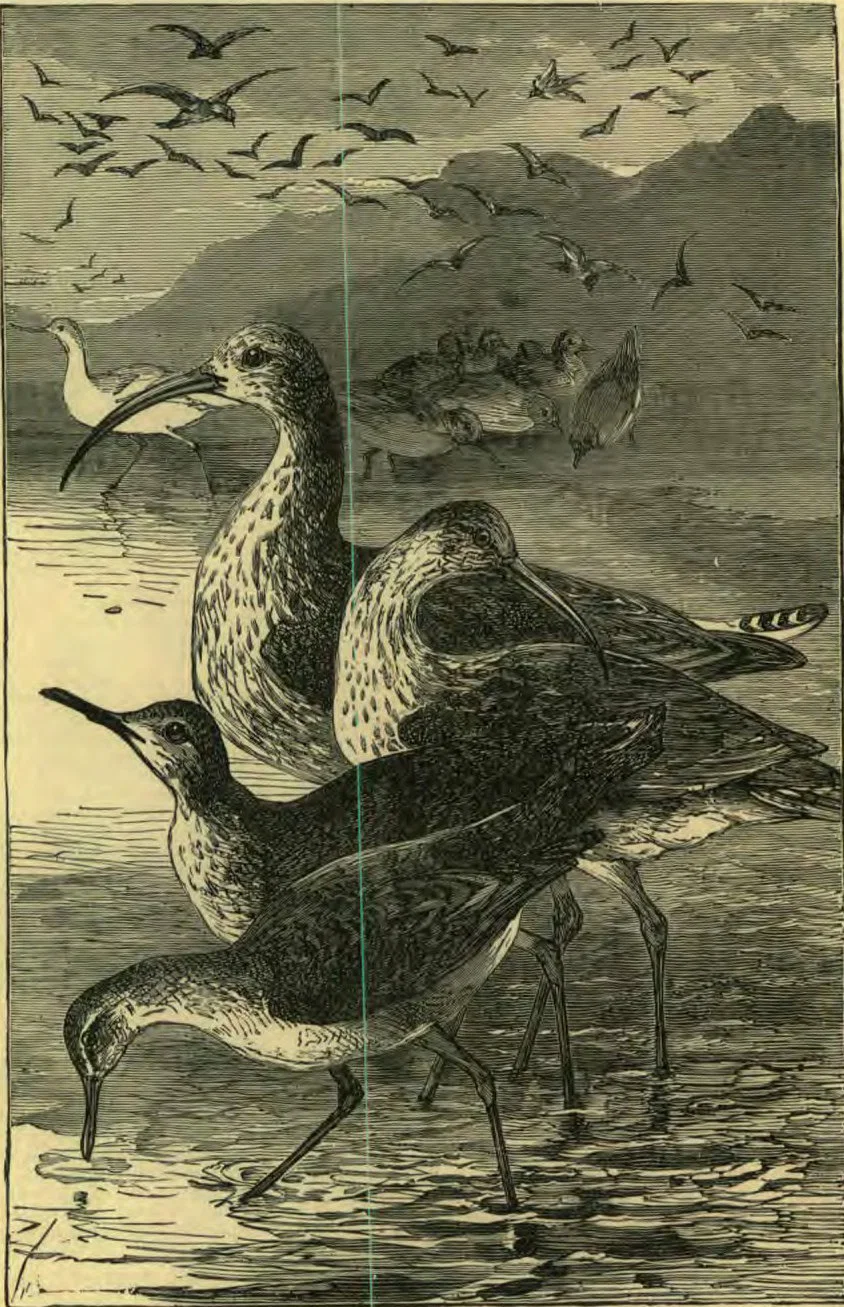
WHEN the bright sun of April brings summer warmth to our Northern lands, then the sandpipers and the curlews return to the marshes and shores of our inland rivers or to the barren beach of the ocean. High in the air they fly, uttering a sweet, mournful call of peet-weet, peet-weet. In our picture you can see these birds, hunting in the water for any bugs or worms that may be found. The larger pair are curlews, and the smaller ones sandpipers.
The sandpiper, scorning the high trees, builds its nests anywhere in the sand or on the ground, lining it with only a few weeds or a little grass. Here can soon be found four little eggs, with the small end placed toward the center of the nest in such a way that if you were to remove one, it would be hard to place it back just as it was before.
The little sandpipers are very active, and can run swiftly as soon as they are hatched. The first thing they do is to hunt for bugs and worms; they seem to understand all about this on the start, and do not have to be taught. But they cannot always tell good food from that which is poisonous, so for awhile the mother sandpiper has to watch her little ones. This is about all the bringing up they have.
Sandpipers are little birds only about ten inches long, with feathers of such a color that it is very hard to distinguish them from surrounding objects. They are also very wary, and fly away at the first alarm. But their flesh is considered very good food, and the hunters are very persevering in trying to shoot them. At the first sight of a sportsman or the sound of his gun, they give a wild scream, and are off, perhaps leaving one or two of their mates wounded or killed.
But sometimes the sandpiper cannot fly away and leave its nestful of eggs or its little ones; so it resorts to a trick that you would hardly think of. It limps and flutters along on the ground as if its leg or wing were broken, uttering a very distressed cry. Farther and farther it leads you away from its treasures, until it thinks they are safe, when off it flies, leaving you astonished at the sudden change.
Celia Thaxter has written a very pretty poem about the sandpiper; and although it has been printed once before in the INSTRUCTOR, I will give a few verses of it for the benefit of the boys and girls who have never read it:—
“Across the narrow beach we flit, One little sandpiper and I; And fast I gather, bit by bit, The scattered driftwood bleached and dry. The wild waves reach their hands for it, The wild wind raves, the tide runs high, As up and down the beach we flit, One little sandpiper and I.
“I watch him as he skims along, Uttering his sweet and mournful cry; He starts not at my fitful song Or flush of fluttering drapery, He has no thought of any wrong, He scans me with a fearless eye, Staunch friends are we, well-tried and strong, The little sandpiper and I.
“Comrade, where wilt thou be to-night, When the loosed storm breaks furiously? My driftwood fire will burn so bright, To what warm shelter wilt thou fly? I do not fear for thee, though wrath The tempest rushes through the sky, For are not we God's children both, The little sandpiper and I?” W. E. L.

PROVIDENCE

“Ah! what will become of the lily, When the summer-time is dead? Must she lay her spotless robes away, And hide in the dust her head?”
“My child, the hand that bows her head Can lift it up anew, And weave another shining robe Of sunshine and of dew.”
“But, father, what will the sparrows do? Though they chirp so blithe and bold, When the shelter of the leaves is gone, They must perish with the cold.”
“The sparrows are little things, my child, And the cold is hard to bear; Yet never one of these shall fall Without our Father’s care.”
“But how will the tender lambs be clothed? For you know the shepherd said, He must take their fleeces all away, For us to wear instead.”
“They are warm enough to-day, my child, And so soon their fleeces grow, They each will have another one Before they feel the snow.”
“I know you will keep me, father; That I shall be clothed and fed; But suppose I were lost from home, Oh, suppose that you were dead!”
“My child, there is One who seeks you, No matter where you roam; And you may not stray so far away, That he cannot bring you home. For you have a better Father, In a better home above; And the very hairs of your precious head Are numbered by his love!”
—Phoebe Cary.

EMMA'S PRAYER.

“Oh, please mend the cup; please mend it. I didn’t mean to break it,” and poor little Emma, on her knees by the sofa, poured out her whole soul in this petition. Then she opened her eyes and looked around to see if the cup was mended.
No; there it lay all in fragments just where she had dropped it, and she prayed again:—
“O my Father, I didn’t mean to break the cup, and you can mend it if you want to. Amen.” And she looked around again, but it still lay there unmended.
Then the poor little girl prayed once more: “Oh, please mend it. If you don’t, mamma will know I took the sugar after she told me not to. Please make it all whole. Amen.” Again she looked, but it was broken as before, and she rose from her knees.
“There! I won’t pray any more, never, never, never. You hateful old cup, stay broken if you want to!” And she gave it a spiteful kick.
“What ails my little girl?” said mamma, coming in from her walk. “Why, Emma, how came my sugar-cup here, and broken too? Did you take sugar while I was gone?”
“But I prayed about it,” said Emma, sobbing. “I prayed three times. Why didn’t God mend it? You said he would answer prayer.”
“My dear child,” said mamma, “we cannot escape the consequences of our wrong acts by asking God to help us cover them. That would be praying that he would help us deceive, and he cannot do wrong. ‘Lead us not into temptation,’ is a prayer that he delights to answer. Remember that the next time, dear.”
Emma has grown to be a woman now, and she has always remembered the lesson of that day.—Child’s Paper.

Letter Budget.

THE little people who have so faithfully written for the Budget, until the letter box is brimful, must keep real patience while waiting to see their own in print. Each one's turn will come in time; for we shall use them as fast as we can. In the meantime others can be writing, and so keep the good things coming in.
LENA C. LORENTZEN sends a letter from Oregon. She writes: “I have been receiving your paper for a long time from an unknown friend. I think it is a very nice paper, and it gives me much pleasure to read it. If the kind lady who sends it would send me her address, I would like to thank her for her kindness. I am nearly fourteen years old, and live in the south-western part of Oregon. It is not very thickly settled here, every one living on his own ranch. Meetings are held most every Sunday in a school-house about three miles from here. Kind regards to the INSTRUCTOR family.”
None at the office of publication know who sends you the INSTRUCTOR, but you may rest assured that the sender will feel fully rewarded if the paper is appreciated. Probably she will see your letter in the paper.
HERE we have letters from MYRTLE and NELLIE CLARK, of Boone Co., Neb. Myrtle writes: “I wish you a happy New Year. I have never written to the Budget before, and as I am only six years old, I can't write much now. I study in Book No. 1, in Sabbath-school, and mamma is my teacher.”
NELLIE writes: “I am a little girl eleven years old. I have two brothers and three sisters. I go to day school. We spent Christmas at home. We had a Christmas tree at our house, and put our offerings for the European and Scandinavian Missions in the envelopes prepared for that purpose. We had good meetings Christmas day, and Sabbath and Sunday. Our church is too much scattered to meet every day during the week of prayer. Papa went to visit one of the churches last Friday. We expected him home to-day (Sunday), but it snowed and blew so much he did not come. I study the Sabbath-school lessons in the INSTRUCTOR, and papa is our teacher. I like the lessons because they make the prophecies so plain, especially now we have the large chart to help us. I am trying to be a good girl, for I want to meet all the INSTRUCTOR family in the new earth.”
The “happy New Year” wish is just as welcome, Myrtle, if it did not get printed on time. We must all remember every day that we have to help make it a happy year. We think you both enjoyed Christmas, and we trust a blessing followed your donations.
ALVIN E. REDNER writes from Jackson Co., Mich. He says: “I am a little boy ten years old. My mother died when I was four years old, and my brother put me into a family who were keeping the Lord's Sabbath. I go to Sabbath-school every week, and have a perfect lesson. I have a brother and sister, but I do not know where they are. I like the INSTRUCTOR. I want to be a truthful boy, and keep all of God's commandments, so that I may have right to the tree of life.”
Although Alvin has suffered the loss of his relatives, what blessings God has bestowed upon him. He has given him the precious truth, which, if faithfully obeyed, will entitle him to a home in the new earth, with the society of angels, and all the redeemed of earth. And better still, Jesus himself will be there.
ELIZA POOL, of Washington Co., Ark., writes: “As I have never seen but one letter in the Budget from this country, I thought I would send one. I am sixteen years old. We have a church of twelve members, and a Sabbath-school of about twenty members. Our school was visited last Sabbath by Prof. White and his wife of West Fork, Ark. This is my first letter to the Budget, but I hope it may not be the last. I ask the prayers of all.”
We all have an interest in the Arkansas letters, and like to hear of your prosperity. You will be remembered.

You have reached the end of this edition.

The Youth’s Instructor · Feb 24, 1886