The Youth’s Instructor, Vol. 34, No. 8.

NATIONAL SPORTS

The Youth’s Instructor

Feb 24, 1886

S. D. A. Publishing Association · Battle Creek, Mich. · Feb 24, 1886

NATIONAL SPORTS.
EVERY nation has some favorite amusement, which is indulged in to excess by the sport-loving portion of the country. In America, base-ball clubs are formed everywhere, and the national game is played with much animation by nearly all the boys and many of the young men. Here in Australia, the game of cricket takes the lead, and at certain seasons of the year, there may be seen, gathered in the open fields, large crowds of men, women, and children intently watching the progress of their national pastime. So exciting does the play become, that sometimes whole days together are occupied in the sport; and ragged urchins in the streets discuss the merits of the game and of those engaged in it, with as much warmth as those of maturer years.
There seems to be something natural in the selection of these pastimes. When the Indians had possession of the American country, and were undisturbed by the industrious advances of the enterprising white man, their favorite pastimes were running foot-races, riding horseback, and chasing wild game—sports which were in perfect keeping with the wild nature of that race. Their children were trained up in the exercise of these pursuits until they were capable of performing the most astonishing feats in athletic sports. Since this untamable people have been driven from their favorite haunts to the mountain fastnesses of the West, where they could not exercise their natural inclinations as they wished, their favorite pastimes have been discontinued, and they have become a diminished and dispirited race.
One hundred years ago the natives of the Sandwich Islands, and of other islands of the Pacific, had very little knowledge of the ways of white men; and like the first inhabitants of America, were children of nature. Living in a climate where little clothing was required for comfort, and where nature provided abundance of food without any effort of their own, they were naturally an indolent people. With no regular employment, instinct alone would suggest something by which to break the monotonous routine of an idle life. Their island homes were small, and could present little to satisfy the desire for change. If amusement were found, it must be sought in the boundless ocean by which they were surrounded.
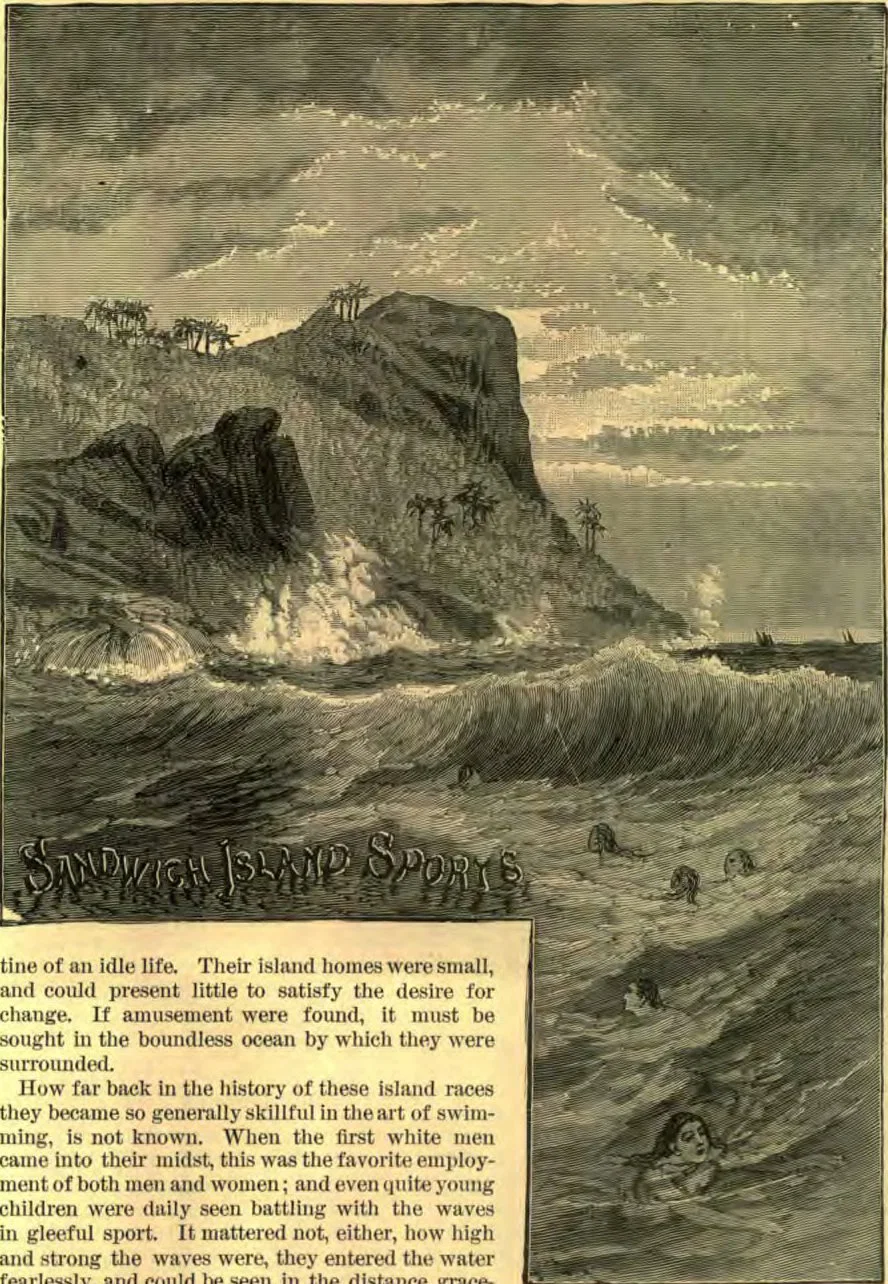
How far back in the history of these island races they became so generally skillful in the art of swimming, is not known. When the first white men came into their midst, this was the favorite employment of both men and women; and even quite young children were daily seen battling with the waves in gleeful sport. It mattered not, either, how high and strong the waves were, they entered the water fearlessly, and could be seen in the distance gracefully rising and falling with the heaving billows for hours together, or until weary with their sport. The picture accompanying this article is a fine illustration of that people enjoying their favorite pastime.
So much at home were they in the water, that many would undertake journeys to some of the nearer islands, or to distant parts of the same island, and perform them with as much ease, apparently, as we would walk the same distance by land. When vessels first began to visit the islands, they were called Moko, meaning islands. Seeing them move about, they considered them living beings, and remained near them much of the time in the water. When one would leave the harbor, many of the natives would accompany it for a long distance, sporting and talking immoderately by the way, until a peculiar signal was heard from one of their number, when in a body they would return to their companions on shore.
In fact, hardly any feat seemed too much for their skill when in the water. It is said that in very early days a look-out was stationed at some commanding point to watch for sharks in the offing. When that peculiar motion of the water, made by certain movements of that voracious monster, was seen at any point in the harbor, the signal was given; and the most daring, arming themselves each with a knife and a piece of wood a foot or more in length, and sharpened to a point at both ends, would plunge into the sea, and hastily swim toward the shark. When near the enemy of their sports, they would firmly grasp their sticks by the middle in one hand, and quietly await the attack of the man-eater. The shark, seeing his prey so near, and bent on seizing it, would quickly turn on his back (his customary method when snatching his victim), and with distended jaws, glide toward one of the natives. The native comprehending the movement, would, quick as a flash, present the sharpened stick held in a perpendicular position, and thrust it into the monster's mouth, the points of which buried themselves above and below, preventing the shark from closing his jaws. The next instant the knife of the native was plunged into the vitals of his foe, and the enemy brought to an untimely end.
In later years, since coming more under the influence of white men, the habits of these islanders have changed somewhat. Their old sport is not indulged in to excess as formerly. Having learned something of the value of money, they now make their skill in swimming contribute toward providing the scanty amount of cash they use. All the islands of the Pacific are surrounded by coral reefs, the avenues and labyrinths of which are filled with rare and curious forms of animal life. Great sea centipedes creep snake-like among delicate stars and huge prickly sea-urchins, and big crabs run and hunt amid the rugged submarine growths that loom up beneath the malachite-tinted waters. When the tide is out and the water is low upon the reefs, the natives station their boats over these coral plantations, and dive for crabs and coral. They also gather, for sale, a very pretty shellfish of a greenish-blue color shaded off into a delicate white.
Were one to pass these reefs knowing nothing of the employment of the natives, he would at first suppose that the canoes he saw scattered about had no owners; but if he would watch one of the boats a moment he would see a head bob up out of the water, and then a dark form would be seen climbing into the boat. After depositing his burden and taking breath for a moment, the native once more dives into the water to search for the treasures of the deep.
Such occupation doubtless seems strange to those who have always lived in a country far removed from the ocean. But the habits and customs of these islanders are formed from the force of circumstances, just as the habits of those are who live on the plains or in a mountainous region. Probably the ways of other nations appear as strange to these native sons of the islands as theirs do to those whose pursuits are confined to the land. It is good to think that there is a home promised to God's children in which all will have the same joys and pleasures, and in which the ways of none will appear strange to others. I am anxious to become a resident of that region. How is it with the INSTRUCTOR readers? Are you daily preparing to live in that “better country”?
J. O. CORLISS.
Melbourne, Australia.

GATHERING FLOWERS.

The golden glow of harvest-tide was shed Across the fields at dawn, where reapers sped About their busy task, nor dreamed of rest Till waiting sheaves in shining store were prest. The wealth of warm, sweet-scented summer air Played with the tresses of a maiden fair, Who idly strayed throughout the sunlit hours In lanes and harvest-field in search of flowers.
The day wore on; and still, in dreams and play, The maiden whiled the happy hours away; The reapers paused to watch the child and ask, “Wilt thou not gladly share our harvest-task, Gather in golden sheaves, nor stay to rest Till yonder blazing sun sleeps in the west?” “Nay,” smiled the maiden, “surely sunny hours Are only meant to spend in gathering flowers!”
The hours rolled by; and evening’s cooler shade Crept with its softness over field and glade; A reaper paused beside the careless child With grave, sad face, which never changed nor smiled. “Suppose the Master came to-night this way, Asking account of hours now gone for aye, Looking to see the sheaves your hands have bound, The work your fingers in his fields have found, How would you answer for the wasted hours Which you have dreamed away in gathering flowers?”
At this rebuke, aroused, dismayed, the child, Filled with a terror half defined and wild, Sprang to her feet, and quickly made her way Where the great shining sheaves of harvest lay, Waiting some willing hand. She toiled and wept And wept and toiled, while weary reapers slept, Under the moonlit skies, nor dared to rest, While that strange terror filled her wakened breast.
But, oh, when once again the morning smiled In fair, sweet beauty on the weary child, How calm her soul! how full of rest her heart! Knowing that in the Master’s work she had a part, Knowing the recompense of work well done— Though late—by her had been most surely won; Knowing that, come he when he would, her hours Bore better fruit than sheaves of withered flowers.
God would not have our brightest, sweetest hours Of life and love spent idly gathering flowers; He has some service for each soul to do In its brief life-day, if it only knew! And when God’s child, heaven-grown to man’s estate, Passes rejoicing through the golden gate, No sweeter memories his life will yield Than those of hours spent in God’s harvest-field.
—The Christian.

ONE LIFE OR A HUNDRED.

It was intensely hot,—one of those sultry August days which are rare in England, when the world seems to be asleep, from the unnatural stillness pervading everything. Willow Cottage, as John Benson’s house was called, was, notwithstanding its name, in an open plain, without a tree or even a shrub for nearly half a mile. Its vicinity to the railway made it more convenient to the Bensons than many more attractive spots. They had only lately taken it, for John Benson had been appointed to a place on the Great Northern Railway.
He was a tall, middle-aged man; and his wife was a pale, delicate woman, who had a sort of nervous terror of living so near the railway, which, as she expressed it, “shook her like an earthquake.”
“I do wish, John, that you would go to some quiet place,” she said to him. “Between the noise of the children and the rushing about of those screaming trains, I get no peace of mind at any time.”
“No, Mary, it would never do for me to give up. It is not everybody that would do for pointsman on a main line like this; and you’ll soon get used to the noise. Besides,” he continued, “where could I get such good pay as I get here?”
“Well, you might as well take Amy with you now. I sha’n’t have a bit of peace while she is in the house, and I have some hard work to do to-day. I can fetch her back when it is done.”
“Come along, then, child,” said her father. He caught her up in his arms, walking very quickly across the field, Amy crowing with delight, till he came to his signal-box, where he deposited her on the floor, saying, “Now be a good lassie, and play with pussy.” He placed the cat in the child’s lap.
Amy seemed perfectly happy, and her father, seeing her quiet, went on with his work, only occasionally looking round to see that she was not in mischief; not that there was much mischief she could do in that little empty wooden house.
All was so quiet, and the heat so oppressive, that he sat down on the only chair in the place, and soon began to feel drowsy. At last the cat, rubbing against his legs, aroused him, and he started up to look for the child. He called, but she did not reply; and looking round, he saw nothing of her.
A sudden terror flashed through his mind; and when he stood at the door, and perceived what seemed like a little pink bundle lying on the line some fifty yards off, he felt as if he was turning to stone.
“Amy, Amy!” he tried to shout; but his voice was hoarse and weak, and the child evidently did not hear. She had picked up something to play with, and paid no attention to her father’s call.
The next moment he heard a sound in the distance, and stood as if paralyzed.
He knew that the express train was due, and that he must turn the points to prevent an accident.
How could he? There was not time to save the child and do what he knew to be his duty.
“My God! What shall I do?” he ejaculated, as he tried with trembling hands to turn the points. “It is her life against the lives of hundreds.”
Drops of agony stood on his brow. Nearer and nearer came the rushing sound; to turn the points might be to kill his child; to hesitate might be to destroy a hundred lives; but his work was done, and in another minute the train swept past him like a whirlwind.
“I have done my duty,” he thought. “O God, remember me also in mercy.”
It had been a fearful struggle—a moment of horror that none could realize but himself. All the agony of which a soul is capable seemed compressed into that moment. He stood still as if paralyzed—he did not dare look up—he dreamed of a fearful sight that must meet his eyes.
In the stillness the blessed sound of a child’s cry caught his ear, and oh, what a thrill of joy entered his heart! His darling was still where he saw her last, unhurt, unscathed, out of the fearful peril that had overtaken her. Somehow as she lay in the hollow between the sleepers, the train had passed over her.
“My Amy! my darling!” he exclaimed, catching her up in his arms, and straining her to his heart.
He carried her tenderly to the signal house, and then the tension of his mind relaxed, and the strong man sobbed like a child. He threw himself on his knees, hiding his face in his hands. His joy and gratitude seemed more than he could bear.
The child, who had been partially stunned by the noise of the train as it passed over her, though it had not injured her, was surprised at the little notice her father took of her, as she awoke to perfect consciousness, and began to cry. This aroused him, and at that moment his wife appeared at the door.
She stopped short at the sight of her husband’s bloodless lips and agitated countenance.
“What is it, John? what is it?” she asked, breathlessly. “Nothing wrong with Amy—she is all right. Are you ill? What has happened?”
“Nothing, by God’s mercy; but O Mary, I never thought you would see her again.”
She looked, as she felt, horror-stricken, as he explained to her what had happened. With thankfulness too deep for words, she carried home her little golden-haired Amy, and the next Sabbath the neighbors were inquiring for what great mercy John and Mary Benson had returned especial thanks at morning service.—Companion.

MORE ABOUT LINCOLN.

Mr. Lincoln, like all truly great men, had a very benevolent heart. He pitied any one in trouble; and that is what we should do. On one occasion, when he was President of the United States, he was found carefully counting over some money. He explained the matter, saying that the money belonged to a poor negro who was at that time sick with the small-pox in the hospital. He could not draw his money because he could not go and sign his name, and the officials would not let him have it without. So Mr. Lincoln went himself, became responsible for the negro, and got the money for him. That is the spirit which Christ had, and which he wants us all to have.
Mr. Lincoln had a beautiful little boy named Willie. He was very fond of him. But Willie became very sick, and finally died. Even the children of presidents die, you see. The father was nearly heart-broken, he loved little Willie so. I know how terrible it is; for only last year I had to bury my dear little boy. A Christian woman tried to comfort him. She had lost more than that. She had lost her husband and two sons,—all she had; and still she bore up and trusted in God. She believed it was all for the best. This helped Mr. Lincoln greatly. Mr. Lincoln then remembered his mother and her prayers, though she died when he was a small boy. He said, “Her prayers have always followed me. They have clung to me all my life.” How good it is to have praying mothers. Children, do you prize your mother’s prayers for you?
Mr. Lincoln was always very fond of children. I think that showed that he had a good heart, don’t you? Once the President saw, while at a party, a little girl timidly approaching him. He at once called her, and asked what she wanted. She wanted his name. “But,” said he, “here are other little girls, and they would feel bad if I should give my name to you alone.”
The little girl said there were eight of them in all. “Then,” said Mr. Lincoln, “get me eight sheets of paper and a pen and ink, and I will see what I can do for you.” So all the great men and women, the officers, and generals, had to wait while the President sat there in the crowded room, and wrote a line for each one of those eight little girls. That is the kind of a man I like.
Soon after that, while the President was having a great party, and everybody was crowding around him to shake his hand, a father brought in his little boy. As soon as the child entered the door, he, of his own accord, took off his hat, and giving it a swing, cried out, “Hurrah for Lincoln!” When Mr. Lincoln could get near the boy, he tossed him toward the ceiling, and laughingly shouted, “Hurrah for you!” He greatly enjoyed such incidents with the children.
Now what can we learn from the life of this great and good man? This was the object I had in writing; and if you fail to learn this lesson, I have lost my work in writing, and you have received little good from your reading. We should try to pattern after the good things we see in others. We like those who are kind-hearted and honest; then let us cultivate those same qualities. We admire industry; let us be industrious. We praise those who love their books more than fine clothes. Which do we love the most? We like people who are not proud, nor above associating with the poor and humble. How do you act? Are you ashamed to be seen with children who wear poor clothes? Do you make fun of them? We love those who do not want everything themselves; how do you act about such things? If we want others to love us, we must do something to win their love. Every child will be loved whose actions are lovable.
D. M. CANRIGHT.

THE BOY THAT WILL LIE.

WHAT is a boy good for who will lie? Many boys at the best make considerable trouble by their ignorance, inexperience, and awkwardness; and it requires considerable patience to put up with their faults, and try to make anything of them. But when in addition to all his usual faults, a boy will lie, what is he good for? He breaks things, and lies about it; he forgets things, and lies about it; he neglects things, and lies about it; you send him on an errand, and he lies about it; you give him work to do, and he lies about that. You never know where to find him, or what to do with him. You cannot know what to depend upon, nor where to trust him. He misleads you, deceives you, and disappoints you. If you hire him to work, you need to hire somebody else to watch him; so you have to hire two persons to do the work of one, and of course what you pay for watching comes out of the wages of the rascal who needs to be watched, or else is his employer’s loss.
A boy who tells the truth, whose word can be depended upon, who owns up to his failures, is a treasure. If he fails to-day, he will do better to-morrow; if he makes mistakes, you can show him how to correct them; if he is thoughtless, you can admonish and caution him; and you can have the joy of seeing him improve from day to day, and grow wiser and stronger and better, so that even in his boyhood he can fill the place of a man, and be worth more than many a man who cannot be depended upon.
There are good things ahead for such a boy. He is wanted to take charge of business, to do honest work, to fill important positions, to watch rascals who cannot be trusted. He is wanted to fill places of responsibility, to manage great undertakings, to be a power in the community, and a blessing in his home.
My boy, God has given you a tongue, to speak the truth and to sing his praises, and you had better bite your tongue off than to use it to tell lies, for “All liars shall have their part in the lake that burneth with fire and brimstone, which is the second death.”—Little Christian.

A WORD TO THE GIRLS.

In Dr. John Todd’s “Letters to a Daughter,” he wrote, “Whatever one does well she is sure to do easily,” and words to the effect that what one goes at thoroughly ceases to be disagreeable.
I knew a girl of twenty years ago who took these words to heart, and they have made work the pleasure of her life. All the careless people who watch her, cry out at the trouble she takes with everything she does; but they are very apt to say, after all is through, “You have such an easy way of turning off things, and things always stay done for you.” Of course they do. Thorough is the Saxon for through, and anything that is thoroughly done, is through with.
It is a queer paradox that if you try to do things easily, to shirk and slur them over, you will always find it hard to get along; while if you put all sorts of pains into your work, and never think how easily it can be done, but how well it can be, you find it growing easier day by day.—Wide-Awake.

ANCIENT SUPERSTITION.

Many of the ancient customs of our English forefathers are looked upon with contempt at the present time, and have ceased entirely to be practiced, because the people have come to recognize the absurdity of them. Among the superstitions which have been discarded by the English people, was the supposed power of the king to heal scrofulous diseases by the laying on of his hands. It was thought that there were certain healing properties in the touch of a king, not possessed by ordinary persons. This ceremony had come down from the darkest of the Dark Ages.
The days on which this miracle was to be wrought, were fixed by the highest officers of the country, and were solemnly announced by the clergy in all the churches of the realm. When the appointed time came, the surgeon of the royal household introduced the sick. A passage from the sixteenth chapter of St. Mark was read by one of the attending clergymen; and when the words, “They shall lay their hands on the sick, and they shall recover,” had been read, there was a pause, and one of the sick was brought up to the king, who stroked the ulcers and swellings, and hung round the patient’s neck a white ribbon, to which was fastened a gold coin. It was supposed that as long as this coin was worn, there would be no return of the disease; but if the piece of gold were lost or sold, the ulcers would break forth again, and could be healed only by a second touch and a second coin. The expense of this ceremony was little less than ten thousand pounds a year.
In the year 1682, when Charles II. was king of England, he touched eight thousand five hundred persons; and two years later the throng was so great that six or seven of the sick were trampled to death in the crowd. During this reign alone, nearly a hundred thousand persons were touched by the hand of the king. So great was the number of applicants at times, that it became necessary to appoint a surgeon, who inspected the applicants to see whether they came to be healed, or to get the piece of gold.
When William III. was made king in 1688, the people came to him to be healed, as they had to the other kings who had reigned before him; but William had too much good sense to be duped, and too much honesty to bear a part in what he knew to be an imposture. “It is a silly superstition,” he exclaimed, when he heard that his palace was besieged by the sick. “Give the poor creatures some money, and send them away.” On one occasion, however, he was persuaded into laying his hand on a patient. “God give you better health,” he said, “and more sense.” Bigoted people lifted up their hands in horror at his impiety, and the parents of scrofulous children cried out against his cruelty; but William was not to be moved, and he was accordingly set down as an infidel.
The superstition died out with William, and in the reign of George I., the University of Oxford ceased to print the Office of Healing in the common prayer book.
EUGENE LELAND.

IMPORTANT BIBLE SUBJECTS.

LESSON 10.—THE END OF THE 2300 DAYS.

1. What were the first words uttered by the angel in explanation of the 2300 days? Dan. 9:24.
2. What event was to mark the beginning of this first part of the great prophetic period? Verse 25.
3. What decree completed this commandment? Ezra 7:12–26.
4. When was this decree issued? (See date in the margin of Ezra 7.)
5. How many weeks of prophetic time were to reach from this date to Messiah the Prince? Dan. 9:25.
6. What is the meaning of the word Messiah?—It means the anointed. John 1:41.
7. When was Christ anointed?—He was anointed by the Holy Spirit at his baptism. See Acts 10:37, 38; Mark 1:10; Luke 4:18.
8. When was Christ baptized?—A. D. 27. (See note.)
9. Why were the 69 weeks reaching from the commandment to the baptism of Christ divided into two parts?—Because the first seven weeks, or forty-nine years, were to be covered by the restoration of Jerusalem.
10. When was this work of restoration completed?—B. C. 408, in the fifteenth year of Darius Nothus.
11. What was to be accomplished during the remaining week of the seventy? Verse 27.
12. What is meant by confirming the covenant?—The preaching of the gospel.
13. Then how could Christ confirm the covenant for one week, when he was to be cut off in the midst of the week?—For the first half of the week by his own preaching, and for the last half by the preaching of his apostles. See Heb. 2:3.
14. What events marked the termination of the seventy weeks? (See note.)
15. When did these things take place?—A. D. 34.
16. How did the events of the seventy weeks seal up the prophecy?
17. How may we be certain that the seventy weeks were the first part of the 2300 days? (See note on the word determined.)
18. At what time in the year 457 did Ezra come to Jerusalem with the decree of Artaxerxes? Ezra 7:8, 9.
19. Since only a part of the year 457 remained at this time, how many years would it take to reach to the Christian era?—About 456½.
20. How many more weeks would it take to complete the seventy weeks?—33½.
21. To what year would this reach?—To A. D. 34.
22. How many years of the 2300 would remain after the 490 had passed?
23. To what year would this reach?
24. What was to take place at the end of the 2300 days? Dan. 8:14.
25. How long, then, has the work of cleansing been going on in the heavenly sanctuary?

NOTES.

Christ’s baptism.—In Luke 3:21, 22, we learn that Christ was about thirty years old at the time of his baptism. But since our Christian era begins when Christ was four years old, he would be thirty years old at the beginning of A. D. 27. See margin in English Bible.
The end of the seventy weeks.—The Sanhedrim, the highest authority of the Jewish nation, met in council, rejected Christ as presented by the Holy Spirit through Stephen, and took the life of this bold witness, even after they had seen the glory of the Lord resting upon him. Thus the Jews filled up the measure of their iniquity; so the Lord turned from them, and sent his apostles to preach to the Gentiles. Read Acts 6:12, and onward; Acts 22:21; 11:1–26; 13:1–4, and onward.
Determined.—“Seventy weeks are ‘determined,’ literally ‘cut off.’ Hebraists all admit that the word determined, in our English version, does signify ‘cut off.’ Not one has disputed it.”—Josiah Litch, Midnight Cry, vol. iv., No. 25.
“Seventy weeks have been cut off upon thy people and upon thy holy city, to finish the transgression, and to make an end of sin-offerings, and to make atonement for iniquity, and to bring in everlasting righteousness, and to seal the vision and prophecy, and to anoint the Most Holy.” Dan. 9:24.—Whiting’s Translation.
Gesenius, the standard Hebrew lexicographer, thus defines this word in his Hebrew lexicon: “Nechtak: Properly, to cut off; tropically, to divide; and so to determine, to decree.”—The Sanctuary and its Cleansing, p. 58.

Choosing Substitute Teachers for Absent Sabbath-School Teachers

ONE of the commonest dangers of the Sabbath-school is in connection with the temporary filling of vacancies in the chairs of absent teachers. The feeling of the superintendent is quite likely to be that the class must be provided for, and that, as the stated teacher is away, the most available substitute at hand is necessarily to be accepted for the time being. As a result, a class is often put into the hands of a well-disposed, but thoroughly incompetent teacher for a single Sabbath, or for several weeks, and the scholars are neglected, or are mistaught, accordingly. In fact, it is sometimes the case that a hastily selected substitute teacher of this sort does much to undo or to nullify the best work of the stated teacher. In view of this danger, a superintendent ought to feel that he has no right to put a class into the hands of a teacher whom he does not know to be qualified for the duties, and worthy of the responsibilities, of the position. To avoid making a mistake of this kind is not an easy matter; and the temptation to do the best thing practicable at the moment, even though it involve some risk, is a strong one. But if worst comes to worst, it would be wiser to merge two or three classes into one, under a good teacher, than to put one class or another into incompetent hands. But better than all is to have some wise provision for good substitute teachers—when regular teachers are irregular.—Selected.

THE MIGHTY AMAZON.

GEO. B. GRIFFITH, in Golden Days, has produced some interesting features of the wonderful Amazon River and its valley. He writes:—
“The march of the great river in its silent grandeur is sublime; but in the untamed might of its turbid waters, as they cut away its banks, tear down the gigantic denizens of the forest, and build up islands, it is awful. It rolls through the wilderness with a stately and solemn air. Its waters look angry, sullen, and relentless, and the whole scene awakens emotions of awe and dread—such as are caused by the funeral solemnities, the minute-gun, the howl of the wind, and the angry tossing of the waves, when all hands are called to bury the dead in a troubled sea.
“The traveler is reminded of our Mississippi at its top-most flood; the waters are quite as turbid; but this stream lacks the charm and the fascination which the plantation upon the bank, the city upon the bluff, and the steamboat upon its waters, lend to its fellow of the North; nevertheless all feel pleased at its sight.
“Its capacities for trade and commerce are inconceivably great. Its industrial future is the most dazzling; and second to the touch of steam, settlement, and cultivation, this rolling stream and its magnificent water-shed would start up into a display of industrial results that would indicate the valley of the Amazon as one of the most enchanting regions on the face of the earth.
“From its mountains you may dig silver, iron, coal, copper, quicksilver, zinc, and tin. From the sands of its tributaries you may wash gold, diamonds, and precious stones. From its forests you may gather drugs of virtues the most rare, spices of aroma the most exquisite; gums and resins of the most varied and useful properties; dyes of hues the most brilliant, with cabinet and building-woods of the finest polish and most enduring texture.
“Its climate is an everlasting summer, and its harvest perennial. The capacities of this vast water-shed can hardly be estimated. The shores of the river are low but abrupt. The lower strata next to the water’s edge are of sand, hardening into rock from the superincumbent pressure of the soil with its great trees.
“The greatest boon in the wide world of commerce is in the free navigation of the Amazon, its confluents, and neighboring streams. The backbone of South America is in sight of the Pacific. The slopes of the continent look east; they are drained into the Atlantic, and their rich productions, in vast variety and profusion, may be emptied into the commercial lap of that ocean by the most majestic of water-courses.
“The valley of the Amazon with the valley of the Mississippi are commercial complements of each other—one supplying what the other lacks in the great commercial round. They are sisters which should not be separated.”

TAKE CARE OF THE MINUTES.

Take care of the minutes, they are priceless, you know, Will you value them less than so quickly they go? “It is but a minute,” the trifler will say; But minutes make hours, and hours the day.
The gold dust of time is those minutes so small; Will you lose even one? Why not treasure them all? As each broken petal disfigures the flower, So each wasted minute despoils the full hour.
Take care of the minutes; they come and are gone; Yet in each there is space for some good to be done. Our time is a talent we hold from above; May each hour leave us richer in wisdom and love!

TAMPERING WITH THE CURRENCY.

It is such a little while since our own mutilated currency was refused a circulation, that even the little boys and girls know the evil which results from taking bits from the coins in use. But ours is not the only nation whose money has been tampered with by the hand of the spoiler. England once had a bitter experience in teaching her subjects not to lessen the value of her gold and silver currency by mutilating it. The following record of this difficulty was published in a recent exchange. The writer began by saying,—
“When a coin gets a hole in it, it ceases to be a coin; its value then depending entirely upon its weight, just as any uncoined piece of gold or silver. To drive out of circulation such slightly defective coins may seem arbitrary; but a little sketch from one chapter of English history will soon show how necessary to the commercial prosperity of a country is keeping the currency pure and exact.
“Before the reign of Charles II. English money was made by hammering it, that is, each lump of material, having been properly weighed, was hammered into shape, its appearance depending largely upon the hand and eye of the workman; a shilling bore a shilling mark upon it; a crown, a crown mark, but probably no coin was perfectly circular, and no two of the same denomination were exactly alike. Bits of silver could have been successfully filed or pared from them without the loss being detected. A wicked man, intent only upon his own gain, might have pared every coin which passed through his hands, thus accumulating a large quantity of material, which, being reminted, would become current coin.
“It was discovered that unprincipled men were thus dealing with the currency. Laws, to which were attached such severe penalties as hanging or burning, were passed without effect. The hope of large gains and the extreme difficulty of detection urged men on.
“When men paid their workmen, they paid them only by tale, that is, by the stamp the coin bore; when the workman went to purchase, few would take his money except by weight. Thus it often happened that what he had been compelled to receive as a shilling shrank to a sixpence.
“Hoping that good money would drive out the bad, a new method of coining was introduced. A mill worked by horses, producing pieces exactly circular and alike, and with edges whose mutilation could be readily detected, was set up in the London Tower. This expectation was doomed to disappointment. Men hoarded or exported the new coin; sometimes they melted it. Thus, though the horses in the Tower turned off large amounts of the new coins, they were hoarded, exported, or melted, and only the old ones passed into circulation. The coins continued to get smaller, and the cry of distress became more piercing.
“Legislators tried fiercer laws, inflicting severe punishments upon those found with bits of gold or silver filings in their possession, or with lumps of uncoined bullion. At length, a law making no mention of punishment put an end to the trouble. A certain date was fixed beyond which the old money ceased to be legal tender. After that date he who possessed any pieces of it could only secure for it its value by actual weight. New coins were made in large quantities and soon passed into circulation.”
Continue reading: SAIL-SKATING IN DENMARK