Pacific Press Publishing Company · New York · May 21, 1896
JOHN BUNYAN.
John Bunyan was born near Bedford, Eng., in 1628, the very year in which Charles I. yielded to the Petition of Right which declared the “illegality of forced loans, of martial law in time of peace, and of the billeting of soldiers on private houses.”
But it was to a deep religious experience, to a sense of duty to his fellowmen and above all, to his God, and to a practical knowledge of the liberty wherewith Christ makes his people free, that Bunyan owed the inspiration of his life rather than to the demand of the times for redress of political grievances.
In 1653, at the age of twenty-five years, Bunyan was converted and became a member of the Baptist Church at Bedford. Two years later he began to preach the gospel. To the latter fact was due his long imprisonment in Bedford jail.
Rights Not Guarded.
Charles II. was placed upon the throne by the English people without giving proper guarantees that their liberties would be respected. True, he had given his word of honor to protect the religious liberty of his subjects, but political reasons and his lust for power soon led him to disregard this sacred pledge.
“Hardly was he seated on the throne,” says Dr. Armitage, “when Venner’s petty insurrection furnished a pretext for vengeance upon all his opponents, and especially those of the dissenting sects, no matter how much they proved their loyalty.
“Amongst the first victims of his tyranny we find Bunyan, charged with ‘devilishly’ and ‘perniciously’ abstaining from going to church, ‘as a common upholder of meetings contrary to the laws of the king,’ and with ‘teaching men to worship contrary to law.’”
Offended Repeatedly.
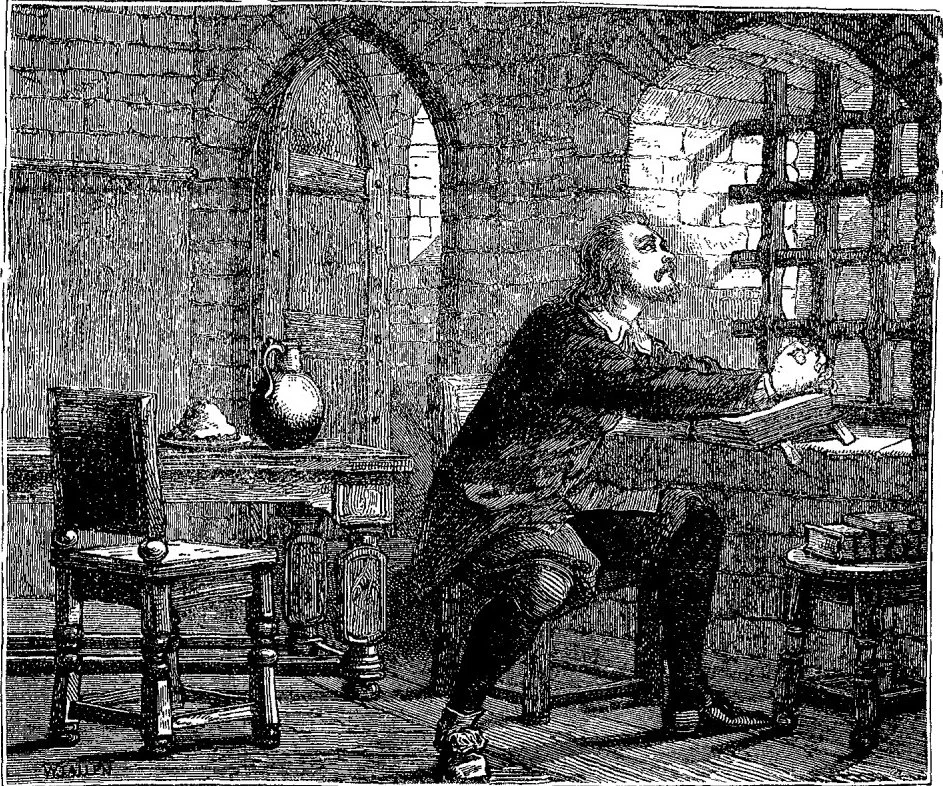
John Bunyan in Prison.
“He was told that if he would give up preaching he should be instantly liberated. His answer was, ‘If you let me out to-day, I will preach again to-morrow.’”
Bunyan was first sentenced to Bedford jail for three months, at the end of which time he was to be banished if he refused to conform to the established worship. He was, however, kept in prison for six years; when released he immediately resumed preaching. He was again imprisoned for another six years. Upon being released the second time, Bunyan began again to preach and was arrested the third time, but was detained only a few months.
“His judges were harsh with him,” says Dr. Armitage, “but his real oppressors for these twelve weary years were the king and Parliament, who made it a crime for anyone to preach but a priest of the Church of England.”
It was while in Bedford jail that Bunyan wrote his “Holy War” and “Pilgrim’s Progress.”
From all he loves on earth though sundered far,
And kept by bolted door, and iron bar;
His genius rises on devotion’s wings,
And, soaring, with unwonted grandeur sings.
Of “Pilgrim’s Progress,” Dr. Armitage says: “While we are obliged to reprehend the base injustice which kept this grand preacher pining in prison, however leniently treated, the fact is forced upon us, that the wrath of man was made to praise God; for had not his zealous servant been compelled to this solitude we should not have had that masterpiece of literature.”
Another, bringing “incense kindled at the muse’s flame,” sings:—
Lo! Sundered from the converse of mankind,
For twelve long years in Bedford jail confined,
A lowly child of genius and of grace
A trophy rears, which time shall ne’er deface.
Pathetic Incidents.
There were some most pathetic incidents in connection with the long imprisonment of Bunyan. Says Dr. Armitage: “His wife was gentle to a proverb. When he was in prison she went to London to pray for his release, and induced a peer of the realm to present a petition to the House of Lords in his behalf; so the judges were directed to look into the matter afresh. She therefore appeared before Sir Matthew Hale, Chester, and Twisden.
“With all the simplicity of a woman’s love she told her artless story. She said her husband was ‘a peaceable person,’ and wished to support his family. They had four helpless children, one of them blind, and while he was in prison they must live on charity.
“Hale treated her kindly, Twisden harshly, and demanded whether he would leave off162preaching if released. In child-like honesty she replied that he dare not leave off preaching so long as he could speak.
“Her request was denied, and she left the court-room in tears, not so much she said, ‘because they were so hard-hearted against me and my husband, but to think what a sad account such poor creatures would have to give at the coming of the Lord Jesus.’
“Jesus wept because Jerusalem stoned the prophets, and Bunyan’s wife was much like him. But, this giant in genius was just as tender-hearted as his wife. Where do we find such pathos in any passage as this, which he wrote in prison:—
“The parting with my wife and poor children hath often been to me in this place as the pulling off my flesh from my bones; and that not only because I am too fond of those great mercies, but also because I should have often brought to my mind the hardships, miseries and wants my poor family was like to meet with should I be taken from them; especially my poor blind child, who lay nearer my heart than all I had besides. Poor child, thought I, what sorrow art thou like to have for thy portion in this world! Thou must be beaten, suffer hunger, cold, nakedness, and a thousand calamities, though I cannot now endure the wind should blow on thee. But yet, thought I, I must venture all with God, though it goeth to the quick to leave you. I was as a man who was pulling down his house upon the head of his wife and children. Yet, thought I, I must do it, I must do it.”
Kindness Cannot Compensate for Injustice.
Bunyan’s jailer was very kind to him. His blind daughter was permitted to visit him at will, and latterly even Bunyan himself was permitted to visit his church unattended and even to preach. But these facts do not abate from the iniquity of his imprisonment. No amount of favor at the hands of an individual can compensate for injustice on the part of the law and the courts.
The chapter of wrong and oppression for Christ’s sake is a long one, and yet the world has only partially learned the lesson. We talk of religious liberty, and yet practice only toleration.
The imprisonment of J. W. Lewis, in Tiptonville, Tenn., and of Wm. Simpson, in Chatham, Ont., for ordinary quiet Sunday labor that interfered with nobody and required nobody else to work, is just as indefensible from the standpoint of religious liberty and of equal rights as was Bunyan’s imprisonment for holding meetings and preaching contrary to “the statutes made and provided.”
His Case Before Sir Matthew Hale.
Bunyan’s imprisonment was according to “due process of law.” As already stated, his case came before Sir Matthew Hale, that eminent justice whose name is revered by all. This only proves the inspired declaration that “great men are not always wise.” Bunyan was not an enemy of civil order, nor did he needlessly defy the authorities. He believed that God had called him to preach the gospel, and he felt that he had no right to forbear. “His persecutors,” says the “Encyclopædia Britannica,” “tried to extort from him a promise that he would abstain from preaching; but he was convinced that he was divinely set apart and commissioned to be a teacher of righteousness, and he was fully determined to obey God rather than man. He was brought before several tribunals, laughed at, caressed, reviled, menaced, but in vain. He was facetiously told that he was quite right in thinking that he ought not to hide his gift; but that his real gift was skill in repairing old kettles. He was compared to Alexander the coppersmith. He was told that if he would give up preaching he should be instantly liberated. He was warned that if he persisted in disobeying the law he would be liable to banishment; and that if he were found in England after a certain time his neck would be stretched. His answer was, ‘If you let me out to-day, I will preach again to-morrow.’ Year after year he lay patiently in a dungeon, compared with which the worst prison now to be found in the island is a palace.”
Did He Court Persecution?
Some might reason that Bunyan might as well have given the required pledge not to preach as he was not able to preach while in prison, and that therefore he courted persecution. This is a shortsighted view of the matter.
The living preacher’s voice is hushed, but not
The voice of noble and unfettered thought;
In that lone dungeon Bunyan breathes the air
Of a celestial clime, for God is there.”
Bunyan preached more loudly and effectively in prison than he could possibly have done any place else; and his patience and endurance under persecution did much to secure a greater degree of religious toleration in England.
Count me o’er earth’s chosen heroes,—they were souls that stood alone,
While the men they agonized for hurled the contumelious stone,
Stood serene, and down the future saw the golden beam incline
To the side of perfect justice, mastered by their faith divine,
By one man’s plain truth to manhood and to God’s supreme design.
By the light of burning heretics Christ’s bleeding feet I track,
Toiling up new Calvaries ever with the cross that turns not back,
And these mounts of anguish number how each generation learned
One new word of that grand Credo which in prophet-hearts hath burned
Since the first man stood God-conquered with his face to heaven upturned.
For Humanity sweeps onward: where to-day the martyr stands,
On the morrow crouches Judas with the silver in his hands;
Far in front the cross stands ready and the crackling fagots burn,
While the hooting mob of yesterday in silent awe return
To glean up the scattered ashes into History’s golden urn.”
Motive of His Release.
Even Bunyan’s release was not the result of the desire on the part of the authorities to do justice. “He owed his complete liberation,” says the “Britannica,” “to one of the worst acts of one of the worst governments that England has ever seen. In 1671 the Cabal was in power. Charles II. had concluded the treaty by which he bound himself to set up the Roman Catholic religion in England. The first step which he took towards that end was to annul, by an unconstitutional exercise of his prerogative, all the penal statutes against the Roman Catholics; and in order to disguise his real design, he annulled at the same time the penal statutes against Protestant Nonconformists. Bunyan was consequently set at large. In the first warmth of his gratitude he published a tract, in which he compared Charles to that humane and generous Persian king, who, though not himself blessed with the light of the true religion, favored the chosen people, and permitted them, after years of captivity, to rebuild their beloved temple. To candid men, who con- sider how much Bunyan had suffered, and how little he could guess the secret designs of the court, the unsuspicious thankfulness with which he accepted the precious boon of freedom will not appear to require any apology.”
Nevertheless the sacrifice which he made was not lost. More than two centuries have passed since Bunyan’s suffering for the truth ceased. But the result of his heroic life survives to day, and in this year of grace 1896, men are nerved and encouraged to endure as he endured for the love of the same truth and the same Saviour for which he counted it a privilege to suffer.
THE CURE FOR IMMORALITY.
The Willimantic (Conn.) Christian Endeavor Union, at a recent meeting adopted unanimously the following resolution:—
Resolved, that we earnestly entreat all good people in this part of the State, and more especially do we urge it upon the parents and young people connected with our churches and Christian Endeavor societies, to refrain from giving, attending, abetting, or participating in card parties and dances, for the reason that the fruits of these things, when there are any fruits at all, are always evil, and the Master whom we serve has said that “a good tree cannot bring forth evil fruit.”
As a method of combatting immorality this is infinitely better than invoking the power of the civil authority to compel an outward show of regard for righteousness which is not felt in the heart, although, as the Outlook of May 9 remarks, mere “prohibitory and restrictive measures are of very little avail in promoting a pure life. Christ said,” it adds, “that when an unclean spirit is cast out of a man, and returning to him, finds the soul swept and garnished, he takes seven other spirits worse than himself and enters into him, and that the last state of that man is worse than the first.” What is necessary is a new tenant in the soul from which the devil has been cast out; and that new tenant must be the Lord Jesus Christ. But if mere resolutions to abstain from exercises tending to immorality cannot fortify the soul against evil, much less can the heart be purified by legal compulsion which has not even the consent of the individual to its operations. “Out of the abundance of the heart the mouth speaketh;” and out of an evil heart will flow an evil life, in spite of all that human power can do to prevent it.
No one, however, can well question the propriety of endeavoring, by precept and example, to induce people to forsake the ways of evil and walk in the path of righteousness; and when the appeal can be made upon the basis of God’s word, it will often take effect in the heart, since “the word of God is quick and powerful, and sharper than any two-edged sword, piercing even to the dividing assunder of soul and spirit, and of the joints and marrow, and is a discerner of the thoughts and intents of the heart.” The word of God strikes conviction to the soul, repentance follows, and the heart is purified by faith.
And here is the difficulty with the efforts made to reform people so as to secure the better observance of Sunday; the appeal cannot be based upon Scripture, since Scripture does not sanction the claims of Sunday as a day of rest. Moral suasion in the matter is robbed of all its potency by this fact; and it only remains to secure Sunday observance by that method which knows nothing of faith or of the convicting power of God’s word,—namely, the force of the civil “law.” But the word of God does support the seventh-day163Sabbath; and this imposes an obligation upon all men which the civil “law” can neither strengthen nor counteract.
Let the churches and religious societies agitate as much as they will by precept and moral suasion, for such reforms as they may think the condition of society demands; no one can properly object to that. But it is proper to draw the line at those “reforms” which cannot be based upon the divine text-book of morality, and can only be realized through the operation of a force which has no power either to convict the soul or to purify the life.
WHERE GOD IS.
It is a tendency of human nature to put faith in visible signs and symbols. The presence of the sign is taken as evidence of the presence of the thing symbolized. This is conspicuously true in religion, where superstition so often plays a prominent part, and where in real spiritual understanding so many have not grown beyond the stature of babes. A name, a picture, a statue, a cross, or other religious symbol, is made the evidence of the reality of that for which it stands in the spiritual realm. By a mere profession of Christianity, or by the practice of outward ceremonies and forms, men are easily deluded into the belief that they possess genuine piety. It is this sort of “faith” precisely that leads some men in our country to-day to view the National Constitution as a godless document, because it does not contain the name of God or make a formal recognition of his authority.
The great trouble with men in this world is their failure to recognize God in the multitude of places and events where his presence and power are manifested. God is invisible; and being not seen, his presence and working must be recognized by faith; for “faith”—not some external sign or token—is “the evidence of things not seen.” Heb. 11:1. It is God’s right to be recognized by his creatures everywhere and in all things, and it is the work of Christianity to point men to him as the Creator and Upholder of all things, and to his goodness and mercy and love in all the circumstances that surround them. “An evil and adulterous generation seeketh after a sign,” said Christ. They were evil and adulterous because they had not faith, and they sought after a sign for the same reason.
God is in nature: in its bright hues, and graceful forms, which delight the eye, or its stupendous and stern aspects, which fill the heart with awe and a sense of human littleness. God is in the hearts of men, even though they may not recognize his presence or acknowledge any of his claims. If they have a love of justice, if they pity the unfortunate, if they have a desire to do good to their fellow-beings, if they have any love of humanity around them, they manifest that God is in them; for “God is love,” and there is no source of love and of good but him. God is in every deed that is done for the uplifting of humanity; he is in every word that breathes justice and mercy and liberty to the afflicted and the oppressed. He is in all that recognizes men as possessing equal rights and entitled naturally to the uninterrupted enjoyment of “life, liberty, and the pursuit of happiness;” and he is therefore already in the Constitution of the United States.
Would it not be better to teach men that God is everywhere in all his works, and that we are to recognize him in every privilege and blessing that we enjoy, beholding him by faith, than to lead men to put confidence in mere names, and signs and outward professions, by which true faith is virtually denied, and by which numberless souls have been deluded to their ruin?
FROM AN IMPRISONED SEVENTH-DAY ADVENTIST MINISTER.
By WM. SIMPSON
Chatham Jail, Chatham, Ont., May 12, 1896.
EDITOR AMERICAN SENTINEL: I received your letter just upon being locked up in my cell for the night, and to me it was a welcome visitor.
I have been in jail now over a week, and as I recall the many bright experiences of my life, none seem so precious to me as the week just past. I don’t feel as though I were deprived of my liberty, because Christ has made me free from that worst of all bondages, sin. Oh, how glad I am for this assurance! Men may condemn me and keep me locked in a prison cell, but the thought that Jesus does not condemn me fills my heart with joy and gladness. I love and prize the favor of God more than the favor of man. The Lord says, “Fear ye not the reproach of man, neither be ye afraid of their revilings.” With these words of encouragement I can say as did the prophet of old, “God is my salvation, I will trust and not be afraid, for the Lord Jehovah is my strength and my song, he also is become my salvation.”
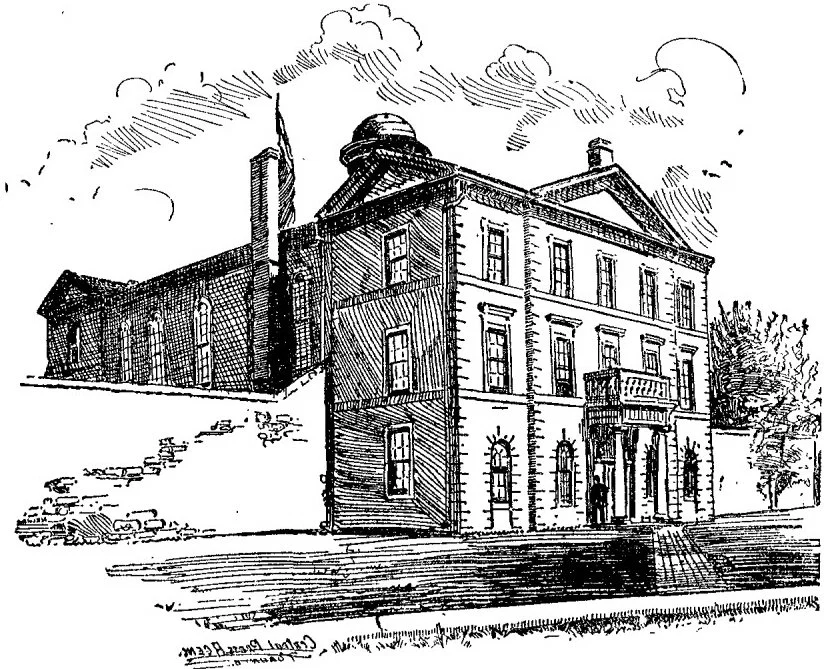
Chatham Jail, in Which William Simpson is Confined.
They give me to eat a piece of bakers’ bread and a basin full of skilly (a sort of old-fashioned oatmeal gruel), generally three times a day. Occasionally they give me a little prison soup for dinner. This is served through a hole in the door just large enough for its admittance. I have not been able, as yet, to bear the smell of the skilly, much less eat it, so pass it back. The jailer says there is no use of his making skilly for me if I do not eat it; so for the last four or five days he has given me bread. He says that I will call for skilly yet, but I don’t think so. I thank God for the bread, and before eating it I ask him to bless it to my use and nourishment. I am sure that he hears my prayer, for never before did food taste so good to me; and while the other prisoners, who have not been confined as long as I, complain of being weak and hungry, I never felt stronger and more satisfied than now.
For thirteen hours out of every twenty-four I am shut up in a small cell just large enough to contain an iron cot. I am glad that they cannot make a cell small enough to shut out the presence of the Saviour, nor keep a man shut up so long that the Lord will grow weary. As long as I have the assurance that Jesus is with me I cannot be made miserable, but can say with Paul that in whatsoever state I am I will be content.
I can see now, why Paul and Silas, even under the most painful suffering, and lying in prison, could sing praises to God; for when God blesses a man, the sufferings inflicted by man are forgotten. I know this by experience. The presence of the Saviour scatters the darkness and gloominess and makes the prison seem like a palace. It makes the bed of iron soft, and my sleep is sweet, and as I arise every morning and dress in the striped garb of the criminal, I am more determined than ever to serve Him even unto death. It may seem strange to some of the readers of the SENTINEL why I should suffer these things rather than keep Sunday. I shall be glad for the privilege of informing any sincere inquirer after Bible truth why I hold to the views that I do. Man has taken away my privilege to preach vocally, but I am thankful that I have still access to pen and ink. Should any desire to inquire further into the reasons of the hope that is within me, I will esteem it a privilege to correspond with them.
WM. SIMPSON.
DANGER IN SUCH APPEALS.
By Editor
[The Christian Register.]
THE Congregationalist, not without good reason, has apprehensions as to the wisdom of settling church quarrels by special legislative acts. It refers especially to a quarrel in the First Church of Lowell, Mass., which has been before the public for some time.
The Lowell church, like most of the Congregational churches of New England, is formed of a church and a society. The society holds the property, and makes contracts with the pastor. The church is a religious organization, existing in association with the society. Membership in the society, according to the laws of the Commonwealth, may be determined by such by-laws as the society may adopt. In the Lowell case there has been a conflict between the church organization and the society.
The resignation of the pastor was first accepted by the society and then by the church. Afterward, however, the church rescinded its action. As the church was unable to secure a sufficient representation in the society to change the result of the society’s vote, the quarrel was carried into the legislature, when a law was passed giving members of the Lowell church the right to membership in the society without the formality of a vote by that organization.
Without attempting to pass at all upon the merits of the difficulty between the church and the society, we believe that it is a dangerous precedent to carry church quarrels into164the legislature. It would be much better to settle them by arbitration, and, if that cannot be done, by the courts. It is a question, too, whether the act of the legislature is constitutional, whether it does not interfere with the right of every religious society to prescribe its own conditions of membership.