The Youth’s Instructor, Vol. 34, No. 24.

BOOKS OF YE OLDEN TIME

The Youth’s Instructor

Jun 16, 1886

S. D. A. Publishing Association · Battle Creek, Mich. · Jun 16, 1886

BOOKS OF YE OLDEN TIME.
“Of making many books,” wrote the wise king, “there is no end.” If Solomon grew weary with “much reading” in those days of limited books, I wonder if he wouldn’t sigh more heavily now could he step into a modern bookstore. What would he think could he see one of the printing-presses of to-day, capable of turning off in an hour between thirty and forty thousand newspapers, printed on both sides, and neatly folded for mailing? In his wildest dreams of improvement, I don’t believe he thought of anything like that.
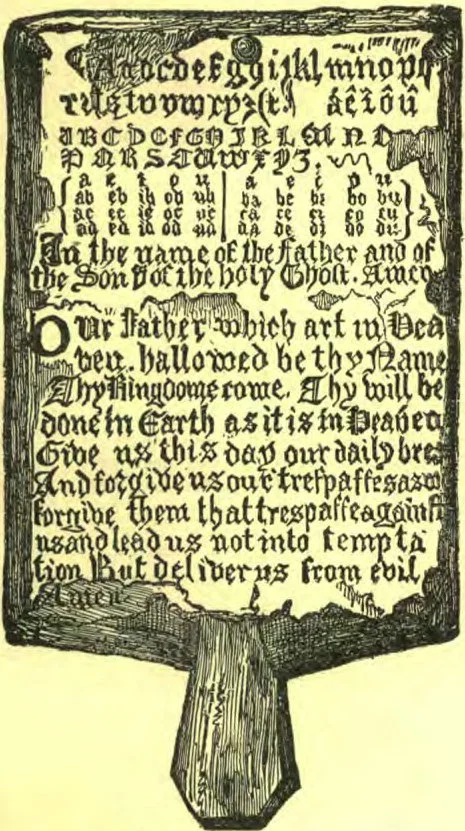
The earliest writing was done on brick, horn, shells, and stone. The bricks, while soft, were impressed with a stamp; and among the ruins of ancient cities, relic-hunters may still find these bricks stamped with curious figures and unintelligible writing. The horn and stones were rudely engraved, and the letters scratched on the surface were often stained with some color. The accompanying picture of the horn-book, with the Lord’s prayer engraved upon it, will give an idea of these first attempts to preserve a record. By and by, thin pieces of board covered with wax came to be used, and were written on with an ivory pencil; but of course, on wax soft enough to take an impression, the writing was soon effaced, and so these were cast aside for the smooth inner bark of trees. Parchment, or the prepared skins of animals, was also largely used, and papyrus, a broad-leaved rush of the Nile. It was often difficult to get parchment, and so the original writing was frequently erased to make way for a new book, in many cases not so good as the original one. These parchment books were not often put up in the square form our books present, but were rolled up; and from this we get our word volume, meaning a roll.
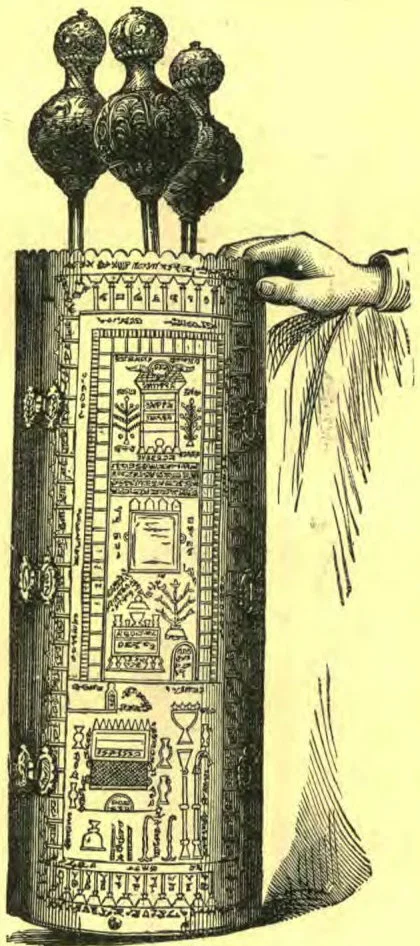
In the little town of Nablus, in Palestine, may be found a very ancient roll. It is owned by the Samaritans, whom you will remember as the mixed race of Jews and heathen inhabiting the Holy Land during the captivity. They form the oldest sect in the world, and perhaps the smallest, numbering, all told, only one hundred and twenty persons. Their famous book roll contains the first five books of the Bible, or the Pentateuch, the only portion of the Scriptures which they believe inspired, and it is said to have been copied by the great grandson of Aaron, thirteen years after the conquest of the Holy Land. Whether this be true or not, it is hard to tell; for strangers are not permitted to handle the sacred roll, and the word of a Samaritan is not always to be relied upon. The roll, a picture of which is given on this page, is kept in a silver case, opening on hinges, and the whole is wrapped in a scarf of red satin. The case is oddly chased with figures of the tabernacle and its furniture.
Frequently the wealthy kept educated slaves, who copied books for them; but at length the greater part of the work fell into the hands of the monks, who in their cloister cells, away from the tumult and bustle of life, peacefully spent their days in keeping alive the feeble flame of learning.
And then came the time of Gutenberg and the first printing-press, when the sun of learning shot his clear beams athwart the land, scattering the mist and the vapor that enveloped the minds of the people. It was a great day for the world when Gutenberg struck off the first sheet from his press! No more were books to be multiplied by the tedious process of the pen.
These early printers, when once the secret of printing was blazed abroad, took great pains to inform the public that their books were printed. One of them said of his book, “It is not written with pen and ink as other books be, to the end that every man may have them at once; for all the books of this story, thus imprinted as ye here see, were begun in one day, and also finished in one day.” And they might justly glory in this “preservative of all arts,” and build air-castles high as the skies, for the most visionary would not have foreseen the perfection to which his beloved art is brought at the present day. W. E. L.

THE BOY WHO WOULD NOT BE WHIPPED.

I MAY as well tell the boys now that my mother was a widow, and a woman of great firmness and decision of character, and of deep piety. When she said anything, she meant it, and yet she was always gentle. One time in the fall of the year, when I was about fifteen years old, I was out in the yard trying to move a heavy stick of timber. I asked my brother, then twelve years of age, to help me; but he stood still and laughed at me, while I almost strained my eye-balls out of my head. At last I lost my temper, and picked up a switch and gave my brother a whipping. That was one thing mother did not allow—she did not permit one child to whip another on her place. When she heard the quarrel, she came out of the house and gave brother a good thrashing, and made him help me put the timber in place, and then said to me:—
“Now, my son, I am going to whip you for whipping your brother.”
I had not had a whipping for a long time, and had begun to feel like a man. I had no idea of taking a whipping. I had violated one of mother’s rules, but the provocation had been a great one to a boy. True, if I had gone five steps to the door, and told mother, she would have adjusted matters, and made brother do what I wanted him to do. Instead of this, I had assumed authority, had taken the law into my own hands, and had done what I knew my mother did not allow.
I said, “Mother, you shall not whip me.”
“But I shall do it, my son,” she replied, and started toward me with a purpose in her eye. I got out of her way; and, bad boy that I was, I turned my back upon home and mother, went off about four miles, and hired myself to a clever, thrifty, well-to-do farmer, for five dollars a month. I told him what had occurred, and how I had been outraged at home, and that, too, by my mother. He told me I had done wrong, and that I ought to go back home; and he proposed to go with me and intercede for me. I was too much like my mother to yield just then. I went to work, but was not happy. I lost my appetite, and could not sleep. I grew worse and worse, but hoped all the time that mother would send for me, apologize, and take me back “scot free;” but I heard nothing from her. I began to feel that I needed mother and home more than mother and home needed me—a lesson some boys do not learn until it is too late. At the end of the week, on Saturday morning, I told my employer I wanted to go home. He approved my purpose, and kindly offered to go with me; but I preferred to go alone. He paid me for my week’s work, but I hated the money. It felt like lead in my pocket, and grew heavier and heavier as I got nearer home, till finally I pulled it out and threw it as far as I could send it into the woods. I did not go home in a hurry. It was four miles, and I was four hours on the way. I hesitated, and turned back, and resolved and re-resolved. The better voice in me said, “Go home, and yield to your mother, and obey her;” but some other thing said, “I would die first.”
Those who have never been in the shoes of the “prodigal son” do not know what an effort that trip home cost the poor boy, nor how long he was making it. When I felt that I could go no further, I knelt down and prayed. That always helped me; I felt firmer afterwards. The last hundred yards before I got home seemed a mile long. If it had been night and no light burning, so mother could not see me, how glad I would have been; but there it was, a beautiful, sun-bright day in the calm, cool November. Oh, how black the bright light makes a guilty heart look! The last hour before day is said to be the darkest hour.
“When I got near enough to hear, my mother was singing—
“Jesus, lover of my soul, Let me to thy bosom fly.”
Ah, that song! What mingled feelings it stirred in my heart, and how appropriate it was! Hope and shame had a struggle, but hope prevailed just as I reached the kitchen door where mother was setting the table for dinner.
“Good morning, my son,” she said, just as pleasantly as I had ever heard her speak in all my life. “Come in,” she continued, “have a seat,” setting a chair for me. “I hope you are well, my son?” That word “son,” it hurt me; I was not worthy of it.
“Very well, I thank you”—I did not venture to say “mother.” “Are all well?” I asked.
“Well, thank you, my son,” and she went on chatting away just as pleasantly as if I were a neighbor who had called in. I wanted to tell her my sin and shame, but did not know where or how to begin. Dinner was soon ready, and mother asked me to dine with her, with all the politeness and deference due a visitor.
When seated at the table, mother said, “Will you please say grace for us?” That was the worst. The words choked me, though I had been accustomed to asking a blessing for a year or two. I could not eat; I was too full already. Mother hoped I was well. I told her I was.
When dinner was over, I said, “Mother, what work do you want me to do?”
“None at all, my son; I do not expect visitors to work for me,” she answered.
“But, mother, I have come home, and want to go to work, and quit this foolishness,” I said.
She replied firmly, “Well, my son, to be candid with you, if you will now take a whipping, you can stay; but if not, you can have your clothes and leave.”
I jumped up and pulled off my coat and vest, and sat down with my face toward the back of the chair, and my back toward mother, and said,—
“Well, mother, I will take the whipping, and stay at home with you. So get your switch and give it to me.”
Then mother burst into tears, caught me in her arms, and said,—
“That will do, my son,” and she dropped on her knees and prayed. Oh, that prayer! It lingers yet like the refrain of some old song, grand with the melody of heaven. I then had a home and a mother, and was about as happy as boys ever get to be in this life. Now, boys, I’m ashamed of my sin to this day, but I am so proud of my mother I thought I would tell you this story.—Selected.

GRASS AND ROSES.

I looked where the roses were blooming, They stood among grasses and weeds; I said, “Where such beauties are growing, Why suffer these paltry weeds?”
Weeping, the poor things faltered, “We have neither beauty nor bloom, We are grass in the roses’ garden, But the Master gives us room.
“Slaves of a generous Master, Born from a world above, We came to this place in his wisdom; We stay to this hour from his love.
“We have fed his humblest creatures, We have served him truly and long; He gave no grace to our features, We are grass in the garden of God.
—James Freeman Clarke. (trans.)

HOW BROOMS ARE MADE.

The first brooms made in this country were manufactured by the Shakers at Watervliet, New York, about the year 1798, and were readily sold at fifty cents apiece. For many years this business was confined almost exclusively to the Shakers, and they gained so good a reputation for making a substantial broom, that even to-day their brooms are, in many localities, preferred to others, although they are really no better.
The first brooms were tied with twine instead of wire, as at the present, and were clumsy and uncouth in appearance. The broom maker, seated in a chair, had his twine wound on a round stick and placed between his feet. The handle for the broom rested upon his lap, and the brush was placed under the twine and rolled round the handle, the twine drawing it down tight, the tension coming from the stick under the feet. We can imagine that in this rude way no very nice broom could be made nor a great many in one day.
But the fertile brain of the Yankee could not long endure such a primitive method of doing things; and a few years later other ways were devised for more rapidly making better and neater brooms. One machine after another was invented, each an improvement on those that had gone before, until we now have a very convenient one, which is used by nearly all broom makers.
The very first thing to be done toward making a broom is to soak the brush in water so as to make it pliable, and then to place it in a tight box, or house, made on purpose, in which a small quantity of brimstone is burned. The smoke of the brimstone bleaches the brush, and makes it look brighter and fresher than before. After bleaching, the brush is laid upon a bench and sorted over for lengths and grades. The longest stalks are called hurl; the next in length, covers; and the remainder, inside, each intended for a different place in the broom.
The hurl stalks are taken by a man or boy, who, with a sharp knife, cuts off the butt-ends of the stalks in such a way as to leave a portion of the splints still fast; these splints are then separated from the part cut off, and, after the coarse center stems are picked out, are ready to form the outside covering of the broom.
Each broom maker has a machine so constructed as to hold his brush ready for the broom, the handle, the tools to work with, and a spool upon which the wire is wound. Everything ready, the broom maker first puts the handle in the barrel of the machine, and secures it with a thumb-screw. The wire, which is on a spool directly in front of the workman, and within easy reach, is then fastened on the end of the handle, and is of such tension as to securely hold the broom. This done, a small handful of brush is placed under the wire, and by means of a foot treadle the handle is made to revolve, and the brush is evenly distributed. Another handful is then placed on one side of the broom, and another on the opposite side, to form the shoulders. The workman then seizes a large, sharp knife, and trims off the stalk ends in such a manner as to form the shoulders, the whole being wrapped with wire.
Over this is next placed another covering, composed of the second length brush, called covers. These are dexterously wound around the handle in such a manner as to cover up the rough edges made by cutting the shoulders. Over this is placed the last finishing coat, the hurl above-mentioned. Some broom makers take great pride in showing their skill by weaving and braiding various devices on the neck of the broom with the hurl, finishing the broom very handsomely.
When the broom leaves the hand of the tier, it appears to be round. It is then pressed in a vice and made flat, ready to be sewed. The man who does this has on each hand a cuff, in the palm of which is a steel plate; and with a long needle pointed at both ends, and the eye in the center, the string is sewed through and through the broom. The ends are then trimmed off, and the broom is done. A smart workman can make from four to five dozen brooms a day, when the brush is prepared for him.
Brooms are manufactured largely in Chicago, St. Louis, Mo., Amsterdam, N. Y., and in many other cities in the United States, and besides there are many small factories all over the country. In some States, brooms are made by prisoners in the state-prisons, and even by the blind in the asylums; but of course these are not so neatly made as those of other factories.
When you select a broom at the store, you should pick for one that is green and fine and not very heavy; and when not using it, you should hang it up, or set it up on the handle, and not on the brush end.
Now, I do not expect that from this brief description of broom making any of you could go to work and make one. You would have to educate your hands to apply the brush, just as you would have to have the practice to do any piece of work. First theory, and then practice. I have given you theory, and leave you to get the practice.
C. S. VEEDER.

SUMMER

All the birds are here again, Winter’s gone, and storm and rain; No more frost, and no more snow; So sing merrily, merrily O.
Now the sun is shining bright, All the day from morn till night; Flowers bloom where’er we go, So sing merrily, merrily O.

BLIND TOM IN INDIA.

Is there one who has not heard of Blind Tom? No one ever listened to his playing without being lost in wonder. But there is another blind Tom. I heard of him for the first time last evening. A native of India, who speaks the English language as well as you or I can, told us about the wonderful continent he lives in.
I was deeply touched when he told us about his blind Tom. Tom is a man who has been blind for many years. He learned to speak English without much trouble, for he had nothing else to do. The teacher who told us his touching story said that Tom heard from him the wonderful story of Jesus and his love, and believed it. He came one day to his teacher and said to him:—
“Teacher, I want something.”
“Well, Tom, what is it?”
“Why, teacher, I want to learn to read.”
“But, Tom,” said his teacher, “I can’t help you.”
“Why not?”
“Because you can’t see, and we have no books for the blind.”
“But teacher, can’t we pray to God to put it into the heart of some one in your country to send us a book in raised print?”
“We can try it,” said the teacher.
But that teacher did not really expect such a book. Tom did. He prayed in earnest.
Two or three months after this interview, a ship came in from America. She brought supplies for the missionaries. But what is that package? It looked like a large book. When opened, it proved to be the gospel according to St. John in raised print for the blind. No one in America had ever heard of blind Tom in India.
The good teacher sent for him at once. “Tom,” said he, “what do you think of this?”
“Think of it?” said Tom; “why, I knew it was coming.”
Then Tom began to learn a letter at a time in raised print. Of course he soon learned to read, for his heart was in it. But that was not enough. He had an object in view. He must tell others the wonderful truth he found in his precious book. He went from village to village, and crowds came to hear him.
It was a strange sight to those heathen when they saw a blind man reading English words with his fingers and translating them into their language.
God blessed his labors among his ignorant countrymen. They sometimes gave him money. Every little while he comes in and says, “Teacher, here is something for Jesus; take it and use it for him.” And then he lays down a rupee. The coin is worth about fifty cents.
To-day, blind Tom in India is giving more money for missionary purposes than many rich men in this country are giving.—Selected.

STUDYING GOPHERS.

THERE are many important matters which turn upon little things, and those who have eyes to see little things will frequently be able to settle and decide questions of the greatest importance.
When Abraham Lincoln was a young lawyer, he was employed in a case in which the question at issue concerned the boundary of a piece of land on a prairie. As there were no trees or stones on the prairie, the surveyors used to fix the corners of lots by shoveling up heaps of earth; but the gophers, or prairie squirrels, also threw up little heaps of earth over their houses, and so in this case the question was whether the mound had been heaped up by the surveyor or the gopher.
Abraham Lincoln endeavored to go to the bottom of the matter, and sent to New York for books on natural history, and studied up the habits of the prairie squirrel; and when the trial came, he went into court and told the judge and jury the difference between the surveyor's mound and the gopher's. The gopher, careful of the comfort of his little family, used to beat down the roof of his house firmly, and make it slope to a point in the middle, so that the rain would run off. The surveyor had no such anxiety, and so would leave his mound flat or irregular on the top. This little difference of course had a very important bearing on the case in hand.
When the trial was over, the judge, Stephen A. Douglass, went to Lincoln's office, and found him with his books, still studying the habits of the gopher. They spent the evening together over the books, little thinking that in future days they would be pitted against each other as antagonists, and that one of them would be president of the United States. But the painstaking care of Abraham Lincoln, which led him to study the habits of the gopher to win his case at law, went with him all his life, and made him a faithful and successful man.—Sel.

THE ART OF LISTENING.

WE learn more by listening than by talking, as a cistern fills up by what runs into it, and not by what runs out of it. Yet few good listeners can be found. To be a good listener does not mean that we should never speak. A cistern that never gives out is not only useless, but its contents grow foul. To be a good listener it is necessary to keep the mind on what is being said, and not let it wander all over the world. Some persons are continually saying what shows that they have not been listening at all.
Never talk, except to ask a question or show approbation, when some one from whom you can learn anything is willing to talk.
If you can't see what is meant, after the speaker has paused, politely ask for further explanation. And when the conversation is over, go to any book or dictionary that you may have at hand for more light.
Never, in the presence of others, correct persons older than you are. You may be wrong. You may hurt their feelings. If you think they are mistaken ask them privately, if you know them well enough; and they will thank you.
When they cease speaking, if you have anything to say, proceed with it, and be sure not to carry it too far. The beauty of conversation is not to wear one thing out, but to have new subjects springing up all the time.
When the company breaks up, ask yourself these questions:—
What did I hear that was new to me, and who said it?
What did I find was wrong that I had thought was right, and what right that I had thought was wrong?
Listen in this way, and you will learn to the last day of your lives.
But those who understand the art of listening are not so numerous as those who can merely keep still.
And those who can keep still are not nearly so many as those who cannot.—Christian Advocate.

LIGHT

THE purest thing that nature knows, The purest thing that God hath shown, Is light, that paints the blushing rose, And vails the Father's blazing throne. —L. L. Turney.

IT'S WHAT YOU SPEND.

“It's what thee'll spend, my son,” said a sage old Quaker, “not what thee'll make, which will decide whether thee is to be rich or no.” The advice was right, for it was but Franklin's in another shape, “Take care of the pennies, and the pounds will take care of themselves.” But it cannot be too often repeated. Men are continually indulging in small expenses, saying to themselves that it is only a trifle, yet forgetting that in the aggregate it is serious, that even the sea-shore is made up of petty grains of sand. Ten cents a day is thirty-six dollars and a half a year, and that is the interest of a capital of six hundred dollars. The man that saves ten cents a day only, is so much richer than he that does not, as if he owned a life estate in a house worth six hundred dollars. Every sixteen years ten cents a day becomes six hundred dollars; and if invested quarterly, does not take half that time. But ten cents a day is child's play, some will exclaim. Well, then, John Jacob Astor used to say, that when a man who wishes to be rich, has saved ten thousand dollars, he has won half the battle. The advice here given should be dearly cherished by every little boy and girl in our land. Much good would result therefrom.

IMPORTANT BIBLE SUBJECTS.

LESSON 11.—UNDER THE LAW.

[NOTE TO THE STUDENT.—Do not consider the lesson learned until you can give at least the substance of every text, with the correct reference for each. The references in black letters indicate those texts that should be committed to memory. A little diligent application each day will enable you to learn them, although this need not be considered a test of scholarship.]
  1. What exhortation does Paul give in Rom. 6:12?
  2. What is sin? 1 John 3:4.
  3. Then what does the apostle really warn us not to do?
  4. Where is this exhortation repeated? Rom. 6:13, first part.
  5. If people heed this exhortation, what will have no dominion over them? Rom. 6:14, first part.
  6. If a person sins, what does he transgress?
  7. Then if sin has no dominion over him, what does he keep?
  8. What does Paul say to those who thus refrain from sinning? Rom. 6:14, last part.
  9. Will those sin who are not under the law but under grace? Rom. 6:15.
  10. Speaking to those who are not under the law, to what does Paul say they had formerly been subject? Rom. 6:17.
  11. But now, being not under the law, from what are they free? Rom. 6:18.
  12. Then what must be meant by being “under the law”?
  13. What do those do who are free from sin, or who, in other words, are not under the law? Rom. 6:18, last part.
  14. And what is righteousness? Ps. 119:172.
  15. Then if people are not under the law, what do they do?
  16. Under what must they then necessarily be? Rom. 6:14, last part.
  17. Why? John 15:4, 5; Heb. 4:14–16.

NOTES.

“Sin is the transgression of the law;” therefore when Paul warns us against letting sin reign over us, he warns us against transgressing the law. And since when a person sins, he transgresses the law, it follows that when sin has no dominion over him, he obeys the law.
In speaking to those who are not under the law, Paul says that they had formerly been the servants of sin (Rom. 6:18), but that now they are “made free from sin.” Now if when they are not under the law, they are free from sin, it necessarily follows that when they were under the law, they were servants of sin. “Under the law,” therefore, is equivalent to being in a state of sin. And so if people are not under the law, they keep the commandments. But the commandments can be kept only by the help of Christ; and this help is given by the grace of God (Heb. 4:16); therefore those who are not under the law are under grace.

THE CREATOR’S WATER-WORKS.

A large proportion of this world is water, . . . which is the most wonderful element we know, and its wonders are as yet but dimly understood. Without its presence in our atmosphere, everything must be parched to aridity and desolation; hence some method is needful by which water can be constantly lifted up into the air. This can be done by the sun’s drawing water directly from the oceans and seas; but the land needs water still more, and so the habitable earth is covered with the most marvelous system of water-works imaginable.
Says a writer in Science for All, “All plants give off their moisture from their leaves, even though this is invisible to the eye, just as our skin is always perspiring, though the sweat may not stand in drops. This can be seen if a plant is grown under a glass shade in such a manner that no evaporation can be given off by the earth or water in which it is grown. Nevertheless, in a few hours the inside of the glass will be dimmed by the moisture given off by the leaves, which has condensed on it. Calculations have been made as to the amount of water thus perspired by plants. A sunflower, only 3½ feet high, with 5,616 square inches of surface exposed to the air, gives off every twelve hours twenty to thirty ounces avoirdupois of water in this form—which is more than a man does. Most of the common agricultural plants, such as wheat, peas, and clover, exhale during the five months of growth more than two hundred times their weight of water. The Cornelian cherry is still more remarkable. In the course of twenty-four hours it exhales water equal in weight to twice that of the whole shrub. Naturally, the degree of light, warmth, and dryness of the air affects the amount of fluid given off, as well as the age and texture of the leaf. However, a calculation of the amount of fluid perspired by an acre of cabbages may be curious. If the cabbages are planted in rows 18 inches apart and 18 inches from each other, it is estimated that in twelve hours no less than 10 tons, 4 cwts., 3 quarters, and 11 lbs. weight of water will have been insensibly perspired by their fleshy leaves.”
It is estimated that a good-sized tree throws off eight barrels of water into the air in a day, and that an acre of forest throws up eight hundred barrels of water in twenty-four hours.
This water is drawn from the earth, and in it all the elements of nutrition are held in solution. It brings all these up into the tree or plant, and leaves them there, thus adding to its substance, while the pure, distilled water passes off to cool the air, condense again into rain and dew, and thus return to the earth once more.
Suppose this process continued the whole year round? Then in the winter the face of the earth would be buried in snow and ice. So in the autumn the evaporators, or leaves, drop off, the water-works cease to operate, and the machinery stands still till spring returns.
When a country is stripped of vegetation then the water is evaporated directly from the soil; the clods grow dry, the sands become arid and desert, the air is dry and hot, and death and desolation brood around.
Hence all plants and trees are ingeniously devised water-works, and from the forest trees to the smallest herbs and grasses, all operate to moisten and cool the air, fertilize the earth, and make it fit for the habitation of man. Be careful, then, how you cut down the Lord’s water-works.—The Little Christian.

ONLY A BROOK.

THAT brook is hurrying away, splashing, and dashing, one crystal ripple mirroring the next, rounding gracefully a ledge, lingering and hiding in a deep cool recess, then flowing out again to chatter away as it meets a bank of pebbles, and then finally disappearing beyond a clump of birches. A capitalist comes along, and sighs as he exclaims, “How much wasted power here!” If only guided, it might unite with another brook, and then what a hum of the spindles would be heard where bees and birds now make the only music!
“Only a boy!” we say. “Only a girl!” It is just youth with its thoughtless fun, its vivacity, its energy, its enthusiasm, its intense vitality. Save, develop, use these forces. Guide these brooks. No service to society and to the church is more important than that of the man or woman who saves mental and moral power, gathers it up, and directs it toward the best ends. No work is grander than that person's who encourages a boy's industry, who teaches him to be honest, manly, temperate, pure; who stimulates his sense of duty toward God, and helps him to be reverent, prayerful, loyal. Only a brook, but to how many useful wheels this now wasted power might be attached, and how effectively it might drive them!—S. S. Journal.

Keeping a Sunday School Growing and Vital

A SUCCESSFUL school should be an increasing school. Not so much that its number should increase, as that there should be new faces to be met, new hearts to be touched, new hands to be shaken. In every school there is the decreasing side. Scholars leave, because of removal, or because they think they have outgrown the school; and some are taken away by death. New scholars should be obtained to take their places. A large school is not necessarily a successful school.

Character Formed in Early Childhood

It is in childhood that we find the germs of a man's true character, and commonly it is found that both his character and his course in life are given their supreme direction before he is seven years old.—H. C. Trumbull.

BELIEVE AND TRUST.

BELIEVE and trust. Through stars and suns, Through all occasions and events, His wise paternal purpose runs; The darkness of His providence Is star-lit with benign intents. —Atlantic.

NATURE'S FANCIES.

An examination of Nature's handiwork reveals her wonderful architectural powers; that she not only builds grandly and beautifully, but as often curiously. We have already, at different times, given you specimens of her singular designing, and there is seemingly no end of such, prominent among which are the Giant's Causeway in Ireland, the Natural Bridge in Virginia, the profile of Washington in the White Mountains, etc. A writer in a recent exchange notices something which has the appearance “of a gigantic, glittering white cross, reposing on the somber slope of a distant mountain-peak,” in crossing the Rocky Mountains at a certain point. He says “the cross is made by two intersecting gorges so deep that the snow never melts in them.” And he further remarks:—
“In our Western country many a traveler has been startled by seeing, not far off, the peaks, turrets, and roofs of a walled city, such as was common in the Middle Ages in Europe. A closer inspection proves the supposed city to be nothing but a mighty mass of rock, so marked and scored as to appear the handiwork of man.
“Very recently an explorer in South America came upon a startling deception of somewhat the same order. While crossing the Andes, from Chili, his eye suddenly fell upon two series of towering waves, chasing each other over the mountains, and each moment threatening to break in an overwhelming flood over the whole country.
“An exclamation of alarm broke from his lips before he had time to assure himself of the impossibility of the waves' being real. An examination proved them to be strata of rock, upheaved and curled into their singular form during some frightful convulsion of Nature.
“The passage-way between these waves of stone called the Gorge Camataqui, is so twisted and grooved that the wind plays most extraordinary pranks in it. When the wind is comparatively still elsewhere, it will often be whistling and shrieking furiously in there. At other times it will gather great clouds of dust and keep them whirling about over the gorge for days, completely obscuring the sun.”
And so, had we space, we might enumerate, almost indefinitely, the strange, impressive outlines Nature assumes in her workmanship.

A NEWSPAPER OFFICE IN JAPAN.

THE office of the Nichi-Nichi Shimbun, a Japanese newspaper, is thus described: “The feature of the Shimbun office was its type case—for there was only one of body type. And such a type case! It is divided, for utility, into two sections, sloping toward an alley five feet wide. Each section is four feet wide by thirty feet long—four by sixty feet. There's a new case for you! This is divided into small compartments or boxes, into which the type is laid in regular piles, several piles in a box, with the faces all toward the compositors, who are mostly boys, big and little. Each holds a wooden ‘stick,’ with brass rule. The type are all of a size; the ‘stick’ is not set to the measure of the column, which is twenty ems pica, but to about half the measure, it being the business of the other workmen to impose the lines in columns, take proof, and make up forms.
“The type-setting was equally curious. Armed with ‘sticks’ and rule and copy, the dozen compositors read the last in an earnest, sing-song way, each rushing to some box, far or near, for the needed letter, then back ten or twelve feet to the needed one; all are on the lively move, rushing and skipping to and fro, right and left, up and down, singing the copy, catching one letter here, another there, prancing and dodging, humming and skipping—a perfect maze of noise and confusion, yet out of confusion bringing printed order! It was a sight to be seen.
“‘How many different characters are there in this case, anyhow?’ we asked our guide. Then our guide asked the printers, and none could answer better than say: ‘Nobody knows, sir. Nobody knows—many thousand.’ Later on we repeated the same question to a more intelligent person, who said: ‘At least fifty thousand.’ That will account for the remarkable size of the case, and the racing to and fro of the compositors.
“Just why they sing their copy all the while was not made so clear, other than the remark that it was the custom. Tokio monopolizes the Japan newspaper business, there being only one other point—Kofu—in Eastern Japan where newspapers are printed. The masses of the people are able to read in their own way, but comparatively few can grasp the full flow of Chinese characters. In point of illiteracy, the statistics place this nation at only seven per cent, or next to Bavaria, which is the lowest on the list.”—Pall Mall Gazette.
Continue reading: HOW THE OYSTER MAKES HIS SHELL