The Youth’s Instructor, Vol. 34, No. 24.

BOOKS OF YE OLDEN TIME
Earlier text: BOOKS OF YE OLDEN TIME

HOW THE OYSTER MAKES HIS SHELL.

Not the least of the wonders of that marvelous book of nature is the formation of the oyster-shell. If you would take a pair of these shells in your hand to examine while reading the following description of their process of growth, as published in the May number of Popular Science Monthly, it might awaken in some minds a desire to know more of God’s work of creation. The editor of this magazine thus writes:—
“Prof. Samuel Lockwood, in a recent lecture before the New York Microscopic Society, thus answers one who wishes to know how the oyster makes his shell. Beginning with the hinge-end, at a point of the shell above the hinge, he says, ‘a small plate, or single scale, now represents each valve, and that is the first season’s growth. The next season a new growth, or plate, shoots out from underneath the first one, just as shingles do. The oystermen call these laps, or plates, “shoots;” and they claim that the number of shoots indicates the years of the oyster. They certainly do contain a record of the seasons, showing the slow-growing and the fast-growing seasons. . . . I have likened these shoots to shingles. Now, at the gable of a house, the shingles may be seen edgewise. So on the side of an oyster-shell is a series of lines. This is the edgewise view of the shoots, or season-growths.
“‘Another factor’ in solving the age of the oyster “‘is the purple spot, or scar, in the interior of the shell. It is the place of attachment of the adductor muscle,” that which serves to draw the valves together. This muscle was first attached “‘close up to the hinge. Had it stayed there until the shell had become old, how difficult would be the task of pulling the valves together!—the leverage to be overcome would be so great. [Here the boys and girls have an opportunity of philosophizing on the use of the lever]; for we must bear in mind the fact that at the hinge-end, the valves are held by this black ligament, which is, in life, elastic, swelling when the shell opens, and being compressed when the animal draws the valves together. So, with every year’s growth, or elongation of the shell, the mollusk moves the place of attachment of the muscle onward, that is, in advance farther from the hinge. As it does so, it covers up with white nacre [a substance with which some shells are lined] all the scars that are back of the one to which the muscle is now attached.’
“To make the likeness of the oyster’s shoots, or season-growths, with the shingles on a roof complete, ‘it would be necessary for the bottom shingle on the roof to underlie the whole series, and reach even to the roof-tree, or ridge-pole. Then the second shingle from the gutter must in like manner underlie all the rest of the series; so of the third, and so on with the rest. In this way lie the shoots or laps of the oyster’s shell. The last one deposited underlies them all, and every one terminates at the channel in the bill; thus this groove in the bill contains a series of transverse lines, each one marking a season, or a year.’ So that from the way the shell is made “we get really four factors for the solution of the question, ‘How old is the oyster?’”

WHAT A SPIDER DID.

A SPIDER, as shown by means of actually weighing it and then confining in a cage, ate four times its weight for breakfast, nearly nine times its weight for dinner, thirteen times its weight for supper, finishing up with an ounce; and at 8 p. m., when released, ran off in search of food. At this rate, a man weighing 160 pounds would require the whole of a fat steer for breakfast, the dose repeated with the addition of a half-dozen well-fatted sheep for dinner, and two bullocks, eight sheep and four hogs for supper, and then as a lunch before going to his club banquet, he would indulge in about four barrels of fresh fish. Ex.

AN AFRICAN PRODIGY.

The Hamburg Zoological garden has received a full-grown specimen of the canis pictus, or spotted wild dog of Africa. The creature is a native of western Transvaal, and in appearance, an astonishing hybrid between a hound and half a dozen other animals. He has the size and general form of a deerhound, the tail of a fox, the black snout of a hyena, and the spots and stripes of a leopard. His voice is a sort of coughing howl, and he paces his cage all day long with the restlessness of a captured wolf. —Felix L. Oswald.

“THOU LORD SEEST ME.”

I WONDER how many of the children stop to think that God always sees them, every hour and every minute? There is not a single thing that they do or say, but what the Lord knows all about it. It seems strange that this should be so, but it really is, for that good book—the Bible—which always tells the truth, says it is so. It says so a good many times, and very plainly, so that we know that it must certainly be true. Here is one text that says: “Neither is there any creature that is not manifest in his sight; but all things are naked and opened unto the eyes of him with whom we have to do.” Heb. 4:13. Then every creature, you see, is manifest in the sight of God, and every thing is open and naked, right before his eyes, so that he sees them all the time. God not only sees the earth, and big cities, and great men, but he sees and notices all of the little things, the birds and cattle, and children. There is not one so small, nor so poor, that the Lord does not see him. So the Bible says again: “Thine eyes are open upon all the ways of the sons of men.” Jer. 32:19.
Not only does God see us, but he sees right into our minds and hearts, and knows just what we are thinking about every minute, for the Bible plainly says so. Here is one text: “For I know the things that come into your mind, every one of them.” Ezek. 11:5. Not a single thing then, children, comes into your mind, but what the Lord knows all about it. How careful you ought to be, therefore, not even to think a wrong, mean thought, much more to do anything wrong. But let us read in the Bible again, in the 139th psalm. “O Lord, thou hast searched me, and known me. Thou knowest my down-sitting and mine uprising; thou understandest my thought afar off.” The Lord sees you when you sit down, and when you rise up, and understands every thought of yours. “Thou art acquainted with all my ways.” Verse 3. But a little further: “For there is not a word in my tongue, but, lo, O Lord, thou knowest it altogether.” Verse 4. The Lord knows every word you speak.
But can the Lord see us in the night? Can he see us when it is dark in our rooms? Oh, yes. The Lord can see just as well in the dark as he can in the light. That seems wonderful, does it not? Yet it is so; for the Bible says, “If I say, surely the darkness shall cover me; even the night shall be light about me. Yea, the darkness hideth not from thee; but the night shineth as the day; the darkness and the light are both alike to thee.” Verses 11, 12. Then, we cannot hide away from the Lord in any place. Suppose you go up into your bedroom, shut the blinds, and put down the curtains, and close the door, can the Lord see you there? Yes, indeed; just as well as though you were right outdoors. Now you blow the light out, and get into bed. It is all dark. Can the Lord see you? Yes; just as well as when the lamp was burning, and he knows just what you do then, and just what you think. Do you know of any animals that can see in the dark? I asked this question to a lot of little children the other day, and they immediately named the cat, and the owl, and the horse, and other animals, and that is so. You know several kinds of animals that can see even better in the night than they can in the daytime. Now, who makes them to see in the dark? Why! the Lord. Then if the Lord can make others to see in the dark, of course he himself is able to see in the dark. So we want always to remember this, wherever we go, whatever we do, and whatever we say, that the Lord sees it all, and he knows all about it, every minute. We all say that we believe this, but I am afraid very few children realize that it is so.
Now, you turn to Genesis, the 16th chapter, and there you will read about Hagar, how she left her home once, and went away out into the woods. She felt that she was entirely alone, that nobody was with her. She sat down and cried. But pretty soon the Lord spoke to her. She had not seen him before, but he had seen her all the time. When she looked up, and saw him, she exclaimed: “Thou God seest me.” Verse 13. Then she realized for the first time that the Lord did actually see her all the time. And it is just so with us, children; we do not realize it, but it is true, for all that.
So we read about Jacob, in Gen. 28:16. How he went out in the wilderness and laid down all alone in the dark one night. He believed in God just as we do, but he did not realize that the Lord was there. In his dream, he saw the Lord, and saw the angels of God coming to him. When he woke up, he exclaimed: “Surely the Lord is in this place, and I knew it not.” The Lord was there all the time, though he did not realize it. And just so with us, children. The Lord sees us every minute, and we should try to realize it. So, if you are tempted to do some naughty thing, to do something secret, something that you do not want your father or your mother to know, something that you would be ashamed to have anybody know, just stop and think a minute, that the great God sees you just then, and knows just what you are doing. Do this, and it will help you to overcome evil, and to keep yourselves from sin!
D. M. CANRIGHT.

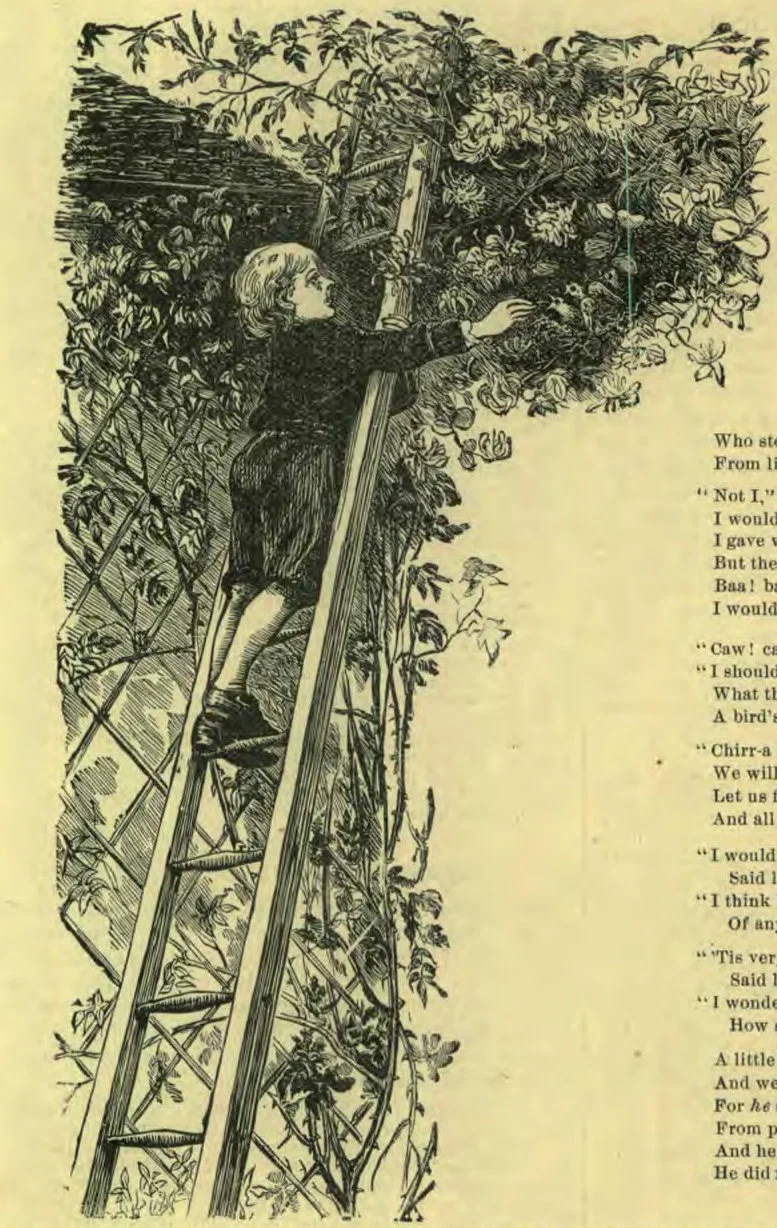
WHO STOLE THE BIRD'S NEST?

“Tow-whit! to-whit! to-whee! Will you listen to me? Who stole four eggs I laid, And the nice nest I made?”
“Not I,” said the cow, “Moo-oo! Such a thing I'd never do. I gave you a wisp of hay, But didn't take your nest away. Not I,” said the cow, “Moo-oo! Such a thing I'd never do.”
“Bob-o-link! Bob-o-link! Now what do you think? Who stole a nest away From the plum-tree to-day?”
“Coo, coo! coo, coo! coo, coo! Let me speak a word too; Who stole that pretty nest From little yellow-breast?”
“Not I,” said the sheep; “oh no! I wouldn't treat a poor bird so; I gave wool the nest to line, But the nest was none of mine. Baa! baa!” said the sheep; “oh no, I wouldn't treat a poor bird so.”
“Caw! caw!” cried the crow, “I should like to know What thief took away A bird's nest to-day?”
“Chirr-a-whirr! chirr-a-whirr! We will make a great stir! Let us find out his name, And all cry, ‘For shame!’”
“I would not rob a bird,” Said little Mary Green; “I think I never heard Of anything so mean.”
“'Tis very cruel, too,” Said little Alice Neal; “I wonder if he knew How sad the bird would feel?”
A little boy hung down his head, And went and hid behind the bed; For he stole that pretty nest From poor little yellow-breast; And he felt so full of shame He didn't like to tell his name.
—Lydia Maria Child, adapted.

Love Begets Love: Kindness Returned in Kind

If you love others, they will love you. If you speak kindly to them, they will speak kindly to you. Love is repaid with love, and hatred with hatred. Would you hear a sweet and pleasing echo, speak sweetly and pleasantly yourself.

Letter Budget.

The letter box has got so much the start of us we don’t see any way of catching up with it only by making the less interesting letters quite short. We don’t like this way best when we have a good variety in the letter-box; but there is such a sameness in some of the letters we now have on hand, that it will be better every way to cut them down. Some of you have never written before, but next time you will find it easy to write something which we will have room for. What you have all written is good of itself, but it lacks variety; so you must be treasuring up all the good things you can, to tell us next time you write. We pray often for these dear lambs of the fold, that they may all be securely sheltered from the coming storm. We give you first a letter from—
LILLIAN A. JORDAN, a little girl nine years old, who writes from Aroostook Co., Maine. She attends day school, and Sabbath-school, and her father superintends the latter. She has a little brother five years old. A series of meetings was just begun there. She is trying to be a good girl.
ASHTON LEWIS, of Webster Co., Ky., had only been keeping the Sabbath three months when he wrote his letter. He is eleven years old. Sabbath-school is held at his home, and he enjoys it very much. He learns his lesson in the INSTRUCTOR, and he likes to read the paper. His day school had closed, so he was helping his father about his work.
WESLEY O. BRISTOW wrote his letter from Macon Co., Mo., when he thought the letter box was nearly empty. There are twenty-nine members in his Sabbath-school. He had just finished Lesson Book No. 2. He loves to read the INSTRUCTOR. As his school was out, he employed his time chopping wood. He is twelve years of age.
MAY A. MAXWELL, of Carroll Co., Ind., who is seven years of age, is regular at Sabbath-school and studies Book No. 1. Her papa is her teacher. She has no sister, but she has ten brothers, and all but the oldest keep the Sabbath. She sends love to the INSTRUCTOR family.
NEXT comes a letter from DUDLIE DORTCH, of Henry Co., Tenn. He writes: “I am eight years old. I have one brother. His name is Freddie, and he is five years old. We all go to Sabbath-school. I study in Book No. 3, and Freddie studies in No. 1. We thank you very much for the good little paper. I worked for papa the week before Christmas, and got twenty cents for a Christmas offering. We have a mare and a filly, seven head of sheep, and one little lamb. We have two cows. The oldest is named Pet because she is such a little pet. Since I began my letter, papa and four others have been prosecuted for working on Sunday, and will be tried soon. I am afraid papa will have to go to prison. If he does, I want the INSTRUCTOR family to pray that the Lord may preserve him.”
Because Dudlie was in trouble, we thought you would like to read all of his letter. It is more than four months since his letter was written, but we do not know whether his father’s trial has come off yet or not. Surely you will remember these dear friends, and any others who may be exposed to prison-life, and pray that God may deliver them from evil.
SPERRY H. WINN, writing from Grant Co., Wis., says his uncle sends him the INSTRUCTOR now, but he is saving his money to subscribe for it himself. His mother keeps the Sabbath, and he hopes his father will soon. Says he wants to keep it too, so he can live in the new earth. He has three brothers, and two of them had the chicken pox at the time he wrote his letter, and he had such a severe burn on his own hand that he got some one to copy his letter. We hope they are all well now, and faithfully keeping God’s law.
BERTIE E. HOBSON, who lives in Daws Co., Neb., says he likes the INSTRUCTOR so well he wants to write for the Budget. He likes his home, which is in a hilly country, surrounded by pine forests. His father has held Bible readings, and now several are keeping the Sabbath. He has four sisters, but no brothers. He likes to read the INSTRUCTOR, and would like to see all its readers together. He is ten years old. Says they have five cows and two calves.
HARLEY NOURSE, a little boy about eight years old, writes from Rome, N. Y. He is a little student both at school and Sabbath-school, and wants to be a good boy. He says: “We used to live on a farm, where we kept cows and horses, some hens, and a cat. I don’t think you could read my writing, so my sister will copy this for me.”

You have reached the end of this edition.

The Youth’s Instructor · Jun 16, 1886