Your ShelfYour Projects

The Youth’s Instructor, Vol. 43, No. 3.

PORT NAGASAKI

The Youth’s Instructor

Jan 17, 1895

S. D. A. Publishing Association · Battle Creek, Mich. · Jan 17, 1895

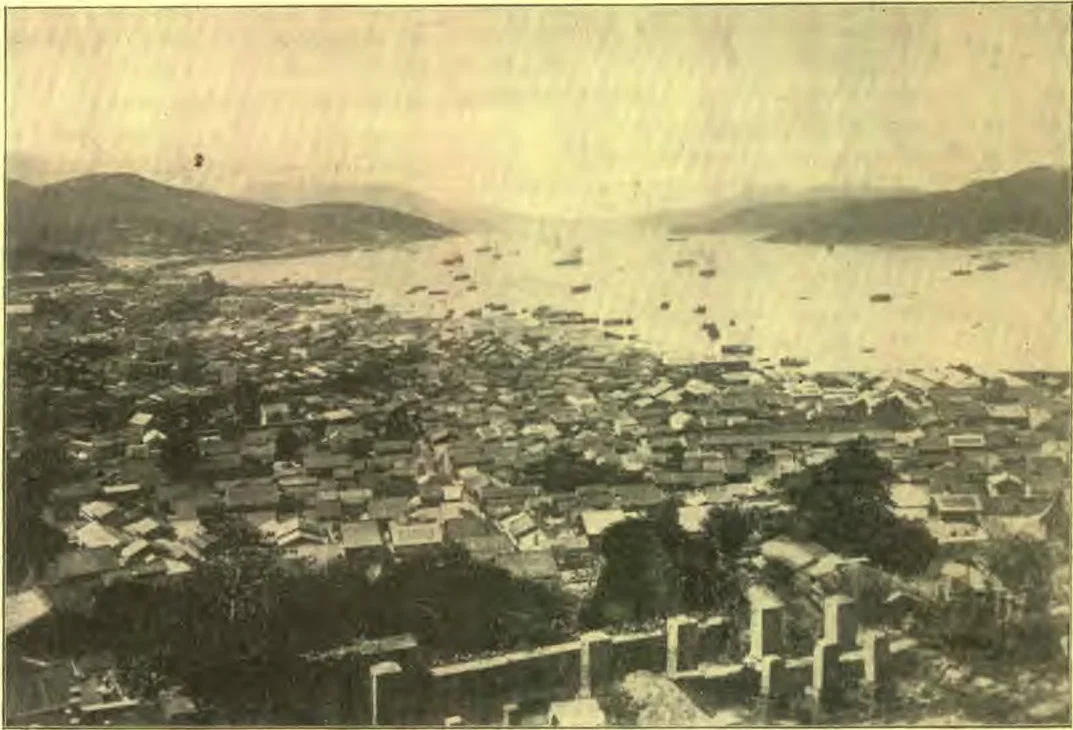
PORT NAGASAKI.
The three best-known cities in Japan are Yeddo, Kioto, and Nagasaki. Yeddo is the old name of Tokio. It was the governmental station of the shoguns (ministers), and it is the present capital. Kioto was anciently the capital, where, for hundreds of years, the successive emperors lived; while Nagasaki was famous as the great and only seaport. Many interesting incidents and stories are related about this place; for it is always one of the topics of every mother’s stories to her children.
PORT NAGASAKI, JAPAN.
Nagasaki is one of the ports which was opened to foreign commerce by the treaty of 1858, in July 1, 1859. Previous to 1859, this was the only place where the foreigners resided and traded with the Japanese. The very first intercourse between Japanese and foreigners took place in this town, in 1545, by the visit of a company of Portuguese. The Dutch and the British East India Company followed them, in 1600 and 1613 respectively. They all alike established commercial relations. It was, for a long time, the central station of Xavier and other Catholic missionaries, whose first visit occurred as early as that of the Portuguese did, as above mentioned. Those who wished to know about the foreigners and their countries, and those who had a desire to learn the sciences and languages, be it from curiosity or real interest, were obliged to visit this place, before 1859, notwithstanding various difficulties which must be met with. Thus being famous in history, the name Nagasaki, as the pioneer city of civilization in Japan, became well known to the people, and even to foreigners.
Nagasaki is situated on the peninsula in the northwest of the island Kiusiu, which is the third largest island of the Japanese archipelago, and located southwest of the main island, or Hondo.
The harbor is formed by a beautiful inlet of the sea, which stretches northward a distance of about seven miles, and is but a mile in width. Both sides of the inlet are inclosed by delightful hills, about one thousand five hundred feet in height. Those hills are broken into varying ridges and beautiful valleys. A number of the most picturesque-looking isles, crowned with charming evergreens, are scattered here and there.
The city lies on the north side of the bay, being about two miles long and one and one-half miles wide. It is laid out with great regularity and neatness. The streets cross each other at right angles. They sometimes ascend the hills, and frequently terminate in steps.
Immediately to the south lies a small artificial island, called Desima, connected with the mainland by a bridge. This was occupied by the Portuguese from 1637 to 1639. Afterward, for about two hundred years, it was the trading-post of the Dutch traders. In 1639 a decree was issued by the government that all the foreigners should leave the country. This was brought about by the intrigues and political intermeddlings of Catholic missionaries. The Christian faith was then prohibited. Many missionaries and native Christians were killed, and all the rest were expelled from the country. A few Dutch traders, however, were permitted to remain in this small island, under rigorous restrictions.
The foreign settlement lies to the south of the native town, on ground which inclines considerably toward the sea. The British, German, French, Russian, and Portuguese consulates occupy the hilly ground back from the bay.
The great Nagasaki dock deserves mention here. The Prince of Hizen, who governed the province in which Nagasaki is located, commenced to build it in 1865, and in 1879 it was rebuilt by the government. It occupies a deep gorge between two hills at Tatagami. On the western side of the firth, opposite the town, a few hundred yards to the north of the dock, are the engine works of Akaonura.
The Nagasaki hospital, which was established in 1861, being the oldest one in Japan, is located on a beautiful hilltop. It has grand buildings, and commands a fine view of the scenery round about.
There is a normal school, a high school, a commercial school, and an agricultural school here. The government is in charge of these schools, which are attended by hundreds of young men. There are also many children’s schools. Children over six years of age are obliged to attend some one of them. In the foreign settlement, five colleges for boys and six for girls were founded. They are now conducted by the foreign missionaries and the natives, according to the Western educational system. There are many young men and women who graduate from Nagasaki every year, prepared to fight on the Lord’s side. There are also many private schools where the languages are taught. Thus facilities for education are furnished not only to those who desire it, but even to those who do not.
The principal exports to China are seaweed, dried fish, and the like. Coal, camphor, tea, and tobacco are exported to Europe and America. Most of the coal is brought from the Takashima mines, about eight miles distant. It makes good coke, and is chiefly consumed by war vessels and merchant steamers.
The principal imports are cotton, woolen goods, sugar, and oils.
Nagasaki has regular steamship communications with Bachian, Kobe, Yokohama, and many important foreign seaports, as Shanghai, Bombay, Ninsen, etc. It is the terminus of a submarine telegraph line from Vladivostok. There exist telegraphic communications from here with every part of the country.
I. M. KAWASE.

THE LAND OF "PRETTY SOON."

I know a land where the streets are paved With the things we meant to achieve; It is walled with the money we meant to have saved, And the pleasures for which we grieve; The kind words unspoken, the promises broken, And many a coveted boon, Are stowed away there in that land somewhere — The land of "Pretty Soon."
There are uncut jewels of possible fame Lying about in the dust, And many a noble and lofty aim Covered with mold and rust; And O, this place, while it seems so near, Is farther away than the moon; Though our purpose is fair, yet we never get there— The land of "Pretty Soon."
The road that leads to that mystic land Is strewn with pitiful wrecks, And the ships that have sailed for its shining strand Bear skeletons on their decks. It is farther at noon than it was at dawn, And farther at night than at noon; O, let us beware of that land down there — The land of "Pretty Soon."
— Ella Wheeler Wilcox.

Travel Among the Lapps.

Away up in the extreme north of Europe, bordering on the dreary Arctic Ocean, lies a country about twice the size of the state of Missouri, with a scanty population, not exceeding one hundred and fifty thousand. Half of this country belongs to Russia, and the remainder is shared in nearly equal proportions between Norway and Sweden. This is Lapland, which bears the unenviable reputation of being the most forbidding inhabited region of the globe, consisting either of rugged mountains, some of them covered with perpetual snow, or of vast tracts of moorland waste. The people who inhabit this desolate country are divided into three classes,—the mountain, the sea, and the river Lapps. The first-named are also the least civilized—in point of fact, are nomads, having no wealth but their herds of reindeer, no habitation save tents made from the skins of these useful animals, and no fixed place of abode, but from year to year follow their herds wherever pasturage is most abundant.
The river Lapps have advanced a stage farther in the road to civilization, have fixed habitations, though these are but huts of earth, and possess considerable skill in several manufactures. They make their own boats, manufacture their own clothing, knives, weapons, and fish-hooks. The wandering mountain Lapps,—also known as the “three-duty Lapps,” from the fact that they pay taxes to the governments of Norway, Sweden, and Russia,—are often extremely degraded.
The sea Lapps have progressed far beyond their mountain brethren. Their houses are of wood or stone; they have rowing and sail boats, with which they traverse the open sea. They have no inconsiderable amount of commerce. Being skilful fishers, they catch and salt large quantities of the fish which throng the waters of the Norway coast, and are thus able to purchase for themselves the luxuries of more civilized lands.
The Lapps are a curious race. Nothing is known of their origin, or whence they came. They seem to be Mongolians, but are as superior to the Eskimos as the blonde Swedes and Norwegians are to themselves. They are of stunted stature, seldom exceeding five feet in height, while four and a half feet is perhaps a good average, but of thick-set bodies, exceedingly strong and active. With dark hair and complexion, black eyes, prominent cheek bones, hollow cheeks, and receding chin, they present strong points of resemblance to the Chinese; but their eyes are not oblique and their color is much lighter, while their language bears not the slightest resemblance to that of any known Asiatic tribe. It is probable that they were among the earliest immigrants to Europe from the Asiatic home of the human race, and that, pressed by subsequent tides of immigration, they were gradually crowded into their far-away corner of the continent, and there remained, a relic of almost prehistoric times. However this may be, the Lapps are in intelligence far in advance of most semibarbarous nations. Many are professed Christians, and at Hatta they have erected a Lutheran church, the most northern church in the world.
The traveler through the valleys of this northern land will from time to time pass the little farms of the sea or river Lapps, small patches of arable land enriched by the careful toil of the farmer, who from the neighboring forests has brought masses of leaves and decayed foliage to fertilize his ground. During the winter he has no fear of trespassers, but in the summer his land must be fenced to keep out the reindeer, and he consequently puts sticks around the little field, and, as his summer is all daylight, institutes a watch, the various members of his household taking turns to keep an eye on the field.
Grain and plants of speedy growth can be easily raised, and although the trees bear no fruits, edible berries are abundant. Grasses and mosses are numerous, and so immense a variety of flowers and plants exists that one botanist has made a collection of over twenty thousand different plants from this frozen land.
Travel in Lapland, whether in summer or winter, is attended by numberless inconveniences. During the summer season the tourist is transported to and fro by means of a two-wheeled cart, made very strong in order to resist the innumerable jolts which it will experience over the Lapp hills. In winter he is obliged to proceed with a train of half a dozen sledges,—one for himself, one for his interpreter, one for his servant (the Lapp who takes care of the reindeer), and one for fuel, all of which he must carry with him, not being certain he will find either victuals, bed clothes, or wood at the various places he may be compelled to visit. The hotels in Lapland, such as they are, were built by the governments of Russia and Sweden, and are nothing but sheds, for all travelers are supposed to carry their own provisions and attendant.
In winter the tourist may be lost or frozen; in summer he is certain to be driven almost mad by the mosquitoes, which are of enormous size and unparalleled ferocity. In order to have comparative peace, the tourist must constantly wear a veil over his face, and protect his hands by gloves reaching nearly to the elbows.
These curious and far-away people have recently attracted attention by a proposition to emigrate to West Greenland, where it would be much easier for them to support life. They are being driven to the wall in their native land. Like the American Indians, they have come in contact with the civilized world, with which they have little sympathy, and they must surrender their nomadic habits or move. Nobody seems to want Greenland, and the Lapps may have the whole of it if they so desire. How they are to be transported, or where the money for expenses is to come from, are questions, however, that remain to be settled.—Basil Restein.

Edison's Kinetoscope Reproduces Motion by Photographs

THE kinetoscope is an invention which Thomas A. Edison has been for years trying to perfect. He has finally succeeded, after spending nearly two hundred thousand dollars in experiments. As the phonograph, one of Edison’s wonderful productions, reproduces sound, so the kinetoscope reproduces motion by a succession of photographs taken at such rapid intervals that not a single movement is lost. A subject is taken. The operator stands with a small camera having a strip of sensitive plates, which takes impressions so rapidly that two thousand pictures can be produced in one minute. The size of negatives is not much larger than a ten-cent piece, and these negatives are printed on a strip of celluloid film so thin that it is almost transparent. The strip, which contains one hundred impressions, is formed into a belt placed on spools, set in motion by a storage battery, and magnified about fifteen diameters. As the strip goes round at the rate of two thousand revolutions a minute, motion is photographed as perfectly as the act is performed by the living subject.
In the barber-shop scene, a man enters, takes off his coat, and sits down, after hanging it on a peg. He is handed a paper by an employee, and every motion of the barber, who is in the act of shaving a man, is seen. In the blacksmith shop even the sparks from the anvil and the smoke from the forge are seen, as true to life as though one were looking at the living subjects.
Each view gives the impression, taken in twenty seconds; therefore it takes only twenty seconds to look at one subject. The features of the living subjects are brought out as clearly as in a photograph, and one would recognize an acquaintance quite easily.
All that is needed now is to combine the phonograph and the kinetoscope, and it will be possible both to see and hear the actions and words of the past as accurately as when originally performed and uttered by the living subject. — Brooklyn Standard Union.

Wrong Doing Exposes Its Own Guilt

He who does wrong because of his surroundings, shows that he is wrong apart from his surroundings.

EDISON’S KINETOSCOPE.

THE initial idea of Edison’s kinetoscope, relating to the production of motion, is based upon the familiar toy known as the zoëtrope, or wheel of life. This rude prototype contains a cylinder ten inches in width and open at the top, around the lower half of whose interior a series of pictures is placed, representing any sequence of motion it may be desired to portray: such, for instance, as wrestling, jumping, or the swift progress of animals. These movements are seen through the narrow, vertical slits in the cylinder during the rapid revolution of the little machine, and are designed to blend into one continuous impression. In the zoëtrope, however, the pictures are woodcuts of rude execution, and the limited speed obtainable in the production of these militate against the lifelike effect, producing a series of jerks instead of the desired continuity of motion. When instantaneous photography, as evolved by Maddox and others, was utilized, superior results were attained; but it seemed impossible to take pictures at sufficiently short intervals to secure the absolute blending of outline essential to a faithful portrayal of life. In Edison’s latest form of kinetoscope, photographic film is in the shape of an endless band from fifty to one hundred and fifty feet in length, which is passed through the field of the magnifying glass perpendicularly placed, and the photographic impressions pass before the eyes at the rate of forty-six a second. Projected against a screen, or viewed through the magnifying glass, the pictures are eminently lifelike.—Cassier’s Magazine.

THE SNOWS OF MARS.

On the first of June the snow around the south pole of Mars was about two thousand four hundred miles across. A snow cap of proportionate dimensions on the earth would, in the northern hemisphere, extend as far south as St. Petersburg, the southern point of Greenland, and Mt. St. Elias near Alaska. By the first of July the diameter of the snowy area had diminished to about one thousand five hundred miles. On the first of August it was only about one thousand one hundred miles; and on the thirty-first of August, the date of the summer solstice on the southern hemisphere of Mars, the snow cap was but five hundred miles across. But heat accumulates in a Martian summer after the sun has begun to decline, just as it does upon the earth, and accordingly the melting of the snows continued after the solstice was passed. At the end of September the snow-covered region was only about three hundred and fifty miles, and at the opening of November it was less than two hundred miles.
Now comes a curious fact. About the middle of October it was reported that the polar snow cap of Mars had vanished; some of the most powerful telescopes failed to reveal a trace of it! yet it is not probable that it had actually disappeared. The explanation of the apparent disappearance is no doubt to be found in the fact that as the snow area diminished, it left the pole uncovered by receding to one side; for previous observations have shown that on Mars, as on the earth, what may be called “the pole of cold” does not correspond in location with the pole of the planet’s axis.
It is probable, however, that at its minimum the snow cap was exceedingly small, perhaps less than one hundred miles in diameter. No such rapid and extensive disappearance of snow and ice ever occurs upon the earth, although the advocates of an open polar sea may find encouragement in the fact that the uncovered south pole of Mars corresponds in color and general appearance with what are believed to be the water areas of that planet, while what remains of the snow cap in such circumstances rests, apparently, upon a mass of land, perhaps no more than an island, rising out of the polar ocean.
Owing to the larger eccentricity of its orbit, the extremes of temperature on Mars are greater than upon the earth, although the total amount of solar heat received by the planet is less than half as much as we get. But more important than these differences is the rarity of the atmosphere of Mars, which has been so clearly demonstrated by the recent spectroscopic observations of Professor Campbell. It may not be scientific, but it is certainly human, to ask whether it is probable that beings resembling ourselves were included in the field of view of our telescopes last autumn, while we watched the southern snows of Mars sparkling to the sun, and melting away at his ardent touch. If such beings are there,—and this is not at all improbable,—they must exist in an atmosphere less than one quarter as extensive as the earth’s.—Garrett P. Serviss, in Scientific American.

THE OSTRICH AND ITS VALUE.

ELDER S. N. HASKELL, writing from Rokeby, South Africa, gives the following in a letter to Elder Tenney, which the latter kindly consented to present to the readers of the INSTRUCTOR:—
“One thing that has interested me here is the ostrich. I can see no earthly use of an ostrich, only for its feathers; and then, if we discount the wearing of these by our sisters, what can they be used for? The eggs of the ostrich are not good to cook, its flesh is not good to eat, and it is the ugliest bird known.
“Ostriches walk on their toes, and step as delicately as did King Ahab. They have only two toes on each foot. The big toe, with its hard toe-nail, is about eight inches long. The other toe is on the outside of the foot, is shorter, and joins with a kind of web. Their legs, although quite large for the bird, and strong to strike with, or, as they call it here, “kick” with, are hollow, like those of other birds, and so comparatively light; yet they are easily broken.
“The feathers come from the wing and the tail. The wing, therefore, is the value of the bird. It is exceedingly small, and unadapted for flight; but in other respects it is perfect. The head is small, and flat like a snake’s head. There is scarcely any brain, and hence the bird is not very apt to learn anything new. An ox or a horse or a cow will learn, after correction; but not so with the ostrich. It knows nothing, and does not appreciate kindness. Even if its young are taken and domesticated,—fed and cared for,—as soon as they are grown, they will as soon strike or kick their best friend as their enemy. They will kill a horse or a man in an instant, bringing their long claw down so as to cut him open, and you do not know when the strike is coming.
“The neck is remarkable for its great length and for its formation. It will allow the bird to turn its head completely around. It is not infrequent for an ostrich to attempt to swallow a bone or stone larger than can go down. In that case the neck can be cut open, the object taken out, and the incision sewed up, healing in a short time.
“It is reported that the bird is hurt in removing the feathers for ladies’ hats, but this is a mistake. When the feather is ready to be plucked, it is ripe, and the owner cuts it off, and it hurts the bird no more than pairing your finger-nails would hurt you. Should the feather be removed before it is ripe, or fully grown, it would injure the bird, of course; for it would be like pairing the living part of your finger-nails. But no one would do this as long as he keeps the bird; for it would injure it all to no purpose.”

Grape Vine Bearing Apples in Anjou

A GRAPE-VINE in Anjou, France, which grows close to a large apple tree, has developed a full bunch of small apples on a stem which is usually set with grapes.

Hair Growth After Death Explained

HUMAN hair often grows after the body is dead.

Charcoal as a Powerful Disinfectant

CHARCOAL is a powerful disinfectant.

THE RUSSIAN THISTLE.

It was only a few years ago that this scourge was introduced to public notice in this country. Scientific investigation since then showed it to be no thistle at all, but a weed—a variety of the common saltwort (Salsola Kali tragus), akin in habits to the tumbleweed of the plains.
Reports to the Department of Agriculture in November, 1893, reveal that all South Dakota east of the Missouri and some twenty counties of North Dakota are infested by this weed. Some parts west of the Missouri, also regions of Minnesota, Iowa, and Nebraska, are plagued with it. “The seed was scattered from Denver to Madison, Wis., and from the Red River of the North into Kansas on the south.” Everywhere it has acted as “a destructive blight upon all grain crops.” No harvester or thrasher can be found to handle a crop infested by this scourge, as it would clog the machinery, foul the grain, and render plowing impossible. For even though these thistles are plowed under when partially grown, they will come up through six inches of soil thicker than ever before. Land must first be entirely cleared of this curse before it can be plowed.
The weed was brought a few years ago from Russia in flaxseed, and so planted in Bonhomme county, South Dakota. In 1892 it had already caused damage to crops amounting to several millions of dollars. The ball-shaped plant is scattered by the wind, which rolls it along with its thousands upon thousands of seeds, from twenty thousand to two hundred thousand on each stalk. Being rounded, averaging from one to six feet in diameter, the weeds roll easily over the prairies for hundreds of miles, accumulating like avalanches as they go, leaping over or breaking down fences, and endangering property as they become dry and combustible. Horses or cattle cannot be driven across a field rankly grown with the Russian thistle; neither will any animal eat of it after its sharp spikes have formed.
It is impossible to predict what this scourge,—which has, in the few brief years of its sojourn in America, deprived thousands of farmers of their crops and homes, and railroads of their traffic, leaving several hundred thousands of square miles of otherwise fertile lands without a furrow turned,—may yet do in the future; but since we know that the damage of last year alone amounts to scores of millions of dollars, it certainly looks as if the grain farmer was going to be driven out of all the prairie states.

Building Constructed From Ash-Based Artificial Stone

ACCORDING to Invention, a building has recently been erected by Herr Wagner, an architect at Limburg, solely of materials formed of ashes, without any admixture of sand. It is claimed that hard natural stones of almost every variety have been successfully imitated with this very cheap material.

Renewal of Brain Tissue After Removal

WHEN a portion of the brain is removed, it seems to be renewed; but whether the substance is true brain tissue or not, appears to be undetermined.

Highest Inhabited Place: Buddhist Cloister of Hanle

THE highest spot in the world inhabited by human beings is the Buddhist cloister of Hanle, Thibet.

New Orleans Experiment with Cottonseed Oil Street Lighting

NEW ORLEANS once attempted to light its streets with cottonseed oil.

New Waterworks of Jerusalem Supply Free Water to Poor

The new waterworks of Jerusalem supply water free to the poor.

Wool Yield: One Pound Makes One Yard

ONE pound of sheep’s wool will produce one yard of cloth.

WILLIAM MILLER'S BIBLE.

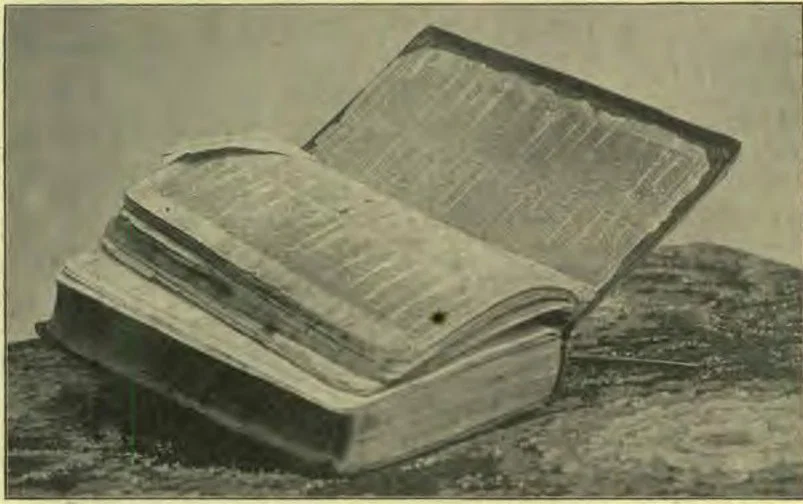
Last summer, while attending a camp-meeting at Concordia, Kans., the writer had the unexpected privilege of seeing and handling the Bible which William Miller used when giving his famous lectures on the second coming of Christ.
WILLIAM MILLER'S BIBLE.
The greatgrandson and namesake of “Father Miller,” William Miller Peck, resides at Concordia, and is cashier of the Cloud county National Bank. His twin brother, Charles N. Peck, an attorney by profession, lives just across the street from him.
During the meeting, Mr. Peck told some of the ministers of his relation to William Miller, and invited them to his home to look at some relics of his celebrated namesake. Accordingly the writer, with others, accepted the invitation, and spent a pleasant hour at the home of Mr. Peck, examining the relics, and talking about Mr. Miller’s work.
Among the articles shown were a sun-glass and a watch, which were William Miller’s constant companions. But that which interested us most was the Bible. It is a plain black Oxford Bible, seven inches long, four and one-half inches wide, and one inch thick, and bears the date 1838. A light gilt border, now almost obliterated, runs around the cover, and the single word, “Bible,” is upon the back.
The book, though much worn, is quite well preserved, save that the leaves after the fourth verse of Revelation 16 are missing. The margin of the leaves of Revelation are worn almost to the reading in some places, but the leaves of Daniel are not worn so much.
I was surprised to find so few notes in the book. There was nothing, so far as I could discover, except a computation of the twenty-three hundred days on the fly-leaf and a few passages marked with blue ink. Among these, Ps. 69: 3-5 attracted my attention especially: “I am weary of my crying: my throat is dried: mine eyes fail while I wait for my God. They that hate me without a cause are more than the hairs of mine head: they that would destroy me, being mine enemies wrongfully, are mighty: then I restored that which I took not away. O God, thou knowest my foolishness; and my sins are not hid from thee.”
I could not help thinking as I gazed at the passage, These words must have comforted the good old man in his disappointment after the passing of the time, or when those that hated him without a cause were speaking bitter words against him. How much sorrow of heart, and how much triumph in God, may be read in those faint blue marks that set off these verses from their companions.
C. C. LEWIS.

A CHILDLIKE SPIRIT.

That childlikeness is indispensable to a true Christian life the Saviour plainly teaches, where he says repeatedly, “Except ye be converted [changed], and become as little children, ye shall not enter into the kingdom of heaven.” Matt. 18: 3, and parallel texts. There are a number of reasons why the spirit and guilelessness of a child are required in the true Christian, in order to have him fruitful as he should be. The child’s obedience to those over it is the more nearly perfect, the more fully the feeling of its own helplessness prevails. Neither does it very easily obey or follow strangers; for it never was told to trust or hearken to them.
Being helpless to care for itself, it realizes the need of help from others; and so, without care or anxiety, it casts itself upon the parents or those about it, that they may care for it. Hence it is itself free from all care or worry.
By the very circumstances in which the child finds itself, its faith in its surroundings,—that is, in its parents or guardians,—is all the more active and firm, and its confidence in their ability to be all in all to it and to provide all it needs for it, is simply complete and unbounded.
The spirit of a child is a happy, cheerful spirit, since it constantly partakes of blessings for which it has not labored, and which it could not earn by the efforts of its own tiny hands; hence it is also constantly thankful, for the same reasons. In the beautiful words of another: “O, the calmness and the gladness of returning to the sweet feeling of childhood! And how gracious the estate of the Christian in which he can do a man’s work, while he carries within the confiding yet courageous, the artless yet active, the fresh yet full, heart of a child! Was not this the privilege our Lord meant to restore to us, world-weary, heavy-laden toilers and sinners?”
In view of these facts, as also by reason of its very nature, the child, on the other hand, endeavors to please those who are so faithfully and indefatigably interested and active on its behalf. And still further: it seeks to do as they do from day to day, as far as lies within its power; and it learns more and more to say and to do those things which will please and make them happy in turn, who are so anxious, and do so much and so constantly, for its well-being.
Just so it should be with the Christian in his relations to God and his Saviour here below. In childlike simplicity and readiness he should render at all times and under all circumstances, be they what they may, implicit and perfect obedience to all the ten precepts of God, and should listen eagerly to catch every command which the Lord may give at any time, that he may go and do it. Alas! how often, however, is there far more inclination not to hear or do, than to hear and perform, eagerly and faithfully, God’s behests, on the part of so many of the Christians of to-day.
The spirit that prevails in modern Christendom is a self-caring spirit, rather than a disposition to cast all our cares on God, as he has enjoined us to do. But O, how happy the soul that has learned to do the latter, and realizes from day to day God’s tender care.
So with faith. One of the saddest sights in the ranks of the professed church of Christ to-day, is a lack of genuine and vigorous faith. The Saviour, foreseeing this, nearly two thousand years ago wrote by the evangelist Luke: “When the Son of man cometh, shall he find faith on the earth?” Luke 18: 8. But the man of faith is calm and composed, even though “the mountains shall depart, and the hills be removed;” for he knows that he who cannot lie, has assured the true believer: “My kindness shall not depart from thee, neither shall the covenant of my peace be removed, saith the Lord that hath mercy on thee.” Isa. 54: 10.
One having such an experience of obedience, faith, and trust, cannot but be happy and thankful continually; for everything about him reminds such a being of the love of God and his bountiful providence, both toward him and all men; and he will surely put forth all earnestness and zeal, with firm perseverance to his last breath on earth, to please such a God, in whom we all “live, and move, and have our being,” and who has given us Christ to be our Saviour, and has forevermore given us the assurance through the great apostle, “He that spared not his own Son, but delivered him up for us all, how shall he not with him also freely give us all things?” Rom. 8: 32. And as he freely gives us all things to enjoy, the least we can do is to make a full and complete surrender to him, to serve and please him evermore, be it by life or by death. Such, in brief, is a truly Christian, a truly childlike and God-pleasing spirit. What professed Christian has it fully? Who will hereafter faithfully cultivate and cherish it? “If ye know these things, happy are ye if ye do them.” John 13: 17. A. K.

THE WORD OF GOD.

This Book unfolds Jehovah's mind; This Voice salutes in accents kind; This Friend will all your needs supply; This Fountain sends forth streams of joy; This Mine affords us boundless wealth; This Good Physician gives us health; This Sun renews and warms the soul; This Sword both wounds and makes us whole; This Letter shows our sins forgiven; This Guide conducts us safe to heaven; This Charter has been sealed with blood; This Volume came to us from God.
— Selected.

Being What God Sees in Us

WHAT thou art, that thou art; neither by words canst thou be made greater than what thou art in the sight of God.

He Went About Doing Good

WHEN did ever five words so graphically describe a whole life of usefulness as when it said of Jesus, our Lord: “He went about doing good”? We are to walk in the blessed Saviour’s footsteps, and do as he did; for he is our great Example. Can it be said of each one of us, as it was of the Master, “He [or she] went about doing good” from day to day?
Continue reading: LESSON 5.—THE WORLDLY SANCTUARY; THE LEVITICAL PRIESTHOOD