The Gold Coast Colony is situated in the western part of Africa, bordering on the Gulf of Guinea. It possesses a seacoast of 370 miles, and an area of 38,000 square miles. The coast is fringed with small lagoons, presenting but few suitable harbors. Politically, the colony is divided into fourteen districts, as follows: Apollonia, Axim, Dixcave, Chama, Elmina, Cape Coast, Salt Pond, Winneba, Accra, Pram Pram, Adda, Kitta, Volta River District, and Wassaw.
As is indicated by its name, this country is rich in the precious metal, and in the sixteenth, seventeenth, and eighteenth centuries vast quantities of gold were drawn from it. Bosman, a Dutch writer of the last century, states that in his time the Gold Coast had an output of over £3,000,000 sterling in gold annually. Since the discovery of gold in Australia and California, and other more healthful sections of the globe, the gold industry of this region has decreased, so that at the present time the amount of gold obtained does not exceed 100,000 a year.
Copra, coffee, cotton, gold, ivory, mica, monkey skins, palm-oil, and palm kernels form the chief productions and exports. As the country is tropical in its character, nearly all the tropical fruits are grown to some extent. However, but little has been done to develop the agricultural resources of the country, owing to the ignorance and lack of industry of the people. The inhabitants are made up chiefly of blacks, and number between a million and a million and a half, congregated for the most part in cities and villages throughout the colony. There are but few cities of any size. Accra, at the eastern boundary, is the most important town, possessing a population of 17,000. Other towns ranging from 10,000 down to mere hamlets, are scattered along the seacoast and through the interior.
The climate is one of the deadliest to be found in any part of the world. Some years frightful mortality is caused by malignant malarial fever, which sweeps off thousands of the population. The danger from this and kindred diseases is augmented by the lack of sanitary regulations, and the almost total ignorance of the laws of health on the part of the people. On account of the deadly climate, but very few white people are found in the colony, the whole number amounting to not more than from two to three hundred, and the majority of these are government officials or traders, many of whom spend only a portion of their time on the Coast.
The work of Seventh-day Adventists was begun in the Gold Coast Colony several years ago by the introduction of reading-matter into that field. Several native brethren became interested readers of the truth, and as a result, took their stand in favor of the Bible Sabbath. Under many difficulties, they have maintained their connection with our work, although having a very imperfect idea of the message for this time. In 1893 two brethren were sent out by284the Foreign Mission Board to organize the work in this field. They did excellent service in the way of selling publications, health supplies, and in other ways instructing the people in our work. Prolonged attacks of the fever, however, compelled one, Brother E. L. Sanford, to return to this country in order to save his life.
Nearly one year ago another company, consisting of Elder D. U. Hale, G. T. Kerr and his wife and child, and G. P. Riggs, was sent to that field. They landed safely at Cape Coast Castle, a town of some 11,000 inhabitants, and after spending time in looking the field over, decided to locate permanently in mission work in that city. This town covers a considerable area of ground, and contains a small Anglican church building, a beautiful Wesleyan chapel, and several modern houses belonging to European and native merchants. The streets are well drained for towns in that country, and quite well lighted; and for the supply of water, large tanks have been constructed. A considerable amount of trading is done at this port, due to its being situated at the terminus of the road running north from Assin to Ashanti. Previous to 1873 Cape Coast Castle was the capital of the colony, but at the conclusion of the Ashanti war, the seat of government was transferred to Accra.
Our workers have been planning to advance the truth by means of preaching, medical missionary work, teaching, selling our publications, health supplies, etc. The medical missionary work in this field, as in nearly every country where it has been begun, is developing a large share of attention, and seems to be the means of gaining a ready access to the hearts of the people. In a letter received a short time ago from Elder D. U. Hale, he speaks as follows in regard to the work done in this line:—
“Since the medical missionary work was opened, we have had our hands full, there being from twelve to twenty-five patients every day. The most of them were of the poorer class, but soon the wealthy people began to come, and we began to charge them for the medicine; but they kept on coming, even from some of the best families. Several have come who had spent many dollars on physicians without relief. When the natural remedies which the Lord has given us were applied, almost immediate benefit was received. This has given us quite a prominence among the people. The chief of this division of the nation (Gold Coast is divided into certain colonies, and each colony has a king, with chiefs under him) came for treatment of a disease on which he had spent much money for other doctors, especially government doctors, without relief. This chief has been receiving treatment for about six or seven weeks, and he is now nearly well. He has offered us a tract of land for an industrial school.
“A lady of some prominence came to Sister Kerr for treatment for fever and ague which she had been having regularly for nine months. After she came to the mission, she never had another chill, and is now apparently well. Some have come from neighboring towns, such as Anamabu, to be treated. So you see how God is blessing in this line. If we had another medical missionary nurse, we could establish another medical mission very nicely with our present force.”
But all the experiences of our missionaries are not so pleasant and encouraging as is the above. Brother Hale writes in this same letter of the sickness experienced by the workers, as follows:—
“I had a hard fever October 24, which lasted over a week. Part of the time I was delirious and unconscious, but the Lord had a care for me, and soon I was better. It has come back regularly every two weeks, but has not lasted more than thirty-six hours at any time, and has not been very severe. Brother Kerr had an attack of the African chills and fever the first of December, which weakened him very much. Sister Kerr has likewise suffered considerably. Frank, the baby, has been troubled much with colds and coughs, but seems all right now. Brother Riggs has likewise had a severe attack of the fever, but got over it nicely.”
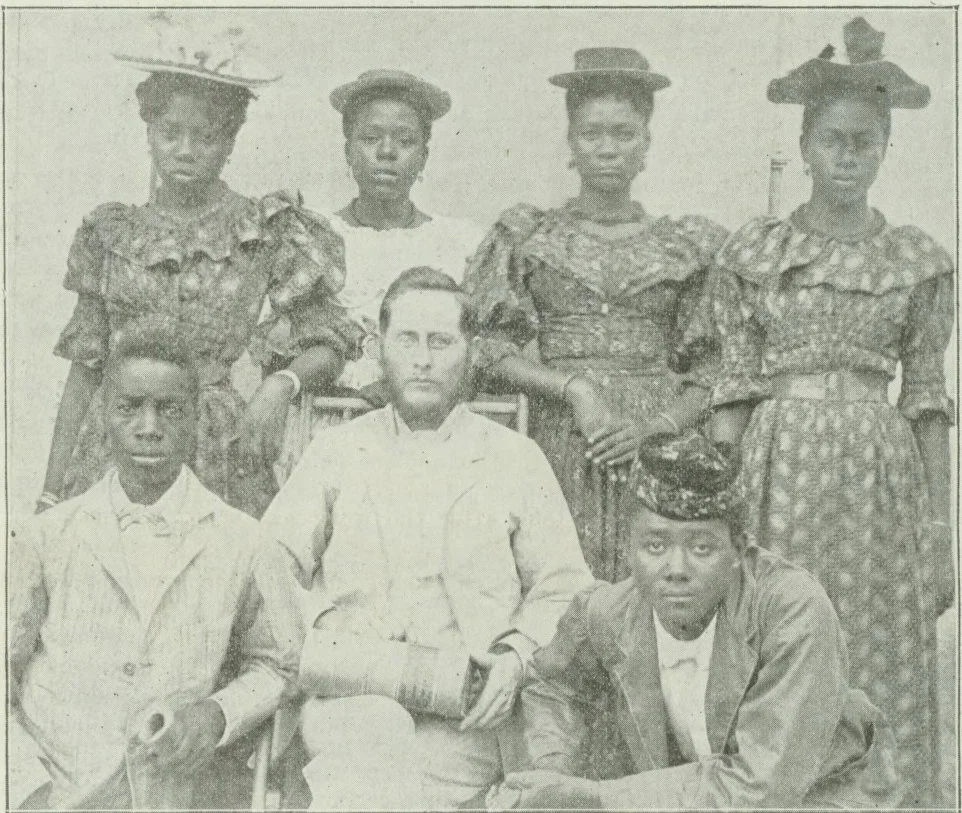
In the last mail there came a letter from Brother Kerr. He states that all the missionaries are enjoying the best of health. The medical missionary work is increasing, and it has been decided to place in training several bright young men and women to act the part of nurses in connection with our work. The accompanying picture shows Brother Kerr in the center. On either side of him is a native young man, and standing in the rear are four young women; these constitute the native training class for nurses, the first organized on the Gold Coast. We trust, however, that it may not be the last, but that this may be but the beginning, and that the work may grow and extend, until thousands of the inhabitants of the Dark Continent shall be brought to a better knowledge of the laws of their being, and in the end to a knowledge of their need of Jesus Christ, the Saviour of the world.
There is but little romance connected with the missionary work on the Gold Coast. As our devoted missionaries have suffered from time to time with the malignant fever so prevalent on that coast, and as they have had to cope with the many difficulties which do not exist in more favored climates, they have realized, as we trust all will who may read these lines, that there is a stern reality in the life of a foreign missionary, after all.
Do we need to ask our dear people for their sympathy and prayers for our missionaries on this coast? We are confident that we do not, but that a knowledge of their situation, and of the dangers and trials that beset them, will be sufficient to enlist in their behalf all the assistance that can be given by way of supplication and aid in temporary ways. The mission on the Gold Coast needs the support which can be rendered by our gifts and offerings. The people are poor, and but little aid can be expected by way of native contributions. This is also true of a larger part of our mission fields. Our home churches, as they have begun, so must they continue to play an important part in the work of God throughout the entire world. The gospel of the kingdom is to go to every people throughout the world; no nation or race, however poor or ignorant it may be, can be passed by. Realizing this, may all seek so to dedicate their lives and their substance to the Lord of the harvest, that the message may go untrammeled and with the Spirit’s power.
F. M. WILCOX, Foreign Mission Sec.
A LITTLE WHILE.
By Ella Cornish
BY ELLA CORNISH.
(Redwood Falls, Minn.)
A little while to linger here;
A little while of hope and fear;
A little while of grief and pain;—
A whole eternity to gain!
A little watching by the tide;
A little glimpse of yonder side;
A little waiting here below;
Our Father's smile at last to know!
CHILE
By G. H. Baker
Since my last report, considerable work has been done in this field by free distribution of literature, both in Valparaiso and in other localities; there are no visible fruits of this effort, but the Lord will give the increase in his own good time. We have had the pleasure of meeting with all three of our canvassing brethren. While they were with us here, we thought it proper to avail ourselves of the privilege of celebrating the ordinances of the Lord’s house, notwithstanding we have no organization. “If ye know these things, happy are ye if ye do them.”
Brother Segesser, who has been canvassing in the south, has gone to Brazil to work in the German colonies there. We were sorry to lose him from Chile, but he seemed to be impressed that his duty called him from our field. Brother Nolen has decided that he will not return to Chile. But while we lose on one hand, we gain on the other. Brother William Springer, who accepted the truth under the efforts of Brother Bishop at Iquique, has decided to enter the canvassing work, and I have just sent him a few books. Brethren Bishop and Davis are now in the south. They expect to try the city of Santiago this winter.
I gave several Bible readings to a young man from North America whose parents now reside in Peru. He has accepted the Sabbath, and I think is on his way to Peru with the Sabbath truth for that needy field. May God give him strength to let the light of truth shine.
We have found it expedient to move our residence, and are now living in the same house with a native lady, a widow of intelligence, who has also accepted the Sabbath. A very intelligent German lady in another part of the city has just informed us that she had kept her second Sabbath on the 14th inst.
Our city and state are much concerned over the increasing prospects of war with Argentina. The two countries are vying with each other in preparations. Those who know, say that no such depression of business generally, has prevailed here within the last fifteen years, and all seem to feel that a terrible struggle for the mastery is inevitable. And, as if to add immediate consternation to gloomy forebodings, the severest earthquake shocks that have been experienced for twenty-five years were felt here last Friday night at about nine o’clock. Many buildings were thrown down, while the earth groaned. There were thirty-two shocks felt during that night. The people who live in high houses take their beds and sleep in the streets. I am informed that the Grand avenue, which is more than a mile long, was, and is yet, every night almost one continuous bed. It seems to me they are unnecessarily alarmed; but they say I am a “gringo,” which means that I am unsophisticated.
G. H. BAKER.
J. M. REES
By J. M. Rees
Oklahoma.
The Lord has blessed in Oklahoma very much the past winter. Elder Russell labored at Whiterock, in the Cherokee strip, during the latter part of January and the first part of February, where he was successful in bringing out a company of sixteen. We expect to organize a church there in the near future. Brother Jacob Kraft has recently labored at Isabella, among the Germans, where ten or twelve have taken their stand for the truth. These, with those who are keeping the Sabbath there, will make quite a good church. Elder Westphal was there last Sabbath, and he has probably organized the church before this.
I have recently labored at Waukomis, where the Lord greatly blessed the work. Satan sent opposition, but the Lord overruled it to his glory. After laboring from house to house, and preaching thirty-one sermons, I was able to organize a church of eleven members, with others keeping the Sabbath who will soon unite with the church.
We have just closed our canvassers’ institute, and though the attendance was not large, we feel assured that the work done is of a beneficial and lasting nature. About all who attended have started out in the work. Oklahoma’s harvest is ripe, but the laborers are very few. If we only had the means to put more laborers in the field, it would be difficult to tell what the outcome would be. Even with the little help we have, the conference has almost doubled its numbers since its organization, twenty-two months ago. Then we had four hundred and sixteen members. Since our last camp-meeting in August, 1895, four new churches have been organized, and three more companies are ready to be organized as soon as we can get around to them. I would say that the companies that have been brought out here the past year are almost all new converts who have embraced the truth here in Oklahoma. We are greatly encouraged in our work, and hope to labor on unselfishly till the Master comes.
J. M. REES
INTERESTING AND HELPFUL TO US: IT WOULD BE THE SAME FOR OTHERS.
By A. O. Tait
We are often in receipt of letters from brethren that give brief statements in regard to the work in their fields, but generally these statements come to us long after the work has been done, and in such meager fragments that we can hardly make an intelligent report out of them for the REVIEW. In reading these letters, it occurs to us that our ministers and other workers all through the field should give much more attention than they have been doing recently to reporting for our church paper.
We are just in receipt of a letter from one of our veteran workers, in which he states that he sent a report to this Office some time ago to the effect that several had begun to keep the Sabbath in his field, through simply reading the Bible alone. We are sure the report did not reach us, because such reports are so interesting that they always find a place in the columns of the REVIEW AND HERALD when we get hold of them. The same person goes on to tell of interesting meetings that he has held from place to place, several having joined the church in one place, five or six baptized in another, and so on.
Now, as our work extends, it will be necessary, of course, to make these reports as brief as possible; but why would not a few columns of short reports from brethren all through the field, telling that they have labored in such a place, and so many have accepted the truth, and in such another place others have accepted the truth, and oftentimes giving some incidents in connection with just how they accepted it, etc., be the most interesting reading that could be placed in the REVIEW?
The editors of the REVIEW have often sent out appeals for just such reports as these, and it seems to me that every one should learn of the needs in that direction, and that more thought should be given to this line of work. In the earlier history of the message much more attention was given to this matter of reporting than at the present time, and the fact that we do not report as much as we did, would seem to indicate that on the part of some there is not the same rejoicing over souls that are brought to the knowledge of the truth, as there was in years gone by.
Do not go into long details over the matter, brethren, and tell all the particulars in regard to any series of meetings, but furnish interesting facts in brief and pointed notes, and they will not only help to make the REVIEW more interesting, but may be the means of encouraging and strengthening many a weak brother and sister who is almost ready to perish. There is no more interesting matter contained in the REVIEW than the reports of the advancement of the message. All such reports, of course, should be addressed to the editors of the REVIEW.
A. O. Tait.
A SHORT CHAPTER OF EXPERIENCE.
By W. B. Hill
I SPENT two Sabbaths, April 4–11, at Amor, Minn., with the little company there. Although few, I found them of good courage, and firm in the faith. During the last summer they held Sunday-school in their schoolhouse, with quite an attendance of Sunday-keepers, using our lessons. The lessons on the Sabbath question stirred the neighbors somewhat, but none as yet have decided to obey.
There are quite a number of Latter-day Saints in that neighborhood, of the Josephite branch. The last Sunday I was there their minister preached twice. He was very earnest, and evidently felt sure he was right. He preached with considerable clearness and power, and held the close attention of his hearers. The great burden of his message seemed to be, “These signs shall follow them that believe.” I never heard any one point out the gifts of the Spirit, and show their perpetuity, more clearly than did he. And then he said, “We are the people whom these signs follow. These wonderful manifestations of divine power are manifested among us. Therefore we are surely the true church of Christ.”
In conclusion he presented a well-attested case of healing a blind woman by the ministration of the elders of the Latter-day Saints. It was a printed testimonial by the woman herself, who has now been enjoying the best of eyesight for twenty years. The testimonial was corroborated by witnesses, and sworn to before a justice of the peace. Names, dates, and places were all given, and the whole thing was as well established as anything could be by human testimony. I saw that his discourse had a telling effect on his audience. As he was speaking, I thought, Have I, as a minister of the truth, any duty to perform in this matter to-day? That we were living in the time foretold by the Saviour, when many would come in his name and do great signs and wonders, and deceive many, was never so vividly impressed on my mind as while listening to this preacher. As I thought of these things, I asked the Lord to help me to say something that would do good.
Liberty being granted me to speak, I spoke well of the truth he had so clearly presented, and referred to the fact that according to the words of Christ, there would be a revival of miracle-working power both in the true church and out of it. That we are in the midst of that time is attested by the miracles and wonders on every side. For instance, see Schlatter, of Denver; Tweed, of Chicago; and many others. Since this is so, how careful we should be to try the spirits, to prove all things, and hold fast that which is good. In his discourse he had said, “Where the Bible speaks, we speak; where the Bible is silent, we are silent.” I asked him where the Bible speaks saying that the first day of the week is the Sabbath? I had looked long for such a verse in the Bible, but found it not. I had also asked others if they had ever found where the Bible speaks in that way, but never found the man that could find the place; but perhaps now I had found the gentleman who could point to the verse requiring286us to keep Sunday. If so, if he would be kind enough to show it to me, we would go arm in arm down life's journey, keeping Sunday together. What do the readers of the REVIEW think he said? Well, he was like the man in the parable that had not on the wedding garment. He was speechless. He never answered a word, but closed his meeting, and went out. I supposed that in his evening discourse he would say something about it, but he did not. At his evening meeting one not of our faith requested me to speak on the Sabbath question, which I did the next evening to a goodly company of interested listeners. As the Sabbath and the law of the Sabbath were clearly seen to be the test of the ages, how thankful I was for the truth! May we all cherish it as a most sacred trust committed to us by our Father in heaven. Brother C. E. Brorgeson was duly elected and ordained elder, and the little company were encouraged to labor on until the Master comes. Now is the time to live close to the good Shepherd's side, and to look well to our goings. W. B. HILL.
COLORADO
By George O. States
CRAWFORD AND TELLURIDE.—At the close of the Delta institute, I visited the Crawford church for a few days. I was glad to find the church growing in the truth. A number have moved to this place, and thus added to the company, and they have decided to build a meeting-house, and trustees were elected. I left them of good courage.
April 3 I began meetings with the Telluride church. This company was raised up last fall by Elders Anglebarger and Trubey, and so the members were new in the truth. They needed much instruction in the various lines of work, but seemed anxious to learn, and it was a pleasure to help them. I remained there three Sabbaths. The church was much encouraged, and two took a stand for the truth, and united with the church. An elder and a deacon were elected and ordained. The ordinances were celebrated for the first time. I obtained three yearly subscriptions for the REVIEW. This place is a mining town, and is surrounded by snow-clad mountains. On account of the high altitude, I found it hard to speak, especially when I was preaching three times a day and holding some business meetings besides. I found the people generous, and ready to assist in carrying on the Lord’s work. GEORGE O. STATES.
MICHIGAN
By J. F. Ballenger
POTTERVILLE, GRAND LEDGE, AND HOMER.—I held meetings with the Potterville church for about two weeks. I tried to bear a plain and pointed testimony to them, and it was evident that the Spirit of the Lord impressed hearts. Some confessions were made. We celebrated the ordinances, and those who took part seemed to enjoy the promised blessing. Two were taken into the church.
I met with the Grand Ledge church April 11, and administered the ordinances, some engaging in the ordinance of humility for the first time. The power of God was felt by some as never before, and all realized the fulfilment of the promise of the Saviour, “If ye know these things, happy are ye if ye do them.” The next day I buried five souls with their Lord in the waters of Grand River. One brother was rebaptized, and four new members were added to the church. Others expect to join soon, and still others are interested. This church, which was recently organized, is in a prosperous condition. May the Lord keep them in the fellowship of the Spirit and the bonds of union. May God bless these dear brethren and sisters.
I came to Homer Wednesday, April 15, and held meetings here until the following Sunday night. I found the brethren and sisters here so busily engaged in working for others that they have no time to find fault with each other, hence perfect love prevails. One brother,—a grandson of the “Ohio Hunter,”—who had recently moved to Homer, and had wandered far from his Father’s house, was reclaimed, and his wife gave her heart to God, and began the observance of the Sabbath. This was an occasion of rejoicing to the church. The ordinances were celebrated, and all rejoiced in a Saviour’s love. I go from this place to visit my home in Illinois, from which I have been absent nearly two years.
J. F. BALLENGER.
TO THE REVIEW.
[THE following letter is from isolated friends of the cause, to whom we had the privilege of bringing present truth twelve years ago.—T.]
I desire to express my appreciation of the blessings I have received from the weekly visits of the REVIEW. We rejoice in the precious truths the paper contains. First is the poetry, with its elevating and inspiring thought, which fill our hearts with love to God; then the sermon by Sister White. The blessed and cheering words we read in each sermon give us courage and comfort us, and also give food for meditation. The varied articles are restful to the mind; and as we look over the names of the dear fellow travelers, sometimes we read a communication from an old soldier, tried and true, of the cross of Christ, who had nearly fallen in battle, and was ready to lay down his lifework. We thank God for these, who have “stood like the brave, with their face to the foe,” and who by their words and work have led the way before us, teaching us the plan of salvation, and to plant our feet on the rock and the faith of Jesus, keeping all his commandments. We esteem them for their work’s sake.
Then the mission work is very interesting, for we know that its progress means that the coming of Christ draweth very near, for which we are truly thankful. Tenderly and carefully do we read the obituaries of those who have finished their course with joy, knowing that when Jesus comes, they will be changed to immortality and be fashioned like his own glorious body. When we have read the REVIEW, as we lay it down, we feel that we have been to meeting, and seen the faces of the dear brethren and sisters; and as it always comes for one Sabbath reading, we are all together in a Sabbath meeting. You cannot know how we appreciate the visits of the paper. May the blessings of God attend its way, and the blessings of God rest and abide with all who have a part in its work, is the prayer of the writer. Mrs. B. D. Eckler.
Hillsboro, N. Dak.
News of the Week.
FOR WEEK ENDING MAY 2, 1896.
NEWS NOTES.
Mr. Booth-Tucker, the lieutenant commander of the Salvation Army in this country, went “slumming,” or on a tour of investigation in some of the worst places in New York, with a notorious character of those quarters. He disguised himself, and after having visited several low resorts and questionable places, he was arrested on a charge of feloniously wearing false whiskers on the streets. He was locked up, but soon released on $1000 bail, and at his trial was discharged, the magistrate deciding that he had violated no law. It was probably a part of the game devised by his guide to show him as much of the process of slumming as possible.
The brother of President Cleveland is a Presbyterian minister, and for several years has had charge of a church in a small town in New York, at a salary of six hundred dollars a year. Lately there has been more or less disturbance of the tranquillity of his flock on account of the Democratic political tendencies of the pastor, who thought that his politics was nobody else’s business. The people made it their business, however, to oust the offensive partisan, and the “Rev.” Mr. Cleveland is where some people hope his big brother will be next March—out of a job. Ministers, as well as other people, may have too little religion and too much politics. When the politics is of the right kind, they will get along; but if they are on the wrong side, it would be politic to restrain them.
News from Cuba is rather meager of late, and there is as yet nothing decisive in the struggle. The Spanish forces have run a line of fortifications north and south, extending clear across the island, cutting off the western province of Pinar del Rio from the rest of the country. Maceo, with his forces, is on the west side, and it has been the expectation of the Spanish to keep him there until his forces were destroyed or obliged to surrender. Maceo has not apparently been worried over the matter, has always said that he would cross the line when he got ready, and has within the last few days proved his ability to do so, having sent a portion of his forces across, and is prepared to leave the province himself, whenever he is ready to do so. This has proved no small disappointment to General Weyler. Anticipating the close place in which he had his enemy, about ten days ago General Weyler issued another proclamation offering a pardon to all the rebel leaders who would come in, yield up the fight, and surrender their arms; but they did not seem to be very anxious to do this. A bomb was exploded in General Weyler’s palace on April 28, which shattered the interior wall of the vast building, broke great stones of the outer wall, and destroyed portions of the roof. Nobody was injured.
News has been received of the assassination of Nasr-ed-Din, the shah of Persia, who was shot at the capital, Teheran, on the first of May. It does not appear that the murder was the result of any widespread conspiracy, although such may prove to be the case upon further investigation. At once the suspicion is whispered abroad that “Russia must have had a hand in it,” from the fact that everybody has become suspicious of the Muscovite. It is premature to make any such assertions. It is considered quite certain, however, that serious diplomatic complications will now arise between Russia and England, in consequence of the wild freak of the political fanatic, by whose bullet the life of the ruler was instantly cut off in its prime. The shah is reported to have been worth about thirty million dollars.
ITEMS.
— April 30 a collision occurred between two steamers, ten miles from Shanghai, China, in which the British steamer “Onwo” was sunk immediately. Three hundred were drowned, mostly Chinese.
— Cripple Creek, the new mining town in Colorado, has been nearly destroyed by two extensive fires of incendiary origin, set for the purpose of plunder. The losses are very heavy. Six hundred houses and $2,000,000 worth of property has been burned.
— It is reported that at the late conference in Washington for universal peace arbitration, a member was heard to say in a loud whisper, “I am for arbitration, but not until Cuba is free.” That is a pretty good sample of the rest of human nature. We are all for peace until trouble comes our way, and then we believe in fighting it out.
— There has been further trouble in the French government. The refusal of the Senate to vote for the Madagascar expenses was accepted as a want of confidence vote, and the resignation of the Cabinet followed. As soon as the resignation had been accepted, the Senate voted the necessary credits, thus showing very definitely its disapproval of the government.
— It appears from reports that the rebellion in Nicaragua is not so easily disposed of as it was expected it would be. Several battles have been fought, in which it is said that the government has been victorious; but the rebellion still lives, and the fight goes on. It should be borne in mind, however, that the reports are from government sources, and are therefore quite liable to be colored in their behalf.
— As reported a week ago, it seems that the Catholic Church is interested in working for peace between Spain and Cuba. The following despatch published last week would confirm this impression. “It is rumored that the nuncio at Madrid has approached Premier Canovas with a view to inducing Spain to accept the mediation of the United States on the Cuban question. The nuncio has had several interviews with Mr. Taylor, United States minister at Madrid.”
— A novel use of the telephone was lately made in the Cuban war by Pablo Oliva, a Cuban general. At the outskirts of a town defended by a Spanish garrison he found a telephone, and by this called upon the commander to surrender. He refused; whereupon the Cuban general called back over the wires that the town would be burned unless the comandante changed his mind within an hour. At the end of the hour the garrison surrendered by telephone, and Pablo Oliva entered the town, with no loss of men or ammunition on either side.
— The following despatch was received May 1 from Buluwayo, Matabeleland, and appeared in the papers of that date: “Earl Grey, co-administer with Cecil Rhodes, of the territory of the British chartered South African Company, has arrived here with a strong escort, and Buluwayo is looked upon as being practically relieved. It is no longer likely that the natives will attack the town in force, although they still number over 15,000 armed men in this vicinity. The Imbezus are said to be threatening their ‘god’ for not having fulfilled his promise to turn the bullets of the whites into water.”
— The Methodist General Conference convened in the city of Cleveland, Ohio, May 1. It is a notable gathering, nearly all the leading men of that denomination being present. The question of admission of women as delegates is one of the prominent issues to come before the meeting, and it was opened early in the session, as there are four lady delegates present. There was a struggle from the outset, the published reports of which read more like the proceedings of a political caucus than a gathering of religious brethren. The indications are that the women will be admitted,287
— An exchange says: “One of the great obstacles to Christianity in Japan is that Buddhism is not only revived, but is adopting Christian methods to carry forward its operations.” We are led to wonder if that refers to oyster suppers, ring cakes, grab-bags, poverty socials, and such like. If so, we are not surprised, for that is what hinders Christianity in this country. But these are not “Christian methods.” They are far better adapted to advance Buddhism than real Christianity. The adoption of genuine Christian methods will produce Christianity, without fail.
CHRISTIAN HELP WORK.
By S. M. Sanders
This department of our church work is by no means a small, unimportant work. It is a grand and noble work, and in order to be successful, this work requires both labor and means. It is a work in which the sisters may quietly engage, without any unnecessary display or “blowing of the trumpet.” It is a work which requires patience and perseverance. This work reaches down and proffers a helping hand to those in need of both temporal and spiritual food, and opens the way to the hearts of the people for our Bible workers. There is no need of any member of the church being idle when there is so much to be done and so short a time in which to accomplish the work.
When our Saviour was here among men, “he went about doing good,” — relieving the distressed, ministering to the sick, healing and comforting all who were afflicted, and even casting out devils, raising the dead to life again, feeding the hungry multitudes, and in many ways giving us an example to “fulfil all righteousness.” The apostle James tells us that “pure religion and undefiled before God and the Father is this, To visit the fatherless and widows in their affliction,” which does not mean that we shall array ourselves in “rich and costly attire,” and make a fashionable call on the poor, hard-worked, disconsolate widow, and after taking an inventory of her poor and scanty furnishings and surroundings, gather up our robes and say, “Well, God bless you. ‘Be ye warmed and filled.’” The apostle James asks, “What doth it profit,” if “ye give them not those things which are needful?” In this work we can very forcibly realize the truth of the words “It is more blessed to give than to receive,” and it is a source of joy to receive the gratitude of the hearts of those with whom we labor; and we have the assurance that “he that hath pity upon the poor lendeth unto the Lord; and that which he hath given will he pay him again.”
When the king comes, he will say to those on the right hand, “Inasmuch as ye have done it unto one of the least of these, my brethren, ye have done it unto me.” Matt. 25:40.