ALMOST in direct proportion as the cause of the union of church-and-state principles is winning adherence in the New World it is growing in disfavor in the European countries. Nearly all the nations of Europe have been seeking to throw off the yoke of bondage that has enthralled them these long years. There is a growing unrest in many quarters, not alone against the state church in Catholic countries, but against this institution in the Protestant states of Europe. This is particularly indicated in the agitation of the last few years in the German Empire. Of this the Christian Observer of Sept. 18, 1912, says:—
For several years there has been a growing sentiment in Germany in favor of the entire separation of church and state. The question is now becoming one of tremendous importance, and is receiving more and more attention among the political parties.
The Social Democratic party has made it one of the “planks” in its platform for many years. The Radicals demanded the separation above sixty years ago, after the stirring events of 1848, and it is assumed that they will again support it if the question should come up for a vote in the Prussian legislature.
Even the Conservative party, which contains most of the orthodox Protestants of the country, is evidently viewing the idea of a separation with growing sympathy. The Kreuz-Zeitung, the organ of that party, has recently printed a leading editorial on the subject, in which it says: “In the Conservative party there is a rapidly growing disposition to prevent the further secularization and externalization of the church by separating it from the state.”
The growing estrangement of the German people from all churches is used as a strong argument for separation. It is said that not more than one person in one hundred in Berlin attends church. Several recent heresy trials in the Prussian Evangelical Church have also given a strong impetus to the sentiment for a separation. It is the opinion of the National Zeitung, a leading National Liberal organ, that there is already a clear majority in the country favoring the separation of church and state.
Our Mission
By O. P. WILSON
O. P. WILSON
Out on the air comes a call full of beauty,
Over the sea from nations afar:
“Come over and help us, we feel it your duty;
There’s a welcome for all, our door is ajar.
There’s a beacon of hope in our ways dreary lighted
Awaiting the time of your coming so true,
When with the dear Saviour our lives are united,—
O land of the free, we cry unto you!”
We with our faces turned high to the eastward,
Filled with the hope we have in his truth,
On to our labor with songs of thanksgiving,
Go, in the pride and joy of our youth.
Though legions of sins and sorrows assail us,
Trying our way and efforts to bar,
Still, full of love, will his Spirit eternal
Beckon us on like a piloting star.
Then down the dim years, wherever he leads us,
Though rocky the way over mountains, between,
We’ll go where he biddeth, and tell unto others
Of treasures so golden and pastures of green.
Shout for the victor, and joy o’er the vanquished,
Praise for our Captain, our Leader, our Friend;
Arouse now, ye soldiers, and tell of the kingdom,
For lo, he is with you e’en down to the end.
The Canary Islands as a West African Furlough Base
Last year, in order to establish a near-by retreat for workers falling ill on the African West Coast, it was decided to start work in the Canary Islands, and make the mission station available as a rest home when the laborers should require a change. Brother W. H. Lewis and family were the first who required this change to the islands. Brother Lewis writes thus of their visit to the Canaries:—
“We left Freetown March 4, in quite a run-down and overworked condition, after two years of strenuous labor in this trying field. I was so weak that I had to be carried in a hammock to the boat; Mrs. Lewis was in a very weak condition after about fourteen months of severe illness, and both the children were far from well.”
“After a smooth voyage of five days, we reached Teneriffe the night after the Sabbath, about ten o’clock. I had gained some strength, but was still so weak that I could scarcely walk. We spent the night in Santa Cruz. Sunday morning we went out to Laguna by electric car, and were met and heartily welcomed by Brother and Sister B. B. Aldrich.
“As Brother Aldrich had not had time to fit up the home for the West African workers, and indeed had not yet received the necessary means to do so, I was in time to lend him a helping hand; and with a few tools which the landlord, who is a mechanic, was kind enough to lend us, was able to save a few cents in fitting up the rooms.
“Teneriffe is not only healthful, but very beautiful and picturesque; and from a health standpoint and for beautiful scenery, Laguna, the town where Brother and Sister Aldrich have established the mission home, is one of the most desirable places I have ever seen. The climate is delightful. In fact, in the island of Teneriffe one can have almost any climate he wishes, from a hot to a very cold one. As one who has spent some time in the hot, debilitating climate of West Africa ascends on the mountain electric railway, which winds in and out, he can but admire the beautiful panoramic view spread out before him; and as he feels the gradual but steady fall in temperature as he nears Laguna, he is ready to conclude that here it is quite cold enough, and is willing to leave the car and find a warm room. This was our experience.
“As I have said, the island is very beautiful. It is a mass of mountains towering one above the other until the highest reaches an altitude of about twelve thousand feet, and is covered with snow and ice the entire year. The soil is very productive and is well tilled, scarcely any being left uncultivated. Vegetables of all kinds, and fruits of both tropical and temperate zones are grown, and yield very abundantly. The flowers are beautiful, both wild and cultivated.
“We had been on the island but a short time when we began to see and feel a marked change for the better in our health. When we left Freetown, I weighed one hundred thirty pounds; and when I returned, my weight was one hundred seventy pounds. Mrs. Lewis weighed more than she ever did before, and both the children gained rapidly. I am quite convinced that as a health resort, where the workers can recuperate for a time after battling with the trying climate of the West Coast, this place will prove to be a great boon and a blessing to both the workers and the work in West Africa.
“I might add just here that when it was decided by the brethren at headquarters that we should go to the Canary Islands for a change and rest, I felt like rebelling, as I did not think it would be far enough away from the coast to do us any real good, and I almost felt that the Mission Board was making a mistake and would be spending time and money for naught. But I have been forced to change my opinion on that point, and I believe, yes, I know, that it was the plan of our Heavenly Father for our good, and also for the good of the people of the archipelago, for surely it is time for them, as one of the ‘isles of the sea,’ to receive the message for to-day. The people are quite intelligent and very sociable, and in my short stay I learned to love them. Several seem ready to receive the truth.
“We spent three months and twelve days in Teneriffe, and surely enjoyed our stay and felt greatly benefited by it; but we were glad to be able to return and again take up the work which we so much love, but which we were forced to lay down for a time. Pray for us, and for this enterprise, that it may prove a great blessing in advancing the message in West Africa, and in the salvation of many souls in the islands.”
Mantandane Mission, Central Africa
By S. M. KONIGMACHER
S. M. KONIGMACHER
This is Tuesday evening, August 6. The baby is asleep. Mrs. Konigmacher is probably preparing a place to sleep in a native village about thirty miles from here, on her way to the dentist. She left this morning, with eight strong men to carry her and a trusty boy to help her. A missionary has a long way to go for anything. She will have a four days’ trip, covering about one hundred twenty miles. This morning I sent sixty miles in the other direction for some necessary supplies and twelve miles for the mail.
On my way home from visiting my out-schools, my hat touched a branch of a tree as I was riding down a short, steep hill; the donkey jumped and a strap broke, so I fell off. I strained my back severely, and could not stand straight for two days, but am all right now.
Just before my fall I stopped to visit my second school that day. I asked the pupils to help me rebuild their church without pay, and was pleased with a hearty response from all. When they have collected enough grass, reeds, lambo and trees, and bark rope, I shall go over and help them rebuild.
I also stopped in a near-by village where a chief had died, to pay my respects to the mourners. I found from fifty to seventy-five people gathered together. Some were eating porridge made from a red seed called maweri, and others were shaving their heads with sharpened pieces of iron. They were also getting the drums ready for a dance and beer drink.85I spoke to them, prayed with them, and then said: “If I hear the drums I shall know that my words have gone in one ear and out the other; but if I do not hear them, I shall know that my words have entered your hearts.” I did not hear them, and I hope the people will honor their dead chief by living better lives.
Since then I have made two trips to this village in the evening to give lantern lectures, and one trip to visit my hill school at Chakachadza.
We rebuilt our Mpusadala school nearer the village in one day, with six men from here and the help of the schoolchildren. Their allowing the school to be built near the village shows that the work is having its effect. Because of the distance and the fear of wild animals, we were obliged to build another school among these Ambo people, as they would not come to the school at the chief’s village.
The work at the station is onward. Last Sabbath one hundred eighteen came to Sabbath-school and service. Many endure hunger, and some walk eight miles every day, that they may have the benefits of the school.
Mrs. Konigmacher and I are studying Portuguese, and hope to be ready for the examination when we are allowed to start work on the new mission site. God is good to us, and we are seeking to give the trumpet a certain sound. We are quite well and happy in the work. Pray for us.
Mexico
By G. W. CAVINESS
G. W. CAVINESS
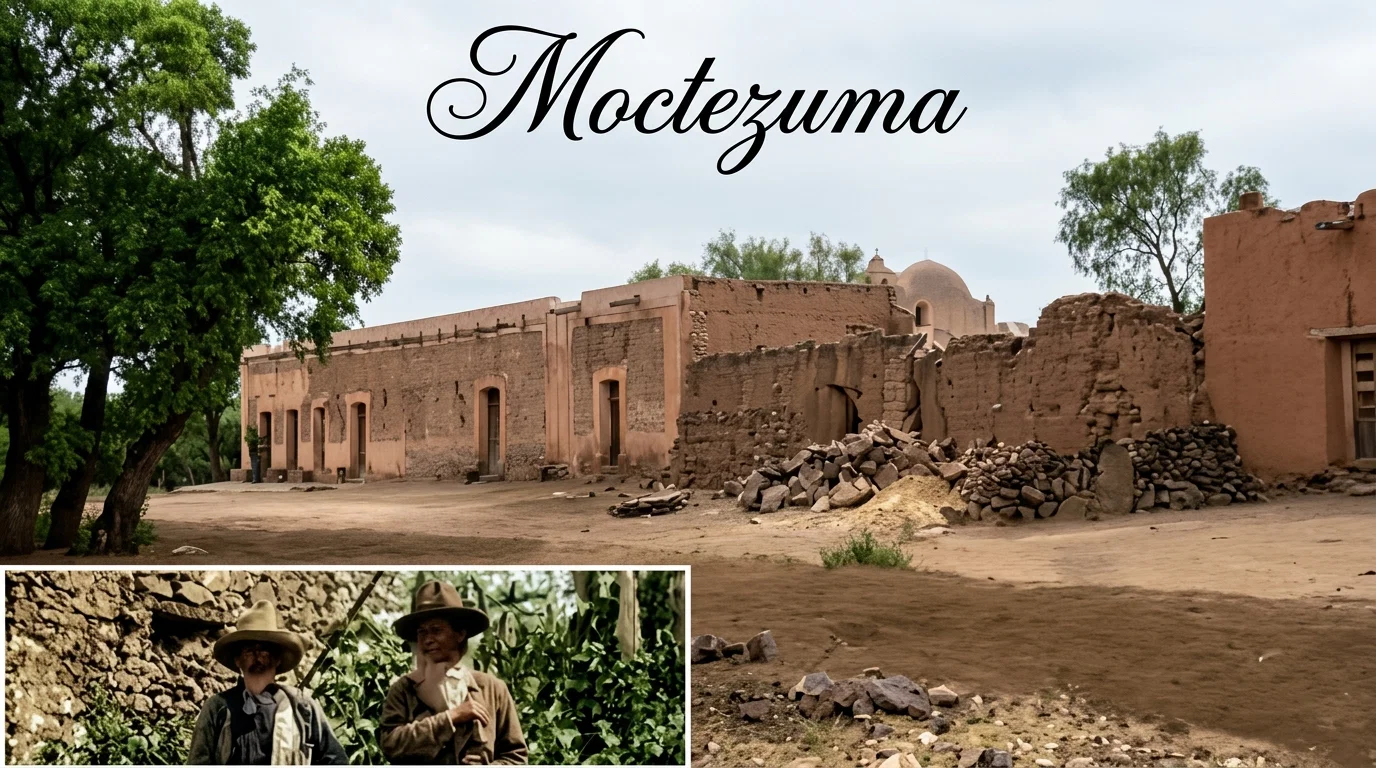
Since my last report I have visited Moctezuma and La Visnaga. In Moctezuma we have a company of eight or ten. They have been anxious to have a small place of worship, as none of them has a room suitable for a meeting. One brother has some land, and he has gone ahead and laid the foundation for a small meeting-house, about sixteen by thirty feet, and has carried the walls up eight or ten feet. The believers will be able to get the structure ready for the roof. It is their intention to turn the land and building over to the mission, and we expect to put on the roof and complete the church for them. This will cost about seventy-five or one hundred dollars, more than one half of which is now provided for. The site is at one side of an open square, or park, in the background of which is a Catholic church. The accompanying picture shows the place where our church will be located. The brethren, though few, have put forth great efforts to get a church. One of them has gone to the United States to work in order to get money for the building. There is some interest in the place, and we hope when the building is completed to put forth an effort to strengthen and enlarge the company.
In La Visnaga the work is very encouraging. Several years ago a few persons in Matehuala received our paper, became interested, and were convinced of the truth. About four years ago, after much correspondence and many appeals, we sent Brother Marchisio to look after the interest there. He found that some of the interested ones had moved out into the country about seventeen miles to a small settlement, or ranch, called La Visnaga. He began work there, and soon had quite an interest, but there was much opposition. The Catholics had a little chapel in the place, but had had no services there for several years. As soon as they knew of our labors, they began to try to start their work again. Such was the opposition that it was scarcely possible to get a place in which to hold meetings. So Brother Marchisio gave thirty pesos, and the brethren built a little adobe hut about ten by fifteen feet, and in this meetings were held for quite a while. It was astonishing to see how many could crowd into this small room.
SITE OF CHAPEL IN MOCTEZUMA
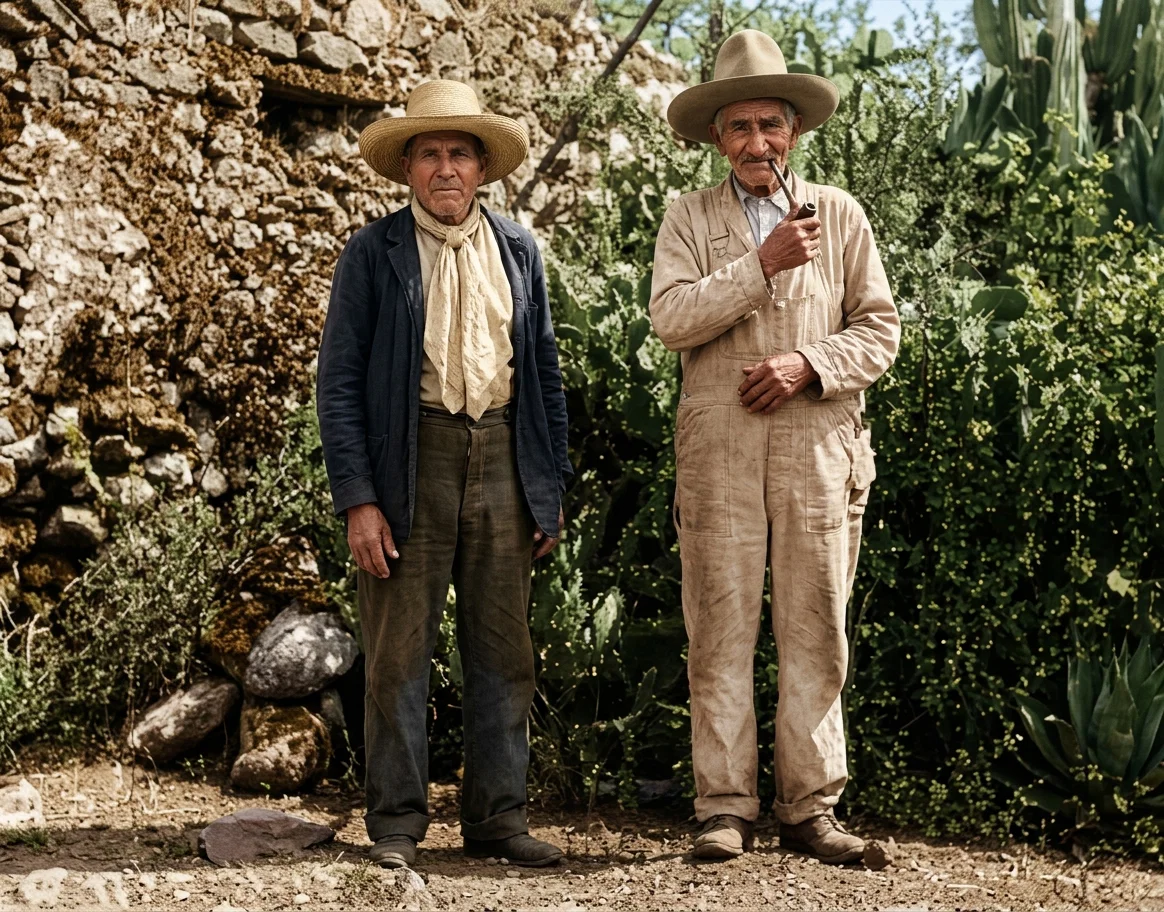
TWO PATRIARCHS OF VISNAGA
The writer spent several weeks laboring, and baptized ten. The work continued, and about three years ago six others were baptized, and on my recent visit fourteen candidates followed their Lord in baptism.
Three years ago we purchased about two acres of land with an old stone house that was roofless on it. This was repaired, a roof put on, and now we have quite a respectable little chapel. For two or three years we have had a school in operation, with an enrolment of about twenty-five pupils. There is no other school of any kind in the place.
The brethren are making advancement in other ways, having left off their vices and become more industrious. They are now buying small patches of ground and building little houses; and this year they have quite good crops of corn and beans. They are all very enthusiastic, and are planning to pay tithe.
Every one of the thirty baptized was present and partook of the Lord's Supper on the last day of my stay. One aged man, the father of the two first interested, was quite slow in giving up Catholicism. For a long time he kept his saints' pictures and images on the walls in his house, and followed his custom of saying prayers to them as he had learned in school in his childhood, but at last he gave them all up. Then he told Brother Marchisio that his saints were gone, and with them his prayers, and he wanted to know what he should do. He was told to go to the Lord as to a friend, and ask for what he needed, and his attention was called to the Lord's Prayer. He could read, and found in the Psalms of David some expressions that he thought were all right; so he committed these and the Lord's Prayer. Then Brother Marchisio thought that the pupil had learned to pray even better than the teacher. Although seventy-five years of age, he is quite vigorous, and I had the pleasure of baptizing him on my last visit. The father of the teacher of the school is quite a venerable-looking man, with a full beard. I am also sending a picture of these two patriarchs.
One good brother and his wife, from Matehuala, were baptized with the rest. They have had our papers for quite a while, and have been convinced, but were a little slow about being baptized. On my way to Visnaga I stopped overnight with this family, as I had done many times before. The wife told me her experience; for some time she had been convinced of the truth, and had felt it her duty to be baptized; but she was a slave to tobacco, and felt that she could not give it up, but had finally done so; she had not the slightest desire for it any more. After discarding tobacco, she dreamed that she was at a meeting and saw the water for baptism, and saw me very distinctly. The next morning she told her husband that she would be baptized the next time I came to their place, and he immediately responded, “All right; I will, too.” I did not know that the woman used tobacco until she herself told me of her victory over it.
This family has been making advancement in other ways also. On my first visit they were in a meson, which is a place with a corral for animals and a few rooms for the drivers. I shall never86forget the first night I spent there. The man took me to a room without any floor, but with a sort of bed in it, and told me I could spend a mal rate (an uncomfortable time) there, which I did. I did not sleep one single moment all night because of the many other inhabitants in the place.
I could but mark the great change between then and now. Now he has bought a little place, built a house of five rooms, and everything is in quite good shape for Mexico. On my last visit, I spent a pleasant time with them, and had a good night's rest. One of the pleasures of the work is to see the improvement that some of these poor people are making. The message is elevating in every sense of the word. The papers are full of revolutions, but we have not been disturbed by them. We are sure that our brethren will all be interested in these revolutions in character and life that the preaching of the message is producing among these poor people, and we earnestly ask your prayers that such revolutions may continue.
The Luminous Valleys of God
By L. D. SANTEE
L. D. SANTEE
THERE'S a city of beauty awaiting the blest,
A country that lies far away,
Where in valleys enchanting the weary may rest
In the joy of a shadowless day;
They shall walk in their gladness 'neath skies that are bright,
Where the footsteps of sin never trod,
And souls that are ransomed shall bathe in the light
Of the luminous valleys of God.
'Tis a wonderful land by the river of life,
And ne'er shall earth's shadows annoy;
But blissful the home, and unending the life,
That fills every heart with its joy.
The harps of the blessed with music shall ring,
While flowers look up from the sod,
And the voices of loved ones with rapture shall sing,
In the luminous valleys of God.
I have longed for that city, whose streets are of gold,
That country where friends never part,
Whose inhabitants never grow weary or old,
But gladness and love fill the heart.
That city of beauty, the Lamb is its light;
In its brightness has sin never trod;
Its day is eternal, there cometh no night,
In the luminous valleys of God.
Moline, Ill.
Worldliness in Dress
By J. E. FULTON
J. E. FULTON
WORLDLINESS is eating at the heart of the religion of many, both young and old, at the present time. Such a sad state has not come without warning or prophetic forecast. Looking down the centuries, our Saviour told how this very sin would steal upon his professed people. In that wonderful prophecy, Matthew 24, we are warned in these words: “Because iniquity shall abound, the love of many shall wax cold.” Opposition from the world is bad; apostasy from the faith is worse; but the lukewarmness and indifference and growing worldliness of many of our professors is the greatest bane of our church life. We can stand opposition and persecution and thrive under it. We may be benefited by the apostasies of unfaithful members, but our faith is corrupted by the worldly professor.
We have been, above all churches, called out from the world. We have been called out from Babylon. We are not to be partakers of her follies, fashions, and sins.
There was a time in the history of Methodism when a member of that church could be known by the plainness of his dress, which stood in marked contrast to that worn by professors of religion in other churches. It has been so in the Seventh-day Adventist Church. It is even yet so to a large extent, but there is coming in among us a drift worldward which is ominous. Why do many of our young men wear gold watch-guards and chains, fancy waistcoats, flashy ties, etc., in fact change with every change of fashion, when the Lord beseeches us, “Be not conformed to [“fashioned according to,” R. V.] this world.” “We should dress in plain, modest apparel, without reference to the fashions.”
Why do many of our young women wear those fashionable skirts, cut tight to their bodies like the wrapping of an Egyptian mummy,—skirts that thousands of men and women look upon as abominable? It is simply a matter of fashion, and God says not to be “conformed to this world.”
Why do some wear feathers, and others fix up ribbons on their hats to appear as much like feathers as possible, if it is not to be like the world? Remember “the friendship of the world is enmity with God.” Why do our sisters wear low-necked dresses when they are condemned by our medical authorities, the laws of decency, and by the religion of our Lord? Remember, when we dress our bodies in worldly, attractive, and fashionable dress, our friends may be pleased, but heaven looks upon it with disfavor. “When you are decorating your bodies with varieties of art, then reflect how the Eternal Word put on the rough suit of humanity.”
May God raise up mothers in Israel to cry out against these shameful fashions of womankind and teach the better way. Traveling on the train some time ago, I sat near two young women, one of whom was a native girl. They were discussing dress. The European girl asked her dark-skinned sister if she did not think those peek-a-boo low-necked dresses were pretty. “No,” was the decided answer; “I should be ashamed to be seen wearing one.” Ah! has it come to this that our sense of propriety is so obtuse that we must be warned by our native brethren and sisters, those who only a generation or two ago emerged from barbarism? Shame to our civilization! Shame to our boasted education! And thrice shame to our profession of a holy religion.
When worldly papers, as the Ladies' Home Journal, condemn these abuses in dress, I conclude that it is time to speak plainly. Many of the articles of dress are15neither beautiful nor modest. O, why then do we, like Israel of old, go after strange gods? Why do we ape the heathen? Why is it necessary to dress the hair in a frizzly, unkempt-looking fashion? Why is it that that part of our bodies which is the citadel of our reason should be adorned in such an unreasonable manner? Worldliness in dress has set in like a mighty tide from the world's ocean. Thousands of our young people are being swept worldward by its deceptive current. Who will stem the tide?
Wahroonga, New South Wales, Australia.
Successors of the Samaritan Woman
“SOME are zealous of being successors of the apostles. I should rather be a successor of the Samaritan woman, who, while the apostles went for meat and forgot souls, forgot her water-pot in her zeal to spread the good tidings.”
Philippine Islands
By ELBRIDGE M. ADAMS
ELBRIDGE M. ADAMS
I AM glad to be able to report an encouraging outlook in the work here. The workers seem to be moved with a sense of the responsibility of the work and the importance of the message. It does my heart good to hear them offering up earnest prayers in behalf of God's cause. I think that it is not possible for any one to realize the opportunity that is awaiting us now in this field, unless he has been here. It makes me sad when I see the full ripe grain falling to the ground unharvested. There is an opportunity now—just now—that we shall not have long. I do not speak in general of the work, but specifically of this field. Coming out of dense darkness suddenly, as the Filipino has, he is ready to grasp the first thing that comes along promising advancement.
You know, doubtless, that in the city of Washington are several of our young men eagerly seeking for knowledge. The reason that they are so thirsty is because they have been without a drink so long. The old Spanish régime either banished, imprisoned, or killed a man who was suspected of intelligence. Rizal, whose picture you will see in most of the Filipino homes, a liberal-hearted, broad-minded, highly educated man, was taken to the Luneta here in Manila and shot, having no other crime than that of education. We ought to have at least five families immediately to plant the seeds of truth in this sowing time among this people. I fear that much will be lost if we do not enter this field with an increased force soon.
Noon-Hour Prayer
“Evening, and morning, and at noon, will I pray, and cry aloud: and he shall hear my voice.” “And the Lord turned the captivity of Job, when he prayed for his friends.”
Many and precious are the promises which our Heavenly Father gives to his praying children, but he bids us to be constant in our asking, to “pray without ceasing.” This is a call to habitual rather than never-ceasing prayer. It is the daily, regular habit of holding on to God that brings things to pass. We know the evil of frequent breaks and interruptions in our daily tasks; if we pray to-day and forget to pray to-morrow, if we cry to God this week and are silent next, our prayer life will suffer in the same way. If we would live a life of power, we must live a life of prayer. Ceasings and interruptions in our daily communion with heaven bring a loss of power. And this loss of power in prayer is entirely our own fault, for God is omnipotent. Unrivaled wisdom, boundless skill, limitless power, infinite resources, are his. “He who shrouded the land of Egypt in awful darkness; he who turned her streams of water to streams of blood; he who laid his hand upon her first-born and filled her borders with mourning; he who broke the stubborn will of her impious king; he who led forth his people Israel, with a mighty arm and an outstretched hand; he who parted the great sea, and made the glassy walls of water to be bulwarks of safety to them, and swift avalanches of death to their pursuing foes; he who, when his children cried for water, sweetened the bitter wells to quench their thirst; he who, when they hungered, sent
them bread from heaven; he who, when they marched about Jericho in utter self-helplessness, leveled its towering walls by the word of his power; he who walked with his three children in the fierce, fiery furnace, yet kept them even from the smell of scorching garments; he who stilled the tempest, walked on the seas, cast out devils, healed the living and raised the dead,”—it is this same mighty Friend who says to you and to me, If ye ask, I will do. But before we can claim this promise, we must be willing to “pray without ceasing.”
Requests for Prayer
39. A mother in Vermont asks prayer for the conversion of two children, a son and a daughter.
40. A Pennsylvania sister desires us to pray that her husband may be led to accept this truth and to give up the use of strong drink and tobacco; also that her parents and brothers and sisters may be converted.
41. From Indiana a sister sends the request that we pray for the healing of her niece. The doctors give very little hope for her recovery.
42. “I desire prayer in behalf of my aunt, who is an invalid, that she may be healed if it is the Lord’s will,” writes a brother from Michigan.
43. An afflicted sister in Canada requests that prayer be offered for her restoration to health.
44. An aged Michigan sister asks that we pray during the noon-hour season for the conversion of her relatives who know the truth but fail to walk therein.
45. An isolated sister desires prayer for the conversion of her husband, five sons, three daughters, and an aged mother.
46. A sister writing from California sends the request that the conversion of her father, who is a policeman in Arkansas, be made a subject of prayer. He makes no profession whatever of Christianity.
47. An anxious mother in the same State (California) asks prayer for the conversion of three sons and two daughters-in-law; also for herself that she may be restored to health and strength.
48. Still another request has come from California. An isolated sister desires us to pray for the work of God in her community, and for the conversion of her children and their families.
49. A burdened Colorado mother earnestly desires our prayers for a son who has given up the truth, and for a daughter who has married an unbeliever, that she may not become discouraged.
50. A friend in New Mexico, who is interested in this truth, asks prayer for herself and husband that they may have courage and strength to obey God in all things.
51. A pathetic request comes from a mother in the East. She desires that prayer be offered for the conversion and healing of her husband, who is suffering from an incurable disease; for the healing of her little daughter who has infantile paralysis; and for the conversion of a brother and a brother-in-law.
The Art of Cooking
COOKERY is or should be a fine art. Like other arts, it has its laws of proportion, harmony, and contrast. The art of cookery appeals to the sense of taste, music to the sense of hearing, and the graphic arts to the sense of sight. Gratification of the sense of taste is as legitimate as enjoyment from any of the senses. The temperate indulgence of the sense of taste is indeed necessary for good digestion, on which depend physical well-being and efficiency. A systematic study of cookery, then, should be a fundamental part of the education of the home-maker.—American School of Home Economics.
Beautiful Thoughts
LIFE'S real heroes and heroines are those who bear their own burdens bravely, and give a helping hand to those around them.
The world is a looking-glass, and gives back to every one the reflection of his own face. Frown at it and it will in turn look sourly upon you; laugh at it and with it, and it is a kind and pleasant companion; and so let all take their choice.
Never cast aside your friends if by any possibility you can retain them. We are the weakest of spendthrifts if we let one drop off through inattention or let one push away another, or if we hold aloof from one through petty jealousy or heedless slight. Should you throw away a diamond because it scratched you? One good friend is not to be weighed against the jewels of the earth. When you rise in the morning, form a resolution to make the day a happy one to a fellow creature. It is easily done. A left-off garment to the woman who needs it, a kind word to the sorrowful, an encouraging expression to the striving,—trifles in themselves as light as air,—will do it, at least for the twenty-four hours; and if you are young, be assured it will tell when you are old; and if you are old, it will send you gently and happily down the stream of human time to a blessed eternity.
It is a perilous and doubtful task to unveil the depths of the human heart; to reconcile the complex and often unconscious duplicities of human nature; to decide where delusion ends and deception begins; to estimate the force of temptations and the degrees of resistance to them; to discern the subtle harmony which binds all the parts of life together, and may unite general purity and noble appetences to grievous frailties and ignoble crimes. None but the All-seeing One, “to whom all hearts are open and from whom no secrets are hid,” can pierce the obscure mazes of human motives. The harsh, censorious, confident, sweeping, unrestricted judgment will blunder, whether it praise or blame.—Selected.
The Rose and the Thorn
By EDW. J. URQUHART
EDW. J. URQUHART
I SAW a rose upon its stem
In all its beauty rare;
But when I plucked it from the bush,
I found that thorns were there.
They pierced my hands as thorns will
pierce,
And blood oozed from the vein;
But O the rose that I had plucked
Outweighed by far the pain!
And in the path of life we tread
In pilgrimage to heaven,
The path with thorns oftentimes is strewn,
The road rough and uneven;
But over all, the love of God
Is balm to pain and sorrow.
Death, as the thorn, may sting to-day,
But life is ours to-morrow.
Winton, Cal.
The Glory Land
By WORTHIE HARRIS HOLDEN
WORTHIE HARRIS HOLDEN
A mist lay o’er the valley,
And air so damp and chill
Pierced through each cozy shelter
Of woodland, vale, and hill;
While overhead the heavens
Bemantled in cold gray
Attuned to earth’s brown meadows
Proclaimed a wintry day.
But on beyond the valley,
Beyond the mist hung low,
Rose mountains in their splendor
Enrobed in sunlit snow.
Forgotten was the keenness
Of winter’s wind and chill;
Entranced, that scene of glory
Caused every heart to thrill.
So earth’s chill love is waning,
And colder grows the night,
But on beyond arises
The glory land of light!
Too dim our mortal vision
To see full radiance there,
But through the veil are glimpses
Of glorious mountains fair.
Though low hang threatening storm-clouds,
Though earth for us is drear,
Our eyes are fixed on Zion,
Whose mountaintops appear.
Forgotten is the anguish
Through watches of the night;
We cry aloud, Hosanna!
’Tis near — our home of light!