The Youth’s Instructor, Vol. 48, No. 17.

BEAUTIES OF SOUTHERN CALIFORNIA

The Youth’s Instructor

Apr 26, 1900

Review and Herald Publishing Company · Battle Creek, Mich. · Apr 26, 1900

BEAUTIES OF SOUTHERN CALIFORNIA

II
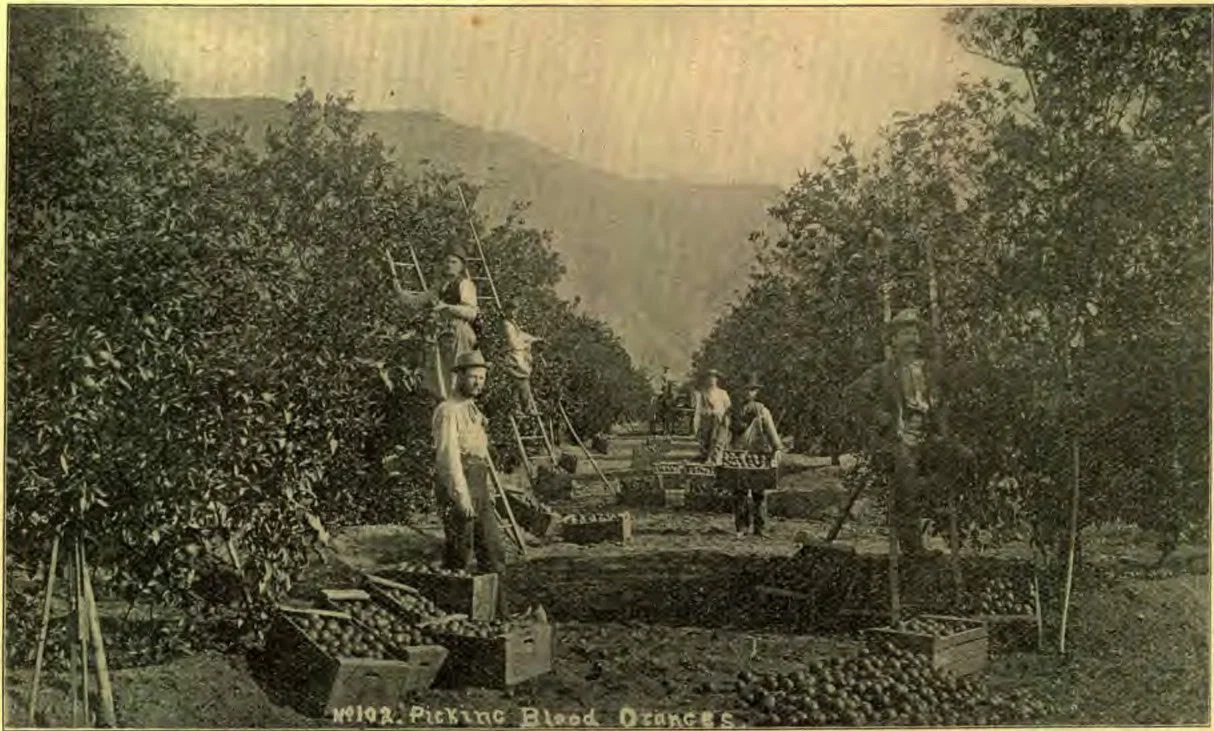
In the days of ’49, thousands of men were lured from their Eastern homes to this far-off Western shore, by the hope of gaining wealth. Every privation was endured to reach that place where, rumor said, “they needed but to look around, and there they’d find the golden lumps lying on the ground.” Many returned disappointed; for so far from lying on the ground, the glittering gold was jealously hidden away, and money and hard work were required to bring it to light; but others, who looked for the value instead of the color, stayed. These gained wealth in different ways. Those realizing the value of the citrus industry rapidly changed this sandy desert of sagebrush into beautiful orange groves and vineyards, receiving gold for gold.
WHERE GREEN GIVES WAY TO GOLD
Southern California is noted for its abundance of fruit, the success of which depends largely upon the excellence of its system of irrigation. The water is conveyed from rivers directly into canals, or, perhaps, from the mountains through granite gorges to where a great dam has been built, making a reservoir, or lake, miles in length. From here it is carried, in many instances, a distance of twenty miles, stored in smaller reservoirs, then directed into cement channels down the valley, being tapped along the way for small rills, which silently meander through orchard and vineyard, beautifying all nature with their magic, and making the desert blossom as the rose.
Orchards are irrigated from four times a season to that many times a month, according to the situation of the land and the composition of the soil.
Nearly all the deciduous fruits of northern climes are raised here, besides oranges, lemons figs, loquats, guavas, and walnuts. Riverside is the mother of the orange culture of the State. The two original trees grown from the cuttings imported from Brazil, still stand there as the parents of all the “Washington navels.” For many years the crop from the Riverside orchards was estimated as half that of Southern California; but now it is regarded as amounting to one third. Still, last year’s crop exceeded three thousand car-loads.
Oranges ripen at varying intervals during all the winter months; hence they are constantly being picked and carried to the packing-houses, scores of which are in operation at this season. The fruit is first scrubbed to remove all scale, then thrown into a device for polishing, and grading in lots of uniform size. Afterward it is rolled into large bins, whence it is taken to tables, wrapped in tissue-paper, and packed into boxes ready for shipment.
The orange orchard is a scene of beauty in the spring. In many places, where the fruit is left on the tree, there will be seen green and ripe fruit growing on the same bough, while the entire tree is covered with fragrant, pure white blossoms.
The olive is also a native of this clime, and is extensively cultivated; but is by no means so luscious as the orange. From its appearance in the ripe stage, one would imagine its flavor to be that of a large black cherry. You who have tasted olives doubtless have been convinced of the contrary. Before they are “cured,” olives are extremely bitter. This bitter taste can be removed by soaking the fruit in water, but it is a long and tedious process. The same results can be accomplished by putting the fruit in a solution of lye for a few hours, and then soaking it in water to remove the lye. After this it is put in brine to preserve it.
Great quantities of olives are utilized every year by extracting the oil, which is noted for its purity, and is a valuable article of commerce.
MRS. KATHLEEN WAGNER-GILMORE.

OTHER TROPICAL FRUIT TREES

NONE of the nut-bearing trees of other countries are found in the Society Islands, except the cocoanut. I do not know the original home of the candlenut, which is found here. This nut looks something like the hickory-nut, but is too rich to use for food. In olden times the kernels were strung on small sticks, lighted, and used as candles; this is probably how they received their name. Kerosene now takes their place.
Another sort of nut is the native mape. “Mape” is the Tahitian word for kidney; and the fact that the fruit is kidney-shaped is no doubt the reason this name was applied to it. The tree grows along the edges of rivers. Like the Italian chestnut, the nut must be cooked to be palatable. It has little fat, and not much flavor; but we believe it to be quite nutritious, and like it very much as a food.
The guava is a smaller tree, shaped much like the cherry tree. Its fruit season begins in January. The fruit is hard, and has a poor flavor. It is deceiving in appearance, having a rich pink color inside, and looking much better than it tastes. Hard seeds fill up most of the fruit, leaving only a thin layer of pulp under the skin. This pulp we slice off and stew for sauce and pies. With the addition of sugar, it is fairly palatable. Most persons eat the fruit raw, swallowing seeds and all; but the seeds must be injurious to the stomach, as it is impossible to digest them. A clear red jelly, which is noted for its excellence, even in distant countries, is made from the fruit pulp. This tree grows everywhere here, and planters are kept busy weeding it out of their plantations. Cattle do not eat the leaves, so it thrives as well in the pasture as elsewhere.
The cherrymoyer, or custard apple, is a delicious fruit, which tastes exactly like a sweet and delicately flavored custard. The trees, which are small, like a cherry tree, are very scarce here, as they are not hardy, and can not bear much sun. It is considerable trouble to get them started to grow; yet they do well when planted in a grove of taller trees, where they are partially shielded from the sun’s rays.
All the trees described so far have hard, solid trunks, and most of them have limbs like the trees of the temperate zone. The banana is unlike them all, and is more like a great plant. It grows from twenty to thirty feet high, but has no branches, only very large, ribbed leaves, which are about two feet wide, and from ten to twenty feet long. As these large leaves all droop over from the center, they give the tree a graceful appearance. The trunk is made up of soft layers, and can easily be cut through with a sharp knife. On account of its being so loosely constructed, it grows rapidly, and in less than a year a bunch of bananas begins to grow out of the top. In a few weeks, they are full-grown and ready to pick. Then the tree is cut down, as it will bear no more fruit, and the bunch cut off, carried home, and hung up to ripen. The juice from the tree has more “staying” qualities than most indelible ink, and we often unintentionally get our clothes marked in a way that is not pleasing. The more we try to wash out the stain, the brighter it grows. Surely this juice would be very useful for dyeing purposes.
We have here more than a dozen different species of bananas. Some are used only for cooking, while others are eaten raw. The apple banana, when baked, tastes very much like baked apple. The wild banana, or plantain, is the staple article of diet with the natives. It grows wild in great abundance in the mountains. When boiled while still green, it serves as a vegetable; but if cooked after it is fully ripe, the starch in it changes to sugar, and the fruit is soft and very sweet. It is never eaten raw. When well baked, it is delicious, and one of the most wholesome of fruits. It is a common food for babes, and they thrive well on it. We also feed it to our horses, and it serves as grain to them, as no grain grows here. There being so many different kinds of bananas, we can use them continually, and yet never tire of them. We eat them raw, baked, and made into pies and puddings.
But I must keep room to speak of another useful fruit,—the papaw, also called mummy apple and jackfruit. Like the banana, the tree grows quickly, but continues to bear fruit for several years. This fruit, as well as the banana, is always in season. The leaves are also large, and very irregular in form. There are no branches, and the fruit is fastened by a short stem to the trunk. It is one of the prettiest of trees; for the leaves are so large, and have such long stems, that they stand out a considerable distance from the trunk. They bear abundantly. The male tree does not bear anything but fragrant little flowers, the color of orange blossoms. The fruit is bright yellow when ripe, and shaped much like a cocoanut. Like the muskmelon, it has a hollow center containing the peppery little seeds. It is a most wholesome food eaten raw, and is also excellent when baked, and served with cocoanut cream. A soup is made from the green fruit, which reminds us somewhat of Irish potato soup. Many persons here feed this fruit to their hogs, preferring flesh-meat for themselves.
We believe that the fruits and vegetables that God has caused to grow here are the foods that are best adapted to this climate, and our diet is made up principally of them. It is sad to see so many whose appetite can not be satisfied without destroying the lives of animals. God did not make them for us to eat, but gave us, instead, the fruit of the ground. And what is better than the delicious fruits? In the new earth we shall eat angels’ food, and partake of the fruit of the tree of life; but we shall be satisfied with that, and shall not wish to kill the beautiful animals and eat their flesh.
MRS. B. J. CADY.

"GO WORK TO-DAY IN MY VINEYARD"

The Lord demands service of every soul. Those to whom the living oracles have been opened, who see the truth, and yield themselves, soul, body, and spirit, to God, will understand the words of the Saviour, “Go work to-day in my vineyard,” to be a requirement, but not a compulsory one. God’s will is made known in his word, and those who believe in Christ will be doers of his will.
The test of sincerity is not in words, but in deeds. Christ does not say to any man, “What say ye more than others?” but, “What do ye more than others?” Full of meaning are his words, “If ye know these things, happy are ye if ye do them.” Words are of no worth unless they are spoken in sincerity and in truth. The talent of words is made of value when it is accompanied with appropriate deeds. It is of vital consequence to every soul to hear the word, and to be a doer of the word.
Good works do not purchase the love of God, but they reveal that we possess that love. By our words and our works we reveal to the world, to angels, and to men whether we believe in Christ as a personal Saviour. If we surrender our way and will to God, we shall not work for God’s love; we shall obey the commandments of God because it is right to do this. The disciple John writes, “We love him, because he first loved us.” The true spiritual life will be revealed in every soul who is doing service for Christ. Those who are alive to Christ are imbued with his Spirit, and they can not help working in his vineyard. They work the works of God. Let every soul think prayerfully, that he may act consistently.
When Adam and Eve transgressed the command of God, they could no longer cultivate their beautiful Eden home. They were shut out of the garden, to work among the thistles and brambles that Satan had sown. Satan told our first parents that by eating of the forbidden fruit they would have higher perceptions, and be like the angels in heaven. They believed and obeyed the words of the apostate, but they proved his words a lie. Henceforth they must work among the thorns and weeds brought by the curse.
Christ came to the world with the invitation, “Go work to day in my vineyard.” Satan will seek to allure by his temptations, but listen to my voice to-day. What blessings are here offered to every man, woman, and child! It is the privilege of all to say, “We are laborers together with God, . . . God’s husbandry, . . . God’s building.”
Take heed to the living oracles, which give you the precious promise of becoming a partner of the divine nature. If you will work on the plan of addition, God will work for you on the plan of multiplication. Therefore add to your faith virtue, to your virtue knowledge, to your knowledge temperance, to your temperance patience, to your patience godliness, to your godliness brotherly kindness, and to your brotherly kindness charity. “For if these things be in you, and abound, they make you that ye shall be neither barren nor unfruitful in the knowledge of our Lord Jesus Christ. But he that lacketh these things is blind, and can not see afar off, and hath forgotten that he was purged from his old sins. Wherefore the rather, brethren, give diligence to make your calling and election sure: for if ye do these things, ye shall never fall: for so an entrance shall be ministered unto you abundantly into the everlasting kingdom of our Lord and Saviour Jesus Christ.”
If you cultivate faithfully the garden of your soul, you will not boast; for it is God that worketh in you. He is making you a laborer together with himself. Receive the grace and instruction of Christ, that you may impart to others a knowledge of how to cultivate the precious plants. Thus we may extend the Lord’s vineyard. The Lord is watching for evidences of our faith and love and patience. He looks to see if we are using every spiritual advantage to become skillful workers before we enter the paradise of God, the Eden home from which Adam and Eve were excluded by transgression. It is ours to have that beautiful garden to cultivate under the supervision of God. Eden restored,—how beautiful it will be! how pleasant will be our employment! Then let us prove our industry by doing faithful work. Do not say, with the faithless sinner, “I will not,” nor with the untrue son, “I go, sir,” and go not; but at the call of Christ let us engage in sincere service.
God has claims upon us that we can evade only at eternal loss to ourselves. But in his service there is perfect freedom. Let us consider the life of Christ. Standing at the head of humanity, serving his Father, he is a pattern of what every youth should and may be. He was given to us to show us how to live the commandments of God. He counted no sacrifice too great, no toil too hard, in order to accomplish the work he came to do. At the age of twelve he said to his earthly parent, “Wist ye not that I must be about my Father’s business?” He had heard the call, and taken up the work. At another time he said: “I must work the works of him that sent me, while it is day: the night cometh, when no man can work.”
He only serves who acts up to the highest standard of obedience. Of Christ it is said, “Though he were a Son, yet learned he obedience by the things which he suffered.” All who would be sons and daughters of God must prove themselves workers in the great firm with God and Christ and the heavenly angels. This is the test for every soul. Shall we prove our submission and obedience? Of those who faithfully serve him the Lord says, “They shall be mine . . . in that day when I make up my jewels; and I will spare them, as a man spareth his own son that serveth him.”
Mrs. E. G. White.

PROVIDENCE

FATHER! unless thou lead my faltering feet, I can not stand. Thick falls the hail, and dense the driving sleet But strong thy hand. Doubt and dismay about me hover near; Stand thou to shield from ill, to vanquish fear.
I would not seek the pride of place to gain, Nor climb to power, Nor stoop to trifle with time's baubles vain, Brood of an hour! But lowly let me strive thy yoke to wear, Thy fight to fight, my daily cross to bear,
And if at once no harvest burst in fruit, And seed well sown Seem idly scattered, never to take root, Let no dark moan Break from my lips, my God! Thou, thou, hast seen; Faith knows no fear; for her, bare fields are green.
—Selected.

The Gap in the Sky

ASTRONOMICAL STUDY—NO. V

The Gap in the Sky
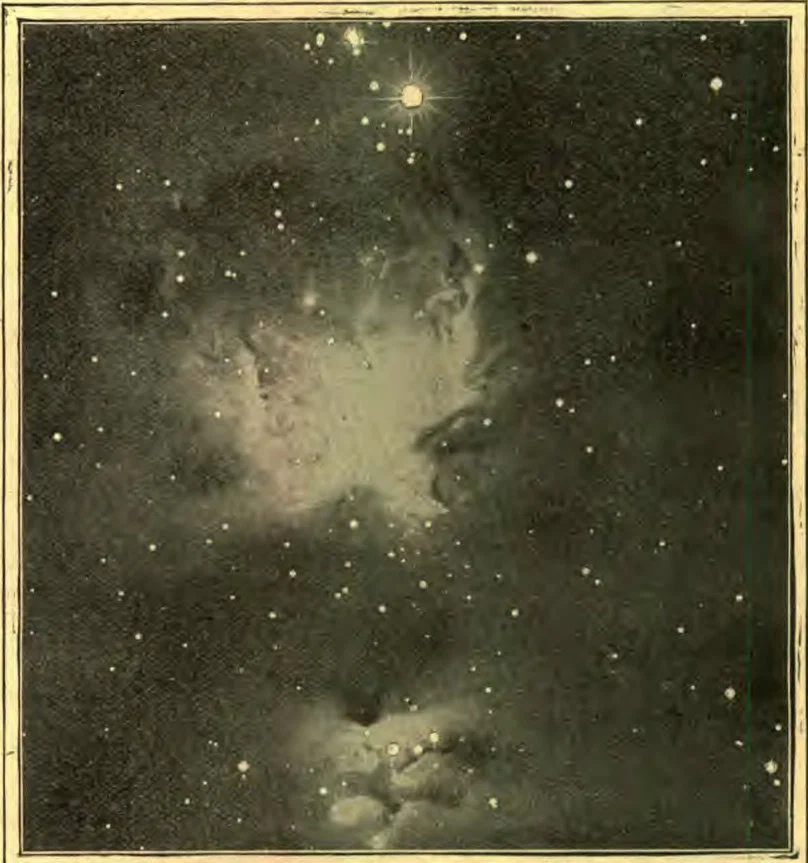
LAST week we learned the location of the constellation Orion, also where to find in this constellation the wonderful nebula that is the “gap in the sky.” As a people we have for years been interested in this portion of the starry heavens; for to us it speaks of a coming Saviour, and of the glories that shine forth from the throne of the Eternal One. When we say that this nebula is the “gap in the sky,” we believe we speak advisedly; for there is nothing else like it in all the heavens.
We are pleased to be able to obtain, for the INSTRUCTOR family, so perfect a picture of this sacred spot. The accompanying half-tone is a faithful reproduction of what we believe to be the best photograph that has ever been obtained of this opening into the glorious realms beyond. We do not like to speak of this opening as a “nebula;” for although it is thus classed in our works on astronomy, it is so different from all other nebulae—and there are over eight thousand of them recorded by our more modern astronomical instruments—that writers upon this subject can not but express wonder, admiration, perplexity, and reverence for this something, which, for lack of a better name, we call a nebula. With this one exception, all true nebulae seem to be composed either of clusters of fine stars or of what is called “fire-mist clouds,” and they are seen to hang separate from, and this side of, the blackness beyond. In other words, we can see space still beyond them; but as will be seen by the accompanying half-tone, this nebula does not hang out separate from a black substance beyond, but is a distinct opening into a realm of glory situated on the other side of the great, impenetrable sphere that seems to inclose all the visible works of God’s created universe known as the starry heavens. In this the light seems to be gushing out from the very heaven itself. As we view this wonder, we can not but feel that God in his mercy is permitting us to see a little of the glory of that city above, as it is reflected from those jasper walls through whose pearly gates the righteous nation soon shall enter in.
Herschel, the astronomer, in speaking of this open space, says: “This nebula has never been resolved into stars by the highest powers of telescopes that have yet been applied: nor is there any reason to believe that it consists of systems of stars, as is the case with other nebulae. It is, therefore, in all probability, a mass of self-luminous matter, but of what nature it would be vain to conjecture.”
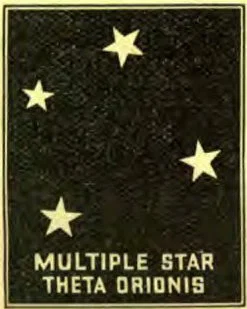
MULTIPLE STAR THETA ORIONIS
“And there was war in heaven. . . . And the great dragon was cast out, that old serpent, called the devil, and Satan, which deceiveth the whole world: he was cast out into the earth, and his angels were cast out with him.” REV. 12:7-9. “And I John saw the Holy City, New Jerusalem, coming down from God out of heaven, prepared as a bride adorned for her husband.” REV. 21:2.
These and many other texts go to show that heaven is a place, out of which the city is to come, the angels that sinned were cast, etc. If heaven were a mere world like our own, or a globe like our sun, or even what is now our north star, it would seem proper to speak of Satan as being cast off from, or away from, it; but no, he was cast out of heaven. We do not believe that either the sun or what is now our north star is heaven. A deeper insight into true science entirely disproves this theory, and we believe it to be a distortion of the Scriptures thus to apply their teachings.
In “Early Writings,” page 34, we read: “Dark, heavy clouds came up, and clashed against each other. The atmosphere parted and rolled back; and we could look up through the open space in Orion, whence came the voice of God. The Holy City will come down through that open space.”
In 2 Esdras 3:17-19 we find reference made to this same gateway of heaven at the time the Lord spoke the law upon Mt. Sinai, in these words: “And it came to pass, that when thou leadest his seed out of Egypt, thou broughtest them up to the mount Sinai: and bowing the heavens, thou didst set fast the earth, movedst the whole world, and madest the depths to tremble, and troublest the men of that age. And thy glory went through FOUR GATES OF FIRE, and of earthquake, and of wind, and of cold; that thou mightest give the law to the seed of Jacob.”
THE GREAT NEBULA IN ORION
The small illustration gives an idea of these “Four Gates of Fire,” one of which—the smaller, upper left-hand one—is shown in the large illustration. Sir John Herschel, in speaking of these four gates of fire, says: “A fourth star was distinctly seen, in addition to the three, near the head of the opening, but smaller than the other three, and forming with them a small, irregular square. The aspect of this nebula is altogether different from that of resolvable nebulae. In the latter we fancy, by glimpses, that we see stars, or that, could we strain our sight a little more, we could see them [the larger telescopes since Herschel’s day show this to be a fact]; but the former suggests no idea of stars, but rather of something quite distinct from them.”
One more quotation, taken from Professor Dick’s astronomy, page 179, must close this hour’s study: “One of the largest and most remarkable nebulae in the heavens is that which is found in the constellation Orion. On directing the naked eye to the middle star of the three which form the sword [the star to which your special attention was called last week], the observer perceives something that has the appearance of a small, but not well-defined, star: this is the great nebula of Orion, of which, however, he can form no definite conception till his eye is assisted by optical instruments. With a common one-foot pocket achromatic telescope the nebulosity may be plainly perceived; but the higher the magnifying power, the larger the aperture of the object-glass, the more brilliant and distinct does this phenomenon appear. The first to discover this phenomenon was the celebrated Huygens, in 1656. He says: ‘Astronomers place three stars close to each other in the sword of Orion; but when I viewed the innermost with a telescope in the year 1656, there appeared in the place of that one, twelve other stars; among these, three that almost touched each other, and four more besides, that appeared twinkling, as through a cloud, so that the space about them seemed much brighter than the rest of the heavens, which appeared wholly blackish, by reason of the fair weather, and was seen as through a CERTAIN OPENING, through which one had a free view into another region, which was much enlightened. I have frequently observed this same appearance, in the same place, without any alteration; so that it is likely that this wonder, whatever it may be in itself, has been there from all times; but I never took notice of anything like it among the rest of the fixed stars.’”
DR. O. C. GODSMARK.

TO-DAY AND TO-MORROW

To-day there is snow, Sifting and whirling and tearing along, Singing a madcap and jubilant song, Filling the highways, and rearing great towers, Rollicking wildly with bleak winds for hours.
To-morrow comes calm: Silent in wavy and picturesque heaps, Glistening snow on the brown old earth sleeps; Dazzling and white in the sunshine serene, Coquette-like sparkling in crystalline sheen.
To-day there is storm, Driving the cold snows of youth on amain, Breathing dire threatenings, dimming the brain (That spark from an anvil celestial caught) With ambitions blighted, and hopes come to naught.
To-morrow comes rest: Gossamer mists lightly float in heaven's blue, As sweet or sad fancies the tired mind imbue; Quiet reigns; and the birds, a dreary fast o'er, Pick in the sunshine the crumbs at the door.
MIRIAM E. WEBBER.

THE FLOOD

In our last lesson we learned how the sin of Adam and Eve, in partaking of the fruit of the forbidden tree, caused the entire world to be placed under a curse. The first curse that came was that of shortening the period of man's life. The first curse that affected the earth, resulted in the bringing forth of thorns and thistles. The earth was cursed a second time when Cain killed his brother Abel. The Lord told Cain that the earth should not henceforth yield her strength. The third and greatest curse that came upon the earth was that of the flood. The inhabitants became so wicked that every thought of the heart was only evil. The Lord saw that in a short time man would be exterminated from the earth if allowed to go on in his course of sin; and the desire of the Creator was to save man.
The Lord knew that the inhabitants of the world would be tempted, and he had provided a way for man to be saved. The great plan of salvation is first spoken of in Gen. 3:15, in the promise that the seed of the woman should bruise the serpent's head. The Lord implanted in Adam and Eve a desire to be free from sin. Ever since the fall of man, God has been doing what he could to rescue man from his fallen condition; so before God destroyed the earth by the flood, he sent Noah to tell the people about the great flood that was to come upon the earth, and how God had commanded him to prepare an ark to save all those who would forsake their evil ways; but only a few received the message.
In destroying the earth by the flood, the Lord destroyed those things that the antediluvians had indulged in for their own selfish gratification and pleasure. The beautiful groves were destroyed, the silver and gold and precious stones were buried beneath the earth. The great forests were submerged, and large areas of this luxuriant growth of vegetation were covered by the removing of mountains and hills. Some of the bones of animals buried at that time have been found, and they show the animals to have been much larger before the flood than they are now.
The flood covered the whole earth, and rose above the tops of the highest mountains, so that the earth was brought back again to the chaotic state mentioned in Gen. 1:2, where it says that the earth was without form, and void. While the flood wrought great destruction everywhere, we see the love of God manifested in that he changed the forests into vast coal-beds, which now furnish us with fuel to keep us warm, and with oil to give us light. Gasoline, naphtha, and benzine are all prepared from coal oils.
The flood continued for many days upon the earth, and about one year passed before Noah and his family again set foot upon the dry ground. The sons of Noah did not remain faithful to God, but did wickedly in the sight of the Lord, so that the earth was again filled with wicked inhabitants.
In the course of time the wicked descendants of Noah planned to build a great tower, which would save them if another flood should visit the earth, notwithstanding the Lord had already promised Noah that he would never destroy the earth again by a flood, and had given the rainbow in the heavens to be a perpetual reminder of his promise. While this great tower was building, the Lord confused the language of the people. Before this time there had been but one language, but now the people spoke different languages, so that they could not understand one another. This caused them to separate, and scatter over the earth. On account of being thus distributed over the earth, and living under such different conditions, also because some of the nations went more deeply into sin than others, we have what is known as the races of men. These are divided into five divisions,—the white race, the yellow race, the black race, the brown race, and the red race.
If the family of Noah had remained true to God, there would never have been this division of races and confusion of language. There would have been but one family on earth, and this would have been after the likeness of the family in heaven. Although God has promised that he will never destroy the earth again by a flood, yet in his word he plainly tells us that it will be destroyed by fire. Next week we will learn how the earth is to be destroyed by fire, and when this event is to take place.
M. E. CADY.
Continue reading: 8—Adder’s-Tongue, or Dogtooth Violet