“CALTHA” means golden cup, and “palustris,” of a bog or marsh,—golden cup of the marsh. The plant is well known, and needs little description. Its flowers are yellow, scentless, and grow in clusters on long petioles. The leaves are kidney-shaped, the upper ones being nearly sessile (that is, attached directly to the main stalk), and the lower ones growing on long petioles, or leaf-stems. The stem is erect, branching at the top; it is hollowed and furrowed.
Marsh Marigold.
This plant boldly opens the spring in the marshes. It grows in both the Old World and the New. Shakespeare in one of his poems calls it Marybud. It is “so abundant along certain English rivers as to cause the ground to look as if paved with gold.”
The word “Mary” in the name probably refers to its use in church festivals during the Middle Ages, when it was one of the flowers dedicated to the Virgin Mary.
It resembles the buttercup, of which it is a relative. It should never be called cowslip; for it is not related to the English primrose, called cowslip.
8—Adder’s-Tongue, or Dogtooth Violet
Erythronium Americanum
This plant has a solitary, terminal, nodding flower, with six slender divisions, streaked with purple. There are but two oblong, pointed leaves; they are spotted with dark purple and white.
The white adder’s-tongue is similar in appearance to the yellow. The flower is bluish white, and the leaves are not nearly so spotted. The plant is more common in the West than is the yellow.
There is a snaky look to the leaf, but why it should be called after a snake’s tongue does not appear. The blossom of the yellow adder’s-tongue is a russet yellow, spotted with a darker color in very delicate penciling.
The plant grows in hollows of the woods by some gurgling brook, in masses or beds. The flower closes at night, and opens in the morning. It has a faint fragrance resembling that of the tulip.
Burroughs has suggested “fawn lily” or “trout lily” as more appropriate names for this plant than those it bears.
L. A. REED.
VEGETABLE POETRY
POTATOES came from old Virginia;
Parsley was sent us from Sardinia;
French beans, low growing on the earth,
To distant India trace their birth;
But scarlet runners, gay and tall,
That climb upon the garden wall—
A cheerful sight to all around—
In South America were found.
The onion traveled here from Spain,
The leek from Switzerland we gain,
Garlic from Sicily obtain;
Spinach in far Syria grows;
Two hundred years ago or more
Brazil the artichoke sent o'er,
And southern Europe's seacoast shore
Beetroot on us bestows.
When Elizabeth was reigning there,
Peas came from Holland, and were dear;
The south of Europe lays its claim
To beans, but some from Egypt came.
The radishes, both thin and stout,
Natives of China are, no doubt;
But turnips, carrots, and sea-kale,
With celery, so crisp and pale,
Are products of our own fair land;
And cabbages, a goodly tribe,
Which abler pens might well describe,
Are also ours, I understand.
— Selected.
Nature Study
“Do you wish the world were happy?
Then remember day by day
Just to scatter seeds of kindness
As you pass along the way;
For the pleasures of the many
May be oftentimes traced to one,
As the hand that plants an acorn
Shelters armies from the sun.”
HOW: TED LENT A HAND
He is such a little boy, this Ted, and his legs are so short, and his chubby fists are so very wee, that you might think he would have to wait quite a long time before he could lend a hand that would be of any use; but he does not think so.
There was a fine shower the other night; and in the morning what should Ted see, right in front of his home, on prim, precise Cottage Street, but a mud-puddle,—yes, a dirty, delightful mud-puddle! How he hurried through his breakfast so as not to lose a minute!
He had a baker’s dozen of beautiful mud pies on the curb, and was admiring them for a moment while he rested, when bump! a big bundle came down upon those lovely pies, flattening them dreadfully.
He jumped up, frowning; but when he saw the tired, sad face of the poor old washerwoman, Mrs. Connolly, the frown smoothed itself into a dimply smile; and he picked up that bundle, which had dropped off the tired arms, which held several others, and carried it clear to the avenue, which was as far as mama let her little man explore the city, on account of the electric cars. There he touched his hat and bowed, just as he had seen his brother Don do.
And Mrs. Connolly stood and smiled after him as he ran back to rebuild his pies. Such a happy little face! The solemn, slow-pacing professor whom he met brightened up, and stepped off briskly, and began to whistle—actually whistle! Think of it! So you see Teddy lent, not only a hand, but two feet and a happy face, even if he was such a little boy.
—Selected.
HUMMING BIRDS
By Lydia M. Droll
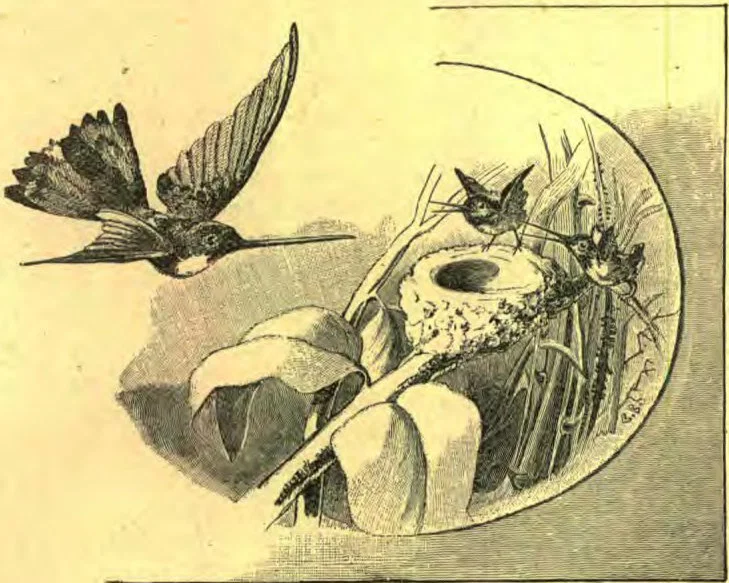
A LONG time ago I visited a home that I will tell you about now. It was a dainty structure. The work on it was so wonderful that I marveled how it could have been made at all, especially without hands. Strange as it may seem, not one of those that lived in this house—father, mother, or children—had hands.
It was late in the afternoon when I made my call, and I found no one at home but the two babies—both snug in bed. They did not like it because I peeped in at the door, but I was anxious to know who lived in this pretty home.
As soon as I spied the wee children, I knew their names; for I had seen some of their relatives in another State. They were Mr. and Mrs. Humming Bird’s children. They were so tiny I knew they could not tell me what I wished to know; so I concluded to wait quietly till the father and mother came home.
As I was waiting, I noticed that the house was fastened to a little twig, and was made of cotton and thread, nicely woven together. “I could not do that, even with hands,” I thought; “how can these birds make this pretty home without hands?”
Soon the father and mother came. They flew so fast I could scarcely see them, but I could plainly hear the humming, buzzing sound caused by the rapid motion of their wings.
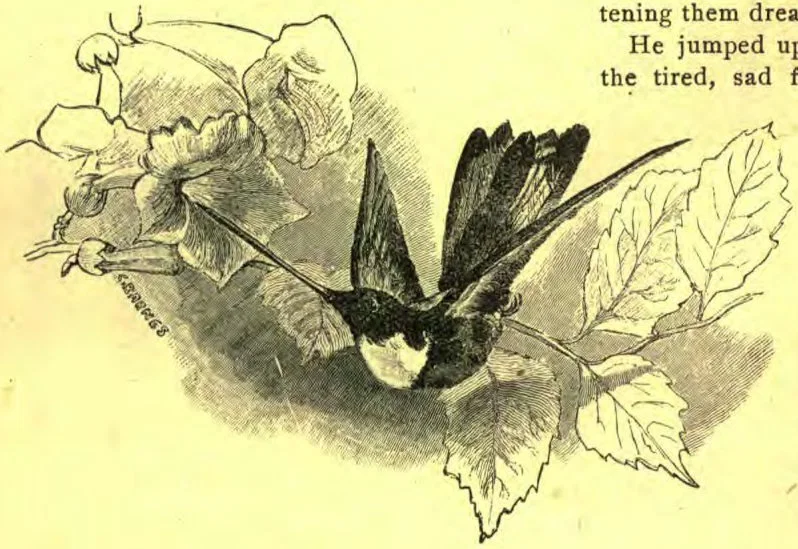
They stayed only a moment, to see that all was well at home; then away they darted. I followed carefully. Such a queer sight I saw! There was Mr. Humming Bird hanging in the air, resting before a flower, not on his feet, but on his wings. His long bill was in the flower. When he had taken the honey from this flower, away he darted again. For a moment I could not see where he was; but I soon saw him hovering over a rose, taking honey in the same way. A short distance away Mrs. Humming Bird was doing the same thing. I wished very much to see them near by, but they had no time to visit with me; so I followed them carefully from flower to flower.
I knew that if I could get a good look at them, especially at Mr. Humming Bird, I could tell what humming bird family they belonged to. Finally I stood where the light was just right to show me his beautiful, glistening coat. He had such a pretty little throat, the very color of a ruby. I was not able to get all the colors in his coat; for every time he moved, they seemed to change. In looking at him from the side, the feathers appeared mixed with green and gold. Underneath on his breast the color was a dull garnet. His wings were purplish brown. The tail was chestnut red, with black at the tip. I felt quite sure now that my friends were Mr. and Mrs. Ruby-Throat Humming Bird, and was very glad I had stayed to watch them.
Since I made this visit, I have often been made sad to see dead humming birds on ladies’ hats.
MRS. HUMMING BIRD’S DAINTY HOME
Surely this is not right. God does not wish us to kill his creatures to adorn ourselves. I hope all the little people who read this will always be kind to the humming birds as well as to all the other members of the bird family.
MRS. LYDIA M. DROLL.
PHUSSANDPHRET
By Our Youth
Have you heard of the land called Phussandphret,
Where the people live upon woes and regret?
Its climate is bad, I have heard folks say;
There's seldom, if ever, a pleasant day.
'Tis either too gloomy from clouded skies,
Or so bright the sunshine dazzles one's eyes;
'Tis either so cold one is all of a chill,
Or else 't is so warm it makes one ill.
The season is either too damp or too dry,
And mildew or drought is always nigh;
For nothing that ever happened yet
Was just as it should be in Phussandphret.
Now, if ever you find your feet are set
On the downhill road into Phussandphret,
Turn quickly and travel the other way,
Or you never will know a happy day.
Follow some cheerful face—'t will guide
To the land of Look-at-the-Pleasant-Side.
Then something bright you will always see,
No matter how dark the day may be;
You'll smile at your tasks, and laugh in your dreams,
And learn that no ill is as bad as it seems.
So lose no time, but haste to get
As far as you can from Phussandphret.
— Our Youth.
THE HAPPIEST BOY
Who is the happiest boy you know? Who has the best time, I mean,—the one who has the biggest bicycle, or the most marbles, or wears the best clothes? Let’s see.
Once there was a king who had a little boy whom he loved. He gave him beautiful rooms to live in, and pictures, and toys, and books. He gave him a pony to ride, and a boat on the lake, and servants. He provided teachers who were to give him knowledge that would make him good and great. But for all this the young prince was not happy. He wore a frown wherever he went, and was always wishing for something he did not have. At length a magician came to court. He saw the boy, and said to the king, “I can make your boy happy. But you must pay me my own price for telling the secret.”
“Well,” said the king, “what you ask I will give.”
So the magician took the boy into a private room. He wrote something with a white substance on a piece of paper. Next, he gave the boy a candle, and told him to light it and hold it under the paper, and then see what he could read. Then he went away, and asked no price134at all. The boy did as he had been told, and the white letters on the paper turned into a beautiful blue. They formed these words: “Do a kindness to some one every day.” The prince made use of the secret, and became the happiest boy in the kingdom.—Selected.
IN THE NAME OF FASHION
By Elizabeth Rosser
THERE’S a little mother, just in the edge of town,
With clear, deep eyes of azure, hair of sunny brown;
With gentle heart that’s always singing in its joy,—
For has she not a treasure in her girl and boy?
Oh the love she bears them! the many steps she takes!
The loving labor daily done for their dear sakes!
The gentle lessons taught them in such loving voice!—
Surely the very angels, seeing, must rejoice.
There was another mother in the edge of town,
Modest, sweet, retiring, clad in robes of brown.
Often in the morning, ere tumult filled the street,
I have heard her singing with tender voice and sweet.
And if the day was sunny, or if ’t was dark with rain,
Still she praised her Maker with an inspiring strain;
For her heart knew the gladness of loving ministry:
Her days were labor-filled to feed her darlings three.
And yet this little mother had to die a cruel death,
Close her bright eyes, and cease to draw her gentle breath,
Still her soft-beating heart, her busy toiling stop,
And yield her carmine life-blood, flowing drop by drop;
Her darlings for their daily food and shelter sadly cried,
And cried in vain; then feebly drooped their heads and died;
For that mother took this one, sewed her on her hat,
And wore the victim proudly — what think you of that?
1. Chapters and Verses.—The division of the Bible into chapters and verses was not made until comparatively modern times. These divisions seem to have been made without reference to the meaning of the text, and without regard for the connection of subjects. We have a forcible illustration of this in the insertion of a chapter heading after Dan. 11:45, when it is very evident that the next verse, and indeed all that follows, are closely connected with it.
2. Persecuted for the Truth’s Sake.—In previous notes reference was made to the decree yet to be made against those who refuse to worship the beast and his image. This week the lesson points out specifically the time of trouble upon which we are entering, and during which the people of God will again endure persecutions. As it was then, so will it be again; not only strong men, but women and frail girls, yes, even the children, will endure without flinching severe persecution for the sake of the third angel’s message. The same power that sustained the martyrs of old will keep the people of God faithful in the closing scenes of this world’s history.
3. The Black Cloud of the Future.—God in his mercy and love has not left us to come upon this time of trial unknowingly, but has revealed what is before us, that we may be prepared to stand against the tempest of opposition and wrath. Through the Spirit of prophecy he has told us that “throughout the land, the papacy is piling up her lofty and massive structures, in the secret recesses of which her former persecutions are to be repeated.” After telling us that when the decree against commandment-keepers is issued, the people of God will flee from the cities and villages, and dwell in the most desolate and solitary places, the statement is also made that “many of all nations and all classes, high and low, rich and poor, black and white, will be cast into the most unjust and cruel bondage. The beloved of God pass weary days, bound in chains, shut in by prison bars, sentenced to be slain, some apparently left to die of starvation in dark and loathsome dungeons. No human ear is open to hear their moans; no human hand is ready to lend them help.”
4. The Silver Lining to the Cloud.—What could be more comforting than this? “Though enemies may thrust them into prison, yet dungeon walls can not cut off the communication between their souls and Christ. One who sees their every weakness, who is acquainted with every trial, is above all earthly powers; and angels will come to them in lonely cells, bringing light and peace from heaven. The prison will be as a palace; for the rich in faith dwell there, and the gloomy walls will be lighted up with heavenly light, as when Paul and Silas prayed and sang praises at midnight in the Philippian dungeon.”
5. Deliverance Is Sure.—“And at that time thy people shall be delivered, every one that shall be found written in the book.” Not one will be overlooked. The Lord did not forget Noah when the world was destroyed by water. Neither was Lot forgotten when the cities of the plain were consumed. Jeremiah was remembered in his dark and dismal prison-house. The three faithful men who passed through the fiery furnace were not forgotten, nor was Daniel left to perish in the lions’ den. A mother might forget her child, the Lord says, but adds, “Yet will I not forget thee.”
6. A Special Resurrection.—Most of our readers probably understand that the Bible teaches that there will be two general resurrections,—that of the righteous dead at the second coming of Christ, and that of the wicked dead a thousand years later. Our lesson touches upon a special resurrection of a limited number of both classes, to take place a short time before the coming of the Lord in the clouds of heaven. This event is thus described in “Great Controversy,” Vol. IV, page 637: “Graves are opened, and ‘many of them that sleep in the dust of the earth’ ‘awake, some to everlasting life, and some to shame and everlasting contempt.’ All who have died in the faith of the third angel’s message come forth from the tomb glorified, to hear God’s covenant of peace with those who have kept his law. ‘They also which pierced him,’ those that mocked and derided Christ’s dying agonies, and the most violent opposers of his truth and his people, are raised to behold him in his glory, and to see the honor placed upon the loyal and obedient.”
7. Already Risen.—The first man to be raised from the dead was Moses. Angels of God buried this faithful servant in a lonely spot upon Mt. Nebo. But he was not suffered to remain long in the tomb. “Christ himself, with the angels who had buried Moses, came down from heaven to call forth the sleeping saint.” Although Satan contended that he had possession of the dead (Jude, verse 9), Christ merely said to him, “The Lord rebuke thee,” and Moses was brought to life, and ascended with Christ to the city of God. Matt. 27:52, 53, also gives an account of a resurrection of the dead, which took place when Jesus himself came forth from the tomb. In “Desire of Ages,” page 786, we are told who these were: “As Christ arose, he brought from the grave a multitude of captives. The earthquake at his death had rent open their graves; and when he arose, they came forth with him. They were those who had been co-laborers with God, and who at the cost of their lives had borne testimony to the truth. Now they were to be witnesses for him who had raised them from the dead.” “They ascended with him as trophies of his victory over death and the grave.”
MAY STUDY OF THE FIELD
PART I: JAMAICA
(April 29 to May 5)
1. Basis of Study.—Our lesson this week is based upon a field with which many are acquainted. A study of its early history, the condition of the people, and the need of the message will, however, be beneficial.
2. Beautiful Jamaica.—One visitor has thus described Jamaica: “The scenery of Jamaica is beautiful beyond description. No man, however blunted his feelings, can behold it without emotion. Lofty mountains, covered to the top with immense forests, hiding their heads in the clouds; the size, structure, and verdure of the trees; the delightful variety of their darker and lighter shades; the beauteous appearance of the shrubs; the purity of the air; the richness and variety of the landscape; the structure of the houses; the color, dress, appearance, and manners of the inhabitants,—all excite astonishment, wonder, and delight.”
3. The Indians of Jamaica.—The native inhabitants of Jamaica were short-lived after its discovery by Columbus. The reason for this, as given by the Spaniards, was that they would not submit to toil, neither would they become the slaves of their discoverers. A short sketch of these unfortunate children of nature will be of interest. Although remarkable for the simplicity of their manners, they were not barbarous. Their government was monarchical and hereditary; their chief was obeyed implicitly, and treated with reverence. Their religion, though superstitious, was not bloody. They believed in a future state in a place of tranquillity, abounding with delicious fruits, cool shades, and murmuring rivulets, where thirst never raged, and the hurricane was unknown. These people were of a clear-brown color, with straight, black hair. Their progress in the arts and in agriculture was considerable. Notwithstanding the spontaneous growth of fruits, they cultivated maize, and displayed great skill in the preparation of cassava bread. They manufactured excellent cloth from their cotton, and possessed the art of dyeing it with a variety of colors. Their domestic utensils, consisting of earthenware, chairs, curiously woven beds, etc.; their implements of husbandry; their canoes, some of them navigated by forty oars, and covered with an awning of mats and palm-tree leaves, in order to protect their women and children from the spray of the sea,—all evinced a surprising degree of ability and development. In the space of but a few years after the Spaniards took possession of Jamaica, these people were entirely extinct. Many were forced into the water, baptized, and immediately killed, “to prevent their apostasy.” Unfortunate people! But how many to-day are sinking into Christless graves? Have you and I no responsibility?
4. Origin of the Maroons.—As early as 1517 slaves were carried into the West Indies from Africa; and so extensively was this trade pursued that in less than three years the annual import of slaves into these islands alone reached more than seventy-four thousand. The slaves were sold to planters and merchants, by whom they were treated little better than animals. When Jamaica was occupied by the English in 1655, many of the slaves belonging to the Spaniards did not leave with their masters, but retired to the mountains and uncultivated parts of the island. They raised a few vegetables, constructed huts for shelter, and wandered through the woods. Being constantly135recruited by runaway slaves, they soon became numerous, and, consequently, formidable. Conscious of their strength, they often laid waste the neighboring plantations, and planters were afraid to settle near them. These negroes were called “maroons,” or “hog-hunters.” For a number of years they were in continuous warfare with the English. This was finally settled by an agreement that the maroons should possess and occupy certain land with full liberty,—a privilege of whose value they were fully sensible, as it had never before been enjoyed. An excellent description of our first work among this people will be found in the April number of the Missionary Magazine.
5. An Interesting Letter.—The following letter is a description of the earthquake that shook Jamaica in 1692. It was written June 20, 1692, and sent to a geographical society in London: “The terrible earthquake which happened the 7th instant, between eleven and twelve of the clock at noon, shook down and drowned nine tenths of the town of Port Royal in two minutes of time, and all of the wharf side in less than one; very few escaped there. The great part of Port Royal is sunk; that where the wharfs were is now some fathoms of water. All the street where the church stood is so overflowed that the water stands as high as the upper rooms of those houses that are still standing . . . I believe there were lost about two thousand whites and blacks. At the north, about one thousand acres of land sank, and thirteen people with it. All our houses were thrown down all over the island, and we are forced to live in huts. The two great mountains at the entering into Sixteen-mile Walk fell, met, and stopped the river, that it was dry from that place for a whole day. Vast quantities of fish were taken up, greatly to the relief of the distressed. At Yellows a great mountain split, and fell into the level land, covering several settlements, and destroying nineteen white persons. One man, whose name was Hopkins, had his plantation removed half a mile from the place it formerly stood. Of all wells, from a fathom to six or seven fathoms in depth, the water flew out at the top, with the great motion of the earth. The earth continues to shake five or six times in twenty-four hours, often trembling. I pray God to avert the heavy judgments that still threaten us. There are about five hundred graves already, and people are dying every day.” It is estimated that not fewer than three thousand persons died of disease at this time, the greater part in Kingston, where five hundred graves were dug in a month’s time, and two or three buried in a grave.
6. Third Angel’s Message in Jamaica.—May 26, 1893, the first Seventh-day Adventist minister and his family settled in Jamaica. Previously to their arrival a few had begun to keep the Sabbath as a result of periodicals and correspondence from the International Tract Society. The latest reports show about seven hundred and fifty persons enrolled in the church membership, with one hundred more keeping the Sabbath. The work has recently been strengthened by two self-supporting teachers. Many more could find a field of usefulness here, as children, especially of Sabbath-keepers, find it very hard to attend the public schools. Church-school teachers who could support themselves would receive a hearty welcome.
Strength of the Soul Through Personal Will
By Mary Alling Aber
SOUL strength comes from the exercise of one's own will, and not from following the will of some other soul.—Mary Alling Aber.
Time: A. D. 31. Place: Galilee. Persons: Jesus, disciples.
QUESTIONS
1. Following the meeting at the Sea of Galilee, to what place did the disciples repair? Matt. 28:16. How many assembled with them at this time? 1 Cor. 15:6. When Jesus appeared, how was he regarded by different ones? Matt. 28:17.
2. What did Jesus say concerning himself? V. 18. Because of this fullness of power, what were his servants to do? V. 19; note 1. What was to be the subject-matter of their teaching? V. 20, first part.
3. What had Jesus previously taught them concerning their work for the world? Luke 24:47, 48. How much would depend upon the acceptance or rejection of the gospel message? Mark 16:16; note 2.
4. What miraculous manifestations were to attend the preaching of the gospel? Vs. 17, 18; note 3.
5. Before entering upon their work, for what were the disciples to wait? Luke 24:49; note 4. What did the promise of the Father include? Acts 1:4, 8, first part. Having received the Holy Spirit, what were they then to be? And where? V. 8, last part.
6. How fully did the disciples carry out the commission given them? By whom and in what way were their efforts made successful? Mark 16:20; Heb. 2:4. Of what promise was this a fulfillment? Matt. 28:20, last part.
7. When the great gospel commission shall have been completely fulfilled, what will occur? Matt. 24:14.
NOTES
1. All the power of heaven and earth is pledged to the one who labors to win souls. And it is pledged to no others. The worker is always strong, because the very moment that he begins his service of saving men, that moment the power of God finds in him a channel through which it can flow. Thus it is that the worker’s life is a life of power, a life of victory. The cause of weakness in the church of Christ is that so few are laboring for sinners. The power of God can not be selfishly hoarded; to attempt to retain it for selfish ends is but to lose it. The life-current is automatic, so to speak, for it shuts itself off as soon as it ceases to find an outlet. “I will bless thee, and thou shalt be a blessing,” is the plan of the gospel in all ages. God is a stranger to all who are shut up to themselves; and the Lord Jesus Christ says to them, “I know you not.”
2. The preaching of the truth of God must inevitably be either a blessing or a curse to men. No heart can be introduced by the Holy Spirit to the truth as it is in Jesus, and remain unchanged. Truth is a positive, active principle, which compels one to take a stand for or against it. To receive it is to be made true, or like itself; to reject it is to become more hardened and calloused in evil. Paul thus expresses the effects produced: “To the one we [that is, our message] are the savor of death unto death; and to the other the savor of life unto life.”
3. The gifts of the Spirit are promised to every believer according to his need for the Lord’s work. The promise is just as strong and trustworthy now as in the days of the apostles. “These signs shall follow them that believe.” This is the privilege of God’s children, and faith should lay hold on all that it is possible to have as an indorsement of faith.—“The Desire of Ages,” page 823.
4. During his ministry Jesus had sent the twelve into the gospel field, and had given them “power against unclean spirits, to cast them out, and to heal all manner of sickness;” yet now he tells them to wait until they shall be endued with power from on high. In their former experience, they had labored under his guidance and in a very imperfect manner; now, they were to go forth without his visible presence to aid them, and to work by naked faith. They must therefore know a power not known before, even the full and perfect power of God. To go forth before they were in possession of this power would mean defeat. The world into which the worker for Christ is sent is filled with satanic power, and only he who is filled with power from on high can meet the enemy and triumph in the Lord’s work.
To Reach BATTLE CREEK
FROM
CHICAGO, BUFFALO, DETROIT, OR TOLEDO,
Purchase Tickets Reading over the MICHIGAN CENTRAL
“The Niagara Falls Route.”
A First-class Line for First-class Travel between Chicago and New York and Boston. Elegantly equipped through trains pass Battle Creek in each direction daily.
R. N. R. WHEELER, Ticket Agent, Battle Creek.
G. W. RUGGLES, Gen’l P. and T. Agt., Chicago, Ill.
TAKE THE Canadian Pacific Railway
for . . CHATHAM, OTTAWA, MONTREAL, LONDON, GALT, QUEBEC, WOODSTOCK, TORONTO, BOSTON, PORTLAND, and
All points in New England, the Maritime Provinces, Great Britain, and the Continent.
Illustrated literature, time-tables, and full particulars, upon application to—
J. FRANCIS LEE, GEN. AGENT,
Passenger Dept. 228 SOUTH CLARK ST., CHICAGO
Branch Offices: 76 Ottawa St., Grand Rapids, Mich.; Room D, Chamber of Commerce, Cincinnati, Ohio; 315 Chestnut St., St. Louis, Mo.
Cincinnati Northern Railroad Co.
TIME TABLE NO. 3.
IN EFFECT SEPT. 24, 1899.
Trains Pass Battle Creek, as follows:
WEST-BOUND
No. 21, Mail and Express ................. 6.58 P. M.
No. 23, Accommodation .................... 2.07 P. M.
No. 27, Local Freight ......................... 8.25 A. M.
EAST-BOUND
No. 22, Mail and Express ................. 8.25 A. M.
No. 24, Accommodation .................... 1.45 P. M.
No. 28, Local Freight .......................... 5.30 P. M.
Direct connections are made at Toledo with all roads diverging. Close connections for Detroit and Cincinnati.
J. L. READE, C.
Ticket Agt., Battle Creek.
E. R. SMITH, City Pass. Agt., 6 West Main St.
E. W. Meddaugh and Henry B. Joy, Receivers,
CHICAGO & GRAND TRUNK RY.
By A. S. Parker
Trains arrive and leave Battle Creek.
WEST-BOUND FROM BATTLE CREEK.
No. 9, Mail and Express, to Chicago — 12.15 P. M.
No. 1, Chicago Express, to Chicago — 9.00 A. M.
No. 3, Lehigh Valley Express, to Chicago — 3.40 P. M.
No. 5, Pacific Express, to Chicago, with sleeper — 1.10 A. M.
No. 75, Mixed, to South Bend — 8.20 A. M.
Nos. 9 and 75, daily, except Sunday.
Nos. 1, 3, and 5, daily.
EAST-BOUND FROM BATTLE CREEK.
No. 8, Mail and Express, to Pt. Huron, East, and Detroit — 3.45 P. M.
No. 4, Lehigh Express, to Port Huron, and East — 8.27 P. M.
No. 6, Atlantic Express, to Port Huron, East, and Detroit — 2.25 A. M.
No. 2, Leh. Exp., to Saginaw, Bay City, Pt. Huron, and East — 6.50 A. M.
No. 74, Mixed, to Durand (starts at Nichols) — 7.15 A. M.
Nos. 8 and 74, daily, except Sunday.
Nos. 4, 6, and 2, daily.
A. S. PARKER, Ticket Agent,
Battle Creek.
Missionary Societies and Bible Translation in Africa
FORTY-FIVE missionary societies are at work in Africa; and the Bible is translated, in whole or in part, into seventy languages.