Your ShelfYour Projects

Signs of the Times, Vol. 39, No. 21.

The Better Way

Signs of the Times

May 28, 1912

Pacific Press Publishing Association · Mountain View, California · May 28, 1912

The Better Way
“For the weapons of our warfare are not carnal, but mighty through God to the pulling down of strongholds.” —Holy Scriptures.
“Secular power has proved a satanic gift to the church, and ecclesiastical power has proved an engine of tyranny in the hands of the State.” —Dr. Philip Schaff.

The Better Way

IF the Almighty has set apart the first day of the week as a time which man is bound to keep holy, and devote exclusively to His worship, would it not be more congenial to the precepts of Christians to appeal exclusively to the great Lawgiver of the universe to aid them in making men better—in correcting their practises—by purifying their hearts? Government will protect them in their efforts. When they shall have so instructed the public mind, and awakened the consciences of individuals, as to make them believe that it is a violation of God’s law to carry the mail, open post-offices, or receive letters, on Sunday, the evil of which they complain will cease of itself, without any exertion of the strong arm of civil power. When man undertakes to become God’s avenger, he becomes a demon. Driven by the frenzy of a religious zeal, he loses every gentle feeling, forgets the most sacred precepts of his creed, and becomes ferocious and unrelenting.—Report of House of Representatives, 1830.
Religious Liberty Series, No. 2

To the Reader

TO THE READER.—This paper is published in the interests of LIBERTY—YOUR liberty as well as ours. We believe that our liberties, yours as well as ours, are in danger; that inalienable rights are jeopardized by movements and influences now operating. Some friend may send you this paper. You will not be asked to pay for it; but we do plead with you to read and weigh what it contains. We should be glad to hear from you either favorably or adversely.

"IF YE WILL INQUIRE, INQUIRE YE."

This Inquirers' Department is conducted for the purpose of helping those who are studying the Bible. The answers are oftentimes only suggestive. They are never to be considered infallible, only as they agree with the infallible Word. The writer who may answer them does not consider that his opinion is infallible. He will simply give the best that he has, and plead with the inquirer to search the Word. Such questions only will be answered as, to the editors, seem to minister to the good of the readers and to the mission of the paper. We can not answer repeatedly in the same volume questions upon the same scripture. The name and address must accompany question, not for publication, but as an evidence of good faith, and that answer may be made by letter if deemed advisable. No letters are answered which do not contain the name of the writer. It is well always to enclose stamp for reply.

3761 — What Is Done Away?

Please explain the meaning of 2 Cor. 3: 6, 11. What does the 11th verse mean that is done away with? M. M. M.
For a much fuller explanation of this chapter see "Bible Students' Library," No. 149, "What Is 'Done Away' in Christ?"
If our correspondent will notice, he will clearly see, however, that it is not the law that is done away, but it is the condemnation that is done away. God made the apostles ministers of a new covenant, not of the letter of the new covenant, but of the spirit. It does not mean that the letter is the old covenant and the spirit is the new covenant, but God's apostles were ministers of that which gave life, not of that which brought death. The letter only of any truth, however spiritual it may be, will kill. It simply condemns. But if the living truth is received in the heart, it cleanses away the sin and the condemnation, and brings justification. The law of God written in tables of stone brought condemnation to the children of Israel as they stood before Sinai (see Exodus 20). But this was not the case with Moses. Moses looked beyond the mere letter to the power of the Spirit of God, which changed his heart, and wrote thereon God's law. Consequently the glory, which brought condemnation to them, and which at first brought condemnation to Moses, swept away the condemnation, and brought in the righteousness or the justification, so that the glory that was within Moses' heart shone out in his face. So in the days of the apostle, the ministration of the Spirit brought righteousness, and swept away the condemnation. The condemnation was with glory. It takes a glorious thing to condemn man for his sins. But that passed away in the exceeding greater glory which was to come, the justification, the righteousness of Jesus Christ. Therefore to the unbeliever there is condemnation, which God designs shall pass away into the righteousness or justification of the Gospel.

3763 — Symbols

What do the symbols, earth, heavens, and seas, fire and brimstone, represent in Scripture usage? E. H.
It is somewhat difficult to answer a question of this kind, because there are so many figures of speech used in the Scriptures, so many times that words are used with various shades of meaning, sometimes literally, sometimes symbolically, sometimes both are combined. The earth may refer to the mere material planet itself, it may include that planet and all that dwell upon it, and it may refer to the people themselves, as, "O earth, earth, earth, hear the word of the Lord." So the term "heavens" may refer to the place where God dwells, to the sidereal heavens where the sun and stars are, to the atmospheric heavens where the clouds float and birds fly; and it may also refer to a spiritual world, as in Rev. 12:1, "A great sign was seen in heaven," that is, in the spiritual world. The "sea" in Dan. 7:2 is used as symbolical of the nations of the earth (see also Rev. 17:15). Fire is the symbol of a purifying agent, a destructive agent of everything that will admit of destruction. Fire and brimstone together, of course, would indicate a destructive burning.

3765 — The Book of Ruth

Can you inform me through the "Question Corner" who wrote the book of Ruth? B.
We do not know, nor do we know that it is known by any one. It is a little story of rare beauty, the chief aim of which is to give the ancestry of David and of our Lord. It may have been written by Samuel; and so the "Popular and Critical Bible Encyclopedia" states, "The true date and authorship of the book are alike unknown, tho the current of authority is in favor of Samuel as the writer." Among the early Jewish writings it was added to the book of Judges.
Schedule for Week Ending June 8

Our Bible Band

Schedule for Week Ending June 8 Sunday June 2 Nehemiah 9 Monday " 3 " 10:1, 28-39; 13 Tuesday " 4 Isaiah 1 Wednesday " 5 " 2 Thursday " 6 " 3 Friday " 7 " 4, 5 Sabbath " 8 Psalms 48, 49, 50
—★—
The first two days of our readings close the stirring account of the reformation under Zerubbabel, Ezra, Nehemiah, on the return of the Jews from the Babylonian captivity. The last chapter is the story of the earnest work of the ardent reformer Nehemiah to bring the Jews back to a strict observance of the law and of the Sabbath.
We then begin the reading of a book of marvelous interest, that of Isaiah, who prophesied between the years 760 and 698 B.C. He began his prophecies as a young man, in the reign of Uzziah, and continued them through the reigns of Jotham, Ahaz, and Hezekiah. Crucial times in Judah were they, and typical of the great days to come. Isaiah is called the "Gospel prophet." No other prophet of the Old Testament speaks so much of the last days, the sufferings and work of our Lord Jesus Christ, and the kingdom of glory which lies on before. His name means "Jehovah is salvation." Tradition tells us that his prophesying extended into the reign of Manasseh, and that he was martyred by that wicked king. The book naturally divides into two parts, chapters 1-39 and 40-66. The first part contains the following in general: the introductory discourse; second, four prophecies, chapters 2-12; third, a series of burdens on Babylon, Philistia, Moab, etc., chapters 13-23; fourth, other various prophecies, especially looking forward to the last days and the judgments of God upon the earth, 24-35; fifth, historical sketch and included messages, 36-39.
Particularly note that the lessons for this week do not point out a time of peace in the last days. They declare to us that the people shall say that peace is coming, but that this message is a false message.
Our Sabbath readings are Psalms 48-50, the first prophetic of the glory of Christ's kingdom, the second on the necessity of trust in God, the third on the second coming of Christ and the preparation for that event.

3759 — From One Sabbath to Another

Please explain Isa. 66:23. When God's people come to worship from one Sabbath to another, does it not mean during the ages, ceaselessly, continuously? If we make it say every new moon, and every Sabbath, for such worship to be done, it seems to me that we are placing God's requirement of worship in the new earth, as we now have it, only weekly.
The scripture is not one which declares all the worship. That is not its object at all. Its object is to show that in that new heavens and the new earth there will be God's ordinances. It is not weekly worship alone that God asks of His children here. There is weekly worship and there is a weekly worship day, but that very weekly worship day in its command implies continuous worship. "Remember the Sabbath day, to keep it holy," is to remember it all the week; but entirely apart from the day, there are God's other requirements demanding constant, faithful worship during all the intervals between the Sabbaths.
The Sabbath is given because man is a social being. If it were God's design that man should live alone, he would need no Sabbath. He could come into connection with God at all times, under all circumstances, as he can now. But He made man a social being. He would have him come in connection with his fellows, learn to know his fellows, and learn better to appreciate the unselfishness of God's requirements, and therefore the Sabbath. And throughout all eternity God's Sabbath will be honored. Throughout all eternity His children will come together to worship Him and glorify His name on that day. And so from new moon to new moon—from month to month is better—will they come up to meet with each other and with God.
It seems clear to us that the text points out Sabbath congregational worship and monthly congregational worship. God's children will go throughout all His boundless realms. He will give them pleasant, glorious tasks to do, blessed employment, on that new earth. They will find the sweetest, holiest communion alone with God and His works. And they will carry all these blessings, from week to week and from month to month, to the great assemblies that shall meet in the great center of God's universe of worship. The text does not imply all worship, but simply social, congregational worship. There is very much which can be said upon this in the origin of the Sabbath itself.

Isaiah 63:1

3760 — Isaiah 63:1

Will you please explain in the "Question Corner" Isa. 63:1? When and how is our Saviour coming from Adam?
Our inquirer has not read carefully; it does not say "Adam," but "Edom." "Who is this that cometh from Edom?" Edom stands as a representative of the great, wicked world. Isaac had two sons, Jacob and Esau. Jacob became Israel; Esau, Edom. They stood as two types of two different conditions, or rather two classes of characters.—Jacob, for those who were faithful to God; Edom, for those who placed their whole hopes in this world. And the text under consideration was when judgment was executed upon the latter class. "Who is this that cometh from Edom, with dyed garments from Bozrah [a city of Edom]? this that is glorious in his apparel, marching in the greatness of his strength?" And He answers, "I that speak in righteousness, mighty to save." And yet His garments were red with the vengeance upon sin and those identified with sin; but the same power is pledged to save His people. The doom of Edom is well set forth in the prophecy of Obadiah; and in this, also, Edom stands as the symbol of the great, wicked world.

Definitions of Democracy and Related Terms

3762 — What Is Democracy? Papacy? Paganism? Huguenot?
There are some questions which I see in political papers and elsewhere which puzzle me. What is Papacy? and what is democracy? and what is paganism? and what and how was a Huguenot? What did they start from? W. H. M.
"Democracy" comes from the Greek "demos," the people. It is a government by the people. This government is not a pure democracy, however, but a representative republic. The Democratic Party hold practically to the same ideas that the Republicans do. The people rule through representatives elected by themselves; and that is what democracy generally means at the present time,—the ruling of the people rather than the ruling of classes. It is opposed to autocracy, the ruling by one man.
There are different views of the Papacy. With some it is identical with the Roman Catholic Church. But in the use which we make of it, it means more than the Roman Catholic Church; it means that system of Church and State which has been developed through the Roman Catholic Church, and its union with the powers of earth. The Roman Catholic Church alone is an ecclesiastical system; the Papacy is that ecclesiastical system connected with the State.
Paganism, generally speaking, is the worship of false divinities, or idolatrous worship; from "pagan," a worshiper of false gods; pagan beliefs or practises; heathenism.
A Huguenot is a French Protestant of the sixteenth and seventeenth centuries. They suffered great persecutions during the religious wars of these centuries. Many were massacred on St. Bartholomew's Day, August 24, 1572. Religious and civil freedom was granted to them by the edict of Nantes by France in 1598; but when that was revoked in 1685, very many of them emigrated to England, to Germany, to the Netherlands, to Switzerland, to South America, and to the North American colonies, so that quite a number of the good people of this land were descendants of the Huguenots. They are simply French Protestants, moral, industrious, and intelligent. The word may have sprung from the personal name "Hugo," or from "hugu," mind.

3764 — Flesh and Blood in the Kingdom

Please explain 1 Cor. 15:50: "Now this I say, brethren, that flesh and blood can not inherit the kingdom of God."
This expression is explained in the latter clause of the verse: "Neither doth corruption inherit incorruption." Man in his present state of mortality can not have place in the kingdom of God. The change must take place. Man must be fitted for that newer and better world. "The first man Adam became a living soul. The last Adam became a life-giving spirit." "The first man is of the earth, earthy," and so are all his children; but the last Adam is the Lord from heaven, and such will be His children. And therefore flesh and blood, or man in his mortal condition, can not inherit the kingdom of God.

America and Religious Liberty

By Charles Miles Snow, Editor of "Liberty"
[The first article in this series appeared last week under the title of "Two Great Charters." This is article two. The whole series should be read. Editor S. of T.]

II—A New Order of Things

FROM the day when the first faint struggles of an enthralled conscience for liberty began in Europe, until the chains of soul bondage were finally broken, there was an unrelenting warfare carried on. The light of Savonarola flickered for a time in the murky gloom, and went out with his martyrdom. A church-ridden and church-fearing State laid heavy hands on every advocate of freedom. The State-recognized religion had become a powerful political machine, setting up and pulling down kings. Princes did its pleasure, trembled under its frown, and changed the policy of their government under threat of its excommunication. Nevertheless, in spite of excommunication, in spite of threats of death, and even in spite of death itself, there were loyal souls who would not bow the knee nor smother their consciences by a seeming acquiescence in that order of procedure.

Failure of the Reformers

Into that darkness, God projected the search-light of His Word through such instruments as Luther, Wyclif, Calvin, Zwingli, Melanchthon, and John Knox, men who loved God and feared nothing but sin. They were not perfect; but they had begun to see "as through a glass, darkly;" and groping toward the light with hearts fired with zeal for the truth, they guided out of that darkness and up toward that dawning light a mighty host grown weary with the tyranny and exactions of a State-enforced religion. So long had they dwelt under the tutelage of that kind of religion, that they were unable at times to carry out in practise the liberty which they preached. It was because of such tutelage that we find Calvin consenting to the death of Michael Servetus.
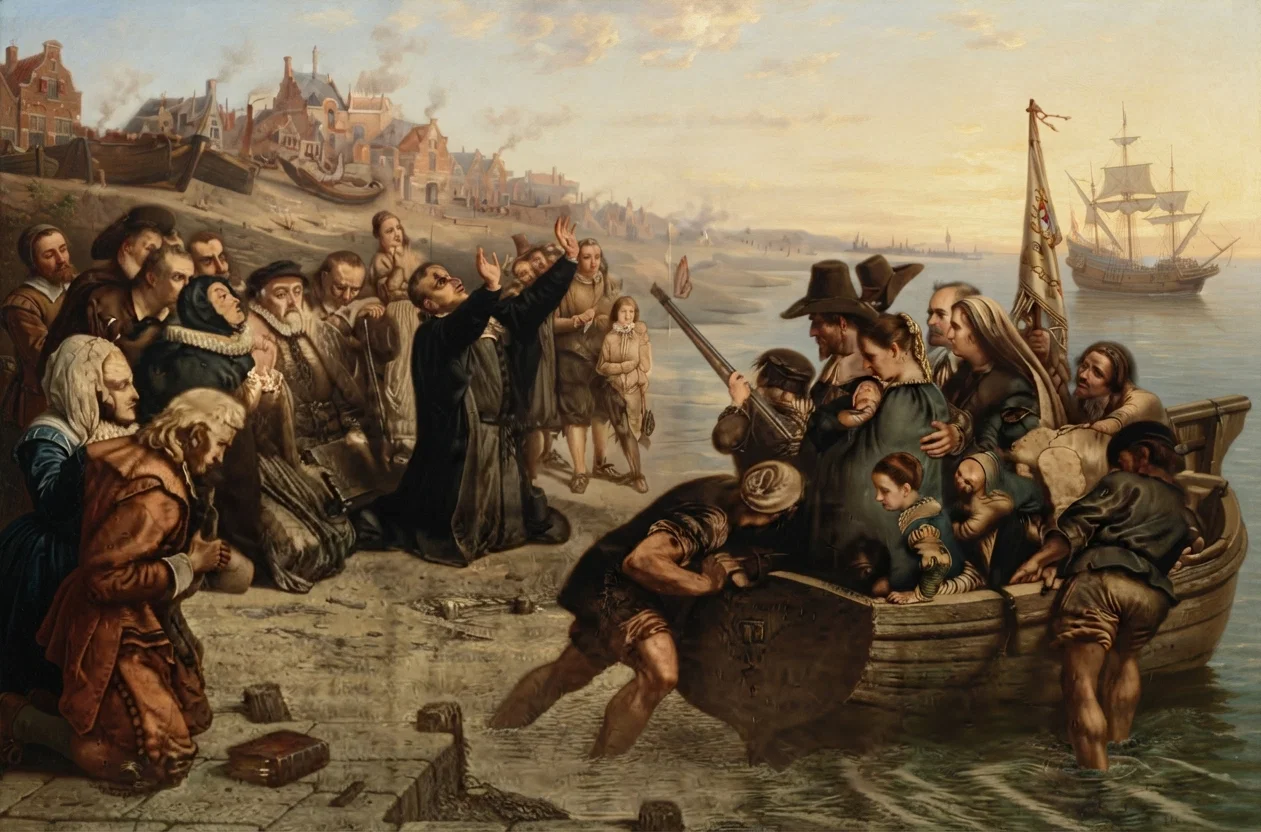
The departure of the Pilgrims at Delfshaven, for America. They left the Old World to escape the intolerance of what they thought was a perverted religion, and they set up in this land an intolerant régime of what they considered the true religion of Christ. Nevertheless it put to death Baptists and Quakers. No church is good enough to be trusted with civil power; and no State can afford to take that risk.
Luther had taken his stand upon the Bible and the Bible alone as man's legitimate rule of faith and practise. He declared:
"It is with the Word we must contend, and by the Word we must refute and expel what has gained a footing by violence. I would not resort to force against such as are superstitious, nor even against unbelievers. Whosoever believeth, let him draw nigh; and whoso believeth not, stand afar off. Let there be no compulsion. Liberty is of the very essence of faith."—"History of the Reformation," D'Aubigné, book 9.
"No one can command or ought to command the soul except God. It is futile and impossible to command, or by force to compel, any man's belief. Heresy is a spiritual thing, which no iron can hew down, no fire burn, no water drown." "Whenever the temporal power presumes to legislate for the soul, it encroaches."—"Religious Liberty," King, page 8.
That was good doctrine; but even the Reformers could not, in the general darkness of their day, hold consistently to it. It was soon found that Protestant hierarchies and synods could fine and imprison and torture and burn dissenters from the State religion as vigorously as under the older name. They found it difficult to cut loose from that papal principle of the union of religion and the State. We hear Calvin saying:
"Godly princes may lawfully issue edicts for compelling obstinate and rebellious persons to worship the true God and to maintain the unity of the faith."
In spite of Luther's noble stand for freedom in the things of God, we hear him saying, in denouncing the Anabaptists:"Let the sword exercise its rights over them."
"Since it is not good that in one parish the people should be exposed to contradictory preaching, he [the magistrate] should order to be silent whatever does not consist with the Scriptures."
That made the magistrate the judge and censor of religious teaching, to prohibit what he saw fit, and to favor the proclamation of whatever agreed with his opinion.
We see thus that Europe in Reformation days was not far removed in principle from the church which the Reformers denounced, and their conduct toward dissenters proves them not far removed in practise.

Influence of Anabaptists

History declares that fifty thousand Anabaptists perished in Europe. A hundred years of persistent persecution succeeded in crushing out the Anabaptist movement in Switzerland and Germany. By fire and by water they testified with their lives for the blessed Gospel of soul freedom. Those who escaped with their lives from Germany and Switzerland—from Lutheranism, Calvinism, and Catholicism—found a refuge in the Netherlands, and their teachings began again to spread abroad over Europe.
This was the "old order of things." It began in union of Church and State, bore fruit in religious oppression, and it literally drenched a continent in blood. But the hour had struck for a "new order of things." The drowning of the Anabaptists could not drown the principles for which they stood—and fell. The shedding of their blood could not drain the vitality out of the truths they held. It is not generally known that with them originated the expression, "Every man has a right to worship God according to the dictates of his own conscience;" but such is declared to be the case. Their principles were these:
"That secular authority has no concern with religious belief; that Christians do not kill or punish with imprisonment or the sword, but only with exclusion from the body of believers; that no man should be compelled by force to believe, nor should any be slain on account of his faith."—"Der Wiedertäuffern Ursprung, Furpang, Secten, Wesen," etc., Bullinger.
It was impossible that their doctrines should perish. The study of God's Word was awaking in the bosom of mankind a consciousness of man's individual accountability to God. The commands of the Decalogue, iterated and reiterated in the ears of the people, were causing men to question whether they could take the lives of their fellow men because of differences of belief, and be guiltless of murder. The leaven was working, and the result could not but manifest itself in the years that were to come.

In England

Anabaptists fleeing from the bitter persecution of Catholic and Protestant alike, crossed the English Channel by thousands, and settled in the eastern and southern counties of England. They were not received with open arms. There was hardship still in store for them, but they kept their light burning undimmed. James I declared, "I will make them conform, or I will harry them out of England."—"Religious Liberty," King, page 63. Richard Hooker denominated freedom of conscience "a loose and licentious opinion of the Anabaptists."—Ib., page 64. The Westminster Confession, adopted in 1647, set forth the illiberal principle that "civil government is designed to support the external worship of God, to preserve the pure doctrine of religion, and defend the constitution of the church."
According to that document it was the duty of the civil officers to preserve the unity of the faith under penalty of the law. Whatever Rome had done, that document authorized the church-and-state officials to do. And Henry VIII, the titular head of the English Church, determined to rid his realm of these dissenters, issued a decree commanding them to depart within ten days from the date of the decree, "on pain to suffer death, if they abide and be apprehended and taken."—"Wilkins's Concilia," volume 3, page 776. Their only crime was "wicked errors and abominable opinions."
In spite of these persecutions, the principles of soul freedom held by the Anabaptists continued to be disseminated throughout the realm. The influence of their persistent teachings in the Netherlands resulted in the establishment of religious freedom in that country when its independence was secured. From those teachings, industriously and fearlessly promulgated in Western Europe and England, have sprung the liberties which the Government of the United States now guarantees to its people. Those principles came to our shores as the colonists came, not welcomed by the majority, and yet winning their way until they succeeded in making persecution hateful here, and in striking the shackles off the minds and consciences of the founders of the young nation.

The Beginning of the New Order

So can we trace the teachings of the Anabaptists from the blood-sprinkled soil of Europe and England, where they paid with their lives for the propagation of their principles, and see them leavening the spirit of the American nation, until they take concrete form in the Constitution of the United States. Those heretical doctrines and "pestilent opinions," those principles which outlawed those who held them, and could find little or no recognition in the Old World, became the stable foundation of a nation whose influence is felt in all the world.
But this happy consummation was not reached in the New World unhindered. The seeds of oppression had found fertile soil, and the pestilence of persecution wrought sad havoc in colonial America. Religion was established by law; church support and church attendance were compulsory; freedom of religion was denied; and even America was compelled to pay the price—the price of blood—for freedom to worship God.
Roger Williams, wandering among the forests of New England in winter, housed in the wigwams of the savages, illustrated the spirit of the times; and out of that womb of intolerance was born a State whose influence has exceeded that of any other State in the Union in making certain for all Americans the freedom of the soul.
The same principles for which Roger Williams stood, and for which the Anabaptists before him had contended, we find eloquently set forth in that memorable document issued by the Presbytery of Hanover in Virginia, which declared that "the duty which we owe to our Creator, and the manner of discharging it, can only be directed by reason and conviction, and is nowhere cognizable but at the tribunal of the universal Judge;" that "to engage in the exercise of religion agreeable to the dictates of our own consciences, is an unalienable right" which "can never be transferred to another;" that "the kingdom of Christ, and the concerns of religion, are beyond the limits of civil control."
These principles were finally crystallized in the Virginia Bill of Rights, article 16, which reads: "That religion, or the duty which we owe to our Creator, and the manner of discharging it, can be directed only by reason andconviction, not by force or violence; and, therefore, all men are equally entitled to the free exercise of religion according to the dictates of conscience; and that it is the mutual duty of all to practise Christian forbearance, love, and charity towards each other.” And those principles were definitely adopted by the nation when its Constitution was made to declare that “Congress shall make no law respecting an establishment of religion, or prohibiting the free exercise thereof.”
There stands the nation, and out of that chaos of oppression was it born. The doctrines of freedom preached under the shadow of the gallows and in the smoke of martyr fires, have come to fruition, and upon the shoulders of every intelligent American rests the responsibility of seeing to it that the great boon conferred upon us at so great a price of suffering and sacrifice shall not be swept away in the clamor for religious legislation. The separation of Church and State, in fact as well as in theory, is the only thing that can guarantee the religious liberties of the people; and that separation can not be insured if the people permit the enforcement of any religious ordinance under penalty of law.

Toleration as a Right

The time was when toleration was craved by dissenters as a boon; it is now demanded as a right; but a time will come when it will be spurned as an insult.—Lord Stanhope, in House of Lords, 1827.

BOUNDS OF HUMAN LEGISLATION

Let the national legislature once perform an act which involves the decision of a religious controversy, and it will have passed its legitimate bounds. The precedent will then be established, and the foundation laid, for that usurpation of the divine prerogative in this country which has been the desolating scourge to the fairest portions of the Old World.—United States Senate Report, 1829.

Speak for Truth and Freedom

Is this the land our fathers loved, The freedom which they toiled to win? Is this the soil whereon they moved? Are these the graves they slumber in? Are we the sons by whom are borne The mantles which the dead have worn?
Shall tongues be mute, when deeds are wrought Which well might shame extremest hell? Shall freemen lock the indignant thought? Shall Pity's bosom cease to swell? Shall Honor bleed? Shall Truth succumb? Shall pen, and press, and soul be dumb?
No; guided by our country's laws, For truth, and right, and suffering man, Be ours to strive in Freedom's cause, As Christians may, as freemen can! Still pouring on unwilling ears That truth oppression only fears. —John G. Whittier.

BIGOTRY AND TOLERATION

The doctrine which, from the very first origin of religious dissensions, has been held out by all bigots of all sects, when condensed into a few words, and stripped of rhetorical disguise, is simply this: I am in the right, you are in the wrong. When you are the stronger, you ought to tolerate me; for it is your duty to tolerate truth. But when I am the stronger, I shall persecute you; for it is my duty to persecute error.—Lord Macaulay.

Religious Violence and Persecution

There are many who do not seem to be sensible that all violence in religion is irreligious, and that, whoever is wrong, the persecutor can not be right.—Thomas Clarke.
Continue reading: The Reformation and Liberty