By K. C. Russell, President of the National Religious Liberty Association
THIS congress was called by representatives of the various organizations of this country and Canada who are seeking to obtain a universal and stricter observance of Sunday by civil enactment.
It was held on the Jamestown (Va.) Exposition grounds, September 25, 26. The exposition grounds are closed on Sunday. The Congressional appropriation was granted on this condition. The friends of Sunday-rest, by civil law, had brought influence to bear upon the United States Congress to secure it in that condition, and obtained it, and it was embodied in the state documents.
It is to be lamented that Congress has committed itself to the religious institution of Sunday-observance by making appropriations to these great expositions on condition of the Sunday-closing of their gates; a precedent has been established that it is difficult to break from. The question of closing or not closing of the gates of this world's fair should be left entirely with the directors of the show, without any governmental interference.
The Churches in Politics.
A speaker in one of the opening addresses at the congress, said, in substance, that if the gates had not been closed on Sunday, they would not have held their congress on those grounds. A prominent United States Senator recently said, concerning the Sunday-closing of the Jamestown Exposition: "I am opposed to any and all phases of Sunday legislation, including Sunday laws. The Jamestown Exposition should not be closed on Sunday. But the truth is, the religious people of this country are getting such a hold on lawmakers that I fear we can not stem the tide in that direction."
This frank statement from the lips of a United States Senator should arouse every true citizen and patriot to the dangers which threaten us when the best element of society has been deceived into a pathway that, if followed to its logical outcome, will ultimately lead to the intolerance and ruin which other church-and-state nations have experienced,—nations that have had a union of church and state.
Among the organizations which were represented at the congress were the "American Sabbath Union," "The Woman's National Sabbath Alliance," "The Lord's Day Alliance," of Canada, "The New England Sabbath Protective League," "The Brotherhood of Andrew and Philip."
The attendance at the congress was small, but there was no lack of able speakers who talked eloquently and enthusiastically in the defense of their unchristian and uncivil Sunday legislation. They were conscious, as well as all others who are acquainted with the growing demand for Sunday laws, that the small attendance of the congress was not an index of the strong extent and strength of the movement. Besides the organizations which we have already made reference to, there are the "National Reform Association," the great "Inter-church Federation" movement, the "Federation of Catholic Societies of America," and other organizations, among which are the noble band of America's best type of womanhood, which constitute the "Woman's Christian Temperance Union," the "Christian Endeavor Society," "Epworth League," and other young people's societies, with their departments of Christian citizenship work, thru which they vigorously, tho mistakenly, champion the cause of Sunday legislation.
We are convinced, however, that many who compose these organizations are conscientious in their efforts to do away with what they regard as Sunday desecration (?). Yet when the principles which were enunciated by Christ concerning the limits of civil authority, and the proper sphere of both the church and the state are understood, they will quickly repudiate their errors, which are subversive of the Gospel of Christ and the principles upon which our forefathers founded this government.
The chairman of the Sunday-Rest Congress, Rev. T. T. Mutchler, D.D., of Philadelphia, read before the congress with great satisfaction a letter from the leader of a great organization which has become a strong ally to the Sunday-rest movement. The letter was from the well-known Samuel Gompers, President of the American Federation of Labor, which reads as follows:
"Washington, D. C., Sept. 14, 1907.
"Dr. T. T. Mutchler,
"President International Federation Sunday-Rest Association America,
"1008 Walnut St., Philadelphia, Pa.
"Dear Sir: Your favor received to-day and contents noted. I regret very much that circumstances are such as to make it impossible for me to accept your invitation to deliver an address before your association at its meeting in Norfolk, September 25, 26, but as I previously stated to you, it is absolutely beyond my power to be present.
"May I take the opportunity, however, of conveying to you my hearty commendation of the principles and purposes of the association which you represent? Not only am I personally in hearty accord with any movement which has for its object the preservation of one day's rest in seven, but the American Federation of Labor has emphatically declared itself in favor of the Sunday rest day, and it has done as much, if not more, than any other organized body of men and women to enforce the observance of the Sunday rest day.
"Again expressing my regret that circumstances prevent my attending the meeting of your association, with every wish for your success, I have the honor to remain,
"Very respectfully yours,11
(Signed) "SAMUEL GOMPERS,
"President A. F. of L."
It is not difficult to imagine the terrible results from such a combination of forces when all the religious organizations which have been mentioned unite with the great federated labor organizations, which are two million strong. The outcome of this is outlined in Rev. 13:15-17: "And he had power to give life unto the image of the beast, that the image of the beast should both speak, and cause that as many as would not worship the image of the beast should be killed. And he causeth all, both small and great, rich and poor, free and bond, to receive a mark in their right hand, or in their foreheads: and that no man might buy or sell, save he that had the mark, or the name of the beast, or the number of his name."
Nearly all the speakers spoke of their very great interest in behalf of the laboring man and denounced those who were not in accord with their ideas of Sunday laws, accusing them of being against the laboring man. They cited how that one of the results of the victories they claimed to have scored in Canada for the Lord's day was the releasing of seventy-five thousand working men from Sunday toil.
Are these tender expressions of sympathy being expressed for the working man because these promoters of Sunday-rest desire to obtain a day of rest for him in the quietude of his own home? Or is it a desire that he should attend religious services? From statements made by different speakers during the congress, they emphasized the danger of the Sunday attraction interfering with their Sunday services.
As evidence of this, I quote from the "Michigan Christian Advocate," Aug. 26, 1890, as follows: "Be it remembered that without a Sabbath there will be no great ingatherings seen into the churches, while with a Sabbath we make it possible to develop a proper home life among the laborers, and make it possible for the church influences to touch them."
So, from this it will be seen that the motive back of this is that they are endeavoring to secure an "ingathering" into the churches. Rest does not always mean a cessation from activity, but a change of activity. The man whose work is of a sedentary character can rest by exercising his body. To illustrate, a man whose work was that of an accountant who had worked with his brain all day was seen running up a steep hill. Some one accosted him by saying, "Why are you running so swiftly up that hill?" To which he exclaimed, "I am resting." To many, physical rest would be a burden instead of real rest.
Again, take the multitudes of men who have no religious convictions to control them, hence care nothing for the church, or its services, a day of compulsory rest would be a galling yoke if they were prohibited from visiting the libraries, the art galleries, the parks, or taking any kind of recreation, even to the reading of the Sunday newspaper. A day of rest of that character to an unconverted man would be indeed a yoke of bondage instead of liberty.
The regenerated man is the only one who can rightly keep the Sabbath, but he does not require a civil law to enable him to do it, for he will observe it regardless of any civil law. He does it upon the authority of the law of God, which is the only genuine authority, for it is both written in his heart and mind.
The greatest bondage that has ever cursed the world is when the professed church of Christ has been armed with the civil power, and enforced her dogmas by civil law, chiefly that of Sunday legislation, beginning A.D. 321, when Constantine enacted the first Sunday law that ever stained the page of history. Therefore the true friend of the laboring man is the one who will enable him to escape the shackles of Sunday legislation. Some argue that a certain class of men are compelled to work seven days in the week or sacrifice their position. To such we say they should be released from the greed and graft of such employers, but not by a Sunday law, merely to give honor to that religious institution. The day observed should be a matter of conscience and not of law; and the conscience of a part should never seek to coerce by law the conduct of all.
Rev. Alexander Jackson, D.D., of Cleveland, Ohio, made a very impassioned speech at the Sunday-Rest Congress, in which he attributed a large per cent of the prevailing and increasing insanity to the disregard of Sunday as a day of rest in these strenuous times. He also said that many of the terrible and heartrending railroad disasters were due to the same cause. We must submit to the candid and thoughtful reader whether the cause is the lack of Sunday rest, or is it due to other causes?
The ordinary laboring man is only required to labor eight hours out of twenty-four, thus allowing him sixteen hours out of each twenty-four for rest and recuperation. Is it not reasonable to believe that the lack of sufficient rest in sleep is the cause of much of the mental diseases which prevail? Many devote a large part of each night to worldly pleasure and dissipation of various kinds. All know that there is nothing which will so affect the mind as being deprived of sleep.
Then, again, another alarming cause of insanity is the intemperate way of eating and drinking which is indulged in to such an alarming extent in these days. Excess in eating and drinking is one of the significant signs of the times as stated by our Saviour in Matt. 24: 38, 39: "For as in the days that were before the flood they were eating and drinking, marrying and giving in marriage, until the day that Noah entered into the ark, and knew not until the flood came, and took them all away; so shall also the coming of the Son of Man be."
The Religious Day.
Another prominent feature that was emphasized by the speakers was that of making more prominent the religious character of the day than they have been doing in the past. This is a strong evidence that public sentiment is being molded by these religio-political enthusiasts, for it has been their policy in the past to try to disguise the religious character of the day by the civil Sabbath argument, giving the day anything but a religious title when attempting to secure legislation in behalf of the day.
It was agreed that the title "The Lord's Day," was far preferable to Sunday, the first day of the week, or American Sabbath, to use in their campaign work for Sunday laws. Their line of work which was outlined for the coming winter was as follows: Securing the passage of a bill by Congress, or a Sunday law in the District of Columbia; influencing Congress to pass a bill requiring the Sunday-closing of the Alaska-Yukon Exposition which is to be held at Seattle, Wash., in 1909, as a condition of obtaining an appropriation, as has been the custom since the Sunday-closing of the World's Fair in 1892, in Chicago; the prohibiting of the landing of immigrants on Ellis Island on Sundays; seeking to prohibit the Sunday baseball playing in the United States Army. A representative of the Sunday-rest movement wrote a letter to Secretary Taft, calling his attention to the desecration (?) of Sunday by the playing of baseball by the soldiers of the United States Army. Mr. Taft replied to the representative, and disapproved of the criticism. Hence their efforts to labor more earnestly with the Secretary of the United States War Department.
Numerous arguments were advanced in the interests of their cherished objects which they claim are the safeguard of the nation, chiefly that of Sunday-observance by civil enactment. The arguments were unsupported by both Scripture and reason. The untiring zeal and enthusiasm actuating these deceived advocates of church and state, which will ultimately lead us back to the Dark Ages, should be a signal of warning to every lover of the Gospel and his country to do all in his power in proclaiming liberty to the captives.
Beneficent Sunday-Laws in Operation.
By J. S. Washburn
One Sunday, early in the present summer, Geo. B. Thomson and D. A. Deedon, of Manchester, Tenn., were stretching a wire fence to keep the cattle out of their corn. Knowing the feelings of their neighbors, they had always been careful not to perform any Sunday labor in such a place and manner as would be offensive. This work they felt to be absolutely necessary on that day. They were, however, observed by some men who were passing and yet who testified that they were not really disturbed by the work being performed.
On the 4th of September they were tried and fined five dollars and costs, amounting in all to $47.80. Not believing that it was a just sentence, they did not think it right to pay the fine and costs. They were therefore sentenced to work out the fine and costs in the work-house or jail, at the rate of forty cents per day. This meant an imprisonment of over two months for each man. As both these brethren were working the same farm, the judge kindly permitted one man to work the farm while the other man went to jail. Mr. Thomson went to jail first, and the other brother was permitted to go freely about his work without even being under bonds. They evidently did not regard these men as dangerous criminals. After the first few days the door of the cell of Mr. Thomson was unlocked, and even the jail door was left unlocked, so he could have gone out freely if he had wished.
The jail was in an unsanitary condition and the air was dangerously poisonous, and the offensive odors in his cell caused him to be sick at first. Through the efforts of the prison doctor these conditions were later somewhat improved. One small window which was more than half iron bars, admitted all the light and air to his cell, except the barred door leading into the corridor. When we visited him, Mr. Thomson was doing missionary work with the other prisoners.
A petition to the governor was circulated throughout the town asking him to release these honest, Christian citizens from the unjust sentence. This was signed by the mayor and the leading attorneys, bankers, and, in fact, nearly all the leading citizens of the town and community. The judge seemed to feel really sorry that these brethren determined to go to jail rather than pay the fine and costs, and offered if they would pay $25.00, a little more than one-half the lawful amount, to let them go. They felt that they could not conscientiously pay the fine and costs or any part of it and thus lend their sanction to this unjust law.
The judge, however, has levied on the goods of these men for the amount of the fine and costs. For the twenty days Mr. Thomson was in jail they allowed him eight dollars.
The sheriff stated that he had been sheriff for over a year, and deputy-sheriff for some years before that, but this was the first arrest for Sunday labor he had ever known in that community, altho many of the people did as much work on Sunday as these Seventh-day men had. He did not, however, seem to be able to see that these men were, according to his own words, arrested for keeping the seventh day rather than for working on the first day of the week. He gave us notice that the law must be observed and would be enforced.
Mr. C. P. Bollman secured a very kind letter of introduction from ex-Governor Porter to the present governor, Mr. Patterson. We visited him without favorable results. He said it was impossible for him to remit the costs. He said if the matter was a prison sentence he would grant our petition, but that the costs must be paid or worked out in jail.
J. S. WASHBURN.
Outlook in Brazil.
By F. W. Spies
THE great territory of Brazil has recently been divided into four fields. The area of the entire country is about that of the United States. The twelve years have passed since we first entered it, and we have about a thousand members in the field, the work is comparatively in its infancy. The first conference to be organized was that of Rio Grande do Sul, a state with a population of 1,300,000, and an area equal to that of New York and Ohio combined. Its working force consists of one minister and five other workers.
The next conference organized was that of the states of Santa Catharina and Parana, an area equal to Pennsylvania, New York, and Ohio, with a combined population of 800,000,—thinly populated with a large part of both states in the possession of the aborigines, and the working force consisting of but one minister and one helper. It takes four weeks of hard and continuous riding on mule-back, the only means of conveyance, to travel from the extreme southern to the northern boundaries of this conference. In the rainy season swollen streams continually impede the rider's progress. Sometimes one has to wait two weeks for a stream to subside, and, if in the forest, has sometimes had to eat rawhide to keep from starving. The writer has often, after a hard day's ride, had to sleep out-of-doors on the open prairie, or what is worse, find a resting-place on the floor of some native hut, with not only cats, dogs, goats, and pigs for companions, but a host of fleas and other vermin. But this the true missionary is glad to do if by this he can but save souls.
The third division is the San Paulo Mission Field, with a population of 2,570,000, and an area of 112,280 square miles, with but one minister and he the editor of our Portuguese journal, O Arauto da Verdade, with no helper. The rest of Brazil, sixteen states, about the same as all of the United States with the exception of Texas and New Mexico, with a population of over seventeen million, has only a single worker, the writer of these lines.
Calls come to us from many places for some one to bring the Bread of Life to the starving, perishing millions, but we lack men and means to answer them. Surely South America is rightly called the "Neglected Continent," but instead of losing courage, our great need inspires us with greater fervor. Pray the Lord of the harvest that He send us men to help gather the grain into the heavenly garner, and means to support them. We know, too, that in answering our prayer He will use human instruments. Who shall it be?
F. W. SPIES.
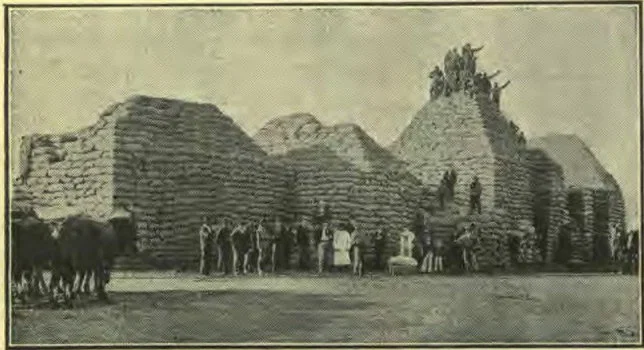
Sacked Grain, Argentina.
Rio Grande do Sul, Brazil.
By H. F. Graf
(From the Conference President.)
THIS state has a population of 1,300,000 inhabitants, and only 450 of them are Sabbath-keeping Christians, with one ordained preacher, and five other workers.
This is one of the countries in which Catholicism held sway until a few years ago, and the majority of the people are members of this persuasion.
Less than twenty years ago no schoolteacher could pass a public examination who was not a Catholic. Thank God, to-day there is more liberty of conscience, notwithstanding the church yet rules in many ways. Almost all men who hold public positions of trust are baptized Catholics, tho in reality there are many of them who hold ideas quite adverse to Catholicism. Some are infidels, some are Spiritualists, others lean to Protestantism. Many are true Catholics, and are doing all in their power to bring Catholicism again into the place where it was—the one state religion.
There have been and are hard times financially in this land, for the locusts have committed fearful depredations, and money is very scarce. But souls are easily turned into the way of righteousness now, if we only had more workers to lead them.
Brethren, if you can help us, now is the time to do it, for soon our way will be narrowed with persecution, which has already begun in this country.
We are not discouraged because of hard times and persecution, knowing that it will soon be in all the countries of earth, and that it is a sign of the end and of our deliverance from this earth into the everlasting kingdom of our Lord Jesus.
H. F. GRAF.
Our India Mountain Mission Home.
LAST year the SIGNS undertook, in connection with Prof. J. L. Shaw, the superintendent of missions in India, to raise enough to purchase a home in the foothills of the Himalayas. The vast population of India is more in the lowlands, and there is where most of our workers have been in the Indian field. The climate is fearful, very humid and very hot. In many cases missionaries of all denominations have failed in health, and such was the case with some of our own. A mountain mission home up in the clearer, salubrious climate of the higher elevation, surrounded by a thickly settled country, was certainly that which appealed to the hearts as well as to the good common-sense of Christians. We therefore asked that donations be forwarded to us for that purpose. It was thought at that time that $7,000 would meet the need. A fine establishment was found, sold at a greatly reduced rate, for $8,000. The amount was raised, some in money coming thru the SIGNS OF THE TIMES and other going direct to the Foreign Mission Board. That which has come to the SIGNS to the present time is $4,475.44. Up to March 1, $1,000 was wanted in order that the home might be dedicated free from debt. We asked our readers to furnish this. We reported September 1, $873.51. The donations for September amounted to $360.43, making a total of $1,233.94. This all has been forwarded to India for the Mountain Mission Home. Any donations that may come in afterward will be placed to the disposal of Professor Shaw, who will use it as the great, needy field demands. The names not previously recorded are as follows:
SUNDAY evening, about 7:30 o'clock, while Elder Andrews was offering prayer at the beginning of Elder Warren's baptismal service in the College View church, the college bell rang the alarm of fire. It proved to be in the college power-house. In some unknown way, perhaps from an electric wire, the fire caught in the upper story of the building, and when first seen was bursting out of the ventilator on the very top. Nearly everybody was at church. One man was in the boiler-room, and another was studying on the first floor, but neither knew of the fire until it was beyond control. So rapid was the progress of the flames that it was seen from the first the building was doomed, especially since there was no adequate provision for fighting fire. In a short time, the entire building, including boiler-room, laundry, printing-plant, bakery, blacksmith shop, and carpenter shop, was consumed. A few tools, one printing-press, part of the week's laundry, the College Press account books, the Messenger list, and a few books, were all that was saved. The loss is estimated at about $25,000. There was $6,000 insurance on the building, nothing on the machinery and printing stock. The actual loss will not be so great as the figures would indicate, since the boilers are thought to be little injured, and a less costly and safer building can be erected. Care will be taken not to bring so many shops together.
After the fire a few of the managers assembled in the business office for a season of prayer and consultation as to the best plan for meeting the necessities of the school. In a short time it was arranged to connect the heating, lighting, and water systems of the sanitarium with those of the college. The parlors and vacant rooms of the sanitarium were placed at the disposal of the ladies of the college Home for study if the weather should turn cold.
The running of the school was not interfered with by the accident. The recitations proceeded next day as usual. Before ten o'clock the sanitarium water supply was flowing thru the college system. That same night South Hall was receiving light from the sanitarium dynamo. Fortunately, the weather has been mild, and there is little need for heat. The steam heating will be furnished by the sanitarium, and our new boiler-house will be completed before cold weather sets in.
The students are meeting conditions nobly. The boys worked like heroes to save property. Some sustained a few burns and bruises, but no one was seriously injured. A good spirit prevails. There is no talk about going home, but all are determined to stand by the college thru this crisis.
At the church the service for baptism proceeded without interruption during the fire. The men went largely to render what assistance they could, but the candidates and a large audience of people remained or soon came back from the fire. When the electric lights, supplied by the college dynamo, were extinguished, lamps were brought in. Perfect order and deep solemnity prevailed while sixty-two candidates were baptized. There will be another baptism soon. The good work is still going on in many hearts, and the influence of the solemn preaching of the last two weeks has been deepened by the fire. Pray for the work of the Lord in College View.