NINE were baptized in the Atlantic near Boston, Mass., September 21.
A NEW church was dedicated at Long Lake, S. Dak., September 29.
BROTHER E. B. HOPKINS reports ten additions to the ranks at Avinger, Texas.
AT a small camp-meeting held in Hoxie, Ark., in September, six were baptized.
AT Morden, Manitoba, ten young people were baptized by Brother C. J. Kunkel, September 28.
FROM Leederville, a suburb of Perth, West Australia, comes the report of eight converts to the truth.
TEN have accepted the message preached by Brethren A. F. Ferguson and J. W. McComas, in Graettinger, Iowa.
TWELVE persons in Granite City, Ill., are rejoicing in the truth thru the labors of Brethren M. G. Huffman and Chaney Wood.
TENT-MEETINGS in Lock Haven, Pa., during the past summer resulted in the conversion of fifteen. Brother W. F. Schwartz had the work in charge.
"FIFTEEN have taken their stand up to this time, and we are hopeful of others," Brother B. E. Miller and G. A. Lagrone write from Comanche, Texas.
BROTHER M. G. HUFFMAN reports the organization of a church at Pana, Ill., with a membership of sixteen, nine of whom received baptism, August 18.
LABORS in Philadelphia during the past summer were rewarded with about twenty who now rejoice in the light of present truth. Brother O. O. Bernstein makes the report.
BROTHER H. M. J. RICHARDS and others conducted a series of tent-meetings in Loveland, Colo., late in the summer, and nine earnest believers were added to the ranks as the result.
AT the close of the Cottage Grove, Ore., camp-meeting, eight were baptized by Brother B. C. Tabor.
THE CARIBBEAN GLEANER reports the baptism of nine candidates at St. Mary, Jamaica, by Brother W. H. Randle.
WHILE visiting the churches at Peoria and Farmington, Ill., Brother W. D. Parkhurst recently baptized seven at each place.
HOUSE-TO-HOUSE work by Sister Lucy Post and others in Parma, Idaho, has resulted in the addition of about seventeen to the ranks.
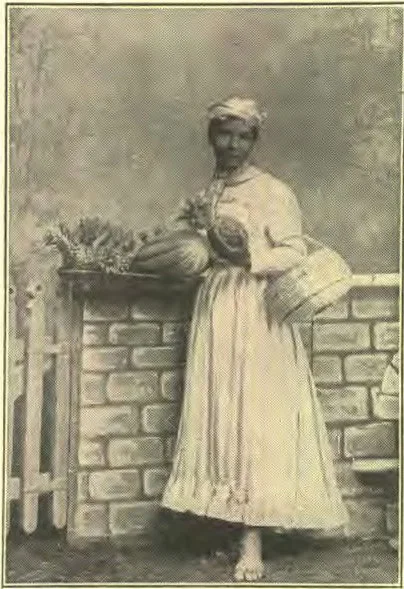
Fruit Vender, Barbados.
THIRTEEN have accepted the truth in Rochester, N. Y., thru the labors of Brethren J. W. Raymond and T. B. Westbrook, in a three-weeks' tent effort.
SISTER D. D. SMITH writes in the New York Indicator: "Within the past month seven of my Bible readers have taken a firm stand for the truth."
BROTHER HERBERT H. DEXTER writes from Nimes, France: "The work in France is onward. We are full of courage. Over fifty were baptized last year."
AT the local camp-meeting at Ute, Iowa, sixteen were baptized, and at a small meeting at Diagonal, seven were buried with their Lord in baptism by Brother L. F. Starr.
BROTHER FRANK S. BUSZ and Thomas Hubbard are seeing results from their labors at Sunman, Ind., where six are keeping the Sabbath, and at least eight or ten more deeply stirred.
BROTHER W. F. SCHWARTZ writes in a letter to the SIGNS that on October 19 he had the privilege of baptizing three at Lock Haven, Pa. He also organized a church of seventeen members.
BROTHER JOEL C. ROGERS writes from Nyassaland, British Central Africa, that the name of the Plainfield Mission has been changed to Malamalo Mission, which means "the commandments of God," or law, in the native tongues of Africa.
THE Nebraska Conference offices are now located at Hastings, Neb. The address is 905 California Ave. New office buildings have been erected, and a branch sanitarium will be in operation by spring, the building being under course of construction.
"The Morning Cometh."
By Frances Eugenia Bolton
WHEN the angels o'er the shepherds
Sang announcement of Christ's birth,
It was heralded forever,
"Joy to men and peace on earth."
Tho an interval like midnight,
Should ensue before the dawn;
Yet the light of life had advent,
And the blazing day comes on!
What a day 'twill be! O rapture!
Not a shadow in the dome,
Glorious life and light and beauty,
Love forever, rest at home;
Harmony for heart's sweet tuning
Into song that can not cease,
One with Christ and with all others,—
"Joy on earth, good-will, and peace."
FRANCES EUGENIA BOLTON.
Northwestern Training School
THE NORTHWESTERN TRAINING SCHOOL, Portage la Prairie, Man., issues a neat little calendar. A four years' course is offered in English and German, and those in that territory should surely take advantage of the school.
Wanted for Missionary Work.
SIGNS OF THE TIMES and Watchman. Address, Mrs. James Woods, 322 S. Detroit St., Warsaw, Ind.
SABBATH and religious liberty literature will be well used by E. R. Button, Greenville, S. C.
D. C. BARTSHE, Lexington, Ky., writes that he has all the papers he desires for the present.
A. STENBERG, R. R. 1, Bronson, Iowa, desires late, clean papers for continuous distribution.
D. E. BLAKE, Bell Ave. and East St., Birmingham, Ala. SIGNS, Watchman, and Instructor.
MRs. CORA M. HEDLEY, Mena, Ark., desires SIGNS, Watchman, Review, and any other of our periodicals and tracts.
DENOMINATIONAL tracts and papers for city distribution. Address, J. S. Killen, 183 Flint St., Asheville, N. C.
Papers from Homes with Contagious Disease
A SISTER suggests that we mention to those sending papers to send none from a home where there have been contagious diseases of any kind. This is surely a good suggestion.
Reports from the Field
DR. W. C. DALBEY writes that twenty-five have signed the covenant at St. Johns, Ill., one a colored minister, who has been largely instrumental in bringing in five others of his people.
BROTHER B. F. KNEELAND reports in the Atlantic Gleaner the baptism of fourteen at Bridgeton, N. Y., making in all twenty-four new members added to the church at that place during the year.
OUR workers in Singapore have leased a place in the country for a school, which is doing a good work in that field. The interest in Singapore is excellent, their place of meeting being crowded.
THIRTY-TWO persons have accepted this message at Chamberlain, S. Dak., where Brother C. M. Clarke and Brother R. E. Harter have labored during the past summer. A church has been organized.
CLOSING a three-weeks' series of meetings in Rochester, N. Y., Brethren J. W. Raymond and T. B. Westbrook report that thirteen have taken a decided stand for present truth, and others are much stirred.
AT the close of camp-meeting at Palisades, Colo., eighteen followed their Lord in baptism. The same number went forward in the sacred rite at a camp-meeting in western Colorado at the same time, September 22.
AT the thirty-third session of the Kansas Conference, held at Wichita, August 15 to 25, Elder Charles Thompson was elected president, Elder A. R. Ogden, vice-president, and J. M. Fletcher, secretary and treasurer. During the meeting about ninety were baptized.
The Building of a Home
By Mrs. L. D. Avery-Stuttle
By Mrs. L. D. Avery-Stuttle
What Home Means.
A GREAT many people have "hobbies." We have all of us known individuals who seemed incapable of talking upon any subject but one. Introduce almost any topic of conversation, and the hobbyist will manage to bring in something on his favorite subject. A farmer discusses the condition of the crops and the fluctuations of the market; a dressmaker talks about dress, and a milliner about bonnets. You can tell a sailor or a soldier in five minutes by his conversation.
Now, at the risk of being called a "hobbyist," we are going to talk a little while about home-building. "Why, you are not a carpenter, are you? or an architect, or a mason, or a plumber?"—O no; none of these; these people build houses. Don't you know that there is a great difference between houses and homes?
There are two classes of homeless people in the world,—the rich and the poor,—both are to be pitied. "The rich?" you question. "How can that be possible? Of course I pity the poor fellow who has not money enough to buy himself even the humblest home; but the rich, really it doesn't strike me that they need any pity."
Well, let us visit that palatial mansion across the street. A servant meets you at the door. Your feet sink into velvet carpets; pictures by the most famous artists, and bric-a-brac and curios from all over the world are everywhere. "What a beautiful home!" you exclaim. Wait. Do you see those sweet children out on the lawn, in the care of their nurse? That nurse could assure you that these children have not looked into their mother's eyes for a fortnight, and that the joys of the sweet good-night lullaby from mother's lips they have never known. They have been defrauded of childhood's sweetest inheritance—the good-night kiss and the evening prayer from the lips of her who gave them birth. She is society's queen and the slave of fashion; her children are well fed and well dressed; but they never knew what it is to have a home; for "what is home without a mother?"
Under the very shadow of the mansion of the wealthy, stands the hovel of the poor woman who toils in the sweatshop from sun to sun. Yonder, in the tiny window, with great, hollow eyes, peeping out to catch a little glimpse of the outside world, is a baby face. Ah! that little one has never known—perhaps never will know—the joys of "sweet home."
Some one has well said that home consists of more than four walls. The humblest cottage, if love and tenderness and patience and forbearance be there, if no harsh words are heard there, and no sullen and ill-tempered frowns are seen there, may be a home in every true sense of the word. There is not a word in the English tongue that often means less, but may mean more, than that much-abused word, "home."
"Hallo, Jim, building yourself a house, are you?"
"I hope I'm doing more than that, sir," replies the young man, as he wipes the honest sweat from his forehead, "I hope I'm building a home for Jennie and me and the bairns."
"That's right; what are you going to put into the foundation, Jim?"
"O, people call it a cement foundation, I suppose, sir, but I am putting in plenty of love; love never faileth, you know, and the foundation must be firm, or the home will not stand."
"Well, it seems to me that you are speaking in parables, aren't you, Jim? But what kind of material are you building with?"
"I'm laying the walls with brick, sir; but I'm putting in plenty of kindness and good temper, and the pillars will be supported with prayer, and the hinges of the doors will be oiled with loving words, and the whole structure covered with praise."
"Well, surely, my friend, God will bless your home, for He has promised to bless the habitation of the just."
"But," some one objects, "it takes more than one to make a home. I try to be kind, and I reckon I should succeed reasonably well, if the children were not so trying. John is a regular torment, and Mary is so careless and heedless that really I forget my good resolutions before the day is half done."
Let me tell you something: It is little credit to you or me when we smile under a sunny sky. But when those days come when everything goes wrong,—and we all know there are many just such days,—if, in the face of all these petty annoyances, we keep a bright and cheery face, then we may feel that we are growing in grace indeed.
O, it is not the beautiful architecture or the costly furniture or even the conveniences and necessities of the house that make it a home. There can be no true home without LOVE. There must be a bearing with the little faults of the dear ones, remembering that we, too, are compassed about with the same infirmities.
Then, in spite of poverty, our home will be a blessed foretaste of that glorious one which the Master is preparing for us.
“I Don’t Fritter.”
Not long ago I escorted two bright young women to New York. Of course they wanted to do some shopping. Coming from a small town, it was perfectly natural that the “wonderful reductions” and “great bargains” should fascinate them.
“Look at that lovely lace, Mame! Reduced from forty-five cents to twenty-five cents! I must get some of it.”
“Do you need it, Netty?”
“No, not now; but it is so cheap. Don’t you want to come in and buy some, too?”
“No,” was the reply, “I don’t fritter.”
So it came to pass that jewelry glittered, and ribbons fluttered, and dainty gloves and shoes tempted her in vain. To each and every appeal she answered, “I don’t fritter.”
At length she found a pattern of wash silk that exactly suited her, and she bought it. Also another pattern of crepe de chine, and some very nice gloves which she needed. That was absolutely all she bought; but her dresses and gloves were worth what she paid, were exactly what she needed, and would do her good service.
Netty gathered up a miscellaneous assortment of odds and ends—fancy pins, so dear to the girlish heart of to-day, cheap handkerchiefs; yards of “reduced ribbons,” which she did not need; gloves, dear at any price; little pieces of china that struck her fancy, and would be so pretty in her room. Before she realized it, her money was all gone, and she had only those trifles to show for it.
“And I did need a dress so much, Mame,” she murmured plaintively, the last evening of our stay. “How did you make your money hold out?”
Again the quaint remark, “I don’t fritter.”
The word remained in my mind. It had an odd sound. I looked it up. “Fritter: to reduce to nothing by taking away a little at a time.” So other things besides money15can be frittered away; things, too, more precious.
Time—how foolishly we spend it! A few minutes here, an hour or two there, a week or a month somewhere else. Before we realize it, the years are gone and life has reached its utmost limit, and we look back over it to feel that we have frittered it away.
Our good influence over the minds and characters of others—how carelessly we do things that lessen it, little by little, over those we love! At last, too late, we waken to the fact that we have lost all hold upon them. We have frittered away our influence.
Our talent—the ability God has given us to do anything well, for the use of which He will hold us to a strict account—how we neglect it, how we forget our high calling, and stop “to play with shadows and pluck earthly flowers!” Finally the day of reckoning comes, but we have frittered away our divine gifts, and Christ Himself has told us what the sentence shall be upon “unprofitable servants.”—Selected.
What Home Is.
By Charles Swain
HOME's not merely four square walls,
Tho with pictures hung and gilded;
Home is where affection calls,
Filled with shrines the heart hath builded!
Home! go watch the faithful dove,
Sailing 'neath the heaven above us;
Home is where there's one to love!
Home is where there's one to love us!
Home's not merely roof and room,
It needs something to endear it;
Home is where the heart can bloom,
Where there's some kind lip to cheer it!
What is home with none to meet,
None to welcome, none to greet us?
Home is sweet—and only sweet—
When there's one we love to meet us!
—Charles Swain.
Young Folks' Clothing.
By M. A. T.
BE sure that the children have suitable clothing for school, for children are often supersensitive to ridicule, and they are often made bashful or sullen by having to wear clothes that are faded or outgrown. We should remember that to the economical mother it may be a trifle for the little girl to wear a faded or outgrown garment; but to a child it is a real affliction, and there are so many ways of economizing in children's clothing that they may be comfortably and nicely dressed, and yet not have anything really new, unless it is stout shoes.
The children should be carefully fitted in shoes, as shoes too small or too large for a growing child are liable to cause trouble with the feet that will follow it thru life. Thin kid and other leather shoes can be kept soft by rubbing frequently with a little vaseline on a soft cloth.
Their school dresses should be strong and comfortable, and these dresses should be above all else simple and graceful. A neat, tasty suit was made from an old, light-gray, woolen dress, but the pieces were first washed clean, and then colored a rich, dark red with Diamond Dye for wool. An old dress of cream-colored nun's veiling furnished the material for another pretty dress after the pieces were colored a dark shade of blue. Good patterns, careful finishing, and thorough pressing are essential to success in the work of making over garments; and when the mother has once learned the art of cutting down and making over, she can keep the children prettily and even stylishly dressed on a very small income. If they must take their last season's best dress for school wear, remove all unnecessary trimming, and make it into a neat school dress; for the practise of wearing soiled finery to school can not be too strongly deprecated, as such clothes are liable to make the children vain and arrogant and their attention is drawn to their clothes instead of their books.
M. A. T.
Bible-Readings for the Home Circle.
This book comprises 162 readings for public and private study, and answers nearly 3,000 questions on religious topics—practical, historical, and prophetical. It contains 600 octavo pages, printed on a superior quality of tinted paper, embellished with 57 full-page engravings and 170 ornamental headings, together with 10 full-page Scriptural and prophetic diagrams, 3 colored plates, and other attractive features. The bindings are elegant and substantial, the styles and prices being as follows: Cloth, gilt side title, marbled edges, $2.25; library, marbled edges, $3.25; full leather, marbled edges, $4.25. Cheap edition, 400 pages, solid type, no illustrations or colored plates, no poetry, thin paper, brown cloth, plain edges, $1.00. Address this office.
Garden Neighbors, My.
—By L. A. Reed. A new nature-study book just fresh from the press. All will be interested in the true story of the sparrows who learned to imitate the bluebirds, of the cat that went wild, of the cowbird that imposed on a sparrow, and all the others in this instructive and entertaining book. It contains 256 pages with over fifty illustrations, several of them colored. Bound in cloth, $1.00. Address this office.
Thoughts from the Mount of Blessing.
An exposition of Christ's Sermon on the Mount. It has 218 pages and six chapters: On the Mountain-side, The Beatitudes, The Spirituality of the Law, The True Motive in Service, The Lord's Prayer, Not Judging but Doing. A new edition just printed on fine enameled paper, new type, and reillustrated with 27 beautiful half-tone engravings specially prepared for the book by eminent New York artists. It will be found full of comfort and blessing by all fortunate enough to obtain and read it. A beautiful gift book. In paper covers, 35 cents; bound in cloth, gold title, 60 cents; half calf, marbled edges, $1.00. Address this office.
"Steps to Christ." By Mrs. E. G. White. Cloth, 164 pages; price, 50 cents; paper covers, 25 cents. Review & Herald, Takoma Park, Washington, D. C.; Pacific Press, Mountain View, Cal.
A most excellent spiritual work showing the Bible steps to Christ and in Christ. It has passed thru many successive editions since 1892, and is now published in fifteen European languages. It is thoroly evangelical and mightily helpful in teaching the way of truth and life. It may be obtained of this office.
Send for my "Winner" Stylographic Fountain pen. Try it five days. If perfectly satisfactory, send me $1.00; if not, return pen. B. H. Patterson, Sta. A., Wichita, Kans.
WANTED.—A Seventh-day Adventist woman to do housework. Good home and wages to the right party. Address, O. O. Osborne, Lodi, Cal.
A GREAT WINTER RESORT.
Do you know that Colorado, and especially the valley in which is situated the Boulder-Colorado Sanitarium, is a most delightful winter climate, equal in every respect to that of California or the sunny South?
The Boulder-Colorado Sanitarium is a well-equipped medical institution, employing the very best and most approved methods of treatment.
The medical staff comprises four physicians—two men and two women—graduates of leading medical schools, together with a large corps of nurses of both sexes.
No tubercular or consumptive patients received. Special reduced rates are afforded during the winter months. Write to-day for large illustrated catalog, with card of rates. Address, Boulder-Colorado Sanitarium, Boulder, Colorado.
DON'T
By I. Allen Sankey
decide on the new hymn-book for your CHURCH or SUNDAY-SCHOOL until you have seen
= HALLOWED HYMNS =
By I. ALLEN SANKEY, son of IRA D. SANKEY
256 Pages JUST PUBLISHED Over 100 New Songs
THE VERY BEST—SEE AND BE CONVINCED
$25 per hundred. Returnable samples mailed to "earnest inquirers." 35c each by mail
THE BIGLOW & MAIN CO., New York or Chicago
Colds
By G. H. Heald, M.D.
Colds.—By G. H. Heald, M.D. A treatise on the causes, prevention, and cure of colds. White leatherette binding. 58 pages, 25c. Address this office.
DATE OF EXPIRATION.
By Editor
THE SIGNS wrapper bears date of last issue due on your subscription. Unless renewed in advance, paper stops with expiration date. If herewith is an order-blank, you will know you have overlooked sending renewal. You will not wish to miss a single issue. Back numbers often can not be furnished.
Anonymous Communications and Mission News
By Editor
THE SIGNS OF THE TIMES, please take note, pays no attention to anonymous communications. It has not time. We do not ask the name for publication, for all matters of such nature are private unless the writer wishes it published; but we ask it as an evidence of good faith.
An awful disaster causing the death of twenty-four, fatally injuring twenty, and seriously hurting twenty others, occurred in the Standard Steel Company's mills in Butler, Pa., October 6. A great pot of molten metal engulfed them. The features of the majority of those who are alive are mutilated beyond recognition.
A letter from Sister Emma T. Anderson, treasurer of our China Mission Board, dated Canton, August 12, encloses a letter from T. F. McCrea, the corresponding secretary and treasurer of the North Kiangsu-Anhuei Famine Relief Committee, as a receipt for $100 for gold sent by the SIGNS OF THE TIMES, given by our friends in different parts of the field. Mr. McCrea states that all danger of famine is over, or in other words, that the harvest of June was very good and they hope that the crop in the fall will also bring relief, but there were many thousands who had nothing left. Still they hope that the balance which they have on hand which has been given by friends in America can be used to help those who are in so much need. He says: "We feel that a great work has been done for the advance of Christianity thru this work. Nearly two million silver dollars have been contributed by the foreigners, and the Chinese have been greatly impressed by this generosity. We trust that a great ingathering may result. Please extend our thanks to Mr. Wilcox and the readers of his paper for their generous contributions. Thanking you for your kindness in this work, I am yours sincerely, T. F. McCrea."
At Rest.—Our hearts were made sad to receive, the evening of October 28, the sad telegram from Oakland: "William Saunders died very suddenly this afternoon of heart disease." So short a time was it since we welcomed him here at our dedication. At that time he was feeling well and strong, tho some remarked his unnatural pallor. He was born in Newport, Wales, March 26, 1821, and was therefore at the time of his death living on borrowed time by over six and one-half years beyond the age of threescore and ten allotted to man. He was brought to America by his parents when an infant of one year, returned the next year to England, and ten years afterward came again to America. He learned the printer's trade, and was connected with the publishing work all his life; at first as a printer making his way to the Pacific Coast, afterward for several years as proprietor and publisher of the Woodland (Cal.) Democrat; for the last twenty years an employee of the Pacific Press, much of the time as director and vice-president, or representing the branch offices in London or San Francisco. For the last two years he had relinquished more and more detailed labor. He saw much of the country's progress, having crossed the continent many times since "the days of gold,"
and the Atlantic thirteen times. He saw the growth of California from 1850 to the present, and had an active part in its progress. He was an old-time, dignified, honorable Christian gentleman, of a type rare in these days. He leaves an aged wife with whom he had been united fifty-five years, and three daughters, who mourn sincerely and deeply their great loss. His end came suddenly and peacefully. He was spared what was to him always sad, saying good-by; especially the agony of leaving alone his wife and youngest daughter. There was no struggle nor pain. He was lying down for a little rest, and his heart ceased to beat. That was all; and he fell asleep in Jesus. Two of the Pacific Press Board were deputed to represent the institution at the funeral, and beautiful floral emblems were sent by both the employees and the board. Our sincere sympathy goes out to the aged widow and the bereaved daughters, especially she who has so faithfully stood by father and mother. May God bless them abundantly.
Bishop Potter, of New York, has been criticized greatly because he stated that The Hague Conference "is only a poet's dream. Until the last day of earth there will be armies and there will be wars." Now why in the world Bishop Potter should be criticized for this, is more than we can understand. Any one who believes God's word reads over and over again in words far more emphatic than the bishop's even that there will be war, and that the very culmination of the age before Christ's coming will be the battle of Armageddon. It is not a matter as to whether one desires peace or not, or believes there ought to be peace; doubtless the bishop believes it and longs in his heart that the world might come to that condition; but he sees that conditions in the world are such that there can be no such outgrowth. One only needs to read God's word to know what the issue of the age will be, and yet there will be souls that will be saved out of the turmoil of war by the Prince of Peace when He comes.
A Mrs. Shepard, of Los Angeles, would certainly have made a devoted Egyptian worshiper of the cult of the dog. A despatch from Denver, dated October 9, states that she has devoted thousands of dollars in an effort to save the life of a maltese poodle. Her final effort to save the dog's life was in chartering a special train at Los Angeles and making a record trip across the continent in an effort to reach a well-known cat and dog hospital in New York, accompanied by her own maid, a maid for the dog, and a veterinary surgeon. And yet the dog died. After the dog's death, it was encased in a five-hundred-dollar casket and interred in the cat and dog cemetery at Hartsdale, where a costly monument will be erected over its grave. What a great blessing it would be if some of that money could be spent for some of the needy children of earth. The dog would probably have enjoyed it just as well.
Regular Atlantic wireless service opened October 17. In all the previous elaborate tests they were completely successful in every instance. The space covered is two thousand miles, between Clifden, Ireland, and Port Morien, Nova Scotia. The commercial rate for wireless messages will be ten cents a word, and the press rate five cents a word.
The "Australasian Union Conference Record" of September 2, gives an account of a brutal assault upon one of our laborers in Australia, Brother J. L. Hindson, not on account of religious views, however, but for the purpose of robbery. He was beaten to unconsciousness and robbed of about fifty dollars in gold and his watch, and left for dead. In a semi-unconscious condition he made his way home and was given the best of care by the sanitarium people. Earnest prayers were put forth for his recovery and Sister Hindson writes us under date of September 3 that he is in a fair way to recovery and making marvelous progress toward health. For this we certainly are glad and rejoice with them that his life is spared.
The New York "World" in a despatch from Berlin, under date of August 31, gives an account of the imprisonment of a Seventh-day Adventist by the name of Muegge because he will not do military service on Sabbath. Several times he has been courtmartialed and imprisoned. One churchman has spoken on the subject and he feels that either the man or the government should give way, and he thinks it ought to be the man, and yet he confesses that the man is simply standing for what Protestantism stood,—the rights of conscience,—and suggests that the government could employ him in some other way. We hope that this brother will be of good courage. Every act of devotion in this way is a sermon in favor of God's truth.
A despatch from Pittsburg, September 16, states that more than a score of the ministers of Pittsburg have gone into the life insurance business, making more money they say than they did while within the church. One of them, who probably represents the rest, declared that he does not quit from choice but from necessity; it is not a question of money either, but of higher cost of living. No salary has been offered him which would justify his accepting it. He hopes some time to unite with the ministry again. The greatest life insurance in the world is the Gospel. If there were more of it preached there would probably be more devoted support in the church for those who preach it.
Tobacco.—In the year 1810 only two states reported the value of their tobacco output, Pennsylvania $410,910 and Virginia $469,000. In 1840 out of thirty states, twenty-eight reported the total value of the tobacco products as $5,819,568. In 1850 this output increased to more than $13,000,000 and in 1905 to $331,000,000. This of course is on the gross value and not on the retail value of the manufactured product. What a blessing it would be if the land were used to produce necessaries of life and the money expended could be turned into the great needs of homes.
The Kongo.—A letter from the Kongo Reform Association declares that still from that wretched district comes the pitiful wail for deliverance, from Leopold's miserable slaves. While the nations delay to intervene, the merciless rubber regime goes on, and the Kongo natives suffer and die. There is little hope that Belgian annexation, unless supervised by the powers, will be more than a nominal change, for the terms now under discussion still leave the Kongo in Leopold's hands. The address of the association is Tremont Temple, Boston, Mass.
"Life and Health."—The October number was greatly enlarged and improved. A new department, called "The Home Acre," will be introduced. Every number will be a special number, such as a Tobacco Number, a Don't-Worry Number, Temperance, etc. Good illustrations will be used, and good contributors are secured. The price of the journal will be increased to ten cents for single copies. It certainly is worth it. Address, Life and Health, Takoma Park Station, Washington, D. C.
A decided effort is being made in Kansas City to introduce an opening wedge to a full Sunday law by closing the theaters on Sunday. Reports of this will be given later on.
The Next Issue
By Editor
OUR next issue will contain,—
A Bible-reading on Prophecy: Its Nature, Scope, and Purpose.
The first of a strikingly strong article by Mrs. E. G. White on "Drunkenness and Crime." This will be completed the following number.
Articles on Romans will begin next week and also studies on the book of Daniel.
The second article in the Home Series is "Honorable Young Manhood."
Our Outlook will be filled with interesting, up-to-date articles. It will be a splendid number.
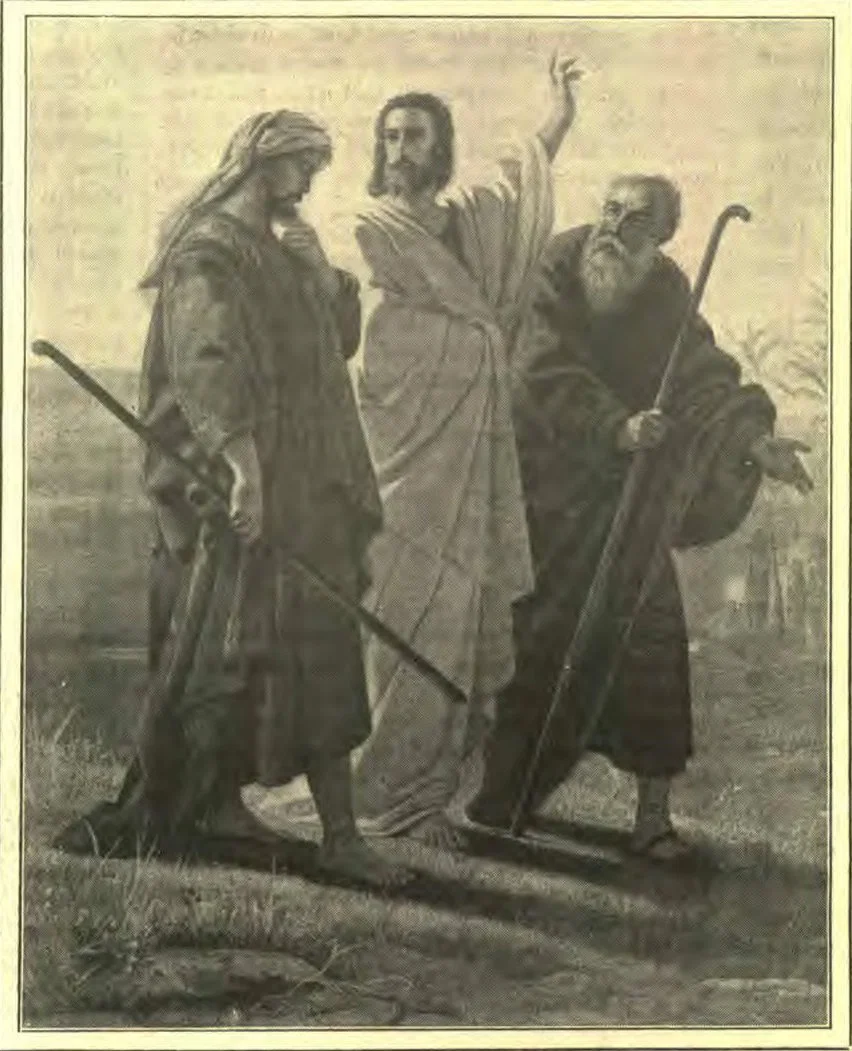
ON THE WAY TO EMMAUS.
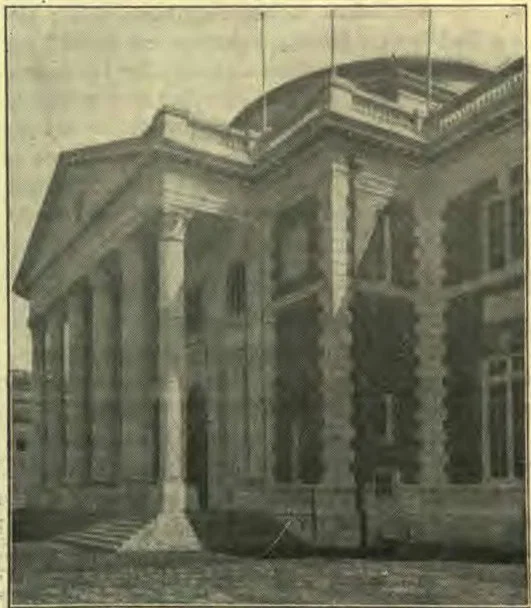
Copyright Jamestown Photographic Corporation. Main Entrance to Auditorium Palace.