The Youth’s Instructor, Vol. 64, No. 20.

Silkworm Feeding Costs and Pacific Coast Silk Experiments
Earlier text: Spare the Snake

IX — The Victory of the Cross

  • (May 27)
LESSON SCRIPTURE: Matt. 27: 39-54.
MEMORY VERSE: “Who, when he was reviled, reviled not again; when he suffered, he threatened not.” 1 Peter 2: 23.

Questions

  1. As Jesus hung upon the cross, what did those that passed by do? Matt. 27: 39.
  2. What did they say? Verse 40. Note 1.
  3. Who were among those that mocked him? Verse 41.
  4. In what words did they tempt him? What did they say would cause them to believe in him? Verse 42.
  5. If he were truly the Son of God, what did they think God would do for him? Verse 43.
  6. Who else mocked the Saviour? Verse 44.
  7. What strange thing happened from the sixth to the ninth hour? Verse 45. Note 2.
  8. At the end of this time what did Jesus cry out? Verse 46. Note 3.
  9. What did some who stood by think that he said? Verse 47.
  10. What was done to relieve his thirst? John 19: 28, 29; Matt. 27: 48.
  11. How did some protest against this? Verse 49.
  12. What were Jesus’ last words before he died on the cross? Verse 50; John 19: 30; Luke 23: 46.
  13. What showed that the temple service was to cease when Jesus died? Matt. 27: 51, first part.
  14. What occurred to the earth? Verse 51, last part. Note 4.
  15. How did the earthquake affect some of the graves? Who arose from them? Verse 52.
  16. When did they come out of the graves? Where did these saints that were raised go, and to whom did they appear? Verse 53. Note 5.
  17. How were the centurion and others who were watching at the cross affected by the earthquake and other strange things that had happened? What did they say? Verse 54. Note 6.

With Our Missionary Volunteers Everywhere

SOME of the societies in the South repeat the Morning Watch verses for the week, in answer to roll call.
The young people at Henderson, Kentucky, are distributing one hundred copies of the Present Truth Series each month.
The first to complete the Junior Reading Course in Kentucky were two little girls, each nine years of age.
The Missionary Volunteer secretary in Kentucky says: “Our Bible Year list is still growing. We now have 348 names on record.”
One of our workers uses the Morning Watch Calendar among friends who are not of our faith. Several of these friends have used it every year since it was published.
The Missionary Volunteer secretary of the Minnesota Conference writes: “We have had a remarkable sale of Morning Watch Calendars. Our tract society has hardly been able to keep them on hand.”
The president of the Montana Conference writes: “In two or three churches, the librarians made each member a present of a Morning Watch Calendar, and I am sure that it has resulted in good.”
The Missionary Volunteer secretary of the British Columbia Conference reported that during the first eight weeks of 1916 more Morning Watch Calendars had been sold in that conference than during the year 1915.
One of our brethren in Europe sent copies of the Present Truth to soldiers in the trenches. Recently a young soldier, a Christian not of our faith, wrote to his mother, urging that she endeavor to have this brother send more copies of the paper.
The president of the Missouri Conference writes: “I feel that the Morning Watch Calendar is an opening wedge for personal work among our people, old as well as young. We are using more copies in this conference than ever before.”
One of the Missionary Volunteer societies in the Northern Union Conference is putting forth extra efforts to do missionary work. The members have determined to see how much they can accomplish in the spare moments of the day, and have definitely planned to use the first half hour in the morning in the study of the texts given in the Morning Watch, and in prayer.
One of our workers writes: “I do think that our Reading Courses are a great blessing to our young people. When I think how a few years ago so little was done for our young people, and then of all the opportunities they have now, I am so thankful for the progress that has been made in this work, and for the help it is to our young people here; and of course what it is to those here it is to others.”
They have a live Junior Missionary Society in the Singapore Training School. Its meetings are every Wednesday at chapel. Many papers and tracts are distributed, and Bible readings are given by the students. A collection, averaging twenty-five cents, is taken. This is good, considering that wages there are much lower than in America. A mailing band sends out papers twice a month. Once a month a devotional service is held. Practically all students take part.
M. E. KERN.

The Bible Year

Assignment for May 21 to 27

For helps and suggestions on this assignment, see the Review for May 18.

IX—The Victory of the Cross

(May 27)
LESSON SCRIPTURE: Matt. 27:39-54.

Questions

1. What did passers-by do to Jesus as he hung upon the cross? Matt. 27:39. Note 1.
2. What mocking language did they use? Verse 40. Note 2.
3. Who else took part in mocking Jesus? Verse 41.
4. In what language did they tempt him? Verse 42.
5. How did they cast doubt on his Sonship? Verse 43.
6. What did the two thieves also do? Verse 44. Note 3.
7. What supernatural occurrence witnessed to the tragedy of the cross? Verse 45. Note 4.
8. What did Jesus cry out about the ninth hour? Verse 46. Note 5.
9. What did some of the bystanders say about his cry? Verse 47.
10. What did one of them straightway do? Verse 48.
11. What protest did the rest make? Verse 49.
12. After crying out again, what did Jesus do? Verse 50.
13. What shout of victory did Jesus utter at this point? John 19:30.
14. What took place in the temple at the same time? Matt. 27:51, first part.
15. What phenomena occurred in nature? Verse 51, last part, and 52.
16. What did those who came out of their graves do? Verse 53. Note 6.
17. How did the centurion and his men feel, and what did they say? Verse 54.

Notes

1. “The enemies of Jesus vented their rage upon him as he hung upon the cross. Priests, rulers, and scribes joined with the mob in mocking the dying Saviour. At the baptism and at the transfiguration the voice of God had been heard proclaiming Christ as his Son. Again, just before Christ’s betrayal, the Father had spoken, witnessing to his divinity. But now the voice from heaven was silent. No testimony in Christ’s favor was heard. Alone he suffered abuse and mockery from wicked men.”—“The Desire of Ages,” p. 746.
2. The first part of verse 40 doubtless refers to the false testimony against Jesus at his trial, as recorded in Matt. 26:59-61. What he did say and mean is found in John 2:18-21.
The expression, “If thou be the Son of God,” in the second part of verse 40 recalls the temptation scene in the wilderness, in which Satan personally sought to overcome Jesus. Then Jesus was weakened through fasting forty days, and Satan would take advantage of his condition. Here at the cross also he again sought to make Jesus’ intense suffering an occasion for gaining long-coveted superiority over him. “The Desire of Ages,” p. 746, says on this point: “Satan with his angels, in human form, was present at the cross. The archfiend and his hosts were cooperating with the priests and rulers. The teachers of the people had stimulated the ignorant mob to pronounce judgment against One upon whom many of them had never looked, until urged to bear testimony against him. Priests, rulers, Pharisees, and the hardened rabble were confederated together in a satanic frenzy. Religious rulers united with Satan and his angels. They were doing his bidding.”
3. “To Jesus in his agony on the cross there came one gleam of comfort. It was the prayer of the penitent thief. Both the men who were crucified with Jesus had at first railed upon him; and one under his suffering, only became more desperate and defiant. But not so with his companion. This man was not a hardened criminal; he had been led astray by evil associations, but he was less guilty than many of those who stood beside the cross reviling the Saviour. He had seen and heard Jesus, and had been convicted by his teaching, but he had been turned away from him by the priests and rulers. Seeking to stifle conviction, he had plunged deeper and deeper into sin, until he was arrested, tried as a criminal, and condemned to die on the cross. . . .”
“When condemned for his crime, the thief had become hopeless and despairing; but strange, tender thoughts now spring up. He calls to mind all he has heard of Jesus, how he has healed the sick and pardoned sin. He has heard the words of those who believed in Jesus and followed him weeping. He has seen and read the title above the Saviour’s head. He has heard the passers-by repeat it, some with grieved, quivering lips, others with jesting and mockery. The Holy Spirit illuminates his mind, and little by little the chain of evidence is joined together. In Jesus, bruised, mocked, and hanging upon the cross, he sees the Lamb of God, that taketh away the sin of the world. Hope is mingled with anguish in his voice as the helpless, dying soul casts himself upon a dying Saviour. ‘Lord, remember me,’ he cries, ‘when thou comest into thy kingdom.’”
“Quickly the answer came. Soft and melodious the tone, full of love, compassion, and power the words: Verily I say unto thee today, Thou shalt be with me in paradise.”—Id., p. 749, 750.
4. “In that thick darkness God’s presence was hidden. He makes darkness his pavilion, and conceals his glory from human eyes. God and his holy angels were beside the cross. The Father was with his Son. Yet his presence was not revealed. Had his glory flashed forth from the cloud, every human beholder would have been destroyed. And in that dreadful hour Christ was not to be comforted with the Father’s presence. He trod the wine press alone, and of the people there was none with him.”
“In the thick darkness, God veiled the last human agony of his Son. All who had seen Christ in his suffering had been convicted of his divinity. That face, once beheld by humanity, was never forgotten. As the face of Cain expressed his guilt as a murderer, so the face of Christ revealed innocence, serenity, benevolence,—the image of God. But his accusers would not give heed to the signet of heaven. Through long hours of agony Christ had been gazed upon by the jeering multitude. Now he was mercifully hidden by the mantle of God.”—Id., pp. 753, 754.
5. “All his life Christ had been publishing to a fallen world the good news of the Father’s mercy and pardoning love. Salvation for the chief of sinners was his theme. But now with the terrible weight of guilt he bears, he cannot see the Father’s reconciling face. The withdrawal of the divine countenance from the Saviour in this hour of supreme anguish pierced his heart with a sorrow that can never be fully understood by man. So great was this agony that his physical pain was hardly felt.”
“Satan with his fierce temptations wrung the heart of Jesus. The Saviour could not see through the portals of the tomb. Hope did not present to him his coming forth from the grave a conqueror, or tell him of the Father’s acceptance of the sacrifice. He feared that sin was so offensive to God, that their separation was to be eternal. Christ felt the anguish which the sinner will feel when mercy shall no longer plead for the guilty race. It was the sense of sin, bringing the Father’s wrath upon him as man’s substitute, that made the cup he drank so bitter, and broke the heart of the Son of God.”—Id., p. 753.
6. The meaning here seems to be that graves were opened by the earthquake, “and the dead were cast out of their tombs” (“The Desire of Ages,” p. 756), then when Jesus arose on the morning of the resurrection these saints came back to life with him at the time of the second earthquake recorded in Matt. 28:2, and went forth to bear testimony of his resurrection, and to serve, like Moses, as a type of the general resurrection of all who sleep in Jesus.

Useless Fretting

It would be impossible to estimate the amount of energy some of us waste in a year in fretting over things which no act of ours could alter, things which in reality are none of our business. A young woman who had worked hard rehearsing an entertainment to be given for charity, became apprehensive about twenty-four hours before the date fixed for the affair, that the weather would not be favorable. All day she worried. The previous night she could not sleep, but slipped out of bed at frequent intervals to creep to the window, and scan the face of the sky. And when about six o’clock in the morning the patter of rain outside sounded on the roof, she buried her face in her pillow and wept. As it proved, the storm cleared about noon and the weather was perfect, but even if the contrary had been true, what was gained by her fretting? No amount of worry can drive a single cloud from the sky, or dry a single raindrop, and common sense suggests that the worry which is not only useless, but detrimental to health and happiness, be eliminated.
There is, of course, a decided difference between worrying about the matter which is our responsibility and that which is not. The youth who has neglected his school work may very properly worry when he comes up to examination. If his discomfort is futile in the present emergency, it may help him another time. But to fret because the weather is not what we wanted is the height of absurdity. Nor is the favorite excuse, “I can’t help it,” any real excuse. You could help anything so useless and unreasonable if your powers of self-control were as developed as they should be.—Elizabeth Harris.

Unwritten Music

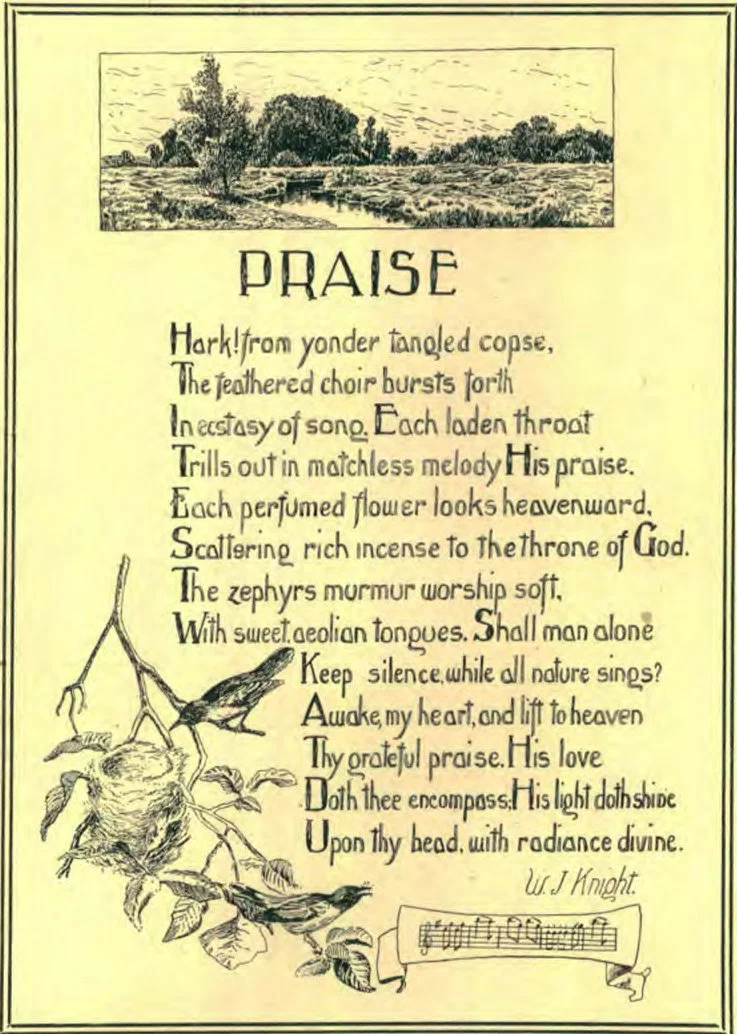
It is not mere poetry to talk of the “voices of summer.” It is the daytime of the year, and its myriad influences are audibly at work. Even by night you may lay your ear to the ground and hear that faintest of murmurs, the sound of growing things. When I was a child, I used to think that it was fairy music. If you have been used to early rising, you have not forgotten how the stillness of the night seems increased by the timid note of the first bird. It is the only time when I would lay a finger on the lip of nature, the deep hush is so very solemn. By and by, however, the birds are all up, and the peculiar holiness of the hour declines, lowing of the cattle blending with the capricious warble of a thousand of God’s happy creatures, and the stir of industry coming on the air like the undertones of a choir, and the voice of man, heard in the distance over all, like a singer among instruments, giving them meaning and language.—N. P. Willis.

For the Finding-Out Club

Answers to Questions in “Instructor” of April 18

1. VON BERNSTORFF is the German ambassador to the United States; Brand Whitlock, the American ambassador to Belgium; Henry van Dyke, to Holland; Walter H. Page, to England.
2. Booker T. Washington, educator and author, founder of Tuskegee Institute, Tuskegee, Alabama, and principal of Tuskegee until his death a few months ago.
Anna Howard Shaw, national lecturer and ex-president of the National American Woman’s Suffrage Association.
Sarah Bernhardt, famous French actress.
Thomas Mott Osborne, prison reformer, ex-warden of Sing Sing prison.
John R. Mott, evangelist and general secretary of the International Committee of the Young Men’s Christian Association.
Mrs. Rorer, domestic science lecturer and writer.
William Dean Howells, American author.
Charles E. Hughes, justice of the Supreme Court of the United States.
Sir Douglas Haig, British field marshal.
3. The Bell Telephone Company allows free emergency calls, such as fire, police, ambulance, or patrol calls to city officials.
4. Paul when converted was on his way to Damascus.
5. Philadelphia was the seat of our government in 1783.
6. “Be Prepared” is the motto of the Boy Scouts.
7. Five thousand.
8. Madame Curie discovered radium in 1902.
9. Japan exerts the greatest influence upon China.
10. United States marines were landed on Haiti to restore order.
11. David Lloyd-George is minister of munitions in England.
12. A policy of self-government.

A Good Way to Cultivate the Memory

THERE are many memory systems nowadays, and I suppose that the greatest benefit of any of them comes from the definite effort put forth by the individual. A Missionary Volunteer secretary writes: “One of our young men has memorized every text of the Morning Watch so far this year, and he can give the text for any day one may suggest. He started this especially to test his memory, but it has proved a great blessing to him spiritually.”
Here is a memory plan we can all adopt; and it not only will strengthen the mind, but will help to sanctify our lives. M. E. KERN.

Start the Day with a Thought

“START the day with a thought that holds sweetness within As the perfume is held in the rose; For the day that with beautiful thoughts may begin Holds its beauty all through to its close.”
“SUMMER TIME IS THE TIME FOR ME”
THE EARLY MORNING OFTEN FOUND JESUS IN SOME SECLUDED PLACE, MEDITATING, SEARCHING THE SCRIPTURES, OR IN PRAYER.

You have reached the end of this edition.

The Youth’s Instructor · May 16, 1916