THERE is a touching story told of the famous Dr. Samuel Johnson which has had influence on many a boy who has heard it. Samuel's father, Michael Johnson, was a poor bookseller in Litchfield, England. On market days he used to carry a package of books to the village of Ottoxeter, and sell them from a stall in the market-place. One day the bookseller was sick, and asked his son to go and sell the books in his place. Samuel, from a silly pride, refused to obey.
Fifty years afterward Johnson became the celebrated author, the compiler of the "English Dictionary," and one of the most distinguished scholars in England; but he never forgot his act of unkindness to his poor, hard-toiling father; so, when he visited Ottoxeter, he determined to show his sorrow and repentance.
He went to the market-place at the time of business, uncovered his head, and stood for an hour in the pouring rain, on the very spot where the bookstore used to stand.
"This," he says, "was an act of contrition for my disobedience to my kind father."
The spectacle of the great Dr. Johnson standing bareheaded in the storm, to atone for the wrong done by him fifty years before, is a grand and touching one. There is a representation of it, in marble, on the doctor's monument.
Many a man has felt something harder and heavier than a storm of rain beating upon his heart when he remembered his acts of unkindness to a good father or mother now in their grave.
Dr. John Todd, of Pittsfield, the eminent writer, never forgot how, when his old father was very sick, and sent him away for medicine, he, a little lad, had been unwilling to go, and made up a lie that the druggist had not got any such medicine.
The old man was just dying when little Johnny came in, and said to him, "My boy, your father suffers great pain for want of that medicine."
Johnny started in great distress for the medicine, but it was too late. The father, on his return, was almost gone. He could only say to the weeping boy: "Love God, and always speak the truth, for the eye of God is always upon you. Now kiss me once more, and farewell."
Through all his after life Dr. Todd often had a heartache over that act of falsehood and disobedience to his dying father. It takes more than a shower to wash away the memory of such sins. Dr. Todd repented of that sin a thousand times.
The words, "Honor thy father and thy mother," mean four things: Always do what they bid you, always tell the truth, always treat them lovingly, and take care of them when they are sick and grown old. I never yet knew a boy who trampled on the wishes of his parents who turned out well. God never blesses a wilful boy.
When Washington was sixteen years old, he determined to leave home and become a midshipman in the Colonial Navy. After he had sent off his trunk, he went to bid his mother good-by. She wept so bitterly because he was going away that he said to his negro servant: "Bring back my trunk. I am not going to make my mother suffer so by my leaving her."
He remained at home to please his mother. This decision led to his becoming surveyor, and afterwards a soldier. His whole glorious career in life turned on that simple act of trying to make his mother happy. And happy, too, will be the child who never has occasion to shed bitter tears for any act of unkindness to his parents. Let us not forget that God has said: "Honor thy father and thy mother."—Theodore L. Cuyler.
RIGHT SHALL RULE.
By J. A. Edgerton
[J. A. Edgerton, in the Denver News.]
Short is the triumph of evil,
Long is the reign of right;
The men who win by the aid of sin,
The nation that rules by might,
The party that lives by corruption,
The trickster, the knave, the thief,
May thrive for a time on the fruits of crime,
But their seeming success is brief.
Sneer if you will at honor;
Make virtue a theme for jest;
Scoff at the man who strives as he can
To seek and do the best;
Make goodness a butt for slander,
And offer excuse for vice,
Proclaim the old lie, the corruptionist's cry,
That every man has his price—
Yet know that the truth shall triumph,
That evil shall find its doom,
That the cause of right, tho subdued by might,
Shall break from the strongest tomb,
That wrong, tho it seems to triumph,
Lasts only for a day,
While the cause of truth has eternal youth,
And shall rule o'er the world for aye.
IS YOUR LIGHT OUT?
By Dwight Lyman Moody
SOME time ago a vessel had been off on a whaling voyage, and had been gone about three years. The father of one of the sailors had charge of the lighthouse, and he was expecting his boy to come home. It was time for the whaling vessel to return. One night there came up a terrible gale. This father fell asleep, and while he slept his light went out. When he awoke he looked toward the shore and saw a vessel had been wrecked. He at once went to see if he could not yet save some one who might be still alive. The first body that came floating to the shore was, to his great grief and surprise, the body of his own boy! He had been watching for that boy for many days. Now the boy had at last come in sight of home, and had perished because his father had let his light go out! I thought what an illustration of fathers and mothers to-day that have let their lights go out! You are not training your children for God and eternity. You do not live as tho there was anything beyond this life at all. You keep your affections set upon things on the earth instead of on things above, and the result is that the children do not believe there is anything in Christianity. Perhaps the very next step they take may take them into eternity; the next day they may die without God and without hope.—D. L. Moody.
Lamp Chimneys for Every Lamp
Our "Index" describes all lamps and their proper chimneys. With it you can always order the right size and shape of chimney for any lamp. FREE. Macbeth, Pittsburg, Pa.
NORTHFIELD HYMNAL
The long looked for hymn book
Just issued.
NORTHFIELD HYMNAL
By GEO. C. STEBBINS
For use in Evangelistic and Church Services, Conventions, Sunday Schools and all Prayer and Social Meetings of the Church and Home.
It contains a very large number of most useful and singable sacred songs, both new and old, among which are
MANY of the favorite “Gospel Hymns” and “Sacred Songs.”
MANY NEW SONGS soon to become FAVORITES.
MANY Church Hymns and tunes, new and old, from the best American and English composers.
MANY pieces especially useful for Evangelistic and Convention Choirs, and many for Solo, Duet and Quartet purposes.
Substantially bound in cloth, $25.00 per 100.
5c. each per copy extra by mail.
Before deciding on the new hymn book for your church you had better see
NORTHFIELD HYMNAL
A returnable copy for examination sent free to any earnest inquirer on application.
THE BIGLOW & MAIN CO., New York and Chicago.
ANOTHER FORWARD MOVEMENT.
By C. H. Jones
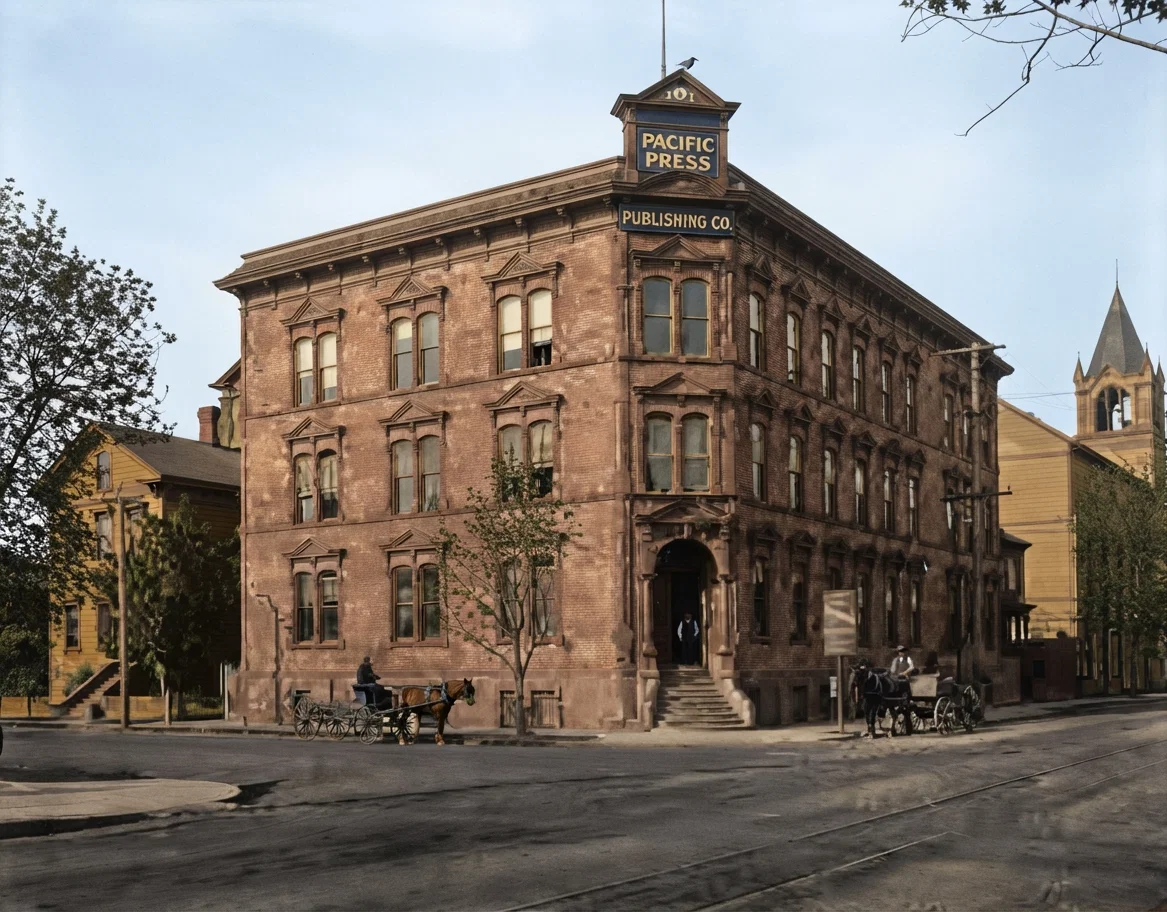
Change of Location of the Pacific Press Publishing Company.
OVER twenty-five years ago the Pacific Press Publishing Company was incorporated and established its business at Oakland, Cal. Since that time there has been a wonderful growth, both in the business of the company and the city itself. When the buildings were erected at the corner of Twelfth and Castro Streets, they seemed to be out in the country, as there were but very few houses within several blocks. But the city has grown, and now we find ourselves in the heart of a large city, bidding fair to rival San Francisco, just across the bay.
The institution was established primarily as a religious publishing house, but, in the early stages of the work, it seemed to be necessary to take in some commercial work in order to keep the hands steadily employed and the machinery moving. This served the good purposes of instruction as well as financial assistance, but several years ago it was seen that the commercial work was assuming such large proportions that it was interfering more or less with our religious and evangelical work. It was also bringing into our office a spirit of worldliness and commercialism which was not concordant with the spirit of our work.
For over two years it has been a decided and declared purpose, according to clear Gospel light, to minimize and eliminate commercial work, and move the office to some rural district, away from the demoralizing and corrupting influences of these large cities.
At the annual meeting of the stockholders held in Oakland, Cal., April 28, 1902, the following action was taken:—
That we instruct the incoming Board of Directors to make a continuous effort to reduce commercial work and develop the publication of religious, educational, and health literature.
Also, That we recommend that the incoming Board of Directors dispose of the plant as a whole, or in part, as Providence may open the way.
We also recommend that, in case the plant is sold, a smaller plant be established in some rural district convenient for our denominational work, for the training and education of missionaries.
The foregoing action was reaffirmed at the annual meeting of the stockholders held last year.
Since that time the Board of Directors have not been idle by any means. At different times negotiations have been entered into with various parties, but, somehow, in every instance, some compromise of pure Gospel principles was involved, and the negotiations came to naught. Nevertheless, we have tried to heed the instruction concerning the matter of curtailing commercial work and giving more attention to our special religious work, with very satisfactory results. We are pleased to say that our religious work is increasing right along, and the outlook is very encouraging.
Until quite recently we have felt that we could not move into the country until we sold this plant, buildings and all, but the way having been hedged up, it has been finally decided to consider the advisability of moving the plant (machinery, etc.) and selling the buildings when we could.
The buildings are in a splendid location, viewed simply from a business standpoint, and there is no question but what they can be disposed of to advantage as soon as they are vacated.
As this question has been agitated, different places have been suggested by different ones, and all have received careful consideration.
In making a move of this kind several points must be taken into consideration.
First, we were instructed to establish our plant in some rural district, away from the large cities with their temptations and allurements, and the trouble that is coming upon them.
Second, railroad facilities must be regarded, for at the present time we are using nearly two carloads of paper per week. Our mail and express business is also quite heavy and must be handled promptly. Banking privileges should also receive consideration.
Third, while we are looking out for the interests of the institution, we must also bear in mind the interests and welfare of our employees. We might find some place quite suitable for the factory as far as shipping facilities, etc., are concerned, but not at all desirable for our employees.
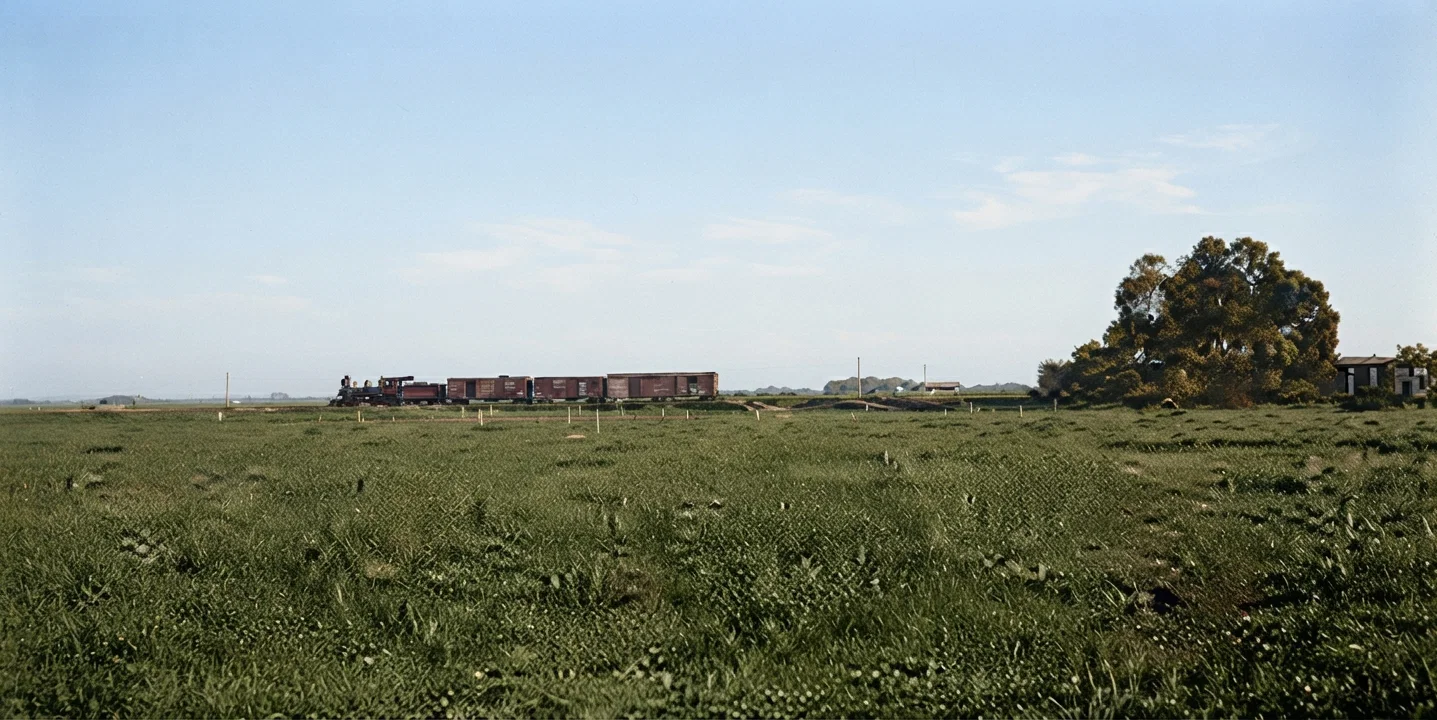
In the investigations that have been made, all these questions have been borne in mind, and the directors have finally decided to locate the plant at Mountain View, Cal., about thirty-nine miles south of San Francisco and eleven miles from San Jose, on the main line of the Southern Pacific Railroad running into San Francisco. It is a rural district and a desirable location, not only for the plant but also for our employees, as it is right in the fruit belt of the famous Santa Clara Valley, and land is quite reasonable.
The incorporated town of Mountain View has about 800 inhabitants, but it is surrounded by small holdings of five, ten, fifteen, and twenty-acre tracts, and settled up with a good class of people. Fruit of all kinds, and the finest varieties, are raised in this valley.
We have been very fortunate in securing for the factory a tract of five acres, fronting on the main line of the Southern Pacific Railroad and near the station. The citizens of Mountain View have raised money to purchase this land, and have put in a switch and side-track, so that material can be loaded and unloaded right from the cars without hauling by team. This property has been donated to the Pacific Press Publishing Company. The citizens will also donate $200 to purchase a lot on which to build our church.
To further show the interest on the part of the citizens of Mountain View in this matter, we quote the following from a letter just received from the Board of Trade of that place:—
PACIFIC PRESS PUBLISHING CO., OAKLAND, CAL.
Dear Sirs: The Board of Trade of Mountain View desires to express to you its pleasure in the knowledge of the fact that your publishing plant is to be removed to Mountain View in the near future, and that you are to become permanent residents of our thriving town. At its regular meeting, held Thursday evening, January 21, the following resolutions were unanimously adopted:—
WHEREAS, The Pacific Press Publishing Company, of Oakland, has decided to move its entire publishing plant to this city,
Be It Resolved, That we hereby extend to them a cordial welcome as members of our community, That we shall at all times be ready and willing to extend to them every courtesy and consideration, collectively and individually.
That the secretary be instructed to mail a copy of these resolutions to the Pacific Press Publishing Company.
Respectfully yours,
[Signed] H. G. COPELAND, Secretary.
The Pacific Press, Present Home of the SIGNS OF THE TIMES.
Mountain View is near the lower end of San Francisco Bay, and there is a little inlet that runs up to within two miles of the city, capable of floating boats of 200-tons burden, thus giving us water competition. Fourteen passenger trains pass Mountain View each way every day, and ten of them stop.
We recognize the fact that this is a very important move, and that it means much to the institution, but it is right in line with the light which God has given through His word, and we confidently believe that He will signally bless the effort. Indeed, we have already had remarkable evidences of His approval.
In moving to Mountain View, it is our purpose to eliminate commercial work, at least to a great extent. Our whole purpose, time, and attention will be given to the extending and building up of our evangelical business. In doing this, it can readily be seen that it will be absolutely necessary so to arrange matters that this work will be placed on a paying basis.
Heretofore we have depended too much upon our commercial work to furnish the funds necessary to support the religious business, on which there has been invariably a loss. This must now be changed, for we know that our patrons and friends do not wish to see the office running behind from year to year.
Plans have already been inaugurated with a view to placing the work on a paying basis, and we now ask for the hearty co-operation of our brethren and sisters and friends everywhere in helping to make these plans effective for Christ and His cause. And, above all, we want your prayers and your counsel. The work is one, and we desire to unite our efforts13with yours in trying to get the truth of the everlasting Gospel before the people in the shortest possible time. We believe that "the pillar of cloud is rising," and it is time for God's people to "move forward."
We are nearing the end of the age. "Evil men and impostors shall wax worse and worse, deceiving and being deceived." Strife and violence are increasing on every hand. And all this will be manifest in the greatest degree in the great centers of congested population—the cities. There wickedness will revel more and more in highhanded, shameless outrage. There first must the judgments of a merciful God fall. And all this is faithfully set forth in the "more sure word of prophecy, whereunto ye do well that ye take heed, as unto a light, that shineth in a dark place, until the day dawn and the day star arise in your hearts."
We believe that our brethren and sisters everywhere will rejoice with us in the move which the Pacific Press is about to make.
Buildings must be erected, and we do not expect we shall be able to move till next July or August, but the work will be pushed forward as rapidly as possible.
C. H. JONES,
General Manager.
Site of the Future Home of the Pacific Press, at Mountain View, Cal.
GOD'S MESSENGERS.
By Robert Hare
BY ROBERT HARE.
UNSEEN they walk through all life's crowded ways;
Unknown they touch the aching brow of pain;
Unheard their footsteps echo through the night;
Leading the lost ones back to life again.
The stars of heaven behold their stately march;
And myriad worlds join echo to their song.
'Tis only human eyes that see them not—
Eyes darkened by the bitter sin and wrong.
O God! to see with angel eyes—to see aright,
To hear with ears that catch Thy whispered word;
To touch with hand as tender, brows that ache,
And thus to serve, as angels do, our Lord.
PRAYER AN ESSENTIAL IN MISSION WORK.
By Editor
[From a Mission Board Circular.]
It was the burden of the prayer of Knox, "Give me Scotland, or I die." Hunt, who was so specially used of God in cannibal Fiji, cried out with his last breath, "O, let me pray once again for Fiji; God, bless Fiji!" And the Lord heard the prayer. When, in 1878, the China Inland Mission saw the need of opening up a work in the interior by women for women, it was felt that possibly Mrs. Hudson Taylor should lead the first effort. But could she leave her little ones to spend months in a new and hazardous endeavor?
One thing was sure. If God wished it, He could provide for the children. Would He? At first it seemed not, but further prayer removed this obstacle completely. Still some thought it wrong. So they put God to the test. Mrs. Taylor asked the Lord one day to send her the money for her outfit, and to give her also $250 for a special purpose—just that, neither more nor less. If He gave her a sign, and did both, surely her way would be clear.
That very day a visitor called to see her and inquired was she really going. On hearing that she expected to go, he handed her a check for the outfit, for that and nothing else—exactly the sum allotted to outgoing missionaries for that purpose. But that was only half her prayer. Yes, but three days later came a check for $250, with express permission to use it for the purpose desired. Is not God more ready to answer than we are to pray? And on the very day of her departure a gentleman, who said he could ill spare it from his business, sent $5,000 to defray the cost of the new effort.
With hearts warm with love for the souls for whom Christ died, let us keep step with progress in the mission fields, with earnest prayer unto God to send forth the laborers and provide the means. Our missionary campaign requires a steady and continuous advance. It must not be the subject of a spasmodic effort one year and a dropping back the next. The ground gained must be held, and the line of battle pushed still further outward. The work can surely be done, for God commands it.
Early in this century, when as yet America was doing practically nothing for missions, six young men in Massachusetts met by a haystack in the field, and prayed definitely that something might be done. They arose from their prayer season for missions with a clear conception of a program of effort that should reach the great regions beyond, and with the rallying cry, "We can do it if we will," they began a work which was the foundation of all that American missionary societies have done toward the evangelization of the world.
Now, with a great work to be done within a few years, and with hearts depending upon the great power of God, pledged to the fulfillment of His own word, let us take as our motto, "We can do it, and we will, by the grace of the Lord Jesus."
OUR WORK AND WORKERS.
THE brethren at Black Rock, Ark., are erecting a new meeting-house.
SIX members were added to the church at St. James, Ill., January 16.
A SESSION of the Northern Union Conference will be held at Milbank, S. D., February 17-22.
TWO PERSONS have accepted the faith in Peoria, Ill., through Bible-readings given by Sister Silver.
THE Herald says that eight new Sabbath-schools were organized in Southern Illinois Conference last quarter.
THREE candidates for baptism at Youngstown, Ohio, is part of a report of Brother C. C. Webster, in the Welcome Visitor.
THE Young People's Society of Battle Creek, Mich., has sent one of their number to Egypt, and will support him until the work shall become self-supporting.
THE brethren of Halifax, N. S., dedicated their new house of worship January 10. The services were conducted by Brethren Wm. Guthrie and F. A. Tracy, and were well attended.
IN connection with meetings held at Pomeroy, Wash., three members were added to the church January 16. The meetings are being conducted by Brethren J. A. Holbrook and F. D. Wagner.
A REPORT of Brother J. G. Walker, in the North Dakota Gleaner, notes that eight persons had begun to observe the Sabbath of the Lord at Langdon, through the humble labors of a Brother Chase, a layman.
TWO YEARS of labor in the province of Alberta, Canada, has so far resulted in four churches and several smaller companies as yet unorganized. There is also one successful church-school in operation.
A LETTER in the Sabbath-school Worker, from Sister Iva Cady, Sabbath-school secretary of the Society Islands, says: "Our brethren here are getting stirred up to give more freely of their means for the Gospel work."
AT the last quarterly-meeting of the church in Du Quoin, Ill., eight members were added. Brother J. M. Rees, president of the conference, reports to the Herald that both the church and the school at that place are in a prosperous condition.
MEETINGS held at West Lebanon, Ind., by Brethren F. M. Roberts and S. S. Davis, have resulted in ten conversions to "the faith once delivered to the saints." The report says: "Among them are a Dunkard minister, his wife, and granddaughter; also a local minister of the Methodist Church, a very promising young man. There are many more who are deeply interested."
WRITING from Farry, O. T., to the Union Record, Brother J. R. Bagby says: "We notice that those who take hold of the SIGNS work are those who are growing in the work, and are the ones who will have to carry the Gospel of the kingdom to this generation."
THE Indiana Tract Society, as stated in the Reporter, is still filling orders for the Capital and Labor issue of the SIGNS. As the matter is as fresh to-day as it was when first issued, there is no reason why it should not be sold in large quantities yet. There are still some on hand.
THE Western Washington and Western Oregon depositories have been discontinued and merged into the new Pacific Press branch office established at Portland, Oregon. This arrangement will save much middle work, and add to the convenience of the workers in that region.
IN the Indicator Brother S. H. Lane, president of New York Conference, reports preaching in the Baptist Church at Locke, on a recent Sunday evening. He says: "All seemed deeply interested, and I received an earnest invitation by the pastor in charge and several of the members, to occupy the house again. They said that any time I would send an appointment the house would be ready."
THE manner in which the details of Gospel labor vary in different countries, is illustrated by a report from Brother B. E. Connerly, in the New York Indicator, concerning his experience in Porto Rico. He says: "We have devoted considerable of our effort to the exaltation of labor, and to defending the rights of the poor dumb creatures, which are subject to such cruelties here that it is almost more than we can stand at times to see it."
REPORTS of good results are still coming. The following is from the Southwestern Union Record: "Brother C. W. Cutter, of Hot Springs, Ark., took 500 copies of the Capital and Labor number of the SIGNS, and since then has been taking a hundred copies each week of the weekly issue. He reports quite an interest as a result, and anticipates an opening for a series of meetings. Sister Harrell, of the same place, is using fifty copies a week. Their courage is good, and they hope to realize a harvest of souls as the result of their labor in that line."
AT the Life Boat Mission, Chicago, many little children from the streets were made happy by Christmas presents, most of which were things they really needed. A letter from the Life Boat Children's Department says, "Presents came in boxes, barrels, and bundles, and warm clothing came in abundance, and to-day many a child is warm and comfortable, who otherwise might have been miserable or perhaps sick." One hundred and forty-four children were counted in the room. At the dispensary, in another part of the city, about forty others were made happy. At the Life Boat Haven about thirty more received good cheer, and many presents were sent out to children who could not come in. The letter states that "hours before the time set for the opening of the Life Boat Mission, eager little faces were pressed against the big windows, and dirty little hands rattled the latch on the door."
REFERRING to the revival at Battle Creek, Mich., Brother G. C. Tenney writes, under date of January 24: "Beginning with the week of prayer, special meetings were held by the church and sanitarium, both in districts and in general assemblies. A good interest was awakened, and we felt that the occasion had been an especially profitable one. Soon afterward a convention of young people was held here, in which a good interest was manifested, and progress was made by many toward a better state of things. These meetings awakened so much interest that it was thought best to follow it up. Brother Luther Warren has had the principal burden of the work. From the first the attendance was large, and the interest increased. Many people began to seek the Lord, and every day souls found freedom in the knowledge of sins forgiven. Families that had been divided in religious practices and interest were united. The altars of prayer were established in many homes. Reconciliations took place, and for about four weeks we have had a remarkable visitation of the Spirit and power of God. As to numbers, it is not possible to approximate how many hearts have been quickened in the service of the Lord. On the evening of January 21, 148 were baptized, and quite a large number are now awaiting the opportunity to receive the rite."
THE DYING GIRL.
A CHINESE girl, the only Christian in her village, lay dying. Her husband had just promised her to become a Christian and she was radiantly happy. Seeing a crowd of people going to their idol worship, her heart was filled with pity, and, after a word of prayer for them, she said: "Throw open the doors and call the people in. Let them see how a Christian can die." They came in and stood looking at her radiant face. They had never seen a Christian die before. They had seen many a bride at her wedding, but never one so bright, so happy, as this dying girl. She told them she had no fear of death, but this last day of her life was the happiest. She besought them to come to the same Almighty Saviour. Suddenly she ceased speaking; her ears heard sounds, her eyes saw sights vouchsafed to no others. She looked up and waved an adieu with her hands. Her face took on a brighter radiance and she cried out, "Jesus is coming, Jesus is coming," and fell asleep. Quickly and silently the people went out. But the witness of her death did more than a whole life might have done. Soon her husband and four of her girl friends were saved and the work of God went on extending into other villages.—Selected.
(1) "At that season Jesus went on the Sabbath day through the grain fields; and His disciples were hungry and began to pluck ears and to eat. (2) But the Pharisees, when they saw it, said unto Him, Behold, Thy disciples do that which it is not lawful to do upon the Sabbath. (3) But He said unto them, Have ye not read what David did, when he was hungry, and they that were with him; (4) how he entered into the house of God, and ate the showbread, which it was not lawful for him to eat, neither for them that were with him, but only for the priests? (5) Or have ye not read in the law, that on the Sabbath day the priests in the temple profane the Sabbath, and are guiltless? (6) But I say unto you, that One greater than the temple is here. (7) But if ye had known what this meaneth, I desire mercy, and not sacrifice, ye would not have condemned the guiltless. (8) For the Son of Man is Lord of the Sabbath.
(9) "And He departed thence, and went into their synagogue: (10) and behold, a man having a withered hand. And they asked Him, saying, Is it lawful to heal on the Sabbath day? that they might accuse Him. (11) And He said unto them, What man shall there be of you, that shall have one sheep, and if this fall into a pit on the Sabbath day, will he not lay hold on it, and lift it out? (12) How much then is a man of more value than a sheep! Wherefore it is lawful to do good on the Sabbath day. (13) Then saith He to the man, Stretch forth thy hand. And he stretched it forth; and it was restored whole, as the other."
Golden Text.—"It is lawful to do good on the Sabbath day." Verse 12.
SUGGESTIVE QUESTIONS.
(1) Through what did Jesus and His disciples pass on a certain Sabbath? In what condition were the disciples? What did they do to satisfy their hunger? Verse 1. Note 1. (2) Who raised a complaint about this action? What was the complaint? Verse 2. Note 2. (3) In replying to this charge, to what circumstance did Jesus refer? Verse 3. (4) What had David and his men done? Verse 4. Note 3. (5) To what other example did Jesus call attention? Verse 5. Note 4. (6) Then what emphatic announcement did He make? Verse 6. Note 5. (7) Of what did Jesus imply that His accusers were ignorant? From what would a knowledge of this scripture have saved them? Verse 7. (8) What did Jesus say of His own relation to the Sabbath? Verse 8. Note 6. (9) Where then did He go? Verse 9. (10) To whom was His attention called in the audience? What question was asked Him? For what purpose was this question asked? Verse 10. Note 7. (11) With what pointed question did Jesus reply? Verse 11. (12) How did He emphasize this question? Then what comprehensive truth did He utter? Verse 12. Note 8. (13) After thus making plain His doctrine, what did Jesus say to the crippled man? And what was the result? Verse 13. Note 9.
NOTES.
1. "Corn" (in the Common Version), as understood in America, was not raised in Palestine. It was a wheat or barley field through which Jesus and His disciples were passing on their way to the synagog. They plucked the heads of grain (called "ears" in the text) and rubbed out the kernels in their hands. Luke 6:1.
2. "Not lawful." They meant that it was contrary to rabbinical law, which allowed no eating on the Sabbath prior to the morning service in the synagog, except in case of sickness. It is also said that the act of rubbing out the grain in the hands was technically reckoned as threshing, and therefore a secular work. This is a specimen of the trivial character of most of the traditions of the rabbis, by which the law of God was set aside. Mark 7:9.
3. The law of necessity and mercy is plainly set forth by the Saviour of men. See Ps. 103:17; 130:7; Prov. 21:21; Micah 6:8; Matt. 9:13. The account of David's trespass is found in 1 Sam. 21:1-6. The showbread, twelve loaves, was kept on the table in the first apartment of the sanctuary, and changed every Sabbath day (1 Chron. 9:32), after which the old supply was used by the priests (Lev. 24:5-9). David and his men came to the sanctuary at Nob on the Sabbath (for the fresh bread had been sanctified that day). See 1 Sam. 21:5, margin. He was given the bread of the priests, which was technically unlawful, and King Saul put to death eighty-five priests because of the act of Ahimelech; but Jesus did not condemn the deed, because David and his men were suffering from hunger. The precedence that Christ gave to mercy is also shown in John 7:22, 23.
4. The priests technically profaned the Sabbath by doing an extra amount of labor on that day, their offerings in behalf of the people being double those of other days. Num. 28:9. Yet Jesus says they were guiltless.
5. The One "greater than the temple" was Jesus Himself. He had a right to construe the meaning of the temple service, and to vary the letter to fit the purpose to any circumstance as He thought best.
6. The Sabbath was an institution of Christ's own creation (John 1:1-3; Col. 1:15-17; Gen. 2:2, 3); therefore He was Lord of it, and shall He not do as He pleases with His own? (Matt. 20:15).
7. "To accuse Him."—There was a determination on the part of the Pharisees to bring some accusation that would serve to condemn Jesus, and, seeing that He was disposed to disregard their traditional Sabbath regulations, their opportunity seemed to lie along this line, and they sought to make the most of it.
8. In verses 11 and 12 Jesus appeals to one interpretation of the Sabbath law which the rabbis themselves allowed, and then turned it against their criticism of Him for healing an unfortunate man. No one would assume to deny that a man was better than a sheep. Then He added an universal principle, which no one could gainsay, namely, that "it is lawful to do good on the Sabbath day."
9. The healing of the withered hand was really an act of creation, but it was done with a word, as was the creation of all things in the beginning. As Christ performed no manual labor, there was no pretext for a criminal charge.