The Youth’s Instructor, Vol. 33, No. 50.

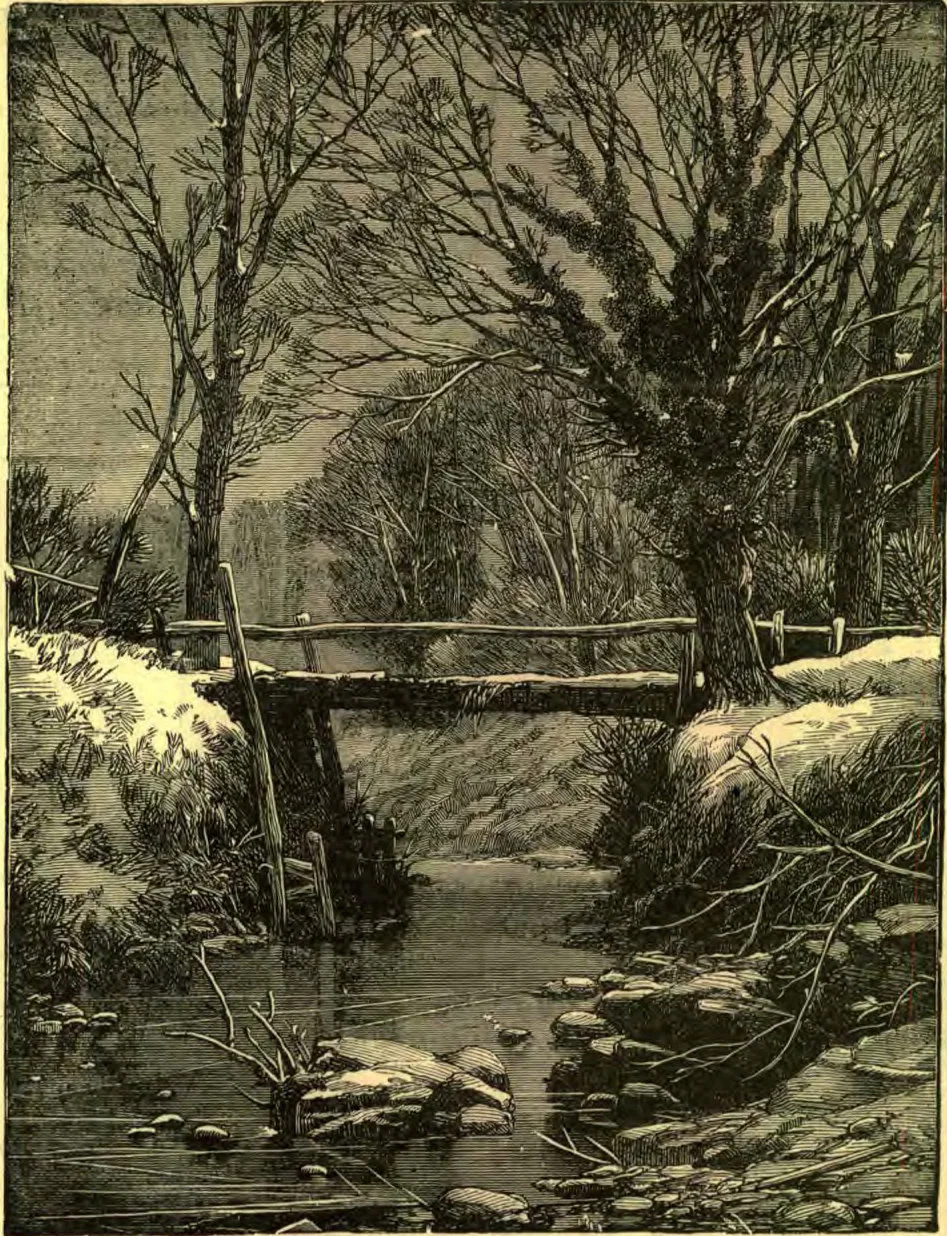
WINTER

The Youth’s Instructor

Dec 30, 1885

S. D. A. Publishing Association · Battle Creek, Mich. · Dec 30, 1885

WINTER

Pile up the fire. The winter wind, Although it nips, is not unkind; And dark midwinter days can bring As many pleasures as the spring.
On barn and thatch and leafless tree The frost has hung embroidery— Fringes of ice, and pendants fine Of filigree and crystalline.
The winter is a friend of mine; His step is light, his eyeballs shine; His cheek is ruddy as the morn; He carols like the lark in corn.
His tread is brisk upon the snows; His pulses gallop as he goes; He hath a smile upon his lips, With songs of welcome, jests, and quips.
A charitable soul is he; His heart is large, his hand is free; He brings the beggar to his door, And feeds the needy from his store.
The friend of every living thing— Old winter, sire of youthful spring; The glooms upon the brow that dwell Are glories when we know them well.
'Tis he that feeds the April buds; 'Tis he that clothes the summer woods; 'Tis he makes plump the autumn grain, And loads with wealth the creaking wain.
Pile up the fire, and ere he go, Our blessings on his head shall flow— The hale old Winter, bleak and sear, The friend and father of the year.
—Charles Mackay.

THE SUCCESSFUL MAN.

There he sits on the piazza of his summer hotel, in his suit of spotless white, the successful man! How is he to get through the day, he who has done everything, seen everything, had everything, and has everything?
Another winter is before him. What is he to do with it? Where shall he go, a man who has been round the world, who has spent three winters in Egypt, two in Rome, several in Paris, four seasons in London, and even a month at Washington?
When this successful man was a boy, and lived in a manufacturing village of New Hampshire, a widow’s son, the greatest luxury he knew was to eat apples. So he told us the other day when we fell into conversation about old times.
“Yes,” said he, “when I was ten years old, I used to think that if ever I was rich enough to have as many apples as I wanted all the year round, I should be perfectly happy. And now!”
He went on to say that he had one of the finest orchards on a small scale to be found anywhere in Massachusetts, which produced last year ninety-four barrels of apples of the best varieties yet grown. But he did not eat two apples per annum. He could not; for while he was making his fortune, he worked as hard, and confined himself so closely, as to contract a chronic weakness of digestion. With all the luxuries of the world at his command, he was obliged to live principally upon oatmeal and milk.
Later in his youth, his ambition soared above apples. He was beginning to get a little more money than he absolutely needed, and was able occasionally to indulge in a ride. He then thought that if he could ever own a horse fast enough to pass everything on the road, and take no man’s dust, he should be the proudest and happiest of men.
“Well,” he continued, “I have got a horse that, I think, is the fastest in my country; but I never drive him. I gave him to my son last summer; and for my own use, I keep an old nag that jogs along six miles an hour without my troubling myself about him.”
At this point our poor successful man wearily took out his watch to see how time was getting on, and we observed that the watch was of a peculiar pattern rarely seen in this country.
“This watch,” said he, “is another case in point. One of my young ambitions was to possess as good a watch as mortal man could make. I have got one. I gave six hundred dollars in gold for it, at a time when gold was a more expensive article than it is now. But knocking about the world in sleeping-cars and Mediterranean steamboats, I was always a little anxious for the safety of my watch; and, besides, the possession of so costly an article by a traveler is a temptation to robbers. One day in Paris I noticed in a shop-window this curious little watch, marked twenty-five francs. A five-dollar watch was a novelty, and I bought it. I deposited my six-hundred-dollar timekeeper with my banker, and it has reposed ever since in an iron safe. I find that this little watch keeps time as well, for all the ordinary purposes of life, as the other, and I have carried it ever since.”
The successful man said these things with what we may call a good-humored despair. He made no complaint; but at the age when he ought to be in the full tide of cheerful activity, he appeared to have exhausted life.
To gain wealth in order to live at leisure is one of the most common dreams of youth. The desire is a selfish one; and wealth gained for self, ends in disappointment. A man can never retire from the work God appoints him to do. The greater his wealth, the larger are his opportunities for usefulness; and conscientious devotion to others’ needs alone can make a man happy in his early life, middle life, or declining years. Selfishness can never bring satisfaction to the heart.—Youth’s Companion.

REGAL FRUIT.

Through our Northern States, the traveler would very naturally be impressed with the abundance of our orchards, and the varied character of our fruit.
In no species would he note so great a variety as in the deep green apple orchards, laden to breaking with russet and red. In passing from one town to another, especially in the richer portion of the Lake States, every mile will unfold to his view from two to a score of these farms, containing each from a dozen to a thousand trees.
Our native Crab-tree we scarcely deign to plant for its fruit; yet its classical name, pyrus coronaria, like the odor of its blossoms, is decidedly agreeable.
The improvement which the wild, sour apple has undergone to become the mellow, blooming fruit of our roadside orchards is quite as striking as would be the change from the savage, poor and unlearned, to a civilized Christian. Yet naturalists tell us that this “stunted-looking tree, with austere, uneatable fruit, is the parent of all, or nearly all the varieties of apple so much prized for the dessert.”
The apple, cultivated and improved, was much planted by the Romans; and they, it is supposed, introduced it into Britain.
It is now the most widely diffused, and the most highly valued of all fruit trees. It reaches its greatest perfection, however, in the cooler parts of the temperate zones.
The apple tree has wonderful individuality. If you notice carefully, you will agree that trees bearing different varieties vary as much, one from the other, as do the children of different families. Nor will you dispute the variations in form, size, and color of different varieties of apples; but have you noticed that these variations in the fruit agree with characteristics of the tree that bore them? The big Northern Spy, a solid, conical, cooling fruit, is borne upon a large, strong tree, usually quite pyramidal, and with vigorous, shady top. The tree which bears the Russet, a light, round, sunny fruit, is quite a different tree. Notice its orbicular, open top, and lithe, spreading limbs. The brown or golden complexion of its leaves seems almost to say it will bear Russets. Let us now visit the old Rhode Island Greening tree. Observe its low, reclining stem, and strong, extended arms. Think how Siberian Crab-apples would look on a tree like that! or how the broad, lusty Greenings would bend the limbs of the Crab-tree! Yonder is the old Snow-apple tree. It has borne, and broken, and borne while healing. Indeed, it seems from all appearances that it never is satisfied even with doing enough, for there is ever a surplus after all the passers-by have helped themselves. Though but a broken emblem of industry, it is the more perfect for being broken.
The blossoms of spring, eloquent with prophecies of autumn fruit, have faded, though their eloquence was associated with the piping of the oriole, and the favorite nesting place of the robin and wax-wing.
The fall rains have been frequent and copious. An occasional sharp frost has, with the warm days, ripened the leaves, and given unwonted richness to the fruit on all these orchard boughs. Where, under the great spreading trees, the sunlight before had fallen only in sprinkles, it now comes down in showers with the falling leaves.
In the midst of such a scene, our young apple picker climbs to the very top of an old Swaar, or a Wine-apple tree; and there, in the midst of such fruit as people who stay on the ground never see, he looks right and left, up and down, among the bending trees, and the whole world seems a vast orchard. One by one he then transfers the blooming fruit to the basket. Now just wait a minute till he comes down. Fit for a thanksgiving by and by, are they not? But apples, even, lose half their charms with the touch that severs them from the tree, and he that would see them in all their native beauty must climb.
But the graces of our royal fruit are not all lost by handling, as our piled-up cellar bins filled with fragrant and ripening apples will testify.
Says one, though, “How cheap apples are!” Let us suppose for a moment that the aroma had been lacking in the blossom or the fruit; or the tempting tints, or the forms and flavors of the thousand varieties. Suppose they were less easy of cultivation, or less adapted to every season, or were less agreeable to the touch. One such lack would detract much from the public favor with which this fruit has been received. In it these noble qualities are all combined. They have brought it into general favor and general cultivation, and that is why we who raise them, think them cheap; but it is no reason for the thankless prodigality with which they are too often used.
GEORGE R. AVERY.

GOOD INFLUENCES.

“O AUNTIE, do tell us a story!” exclaimed little Mamie Lee, as she came in from play, swinging her hat by the strings, while her hair was flying about in wild disorder.
“Yes, do tell us a real nice story, Aunt Kate,” added Carrie, “for we are tired out playing tag.”
“You look tired, chicks; for your cheeks are flushed, and your hair is in such a state that I fancy your hats have been anywhere but on your heads.”
“Oh, they blew off on the start,” replied Carrie, “and we could not stop to pick them up until just as we came in.”
“You must not be quite so lawless unless you wish to be called tomboys.”
“O Aunt Kate, what a name! That is just what the girls all call Maria Dean, for she is as rude as rude can be.”
“Well, then, if you do not care to gain the same name, you must try to be more gentle and lady-like. Now hang up your things, and comb your hair neatly; then I’ll have a little talk with you while you are resting.”
Carrie and Mamie soon came back with hair well brushed, clean white aprons, and cheeks looking so rosy that their aunt at once said,—
“Now I can give my pets each a kiss before they seat themselves. You say, dears, that Maria Dean is ‘as rude as rude can be,’ and so has won the name of ‘tomboy.’ I am sorry to hear it, for her mother is a sweet, gentle woman, and has tried to bring Maria up well. Shall I tell you how she has become so rude?”
“Yes, auntie,” replied the little girls, settling themselves down by their Aunt Kate’s side. “Please tell us all about it, for it does not look a bit nice to be so harum-scarum; and yet Maria is warm-hearted, and I don’t believe she means to be so rude.”
“That’s right, Carrie, try always to see some good in every one, and especially so in your little school-mates, for then you may help them to overcome their faults. We may help to influence one another for good. This is why I would now tell you of Maria. Her mother, who is still away from home trying to regain her health, was very, very ill for many months, so she could not see at all after her little girl; and as Maria had no sister to play with, and their nearest neighbors had only boys, she spent much of her long vacation with them.
“Unfortunately they were uncommonly rude, wild boys, and Maria followed them into all sorts of pranks. And now, since she has returned to school, more gentle children shun her; and I’m afraid when her mother returns home, she will grieve sadly over her wild little girl.”
“Auntie, you say we can influence one another for good. Do you think we can do anything for Maria?” asked Mamie after a few moments’ thought. “I’m sorry for her, for the girls all seem to dislike and shun her.”
“Yes, dear, I have been thinking of this. Suppose we invite her to spend a week or two with us, and then all try to make her happy through more gentle ways.”
“What! invite that rude girl here?” exclaimed Carrie. “Why, Aunt Kate, she’ll tear down the house and garden too, and we will be made to yield to her.”
“Not quite so bad as that, Carrie. For her mother’s sake as well as her own I am anxious to do something for the poor child; but you will both have to second me in the effort to subdue a little of her wildness.”
The girls consented, and Maria Dean was invited to their house. It was a great surprise to the poor, neglected child.
“Mamie Lee, are you in earnest? Do you really mean to have such a harum-scarum as I am come and stay with you for two whole weeks in your lovely home?”
“Yes, Maria, and you’ll see if we don’t have fine times. Aunt Kate, who is with us now, is such a hand to get up games and amuse us.”
We cannot now tell you of all the pleasure crowded into the two weeks of Maria’s stay at the Lees’. At first it was a great trial to her to conform to lady-like ways; but when she understood the efforts of all to please her, and listened to the family prayers in which she felt herself included, she became more subdued, and saw how rude and ungainly she was fast becoming. One day, when found in tears by Aunt Kate, she told her how angry it had always made her to be called tomboy, and how it drove her into acting ten times worse than she had meant to be; but now she would try to be a gentle, Christian child, if Miss Lee thought she ever could become one.
“To be sure you can with God’s help. You must daily ask your heavenly Father to help you, and then in his strength you will be enabled to overcome your rude ways, and not feel cross when others say unkind things of you. By and by they will understand the struggle you are making to do right, and will learn to love you.”
“Then I’ll try, Miss Lee,” and with a kiss and whispered words to pray for her, Maria rejoined the little girls.
Her warm heart had helped her to appreciate all the kindness shown her while with Mamie and Carrie Lee; and they felt repaid when they saw the change wrought in the once rude girl, through a little self-denial and kindness on their part.
In time Maria became so gentle and lovable that it was a proud, happy day to her when told she was growing so like her mother—the beautiful, gentle mother, who was to her, even in her rudest days, something sweet and almost saintly.
—The Child’s Paper.

HIS INNER LIFE.

ABOUT a year ago a prominent broker in New York died, and was discovered, to the surprise of all the business world, to be bankrupt. His estate was brought to the hammer.
He had been a noted collector of works of art, and the sale attracted connoisseurs and dealers in pictures, rare and antique furniture, china and bric-a-brac.
The sale of his library was the most important of the year. Catalogues were sold at a high price, and the lovers of fine editions in all parts of the country came, or appointed agents, to compete for the treasures which, at enormous cost, he had gathered on his shelves.
Several ladies were present. Among them, one, in deep mourning, seated in a quiet corner, attracted much silent sympathy. It was his only child, a married daughter, who had just arrived from New Orleans, for the purpose, it was supposed, of securing some of the rare volumes which her father had accumulated with such infinite trouble and cost, and had held at such priceless value.
As one volume after another was put up, the auctioneer glanced at her, expecting her to bid; but she remained motionless. Old Elzevir's unique folios, specimens of the earliest or the most perfect printing, were sold; but she made no effort to keep them.
At last, near the close of the sale, a small octavo, cheaply bound but well worn, was put up. She bid on it eagerly.
One or two dealers, seeing her agitation, and supposing she would know the chief treasure of the collection, opposed her.
The price rose rapidly. She was a poor woman, as they all knew, but she continued to bid, with pale cheeks and trembling lips. The book was knocked down to her at last at an exorbitant price, and she at once left the hall.
“What rare treasure have you gained?” said a friend, who went out with her.
She opened it. It was a cheap, common copy of the New Testament. There were faint pencil-marks against some of the verses.
“I knew my father had this book. I have seen him read in it. I came from New Orleans to find it. These little marks show me his secret thoughts.”
Now that the rich man was dead, the faint pencil lines on the cheap book were worth in her all the vast sums and the rich treasures he had gathered, for they showed that his soul was at peace with God.
Before we decide on the value of an object, or give ourselves to its pursuit, we should consider how much it will be worth to us the day after our death.—Youth's Companion.

GOING TO SCHOOL.

I see the little children, creeping, creeping, Down the long hillside to the village school, With slow, reluctant feet, and almost weeping To end glad summer with the sterner rule Of tasks and hours, and waste October weather Pent up in irksome study all together.
I see the little children, running, running, When school is over, to resume their fun; Or in the late, sweet warmth of daylight, sunning Their little discontents away, each one. “How nice to be grown up,” so they are saying; “And not to study, but be always playing.”
Ah, foolish little children! if you knew it, Grown folks must study, just as children do. Must punctual be at school, or else they rue it, And learn a harder lesson yet than you. Early they set to work, and toil all day; The school lets out too late for any play.
Their school-room is the world, and life the master; A stern, harsh master he, and hard to please. Some of the brighter children study faster Than the others who are dull; and these, When they’ve recited, if they stand the test The master suffers to go home and rest.
But all must learn a lesson soon or later, And all must answer at the great review; Until at length the last discouraged waiter Has done his task, and read the lesson through; And with his swollen eyes and weary head, At last is told he may lie home to bed.
So, little children, when you feel like crying That you are forced to learn to read and write, Think of the many harder lessons lying In the dim future which you deem so bright. Grown folks must study, even against their will; Be very glad that you are children still! —Susan Coolidge.

THE WISE LITTLE PLANTS.

THIS morning our little girl called my attention to something very interesting about her plants. In this cold weather, she keeps them in the house, and sets them in the windows. She said, “Now just see, papa, how they all turn right toward the light. I have to turn them around often, or they would grow all one-sided. There, I will turn this one away from the window. Before night it will be turned right the other way. Isn’t it curious?”
Why do these plants do so? Is it that they may look out of the window?—No; but they want to get where the light is, and get more of it; for it is the light that makes them live and grow strong. In the dark they become sickly. They always stretch out their faces toward the light wherever they can see it.
The roots of plants and trees will do just so to find water. Plant them where there is water on one side and none on the other, and the roots will turn toward the water, and grow largely that way. Roots have been known to go several rods underground to reach a well for water.
These plants act wisely, and that is the way we should do. Learn what is really for our good, for our health and life, and then go that way. God is our life and our light, and to him we should constantly turn as the plants to the sun or the roots to the water. Children, do you act as wisely as those little plants?
D. M. CANRIGHT.

YOUNG LADIES AND DRESS.

A LADY, who had taught for over thirty years, once gave the writer some very interesting information. “When a new scholar was introduced,” she said, “I always looked first at her dress. If that was plain, neat, and tidy, I was pretty confident that I had good material to work with. For the first two or three years of my teaching, I was in the habit of scrutinizing the features, and the formation of the heads; but these came at last to be quite secondary considerations. Our school was so expensive that none but daughters of the wealthy could possibly enter it; so when a young lady came to the class-room in a plain dress, I was sure it was on account of her idea of the fitness of things. This argued common sense. Common sense is always in direct antagonism to vanity; and where there is no vanity, there is seldom self-consciousness. So, you see, a plain dress came to mean a great deal to me. I learned never to expect anything from a girl whose school dress was silk or velvet. I shall always retain the impression made upon me by a quiet little body in a blue flannel dress. She came from one of the first families in wealth and culture, and was the most unobtrusive child I ever knew, as well as the most brilliant. When she told me, graduation day, that she had decided to study for a physician, I was not in the least surprised. I was sure she would succeed, as she certainly has in the most marvelous manner. She carried off every honor, and though the girls in “purple and fine linen” sneered at her plain attire and lack of style, there was not one who could ever compete with her.
Certainly, on the whole, the deductions of this teacher are correct. It takes time to array one's self in elaborate garments, and the girl whose mind is occupied with loops and trimmings and general furbelows cannot, for a philosophical reason, have room for much else.
Then there is a reason much deeper than this, even. The girl whose tastes are in the line of dress and display has not an intellectual development. She may be imitative and intuitive to a degree, but she will generally be superficial in her learning and shallow in character.—Selected.

The Mind Strengthened by Discipline

THE mind is like the body in its habits—exercise can strengthen, as indolence can weaken it; they are both improved by discipline, both ruined by neglect.

A HINT TO THE BOYS.

I stood in a store the other day, when a boy came in and applied for a situation.
“Can you write a good hand?” he was asked.
“Yaas.”
“Good at figures?”
“Yaas.”
“That will do; I do not want you,” said the merchant.
“But,” I said when the boy had gone, “I know the lad to be an honest, industrious boy. Why do you not give him a chance?”
“Because he has n't learned to say ‘Yes, sir,’ and ‘No, sir.’ If, when applying for a situation, he answers as he did, how will he answer customers after being here a month?”
“What could I say to that? He had fallen into a bad habit, young as he was, which turned him away from the first situation he had ever applied for.—Sel.

THE NEW YORK FIRE-ENGINE HORSE.

Within a score of years, a great change seems to have been wrought in the minds of many individuals respecting the faculties of dumb animals, the opinion having largely prevailed that they did not possess the power to think or reason. Among the lower class of animals, close observation is revealing such remarkable instances of sagacity and cunning, which can be attributed to nothing else than an active brain, that it is becoming the common opinion they only lack the power of speech to give expression to thought. The following which we clip from Our Dumb Animals, is only one of many instances displaying—shall we not say—human intelligence:—
“The firemen who train the horses for the department, says the New York Times, have abundant opportunities for a confirmation of the theory that horses reason from cause to effect. Of one horse in particular, which is now in active service, many anecdotes are current, showing his great intelligence and ability to master questions for himself. The following story was told by one of the assistant-engineers at the fire on Broadway on Saturday night:—
“‘Jim,’ he said, pointing to a powerful black horse, who was pawing and snorting in time with the puffs of the engine, ‘was a difficult horse to train. He was slow at learning to leave the stall and make a rush for the pole as soon as the gong sounded. We tried him in various ways, and finally made him one of the quickest horses in the service by simply feeding him an apple as soon as he had taken his place at the pole. This plan worked admirably, but the department didn’t supply unlimited apples; so when we thought him fully trained, the customary apple was omitted. What did Jim do then but quietly remain in his stall when the alarm rang out. The apple business was resorted to again, and he was as spry as before. Then again the apple was dispensed with, and Jim did not budge, but looked at the men calmly; and if a horse can wink, I think one could see the merry twinkle in his eye, and imagine him saying: “No apple, no move.”’
“‘He is too strong and too valuable to lose; so the foreman rigged up an automatic whip, which was released at the first tap of the gong, and came down with a sharp thwack across Jim’s quarters. For two or three days this answered every expectation; but it was then noticed that when Jim backed into the stall, he furtively looked behind him, and, after a cogitation with himself, he squeezed his body close up to the side of the stall, so that the lash came harmlessly down by his side. This happened not only once, but every time he was put into his stall; and it was clear that he had beaten the men. Well, then another plan was adopted. The whip or lash was strung along the side of the stall; and when the gong sounded, out it sprang, hitting Jim a smart clip in the side. This brought him out on a run for two or three days, when he again got the best of us. When he was backed in, he planted his body firmly against the side of the stall, and the gong might have sounded a week; for the lash would never touch him, as he held it tight against the boards. We then tried a third and last plan of having half-a-dozen lashes working from the gong, so that however he might place himself, some of them would be sure to hit him. This has succeeded so far; but Jim has evidently been thinking out a plan to get the best of this, and I am not sure but he will succeed.’
“During the narrative Jim stood quietly, as if listening; and when the engineer, walking by him, gave him a friendly pat, he neighed out a whinny of satisfaction, acting as if he understood every word.”

IMPORTANT BIBLE SUBJECTS.

LESSON 17.—THE EVERLASTING KINGDOM.

[NOTE TO THE STUDENT.—Do not consider the lesson learned until you can give at least the substance of every text, with the correct reference for each. The references in black letters indicate those texts that should be committed to memory. A little diligent application each day will enable you to learn them, although this need not be considered a test of scholarship.]
1. WHEN is the everlasting kingdom to be set up? Dan. 2:44.
2. By what symbol is it represented? Verse 34.
3. Where is the image to be smitten by this symbol?
4. What part of the world's temporal history is represented by the feet of the image?
5. Did either of the four great kingdoms utterly destroy, or exterminate, the kingdoms that ruled before it?
6. Repeat a scripture that seems to allude to this fact. Dan. 7:12.
7. For what does this account?—For the fact that the gold, the silver, the brass, and the iron, of the image, all exist when the stone smites it on the feet.
8. What is to be the effect of this smiting? Dan. 2:35.
9. When will this utter destruction take place? Rev. 19:11–21.
10. What change is to take place in the stone after all earthly kingdoms are destroyed and utterly removed? Dan. 2, last part of verse 35.
11. Where, then, is this everlasting kingdom to be set up?
12. How will the earth itself be purified from the effects of sin and the curse? 2 Pet. 3:7, 10.
13. How will all the righteous, both the dead and the living, escape this terrible destruction? 1 Thess. 4:16, 17.
14. What change will take place in them before they are caught up to meet their Lord? 1 Cor. 15:50–53; Phil. 3:20, 21.
15. What does our Saviour say of the condition to which they are raised? Luke 20:35, 36.
16. What is said in Rev. 20:6 about those who have part in this first resurrection?
17. When will all the wicked have a resurrection? Rev. 20:5, 8, 9.
18. What will be their fate?

GIFTS AND DUTIES.

There is every variety of work to be done, and there is need, therefore, for every variety of workmen; and God so distributes his gifts that there may be a hand for every task, a foot for every errand, a tongue for every word that needs to be spoken, and a heart for every service. There is no confusion in this distribution. As the many members of the body, working together in perfect harmony, make up one complete body, so the many members of the church of Christ, if each is faithful in his own place, make together one complete and harmonious whole.
Every individual, even the humblest, has a distinct mission of his own; and God bestows just the gifts each one needs for the work allotted. He wanted some great apostles to found his Church, and to bear his name before kings; and he chose twelve men, gave them the needed gifts, and trained them. He wanted a reformer to tear the draperies of superstition from the cross, and unchain the Bible; and he fitted Luther for the task. He wants humble servants to go and sit down by the poor sick woman in her dingy garret, and tell her of the Saviour’s love; to visit prisons, almshouses, and hospitals; to teach in the Sabbath-school, and to do the thousand little things of Christian service which must every day be done; and he gives to many of his servants just one talent to fit them for doing just these little things.
Sometimes God touches a woman’s tongue, and she writes songs that thrill a nation; or she has the gift of eloquent speech, and her words move the masses, and fire the people’s hearts; but if all women wrote poetry, or were public orators, who would mold and train infancy and childhood? who would perform the countless little lowly ministries that are so needed and so blessed, in the sick-room, among the poor, in the abodes of sorrow? There must be a great many people with common gifts for plain, common work.
Whatever our particular talents may be, they are just what God has given us; and they are just what we need for the special work which God has allotted to us. If we diligently use our own gifts, however small they may be, and fill faithfully our own places, however lowly they may be, we shall be noble, and shall meet God’s approval.
Who will say that the modest daisy is not as noble in its own sphere as the tallest, proudest oak in its sphere? Nobleness consists in being what God made and meant us to be, and in doing what God gives us to do. Faithfulness to our mission will receive the reward; and unfaithfulness in the use of our gifts, whether they be great or small, will bring condemnation and loss of all.—Westminster Teacher.

None Are Left Out of God's Invitations

None are left out in God’s invitations of love.

SWEET MEMORIES.

I THINK sweet memories will not die, But live and die not ever. I think the hearts sweet memories tie Will bounden be forever.
I think sweet memories will awake That long have slept and slumbered. I think the longest night will break In dawn and joys unnumbered.
—T. O. Paine.

KRODHAGARA

In this country, when children “lose the happy out of their hearts,” they sometimes have to go into a room by themselves to find it again. We once knew a little boy who was subject to severe fits of crying; and when these spells came on, his mother would send him into the family bedroom, there to remain until he should stop. He soon learned, at such times, to go and shut himself in the room, coming out when he could smooth his face and appear cheerful. It often happened that another attack would come on just as he opened the door to come out; and then he would go back, sometimes trying three or four times before he could control his feelings.
Far away in India, the grown up people, when out of sorts, do just like the little boy here described; and children with ruffled tempers are sent into another room until they can control their spirits. A writer in the Companion says:—
“In the land of the Hindoos, who are a very amiable and gentle people, there is, in many houses, a room called the ‘krodhagara,’ or the chamber of bad humor.”
“‘You had better go into the krodhagara, my child,’ observes the Hindoo mother, when little Toru is disturbed in mind, ‘and there remain until you feel as a blessed Hindoo child ought to feel.’”
“‘This apartment serves a still more important use in the family. Strange as it may seem to us, it sometimes happens in those far-off heathen lands, where every one is always amiable and good-tempered, that the mother is not in the best humor; or sometimes the father is positively cross; sometimes a mother-in-law is less amiable than usual, and occasionally a grandparent does not enjoy the festive morn when the gruel is lumpy. In such cases the afflicted person, goes of his own accord, into the krodhagara, and stays there until he feels himself in benign accord with all mankind, and in particular good humor with his own family.’”
This room has a hard-sounding name in Hindoo; but is it not a commendable practice,—when an unruly spirit takes possession of us, to shut ourselves away to meditate upon the foolishness of indulging it? But few unkind words would be exchanged, if, as soon as we feel our temper in the least stirred, we should go by ourselves to meditate and pray until we bring it in subjection. Let us learn of the heathen, if need be, how to maintain a calm, cheerful frame of mind.

A MONEY DRESSER.

In great cities, into which the poor crowd themselves without the faintest shadow of a prospect of earning their living, the people necessarily resort to every way that ingenuity can invent to catch a penny. One of the most novel ways of making a living in New York city is described in the Sun as follows:—
“An old coin man visits the office of the elevated railroad every few days to purchase the worn and plugged coin taken in at the stations, and refused at the banks, as well as the foreign coin. He also buys the mutilated silver, nickels, and coppers that are dropped by absent-minded passengers into the gate boxes. There are many persons who, on getting their change with a ticket at the window of the ticket office, will carefully put the ticket into their pockets, and will drop their change into the toll-collector’s box. Some ladies drop their pocketbooks in, while they hold their tickets with great care. Inside of each box, there is a cylinder full of teeth; and when a piece of coin gets into the receptacle below, it has two holes in it, or is clipped at the edges. Every day the mass of mutilated tickets is overhauled in the main office before being sent into the waste, and these coins are sifted out. From five to fifty dollars a day have been picked out in this way. The money is so mutilated that it cannot be passed, and it is sold to the old coin man for about seventy cents on the dollar.”
“This curious speculator sometimes carries away six or seven hundred dollars’ worth of such coin. He calls himself a ‘money dresser,’ a business which he insists is just as legitimate as that of a ‘coffee polisher,’ or a dry good’s dresser. He beats out the twisted and bruised coin, cleans the soiled copper, brightens the foreign coin, and goes on his tour to dispose of his goods. The foreign money is sold to the stewards of foreign vessels, and the poor American coin is worked off at the cattle yards and sent out West. Much of it finds its way into the hands of the cowboys, who spend it as freely as though it was fresh from the mint. The ‘money dresser’ searches his purchases very carefully, and occasionally finds an old coin that pays him several hundred per cent profit when resold to collectors of rare coins. He claims to make a very nice living in this way.”

An Elephant's Trick.

An elephant of the Jardin des Plantes at Paris used to play his visitors a trick which could not have been thought of but by an animal of much intelligence. His house opened upon an inclosure called the elephant's park, containing a pond, in which he would lay himself under the water, concealing every part of himself except the very end of his trunk. A crowd would often assemble round the inclosure, and, not seeing him in it, would watch in expectation that he would soon issue from his house. But while they were gazing about, a copious sprinkling of water would fall upon them, and ladies and gentlemen, with their fine bonnets and coats, would run for shelter under the trees, looking up at the clear sky, and wondering whence such a shower could come. Immediately afterward, however, they would see the elephant rising slowly from his bath, evincing, as it seemed, an awkward joy at the trick that he had played.
In the course of time his amusement became generally known, and the moment the water began to rise from his trunk, the spectators would take flight, at which he appeared exceedingly delighted, getting up as fast as he could to see the bustle he had caused.—Golden Days.
Continue reading: TRANSPORTING SHIPS BY RAILWAY