THE world will soon know whether or not loaded ships can be safely and profitably lifted out of their element, and carried across an isthmus upon a railway. Vessels plying between the Gulf of St. Lawrence and the ports of our North-eastern seaboard are now compelled, of course, to go around the peninsula of Nova Scotia. About three hundred miles would be saved if they could use a canal across the narrow neck that connects that peninsula with the mainland of New Brunswick. It was once proposed that a canal should be made there; but now a ship railway is to be built on the line of the proposed waterway. Work has already been begun upon this railway, and it will be carried on by an English company whose president is Lord Brabourne, and whose chief engineer is John Fowler, the builder of the London Underground Railroad. It may be that Captain Eads will find by and by in the Dominion the strongest of arguments to support his project for an inter-oceanic ship railway on the Isthmus of Tehuantepec.—New York Times.
WHAT A RAT DID.
Miss Francis Power Cobbe tells us how a French convict, a man long the terror of prison authorities, was reformed by a rat. Time after time he had broken out, and made savage assaults on his jailers. Stripes and chains had been multiplied year after year, and he was habitually confined in an underground cell, whence he was taken only to work with his fellow convicts in the prison yard; but his ferocity long remained unsubdued. At last it was observed that he grew rather more calm and docile, without apparent cause for the change. One day, when he was working with his comrades, a large rat suddenly leaped from the breast of his coat, and ran across the yard. Naturally the cry was raised to kill the rat, and the men were prepared to throw stones at it, when the convict, with a sudden outburst of feeling, implored them to desist and allow him to recover his favorite. The prison officials for once were guided by happy compassion, and suffered him to call back his rat, which came when it heard his voice, and nestled in his dress. The convict’s gratitude was as strong as his previous rebellion, and from that day he proved himself submissive and orderly. After some years he became the trusted assistant of the jailers, and finally was killed in defending them against a mutiny of the other convicts. The love of that humble creature, finding a place in his rough heart, had changed his whole character. Who shall limit the miracles to be wrought by affection?—Selected.
AN OUTDOOR SCHOOL.
By D. E. H.
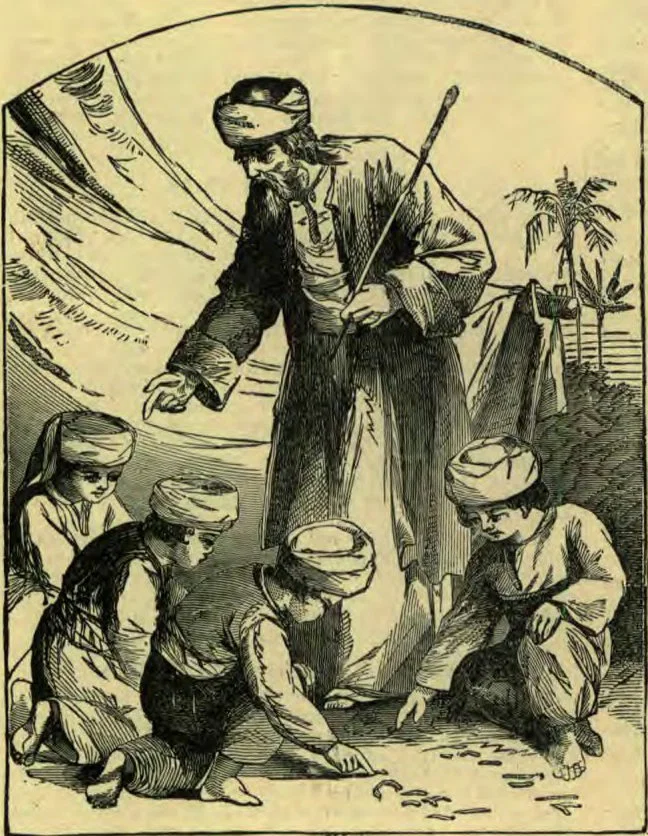
THESE little fellows in the picture seem to be having a happy time. How bright their faces look, and how earnest, too. They are very busy marking on the ground. I wonder if you know what they are doing? They are learning to write, but it is not our language, as you can see by the strange looking letters they have made. Then, they have begun at the right hand, and are writing towards them, instead of away from them, as you do.
Perhaps they live in India. If they do, they always have school outdoors in fair weather, and that is during the greater part of the time. It is a very cheap way to keep school, for they have no books, desks, seats, nor anything of the kind. All they need to write on is the smooth, bare ground. They spend most of their time in writing, because the language is so hard to learn. Would you not like to go to school outdoors? I fancy these little fellows enjoy it, but I do not think they like their master so well; for he is very harsh and stern, and punishes them severely if they do not mind him and learn their lessons well.
By and by these little boys will be promoted, and have slates of tree-bark to write on, with betel leaves for sponges. I expect they will get their faces and hands very smutty with the ink they use, and will be praised when they get home for being so industrious.
The little boys have all the best times. They get all the good things and all the praise. They have a chance to learn; but the little girls are never sent to school, nor taught to read and write. And when they grow up, they are kept so strict. They do not have any cozy evenings, when father and mother, brother and sister, sit down together, and talk over the affairs of the day; for they think it is a dreadful thing for the women even to speak in the presence of any of the men belonging to the household.
But the Christian teachers who have gone there, teach the little girls to read and write, and to do all kinds of housework. They teach them, too, about Christ; and the girls like that best of all. By and by we hope they will have an easier time, and be allowed their rights as well as the boys; then they will have as good times as you do over here. D. E. H.
THE LORD'S MONEY.
HERE is something for the boys and girls to think about when they put money into the contribution-box. The incident is told by Mrs. M. E. Sangster, in the Christian Giver:—
“Bertie, Bertie, isn’t this a shame?” cried little Casper Hall, as he held up a silver quarter for his older brother to look at.
It was a bright quarter, and at first sight there was nothing the matter with it; but closer inspection showed that it had been bored, and the hole had afterwards been carefully filled up.
“They wouldn’t take it where I bought my slate,” said Casper, ruefully; “and then I tried to pass it at the candy shop, and the lady shook her head; and when I offered it to the conductor of the car, he was quite cross, and asked me if I didn’t know how to read. When I said, ‘Yes, of course I did,’ he pointed to a notice in big letters. ‘No mutilated coin received here.’ What shall I do with it?” finished the little fellow, with a sigh.
“You have no idea who gave it to you, have you, Casper?” said Bertie.
“Not the least. It is part of the change I had from Uncle John’s Christmas gift to me.”
“Well, you must be sharper the next time. Now if I were you, I would put it into the missionary-box. The society will work it off somehow.”
“But I don’t want to put a whole quarter into the box.”
“It is not a whole quarter, Casp; it’s a quarter that’s had a hole in it. Nobody’ll take it from you. You may just as well get rid of it in that way as any other.”
Bertie and Casper Hall were in their father’s library when this conversation took place. They thought themselves alone. But, just on the other side of a curtain which divided the room from the parlor, their little Cousin Ethel was sitting. As Casper moved towards the mantel where the family missionary-box stood in plain sight, Ethel drew the curtain aside, and spoke to him.
“Boys,” she said, “I did not mean to listen, but I could not help overhearing you; and, Casper dear, don’t drop that quarter into the box, please.”
“Why not, Ethel?”
“The Lord’s money goes into that box.”
Bertie looked up from his Latin grammar to meet the glowing face of the little girl. Her eyes were shining, and her lip quivered a little, but she spoke gravely. “It was the lamb without blemish, don’t you know, that the Hebrews were to offer to the Lord? If you saw Jesus here in this room, you wouldn’t like to say, ‘I give this to thee, because nobody else will have it.’ It was gold, frankincense, and myrrh the wise men offered the infant Jesus.”
The boys drew nearer Ethel. She went on: “It isn’t much we can give to him who gave himself to us, but I believe we ought to give him our best, and what costs us something. Excuse me, but it seems mean to drop a battered coin into God’s treasury, just to get it out of sight.”
Casper and Bertie agreed with Ethel. They were about to do wrong for want of thought. Are there no older people who should remember that the Lord’s money ought to be perfect, and of our best?—Congregationalist.
CHILDREN OF THE TYROL
Perhaps American children sometimes think they have a hard lot—so much work, so much study, so few toys, so few “good times.” But I think they will change their minds when they hear about their little brothers and sisters in the Tyrol, and will never feel like complaining again.
Early in March the “Schwabenkinder,” so called because they are sent into Swabia every spring to work in the farm-houses of that country, begin to gather at different points in the Tyrol. Many of these children are not more than eight years of age; and the little ones weep bitterly when leaving their poor homes for the first time. The children are poorly clothed. Each one carries a little stick in his hand, and has a little bundle on his back containing a clean garment and a piece of bread and cheese.
A little company is formed, with an old man or woman in charge of it, and the journey begins. The little ones wander on foot from village to village, living on charity, until at last they reach a large town where a “market” is held. Tired, foot-sore, and heart-sore, the children line the streets, waiting for employers to come and “buy” them! And this is a sad, strange sight. The farmers go picking out the stout, hearty-looking children; and the children eagerly wait their turn, often crying out to a kind-looking man, “Please buy me! please buy me!”
Sometimes brothers and sisters are separated, and a little wailing follows; but it cannot be helped. Then the market closes, the children go to their new homes, and the work of the summer begins.
It is a comfort to know that, as a rule, the children are well treated. Their work generally consists in looking after the cattle, sheep, pigs, and poultry, and leading the horses or oxen in the plowing-field.
In the autumn the old man or woman appears again, ready to take the children back to their homes. They return better dressed than when they came, having earned a good suit of clothes, besides a little money; and we can easily believe that this journey is a much happier one than the first. But at the best, it seems hard and sad that these tender children should be sent away from home, love, and care, to “begin the world” among strangers; to suffer from loneliness and homesickness, and sometimes from real sickness, without the touch of a mother’s hand; and at last learn to get along without the sweet ministries of love which makes home a little heaven.—S. S. Advocate.
UNDER THE SNOW.
By Alice Cary
The leaves have faded and fallen,
The winds are rough and wild,
The birds have ceased their calling;
But let me tell you, my child,
Though day by day, as it closes,
Doth darker and colder grow,
The roots of the bright red roses
Will keep alive in the snow.
And when the winter is over,
The boughs will get new leaves,
The quail come back to the clover,
And the swallow back to the eaves.
The robin will wear on his bosom
A vest that is bright and new,
And the loveliest wayside blossom
Will shine with sun and dew.
The leaves to-day are whirling,
The brooks are all dry and dumb;
But let me tell you, my darling,
The spring will be sure to come.
There must be rough, cold weather,
And winds and rains so wild;
Not all good things together
Come to us here, my child.
So, when some dear joy loses
Its beauteous summer glow,
Think how the roots of the roses
Are kept alive in the snow.
—Alice Cary.
Full Devotion to Christ's Banner Against Evil
BE not satisfied with half-service. Be a soldier all over, and follow Christ’s banner across the whole world of evil.
Letter Budget.
By Editor
You little folks who like the Budget so well are having a nice treat in reading so many letters. We can give you this privilege very often if you will do your part,—that is, to write; and remember that the more interesting you make your letters, the better pleased you will be with the Budget. You would not like to have five, six, or seven letters in one paper all read alike; then what have you to do but to study to tell the best things you know about. Suppose some little boys and girls should visit you, you would know how to entertain them. So when you write letters, you should feel free, and write as if you were really visiting with this great INSTRUCTOR family. You are all improving, and with proper care you will learn to do good work. Let us see what we have this time. First, a letter from—
HARRY B. ARDELL, of Mecosta Co., Mich., who says: “I wrote once before, but mamma says I may write again and thank you for the nice books you sent with the INSTRUCTOR. My auntie sends it to me this year. I have only missed one day at school this term. My teacher gave me a beautiful reward of merit last Friday. I love my teacher. I have a dog, cat, some ducks and chickens, and two pretty canaries. Some one shot my dog, but he will get well. I am glad to get my INSTRUCTOR again.”
If all the aunties knew the pleasure an INSTRUCTOR gives in a family where none is taken, they would oftener surprise the little folks with a copy. Harry appreciates his paper. One who is so cruel as to shoot a pet dog, unless the dog is troublesome, ought to have “coals of fire heaped upon his head.” Do you know how that is done?
SUSIE SMITH writes from Barry Co., Mich. She says: “I never wrote a letter before, but I thought I would write and tell the INSTRUCTOR family that I have learned the last chapter of the Revelation. I did it by learning three verses a day. The editor asked all the children to learn that chapter. I study my Sabbath-school lesson in Book No. 2. I am ten years old. My sister and I each got a prize at school last summer for leaving off at the head of our spelling class the greatest number of times. I hope to meet all the INSTRUCTOR family in heaven.”
Well done for you, Susie! Do you think you will ever be sorry you learned that beautiful chapter? The beautiful city described is a real city, which, if you are faithful, you may have a right to enter in a little while; so don’t forget its description. You can fasten it in your memory by repeating it every Sabbath-day, and as much oftener as you like.
MINNIE E. SPRING, of Clarke Co., Ohio, writes: “I have written two letters for the Budget, but have not seen either of them in print. I am thirteen years old. We have taken the INSTRUCTOR about seven years, and like it much. I keep the Sabbath with my aunts, uncle, mother, brother, and grandmother. My father is dead. I go to Sabbath-school nearly every Sabbath, and like to go very much. My aunt is my Sabbath-school teacher. I study my lessons in Book No. 4. There are but three in my class. There are twenty-three members in our school. I am trying to keep all the commandments of God, and hope to meet you all in the new earth.”
Little boys and girls sometimes say, “Three times and out,” when they have tried twice, and failed; but with Minnie’s letter, it must be three times’ trying, and in. We don’t know what happened to the first two letters; for we have no recollection of seeing them. Let us hear from you again.