It was a honey-suckled cottage, a nest of a home, in the daintiest of settings. An invalid upon the second floor was the magnet drawing a motley stream of visitors. The evidences of love and sympathizing care were about her. The window-sill was abloom with azalia and cactus plants, an orange tree flourished, and an ivy vine twined about the windows inside, beguiling weary hours as the sufferer watched the cunning fashioning of flower or leaf.
Here was co-operation with the laws of nature, but just across the street, this harmony was broken by God’s crowning masterpiece—man, rebellious and proud.
For five years Agnes Fletcher had lain upon her couch unable to move a limb or lift her head unaided. Yet a sweet, indescribable influence, like the fragrance of her flowers, had attracted to her bedside many a heart-sick, sin-sick soul longing for a glimpse of life and of themselves through the eyes of this little heroine. Sometimes Agnes would point to the wonderful depths of the sky and say:—
“We gaze too much upon the earth. It is sick like ourselves. See eternity above, you. Let its light shine into your soul. Now how about the trials? Don’t they fade, like man-made dyes under strong light; but the truth of God, like His many-hued blossoms grow richer and more glorious in His sunshine. When this sunshine beams into your heart what is not of God will fade and perish.”
Then suddenly, at times, would she be torn back from her flight into the realms of joy and harmony to the rude, jaunting care of daily experience.
From her couch, by a turn of the head, she could see into the rooms of widow McCaul’s uninviting home where was enacted many a painful scene. The child, it is true, did not obey her mother. To her Master and heavenly Father, however, the mother did not yield her will. The child’s offense toward the mother was that of the mother toward God. Yet, the older in experience, in years, and in rebellion against a superior authority, was so blinded by selfishness that she failed to see the parallel. She sought to enforce obedience in her child with broom, tongs, or chair.
Vain endeavor! In the clear atmosphere of childhood, unbefogged by conformity to the world, many a childish mind is more clearly logical than its more learned senior. When God at last becomes exasperated and ceases to strive with rebellious human nature, and begins to perform His act, His “strange act” of permitting the working of wrath unmixed with mercy, what will be the reflections of the proud, exacting tyrant? In such a time, “blessed are the merciful, for they shall obtain mercy.”
In vain, did her friends beseech the delicate girl to remove her quarters to the rear of the house and be spared these nerve-racking sights.
“No dear!” she would say, “It would be happening just the same, and I am trying to solve the problem of how such a child ought to be governed. Of course, the mother is to blame. She has blundered from the first. Her first wrong to that dear child, I remember, was when she was a baby. The baby saw a beautiful flower growing in the window, and with a little scream of joy pulled up the plant with its roots, and the pot crashed upon the floor. I shall never forget the frown she received. How the delicate nerves of a sensitive child must have been shocked as she was cruelly punished—for she knew not what—loving a ‘pretty flower.’ The mother seemed to expect the wisdom of maturity in the tiny head. What if she did injure the plant? Better than what the mother did—injured the child. The motive of the baby was beyond reproach. Strange, how many people place a higher value on plants and pet animals than they do on their babies.”
“How would you have done?” the question was asked.
“I remember when I was three years old I went out, one spring morning, and pulled up every one of my mother’s plants by the roots.”
“What did your mother do?”
“Do? She laughed and said, ‘The little innocent! Bless her heart!’”
The next day I ran to my best of friends in distress.
“Quick mama,” I cried, “the poor little flowers are thirsty. They want a drink.”
My mother then explained that they were all dying because I had pulled them up by the roots. This was a great grief to me, and there was never any more difficulty about my disturbing the flowers. We anticipate too much, leap ahead of a child’s experience, and harden its little heart. Why not have a little faith in God working in the child, as we give the young conscience a chance to work? The tongue no man can tame, and every mother who has learned the lesson, when not to speak, will have an experience similar to David’s when he said:—
“I was dumb, I opened not my mouth; because Thou didst it.”
Agnes had with her an attendant whose name was Margaret. She asked her to induce poor, misunderstood Katie to pay her a visit. At length, the child consented. She entered the room with a dogged air and sat down on the edge of a seat. Her hair was done up in two tight braids and tied with shoe-strings. Her face showed evidence of scanty nourishment, and she was poorly clad.
“Come here, dear. I wanted to meet you,” said Agnes with a winning smile. But Katie gazed in sullen silence.
“You know, I am not strong. I can not walk as you can. How nice it must be to walk, Katie. I just love little girls like you and I hope you will come in often to see me.”
“You’re foolin’,” Katie began; then, checking herself, she looked straight at her hostess, her eyes opening with interest, really handsome eyes, Agnes noticed. “Can’t you walk, sure?”
“No, dear, I used to walk, but fell out of a swing and hurt my spine. Now, I am helpless. I can not move my hands nor my feet.”
This seemed to touch the girl, but forcing back a tear:—
“How you speak,” she said, “as tho you cared a little—what you say. Yes,” with a pleading glance, “I would like to come again, if you really mean—” she stopped—“Everybody lies to me.”
“Do you think I would lie to you, Katie?” Katie gave her a quick, searching glance and replied slowly:—
“No—o; but if you don’t you’re the first.”
And thus was laid the foundation for a lifelong friendship between those two cripples—the one physical, the other moral.
Yet the unequal struggles went on from day to day, the disgraceful quarrels between mother and daughter.
Agnes pleaded with Katie to obey her mother.
“Nobody could,” was the terse reply.
With fiendish cruelty Mrs. McCaul finally planned a means of bringing Katie into subjection. A hypnotist was in town and the people were attending his meetings with great interest. From the platform he waved his hand over the audience and some left their seats and walked in a sort of trance to the platform to make a laughing-stock of themselves.
Mrs. McCaul became a regular attendant at these meetings. At the close of one she stepped to the platform to consult with the hypnotist as to a means of dealing with her refractory child.
“That’s an easy matter,” he at once affirmed. “If you will allow me to take the matter in charge, I will come a few times to your home, and she will be as docile as a kitten. But you must let me have my way. I will be rough with her. I must get her afraid to disobey me before she will yield to my influence.”
In the meanwhile Katie and Agnes were cementing their friendship. Agnes could see that noble sentiments were slowly gaining a foothold in the obstinate heart.
Suddenly, one day, Katie rushed up the stairs to Agnes’ bedside, as tho pursued by the fancies of a nightmare. She was much agitated.
“What is the matter, my child?”
“O, Miss Agnes!” and the child burst into a spasm of weeping such as seldom escapes from one so young. When she had given vent to her feelings, she sobbed out:—
“Such a terrible man with eyes like a snake has come to hypnotize me. He shook me and hit me, yelling at me all the time, and made me sit just where he said and do just as he liked. I knew he would beat me awfully if I refused. What is it to hypnotize?”
“To hypnotize?” said Agnes indignantly. “It is to rob one of his God-given right of the power of choice.”
“To rob?”
“It is always robbery even when the subject is willing; for when an individual takes your will and makes it his he is doing more than God, an infinitely superior being to man, ever permits Himself to do. If He did so, He could make us all obey Him without waiting until we wish to do it. You, moreover, have no right to yield yourself to anybody. You are not your own to give away. You are bought with a price. God says to us, ‘Yield yourselves unto God.’ Since He is the only One who can be trusted not to take advantage of this confidence and who will, at any time you grow tired of your bargain, return you fully to yourself. By yielding to man you yield in fact to Satan, the master hypnotist, and no man can break the chains with which he binds you. He means to get you, by fair means or foul, for time and eternity; God never will do that. When does this hypnotist come again?”
“This evening. My mother says she has found out how to conquer me at last.”
“Dear Kate, why don’t you obey her?”
“She beats me when I do right and when I do wrong. I can’t please her.”
Agnes, with a feeling of horror and indescribable helplessness, looked at the child. Kate was no coward, but there was an expression of unconcealable fear upon her features.
“O his dreadful eyes,” she shuddered, “Miss Agnes, is there a real devil?”
“Can you doubt it when such wickedness abounds?”
“Maybe it’s him.”
At length Scripture came to her memory, and Agnes softly quoted:—
“Let not your heart be troubled, neither let it be afraid.” We have a Saviour who said, “No weapon that is formed against thee shall prosper.”
“What does that mean?”
“It means that God won’t let them injure you if you put yourself under His care.”
“Does God care?”
“He loves you, and when you are in trouble He hears your cry. Don’t you want to ask Him to help you now?”11
“How can He, they are going to do it sure.”
“But God can do anything. All things are possible with God. Will you pray after me, kneel down and repeat the words?”
Slowly, reluctantly, the girl bent her proud will and those wilful knees, and repeated the words, making her own additions, and closing with the request:—
“Don’t let that man hypnotize me, dear Lord; please don’t.”
There was a smile on the pallid face of the invalid. She said: “The Lord will cause something to interfere.”
When Kate arose her face was radiant.
“I ain’t afraid now,” she exclaimed. “How strange I feel. I believe it’s God that’s here,” pointing to her breast.
“What time is it?” inquired Agnes of her nurse, Margaret, that evening.
“Nearly seven,” was the reply.
“Time the hypnotist is due. I am strongly impressed that God is to use me as an instrument. I must go to rescue Kate.”
“You?” gasped Margaret. But before she could interfere Agnes had, tho not without an effort, tossed back the bed covers and arisen to her feet. As she tottered across the floor Margaret gazed expecting to see her drop dead. Agnes slipped in her mother’s white wrapper and went out into the hall and down the stairs. Strength seemed to increase. She went across the street, Margaret following dazed, into the house of her neighbor, and stood before the terrified spectators. Mrs. McCaul believed she saw a ghost. The hypnotist, as he glanced into Agnes’ face, recognized a spirit antagonistic to his own and, without ceremony, left the premises.
Katie alone was calm. She murmured:—
“I knew God would send you. I was praying for this.”
But her mother cried out in fear:—
“Good Lord! What is it? Are you dead or alive? Who are you anyway? This is a judgment on me.”
Agnes quickly explained:—
“Don’t be afraid, my dear woman. I am no spirit. I am only Agnes Fletcher, your neighbor, whom you have often seen on her couch at the window. The Lord has healed me to-night that I might save your daughter and show you that He will hold you, as a mother, accountable for her soul. But, thank God, she has given her heart to Him already, and He would save His trusting child if He had to empty heaven of His angels to do it.”
“A miracle! a miracle?” exclaimed Mrs. McCaul with ashen lips. “You walking? Is this really Agnes Fletcher?”
“Yes,” said Agnes as with returning strength her spine straightened, and she raised her head to an erect posture. “See how strong He is making me, and I can walk, see!” She stepped to the other side of the room and back with a steadiness that amazed them all. Then she stopped and looking searchingly into the face of the widow said:—
“Isn’t God good? Isn’t He worth loving and serving? That’s the kind of a Father I have.”
Mrs. McCaul sighed:—
“I had never thought of Him as my Father. Do I deserve a kind Father? I have not even been a kind mother,” and she burst into tears. “Can He, could He save such a wretch as I? I am sick of myself. I want to be saved. O Agnes! you know something about these things. Is it too late? Have I gone too far?”
“Listen to what Job says, ‘He looketh upon men, and if any say, I have sinned, and perverted that which was right, and it profited me not; He will deliver his soul from going into the pit, and his life shall see the light.’”
“That means me, for I have sinned, God knows how much. Katie, can you forgive such a wretched mother as you have had?”
Kate was in her mother’s arms and together they were confessing their faults in broken-hearted tones, and together they took it to Jesus, and left their burdens at His feet. Transformed in heart and face, old things are passed away, behold, all things are become new.
And the news of these marvels spread over the country. Some scoffed, some feared, but a few, when they saw the mother and daughter working harmoniously in service for others, and Agnes walking about caring for the sick and pointing erring ones to the Saviour, were softened, and a revival swept over the town such as had not been seen in years.
And, some day, not far distant, will a voice, O so lovely, be heard to say in tones of sweetest music to such as these:—
“Well done! Enter thou in”—and upon their modest heads will Jesus place with His own beautiful hand, rare golden crowns brilliant with many stars.
LIDA F. SCOTT.
THE BURDEN-BEARER.
“Take me, papa,” said my darling,
As we stood within the hall;
So I bore him up the stairway,
Scarcely felt the burden small.
In my other hand I carried
Books I wished to scan that night,
And the elfin begged me let him
Take them in his arms so slight.
Step by step to top we mounted;
Then he said with childish pride:
“Baby carried books for papa,
Didn’t he?” “Yes,” I replied.
Little innocent! ne’er dreaming,
As he bore the asked-for load,
That his father’s strength upheld him,
Double-burdened on the road.
God is sometimes pleased to give us
Work of wondrous skill and thought;
Gleefully we don the laurels,
When His hand the triumph wrought.
—Anon.
COSTLY GARMENTS.
The great costumer, George Pilotelle, said that he once designed $200,000 worth of dresses for one lady, while Worth confessed that a Peruvian heiress paid him $24,400 for a single frock. After this the price paid for the coronation train of the present Empress of Russia seems hardly worth mentioning. It was a mass of silver embroidery, upon which eight girls were at work, in relays, night and day for six weeks, and the bill came to just $45,000.
For lace a lady may, of course, pay anything she pleases. Good lace is not valued by its weight in gold, but rather by its weight in diamonds; $23,000, of the $24,400 mentioned above as being paid for a single dress, was the price of the lace upon it. As a further example of lace prices, it may be added that the lace handkerchiefs made at Saint Gall, Switzerland, are charged for at the rate of $11 apiece, and these are, of course, of modern make. Lace, like wine, increases in value with age. The Queen Dowager of Italy is said to be the possessor of a lace handkerchief 300 years old, and valued at $10,000. “Point Tresse” lace, which was made from threads of flax mixed with human hair, is also immensely valuable. A French collector owns a tiny square made from the gray hair of Margaret, Countess of Lennox, mother of the unhappy Darnley. This is valued at $6,000.
Now and then one hears of garments so unique in material that they are not thrown aside as are even the most expensive of silks or satins, but are preserved as wonderful specimens of what the art of man can accomplish. Of this type is the beetle-wing dress, which made a fortune for its lucky owner, and is still worth a fortune to-day. Mrs. Sam Edwards, the wife of an actor, is the possessor of this wonderful garment, which was sent to her as a wedding present by an Indian rajah in return for a service done him by her husband.
Fifteen thousand of the wing-cases of an Indian beetle are sown upon the material, and lend a shimmering green iridescence to its flowing folds. The lady has worn it on the stage, where it created a perfect furor. Many fashionable ladies wished to duplicate it, but found it impossible, both from the rareness of the insect and the difficulty of affixing the delicate wing-cases to the material. As for cost, it can only be guessed at, but $15,000 would be well within the limit.
Certain races of people we are pleased to call savages are famous for the production of most expensive garments. Women of the Cheyenne Indians wear on festal occasions dresses which would tax the purses of even our own fashionable dames. They are made of beautiful white buckskin, so tanned as to be soft as cotton. They are trimmed, not with lace or jewels, but with elk teeth. A first-class robe of this kind is priced at $1,500. None can be bought under $300.
The most costly garment in the world was exhibited at the Fisheries Exhibition in London in 1883. It is one of the Royal cloaks from the Sandwich Islands. It is made of red, black, and yellow feathers, and the bird which supplied the yellow feathers is now extinct. It was always so rare that it took a century and a half to collect enough to make a cloak, and each bird produced but three or four feathers of the requisite delicacy. The cloak is valued at $500,000.—Pittsburg Bulletin.
COMPENSATION
By Mrs. R. N. Turner
[Mrs. R. N. Turner, in Our Young Folks.]
We sleep and dream of joys
Too sweet for earth;
We wake, and sighing, say,
“O life,
What art thou worth?”
Who liveth to the Lord,
He lives indeed!
Who loveth fellow man,
He sows
Most precious seed!
O, recompense most sweet!
With willing heart
We take the cross of life.
O life,
How fair thou art!
The Robe of Everlasting Righteousness
[There is one robe for which more has been paid than for all the costly garments of earth. It cost the death of the Son of God. It is the robe of everlasting righteousness, which when the wearer is once perfectly fitted to, will last eternally, scintillating, shining, coruscating, with all the glory of God. It can not be bought with money or gems, but it is free, free to all, rich or poor, who will accept Jesus Christ. Only so may it be obtained.]
WORKING WITH GOD.
[The late Dr. Cyrus A. Bartol, in The Watchman.]
How we run neck and neck and get overstrained! Neuralgia, paralysis, and consumption await selfish aspirants who burn the midnight oil when they should be asleep. They die at forty or fifty and we say they have been working too hard! Indeed they have, hindering God's work in and through them, and never opening that humility which is His only door.
Delicious awe before the Highest is worth all the discoveries of cotton gin, mill turbine, patent reaper, and field fertilizer, purely as an economic force. The Romans reared massive aqueducts, filling valleys and crowning hills, not understanding the law by which a flood would run with all inequalities of level through a little pipe. All we want for a nobler efflux is that head of power in the heart which genuine ownership of Deity will supply, and which makes men as fresh and young at eighty as at twenty, with feeling virgin and untouched.
If, after the Latin motto, prudence is a great revenue, so is reverence. How men sweat and toil to beat in the arena or to distance in the race! But when I tie to that will which is a perpetual going forth, I feel like a skiff towed at a steamer's stern; for we can use up gravitation sooner than God. My neighbor got tired pumping water into the tank at his housetop, and he put a vane on his barn over the well so that it now furnishes kitchen, and table, and hose sprinkler, with a fountain in front of his lawn into the bargain, while from his siesta he looks on. Doubtless we must work as well as wait; but there is no work like subduing our own selfish will.
Age Is Opportunity
By Longfellow
AGE is opportunity no less
Than youth itself, tho in another dress;
And as evening twilight fades away,
The sky is filled with stars invisible by day.
—Longfellow.
OCEANIC S. S. CO.
SAILING REGULARLY TO — FleetHAWAII — SIERRASAMOA — SONOMANEW ZEALAND — VENTURAAUSTRALIA — ALAMEDA
and — MARIPOSATAHITI — AUSTRALIA
— ZEALANDIA
Under mail contract with the United States, Tahiti, New Zealand, and Commonwealth of Australia.
Steamers sail THREE TIMES a month to Honolulu; every TWENTY-ONE days, via Honolulu to Samoa, Auckland and Sydney. Every-THIRTY-SIX days to Tahiti.
TALOFA, illustrated in colors, tells something of Samoa, 20c in postage.
HAWAII, in colors, by STODDARD, 10c.
TAHITI, The Golden, by CHAS. KELLER, send 20c in postage.
“Round the World” folder, time-table, etc., free upon application.
J. D. SPRECKELS & BROS. CO.
643 Market St. — San Francisco, Cal.
OLD KING SOBA BANGA.
[By a Missionary.]
THIS is the old king who called on us when we reached Malange, Africa, in September, 1885. He declared that he was king of all the earth that he could see, and gave us to understand that if we lived in this part of Africa it would be necessary to make him a good present. Our beloved Bishop Taylor said if he was the king he would willingly do the right thing with him, but as the bishop was in bed suffering with fever, caused by exposure and a long march from Dondo to Malange, he could not pay him then, but asked him to call another day. This the old king was not inclined to do, feeling that then was his time. This much perplexed our bishop, and he turned to me and said:—
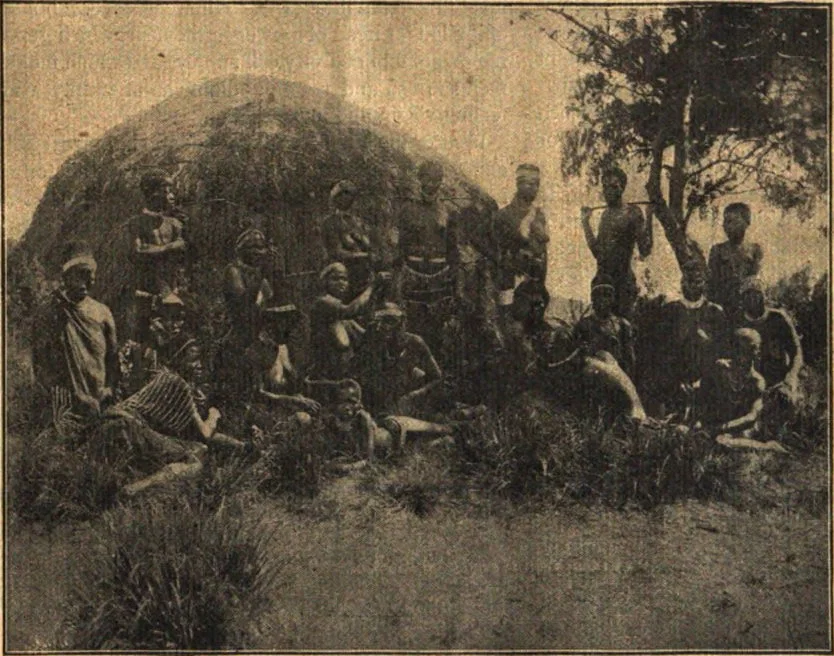
Group of Zulus at a Kraal Making Their Toilet.
“What can I do to get rid of this old fellow?”
I said, “Invite him to come another day.”
“I have done this repeatedly, and it seems to do no good.”
I said, “Bishop, you must first dismiss him, and then invite him to come again.”
“Well,” he said, “you manage it, then. I am too sick to attend to it.”
So I simply dismissed him and invited him to come again, and everything passed off quietly. Soon after this I was invited by Doctor Summers to go out and visit this old king at his home. I can never forget that evening. It was the first time that I ever saw the “heathen dance.” I think it was one of the saddest nights I ever saw in Africa. The old king’s women were the chief performers. One part that I remember well was the “muscle dance.” The dancer stood in the center and began with the muscles of her neck, twitching and swelling, then her arms, and so on down to her feet; but she did not seem to move once from her tracks. We did not know that this entertainment was gotten up for us till after we had gone.
I noticed in the dance several young men, one or two in particular, and also that one played the “marimba.” I wondered, as I looked into their faces, if God would ever call such as they into His service. Soon after that evening I invited several of these young men to come to our mission Sunday-school, which they did, and were very apt to learn.
In a few months after this I visited the village again. As I approached the village the moon was just rising over the hill, and I heard the sound of the “marimba,” and I groaned within myself as I thought they were having another dance; but as I drew nearer I did not hear the shouting and noise that always accompany dances, and, to my great surprise, there was no crowd there; but in the center, the full moon shining bright, a young man sat by the side of his “marimba,” and he sang in a plaintive voice as he played:—
“There is a happy land,
Far, far away,
Where saints immortal stand,
Bright, bright as day.”
I listened and wept and prayed. Finally I went to the young man and said, “Do you know these words that you are singing?” He said, “O, yes; those are the words that I learned at the Sunday-school, and I wish I could learn to play this hymn on this instrument.” Then he explained to me how the “marimba” was used for a kind of heathen telegraph. By the sound of the “marimba” they could call people for war or feasting, or notify them that strangers were approaching, or whatsoever they wished to say, all the people of the village knowing the different sounds of the “marimba” and what the call meant.
Bernardo replied, “If I could play this piece all the people would know what it meant.”
Bernardo was the old king’s nephew. In a short time after this in Malange, when we had finished our evening prayers and retired for the night, I heard a gentle tap at the door, and some one in the native tongue said, “I am sick with fever; won’t you let me in?”
I opened the door, and there stood Bernardo, with his blanket wound around him.
I said to him, “Why have you come here.” He said, “I have the fever, and my people insist that I shall have the idol doctors, and while they were preparing I ran away and came here.”
I soon had a bed fixed for him on the floor, gave him some remedies, and in a few days he was himself again. He remained in the mission some months, and was a great help in our first mission buildings. His marvelous strength would often surprise us. He would carry upon his head what it would take two or three ordinary men to carry. His desire for learning was so great that in a very short time he learned to read and write the Portuguese language. He said to me one day, “I must return to my people,” and he did so.
I said to Mrs. Mead one day, “We must go and look up Bernardo; I fear he has gone wrong.”
We saddled our riding bullocks and rode into their native village. When we reached the square we heard many voices, and there stood Bernardo in the center of the circle with his Bible, preaching the Word of God to them.
It would be useless for me to say that our hearts rejoiced and praised God. After he had finished his discourse he greeted us as a Christian, and then introduced us to several of them in the circle, saying, “This man has left his idols; he has left his tobacco; he has left his women; he hears God’s words, and is glad. I believe he is in the way of salvation. Here is another one. He has left his idols, but he will not leave his beer and pipe.”
So he went around, giving us the characters of the different ones in his congregation. He continued his Sunday work until Bishop Taylor visited us again, and he brought his class to the bishop to be examined. The bishop baptized nine and took them into the church on probation.
George Grenfell, who has charge of the English Baptist missions on the upper Congo, came across the country to Malange, in the interest of the Belgian government. He preached to us in the morning, and Bernardo spoke to the people in the afternoon. After Bernardo had finished, George Grenfell wished to know where the young man received his education. When I told him that he had scarcely been out of his native village farther than Malange, he could hardly believe it. The strong stand that Bernardo took among his people brought fierce persecution. The old king was much tried with him, for Bernardo had commenced to learn and practise their fetish ways (his uncle being his teacher), and they did not wish to lose him.—World Wide Missions.
FROM OUT THE SEAS OF SIN.
By Benj. Phillips
From out the seas of sin I rise
To freely sing my Master's praise;
He swept the dimness from mine eyes
And gave me lessons in His ways.
I would that all the coming days
Might harvest never tears or sighs;—
From out the seas of sin I rise
To freely sing my Master's praise.
No more for me is gloomy night,
I have received celestial light;
How soon He heeds the mortal's cries
And sheds o'er him sweet mercy's rays
From out the seas of sin I rise
To freely sing my Master's praise.
Seiad, Cal. BENJ. PHILLIPS.
OUR WORK AND WORKERS.
On the 14th ult., a church of fourteen members was organized at Fredonia, N. Y., by Brethren George B. Thompson and A. O. Burrill. Eight candidates were baptized.
BROTHER J. V. WILLSON writes to the Visitor, published in Cape Town, S. Africa, that work at the baths in Kimberley is progressing finely. The doctors are sending many patients to receive treatment, and the Lord is blessing the use of these simple, natural remedies. Also at Stellenbosch, the treatment rooms are in a good condition for work.
BROTHER W. T. KNOX, president of the Pacific Union Conference, brings word of a new conference organized by him at the recent meeting in Vancouver. The name of the organization is British Columbia Conference. The president chosen is Pastor J. S. Wilson; the conference secretary, J. J. Dugan; the missionary secretary and treasurer, C. Enoch. The headquarters are at Vancouver, B. C.
FROM a recent Mission Board circular we take this report of Brother Passebois, of Cairo, Egypt: “Being unable to speak Arabic well enough to hold meetings in that tongue, I use an interpreter. But the Lord has touched the hearts of some of the Copts who speak English, and one is giving his services every night freely as a translator. Many times we have eight or nine nationalities at the meetings. A Bulgarian who accepted the truth recently proves a faithful brother, and others are at the point of decision.”
A NEW educational institution has been opened under the auspices of the Seventh-day Adventist Conference of Southern California. For this purpose the institution known as Fernando College has been purchased, and the first term of school was opened on the 1st inst., with the following faculty: President, Prof. H. E. Giddings, Natural Sciences and Bible; R. S. Owen, Horticulture and Botany; Miss M. E. Harris, History and Language; Mrs. E. M. Giddings, Bookkeeping and Mathematics; Miss M. E. Dail, Primary Instructor; T. Sterling, Mechanics and Engineering; Mrs. T. Sterling, Matron. The college is well equipped with buildings for all present needs. The location is at Fernando, twenty miles northwest of Los Angeles, on the Southern Pacific Railway, in an excellent fruit region. The prospect is encouraging, and our prayer is that success may attend the new enterprise. For further information, address the president, Prof. H. E. Giddings, Fernando, California.