In the evangelization of the world, and the amelioration of human woe, medical missionary work has come to be recognized as an essential factor. Many mission boards, those operating in the home land as well as in foreign fields, have encouraged the training and education of this class of workers. This is in recognition of the great truth that the Gospel of Christ has to do with the physical as well as with the spiritual nature of man. But it should not be considered that the development of such workers, nor the recognition of this truth, were foreign to other ages than our own. We have only to look at the earthly life work of Christ to see an exemplification of both the worker and the work. It is but necessary to read the Gospel story to discern the ways and means adopted by earth’s greatest Teacher in the accomplishment of the work He came to do. Christ was a true type of the missionary, and without limiting the word to its proper scientific sense, Christ was the true type of a medical missionary. He did what every missionary should do to-day; and if Christ did what every missionary should do to-day, the converse is equally true, that every missionary to-day should do what Christ did. In other words, every laborer for God to-day should be, in the liberal sense in which we use the word, a medical missionary, “going about doing good,” ministering to the bodily necessities as well as to the spiritual needs, teaching men how to live here in order that they may live hereafter.
THE COLORADO SANITARIUM NURSES AND THEIR INSTRUCTORS.
Of all men, the missionary, whether laboring at home or abroad, should be an intensely practical man. The spiritual, the intellectual, the physical, and the temporal, should claim his attention. By life and precept he should teach men how to serve God with every attribute with which the Creator has endowed them. Only by such methods can the development of well-rounded Christianity in the lives of the believers be secured.
In the denomination represented by this journal, special encouragement has been given to this class of labor during the past few years. In this country, in connection with the four sanitariums established in various parts for the treatment of the sick, schools have been established for the education and training of medical missionaries. The same is also true of the sanitariums of Switzerland and South Africa.
The accompanying cut is made from a photograph of the Colorado Sanitarium nurses and their instructors. The Colorado Sanitarium school for nurses was established in the fall of 1896. Thus far two classes have entered the work. The course of instruction covers a period of two years, and embraces instruction in Bible, anatomy, physiology, hygiene, hydrotherapy, massage, calisthenics, Swedish gymnastics, physical culture, electricity in its various forms and applications, general, surgical, and special nursing, as well as a study of disease and its symptoms. The instruction includes both class work and practical work. Much importance is attached to the practical side of the art of nursing, and the student becomes thoroughly acquainted with his life-work by doing the things while in training that he will be obliged to do after he leaves the school.
As the sanitarium contains constantly from 50 to 100 patients, ample opportunity is afforded for practical experience in the application of the principles of instruction. The members of this school are all Christian young men and women, and are thoroughly imbued with the sacredness and responsibility of the work to which they have given their lives. The large majority have already signified their intention of entering the foreign mission field when Providence shall so indicate. It is indeed encouraging to see such a company of noble youth devoting their lives to such an unselfish calling. But it might be added here that the opportunities for such labor are not necessarily confined to those who may have had the advantages of a training-school, nor is it necessary to go to foreign lands to find openings for such work. Every hamlet and neighborhood presents avenues for labor, and every follower of the Lord Jesus has the blessed privilege of engaging in this class of work. Wherever the hungry are to be fed, the naked clothed, or the sick visited, are presented opportunities for medical missionary effort.
And what a need is presented to the world to-day for this class of labor! Discouraged hearts, depressed minds, and afflicted bodies, are found on every side. To minister to the physical gives access to the spiritual nature. It is not enough to say to the hungry who apply to us for aid, “Depart and be ye fed;” nor to the naked, “Depart and be ye clothed.” It is not enough to answer the cry for bread with a religious paper or tract alone. It is indeed true that the hungry and destitute need Christ above every earthly blessing. But let the needy individual first see Christ in temporal blessings, then can he more readily grasp Him in the realm of the spiritual. In the temporal good bestowed will be a foretaste of the eternal good derivable from the same source by closer search and deeper application.
The world to-day needs a practical Christianity. Too long has the professed church of God been content with the promulgation of a theory. It is for Christ’s disciples now to prove in their lives, and by their works, the power of God in the Gospel of Christ. The hungry man can see more of God and more of the Gospel of Christ in a loaf of bread to satisfy the gnawing pangs of hunger, and satisfy the mouths of his famished children, than he can in all the religious talk and exhortation which might be forced upon him. With his temporal wants thus satisfied , the way is opened for ministry to his soul’s needs.
The greatest missionary this world ever saw was the Man Christ Jesus. And the next greatest missionary this world will produce, will be the disciple who follows most closely in the footsteps of his divine Master.
FRANCIS M. WILCOX,
Chaplain of Colorado Sanitarium.
The Wheat and the Tares
Lesson XI.—Sunday, March 13, 1898.
The Wheat and the Tares
Note.—There is a marked difference between the manner of the Saviour’s teaching in the present lesson and that recorded in the lesson of last week. The difference seems to have been occasioned by the attitude of the Jews. Christ had taught them plainly, but they refused to hear; now He taught by parables, and those who desired to know the meaning of the parables received their explanation from the Saviour’s own lips. The Jews had been opposing Christ at every step, and seeking to catch Him in His words, that they might have an excuse for putting Him to death; but they did not understand the meaning of the parables nor comprehend the truths contained therein. Those who were not looking for truth for truth’s sake could find nothing in the parable with which to condemn the Teacher or hinder His work; and yet the truth was not hidden from those who were seeking, with honest hearts, to know the truth of God.
24 “Another parable set He before them, saying, The kingdom of heaven is likened unto a man that sowed good seed in his 25 field; but while men slept, his enemy came and sowed tares 26 also among the wheat, and went away. But when the blade sprang up, and brought forth fruit, then appeared the tares 27 also. And the servants of the householder came and said unto him, Sir, didst thou not sow good seed in thy field? 28 whence then hath it tares? And he said unto them, An enemy hath done this. And the servants say unto him, Wilt thou then 29 that we go and gather them up? But he saith, Nay; lest haply while ye gather up the tares, ye root up the wheat with them. 30 Let both grow together until the harvest; and in the time of the harvest I will say to the reapers, Gather up first the tares, and bind them in bundles to burn them; but gather the wheat into my barn.” 36 “Then He left the multitudes, and went into the house; and His disciples came unto Him, saying, Explain unto us the 37 parable of the tares of the field. And He answered and said, 38 He that soweth the good seed is the Son of man; and the field is the world; and the good seed, these are the sons of the 39 kingdom; and the tares are the sons of the evil one; and the enemy that sowed them is the devil; and the harvest is the end 40 of the world; and the reapers are angels. As therefore the tares are gathered up and burned with fire; so shall it be in the 41 end of the world. The Son of man shall send forth His angels, and they shall gather out of His kingdom all things that cause 42 stumbling, and them that do iniquity; and shall cast them into the furnace of fire: there shall be the weeping and gnashing of 43 teeth. Then shall the righteous shine forth as the sun in the kingdom of their Father. He that hath ears, let him hear.”
Golden Text: “He that soweth the good seed” is the Son of man.” Matt. 13: 37.
SUGGESTIVE QUESTIONS.
(1) In what way does Christ begin to teach, as shown in this chapter? Verse 24, also verse 3. (2) With what does this parable deal? Same verse. (3) To what does He liken it? Same verse. Note 1. (4) Who also sowed seed in the same field? Verse 25. (5) What circumstance made the sowing possible and fruitful? Same verse. Note 2. (6) What was the result of the sowing? Verse 26. Note 3. (7) What question did the servants ask of the owner of the field? Verse 27. (8) What did he reply? Verse 28. (9) What further question did they ask him? Same verse. (10) What did he reply? Verse 29. (11) What reason did he give for not allowing the tares to be gathered at that time? Same verse. (12) How long did he say they should be allowed to grow together? Verse 30. (13) What command would be given to the reapers at harvest-time? Same verse. Note 4. (14) After Jesus had sent away the multitude, who came to Him? Verse 36. (15) What did they desire Him to do? Same verse. (16) In answering them, who did he say was the sower of the good seed? Verse 37. (17) What is the field? Verse 38. (18) Who are the good seed? Same verse. (19) Who are the tares? Same verse. (20) Who is the sower of the tares? Verse 39. (21) What is the harvest? Same verse. (22) Who are the reapers? Same verse. (23) How were the tares disposed of after gathering them out from the wheat? Verse 40. (24) How will the wicked be destroyed after being separated from the righteous? Same verse, with verses 41 and 42. (25) How will it be with the righteous at that time? Verse 43. (26) With what admonition does the Saviour close His explanation of the parable? Same verse.
NOTES.
1. A man that sowed good seed.—That man is God and the sowing was done through Christ. While all the words of Christ’s teachings are good seeds, yet the seeds to which the Saviour here refers are the followers of Christ themselves. Upon the persecution of the Christians at Jerusalem in the time of Philip, the Christians were scattered abroad and “went everywhere preaching the Gospel.” They were like seeds which the wind scatters. The scattering but fulfils the object for which they were created, for in each place to which they went, others13sprang up like grain-bearing stalks where the sower has scattered his grain.
2. But while men slept.—While parables are not always applicable in all their details, yet there is a beautiful truth brought to view in this verse. It was not the Sower who slept, for “He that keepeth Israel shall neither slumber nor sleep;” it was while men slept—while they were asleep to their eternal interests. While Christians are sending their missionaries—the good seed—throughout the world, Satan has his missionaries working right among them, on the same ground, among the same people. It is a sad fact, too, that many of these missionaries for the wicked one put more of their life and soul into their work than the missionaries for God do into theirs. They throw their whole soul into the work, and only when Christians do likewise can they expect to compete with these powers of evil. God can not use a half hearted-worker.
3. Then appeared the tares also.—It was difficult to distinguish between the tares and the wheat until near the time for harvesting. “There can be no mistake then. As once I heard it remarked in that country, ‘The ears which God has blessed bow their heads, but these accursed tares stick theirs above the whole field.’ For the tare then carries a tall, light head of small, dark grains, which in every respect contrasts with the weighty, golden ear of the good seed.”—Thomson. The tare is said to be the only grass which bears a poisonous seed, “a fitting symbol of the fruit of the devil’s sowing.” It is both a narcotic and an emetic, and can not be eaten without producing nausea, even when mixed with good flour.
4. Bind them in bundles to burn.—The fate of the tares will be the fate of the wicked. This is not a figure of speech, but a statement by the Saviour Himself of what will actually occur. It is also forcibly expressed in Mal. 4:1, 3: “For, behold, the day cometh, that shall burn as an oven; and all the proud, yea, and all that do wickedly, shall be stubble; and the day that cometh shall burn them up, saith the Lord of hosts, that it shall leave them neither root nor branch.” “And ye shall tread down the wicked; for they shall be ashes under the soles of your feet in the day that I shall do this, saith the Lord of hosts.” There will be no endless torment in such punishment as here mentioned. The chaff and the tares will be as tho they had not been. So will be the condition of the wicked, as shown by the Saviour’s parable and the text above quoted.
HELPING HAND MISSION.
By S. N. Curtiss
There have been no large amounts received during the last week, but quite a large number of letters containing contributions ranging from $1.00 to $10 have reached us. These letters, coming as they do from all parts of this country, indicate the widespread interest in the work for the poor which has been undertaken here. We quote from letters received during the last twenty-four hours:—
“I will respond to the call. You will find my mite inclosed for the Helping Hand Mission in the form of a check for $5.00.”
“Please find inclosed $2.00 from myself and husband for the Helping Hand Mission. I wish it were more. We are poor ourselves, but we are in heartiest sympathy with the work, and we can add our daily prayers for God’s blessing on this Christ-like effort for the suffering.”
“Inclosed find $5.00 which I send in answer to the call for help in the SIGNS OF THE TIMES of January 27, for the Helping Hand Mission, trusting that it will be wisely used. We do not begrudge giving where it really helps. But there seems to be a great deal of charity in these days just to be seen of men, and the result is only to make the poor helpless and dependent.”
We can assure this brother that the daily prayer of all connected with the Mission is that God will give wisdom to spend aright all the money so kindly sent. Our only aim is that the work of the Mission may be of practical assistance, such as will enable men to help themselves, and not such as will make them dependents.
Another says: “Find inclosed $10 in post-office money order as a donation to the Mission. We are glad to be able to send a little to help on the good cause, and sincerely wish it was so we could send more. We wish you success in the good work, and hope you will receive donations, food, etc., to carry it on.”
“The Eastern Question, What Its Solution Means to All the World,” by Alonzo T. Jones. While this great question is absorbing the attention of millions on both hemispheres, we wish to call your attention to the importance of reading and circulating something treating the subject from a Biblical standpoint. This tract contains the following subheadings: The Seven Trumpets; The Rise of the Turkish Power in Prophecy and History, Fulfilled to the Very Day; The World’s Crisis; Daniel’s Visions; “At the Time of the End”; The King of the North and His End; When He Comes to His End; The Plagues of God’s Wrath, and Need for Watching and Praying. It contains 16 pages; price, 1 cent.
PACIFIC PRESS PUBLISHING CO.,
New York City, N. Y. Oakland, Cal. Kansas City, Mo.
SABBATH SCHOOL Maps
4 A. Lands of the Bible, especially the travels of St. Paul, 52x71 inches . . . $5 00
4 B. Same as above, reduced to one-half size . . . 3 00
4 C. Same as above, but reduced to 36x26 inches . . 1 00
Pacific Press Pub. Co., Oakland, Cal.
39 Bond St.,14 to 18 West Fifth St.,
New York City.Kansas City, Mo.
OUR GENERAL AGENTS.
General Eastern Agency.—Pacific Press Pub. Co., 39 Bond St., N. Y. City, N. Y.
General Central Agency—Pacific Press Pub. Co., 14-18 W. 5th St., Kansas City, Mo.
Argentina—Señor N. Z. Town, Casilla del Correa, 481 Buenos Ayres, Argentine Republic, S. A.
Arkansas Tract Society—Fayetteville, Ark.
Atlantic Tract Society—39 Bond St., New York City, N. Y.
Australia—Echo Publishing House, North Fitzroy, Victoria.
Australian Tract Society—251 St. George’s Road, North Fitzroy, Australia.
California Tract Society—1059 Castro St., Oakland, Cal.
Texas Tract Society—626 and 628 Elm St., Dallas, Tex.
Upper Columbia Tract Society—College Place, Wash.
Utah Tract Society—Box 1058, Salt Lake City, Utah.
Vancouver Island—R. Robb, 231 Pandora St., Victoria, B. C.
Vermont Tract Society—190 N. Winooski Ave. Burlington, Vt.
Virginia Tract Society—2504 E. Clay St., Richmond, Va.
West Virginia Tract Society—Newburg, W. Va.
Wisconsin Tract Society—Milton Junction, Wis.
TRACTS FOR THE HOUR.
B. S. Library, No. 31. The Second Advent.—By James White. This tract shows the manner, object, and nearness of Christ’s coming. It is a clear and forcible presentation of the Bible argument on this solemn and important subject. Price, 2 cents.
B. S. Library, No. 36. The Signs of the Times.—This excellent tract has been revised up to date, so that the thrilling events of recent years are noted as evidence that the end of all things is at hand. Price, 1 cent.
B. S. Library, No. 49. Can We Know?—This shows that just before the second coming of Christ we may know that his coming is near. Price, ½ cent.
B. S. Library, No. 50. Is the End Near?—This gives evidence showing that the end of all things is at hand. Price, ½ cent.
B. S. Library, No. 136. The Millennial Age.—By J. H. Dorland. The author gives an idea of the contents of this tract in the following words: “Little will be said in regard to the conversion of the world, or the return of the Hebrew people to their own land, but the space will be used rather in giving scriptures that tell us positively when the thousand years begin, the events taking place during that time, and those that mark its close.” Sixteen pages. Price, 1 cent.
B. S. Library, No. 143. Truth for the Times.—By G. C. Tenney. Shows that “the great epochs in the history of the work of God have each of them presented to the world some special message of sacred truth.” It takes up some of these special messages, and thus makes plain the fact that present truth for this time is the message of Christ’s coming. Contains sixteen well-filled pages. Price, 1 cent.
B. S. Library, No. 144. The Eastern Question; What Its Solution Means to All the World. By Alonzo T. Jones. This tract is divided into the following parts: The Seven Trumpets; The Rise of the Turkish Power in Prophecy and History; Fulfilled to the Very Day; The World’s Crisis; Daniel’s Vision; “At the Time of the End;” The King of the North and His End; When He Comes to His End; The Plagues of God’s Wrath, and Need for Watching and Praying. Sixteen pages, 1 cent.
A. G. Library, No. 26. “I Will Come Again.”—This blessed assurance given by Christ to his disciples is shown to refer to a literal return to this earth. That this coming is right at hand is also clearly proven. Four pages. Price, ¼ cent.
A. G. Library, No. 40. The Coming of Our Lord.—“We Would See Jesus,” and Why Speak of Christ’s Coming? are the two sub-titles of this excellent number, and the thoughts which they suggest are treated in a profitable and interesting manner. Price, ½ cent.
PACIFIC PRESS PUBLISHING CO.,
Kansas City, Mo. Oakland, Cal. New York City, N. Y.
1 “And after the uproar was ceased, Paul having sent for the disciples and exhorted them, took leave of them, and departed for to go into Macedonia. 2 And when he had gone through those parts, and had given them much exhortation, 3 he came into Greece. And when he had spent three months there, and a plot was laid against him by the Jews, as he was about to set sail for Syria, he determined to return through Macedonia. 4 And there accompanied him as far as Asia Sopater of Berea, the son of Pyrrhus; and of the Thessalonians, Aristarchus and Secundus; and Gaius of Derbe, and Timothy; and of Asia, Tychicus and Trophimus. 5 But these had gone before, and were waiting for us at Troas. 6 And we sailed away from Philippi after the days of unleavened bread, and came unto them to Troas in five days; where we tarried seven days.
7 “And upon the first day of the week, when we were gathered together to break bread, Paul discoursed with them, intending to depart on the morrow; and prolonged his speech 8 until midnight. And there were many lights in the upper chamber, where we were gathered together. 9 And there sat in the window a certain young man named Eutychus, borne down with deep sleep; and as Paul discoursed yet longer, being borne down by his sleep he fell down from the third story, 10 and was taken up dead. And Paul went down, and fell on him, and embracing him said, Make ye no ado; for his life is in him. 11 And when he was gone up and had broken the bread, and eaten, and had talked with them a long while, even till 12 break of day, so he departed. And they brought the lad alive, and were not a little comforted. 13 “But we, going before to the ship, set sail for Assos, there intending to take in Paul; for so had he appointed, intending himself to go by land. 14 And when he met us at Assos, we took him in, and came to Mitylene. 15 And sailing from thence, we came the following day over against Chios; and the next day we touched at Samos; and the day after we came to Miletus. 16 For Paul had determined to sail past Ephesus, that he might not have to spend time in Asia; for he was hastening, if it were possible for him, to be at Jerusalem the day of Pentecost.
QUESTIONS.
1. Relate the circumstances of the uproar at Ephesus.
2. How did it arise, and how was it quieted?
3. After it had ceased, what did Paul do? Where did he go? Verse 1.
4. Where did he stay for a short time? Verse 2.
5. What caused him to alter his route on his return? Verse 3.
6. Who accompanied him back to Asia? Verse 4.
7. Having left Paul behind, where did they wait for him? Verse 5.
8. At what time of the year did Paul sail from Philippi? How long were they on their voyage to Troas? Verse 6.
9. How long had it taken them to make this distance the first time? Acts 16:11.
10. How long a time did they spend at Troas? Acts 20:6.
11. What kind of meeting was their closing meeting? When did the disciples come together? What time of the day was it? How long did Paul continue his discourse? Verse 7.
12. What serious accident took place while he was preaching? Verse 9.
13. What did Paul do and say about the case? Verse 10.
14. How did the company spend the rest of the night? What did Paul do at break of day? Verse 11.
15. What about the young man who fell from the window? Verse 12.
16. While Paul had been preaching, what had his traveling companions been doing? What arrangement had Paul made as to the journey? Where were they to meet? How did he reach the place? Verse 13.
17. What was their course after they again met? Verses 14, 15.
18. What place had Paul determined not to visit? Why? Verse 16.
NOTES AND QUESTIONS.
1. Since the special meeting spoken of at Troas was on the first day of the week, in the night, when, in the ordinary language of the present day, was it? What day was it when he resumed his journey?
2. Note that Paul was much delayed on his voyage from Philippi to Troas; since he was at Troas seven days, at what time must he have arrived there?
3. Note the change in pronouns in verses 6–14. The writer says “we” till the close of verse 6; then in verses 7–12 he says “the disciples,” and “they;” and from that point onward he says “we” again; what does this show? Compare verses 13, 14.
4. Since Paul was so anxious to get to Jerusalem, why should he have tarried at Troas just seven days? Does the time when he arrived there, throw any light on this?
5. Note the harmony of the narrative throughout. Paul was so anxious to get to Jerusalem; having been hindered by the slowness of the vessel from spending the Sabbath that he had designed to with the church at Troas, he waited there seven days, so that he could spend one Sabbath with them; yet in order to lose no more time than was absolutely necessary, he sent his traveling companions on with the boat as soon as the Sabbath was past, while he himself remained to hold one last meeting, knowing that he could overtake the others by a shorter route the next morning on foot.
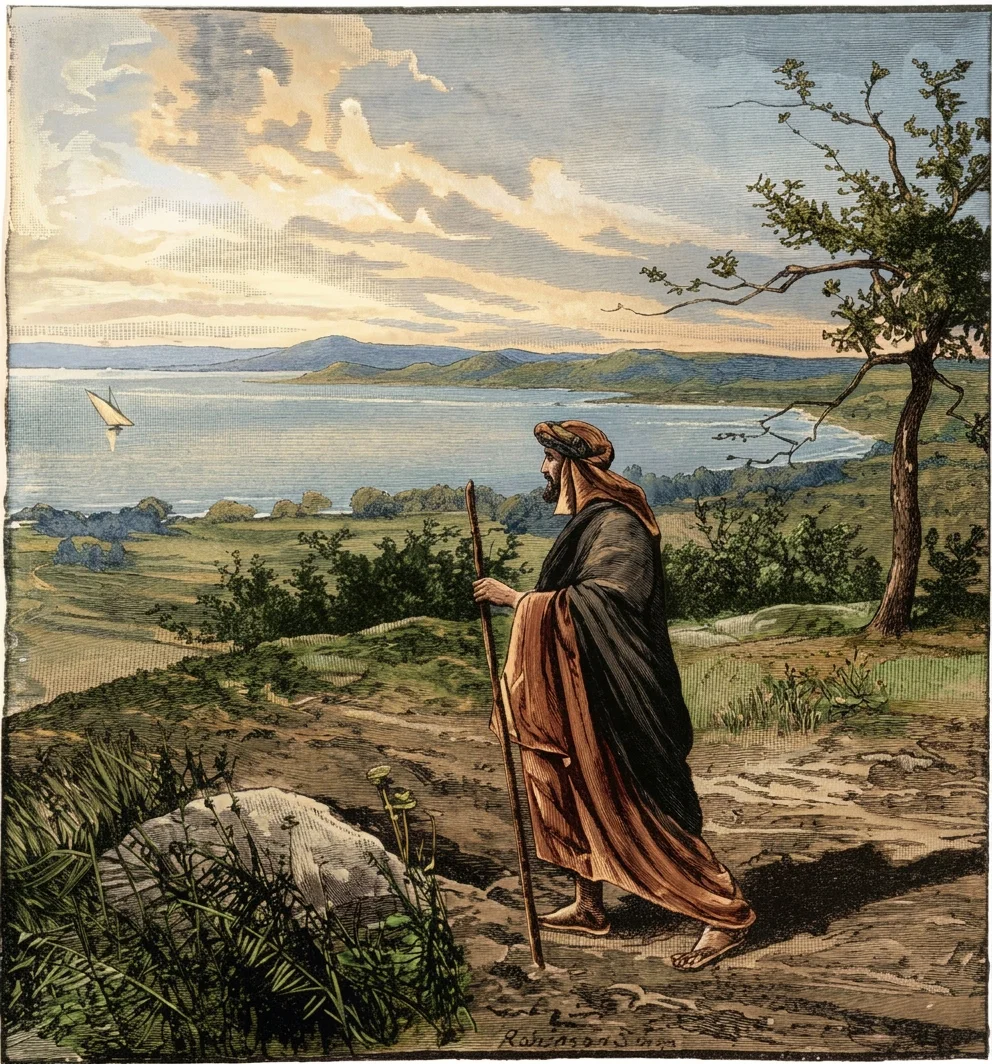
PAUL'S JOURNEY FROM TROAS TO ASSOS. Copyrighted, 1888.
CHRISTIAN HELP TRACTS.
The following numbers of the Apples of Gold Library were written especially for the unconverted and discouraged. As our work is largely among such people, these good tracts should be scattered by the hundred thousands.
No. 3. The Sure Promises of God, by C. H. Spurgeon. Filled with “the sure mercies of David” to both the fallen and discouraged. 50 cents per 100.
No. 1. “Choose Ye This Day,” an urgent appeal to the unconverted to turn quickly from trivial things to things eternal. 50 cents per 100.
No. 17. “What Must I Do to be Saved?” by Mrs. E. G. White. Presents in clear and simple language the sinner’s work, or part to act, in securing salvation. 50 cents per 100.
No. 23. The Riches of His Grace, by Elder M. C. Wilcox. The wonderful richness of this grace, and how it may be appropriated by man, are both made prominent. 50 cents per 100.
No. 24. He Saves to the Uttermost, a direct and stirring appeal to the sin-burdened heart. Two pages; $1.25 per 1,000.
No. 26. “I Will Come Again,” by J. G. Lamson. That this coming is a literal one and that it is right at hand are conclusively shown. Four pages; $2.50 per 1,000.
No. 47. The Great Threefold Message, by Elder M. C. Wilcox. Especially for those who wish briefly to study the nature and object of this great message. Sixteen pages, illustrated; $1.00 per 100.
Special editions of these tracts with your imprint at a slight advance in price. Write to us about it.
PACIFIC PRESS PUBLISHING CO.
OAKLAND, CAL. 39 Bond St., New York City 18 W. 5th St., Kansas City, Mo.