The Youth’s Instructor, Vol. 33, No. 40.

THE BARTHOLDI STATUE

The Youth’s Instructor

Oct 21, 1885

S. D. A. Publishing Association · Battle Creek, Mich. · Oct 21, 1885

THE BARTHOLDI STATUE.

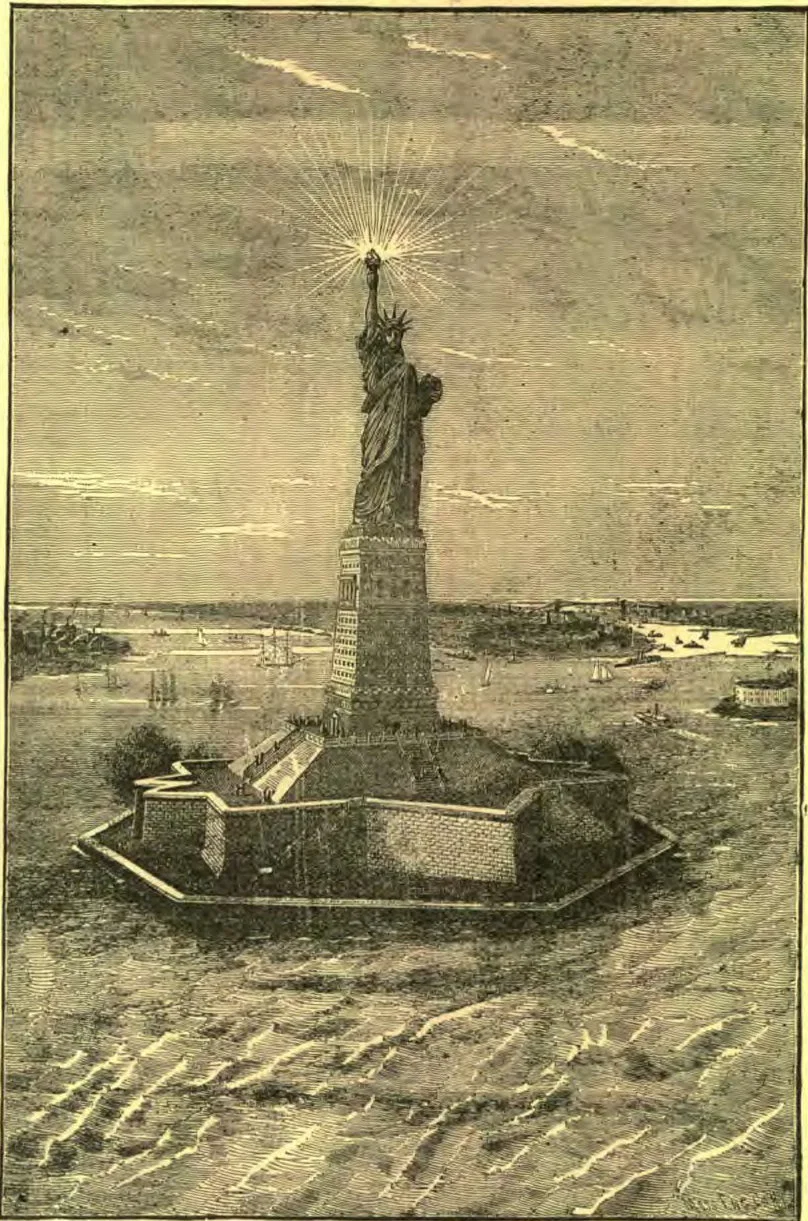
On one of the islands of New York harbor is soon to be erected one of the tallest monuments in the world. Eighteen years ago the French sculptor Bartholdi paid a visit to the United States. As he sailed on the waters of New York harbor, he thought what a fine place it would be on which to erect a great statue to the Goddess of Liberty. Returning to France, his countrymen very readily adopted the idea; and wishing to cement more strongly the union and friendship that exists between the French and the Americans, proposed that the two nations erect a statue to the Goddess of Liberty, and place it on one of the islands of New York harbor. The plan was enthusiastically received by the people at large, on both sides of the ocean, and subscriptions were immediately raised to forward the work.
This statue, of which a view is given in the accompanying picture, was designed by Auguste Frederic Bartholdi, and is a gift to liberty-loving Americans from Frenchmen, who love liberty no less. The pedestal on which the foundation stands was erected by contributions from our own people.
No doubt a description of this statue would be of interest to many of our readers. Bartholdi first made a statue seven feet in height; and from this model he made one four times larger, giving a statue of about thirty-five feet in height. This he divided into a great number of sections, each of which was enlarged four times. A model of wood, the exact counterpart of each section, was then made, and to these models were shaped sheets of copper, some less than an inch in thickness. Great care was taken to shape these sheets exactly to the models, so that every curve would be faithfully reproduced. The whole is supported by braces and trusswork. Says an exchange: “The pose, stride, and gesture, with its classic face, are pronounced perfect; the drapery is both massive and fine. ‘You can hardly realize that the folds on the huge robe are stubborn bronze. The surface is so wrought by the hammer that it gives the effect of mottled silk.’”
The following measurements, as given in the Scientific American, will give you some idea of the immense size of this statue: From the heel to the top of the head, 111 feet; height of head, 13½ feet; length of nose, 5 feet and 9 inches; length of forefinger, 7 feet and 11 inches; circumference of finger at the second joint, 4 feet 9 inches. The statue itself, reaching to the top of the torch is 151 feet high, almost fifty feet higher than the celebrated Colossus of Rhodes, one of the seven wonders of the ancient world. But the statue is placed on such an enormous pedestal, that it will tower over three hundred feet above the ground. Forty persons can easily accommodate themselves within the head, and twelve within the torch held in the hand. The torch is to be lighted with an electric light, that will shed its beams for many miles over the stormy waters, guiding the mariner to the “land of the free.”
This statue was taken to pieces and shipped to New York on the 20th of May last.
On May 13th an interesting ceremony took place in Paris. It was the inauguration of a statue of liberty, the exact counterpart of the larger statue but only one-fifth of its size. This was presented to the French by the American people, and it stands before the hotel of the American Legation.
W. E. L.

CHANGE

The grapes are purple on the vines; The ripened peach falls from the trees; The sun through misty vapors shines; While happy birds and murmurous bees Drop music on the wandering breeze No more, no more.
The grasses wear a faded look; The violets died long, long ago; The river bright, and glancing brook, With sad and gentle whisperings flow, And roses in the sunshine glow No more, no more.
The cricket and the katydid, That told their love in merriest tone, Beneath the velvet grasses hid, From out their pleasant haunts have blown, Since summer sits upon her throne No more, no more.
Each leaf that quivered in the air, Through all the splendor of the days, Now listless drops as if some care Had changed the sweetness of its ways, And in the mellow sunshine plays No more, no more.
There rests o'er all the azure sky A chastened look of tenderness, Like those who've watched some loved one die, Yet learned the chastening hand to bless, E'en while they felt love's warm caress No more, no more.
O summer-time, sweet summer-time, Too soon we've seen thy beauty fade; Scarce had thy morning bell's soft chime O'er the glad earth their music made, Till “summer comes,” sad voices said, “No more, no more.”
So youth departs, and love, and hope, And the sweet summer of the soul; While o'er each fair and sunny slope, The wintry floods of sorrow roll; But peace is ours, if heaven's our goal, Once more, once more.
—Mrs. Annie Howe Thompson.

ROB'S CONSCIENCE.

“Robert, when you go to school this morning, you may take some money and pay Mr. Black's bill,” said Mrs. Golding.
“All right, mother;” and the boy took the five-dollar note, and folded it away in his pocket-book.
Mr. Black was the town shoemaker. His bill against the Goldings that month was but a small one, amounting to a dollar; so the five would pay it, and leave four dollars as change.
How Rob felt as he crumpled the four bills into his pocket-book with the receipt! With all the airs of a capitalist, he left the store, and marched on to school.
During the first hour he had no opportunity to look at the money. At the end of that time, the teacher was busy with the geography class, and he drew out his bills, one at a time, spreading them on his knee, and showed them to his admiring seat mate. Wetting his fingers, he ran through them as he had seen bank clerks do. What a delightful rustle they made! What a privilege it was to be wealthy!
In the midst of his enjoyment Rob suddenly stopped, turned very red, then very white, and stared at the money. On the top of the pile lay the identical five-dollar note that he had paid Mr. Black! It couldn't be! He rubbed his eyes and looked again. Yes, there it lay. Mr. Black had made a mistake, and handed it back with the change. When he reached this conclusion, Rob became cool, and put the money away, intending, as a matter of course, to carry it back that noon.
“Say, what was the matter when you were counting the money?” inquired Jim, his seat mate, at recess.
Rob explained.
“Just like old Black; he makes lots of blunders. He gave Justin Edwards a dollar too much last week. Justin said he thought it was just as sinful to refuse money as it was to refuse a drink, so he kep' it.”
His listener reflected on the course of the namesake of the famous theologian, but said nothing.
“Black never knows when he makes a mistake. He would have failed up long ago, only he charges such high prices for his goods; folks kinder feel that they have a right to keep what he gives them by mistake. They never return it.”
“They ought to,” replied Rob, with a tremble in his voice.
“Oh, I don't know. You see, they look at it this way. If they pay a dollar too much for a pair of shoes, he never gives it back; so if he pays a dollar too much in change, they don't pay that back.”
Yielding to Jim's entreaties, and his own secret desire, Rob did not go home to dinner by the usual route; instead, he went across lots.
“We won't have any other time to see that wren's nest,” said Jim, and this artful suggestion settled the question.
At night, with the crowd of boys, he went down to the post-office. All the school children went there once a day, whether they expected a letter or not. Most of them went because the others did.
The five-dollar bill still remained in Rob's pocket. He had given his mother the four “ones” and the receipt, but had said nothing about the other. What he intended to do he could not determine. What was right he well knew. The matter could not be put off much longer. Jim saw the battle that was raging in his companion's mind, and drew him out behind the great brick building in which was the post-office.
“Say,” he said intensely, “You an't going to be fool enough to carry that back to old Black? If you do, like as not he will make another blunder, and give it to Tim Connor. An't your folks overpaid him more than that amount in the last three years?”
Tim Connor was Rob's particular enemy, and the thought of his getting the money, although remote, was not without its effect.
“Say, let me take it in to Perkins and get it changed. It'll be just as much: five ones are just as good as one five. It will fill out that pocket-book ever so much better.”
Rob complied. The bill was changed, and before he went home that night, partly spent.
Three days later the money was all gone.
“If I'd stole that money I would have had more than half of it now,” remarked Jim, putting the last peppermint out of sight.
Very meekly Rob accepted the rebuke, and went away alone to think. Now that the excitement was over, and the candy all gone, he felt mean enough. Jim no longer hung around and flattered. Instead, he grinned provokingly when money was mentioned. So sensitive did Rob become that he started whenever his name was called. Oftentimes “Robert” sounded in his guilty ears like “robber.” If the money was only in his pocket now, how gladly he would return it! When he tried to pray, before going to bed, he saw five-dollar bills by the hundred, although his eyes were fast shut. At length, after a week of misery, he determined to spend all his leisure minutes in earning money enough to pay Mr. Black.
Five dollars! What a sum it seemed to earn! Little by little he gathered together his pennies, and nickels, and dimes. It seemed an age before he had a dollar. The thought that five times that amount was required was most discouraging.
“Say, got any money?” asked Jim.
“None to spare.”
“Lend me a quarter till to-morrow? I'll pay you, sure.”
Rob pondered. He disliked to be thought mean, yet he feared Jim's “to-morrow” would never come. He recalled similar loans which his friend always forgot to make good. A queer sense of pride kept him from mentioning these petty debts, although each new request brought them vividly before his mind.
“The money that I have is not mine to lend,” he said at length.
“Where did you get it?”
“It belongs to somebody else. I can't touch it.”
“You an't always so careful,” was the rejoinder.
“I'm going to pay back every cent I took from Mr. Black,” replied Rob, flushing.
So he toiled on: running errands, doing chores, weeding, sawing wood, doing anything that would bring in a cent. Very, very slowly his little hoard grew. Finally, he had enough. Tremblingly he went into the store, and waited until Mr. Black was at leisure.
“Well, sonny, what is it?”
“You gave me too much money for change, and I want to return it,” said Rob, with a shake in his voice.
“Did I? Just like me,” said Mr. Black, throwing the bill into his drawer and turning to a customer.
“Much good it did you,” said Jim, with a sneer; “he didn't even say ‘thank you.’ I guess next time you won't break your neck to pay him.”
“There isn't going to be a ‘next time,’” replied Rob. “I paid that back because I hate to be a thief. Now I can look people square in the face. I wouldn't sell the clear conscience that I have now for five hundred dollars.”
“Humph!” said Jim, “I would.”
“A fellow can't sell what he hasn't got,” remarked Rob.—Little Christian.

SCARLET LEAVES.

It is an error to suppose that the bright color of autumn leaves is given them by the frost. At the time of writing this article there has been no frost in the vicinity; yet there are large branches and occasional small trees, whose leaves are as highly colored, and as brilliant, as any that autumn ever displays. Branches are now hanging in my room that vie in splendor with the most gorgeous flowers.
These leaves began to turn red early in August. Every year, the autumn queen gives notice of her approach by displaying her blood-red banner as soon as the twentieth of the eighth month, and sometimes earlier. August 14, 1882, while among the hills of New Hampshire, I plucked a branch from a large maple tree whose entire top was blushing with flame. These leaves had assumed this color before any frost appeared. All along the sides of the low mountains, might be seen, here and there, patches of crimson and scarlet, that contrasted with the dark green of the forest and the gray battlements of granite, like flags planted on the towers of an embowered castle. In 1883, I saw, near Spectacle Pond, Massachusetts, branches of the June Berry shrub, whose leaves were as bright in the latter part of June as they could have been in October; yet there had been no late frosts or cold weather. The theory advanced some years ago by Mr. Thoreau, of Concord, Mass., is certainly the true one. He holds that leaves, like fruit, take on bright hues when they are fully ripe. Some leaves turn red, some crimson, some scarlet, some bronze, and some yellow; while others remain green until killed by the frost. Just so it is with fruit. The fruit of the same tree takes the same color every year, and so do the leaves. The fruit is most highly colored wherever it is most exposed to the sun, and so are the leaves. Some seasons are more favorable for bright leaves than others, and the same difference is noticeable with respect to fruit. The branch that bore the red leaves in June, had been injured, causing the leaves to ripen prematurely; and the same thing happens to fruit, especially when bored by insects.
Blossoms are beautiful, and young leaves are fresh and delicate; but nowhere else does nature display so rich a combination of colors as in ripe fruit and leaves. Just so it is in life. The innocence of childhood is sweet, the bloom of youth is lovely; but a mature character, well ripened off for the kingdom of heaven, is the grandest thing on earth.
G. H. BELL.

MORE ABOUT SAMOA.

SAMOANS, like all other people, have a preference for certain kinds of food. The bread-fruit that grows very plentifully on their islands, is an especial favorite with them. The fruit is something like a small melon in shape, but is covered with a rough rind. The inside is of a white, pulpy nature, and is always cooked by the natives before they eat it. Even then, it would be considered by those in cooler climes as a rather insipid diet. Besides bread-fruit, the natives eat taro, yams, bananas, and cocoa-nuts.
The cocoa-nut palm is the most useful tree known to the native Samoan. One of these trees bears about one hundred nuts in a year, which are worth at the islands, one cent apiece. As each tree is worth one dollar a year, it follows that the more cocoa-nut trees a native owns, the more money he is worth. And as it is very little labor to rear a cocoa-nut grove, they are found in great abundance in all the South Sea islands. The tree grows very rapidly, so that in ten years it becomes as large as a forest tree. It commences bearing nuts when four or five years old, and lasts sixty or seventy years.
The tree is made useful to the native in many ways. It furnishes the material of which he builds his house, and the fuel with which to cook his food; he makes his household utensils from it, and it is his chief article of commerce; the nut furnishes meat and drink, and clothing is made from its leaves. The milk of the cocoa-nut varies much at different stages of its growth. When the nut is quite young, the flesh, instead of being a pure white, and of even thickness, is merely a jelly-like pulp of a bluish-white color. At this stage, the milk is said to be delicious.
To gather the nuts, the natives climb the trees. Those who have seen them at this work, say that they ascend the trees with the greatest ease. If the tree leans considerably, as many do, they simply walk up; but if it is straight, they usually fasten a piece of bark around their ankles, leaving a space between them of eight or nine inches; and then clasping the trunk of the tree, they ascend with the agility of a cat. While growing, the nut is enclosed in a very thick, strong husk. In order to strip it of this coat, they set a stake in the ground; then seizing the nut in both hands, they strike it down upon the pointed end of the stake a few times, and the nut is scalped quite clean.
The climate of Samoa is, at times, almost intolerably warm; and as soon as the sun is up, one feels his energies begin to give way before its oppressive rays. The middle of the day is consequently given up to sleep. At that time not a native can be seen moving about; all are inside their cool houses, stretched out in rows on their mats, covered from head to foot with sheets of tappa, and resting their heads on little bamboo pillows. Sometimes they put snakes inside the pieces of bamboo, and fasten them there by closing up the openings at the ends of the stick. They say that the hissing noise made by the snakes sends them to sleep.
Tappa is made from the bark of the paper-mulberry tree. The inside lining is stripped off, and put in the water to soak. When sufficiently soft, these strips are placed in layers on a flat log, and beaten out to the required width by heavy wooden mallets. After considerable beating, the strips become blended in one piece; and by adding fresh bark, the size is increased to any desired width or length. So ingenious are they in making their native cloth, that they will sometimes beat it out very evenly, and nearly as thin as tissue paper. It is then spread on the grass to dry, after which it is dyed in various patterns. Two pieces, each eight or ten feet square, were brought aboard our ship at the islands. These were ingeniously dyed in bright colors, and were really pretty.
The native Samoan never takes anxious thought for the morrow as to what he shall eat or wear. His food and clothing—what little he wears—grow spontaneously, and if he chooses, he may pass all his time lounging beneath the orange and banana trees, or strolling about in the shadow of the silent cocoa-nut groves. But to those accustomed to a life of activity, that would soon become the dullest kind of monotony. There are also many disadvantages there which would be very disagreeable to one reared in other lands. The natural advantages enjoyed by the natives of the South Sea islands are necessary to their existence, and show the wisdom and goodness of God in thus providing for the needs of his creatures. It is better for all to be contented with their lot, than to wish themselves in possession of something that has been given to another. Had we inherited all the good things the Samoans possess, we would also have had their native tendencies. It is true that they have accepted the forms of the Christian religion, to some of which they strictly adhere; but from what I could learn, theirs would not be considered by some a saving faith. It is our duty to walk in the ways of God, according to the best knowledge we have, knowing that he alone understands the human heart, and will judge all men righteously.
J. O. CORLISS.

THISTLE DOWN.

The thistle-down rises, now here and now there, Like feathers of snow on the breeze; I watch as it melts in the blue of the air, Still sailing o’er hilltops and trees. Oh, where will it rest when the soft winds have died? And where will its cradle be found? And who that could find it if any one tried, Hid away on the nurturing ground?
When summer and autumn and winter have fled, The thistle-down, wakened from sleep, Will spring here and there from its low-lying bed, And bright in the sunshine will leap. Our words are forgotten; like thistle-down light They scatter, and none may recall; Do they go with a mission to bless or to blight— To heal or to wound as they fall?
—M. D.

WHAT MAKES A MAN.

Most boys wish to be men. Some of them do not know how. Smoking and swearing do not make men, for boys can do such things, and very small boys, and very dirty ones, too. To be men, boys should grow, not only in body but in mind. A boy’s mind does not work well in a man’s body; and if a boy grows tall and strong, and yet remains ignorant and foolish, he makes a very poor specimen of a man. To be men, boys should eat and work and play and learn; and they should learn not only the things taught in books, but they should learn of the things that are occurring around them. They should learn also how to use their hands and their eyes, and how to use their tongues, and how to hold them. There are many people who walk through the world and see but little of it; and some are quite well educated in books, but have never learned to use their eyes. Every star above us, and every plant beneath our feet, has a lesson for us which children may well learn, and which men may well know.
If boys wish to be men, they must also learn to rule the spirit, and control the temper, and above all, to fear the Lord. A man who does not know how to rule himself, but who, when provoked and irritated, would strike and kick like an ungoverned child, may easily become a brute and a murderer. A man needs to learn wisdom, righteousness, gentleness, honesty, faith, and truth. These are some of the qualities that go to make up a man:—
“A truthful soul, a loving mind; Full of affection for its kind; A spirit firm, erect, and free, That never basely bends the knee; That hears the voice of God within, And never makes a league with sin; That loves the truth for its own sake, And snaps the fetters despots make; That worships God, and him alone, And reverent bows before his throne; That trembles at no tyrant’s nod, And only fears the living God; That fears no mortal’s curse or ban,— This is the soul that makes a man.” —Little Christian.

FIDELITY AS AN APPRENTICE.

THE late Deacon Daniel Safford, of Boston, was a successful mechanic. Beginning life as a blacksmith, he conferred honor on his trade by his high character, his thorough work, and his large business enterprises. He built up an extensive business, and accumulated a fortune, which was liberally used for benevolent objects. One secret of his success was his uniform fidelity, never slighting any work, but finishing everything that passed through his hands in the best manner possible.
When he was an apprentice, he made this record in his journal: “Resolved to do work for my employer as faithfully as if I were doing everything for myself.” Many clerks and apprentices make a great mistake in slighting their work when it is not subject to careful inspection. They draw a broad distinction between their own interests and the interests of their employers, and try to go on as easily as possible for themselves. Such young men rarely succeed in life, and they do not deserve to succeed.—Youth’s Companion.

THE BIBLE.

For many years John Quincy Adams, by reading for one hour each morning, read the whole Bible once a year. He said that in whatever light he viewed it, whether with reference to revelation, to history, or to morality, it was to him “an invaluable and inexhaustible mine of knowledge and virtue.” Daniel Webster said that from the time when, at his mother’s feet or on his father’s knee, he first learned to lisp verses from the sacred writings, they had been his daily study and vigilant contemplation; and that if there was anything in his style or thoughts to be commended, the credit was due to his kind parents, who instilled into his mind an early love of the Scriptures.—Selected.

Guarding Diet, Company, and Reading for Health

Be always careful what you eat and drink, with whom you associate, and what you read. These are essential to preserve your health, your good repute, and to increase your wisdom. Health, good reputation, and wisdom are jewels of the most precious value.

UP AND DOING.

COME out, and show your better self, Nor lag while others run; There's not an hour, or day, but hath Something that may be done; Something, my friend, that you can do, If but to earn a crust. And better that, than sit and mope, And be content to rust. —D. B. Williamson.

IMPORTANT BIBLE SUBJECTS.

LESSON 7.—THE KINGDOMS OF DANIEL TWO, SEVEN, AND EIGHT.

[NOTE TO THE STUDENT.—Do not consider the lesson learned until you can give at least the substance of every text, with the correct reference for each. The references in black letters indicate those texts that should be committed to memory. A little diligent application each day will enable you to learn them, although this need not be considered a test of scholarship.]
1. What is the name of the first universal kingdom of Daniel 2, and by what was it represented?
2. By what is this same kingdom represented in Daniel 7?
3. What change took place in the lion? Daniel 7:4.
4. What did this change denote? (See note.)
5. By what was the Medo-Persian Empire represented in Daniel 8? Verse 20.
6. What peculiarity in regard to the horns is mentioned in verse 3?
7. What did this represent? (See note.)
8. By what is this kingdom represented in chapter 7? Verse 5.
9. What may be inferred by its raising itself up on one side? (See note.)
10. What may the ribs denote? (See note.)
11. What was said to the bear? Dan. 7:5.
12. What similar work of conquest and slaughter was to be performed by the ram of Daniel 8? Verse 4.
13. By what was the Medo-Persian Empire represented in chapter 2?
14. What characteristic of the great image represented the two branches of this kingdom?
15. By what is Grecia represented in chapter 8? Verse 21.
16. By what is the same kingdom represented in chapter 7? Verse 6.
17. What characteristic was represented by the four wings? (See note.)
18. What did the four heads signify? (See note.)
19. By what metal was this third kingdom represented in Daniel 2? Verse 39.
20. How extensive was to be its rule? Ibid.

NOTES.

The wings were plucked.—At first the lion had eagles' wings, denoting the rapidity with which Babylon extended its conquests under Nebuchadnezzar. When this vision was given, a change had taken place; its wings had been plucked. It no longer flew like an eagle upon its prey. The boldness and spirit of the lion were gone. A man's heart, weak, timorous, and faint, had taken its place. Such was emphatically the case in the person of the imbecile and pusillanimous Belshazzar, who in weakness and fear shut himself up in the city of Babylon, and with whom the Babylonian kingdom came to an end, B. C. 538.—Thoughts on Daniel and the Revelation.
Raised up itself on one side.—The bear raised itself up on one side. This kingdom was composed of two nationalities, the Medes and the Persians. The same fact is represented by the two horns of the ram of chapter 8. Of these horns it is said that the higher came up last; and of the bear, that it raised itself up on one side; and this was fulfilled by the Persian division of the kingdom, which came up last, but attained the higher eminence, becoming the controlling influence in the nation.—Ibid.
Three ribs in the mouth.—The three ribs perhaps signify the three provinces of Babylon, Lydia, and Egypt, which were especially ground down and oppressed by this power.—Ibid.
Four wings of a fowl.—If wings upon the lion signified rapidity of conquest, they would signify the same here. The leopard itself is a swift-footed beast, but this was not sufficient to represent the career of the nation which it symbolized in this respect; it must have wings in addition. Two wings, the number the lion had, were not sufficient; it must have four: and this must denote unparalleled celerity of movement, which we find to be historically true of the Grecian kingdom. The conquests of Grecia under Alexander have no parallel in historic annals for suddenness and rapidity.—Ibid.
The beast had also four heads.—The Grecian Empire maintained its unity but little longer than the lifetime of Alexander. Within fifteen years after his brilliant career ended in a drunken debauch, the empire was divided among his four leading generals. Cassander had Macedon and Greece in the west, Lysimachus had Thrace and the parts of Asia on the Hellespont and Bosphorus in the north; Ptolemy received Egypt, Lydia, Arabia, Palestine, and Coele-Syria in the south; and Seleucus had Syria and all the rest of Alexander's dominions in the east. These divisions were denoted by the four heads of the leopard.—Ibid.

THE CITY OF THE SUN.

“Who has not heard of the Vale of Cashmere?”
ONE who visited this beautiful valley a few years ago, gives this pleasant description of its capital:—
“Srinagar, or literally Surya Nagar, the City of the Sun, is the capital of the beautiful and romantic valley of Cashmere, one of the most charming spots on the whole earth. A lonely march of one hundred miles along the banks of the Jhelum River, the ancient Hydaspes, brought me to the smooth waters of the Cashmere Lake. Here I hired a boat covered with matting, and so arranged, that the stern of the boat formed a cooking kitchen, both for the crew and passenger. My crew consisted of a full-grown man, an undergrown boy, an old woman, two small children, and a young mother and a plump baby. The whole party, except the plump baby, took their turn at the oars and towing rope, and I managed to get along at the rate of two miles an hour.
“It was a clear morning, and beautiful beyond description was the panoramic view as we wound along the river in its circular course. All around, the country was rich with verdure. Rising at a distance were the snowy ranges of the Himalaya mountains, many of them as much as thirteen thousand feet above the sea level. To quote the words of the traveler Vigne: ‘Softness mantling over the sublime, snugness generally elsewhere incompatible with extent, are the prevailing characteristics of the scenery of Cashmere.’ In the center of this lovely scenery is the City of the Sun, which was destroyed by an earthquake recently.
“Srinagar is a considerable city of some one hundred and fifty thousand inhabitants, of whom twenty thousand are Hindoos and the remainder Mohammedans. The houses are built entirely of wood, usually about three stories high. The streets are narrow and dirty. The people were dirtier than the streets. No pen could possibly depict the real sanitary condition of Serinagar.
“The city of Serinagar is on an island in the midst of the Cashmere Lake. It has seven bridges, all made of wooden logs. Some of the bridges are occupied with shops, like old London Bridge, which are extremely quaint, although unsightly structures. There are no cabs, or carts, or carriages in the city of Serinagar, and therefore no conveyances rumble along its narrow streets. The manufactories of Cashmere are well known. Cashmere shawls have a world-wide reputation, although the trade is not as prosperous as it used to be. A Cashmere shawl has been sold in Paris and London for four thousand pounds, and even more. The silver and gold work in bracelets and necklaces is perhaps unequaled in the world, for it has a peculiar, unfinished style of its own, which cannot be imitated. The copper work is very antique in its appearance. The painted and inlaid wood-work, erroneously called by Europeans papier-mache, is also exceedingly beautiful. It is an interesting fact that the well-known Cashmere shawl pattern, which finds expression in all articles of Cashmere manufacture, has its origin in the peculiar windings of the river Jhelum along the valley.
“The Cashmeree comes very low down in the scale of humanity. He won’t work if he can help it, and to beg he is never ashamed; and such is the race that inhabits one of the fairest and most productive provinces on earth.”

God Gives the Increase

We cannot always be sure when we are most useful. It is not the acreage we sow, but the multiplication God gives the seed, that makes up the harvest.

POWER OF MEMORY.

There was a Corsican boy who could rehearse 40,000 words, whether sense or nonsense, as they were dictated, and then repeat them in the reversed order without making a single mistake. A physician, about sixty years ago, could repeat the whole of “Paradise Lost” without a mistake, although he had not read it for twenty years. Euler, the great mathematician, when he became blind could repeat the whole of Virgil’s “Æneid,” and could remember the first line and the last line in every page of the particular edition which he had been accustomed to read before he became blind.
One kind of retentive memory may be considered as the result of sheer work, a determination toward one particular achievement, without reference either to cultivation or to memory on other subjects. This is frequently shown by persons in humble life in regard to the Bible.
An old beggerman at Sterling, known about fifty years ago as Blind Alick, afforded an instance of this. He knew the whole of the Bible by heart, inasmuch that if a sentence was read to him, he could name book, chapter, and verse; or if the book, chapter, and verse were named, he could give the exact words. A gentleman, to test him, repeated a verse, purposely making one verbal mistake. Alick hesitated, named the place where the passage was to be found, but at the same time pointed out the verbal error. The same gentleman asked him to repeat the ninetieth verse of the seventh chapter of the book of Numbers. Alick almost instantly replied: “There is no such verse. That chapter has only eighty-nine verses.”
Gassendi had acquired by heart six thousand Latin verses; and in order to give his memory exercise, he was in the habit daily of reciting six hundred verses from different languages. Saunderson, another mathematician, could repeat all of Horace’s odes, and a great part of other Latin authors. All could remember more than they do if they would try their memories.—Selected.

ANIMALS AS BAROMETERS.

If the habits of animals are reliable as storm-signals, this would be a sufficient inducement for some to study them. By observation one could test their reliability. A writer in the Cincinnati Inquirer says of their habits:—
“I do not know of any surer way of predicting the changes in the weather than by observing the habits of the snail. They do not drink, but imbibe moisture during a rain, and exude it afterward. This animal is never seen abroad except before a rain, when you will see it climbing the bark of trees and getting on the leaves. The tree-snail, as it is called, two days before rain will crawl up the stems of plants; and if the rain is going to be a long and hard one, then they get on the sheltered side of a leaf; but if a short rain, on the outside. Then there are other species that before a rain are yellow; after it, blue. Others indicate rain by holes and protuberances, which before a rain rise as large as tubercles. These will begin to show themselves ten days before a rain. At the end of each tubercle is a pore which opens when the rain comes, to absorb and draw in the moisture. In other snails deep indentations, beginning at the head between the horns, and ending with the jointure of the tail, appear a few days before a storm.
“Every farmer knows when swallows fly low that rain is coming; sailors, when the sea-gulls fly toward the land, when the stormy petrel appears, or Mother Carey's chickens, as they are called, predict foul weather.
“Have you ever noticed the activity ants display before a storm—hurry, scurry, rushing hither and yon, as if they were letter-carriers making six trips a day, or expressmen behind time? Dogs grow sleepy and dull, and like to lie before a fire, as rain approaches; chickens pick up pebbles, fowls roll in the dust, flies sting and bite more viciously, frogs croak more clamorously, gnats assemble under trees, and horses display restlessness.
“When you see a swan flying against the wind, spiders crowding on a wall, toads coming out of their holes in unusual numbers in the evening, worms, slugs, and snails appearing, robin redbreasts pecking at your windows, pigeons coming to the dovecote earlier than usual, peacocks squalling at night, mice squeaking, or geese washing, you can put them down as rain signs. Nearly all the animals have some way of telling the weather in advance. It may be that the altered condition of the atmosphere in regard to electricity, which generally accompanies changes of weather, makes them feel disagreeable or pleasant. The fact that a cat licks herself before a storm is urged by some naturalists as proof of the special influence of electricity. Man is not so sensitive. Yet many people feel listless before a storm, to say nothing of aggravated headaches, toothaches, rheumatic pains, and last, but not least, painful corns.”
Continue reading: NATURE'S DOINGS