The Youth’s Instructor, Vol. 33, No. 40.

THE BARTHOLDI STATUE
Earlier text: THE BARTHOLDI STATUE

NATURE'S DOINGS.

A WRITER in the Child's Paper mentions some interesting curiosities he observed while boarding at one of the oldest country farmers' last summer. He says:—
“This farm of two hundred acres had originally been bought of the Indians, and had been long held by the same family. Under a certain maple-tree upon this farm I chose to sit with my camp-stool and sketch-board. I selected this place for my work before I knew there was anything curious about the tree; but having heard the story, I looked up, and saw overhead, hanging down from the lowest branch, and quite within reach, a heavy iron chain, which seemed to start from a notch in the tree just as if it grew there. Pull as hard as I could, it did not budge, for it had indeed grown into the wood of the tree. The branch, as it enlarged, had wrapped its woody fiber and bark all about the iron links, concealing the upper end of the chain. Probably every season, as the maple keeps on growing, the end that hangs down will grow shorter, though it is now about as long as my arm.”
“Some ten or eleven years ago, when the farm hands were at work near the maple, this chain was seen lying carelessly on the ground, and some one had picked it up and thrown it over the lowest branch, where it was soon forgotten. But the tree could not forget it, and soon, in growing, began to take the stranger into its life and make it a part of itself.”
“One other natural curiosity I must tell you of. We were riding one afternoon, when my friend stopped his horse to show me a grand old elm, whose wide-spreading branches arched over the road; and looking up to the first great branch, I saw a flourishing currant-bush growing in the notch, as much at home as though planted in a garden-border among its fellows. This little bush was a well-known resident of the hospitable elm, and every spring it puts forth its green leaves and draws the attention of the passers-by. Years ago, some bird must have dropped the seed into the tree, and the chance dust from the roadside mixed with the decaying leaves of autumn gave its roots soil enough for growth. The dews and the rains fed and refreshed this foster-child, and possibly the stray currant-bush even blossoms and bears in this its airy shelter.”

A NOVEL MOLE TRAP.

The mole, from its burrowing habits, sometimes does great damage to crops, and it becomes necessary to devise some means of ridding the soil of these troublesome creatures. A boy in Illinois has adopted this novel way of catching them:—
“Taking two old horns, the boy places them point to point, turning the hollows outward in the track of the mole, and then replaces the soil over them. When the mole comes along, it crawls into the horn just as far as it can go, and remains there. The mole cannot turn round in the narrow horn, and as it never goes backward, it is fast in the trap. The Illinois boy finds a mole or two every time he takes up his horns.”

INTERESTING ITEMS.

AN English sparrow built her nest and reared her young, this season, in the mouth of the eagle on the roof of the court-house at Charlotte, Michigan.
ACCORDING to the latest return, the number of volumes in the British Museum is just over 1,300,000. There are 160 miles of shelves, and about twenty more miles to be filled. It is calculated that about one ton of literature a day is sent into that institution.
ANOTHER tunnel has been bored through the Alps, connecting Eastern Switzerland and Western Austria. Though one of the greatest of these modern engineering works, this tunnel through the Alberg (the Eagle’s Mount) was finished in much less time and at less expense than either of the other great tunnels.
THE highest point yet known to have been attained by a mountain climber is 23,700 feet, which has recently been accomplished by Mr. Graham in the Himalayas. He reports that he did not feel any inconvenience in breathing, or experience any nausea, or bleeding at the nose, or temporary loss of sight and hearing; but the motion of the heart was perceptibly affected, as its beating became audible, and its rate was decidedly increased.

LETTING THE OLD CAT DIE.

Not long ago I wandered near A play-ground in the wood, And there heard a thing from youthful lips That I’ve never understood.
“Now let the old cat die,” he laughed; I saw him give a push, And gaily scamper away as he spied My face peep over the bush.
But what he pushed, or where it went, I could not well make out, On account of the thicket of bending boughs That bordered the place about.
“The little villain has stoned a cat, Or hung it upon a limb, And left it to die all alone,” I said; “But I’ll play the mischief with him.”
I forced my way between the boughs, The poor old cat to seek; And what did I find but a swinging child, With her bright hair brushing her cheek!
Her bright hair floated to and fro, Her red little dress flashed by, But the liveliest thing of all, I thought, Was the gleam of her laughing eye.
Swinging and swaying back and forth, With the rose-light in her face, She seemed like a bird and a flower in one, And the wood her native place.
“Steady! I’ll send you up, my child!” But she stopped me with a cry: “Go ’way! go ’way! Don’t touch me, please; I’m letting the old cat die!”
“You letting him die?” I cried aghast; “Why, where is the cat, my dear?” And lo! the laughter that filled the woods Was a thing for the birds to hear.
“Why, don’t you know,” said the little maid, The flitting, beautiful elf, “That we call it ‘letting the old cat die’ When the swing stops all itself?”
Then floating and swinging, and looking back, With merriment in her eye, She bade me “good day,” and I left her alone, A-letting the old cat die.
—Mary Mapes Dodge.

HOW THE ESKIMOS LIVE.

The people who lived along the coast of Siberia, generations ago, it is supposed, traveled eastward in their skin boats. The descendants of these are the Eskimos, among whom Sir John Franklin, Kane, and many others, have spent long, dreary winters, while waiting for the sun to open a path toward the pole.
They are a strange people, small, with little black eyes and long, straight hair, and with most peculiar habits. In the short summer, violets spring up in the moss which grows on the hillsides, and a vine, bearing tart little berries, similar to the huckleberry. The Eskimos are so fond of these that they will stop in the midst of any game to eat them. They take great pleasure in looking at pictures, not minding whether they are right side up or not.
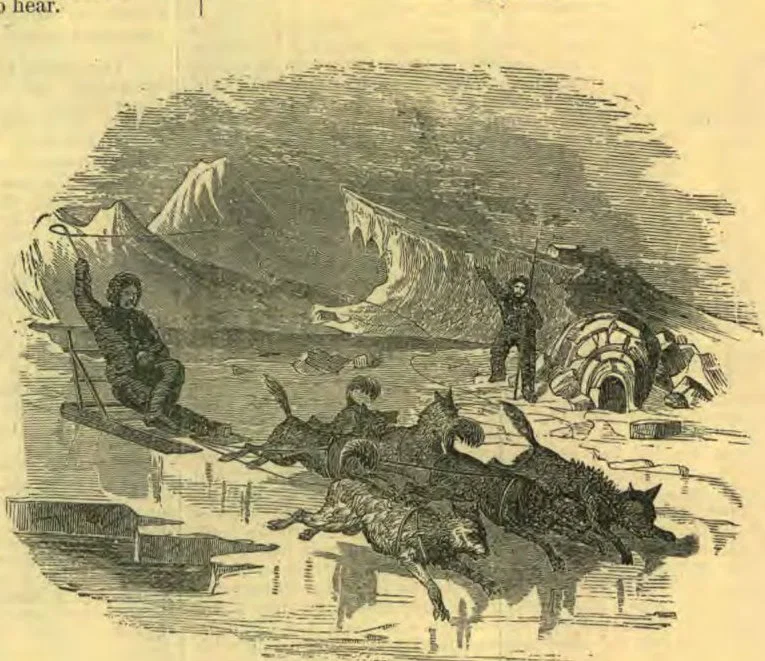
When winter comes, the Eskimos set about building his house. Blocks, two feet long and one wide, are cut from a drift of firm snow, and laid on the ground in the form of a square. On these, and inclined a little, another layer is placed, the corner blocks resting diagonally on the ones below. When the sides meet at the top, the cracks are filled with loose snow, a door is cut, and he has as warm a house as could be wished. When he is not busy at home, he must be off hunting to obtain food and skins. The hunter approaches a seal on the ice by pulling himself along on a blanket; when the animal looks up, the man blows and flops, until the seal, thinking him another seal, goes off to sleep again. Then the hunter slowly draws himself along, until near enough to throw the lance.
When a reindeer is killed, the Eskimo takes off the skin, and eats some of the warm meat. Then he makes a bag of the stomach, which he fills with the blood, and places the carcass and bag under a pile of stones to keep away from the wolves. After putting the antlers on the top, that he may easily find the pile, he takes a smoke, and throwing the hide on his back, trudges home. His wife holds the skin between her teeth, and scrapes the flesh off with a knife; when it is stretched out on the ground to dry. In the fall, the skins are laid out, and dampened by water warmed in the mouth. If dried by a lamp, they would be hard; so the women keep the wet, cold hides around their bare backs all day, and on the next morning they are again scraped, when they become soft and of a delicate cream color. About thirty-five skins are needed for the clothing of a single family.
In very cold weather two suits are used, the inner one of young reindeer, with the soft hair turned toward the body. The coat is very loose, with a large hood, and the trousers are held up by a cord. Reindeer slippers are used, and seal-skin boots with soles of walrus. The women dress about the same, except the coat, which is quite long and of seal-skin. The Eskimo is very fond of his pipe, and carries it in a little bag thrown over his shoulder. The bag is often very pretty, made of different colored furs, and trimmed with a fringe of reindeer teeth. When he wants to smoke, he says to his wife, “Pau-u-let-e-now?” (Where is the pipe?) and she, after getting it ready, takes a few puffs and hands it to him.
They seem to have no real laws. In some tribes, if a man does wrong, he is asked to pay for it in dogs or knives; but if he refuses, nothing more is said. One of the explorers says when he asked the natives why they had not killed a certain murderer, they replied that his life would not bring back the other man’s, and so they would be equally guilty. If a man lays a few stones on a pile of driftwood, it belongs to him; and a bear is the property of the one who first sees it, no matter by whom it is killed.
One of his best friends is the dog-team. The Eskimo has a whip, with a handle of bone or wood and a lash twenty or thirty feet long, made of seal-skin, which he drags in the snow. The leader of the team is the most intelligent dog, which always sets a good example by obedience and hard work. The Eskimo talks to his dogs all the time he is not whipping them. When a dog is struck, he jumps against his neighbor, and he in turn against the next, to avoid the whip, which is used freely on the innocent as well as the guilty, the driver thinking that, if a dog does not deserve a whipping now, he will in a little time. The animals are soon so tangled in the harnesses that they often have to be unhitched before they can pull again. It is said that if the master is short of dogs, his wife and children are harnessed up and help to pull, while he sits on the sled and smokes.—Charles K. Bolton.
Written for the INSTRUCTOR.

LITTLE THINGS.—NO. 1.

For awhile I want to talk to you about little things at home, because the little things have more to do with your real happiness than anything else in life. A large house, fine clothes, and nice things will not make you happy. Many children have all these, and yet they are very unhappy; while others who live in a poor house, and have only the plainest food, are contented.
Little things, too, often do the most mischief. Little chickens are the ones that get into the garden and scratch up things. Can you think of any little thing that gets into the pantry, and often proves so troublesome? Mice? Yes, they are bad; but there is a greater pest in the little red ant, because it is so small that nothing will keep it out.
In my hand I have a grain of sand. It is so small you can scarcely see it; yet the whole wide world is made up of just such tiny particles. On the tip of my finger is a drop of water. It is very small; but lakes and rivers are made up of millions of just such little drops. The years are made up of seconds—just one second at a time. The Lord takes very little things to make the great ones out of. The other day I heard a little girl repeating some verses that I wish all little children knew, for it would help them to remember the value of little things. They were these—
“Little drops of water, Little grains of sand, Make the mighty ocean, And the pleasant land.
“Little deeds of kindness, Little words of love, Make this earth an Eden Like the heaven above.”
Little boys and girls are important, too, for they are the stuff men and women are made of. To be really useful, the little people must learn to do the little things well; then, when they are older, they can do the larger things. I think the Lord says something about that. “He that is faithful in that which is least, is faithful also in much: and he that is unjust in the least, is unjust also in much.” Luke 16:10. That means that a little boy who will go on an errand and come right back without stopping to play, will be a trusty man when he grows up. It means that a little girl who will tell mamma just how she broke that plate will tell the truth when she becomes a woman.
Now can you tell what lies at the very beginning of all home duties? It is that “first commandment with a promise,”—“Honor thy father and thy mother.” The first duty every child owes is to his father and mother; and no matter how bright and smart he is, the Lord is not pleased with him when he does not do it.
Can you think of any reason why you should do so? In the first place, the Lord commanded it, and that should be reason enough. Your parents have taken the tenderest care of you when you could not care for yourself at all. They have fed you and clothed you, and have given you a home. They are the very best friends you have in the world. They would die for you if it were necessary; and they are very anxious that you shall learn to be good. How wrong it is to be disobedient, or saucy, or cross to father and mother! You may think that it is a little matter, but it will grow into a grave one. Children who are not good and kind to their parents are seldom good to any one else when they are grown up.
In the New Testament we read about a little boy who was a pattern in this respect to all the little boys and girls who should live after him. The Bible says he was “subject unto his parents.” If Jesus, who knew no sin, was obedient to his parents, how much more so should we be to our parents. They know what is best for you, and you ought to have confidence to believe that whatever they tell you to do will be for your good.
In my next talk we will try to find out some of the things that the little people ought to do.
D. M. CANRIGHT.

LITTLE THINGS.

A LITTLE bit of patience often makes the sunshine come, And a little bit of love makes a very happy home. A little bit of hope makes a rainy day look gay, And a little bit of charity makes glad a weary way.

Letter Budget.

BERTIE BEARSS, of Waushara Co., Wis., writes: “I am nine years old. I have been stopping at my grandfather’s through vacation, and I am going to my home in a week or so, to go to school. I have been to Sabbath-school every Sabbath since I have been with grandpa, and I have had my lessons every Sabbath. I want to be a good boy, so as to meet the INSTRUCTOR family in heaven. Good by.”
Bertie wrote in August that he was at his grandpa’s to spend his vacation. His letter was printed in the INSTRUCTOR for August 12. We are glad to hear from you again, Bertie, and to have such a good Sabbath-school report from you. It brings homesick feelings to hear the children tell about going to grandpa’s. We know you had a pleasant time during your vacation.
LEVI L. NEFF writes from Henry Co., Ind. He says: “I am twelve years old, and keep the Sabbath with my parents. I have three miles to go to Sabbath-school. As I have not had a chance to go until lately, I am only in No. 1 Book. I also have Book No. 2. I have no brothers or sisters, so I am ma’s girl and pa’s boy. I help my ma wash dishes and cook, and I help my pa do his work. I love to read the INSTRUCTOR, and hope I may meet all the good boys and girls in the new earth.”
What a fine thing it would be if all the little boys could learn to help ma wash dishes and cook. Little boys ought always to learn to do housework, because so many times in their life it would be worth a small fortune to them if they knew how, besides adding much to their own and their friends’ comfort. They should all learn to cook, wash dishes, and make beds.
MARY DAVIS, of Harvey Co., Kan., writes: “I have never seen a letter from our Sabbath-school, so I thought I would write to see if it would come back in print. I am a little girl almost eleven years old. I have two little brothers younger than I am. I am trying to keep the Sabbath with my parents. We have fifty-four members in our Sabbath-school. There have been twenty-two members taken into this church since the fourth of last July. About two years ago a church of nineteen members was organized here, and now there are forty-seven members. Pray for this school, that we may meet the INSTRUCTOR family in the earth made new.”
Shall we not all remember Mary’s request for her school? We hope each individual member will grow, and grow to the fullest stature of a Christian.

You have reached the end of this edition.

The Youth’s Instructor · Oct 21, 1885