Your ShelfYour Projects

Signs of the Times, Vol. 37, No. 48.

OUR BIBLE BAND
Earlier text: Our London Letter

Shiloh: the Man of Sorrows

By Mrs. L. D. Avery-Stuttle

Chapter XLI.—In Bethany

Four times had the sun risen above the mountains of Benjamin, and still the friends of the stricken family lingered in the lonely home on the slopes of Olivet.
Still, also, like greedy vultures waiting opportunity to sweep down upon their prey, Jonathan the priest and Jazer the scribe were at their posts, together with Demas, the aged servant of the high priest, and one named Malchus, besides half a dozen others who, attracted by the golden bribes of Annas and Joseph Caiaphas, were waiting to do their unholy bidding.
“Surely this Nazarene will come,” whispered Jazer to Jonathan, “because He loveth the household of Lazarus, and because they have sent Him word by this man Matthias.”
“He will come,” echoed Jonathan, “and we shall be able to catch the Sorcerer in His words.”
“Look!” whispered Demas, excitedly pointing toward the east. “Verily, the traveler who cometh yonder, is one of the followers of the Nazarene, for I have often seen him in company with Him.”
A travel-stained messenger was hurrying up the slope of Olivet. Looking neither to the right hand nor to the left, he hastened along over the streets of Bethany. Something in his quick, impulsive manner marked him at once as Bar-jona the fisherman. Without pause or ceremony he hurried toward the house of mourning, and entered.
“Whither goest thou, Bar-jona?” questioned Demas, rudely snatching at the traveler’s abba. “Comest thou from the Sea of Galilee? Verily thy garment is still wet with the salt waves!”
A deep flush stained the swarthy brow of the Galilean; but without deigning a reply he stooped and whispered in the ear of the woman Martha a single sentence. But it was enough to bring an expression of infinite relief and joy into the care-worn face. Quickly drying her tears, she passed through the outer court into the street, and thence, with swiftly flying feet, she accompanied Bar-jona back to meet the Master on the Jericho road, for He was coming from Perea.
Let us take a closer look at the man Demas. The expression of the small, crafty eyes is much the same as at our first meeting, when young Bar-jona and Sylvanus discovered him acting the part of spy in the house of the aged prophet Simeon, at Jerusalem, so many years ago.
Having revived our memory of the man, let us listen to his words.
“Thou seest that this man Bar-jona seeketh no acquaintance with me!” he remarked sneeringly to Jazer.
“Verily he payeth thee small honor,” replied the scribe. “Sawest thou his uneasy look and his abashed countenance when thou didst recognize him?”
“In truth. But knowest thou why this Galilean should fear me—who am but a servant? Surely he feareth the ridicule of my tongue!” And Demas laughed.
“A typical Galilean is this man Bar-jona,” replied Jazer condescendingly, “for of a truth he feareth nothing unless it be the wagging of a man’s tongue! But what knowest thou of him, Demas? for he is one of the foremost of the followers of the Man of Nazareth, and verily he knoweth how to handle a sword as well as a fish-net!”
All this conversation, of course, took place outside the chamber where still sat the grief-stricken sister.
“But verily,” continued Demas, “I have seen him tremble like a kid before slaughter;” and the unseemly laughter of the speaker drew the attention of half a dozen others, scribes and Pharisees, who came nearer to listen to his words. Seeing which, the ugly face shone with gratified vanity as he proceeded at once with his story:
“One evening not long ago, my master, Annas
the high priest, was minded to send me up to Capernaum on important business relative to the weaving and making of the new veil for the holy temple; for as ye well know, it hath been my business for many years to see that the veil of beauty and of cunning workmanship which divideth the two sacred apartments should be renewed yearly.” And Demas waved his hand, cumbered by heavy phylacteries, pompously toward Jerusalem.
“Seeing a small boat near Bethsaida about to push out bound for Capernaum, I, with some others, took passage. Now it so happened that, behold, I had embarked with the disciples of this Jesus of Nazareth, and among them was this fellow Bar-jona. But their Master, the Nazarene, was not on board.
“We had not gone far, when a mighty wind arose, and it was against us, for it was northward. At last, about the fourth watch of the night, when the gale had continually increased until it had become a great tempest, and the disciples of the Nazarene were bending to their oars, one of them, whom they called Thomas, espied afar out upon the sea a strange figure.
“‘Behold! an apparition!’ he cried out. Now I am a Sadducee,” declared Demas, the speaker, “even as is my master, the high priest; and I said: ‘It is but the form of a man! Then wherefore fear ye at all!’ for they were very fearful.
“But the man Bar-jona cried out lustily in his terror; and I said: ‘What! hast thou not thy sword, Bar-jona? for surely thou knowest how to use thy sword as nimbly as the soldiers of Pontius Pilate.’
“‘Why dost thou mock me, thou servant of Annas? It may hap it is well that I have no sword. But who is he that dareth a battle with that which hath no life—even a phantom! But see! the apparition cometh nearer, and lo! it passeth us by,—and verily we be all dead men!’ and the fellow shuddered and cried out again, and his voice shook with terror, as he dropped upon his knees and wept and prayed like one bereft of his senses. It provoketh a smile from me, even now, whenever I think upon it!” and Demas laughed again at his own exaggerated story.
“Verily, thy laughter is odious and unseemly, O Demas,” exclaimed one who stood near, while an expression of deep annoyance curled his lip; “surely thou dost forget the house of mourning and the shadow of death!”
The speaker was Issachar, the priest, who not long ago, in the house of Caiaphas at Jerusalem, testified to the healing of Simeon the leper.
Standing close beside this priest Issachar, with hand resting upon his arm, was a man about whose eyes a bandage of linen was tightly drawn. It was Abner, the lawyer.
With a shrug of the shoulders and a slight modulation of his voice, Demas proceeded with his narration.
“I had no thought of fear, myself,” he continued boastfully, “altho the tempest was not to my liking, and I wondered at the sight of a man walking upon the sea as if it were solid ground. Finally, one of the men named John cried out saying that it was the Nazarene, their Master! At these words, this Bar-jona jumped into the sea like an impetuous child—because the Man bade him, and indeed, though I myself fully expected the sea to swallow him up, at once, of a truth, the fellow did walk upon the waves a little distance to meet the Man, which, when I saw, verily the hairs of mine head stood upright as did those of Eliphaz the friend of Job. But as we who were in the ship watched, Bar-jona turned his head and regarded us boastfully; and in that very moment we heard him shriek wildly to the Nazarene, who at once stretched out His hand and caught him as the waters were closing over his head. So,” and Demas smiled again, as if well satisfied with his story, “and so no man can blame me if I shoot out the lip at him this day.”
“Tell me, thou servant of Annas,” demanded Issachar the priest, “sawest thou indeed so great a miracle? for behold, even since the days of our father Moses there hath not been the like. But tell me, Demas, did the storm cease?”
“As soon as the Nazarene stepped on board the boat, the wind ceased, and I beheld with amazement that we were even then in the harbor of Capernaum. Then some who were in the boat fell at the feet of the Man and worshiped Him.”
“Didst not thou worship Him also?” testily questioned Abner, the blind lawyer.
“Verily I did not; for I remembered that I was of the household of the high priest, and that my daughter is also in the employ of Joseph Caiaphas—and of a truth the maid pleaseth him, and he filleth her pockets with silver.”
“As the Lord liveth, if this Nazarene would but heal me of my blindness, I doubt not that I myself would be minded to worship Him also,” declared Abner.
“Of a truth thou wouldest!” quickly replied Issachar.
“This man Issachar the priest seemeth to favor the cause of the Nazarene,” whispered Jonathan to Jazer.
“So it seemeth; but he only prateeth against his own good. There be many who are cast out of the synagogue for less folly than we have heard from his prating tongue this day.” And the scribe glanced scowlingly in the direction of Issachar.
Meanwhile the woman Martha had returned alone, and hurrying quietly and unnoticed into the house, whispered a blessed message into the ear of her weeping sister:
“Behold, my sister, the Master cometh and calleth for thee!”

Chapter XLII.—Forth from the Dead

The wrinkled face of Annas, the high priest, was distorted with passion, as he paced back and forth over the marble floor of his own private apartment in his palace at Jerusalem.
“What sayest thou, Demas? that this Nazarene Sorcerer hath come from Perea, beyond Jordan, and that thou sawest Him and His disciples on the Jericho road nigh unto Bethany, bound for the house of Lazarus,—the man who hath lain in his grave these four days? Then wherefore goeth He thither? Thou mayest depend that the head of this Necromancer is filled with mischief! Now why didst thou not take Him? for there were with thee others also,—men whom my gold hath hired that we might bring this Fellow to swift vengeance. Why didst thou not then apprehend Him?”
“Verily, O my master,” stammered Demas, “thou forgetest that this Nazarene keepeth in His company men who would lay down their lives for His sake; and besides, they tell me that multitudes have been healed by His touch, and—and thou knowest that we fear the people.”
“Thou art indeed the son of a craven father!” hissed Annas, “and thou art—”
“Hold, O Annas!” cried the servant; “thou forgettest that thine own son, even Jonathan, was in my company this day!”
“O! that I had my youth again! that I might exchange the hoar locks of mine head for the brown hairs of Jonathan my son,—then would I teach this Nazarene Carpenter!—Bring hither Caiaphas, my son-in-law!” roared Annas, as if a new thought had suddenly possessed him.
Glad of an opportunity to escape the tongue of his irate master, Demas hurriedly left the chamber and hastened to the palace of Joseph Caiaphas; and the next half-hour found these two men, upon whose guilt-ridden shoulders lay the burden of the spiritual ministration of groaning Israel,—these two men, Annas and Caiaphas,—in close converse, seeking to
decide the all-important question, “How shall we apprehend and destroy this Jesus of Nazareth?”
The conference had continued, perhaps, half an hour, when a panting messenger, bearing tidings of vast import, was announced.
“Conduct the messenger into my presence!” commanded Annas, who rightly guessed that the “important tidings” had a marked bearing upon the great question at issue.
At once, a man, wild-eyed and trembling, reeking with perspiration and splashed with the mud and dirt of the highway, rushed into the presence of the aged high priest and his pompous son-in-law. Without waiting for salutation, he began his strange recital.
“It is Jazer, the scribe of the holy temple!” exclaimed Caiaphas, conducting the trembling man to a seat.
“I have tidings for thee, O Annas! and for thee, O Caiaphas! and for thee, O Israel! for verily the Lord God of Hosts hath visited His people!”
“What hast thou seen, man? Art thou mad?” And Caiaphas held out his arm as if to support the trembling messenger.
“What have I seen? Great God!” and the scribe smote upon his brow. “Seen?—I have seen a dead man stalk from his sepulcher!”
“Thou hast but witnessed some of the conjuring tricks of the Nazarene, thou fool! and thou art thyself bewitched with the arts of Beelzebub!” screamed Annas, the purple veins standing out upon his forehead like whip-cords.
The grizzly head of the panting messenger drooped upon his breast; his deep-set eyes closed; his jaws relaxed, and the hue of death gathered for the moment upon his face. But in a little time he had recovered himself, and rising to his feet with an effort, he again spoke:
“Hear me, O ye priests of Israel! This Jesus of Nazareth is the Christ, the Son of the living God! and woe is me; for I, even I, also, have condemned the Holy One of Israel!” And the conscience-stricken man again smote upon his breast with his clenched fist.
“And yet thou hast not told us,” interrupted Caiaphas fawningly, for he was more tactful than Annas, and saw at once that a great change had taken place in the scribe. “Tell us the truth, man,” he repeated; “it may hap thou hast seen a vision.”
“I have seen no vision; but of a truth mine eyes have seen strange things to-day. The Nazarene and His disciples came up from Perea, and a certain one of them named Bar-jona ran to bring the word to Martha and Mary, sisters of the young man Lazarus, who we know hath lain in the grave four days! None knoweth this better than I know it, for I saw the man die, and of a truth mine own eyes witnessed his burial also; and when the sisters of the dead man led the Nazarene to the sepulcher of their brother, behold, I followed after them, as did also many others. As we approached the tomb, I saw that the Nazarene wept; and Machbor of Jericho said unto me, ‘Behold, how He loved him!’”
“Yet was mine own heart filled with bitterness against the Man; and when He stood by the sepulcher and said, ‘I am the resurrection and the life!’ verily, I laughed Him to scorn.”
“And well mightest thou laugh Him to scorn,” sneered Annas. “The Nazarene is a sorcerer and a necromancer!”
“Say not so, O Annas,” faltered the scribe, “until thou hast heard my words. Finally the Man commanded, ‘Take ye away the stone!’”
“I was mine own self determined that this should not be done; and I said unto Jonathan, ‘The Man is mad!’ Then the sister of the dead man said tremblingly: ‘Lord, by this time he stinketh; for he hath been dead four days!’”
“The Man should have been apprehended!” exclaimed Caiaphas, nervously fingering the straps of the phylactery upon his left hand. “He should have been brought before the council! Why didst thou not secure and take Him, O Jazer?”
But the scribe continued his narration, scarcely heeding the interruption:
“The Nazarene turned, at these words from the lips of the woman, and fixed His mournful gaze upon her. I have never seen the Man so sad. Said I not unto thee, that if thou wouldest
believe, thou shouldest see the glory of God?”
“As He said this, the great tears again gathered in His eyes. Still in my heart I hated Him; for I said, ‘Is not this He who, even as a little child, stood in the holy temple and spoke strange words, which even the priests and the rabbis could not understand?’ But at once the disciple Bar-jona and one named Matthias, son of Sylvanus, and one or two others, laid hold of the great stone at the mouth of the sepulcher, and rolled it away. I watched to see what the Man would do—”
“Why didst thou not seize Him, O Jazer!” again demanded Caiaphas. “There were many with thee, and thou couldest have bound this Sorcerer, and we would—”
Again ignoring the interruption, Jazer continued: “As soon as the stone had been rolled away, the pestilent breath of the tomb smote upon my face until I cried out; and many others turned their faces away. Of a truth I wondered what the Nazarene would do; and I watched Him closely, for I said, ‘If this Fellow speaketh blasphemy, it will be opportunity to hale Him before the high priests at Jerusalem, and verily no man shall gainsay that which we do.’”
“By this time there was a large company in the place by the open sepulcher, and I sought to stand close by His side, that I might hear the words of the Man, and that I might be ready to give signal unto the scribes and the Pharisees who were of our company.
“While I thought on these things, behold, the Nazarene raised His eyes to heaven and prayed. There was that in the tone of His voice and in the words of His mouth which commanded silence. Yet was my heart filled with hatred against the Man, and I was about preparing to give signal to rush upon Him and take Him, when I—”
“I perceive, O Jazer,” hissed Caiaphas, “that thou hast betrayed thy trust. For behold, thou hast allowed this pestilent Fellow to escape our hands! Now if thou—”
“Hear me, hear me, O Caiaphas!” again interrupted Jazer; “just at that moment, the Man cried with a loud voice:
“‘Lazarus, come forth!’
“Instantly every eye was fixed upon the open door of the cave. One moment I held my breath, and, verily, I could hear the throbbing of mine own heart. Then there sounded a rustle of soft garments, while from the dim entrance of the damp cavern was wafted a perfume like unto that of the gardens of God. A soft footfall echoed for a moment in the depths of the dim corridor, and he that was dead came forth, bound about with the garments of the grave. At once there was a great commotion; but I remained until one Bar-jona, with Matthias, and John the son of Zebedee, had unbound the man, and his sisters had removed the napkin from his face. Then was taken away my last doubt, O Annas, for I saw that the face was the face of Lazarus! But when I essayed to run, behold, there was no strength left in my body. But I made my way to Jerusalem as quickly as I could, that I might bring thee word; for I saw, of a truth, that many in the multitude were convinced, even as I, that the Man, Jesus of Nazareth, is indeed the Shiloh of Jacob.”
Having finished his recital, the scribe bowed respectfully to Annas and Caiaphas, and turned to leave the chamber, when the aged high priest intercepted him almost violently.
“Hold, O Jazer, thou scribe of the holy temple!” he cried, springing before him like a tiger, and waving his arms furiously; “hold! thou hast proved false to me! for thou knowest that I have given thee gold, and that thou wast hired to do my bidding! and now, behold, thou art gone after this Pretender. Verily, I have trusted thee, O Jazer,—but now thou art cut off from Israel!”
The appearance of the aged high priest was so terrible that the scribe trembled, and his already ashen cheek, in which a faint color had just begun to show itself, again turned livid, while his knees shook with terror.
Then it was that Caiaphas, subtle-tongued as the fiends of darkness, sprang forward.
“Trouble not the man, my father; for as the Lord liveth, there be many a son of Israel who looketh not lightly upon the gold of Annas and Caiaphas, and who also respecteth a position among the chief men of our nation, and who coveteth a seat even in the Sanhedrin?”
For many years it had been the supreme ambition of the scribe Jazer, to become a member of this learned and important body. Was it possible that the high priest indeed meant to offer him this honor, or to make this coveted position possible for his attainment?
The scribe paused and hesitated. “What wouldest thou that I should do, O Caiaphas?” he faltered.
“Do? Thou needest do nothing out of reason,” fawned Caiaphas smilingly. “Do as thou hast ever done,—forgetting this day’s folly; swear thyself the friend of the high priest, and the enemy of this Sorcerer who hath bewitched thee, and watch for opportunity to apprehend the Man,—for, verily, thou art a scribe of the temple, and thou also hast influence among the people. Why shouldest thou refuse a seat with the rulers of Israel,—even in the hall Gazith, where sitteth the great Sanhedrin?”
A moment longer the scribe hesitated,—a moment. Then the fiends of the pit gathered thickly about him, and entered the citadel of his soul.
(To be continued)

IN THREE DAYS

SAN FRANCISCO

Overland Limited

TAKES YOU

To Chicago

ACROSS GREAT SALT LAKE AND HIGH SIERRA BY DAYLIGHT
Luxurious High-class Equipment Electric Lighted Throughout
Pullman Drawing-room Stateroom Vestibuled Sleeping-cars Careful and Attentive Dining Service Parlor Observation-car with Library and Cafe Ladies' Reading-room Gentlemen's Smoking-room Daily News Bulletins Latest Papers and Magazines
Southern Pacific

Flying Swiftly into All the World

Facilities for a Quick Work

In the light of Holy Scripture and the plans and purposes of God regarding the world, it is plainly evident that the wonderful development of swift modes of intercommunication has a direct relation to the divine scheme of world evangelization.
Here is one picture that Inspiration gave long ago of the closing of the Gospel work in the earth: “And I saw another angel fly in the midst of heaven, having the everlasting Gospel to preach unto them that dwell on the earth, and to every nation, and kindred, and tongue, and people.” Sometime the generation was to come in which not only would the world and all its peoples be brought to the knowledge of Christendom by exploration and development, but facilities must come to that generation by which a quick work could be done. So swiftly was the evangel to be carried that the prophet could represent it only as by an angel flying through the midst of heaven.
Does it not seem strange to us now that just a few years before the opening of this present generation there had been scarcely a new idea as to swift travel and intercommunication since the days of Moses? Men were traveling up and down the world and over the seas just as they did in the days of Phenicia and Babylon.
But mark you: the last generation was at hand. In that generation a Gospel message was to be carried to every nation and people. And suddenly, as tho at one motion of the hand of Providence, there was set stirring a train of new ideas in transportation which have changed the whole six thousand years of human history.
In his “Short History of Our Own Times,” Mr. Justin McCarthy, writing about 1880, nicely puts this sudden development as follows:
“The history of the past forty or fifty years is almost absolutely distinct from that of any preceding period. In all that part of our social life which is affected by industrial and mechanical appliances we see a complete revolution. A man of the present day suddenly thrust back fifty years in life would find himself as awkwardly unsuited to the ways of that time as if he were sent back to the age when the Romans occupied Britain. He would find himself harassed at every step he took. He could do hardly anything as he does it to-day. Sir Robert Peel traveled from Rome to London to assume office as prime minister, exactly as Constantine traveled from York to Rome to become emperor. Each traveler had all that sails and horses could do for him, and no more. A few years later Peel might have reached London from Rome in some forty-eight hours.”
The heart is filled with awe as we contemplate the wonderful changes of our own generation, and realize that they have come about according to the purpose of God, that in our time the whole world shall be evangelized.
Here is the world's system of international postal communication. What a place that has in the evangelical effort, in spreading the printed messengers of truth, and keeping the forces in the world-wide campaign in touch with one another! Every week in our Mission Board office we thank God for this facility which brings the communications so swiftly from across the seven seas. It is so much a very part of our life to-day that we scarcely give a thought to the fact that it is really a very modern thing; for Rowland Hill, the originator of the cheap system of postage, died only in the ’70’s. Miss Harriet Martineau tells the following story of the manner in which Mr. Hill was led to give attention to the improvement of the postal system:
“Coleridge, when a young man, was walking through the lake district, when he one day saw the postman deliver a letter to a woman at a cottage door. The woman turned it over and examined it, and then returned it, saying she could not pay the postage, which was a shilling. Hearing that the letter was from her brother, Coleridge paid the postage in spite of the manifest unwillingness of the woman. As soon as the postman was out of sight she showed Coleridge how his money had been wasted, as far as she was concerned. The sheet was blank. There was an agreement between her brother and herself that as long as all went well with him he should send a blank sheet in this way once a quarter; and she thus had tidings of him without expense of postage. Most persons would have remembered this incident as a curious story to tell; but there was one mind which wakened up at once to a sense of the significance of the fact. It struck Mr. Rowland Hill that there must be something wrong in a system which drove a brother and sister to cheating in order to gratify their desire to hear of one another’s welfare.”

Rua School, Santiago, Chile
In 1839 the British government took up Mr. Hill’s scheme of postal reform; and from that day to this, improvements have been bringing widely separated parts of the world into closer and swifter and cheaper communication. Hardly a place is off the postal circuit summer or winter. Not long since a Canadian paper gave a picturesque description of the departure of the Christmas mail on sledges from the old Hudson Bay frontier post of Edmonton to the regions of the Great Slave Lake and the MacKenzie River, by the Arctic Sea.
Those were beautiful sailing ships pictured in the early missionary literature as bearing the missionary to strange places over the sea. Even yet one of the prettiest sights in mid-ocean is a full-rigged ship under sail. But it was too slow and uncertain a method for the carrying within one generation of a message to every land. So while Mills and Judson and their associates were praying in 1806 at Williamstown, Massachusetts, for God to rouse the churches to the needs of the heathen—which led to the first American foreign missionary organization—Fulton, by the Hudson, was working away on his steamboat, the Clermont, which three years later was to revolutionize ocean travel.
As Julia Ward Howe wrote for the recent Fulton centenary,—
“And not alone for Hudson’s stream Avails the magic power of steam. Blessings of unimagined worth Its speed shall carry ’round the earth; Knowledge shall on its pinions fly, Nor land nor race in darkness lie; Commerce her hoards shall freely bring To many an urgent summoning, And Want and Wealth, in sundered lands, Shall closely clasp redeeming hands.”
By the means placed in our hands, the whole world is reduced to practical compass for such a movement as is called for in the closing years of this generation. Across Asia by rail is realized, and already it is meaning much in the development of the work of our Seventh-day Adventist Mission Board in Siberia and Turkestan. Railways pierce Africa at various points, and the great trunk system of the Cape-to-Cairo route makes swift progress in the far interior.
Thank God, the time has come when as the church of Christ rouses to its solemn obligations, the truths of His Holy Word and the message of the coming of the Lord may be carried swiftly to every nation, kindred, tongue, and people, even as by an angel flying in the midst of heaven. That is the heavenly vision to which we must never be disobedient. To our generation these wonderful facilities for a quick work have been given. In our time, then, must be fulfilled the promise and prophecy of the Saviour: “This Gospel of the kingdom shall be preached in all the world for a witness unto all nations; and then shall the end come.”
W. A. SPICER.

ELO THE EAGLE AND OTHER STORIES

BY FLOYD BRALLIAR
This new animal book for young folks is receiving an eager welcome by all nature lovers. ELO THE EAGLE is the first of a series of ten interesting stories of animals, wild and otherwise; being, with one exception, the life histories of boyhood friends of the author. Many strange and laughable anecdotes are related by Mr. Bralliar, all of which are strictly true and vouched for by reliable witnesses.
The book is lavishly illustrated by special drawings, with a full-page half-tone design printed in Luxotype at the beginning of each chapter. Two hundred pages, printed on egg-shell paper, beautifully bound in red cloth. Price, post-paid, $1.00.
Easily sold by young people. Agents wanted.
Pacific Press Publishing Assn.
Mountain View, California
Portland, Ore. Calgary, Alberta Kansas City, Mo.

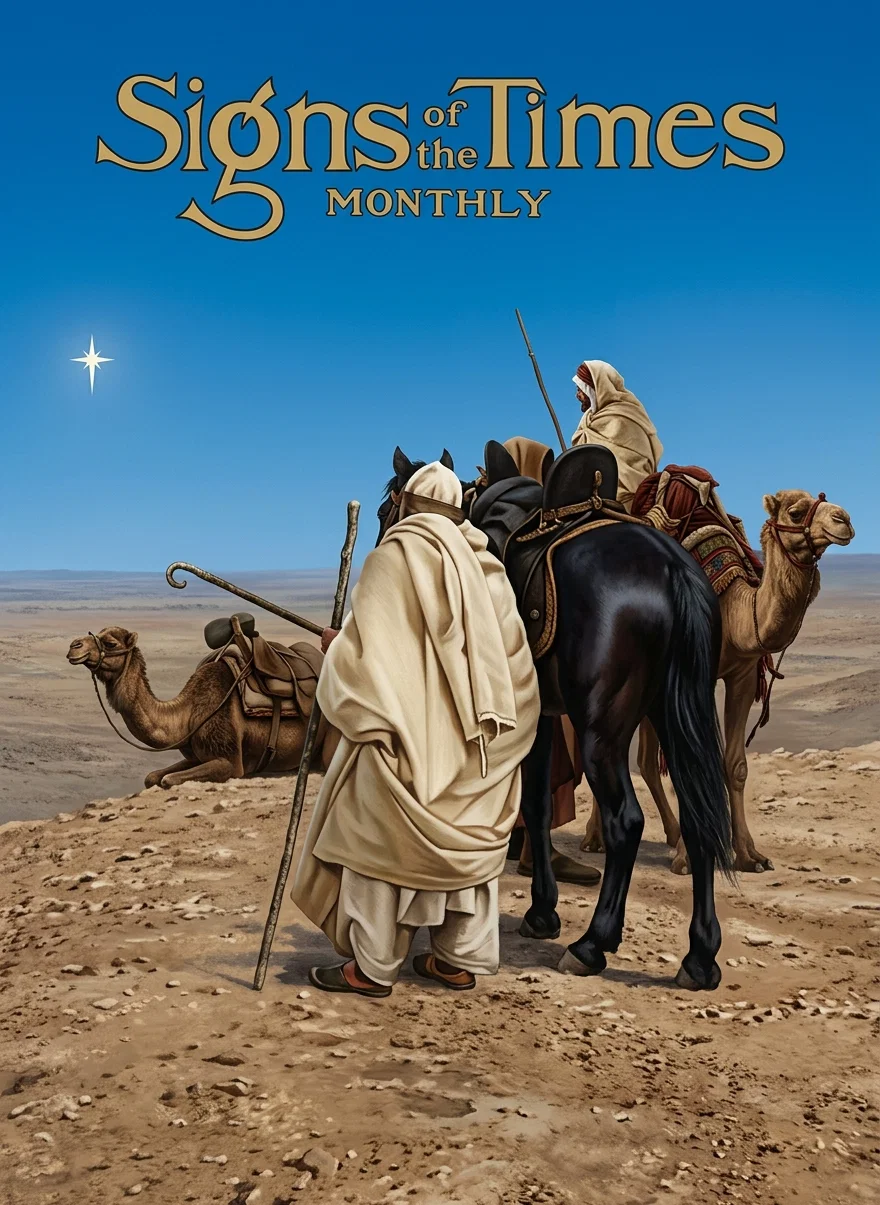
The Christmas Number

BEAUTIFUL is just the word to describe the Christmas number of the Signs of the Times Monthly magazine. The thoughts expressed in the articles are beautiful, and the cover is probably the most attractive that has ever adorned any number.
December cover, in three colors
Our agents will sell many of them and easily. Boys and girls wishing to earn Christmas money to buy books or other useful gifts for father, mother, friends, or one another, would do well to order some of these magazines at once. Sell them for 10c a copy. If you order 50 or more you get them for 4c a copy and thus earn 6c a copy for yourself. At this rate, you see, it wouldn't take long to earn a dollar or two. And think what a lot of good these excellent magazines may do!
Don't dismiss this suggestion from your mind without giving it careful thought. Send your order to us through your tract society, and don't fail to ask for the Christmas number.
SIGNS OF THE TIMES, Mountain View, Cal.

Bible Readings for the Home Circle

Bible Readings for the Home Circle. This book comprises 162 readings for public and private study, and answers nearly 3,000 questions on religious topics—practical, historical, and prophetical. It contains 600 octavo pages, printed on a superior quality of tinted paper, embellished with 57 full-page engravings and 170 ornamental headings, together with 10 full-page Scriptural and prophetic diagrams, 3 colored plates, and other attractive features. The bindings are elegant and substantial, the styles and prices being as follows: Cloth, gilt side title, marbled edges, $3.00; library, marbled edges, $4.00; full leather, marbled edges, $5.00. Cheap edition, 400 pages, solid type, no illustrations or colored plates, no poetry, thin paper, brown cloth, plain edges, $1.25. Address this office.

The Florence Crittenton Home

942 Park Avenue, San Jose, California, stands ready to aid destitute, friendless women, especially young girls who, having been betrayed from the path of virtue, are willing to reform. Full information given interested parties. Mrs. Sara E. Ayres, President of Board, 530 N. 4th Street, San Jose, California.

Meeting of the Medical Missionary Conference

The third annual meeting of the Medical Missionary Conference will be held at the sanitarium at Battle Creek, Michigan, January 5 to 8, 1911. The conference will open at noon of the 5th, with a banquet to all visitors. Missionaries and missionary officers will be entertained free for one week. It is expected that a large number of missionaries, both medical and evangelical, will be present, including men and women of prominence. A cordial invitation is extended to all missionaries, on furlough or retired, to attend this gathering. The conference is interdenominational. All Christian bodies meet on the same footing. Information will be cheerfully given by the secretary, Geo. C. Tenney, Sanitarium, Battle Creek, Michigan.

APPROXIMATE CHRONOLOGY, OR THE TIME OF THE CRUCIFIXION

Places in condensed form a few facts, from Scripture, history, and astronomy, that will enable the reader to understand the exact time of the crucifixion and resurrection of Jesus, giving the year, the month, the day of the month, the time of the moon, the day of the week, and the day of the Jewish month. Price 25 cents. Address H. H. Perry, 67 19th St., San Diego, California.
Having read the “Time of the Crucifixion and Resurrection of Christ,” we testify that to our minds it contains a clear and interesting statement of the facts in the case, fortified with good evidence for the positions taken.
J. N. Loughborough, J. O. Corliss, E. J. Hibbard.

WHY NOT BE AN ARTIST?

Our graduates are filling High Salaried Positions.
EARN $25 TO $100 PER WEEK
In easy, fascinating work. Practical, Individual Home Instruction. Superior equipment. Expert Instructors. Eleven years' successful teaching. Financial returns guaranteed.
Write for particulars and Handsome Art Book.
FREE ARTIST'S OUTFIT (of the best art materials) supplied to each student.
SCHOOL OF APPLIED ART (Founded 1899)
A 300 Fine Arts Bldg., Battle Creek, Mich.

LIBERTY

THE OFFICIAL ORGAN OF

THE RELIGIOUS LIBERTY BUREAU

An illustrated, 48-page, quarterly magazine, published as an exponent and advocate of true religious liberty; defending Christianity and the rights of conscience; upholding the Bible as the infallible word of God; recognizing the church and state as ordained of Heaven for specific and distinct purposes, but vigorously protesting against the alliance of the church with the state in the attempt to advance religion and to promote the state.
Price 25 cents per year. Liberal terms to agents.
Address, LIBERTY, Takoma Park, D. C.
Continue reading: Our Little Friend