Again the annual week of prayer season comes, with its call to us to seek the Lord, and to renew the dedication of our lives to his blessed service. Never yet have we turned aside to seek the Lord's face but we have found his favor. This year the conditions in the world constitute a yet more earnest appeal than ever to praying hearts. Prophecy is fulfilling, the calls for advanced work are sounding, and the week of seeking God was never more timely. We need to seek him for ourselves, for our families, and for every interest of the cause we love. And how greatly the mission fields need our prayers and our means! Events are moving rapidly, and the day of God is hastening. Let the officers of the church and their helpers meet for prayer and counsel before the week of prayer, to plan for revival and blessing in the services. Where a conference laborer is present, naturally he will lead out; but let all unite for earnest work.
Plan to make the week as fully as possible a week of prayer and of rededication to service. Work and pray for the revival of all and for the conversion of those who have not fully surrendered to God. Labor for the young people and the children, and encourage them in working for others.
On the first Sabbath, December 2, announcement should be made of the Annual Offering for missions to be taken up the next Sabbath, December 9, at the close of the morning service. Make sure that all have offering envelopes, so that the gifts may be made up during the week. There is call for the usual enlargement in all the mission fields. It is not man's call, or the call of the missionaries who find themselves overwhelmed, but it is the call of God's own wonderful providence. He is looking to us. Explain these things again and again in the meetings before the week of prayer, and encourage all to plan to meet this annual offering occasion as faithful stewards, doing business for God in his closing work.
May the rich blessing of the Lord be with every believer and every company as we unite in seeking God.
THE COMMITTEE.
Week of Prayer for the Children
By MRS. L. FLORA PLUMMER
MRS. L. FLORA PLUMMER
Our children should have part in this week of prayer, and receive a blessing from God. They need it. They must meet temptations and tests of faith such as children in no other age have experienced. If they learn to seek the Lord for themselves, to exercise faith in his promises now, they will be better prepared to meet the trials and tests of the future.
Let the children not be forgotten nor neglected on this occasion. If no better time can be had, give them part of that devoted to the regular service. They may be given a place on the front seats, and their meeting continue the first fifteen minutes, while the older ones sit back and listen. But it would be much better if they could meet by themselves in a separate room. Their meeting could then be held while the other is in progress, and more time be given to it.
Encourage the children to pray and to take part in their meetings. After the lesson, on some occasions have a testimony meeting. Ask all who would like to speak to rise, then call on one, then another, till all have spoken. This method enables them to overcome embarrassment, and prevents loss of time. This occasion should be one of real revival, and of earnest seeking for a new and better experience.
Do not hold long meetings. Sing the songs the children love. Let every exercise be short, spirited, spiritual. The long prayers should be offered at home and in secret, where the heart may break before God in earnest pleading that he will spare and save the children.
The lesson outlines printed are simply suggestive, and in our small space only a few seed thoughts can be given. Teach the children how to pray at home. Name special objects for prayer each day. Do not simply talk about praying, but pray.
The Week of Prayer: What It May Mean to Us
By I. H. EVANS
(Reading for Sabbath, December 2)
The Week of Prayer: What It May Mean to Us
I. H. EVANS
“We are ambassadors for Christ, as though God did beseech you by us: we pray you in Christ’s stead, be ye reconciled to God.”
This exhortation was written by the great apostle to the Gentile church. This people lay very near his heart. He had suffered many things that he might preach the gospel in Corinth; now that the believers had received Christ, he wrote them, as one anxious for their salvation. “Be ye reconciled to God.”
Reconciliation with God is brought about through Christ; it cannot be accomplished through works. In the work of reconciliation, there must be three parties; namely, the two to be reconciled —the offended and the offender—and the mediator. The offended must be satisfied for the wrong he has suffered, and be persuaded that the offending party will cease offending. The offender must have experienced such a change of heart through greater knowledge, or a changed will and desire, that he not only regrets past offenses, but purposes in his heart to cease doing the things that gave offense. The third party is an intermediary, or middle person, who acts as a go-between, bringing the alienated parties together, and assuring each of the other’s good will and purpose.
The one to be reconciled is God. He is the offended party. It is against him that we have sinned. It is his law that has been broken. When David confessed his sin, he said, “Against thee, thee only, have I sinned, and done this evil in thy sight.” When Christ put words of confession in the mouth of the prodigal, he cried, “Father, I have sinned against heaven, and in thy sight.” Our text says, “Be ye reconciled to God.” Then God is the one to whom the sinner must be reconciled.
The sinner is the offender. Man, created in the image of God and crowned with glory and honor, entered into rebellion against his Maker. Treason against the government of heaven is charged up to man’s account. Man’s rebellion and disobedience is unthinkable,—it would appear unbelievable did we not know it from observation, experience, and the Word of God. When we sing,—
“I’ve wandered far away from God,
The paths of sin too long I’ve trod,”
we only feebly describe man’s fearfully fallen condition. Rebellion and treason are the high crimes against earthly governments. Death is the inevitable penalty. Nothing but mercy can save the offender from ruin and death. In man’s rebellion against God there are no works that he can do to make atonement for his sins. Death is the verdict for sin. “The soul that sinneth, it shall die.” “The wages of sin is death.” These are God’s pronouncements against all transgressors. It is because of our sins that the apostle cries out, “Be ye reconciled to God.”
Christ is our Mediator. He entered into man’s estate, took man’s sinful flesh, and perfectly obeyed God while in this condition. Then he died, tasting “death for every man.” Paul says, “God was in Christ, reconciling the world unto himself, not imputing their trespasses unto them; and hath committed unto us the word of reconciliation.” Not only did Christ die that he might pay the price of8man’s guilt, but he also lives as man’s intercessor.
Again: we are taught in the Scriptures that Christ entered man’s estate, taking upon himself man’s experience, that he might become a high priest in our behalf, to make reconciliation for the people of God. We read, “Verily he took not on him the nature of angels; but he took on him the seed of Abraham. Wherefore in all things it behooved him to be made like unto his brethren, that he might be a merciful and faithful high priest in things pertaining to God, to make reconciliation for the sins of the people. For in that he himself hath suffered being tempted, he is able to succor them that are tempted.”
Not only did Christ give his life while on earth in man’s behalf, but he is giving his life as a high priest now. Even now he is at the right hand of God, ministering in the heavenly sanctuary, interceding for his people, and making atonement in the sinner’s behalf. “Wherefore he is able also to save them to the uttermost that come unto God by him, seeing he ever liveth to make intercession for them. For such a high priest became us, who is holy, harmless, undefiled, separate from sinners, and made higher than the heavens.” Our hearts rejoice that “we have not a high priest which cannot be touched with the feeling of our infirmities; but was in all points tempted like as we are, yet without sin. Let us therefore,” as we are exhorted, “come boldly unto the throne of grace, that we may obtain mercy, and find grace to help in time of need.” We have every reason to believe that Christ is ready to offer himself as our high priest, and to make atonement for our sins. Therefore this scripture, “Be ye reconciled to God,” should come to each one of us with special emphasis at this time.
The week of prayer is set apart for the express purpose of giving opportunity for God’s people to find that reconciliation, and become conscious that they are accepted in the Beloved, with their sins all confessed and put away. As we enter upon this week of prayer for 1916, it seems fitting that we should have a season of close self-examination, and resolve that the week shall not pass until we find full and complete satisfaction for all our sins through faith in Jesus Christ. We know not how many of us who enjoy this privilege today will, through sickness, accidents, or other misfortune, be called to lay down our lives before another week of prayer shall come.
The years, swift-winged and unchained, are inevitably bearing us rapidly to the end of our race. We stand face to face with eternity. Events that once seemed tardy and slow in coming, are now hurrying, rushing, and overwhelming in the rapidity with which they are marching into history. Ought we not at this time to take a retrospective view of the past, and a prospective view of the future, and early fix our purpose concerning our personal duty and experience? A clear vision is of primary importance for a successful Christian.
The Past
No retrospective view can atone for wrong. Yet it seems becoming that we should carefully review the past, and see wherein we have missed the way. When we find ourselves in the wrong, we should seek reconciliation with God, and find pardon through faith in Christ our Saviour. Would it not be for our own best interests that we should determine at the opening of this week of prayer to reach certain results?—
First, to obtain forgiveness of our sins.
Second, to reconsecrate our lives to God.
Third, to resolve to lead some soul to Christ during the coming year.
Fourth, to determine, as far as we are individually concerned, that we will maintain a state of preparedness for life or death, or whatever the Master may see is best for us.
Let us consider these questions in their order, and resolve in our hearts that as far as we are personally concerned, the week of prayer shall bring to us experiences in the four objects mentioned.
The Forgiveness of Sin
Forgiveness and pardon belong to every repentant sinner, and surely the Christian can have them if he will but take them by faith. Few professed Christians have personal faith to believe that their sins are forgiven; yet it is primary and all-important that the children of God should know from his Word that forgiveness is theirs. The receiving of forgiveness of sins is dependent on faith in the Word of God, and on the determination to put sin out of the life. It is not enough to say that God has promised to forgive our sins, if, when we use these words, we have no intention of ceasing to do the thing for which we ask forgiveness. If a man asks the Lord to forgive him for stealing, the very fact that he asks forgiveness implies that he intends to steal no more. If a man asks the Lord to forgive him for being angry, he implies in the asking that he intends to cease getting angry. It is true that he may fall into the snare of the enemy, but as far as his will is concerned, he must be firmly resolved that he is forever through with that thing. When he has thus resolved that he will quit the thing, it is his privilege to believe with all his heart that when he confesses his sin before God, he is forgiven.
Sometimes it is necessary, in order to obtain forgiveness, to go to those whom we have wronged, and, as far as is in our power, to make that wrong right. If we have defrauded or in any way taken advantage of another, before we can expect God to forgive us, we must undertake to make that wrong right as far as we can, by restitution and acknowledgment. Having undertaken this, it is our privilege to believe with all our hearts that God has forgiven us, and cleansed us from all iniquity.
Again, it is our duty to forgive. It matters not what has taken place, nor who the offender may be, it is our duty to forgive and forget all. Christ said, “If ye forgive men their trespasses, your heavenly Father will also forgive you: but if ye forgive not men their trespasses, neither will your Father forgive your trespasses.” Matt. 6:14, 15. Therefore, if we expect mercy, we must extend mercy; if we receive pardon from God, we must forgive those who trespass against us. As we seek for forgiveness, let us also forgive. Let love to all God’s children dwell richly in our hearts. Not a day should pass in which we do not confess our sins to God, and receive from him mercy and pardon for our transgressions. This is our privilege in Christ Jesus. As sons of God, as children of our heavenly Father, it is our privilege to receive from him the forgiveness of our sins. And if we would maintain a Christian life, we must continually live in a state where we are conscious of no sin that we have not confessed, and as far as possible made right. As we sing, let us believe that—
“Jesus paid it all,
All to him I owe;
Sin had left a crimson stain:
He washed it white as snow.”
Reconsecration for Service
Again, the week of prayer should find us in such a spiritual condition that our hearts have been given anew to God for service. The Christian must reconsecrate himself to God daily. Every morning, when he arises, he should give himself to God in a very definite way, by offering to the Lord all his strength, his mind, and his affections, so that there is nothing that he does not daily give to the Lord.
There is nothing in this world that God so much desires as the affections and love of his children. If we have grown cold and indifferent during the past year, the week of prayer should bring to us an experience that will help us to give ourselves anew to God. The enemy is fighting hard for our souls. He is using every agency of which he knows to lead us into disobedience and rebellion against God. It is therefore necessary for every one of us to reconsecrate himself anew to the service of God, and this week of prayer should not close until every heart has made this new reconsecration.
This reconsecration will bring reconciliation between the members of families and between brethren. It is most unfortunate that the enemy should sow alienation in the church or in the home; yet sometimes he gains the supremacy over God’s children in such a way that bitterness springs up, and unless the heart is cleansed of this, many will be defiled by it. This week of prayer should not close until all such alienations are put away, and reconciliation is made.
We cannot understand how any can feel that they are accepted children of God while living in a state of envy and hatred toward God’s children. 1 John 2:10, 11, reads, “He that loveth his brother abideth in the light; and there is none occasion of stumbling in him. But he that hateth his brother is in darkness, and walketh in darkness, and knoweth not whither he goeth, because that darkness hath blinded his eyes.” And again,9“We know that we have passed from death unto life, because we love the brethren. He that loveth not his brother abideth in death. Whosoever hateth his brother is a murderer: and ye know that no murderer hath eternal life abiding in him.” Again we read, “If a man say, I love God, and hateth his brother, he is a liar: for he that loveth not his brother whom he hath seen, how can he love God whom he hath not seen?” We ought not to deceive ourselves, thinking that we are children of God, when we have a spirit of alienation toward any of God’s children. Should not this week of prayer bring reconciliation between brethren and between members of families? The command is, “Be ye reconciled to God,” and this is impossible without reconciliation with one another.
Winning Souls to Christ
Then again we ought individually to resolve that this coming year shall not pass without our putting forth every possible effort to win some soul to Christ. Oftentimes our brethren and sisters seem to think that God has laid on the ministry alone the responsibility of saving the lost. A closer study of the Word of God cannot but lead to the conclusion that this responsibility rests on the church as well as on the ministry, and that each church member must be a soul-winner for Christ. The times in which we live demand great activity in giving the third angel’s message to the world. Events on every hand indicate the nearness of the end. From all that we can see among the nations of earth the prophecies applying to the time of the end are fast fulfilling before our eyes. The church must be aroused to finish the work which God has committed to it. But the church cannot be aroused to this great work until its individual members are aroused.
I know of no one thing that will keep the heart truer to God, and incline the soul more to prayer, to the unity of the faith, and to the love of the brethren, than striving to bring the truth before some one in darkness. Every one of us needs this experience, and we need the faith and courage that come with active service in behalf of our friends and neighbors. If we would but undertake to bring one soul to Christ during the year through agencies God can use in imparting the third angel’s message to others, it would be possible for this church to do a work that would bring the loud cry of the third angel’s message.
Preparedness for Christ’s Coming
Again, we should maintain a state of preparedness for the coming of Christ. If we are to continue in this work, and be ready for the coming of our Master, it is necessary for us to maintain a well-balanced, growing Christian experience, and day after day to continue in a state of preparedness for Christ’s coming. This cannot be attained except through faith in the righteousness of Jesus Christ. The time has come when the people of God should obtain justification by faith and maintain this experience. It is not enough for us to go on as we have been going. We must make a new order of things for 1917, and resolve that as far as we are individually concerned, we will live a clean Christian life, and continually keep our souls so free from sin and so filled with faith, that we can be ready for whatever work the Master may appoint us. It is not safe for the people of God to slumber as did the five virgins. We must have oil in our vessels, and must know that we are ready to meet the Bridegroom. This preparation can be received only through faith in Jesus Christ, believing that he has imparted to us his righteousness.
We sincerely hope this week of prayer will be the very best in the history of our people. Let us set apart each day some definite time when we will go apart by ourselves and commune with God. This is what the week of prayer is for. We do not want to make this week merely a formal week of going through the regular readings and taking the Annual Offering at the close. No; we must have a renewed Christian experience. This will come only as we set apart some definite time to read the Word of God, and to commune with him in prayer. If God’s people will do this, there is no question but that the week of prayer will bring to our people a great revival in spiritual things, and many sinners will be converted to the Lord.
Let us put ourselves in a state of preparedness, and of complete surrender and consecration, as expressed in the hymn which we have so often sung,—
“Ready to suffer grief or pain,
Ready to stand the test;
Ready to stay at home, and send
Others if he sees best.
“Ready to go, ready to bear,
Ready to watch and pray;
Ready to stand aside and give,
Till he shall clear the way.
“Ready to speak, ready to think,
Ready with heart and brain;
Ready to work where he sees fit.
Ready to bear the strain.
“Ready to speak, ready to warn.
Ready o’er souls to yearn;
Ready in life, ready in death.
Ready for his return.”
Then that grand chorus let us all make the motto of our lives,—
“Ready to go, ready to stay,
Ready my place to fill;
Ready for service, lowly or great.
Ready to do his will.”
For six thousand years this earth has been the battleground in the great controversy between Christ and Satan. During this long period dynasties have come and gone, kingdoms have risen and fallen, and the map of the world has been drawn and redrawn, under the varying fortunes of war, and still the struggle continues. What is the prize at stake? What are the issues involved? Have we any means of judging what the outcome will be? Are there any signs, indicated by divine authority, which enable us to determine with certainty whether the final crisis in the controversy is at hand?
“Watchman, tell me, does the morning
Of fair Zion’s glory dawn?
Have the signs that mark its coming
Yet upon thy pathway shone?”
It is true that all through the centuries the waymarks to the kingdom have indicated the progress of God’s work in the earth, and these signs have no less force now than at any time in the past. But our theme leads us to consider present-day indications. There is in these days a sort of universal consciousness that something unusual is impending. It appears to be true now, as it has been at different times in the past, that God is impressing upon the minds of the people the feeling that he is about to arise and fulfil his word. This is clearly shown by the fact that when the destructive forces of nature seem to break loose, or when any especially appalling event occurs, the inquiry passes from lip to lip, “Is this a sign of the end of the world?” So it was at the time of the first advent. So general was the feeling that the Messiah was about to be manifested that “the people were in expectation, and all men reasoned in their hearts concerning John, whether haply he were the Christ.” Luke 3:15. This universal expectation prepares the minds of the people to weigh the evidence presented concerning the fulfilment of prophecy, and in itself constitutes a sign.
Several years ago we were instructed that a spirit of intensity was taking hold of Satan’s agencies:—
“While a new life is being diffused and is springing up from beneath and taking fast hold of Satan’s agencies,10preparatory to the last great conflict and struggle, a new light and life and power is descending from on high, and taking possession of God’s people who are not dead, as many now are, in trespasses and sins.”—“Appeal to Ministers and Conference Committees,” pp. 38, 39.
The spirit of evil seems to be rampant. The public pulse is feverish. Those who pursue pleasure are going to the extreme. Those who are seeking after wealth are running a mad race. Those who are coveting position and power are often found sacrificing honor and character in order to gain their ends. In the whirl of gayety on the one hand, and the struggle for the necessities of life on the other hand,—made more bitter by present economic conditions,—the minds of the many are so fully occupied as to shut out the things of the kingdom of God, and to deter them from making the needed preparation for the coming of the great day.
The Saviour himself foresaw this condition of the last days, and warned us against it: “Take heed to yourselves, lest haply your hearts be overcharged with surfeiting and drunkenness, and cares of this life, and that day come on you suddenly as a snare.” Luke 21:34. The whole picture is clearly drawn by the apostle Paul: “But know this, that in the last days grievous times shall come. For men shall be lovers of self, lovers of money, boastful, haughty, railers, disobedient to parents, unthankful, unholy, without natural affection, implacable, slanderers, without self-control, fierce, no lovers of good, traitors, headstrong, puffed up, lovers of pleasure rather than lovers of God; holding a form of godliness, but having denied the power thereof: from these also turn away.” 2 Tim. 3:1-5.
Sin in some of its most abhorrent forms has become so common as to blunt the senses; and many of the watchmen upon Zion’s walls, instead of crying aloud and sparing not, have lowered the standard, and are making no adequate effort to check the fearful current of evil. A pure gospel of social betterment is taking the place of the gospel of salvation from sin, and special emphasis is being placed upon the desirability of making this world a good place in which to live, rather than upon the necessity of preparing to live in the new earth. The god of this world will not discourage such preaching as this, for he is perfectly willing that men should enjoy the pleasures of sin, and regard this world as an attractive dwelling place, provided only that God is left out of the account. Such a worldly gospel does not turn men from Satan unto God.
The fearful struggle between capital and labor has been increasing in intensity, and the conflicts have been more frequent, more determined, and more destructive, until as we write there is impending a nation-wide strike of railway employees with the avowed intention of tying up every principal transportation system in the United States. The rich are growing richer. “Ye have laid up your treasure in the last days.” The poor are growing poorer, and the gap between the classes is widening.
Disasters by sea and by land are increasing in number, and are claiming more victims than ever. Aside from the terrible destruction for which the war is directly responsible, cloud-bursts, appalling accidents, famines, floods, and fires have occurred with shocking frequency, and the toll of human life exacted has been very large. The terrible explosion in New York City on the morning of July 30 caused a thrill throughout the whole country; and along with the destruction of life and property there was intensified in the public mind the feeling that such occurrences are but the harbingers of worse things yet to come. We are surely living in the time of the last woe trumpet.
With all the rest there is a widespread apostasy from the truth, and the false philosophies of the East, which are at the basis of Spiritualism, Theosophy, etc., are gaining a fresh hold on the West. Those who have refused to listen to the pure gospel of salvation are now “giving heed to seducing spirits and doctrines of demons.” Along with this there naturally comes a laxity of morals and a looseness of sacred relationships, indicated by an appalling increase in the number of divorces and of separated families.
But perhaps the culmination of present-day signs is found in the great war, now in its third year,—a war unparalleled in history for the number of men engaged in the conflict, the destructiveness of the weapons used, the shocking loss of human life, and the creation of war debts expressed in figures so large as to be beyond human comprehension, and which seem likely to bankrupt the world. This is the climax of the outworking of the principles sown broadcast in the earth by the god of this world, the outcome of the substitution of hatred for love, of physical force for the power of love, and of the effort to establish the law of selfishness in the place of the law of self-sacrificing love. The great outstanding facts of this fearful conflict have been so constantly impressed upon the world during the last two years that they need not be repeated here. It must be plain to all that we are in the time of the sounding of the seventh trumpet, when “the nations were wroth, and thy wrath came, and the time of the dead to be judged, and the time to give their reward to thy servants the prophets, and to the saints, and to them that fear thy name, the small and the great; and to destroy them that destroy the earth.” In the expressive words of President Wilson, “the world is on fire.” The Biblical description is absolutely correct: “Upon the earth distress of nations, in perplexity for the roaring of the sea and the billows; men fainting for fear, and for expectation of the things which are coming on the world.” Luke 21:25, 26.
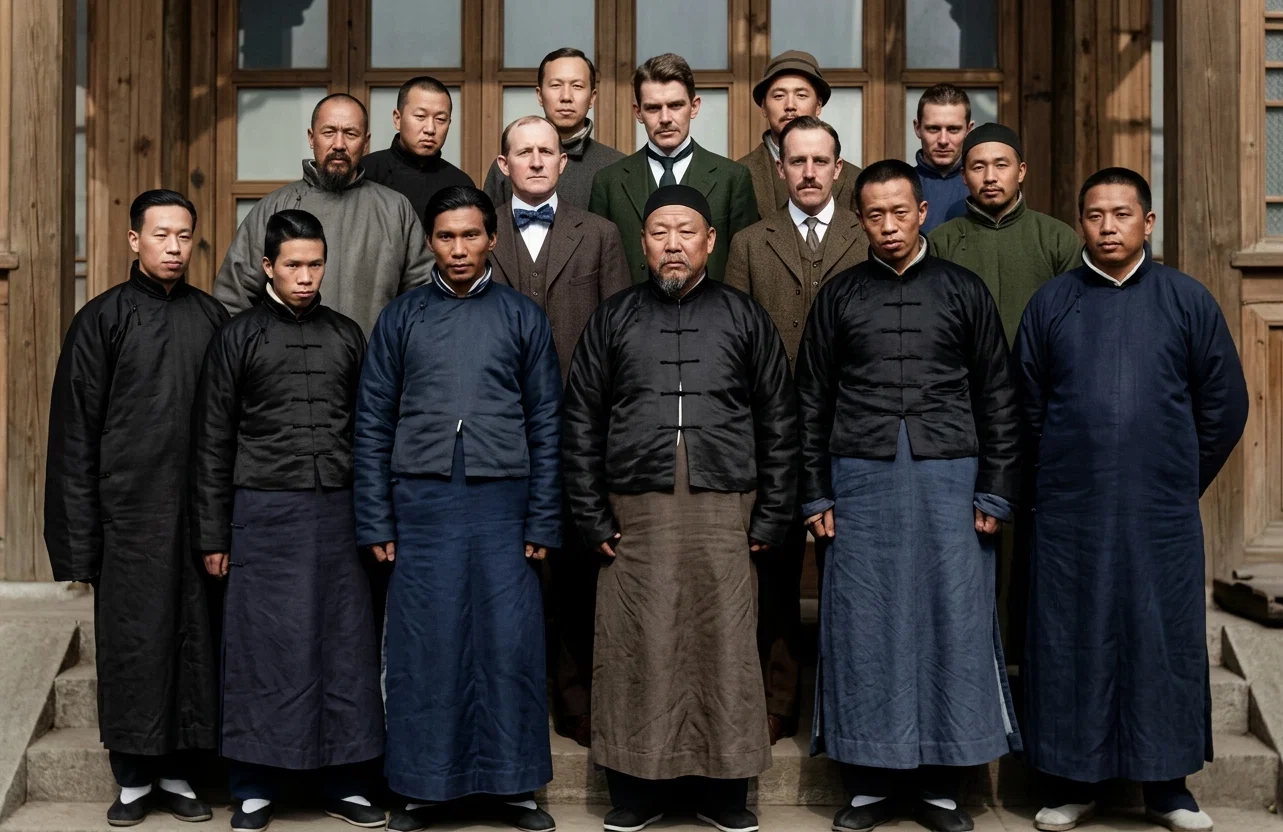
A GROUP OF CHINESE EVANGELISTS WHO GIVE THE SAME STIRRING RING TO THE MESSAGE AS IS CHARACTERISTIC OF IT IN THE HOMELANDS
Another impressive sign of the times is the progress made in the effort to reestablish the power of the Papacy in fulfilment of prophecy. Those who have followed the fresh pretensions and the activities of the head of the papal organization since the opening of this war, must have been impressed with the feeling that among the most notable results of this world-embracing conflict will be the reëstablishment for a short period of the world supremacy of the Papacy. In just what way this will be brought about, whether by recognizing the Pope as the mediator among the nations, or by direct reëstablishment of the temporal power of the Papacy, we are unable to forecast; but it is evident that the self-styled sovereign on the Tiber expects to profit by the miseries of the nations, and to rebuild for himself that power which in recent decades has been shattered by some of the very nations which formerly sustained it. It is certain that the death stroke inflicted upon one of the heads of the beast from the sea will be healed, and that again the whole world will wonder after the beast.
While making a hasty review of some of the leading signs of the present hour, we must not overlook the fulfilment of the prophecy relating to the final proclamation of the gospel of the kingdom11in immediate preparation for the second advent. In the last generation “this gospel of the kingdom shall be preached in the whole world for a testimony unto all the nations; and then shall the end come.” Matt. 24:14. John foresaw it in vision, and definitely described the fulfilment of our Lord’s prediction in the threefold message of Rev. 14:6-12.
This movement which has called us out from the world, this movement which in a single generation has extended to the ends of the earth, this movement which is the final call out of Babylon and the summons to obedience to the commandments of God, is in itself convincing proof that we are in the last days. The unusual experiences which have been reported from various fields since the opening of the great war show clearly that while an intensity is taking hold of the power from beneath, power also is coming down from above to make efficient the agencies for the proclamation of gospel truth. The recent organization of the Asiatic Division Conference and of the South American Division Conference has brought all the world into a consistent and well-developed organization for giving the last message to the world and finishing the work of God in the earth. From China, from India, from the Philippines, from Africa, from South America, from almost every quarter of the globe, there have come stirring reports showing the rapidity with which the message is extending. The power of God has been revealed in a special manner in winning thousands directly from the darkness and the bondage of heathenism into the light and liberty of this threefold message.
Thus in the developments of the last two or three years we see wrought out before us the destructive results of the working out of the principles of Satan’s government in this world, results which clearly show the real nature of sin and the consequences to the human family of that rebellion which would, if possible, dethrone God and establish Lucifer in his place. This ambitious design has been exposed by the prophet Isaiah: “Thou saidst in thy heart, I will ascend into heaven, I will exalt my throne above the stars of God; and I will sit upon the mount of congregation, in the uttermost parts of the north; I will ascend above the heights of the clouds; I will make myself like the Most High.” Isa. 14:13, 14.
At the same time we see revealed in their fulness the principles of mercy, love, and justice, and the outworking to its final consummation of the plan of God to save a fallen world, to redeem the human family, and to restore righteousness and peace in this part of his domain. This twofold climax marks the nearness of the end. It shows that we have come to the crisis of the ages.
The great controversy is over the possession of this world. Even now voices are heard in heaven saying, “The kingdom of the world is become the kingdom of our Lord, and of his Christ,” but the god of this world is putting forth the most strenuous efforts to retain his dominion, to hinder the purposes of God, and to carry down with him to final destruction as large a proportion as possible of the human family. Humanity is being intoxicated with the love of pleasure, with the love of power, and indulgence is being carried to the extreme limit. Only one step farther can be taken in this desperate struggle, and that will be the personal appearance of Satan upon the earth, to deceive, if possible, the very elect, and to bind to himself every one whose allegiance to God is not sealed under the everlasting covenant of peace. But soon the glorious consummation so long hoped for and waited for,—the personal revelation of Christ to gather from the earth those whom he has redeemed by his own blood,—will be realized, and the triumph of the gospel, and the full establishment of the sovereignty of God in the earth, so long a subject of prophecy, will become an actual fact. “Behold, he cometh with clouds; and every eye shall see him.”
We are living in the hour of God’s judgment. Daniel described the scene, and John completed the outline with the details of a most solemn character. The destiny of souls is in the balance. This final message of preparation calls for that personal experience in walking with God as did Enoch of old, which will prepare a perfect people to pass from earth to heaven without seeing death. This means the perfection of Christian character. This means the full realization of all the blessings promised through the gospel. A special reward awaits those who now realize this experience of fellowship with God, and who are thus prepared for the final issue.
“Watch therefore: for ye know not when the Lord of the house cometh, whether at even, or at midnight, or at cockcrowing, or in the morning; lest coming suddenly he find you sleeping. And what I say unto you I say unto all, Watch.” Mark 13:35-37. Happy is he who heeds this exhortation, and is prepared to meet his Lord with joy.
The Lord's Prayer
Children's Lesson — No. 2
The Lord's Prayer
“HALLOWED be thy name.”
Memory Verse: “Holy, holy, holy, Lord God Almighty, which was, and is, and is to come.” Rev. 4:8.
“The angels veil their faces in his presence. The cherubim and the bright and holy seraphim approach his throne with solemn reverence. How much more should we, finite, sinful beings, come in a reverent manner before the Lord our Maker.” — Mrs. E. G. White.
The commandments forbid the careless use of God's name. Ex. 20:7.
We cannot truly hallow God's name, and not also hallow that which he has hallowed or made holy.
The Lord hallowed the seventh day. Ex. 20:8-11. He says to us, “Hallow my Sabbaths.” Eze. 20:20.
The name of God is not hallowed when his Spirit is grieved away from meetings for worship by irreverence. This may be indicated by noisy behavior, laughter, whispering, thoughts of work or play, feelings of pride in our own appearance, or envy of others, carelessness in hearing the word spoken, or any lack of a spirit of devotion.