The Youth’s Instructor, Vol. 34, No. 28.

MATTY'S NEW HEART
Earlier text: MATTY'S NEW HEART

Nova Scotia's Vast Coal Fields

NOVA SCOTIA has a known coal area of nearly seven hundred square miles, or nearly twice the area of the Pennsylvania anthracite fields. Some of the Nova Scotia fields have a greater thickness of workable coal than probably exists anywhere else in the world.

Lord Holland's Weekly Concerts for His Horses

The eccentric Lord Holland, of the reign of William III., used to give his horses a weekly concert in a covered gallery specially erected for the purpose. He maintained that it cheered their hearts and improved their temper, and an eye-witness said, “They seemed to be greatly delighted therewith.”

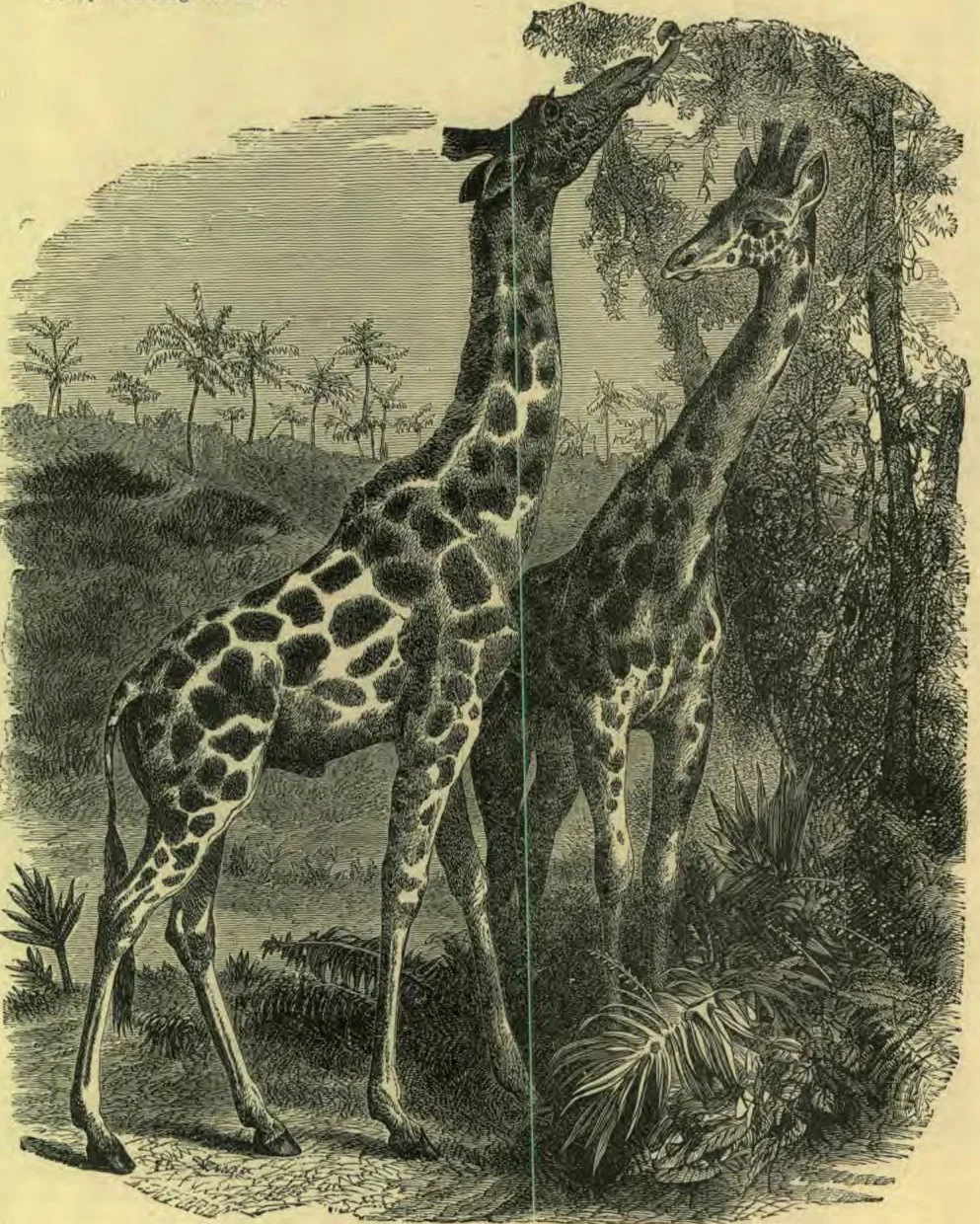
THE GIRAFFE.

HERE is an animal whose long legs and high head are a wonder indeed! He is the tallest of all earthly dwellers, and crops his food with ease from the branches of the trees. Other animals are content to eat the grass at their feet, but the giraffe never stoops to any thing so low. He is ever looking upward; indeed, he cannot put his nose to the ground without much effort and straddling of his forelegs.
The male is often eighteen or twenty feet high, and if three tall men stood one on the head of the other, the highest would hardly reach the giraffe’s nose. What a neck this would be to have a cold in! Just think of two or three yards of sore throat! A bed blanket would be required to wrap around it.
Not many years ago this animal was known only to a few travelers, whose accounts of it were scarcely believed. But at length four giraffes were trapped in Abyssinia, and were exhibited and became known to the world.
The giraffe resembles the leopard in color, having a sleek and spotted skin. The shoulders are high, giving it a tapering appearance from the head to the tail; but the hind legs are as long as those in front. Its tongue is often stretched out a foot or more from its mouth, and is used, like the trunk of the elephant, as a feeler, grasper, and an organ of taste. With it he picks out the best and tenderest of the leaves, rejecting all others instantly by the touch. When carried around for a show, he is quite inclined to reach up to the high seats and twist off the flowers from the ladies’ bonnets, and, as might be expected, he makes no little stir among them. Other mischief he does with this unruly member, which he can contract to a very small point.
His eyes are large and very beautiful, and so made that he looks in every direction without the trouble of turning his head; no enemy can approach undiscovered. He is fond of company, and is said to shed tears when separated from his mate.
His nostrils are protected, even down to the margin, by strong hair which shuts out the entrance of the fine sand, which the suffocating storms of the desert stir up. Thus God wonderfully adapts him to the place where he is to live.
He is swift of foot, and presents a singular appearance when running. His tail is curled up over his back, and he switches it to and fro so swiftly that it makes a hissing sound; his head moves with it in exact time, while his two hind feet at every leap strike far ahead and on either side of the front ones.
These animals are as gentle and inoffensive as deer, and when tamed, are playful and affectionate. The giraffe has some human traits of character, being very fond of attention, and often resorting to little tricks to gain the admiration of visitors.
Unlike most other animals, it is dumb, never expressing by a sound its pleasure or its pain; even when dying, no groan or sigh escapes it; but its great, lustrous, mild eyes tell what its tongue fails to articulate. Oh, who would wish to hurt or annoy so beautiful and helpless a creature!
When attacked by beasts of prey in their own native woods, the giraffes escape by flight, if possible; but if not, they let fly their nimble hind legs with such lightning-like velocity, that even lions are glad to beat a retreat. But if the lion springs unperceived upon the giraffe, he soon overcomes it by his superior strength and terrible claws, and the poor creature yields to its fate, looking mildly and imploringly upon its foe.
In their own native woods, giraffes like company; they herd together in droves of twenty or more, and are led by an old experienced male. Hunters often mistake a drove for so many trees; or think the tall trees are the necks of the giraffe, and so creep up very slyly, only to laugh at their own mistake.
There is a peculiar and not unpleasant odor about these animals, which reminds one of the smell of balm honey; and the same is perceived in the flesh when cooked. This is supposed to be derived from the fragrant flowering shrubs on which they feed.
Hunters find it difficult to bring down these haughty monarchs with their rifles, and so resort to deep pit-falls, with an inside cross wall, not as high as the sides; and if a giraffe is so unfortunate as to fall in, his hind feet are on one side of the wall, while the forelegs are on the other. Thus hung, he is unable to touch the ground.
Surely a man must be cruelly hard-hearted to hunt for sport these noble and confiding creatures, and God will not hold him guiltless who wantonly torments and destroys them.—Selected.

A MASQUERADE.

A LITTLE old woman before me Went slowly down the street; Walking as if aweary, Were her feeble, tottering feet.
From under her old poke bonnet I caught a gleam of snow, And her waving cap-strings floated, Like a pennon, to and fro.
In the folds of her rusty mantle Sudden her footstep caught, And I sprang to keep her from falling, With a touch as quick as thought.
When under the old poke bonnet, I saw a winsome face, Framed in with the flaxen ringlets Of my wee daughter Grace.
Mantle and cape together Dropped off at my very feet; And there stood the little fairy, Beautiful, blushing, sweet!
Will it be like this, I wonder, When at last we come to stand On the golden, ringing pavement Of the blessed, blessed land?
Losing the rusty garments We wore in the years of Time, Will our better selves spring backward, Serene in a youth sublime?
Instead of the shapes that hid us, And made us old and gray, Shall we get our child-hearts back again, With a brightness that will stay?
I thought—but my little daughter Slipped her dimpled hand in mine; "I was only playing," she whispered, "That I was ninety-nine."
—Selected.

Letter Budget.

You will all be glad to read a letter from a little girl away in New Zealand. It came by the way of Eld. Haskell, who, you know, has recently returned from starting a mission there. Eld. Haskell says he “had the pleasure of baptizing her among the first few who were baptized, and she is now a member of the church.” The letter is from MARGARET HARE, of Auckland, New Zealand. She writes: “As I have never written for the Budget, I thought I would write a few lines. I am a little girl eleven years old. I have one brother and four sisters. We have been keeping the Sabbath since Mr. Haskell came here first. There are a good many keeping the Sabbath in Kaeo. We go to Sabbath-school nearly every Sabbath. I go to day school, but just now there is no school because the schoolmaster’s daughter is sick.”
ROSA JACKSON writes a letter from Tippecanoe Co., Ind. She says: “I am a member of the INSTRUCTOR family; so I will write a few lines for the Budget. I am ten years old. I go to Aunty Peret’s Sabbath-school. We have just begun Book No. 2. I like the INSTRUCTOR very much. I have three brothers, and we all go to school. I go every day. There are about five hundred children in our school. At home we have chickens, geese, and cows. I like to help mamma take care of them. I would like to have my letter printed.”
EVELINE VAN GUNDY, writing from Deer Lodge Co., Montana, says her arm that she hurt some time before, and which she had written about, is getting well. Her great grandma is now eighty years old. They had a young bear, but he became so unruly that they had to kill him. He was so fat his flesh looked like pork.
JESSIE McNEAL and TENSA HOWELL write a letter from Sciota Co., Ohio. Jessie says: “Thinking you would like to hear from us away down in Southern Ohio, and as Tensa was making me a visit, we thought we would write to the Budget. I am the youngest of the family. I attend Sabbath-school, which is four miles away, with my parents, brother, and sister. There are fifteen scholars in the school and four classes. Papa is superintendent.” Tensa says: “Jessie and I get our lessons in Book No. 3. My aunt is our teacher, and we like her very much, because she explains things so well to us. I go to Sabbath-school with mamma and my brother. My little sister Flora died last November with the diphtheria. We all miss her very much at the Sabbath-school. I am fourteen years old. My oldest brother and sister do not keep the Sabbath. We do not have preaching very often. We will close, hoping to see this letter printed.”
GEORGE PEAVY, of Harvey Co., Kan., says: “If you will let mamma write for me, I will send a letter to the Budget. I am seven years old. I help papa do the chores. I water the mule, feed and water the chickens, and help take care of my little brother Eddie, who is three years old. We both go to Sabbath-school. I study in Book No. 1. We have a good school. Eld. Cook preached here Monday night from Revelation 22. The house was full. I want to be a good boy, so I may be saved when the Lord comes.”
ROSETTA HILL, writing from Mercer Co., Mo., says: “This is my first letter to the Budget. I am a little girl eleven years old. I have one sister and two little brothers. We go to Sabbath-school with our parents. I study in Book No. 4, and my brothers in No. 1. I love the Sabbath-school, and try to have good lessons. I give my teacher and school-mates at the day school some of my INSTRUCTORS to read, and they seem to like to read them very well. I am trying to do missionary work this way. Father says he will give me some ground for a missionary garden, and I am going to try to make a success of it. I hope to meet the INSTRUCTOR family in the new earth.”

You have reached the end of this edition.

The Youth’s Instructor · Jul 14, 1886