“O HAN! I’ve heard bad news about you,” said Mrs. Eldred, excitedly, rushing into her friend Mrs. Peeble’s cozy room.
“Why, Emily,” said Mrs. Peebles, her rosy cheeks growing more rosy still, “how you startled me! I thought the house was on fire.”
“ Worse than that, Han; I have heard that you have sold this lovely farm and bought a horrible hotel. Tell me it isn’t so; I cannot bear it.”
“We have certainly sold our farm, and bought, not a ‘horrible’ hotel but a nice one at Mt. Morris; I am tired of hard work. But why should this excite you?”
“O Hannah!” said Mrs. Eldred, sinking down in a chair and covering her face with her hands, “I am so sorry! so sorry! Suppose your husband and son become drunkards?”
“My husband is a gentleman, I do not fear him; and Johnny—if we cannot control such a slip of a boy as that, I’m sorry.”
“Bet I’ll have all the wine I want for once!” said ten-year-old Johnny looking saucily up.
“And I too,” said his little sister; “it’s so good!” And the dimpled little maiden began to practice her dancing steps. They were lovely children, and the mother, fresh and blooming as a girl, was a beauty. The neat, tasteful home bore evidences of good house-wifery, and Mrs. Peebles bore the palm in all the country around for cookery.
“Just the place to put you my bonnie wife,” said Mr. Peebles, as he regaled himself at her bountiful table. “It’s just barbarous for me to monopolize all your talents. You’ll make my fortune in a hotel, where so many can enjoy your exquisite, fine cookery.”
“Only think of it, Ezra! that ridiculous Emily is afraid you’ll get to be a drunkard if you go into a horrible hotel, and she cried about it!”
A merry laugh followed this speech, which prevented Mrs. Peebles from noticing the flush which covered her husband’s handsome forehead.
“Thank fortune! we’ve got a gentleman for hotel-keeper now,” said the Mt. Morris people, as the new landlord and his family settled down in their new home, which was freshly garnished for the sacrifice.
Down grade is the swiftest. Is that why so many take it? Not a year had passed by when friends began to whisper, “Mr. Peebles is too good a customer of himself.” Johnny grew up rough and roystering. Nettie became more beautiful than her mother, and while she was yet in her early teens, ran away with a traveling agent who frequented the house, and married him. This ill-assorted marriage was soon dissolved by voluntary separation, and Nettie, a tarnished flower, returned to her father’s house. Life in the hotel only lasted a few years,—years which sufficed to plant the appetite for the “liquid fire” firmly in father and son. Disease, too, was rioting upon the abused vital forces. Consumption means something when it is super-induced by alcohol.
Mr. Peebles, after a few months of intense suffering, went down into the grave, and Mrs. Peebles, wasted and worn, looks back upon her ten years’ work, lost treasures, dissipated fortune, and sighs, “Oh if I had only known!”
She sees the cows and sheep quietly grazing near the dear old farm-house, where the birds sing all the day long. She passes by the “horrible hotel,” still busy at its work of death, and murmurs, “What a choice I made! and I am reaping the fruit of what I have sown.”
Reader, this is no fancy sketch; only the names are fictitious. It is a true record of a part of ten years’ work.—National Temperance Advocate.
Economy in the Household
By Mrs. W. F. Crafts
—Margaret J. Preston, in Independent.
Economy in the Household.
“It’s what thee’ll spend, my son,” said a sage old Quaker, “not what thee’ll make, which will decide whether thee is to be rich or not.”
Not what we spend, but what we save, is what will make rich, is the usual way of putting this matter. Evidently, the old Quaker was thinking more about the money that should be spent rather than the amount. Sometimes we hear people say, with a laugh, when they are spending an unusual amount of money, “I am buying myself rich,” meaning that they are getting so many things. To teach how to buy one’s self rich, is the aim of this short chapter on economy. It is easy enough to buy one’s self poor; that can be done without any instruction. The first rule we shall give is,
BUY NOTHING THAT IS NOT NEEDED.
Plain food will satisfy the actual needs of the body. Pies, cakes, puddings, preserves, and sweetmeats, are not necessities; they are often the causes of disease and unfitness for work. It will take less money to buy meat, fruit, and vegetables, than these dainties, and they will yield a large return of muscle and strength in every part. The actual needs of the body in clothing are not large. An oreide breast-pin, or sham diamonds, or lace-trimmed flounces, or sparkling jets, or tinkling bangles, do not add any to the comfort of the body, but rather to its discomfort. It is not by spending money for foolish articles of food or clothing that we are going to buy ourselves rich. Economy in food does not mean that our tables shall be uninviting; neither does economy in dress necessitate ugliness. Let us bring to plainly, neatly-spread tables the sauce of hunger and the bread of contentment, and the repast will prove fit to set before a king. Let us clothe ourselves with the ornament of a meek and quiet spirit, and flashing jewels, lace, and velvet, will not be needed to make us attractive. It would not be a bad idea for a house-keeper to take an inventory of stock the first of each year, something after the fashion of business men; that is, to make a list of household possessions under two heads—“things needed” and “things not needed.” It might be well, also, to add up the two columns and compare the sums. “Why spend ye your substance for that which is not bread?” would be a question that would naturally follow in many homes. The second rule to be given is,
BUY ONLY GOOD MATERIAL.
“Cheap” is a snare in which even very sensible people are sometimes caught. It is not unusual for people to buy things that they do not need, just because they are “cheap.” The auction room becomes to such people somewhat like a spider’s web to catch the silly fly. In making purchases, it is safe to conclude that we get no better things than we pay for. The trade cannot afford to give us better bargains than that. Our care, rather, should be to get as good as we pay for; cheap things are cheap; the price will never be below the quality. When a cheap piece of silk is offered, let us consider whether or not we can afford to pay the price asked for so much dye stuff and material. When a cheap piece of muslin is offered, let us stop to think of the price of starch, and decide that cotton, not starch, makes the best wearing material. In getting shoes, let us remember that strong leather costs more, but wears better, than brown paper soles.
A dress of good material will “make over as good as new” two or three times, while a poor material will be unsightly with a few times wearing. The third rule is,
KEEP AN ACCOUNT OF EXPENDITURES.
“I must have lost some! Where can my money have gone?” are expressions that may often be heard, when one returns from a shopping expedition. Then the buyer will sit down and make a list of things purchased, and add up their cost, and find that nothing has been lost except in foolish bargains. To keep an account of all money spent is a wholesome check upon extravagance. It would be well to add up the account once a week, and see how it compares with the income. This is a sure recipe for living within one’s means. The fourth rule is,
DO NOT GO IN DEBT.
It is so much harder to pay for things already eaten or worn, that they seem to cost twice as much as when they are paid for at the time of their use. Debt is a destroyer of self-respect, of peace of mind, of the good opinion of others, of one’s ability to do the best possible with the amount he has to spend. A buyer with cash in hand can always do better, get fairer prices than one who must ask for time. Do without things until you can pay for them, is sound advice.
“Economy is a virtue in the richest king!” Why should the rich be careful of their means? To teach those who are less fortunate that it is not mean or stingy to be economical, and so as to have more to give to the poor. Both rich and poor should remember that the earth is the Lord’s, and the fullness thereof, and that they are only stewards to make a wise disposition of what is only for a lifetime placed in their care.
—Mrs. W. F. Crafts, in Christian at Work.
What People Will Say.
By Anna Oliver
At a prayer-meeting recently the burden of three of the prayers was that we might be "freed from a man-fearing spirit." In some form this thought is frequently expressed in private and in public. We leave duties neglected, lest some one should say we are putting ourselves forward; or we do what we otherwise would not in order that persons may form of us some opinion we hold to be desirable. Multitudes of men and families sacrifice comfort, health, and self-respect to grasp and hold; not for the sake of enjoying wealth, but that they may be reputed wealthy by the world. We say "the world," and it sounds large; but really to most of us a very small circle constitutes our world. If some five or six persons approve our course, it is all right with us. In short, "what people will say" gives the key-note to many actions.
Now, a few days since we were pondering the question why it is that, with few exceptions, every one is under the thumb of Mrs. Grundy, when we called to see a friend. Her little child was playing in the room. Presently the nurse-girl came to take him away and prepare him for dinner. But the young gentleman preferred to remain with the company, when Mamma interposed in this manner:—
"Oh! Willie must go and have his hair brushed. Why, that lady thinks Willie has not had his hair brushed to-day. See how astonished she looks! And (to the nurse) Mary, every one will think Willie has no more clean aprons unless you put one on him right away."
This had the desired effect. The child went at once to be brushed and dressed, from fear of what persons would think of him.
The next call made was on a poor sick woman. She had a child somewhat younger than the other—two years old, perhaps. Soon the little one began to cry, interrupting our conversation.
"Oh, my!" said the mother. "See Gampa looking at you. He thinks it awful queer Minnie should cry."
Now, Grandpa was a surly old man, sitting in the corner of the room, reading his newspaper and paying no attention whatever to the child. But Minnie straightened her face, and wiped her eyes, to see whether "Gampa" didn't think her "awful queer."
This visit finished, we returned home, and proposed to take Ethel, our own little girl, out for a walk. We asked the lady who has her in charge to put on her coat. But Ethel said,—
"Oh! no. I want to wear my 'ittie boo shawl."
Immediately the lady exclaimed: "Mercy on us! If the little girl should go out with only her little blue shawl on, everybody in the street would look at her. And they would all say to themselves: 'Is it possible that little girl hasn't got her winter coat yet?'"
At this Ethel laughed. The coat went on and the walk proceeded. The young lady carried herself and eyed every passer-by in a manner that said "Look at me. I've got my winter coat on."
Returned from the walk, her wraps were removed; but her mittens, being a novelty from gloves, she did not wish to relinquish.
"Mercy on us!" was again exclaimed. "Did I ever hear of a little girl's wearing her mittens in the house? What would everybody think?"
At this point we sat down, with the clear conviction that we had arrived at the solution of the question previously pondered. From the earliest dawn of consciousness up to maturity, the motive most frequently held before our children is the opinion of others. What wonder that so many of us are slaves to Mrs. Grundy. Boys and girls thus trained will be at fourteen years of age thoroughly self-conscious, and will ask themselves, in regard to every action, not what is wise and right, but "What will people say?" If parents and all who have the care of children will watch themselves, they will probably be surprised in discovering to what an extent they present this motive. It is so easy in this manner to stop children from crying or induce them to conform to our motives that the temptation is great. But a very little thought will obviate this and offer true motives of action.
For instance, take the case of Ethel. The very next day she was going to play in the yard, and her warm coat was needed; but again she preferred her shawl and was 'cute enough to suggest,
"Nobody tan see me in the yard."
We drew her into our arms, and said,—
"Our little darling must wear her coat because it is right to do so. Does she not remember how bad a cold and cough and sore eyes she had when she came from the asylum to live with us? She is now strong and well, and we love little Ethel too much to let her get so sick again. At that time, you know, pet, you had no warm clothes to wear; but now our Heavenly Father has given you home and friends and nice warm things, and he expects you to wear them and keep well. Is it not kind in our Heavenly Father to take such good care of little Ethel?"
By this time the coat was on and buttoned, and the child's lips were held up to us for a kiss, as she said:—
"I 'uv Heav'ly Father most and 'ou next."
And thus, her thoughts drawn off from herself to the goodness of God, she went out to her play.
Now we submit if such motives are not far in advance of the former. Besides, the former are not true. People are not thinking about us, are not talking about us. If we pause to reflect, it is very apparent that the world—a few gossips excepted—is thinking of itself, not us.
The one general reason to be given to children, however young, for any course to be pursued is, because it is right. Why it is right can also usually be explained to them. If we had one generation trained to such motives, we would need fewer prayers against a "man-fearing spirit," and heroes would be more common who would "dare to be a Daniel, dare to stand alone."—Anna Oliver, in Independent.
The Home Circle.
By Margaret J. Preston
ANISE AND CUMMIN.
WEARY with homely duties done,
Tired through treading day by day,
Over and over from sun to sun,
One and the same small round alway,
Under her breath I heard her say:
"Oh! for the sweep of the keen-edged scythe,
Oh! for the swaths, when the reaping's o'er,
Proof of the toil's success. I tithe
Anise and cummin—such petty store!
Cummin and anise—nothing more!
"Only a meagre garden-space,
Out of the world so rich and broad—
Only a strip of standing-place!
Only a patch of herb-strown sod
Given, in which to work for God!
"Yet is my hand as full of care
Under the shine and frost and rain,
Tending and weeding and watching there,
Even as though I deemed a wain
Were to be piled with sheaves of grain.
"Then when the work is done what cheer
Have I to greet me, great or small?
What that shall show how year by year,
Patient I've wrought at duty's call?
Anise and cummin—that is all!"
Turning, I raised the drooping head,
Just as I heard a sob arise:
"Anise and cummin and mint," I said
(Kissing her over her aching eyes),
"Even our Lord doth not despise.
"Think you he looks for the headed wheat
Out of your plot of garden ground?
Think you he counts as incomplete
Service that from such scanty bound
Yields him the tithing he has found?
"What are to him the world's wide plains?
Him who hath never a need to fill
Even one garner with our small grains?
Yet, if the plot is yours to till,
Tithe him the anise and cummin still?"
—Margaret J. Preston, in Independent.
HEALDSBURG COLLEGE.
A MODEL INSTITUTION.
Instruction given in Ancient and Modern Languages and the Physical Sciences.
Common Branches Thoroughly Taught.Special Training for Teachers.
GREAT SUCCESS.
This Institution has met with almost Unparalleled Success in the short time since its incorporation.
WHY DOES IT PROSPER?
1. The Instruction is very Thorough and Practical.
2. The Discipline is Rigid yet Parental.
3. The Strong Moral and Religious Influence finds its equal in no other Institution of the kind.
4. The Expenses of Students for Board, Tuition, etc., come within the ability of all.
5. The Methods employed in the class-room, and the Professional Instruction, afford special advantages to those desiring to teach.
While its courses embrace all the higher Collegiate Branches, which are taught in the most thorough manner, especial attention is given to the Common Branches.
DISCIPLINE.
One of the prominent features of Healdsburg College is the effort to impress upon its students the claims and benefits of morals and religion. Any one of known evil habits, who is exerting a pernicious influence upon his fellow-students, is not tolerated in the school.
EXPENSES.
The tuition ranges from $2.25 to $6.00 per month. Board in private families and in the college boarding-house ranges from $3.00 to $3.50 per week, with room completely furnished.
ADVANTAGES TO TEACHERS.
Besides the regular class drills in the different branches, there is given occasional instruction concerning methods and genera. school management.
A PRIMARY DEPARTMENT
Is connected with the College to accommodate those children whose parents desire to place them under the instruction and moral influence of the school.
CALENDAR.
The Spring Term begins January 3, 1883, and closes May 29, 1883. After a vacation the Fall Term opens July 25, 1883.
Address, S. BROWNSBERGER, A. M., President,
Healdsburg, Cal.
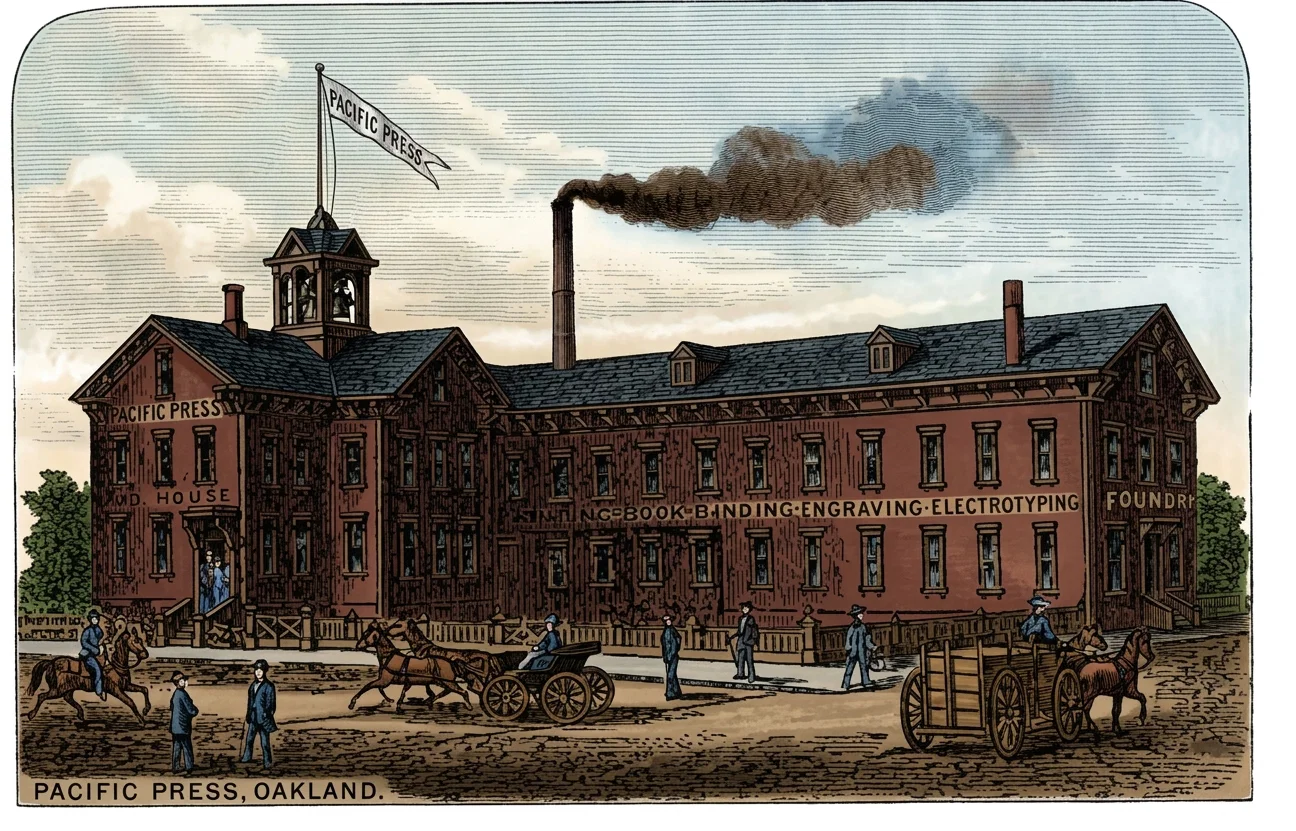
PACIFIC PRESS PUBLISHING HOUSE,
By Editor
PUBLISHERS "SIGNS OF THE TIMES," Etc.
GENERAL BOOK AND JOB PRINTING,
In the Best and Latest Styles, and at Satisfactory Rates.
BOOK-BINDING,
In all its Various Branches, Promptly Executed in the Most Substantial Manner.
STEREOTYPING AND ELECTROTYPING,
By the Latest Improved Methods.
ENGRAVING.
In the Finest Styles of the Art.
Orders for anything in our line, by mail or express, will receive prompt attention.
Address, PACIFIC PRESS, 12th and Castro Streets, Oakland; Or, 529 Commercial Street. San Francisco.
News and Notes.
—A violent earthquake shock was felt in different parts of Northern Ohio, Jan, 6.
—By the sinking of a flat-boat in North Carolina, Dec. 30, eighteen convicts were drowned.
—The number of failures in the United States in 1882 is reported at 6,738, with liabilities aggregating $101,000,000.
—Los Angeles, Cal., is now lighted by electricity. The lights aggregate 69,000 candle power, and illuminate fifteen square miles of territory.
—A correspondent of the Tulare Times states that Tulare Lake fell fourteen inches during 1881, but lost twenty-six and a half inches in 1882.
—By the census bulletins it appears that between 1850 and 1880 the number of farms in the United States increased from 1,449,073 to 6,008,007.
—The Illinois State Board of Health has driven from the State thirty-one persons who falsely made oath that they were graduates of foreign medical universities.
—Dispatches from Germany say that 10,000 persons are rendered homeless by the floods in the districts near Worms, and are in danger of starvation. The floods are now subsiding.
—W. H. Vanderbilt proposes, on certain conditions, to erect a picture gallery in New York, and fill it himself with the best pictures that can be obtained, at a cost of not less than $5,000,000.
—Advices from Cape Town to the National Board of Health state that during the past two months 9,000 people have been stricken with smallpox and 2,400 have died. The negroes object to vaccination.
—Smith, the man who murdered his child in Los Angeles County, and was sentenced to imprisonment for life, jumped from the train, while on the way to prison, and received injuries from which he has since died.
—Brigands have carried off the Mayor, Justice, and Board of Aldermen of Ahuaclatan, Mexico. And now some of the newspapers are wickedly wishing that those brigands would visit a few cities in the United States.
—The Deputy County Clerk of Alameda County has left for parts unknown, after appropriating over $14,000 of the county money. His embezzlements have been carried on for over a year, and the proceeds were spent in gambling.
—The Naval Advisory Board recommends the building of the following vessels: One steel cruiser, to cost $1,500,000; three steel cruisers, to cost $1,041,000; one iron dispatch boat, to cost $460,000, and one cruising torpedo boat, to cost $38,000.
—Private letters from St. Petersburg state that the Czar recently found in his bedroom a letter from the Revolutionary Committee, demanding a commencement of the promised reforms and adding that the committee possesses power to forcibly obtain concessions.
—A Mrs. Stillwell of Mt. Vernon, Ohio, has made confession on her death-bed, than she had murdered her first husband, a stranger who was stopping at her house, her daughter, and her mother, and had also attempted to murder her second husband, in order to obtain his life insurance.
—The sand-storm on the Mojave Desert, Jan. 2, extended for 100 miles along the Southern Pacific Railroad, and was the worst ever known. Trains were delayed, and the passengers on the emigrant train were nearly suffocated, the sand sifting through the cracks and filling the cars.
—A Montreal firm failed in 1875, and resumed only after paying the English creditors eleven shillings on the pound. On the 1st inst., they paid up in full, the amount required being £82,000. It is a rare instance of honesty, since there was no legal claim upon them.
—The French General Chanzy died suddenly, Jan. 4. He was one of the most noted of French Generals, and was elected Senator for life, in 1875. The London Times says: “The death of General Chanzy, following so quickly that of Gambetta, must disturb many political calculations, and will increase the uncertainty prevailing as to the immediate prospects of the French political parties.”
—There is a deficit in the Tennessee State Treasury of $400,000. The Legislative Committee, appointed to investigate the matter, after consultation with the bondsmen of the Treasurer, recommend a suspension of the business of his office for the present. The missing funds are supposed to have been lost in speculation, or loaned to personal friends engaged in dealing in stocks. The Treasurer has left the State on a visit, and will not return until sent for.
Religious Notes.
—The Metropolitan Temple in San Francisco, Mr. Kalloch's church, was used on the 8th inst., for a sparring exhibition, "all the local fraternity," i. e. all the first-class hoodlums, taking part. Still we are doubtful if the church was desecrated by the performance. That was done long ago.
—The Presbyterian Banner says that the working people throughout continental Europe are beginning to plead for deliverance from a secular Sunday. It says that a meeting of three thousand workmen was recently held in Vienna, at which a resolution was passed, protesting against Sunday work.
—Rev. Titus Coan died at Hilo, Sandwich Islands, Dec. 2, aged 82. Dr. Coan was a veteran and widely-known missionary of the American Board, and had been known for years as the apostle of the Sandwich Islands, having been there for over fifty years, and wielded a great influence with the people.
—It is not alone in Russia that the spirit of intolerance is exhibited against the Jews. Even in England, where Jews have ranked the highest, and have had the most liberty, they are beginning to feel that all is not good-will towards them. The Jewish Chronicle says: "A remarkable change has, during the past few years, come over the outer world in relation to Judaism. Where previously all was good-will towards Jews and all that was Jewish, one finds in many quarters a tendency to criticize every point that can by any means be regarded as open to criticism."
—The Pacific (Congregationalist) advises all the churches that have not already done so, to fall into line, and drop out of the Sunday list of churches. As a reason for so doing, it says: "The fourth commandment is still in the Bible, which we love and have solemnly promised to make our rule of faith and practice." We fear that in spite of its professed love for the fourth commandment, the Pacific has not read it lately, or else it has a mutilated copy of the Bible. There is evidently something wrong. The fourth commandment as it stands in King James' Version, which we use, does not condemn Sunday work; in fact, it says nothing about Sunday whatever, except as it is included in the six days in which work may be done.
—Although Dr. Kohler, as noticed on the next page, advises his Jewish brethren to make Sunday their day of worship instead of Saturday, he does not advocate a rigid observance of the day. He rather favors a California "rest and recreation" Sunday. He says: "Why should the workingman not be allowed to exchange the close air of the tenement house or factory for the fresh air of a garden, and enjoy the healthy exercise and mirthful pastime with his family and kindred? Why should hale and hearty youth refrain from invigorating sport on the Sabbath? On the contrary, having spent part of the day in solemn devotion, in prayer and song, man should for the rest of the day display all his social virtues to the best advantage."
THE YOUTH'S INSTRUCTOR.
By Editor
AN ILLUSTRATED WEEKLY PAPER DEVOTED TO THE MORAL CULTURE AND RELIGIOUS INSTRUCTION OF YOUTH AND CHILDREN.
This paper is already favorably known to a host of readers throughout the country. It is filled with a great variety of excellent matter written and selected with special reference to the wants of the young. Its pages are entirely free from the insipid, trashy literature with which so many youth's papers are filled, yet there is no approach to dullness. Each number contains interesting anecdotes and incidents, as well as much useful information, and is well illustrated. It always contains something fresh and new. Carefully prepared
SABBATH-SCHOOL LESSONS
Are presented each week. These are adapted to the needs of everybody, from the oldest to the youngest, and are calculated to increase the interest of all in the study of the bible.
It will be the aim of the publishers of the Instructor to make it the BEST PAPER OF ITS CLASS NOW ISSUED.
SUBSCRIPTION PRICE.
SINGLE COPY, 75 cents per year. IN CLUBS—5 copies to one address, 60 cents each. 10 copies to one address, 50 cents each.
THE SUNSHINE SERIES.
This consists of a set of ten small books containing choice moral and religious stories for the little ones. It is adapted to children from four to eight years of age, and older.
Put up in glazed paper covers, 320 pages, price 50 cents.
The Instructor with Sunshine Series as premium will be sent to new subscribers for 85 cents.
Address, YOUTH'S INSTRUCTOR, Battle Creek, Mich. Or, SIGNS OF THE TIMES, Oakland, Cal.
LIFE SKETCHES.
By Editor
THE EARLY LIFE, CHRISTIAN EXPERIENCE, AND EXTENSIVE LABORS OF ELDER JAMES WHITE, AND HIS WIFE, MRS. ELLEN G. WHITE.
The production of this book was the last literary labor performed by Elder White. As nearly the whole of his active labor was performed in connection with the Seventh-day Adventist denomination, which he was largely instrumental in founding, the work is necessarily quite a complete history of that people.
The book abounds in interesting incidents, personal sketches, and religious experiences, some of which are quite remarkable, and altogether it forms a volume at once instructive and interesting.
416 pp. Price, $1.25.
Address, SIGNS OF THE TIMES, Oakland, Cal.
EARLY WRITINGS OF MRS. WHITE.
By Editor
Comprising "Experience and Views" and "Spiritual Gifts Volume One," bound in one volume. This makes a neat and attractive book nearly 200 pages, and should be read by old and young. The matter and the style in which it is presented are so interesting that no one who has read one chapter will forego the pleasure and profit of reading the remainder. Price, 75 cents.