The Youth’s Instructor, Vol. 64, No. 41.

Bible Facts Cards
Earlier text: Bible Facts Cards

The Ethiopian — and Ethiopia

In the days of Christ and of the apostles, ancient Ethiopia was only one of several lands in Africa where a knowledge of the true God had penetrated. For centuries, colonies of Jews had been living in Egypt and in other parts of Northern Africa; and during the first century of the Christian era these were among the most ready of all the Jewish people to acknowledge Jesus of Nazareth as the promised Messiah.
Of this experience, and of the apostasy of later centuries, Mr. Iglehart writes in the American Review of Reviews for March, 1909:—
“When the people of North Africa heard of His beautiful life and of his death upon the cross, they worshiped him as divine, and founded some of the most magnificent churches that ever existed upon the face of the earth, having as able writers, as eloquent pulpit orators, and as consecrated men and women as the church has ever had in any age. . . .
“But men came with swords in their hands, and frightened some, and some with honeyed words that enticed others, and after centuries of fidelity they let their faith slip, and gave up Christ for Mohammed; and the light that should have illumined all of Africa went out, and the continent . . . sank down into the darkness of heathenism.”
Yet spiritual darkness cannot always prevail. Before the coming of Jesus the whole earth is to be lightened with the glory of the everlasting gospel; and today this very process of enlightenment is taking place in the darkest of heathen strongholds. A people is being prepared, even in Africa, for the coming of the Lord of glory.
Marvelous and many are the changes that have come to Ethiopia—and to all the vast continent for which this name has become a synonym—since the titled traveler from that land was instructed and baptized by good Philip. And most marvelous of all are the changes wrought in Africa within the memory of some who during the brief span of a lifetime have seen this continent emerging from age-old darkness into light.
It was in 1768 that James Bruce, the Scotchman, reached Abyssinia; and when his “Travels” were published in London, in five large quarto volumes, in 1790, his stories of what he found in interior Africa were regarded as veritable travelers’ tales, true though they were. During the busy century that followed, many intrepid explorers entered Africa and spent years of untiring labor in mapping hitherto unknown regions. Among these brave pioneers, Livingstone and Stanley rank among the foremost. Thus was the Dark Continent brought into the light, so that all men could see it.
The Africa of Livingstone’s day has passed, never to return. It is said that when Stanley prophesied that within twenty-five years Victoria Nyanza would be joined with the Indian Ocean by a railway, many laughed at him as a visionary. Yet in 1902 just such a railway, traversing Uganda, was completed, connecting the northeastern corner of the lake with the ocean at Mombasa. The distance of 584 miles was covered by Stanley in eight months; travelers nowadays make the journey during the daylight hours of two days.
“‘Give us transportation, or this country is not worth a penny,’ is the cry rising in all parts of Africa, and it is meeting with a wonderful response. There is now continuous steam transportation, by rail or water, from the Nile Delta to Gondokoro, within 300 miles of the equator; and from Cape Town to Broken Hill, 1,940 miles north, crossing the Zambesi at Victoria Falls, now a tourist resort, though not a dozen [white] men saw them for nearly fifty years after Livingstone told of their existence. The Kongo government is building railroads around every stretch of rapids that impede navigation in the Kongo, and in a few years it expects to have steam transportation on or along the river for 2,500 miles. The whistles of locomotives are heard daily in the capitals of Dahomey and Ashanti, once notorious as the scenes of wholesale human butchery. The railroad from Lagos will soon cross the Niger on its way through Northern Nigeria, the cotton region of greatest promise in Africa. These are only the larger enterprises now in construction; a score of others are on the way.”—Cyrus C. Adams, in Review of Reviews, March, 1909.
Since these lines were written by Mr. Adams, the railways have been extended yet farther into the interior, until at the present time only a comparatively short distance remains to be covered in order to link the two systems extending northward and southward across the continent.
The late Wm. T. Stead, the British publicist, once jestingly remarked “that but for Mr. Cecil Rhodes, the so-called Cape-to-Cairo Railway would have got itself built by sections, and no one would ever have discovered that it was a Cape-to-Cairo line at all until the last gap had been bridged and through trains were actually running.”—New York Independent, Oct. 3, 1907.
This is literally true. The opening of the lands of heathendom through the extension of trunk lines of railway, is advancing quietly, and seemingly with no purpose other than that of commercial expansion or of military strategy. Yet in this quiet development of Africa and other awakening continents in these closing years of earth’s history, may be seen most clearly the hand of divine Providence. The way is preparing for the rapid spread of the gospel to every kindred and tongue and people in Dark Africa.
For Africa is yet dark, despite the flood of light thrown upon her hitherto unknown regions now accessible to all who care to enter. The veil still enshrouding Africa, is one of moral darkness.
“It is a darkness that may be ‘felt,’” observed the late Dr. A. T. Pierson in the Missionary Review of the World for August, 1906. “In many places paganism here reaches its lowest depths. . . . Islam, though holding a smaller number in bonds, presents a graver problem than paganism.”
Africa’s only hope today is the hope that comes through acceptance of saving truth. The same glad tidings of a living Saviour that Philip proclaimed to the Ethiopian returning to his African home, are today bringing transformation of heart and life to many a seeker after truth in the interior of the Dark Continent. Herein alone lies hope for the future.
Away up beyond the Zambesi, along the borders of a small stream running into the Kafue, and mentioned favorably by Livingstone in his Journal full sixty years ago as a place where “a white man of good sense would be welcome and safe,” is planted Pastor W. H. Anderson’s mission station among the Batongas,—the first that has been established in answer to the Macedonian call given Christendom through Livingstone, for this district, more than half a century ago.
How changed the circumstances, since the intrepid missionary-explorer surveyed these lands ripe for the harvest! So marvelously has God prepared the way that our veteran missionary, Elder Anderson, despite his effort to advance far into the interior, finds himself nevertheless but eight or nine miles from a railway siding station, Monze’s, to which point large quantities of supplies from the Pemba Mission farm — eggs, oranges, lemons, and vegetables — are taken regularly to replenish the stores of the dining-car service maintained by a modern railway that has penetrated into that distant region! What hath God wrought!
Yet “that which has already been accomplished only urges us on; the few outstations that have been established are only a beginning of what must be done all over that great field,” declared Pastor H. J. Edmed on the occasion of his visit to the General Conference of 1909, at Washington, D. C. “The conditions themselves constitute the strongest possible argument in favor of the extension of our work in that mission territory. Those who are already on the ground, are laboring to the utmost of their strength; their brethren in America, we are confident, will give them most hearty support.
“By and by, when the Lord Jesus comes in glory, yea, when he stands in the midst of his brethren, his church, and sings that lovely song spoken of in Heb. 2:12, we hope that thousands of these dark sons and daughters of Africa will be there to say ‘Alleluia!’—and they will be there, if we support God’s missions. We appeal to you: . . . lift up your prayers to God, that he may bless poor, benighted Africa!”
C. C. CRISLER.

For the Finding-Out Club

  1. GIVE a brief sketch of the life of Charles G. Finney.
  2. Who is heir to the Italian throne? Tell something about this young prince.
  3. Who was “Carmen Sylva”?

Answers to Questions in “Instructor” of September 5

  1. Psalm 117.
  2. Ben-hadad, king of Syria. 2 Kings 8:7, 15.
  3. Jair. 1 Chron. 2:22.
  4. Nebuchadnezzar. Dan. 1:1.
  5. Ahasuerus. Esther 8:10.
  6. Abraham. Gen. 12:1, 2.
  7. Saul, by falling on his sword. 2 Sam. 1:6.
  8. Jonathan and Ahimaaz. 2 Sam. 17:17, 18.
  9. Saul. 2 Sam. 1:25.
  10. Obadiah. 1 Kings 18:4.
  11. Moses. Deut. 34:7.
  12. Job. Job 3:17.
  13. Solomon. 1 Kings 10:22.
  14. Ahab. 1 Kings 21:25.
  15. Joseph through his sons. 1 Chron. 5:1, 2.
  16. Abijah. 1 Kings 14:1, 13.
  17. Nehemiah. Neh. 6:10–13.
  18. Midianites. Judges 8:26.

Answers to Questions in “Instructor” of September 12

  1. Abimelech. Judges 9:45.
  2. John the Baptist. Mal. 4:5, 6.
  3. Jehoshabeath; Joash. 2 Chron. 22:11.
  4. Cave of Adullam. 1 Sam. 22:1.
  5. Eliphaz. Job 4:15.
  6. Nebuchadnezzar. Jer. 52:4, 11.
  7. Zedekiah. Jer. 52:8.
  8. Athaliah. 2 Chron. 22:10–12.
  9. After the captivity. Neh. 8:17.
  10. Deborah. Judges 4:4, 5.
  11. Ehud. Judges 3:15.
  12. Hezekiah. 2 Kings 20:5, 6.
  13. Balaam. Num. 23:5–10.
  14. Vophsi (Num. 13:14); Vashni (1 Chron. 6:28); Vashti (Esther 1:9).
  15. Adoni-bezek. Judges 1:6, 7.
  16. Esther.
  17. Moses to Hobab. Num. 10:29.

Members of the Finding-Out Club

T. D. Sanford5 Mrs. L. A. Jacobs2
Milton K. Dymot Mary H. Moore3
Helen Salisbury Evelyn Karr
Harold E. Beasley Laurence Mac Lafferty
George F. Webb3 R. R. Sweany
Frances C. Rosenkrans W. M. Andress
Bessie Mount4 William S. Thomson
Earle Stiles Hattie M. Shoals
W. C. Van Gorder Lillian Burrows-Parker
Mrs. Blanch Spriggs Charles S. Channing2
Norman Lee Marsh C. J. Dart
Harold W. Clark Lavina Burkhalter
Inez Mortenson3 Engracia Hansen
Mrs. Grace Hoover Gussie Field-Colburn
Edwin Montgomery Mrs. C. M. Babcock
Ruby E. Lea2 Thelma Aletha Fretz
Louise Quick Mrs. W. T. Lewis
Almeda Laing Hazel Brooks
Ily Ruth Thompson John Newton
Alfred Shryock3 Harold N. Williams
Loretta Heacock Clora H. Curtis
Ross A. Curtis Mrs. Grace C. White
Mae C. Laing Mrs. E. M. Glass
Rose M. Brown Mrs. Minnie Norman
Cora Felker Lois A. Christian
Grace M. Steves Irene Mac Donald
May Willhelm Lolita Leadsworth
Faye F. Felter Orie A. Johnson
Frank Steuenberg Lillian Beatty
Milton Dillon, Jr. Mary F. Beatty
J. D. Mac Ginn Bernice Mac Lafferty2
Eva B. Santee2 Katherine Coleman
Reuben Coquillette Pauline Sanford
Virgil Jackson Lou Smith
G. Nystel Myrtle E. Cooper

A Sunset on the Sea

I HAVE watched the moon at midnight Wander on her westward way, I have seen the liquid jewels Of old Ocean’s sparkling spray; But the picture book of nature Hasn’t one so dear to me As that of the golden sunset Sinking in the silver sea.
I have seen Niagara’s waters Wrap the rainbow round his feet, I have looked up at the Rockies Where the earth and heavens meet; And yet these lost all their beauty, And seemed commonplace to me, When I saw the golden sunset Sinking in the silver sea.
O, this passing, perfect picture, Climax of a sunny day, Leaves a permanent impression That the years can’t wipe away; For we catch a higher vision Of the wonder-world to be, As we watch the golden sunset Sinking in the silver sea.
—H. C. Carlisle, in Golden Age.

The Girl Who Says "I Didn't Think"

THE girl who excuses her mistakes and shortcomings by saying “I didn’t think” is a selfish girl, and will grow more selfish as she grows older, unless she abandons the expression. It is her business to think. There’s no excuse for not thinking, especially when failure to think brings trouble or inconvenience to others.

Do Good Clothes Help?

A YOUNG man who sells hundreds of dollars’ worth of our books each year, came into one of our offices before starting out to canvass near a large city. He presented a good appearance in general; but when one came close to him, it was very evident that he had breakfasted, dined, and supped, not once but many times, in the suit he wore; and that he had not followed the old-fashioned way of tucking his table napkin into his waistcoat for protection. The spots on his coat, waistcoat, and trousers made one fear lest his carelessness in dress would bring a reproach upon the cause of God even while he zealously sought to scatter seeds of truth.
This condition was unnecessary, for he had a trim little wife, and there were those near by who would for a few cents remove the offending ocular evidences of careless eating.
While untidiness is always inexcusable and detrimental, it is imperative that one bearing the gospel message to others should give no offense in such matters.
The following incidents related by Mr. Bruce in Every Week show the influence of dress even in the business world. He says that “in a Springfield, Massachusetts, dry-goods store two traveling salesmen were paying a morning call on the head of the firm. One had been with him for perhaps ten minutes, and was evidently having a hard time trying to book an order for the spools and other small goods he carried. The other salesman, a representative of a silk manufacturing company in Maine, sat composedly awaiting his turn, a dignified, well-groomed figure of a man.
“He had not long to wait. At his entrance the dry-goods merchant had looked up with a cordial smile of greeting and the remark:—
“Glad to see you, Mr. Woods. I’ll be ready for you in a moment.”
“He was as good as his word, despite the almost pathetic efforts of the first salesman to hold his attention.
“‘No,’ the merchant told him; ‘I don’t care to order anything this morning. I’m sorry; but I’m pretty well stocked up.’”
“As the disappointed salesman left the store, the merchant gazed after his retreating form, and, as he gazed, frowned slightly. Then he turned to the man from Maine.
“‘Do you know that fellow?’ he inquired.
“‘I can’t exactly say that I know him. I’ve run across him on the road a few times.’”
“‘Well,’ the merchant’s frown deepened, ‘he’s not a bad sort. If only he’d wear decent clothes, keep them brushed, and change his linen oftener, I think he’d do some real business.’”
“Here is an instance of the truth that a man’s career is influenced for good or for evil by the kind of clothes he wears and the way he wears them. Nor is it only because others are prone to judge us from external appearances that the question of clothes is of great importance. Of even greater significance is the fact that clothes directly and indirectly affect the character of their wearer; so that a man can actually increase or decrease his mental and moral powers by the way he dresses.
“Some day—may it be in the not distant future—a new profession will be established, the profession of scientific character builder will be sure to have a good deal to say on the subject of clothes to those who apply to him for advice. Suppose the unsuccessful salesman of our instance, realizing that something was wrong with him, sought the character builder’s aid, this is about what he would be told:—
“‘It will, of course, take time to find out exactly what you lack. We shall have to inquire into your heredity, early history, personal habits, general outlook on life, and the state of your physical health. But there is one thing I can tell you offhand. If you wish to make more of yourself, it will be wise for you to dress better than you now do.’”
“‘You quite evidently, like a good many other men, are not overparticular as to the fit and general appearance of your clothes. Baggy trousers, and loose, ill-fitting, somewhat dusty coat suggest unmistakably that your habits of thought as well as your habits of dress are a trifle disorderly and slovenly. It is a safe wager that inaccuracy and inattention to detail are characteristic of you. This is fatal to business success. Make it a practice to give some thought to the details of your personal appearance, and you will gradually develop more orderly and efficient ways of thinking about the work you have to do.’”
“A young man from a Western State came to Harvard University as a postgraduate student. It was necessary for him to do outside work, and to be as economical as possible. As one means to this end he hit on the ingenious scheme of persuading a tailor to make him clothes at a nominal price, in consideration of his promising to recommend the tailor to fellow students.”
“As may be imagined, the tailor saw to it that this clever young man was well dressed. The result was that, as far as externals went, the tailor worked a veritable transformation in him, changing him from an uncouth, awkward-looking youth to one of the best-dressed men at Harvard.”
“This young man had been rather abrupt and self-centered in his manner. Now he became noticeably courteous and considerate of others. He made it his custom to use the choicest of language, whereas before he had been careless in this important respect. In other ways his personality expanded and grew more attractive. Students who before had not given him a moment’s thought, began to cultivate his acquaintance. He was spoken of flatteringly by members of the faculty. And, before his first year at Harvard ended, he had been appointed to a secretaryship in one of the college departments.”
“To be sure, clothes alone do not account for this young man’s success. He must have had some striking personal qualities before he went to the accommodating tailor. But the point is that the clothes he wore, besides prepossessing other people in his favor, did play a decisive part in bringing out these qualities. As a shabbily dressed man he would not only have been less successful, he would have been handicapped in the important points of self-expression and self-realization.”
“Even a single detail in one’s clothing may have far-reaching developmental consequences, either by affecting the mind directly, or by affecting it through affecting the bodily condition. In New York City there used to be—perhaps there still is—a refuge maintained by philanthropists for the redemption of tramps, drunkards, and other human derelicts. Religious influences were brought to bear on these; but also the attempt was made to give them moral stamina by exceedingly practical measures. Among these measures was the hiring of a cobbler to put good heels on the shoes of the unfortunates who came to the institution.
  • (Concluded from page ten) *
“The theory was that if their heels were mended they would stand straighter physically than they had done before, and that with the improvement in posture brought about by this simple device there would be a gain in moral strength. The actual results vindicated this theory. The men whose heels were repaired showed greater readiness to respond to good advice. They found it easier to assert their will-power. They were, that is to say, much more like real men than they had been when they first shuffled through the doors of the refuge.”
“Are the heels of your own shoes worn down, my reader? Have them mended. Do you let dust accumulate on shoes, trousers, coat? It is a success-hindering habit. Are you careless about the state of your linen? Become careful. And how about your suits of clothes? Are they of good fabric, of good cut, and neatly pressed? See to it that they are. For of a surety it will pay you to be well dressed.”
“And by well dressed I mean, of course, dressed in good taste. Freakish and ‘loud’ clothing is almost as disastrous to a man as shabby clothing.”
“‘That man is really well dressed who is so dressed that, after he has left you, it will be difficult for you to recall just what his clothes looked like.’”

The Nautical Almanac

By the year 1714 navigators had come to the place where they realized the value of having good timekeepers at sea. The need was for a timepiece that would not be affected by the jar of the ship or the weather changes. Consequently, large prizes were offered by the king of England for such an instrument; and immediately a large number of experts began work to secure the prizes offered by the perfection of such an instrument. Among such rivals were Flamsteed, Harrison, and Maskelyne.
In 1762 Harrison claimed the prize, but there seemed to be some dissatisfaction and he did not receive the full amount until 1773, after he had made trials with five different watches. John Arnold and Thomas Earnshaw are prominent as watchmakers. It was Arnold who introduced the name “chronometer.”
The controversy did not end at this time, however; but the good work of improvement continued until the present state of chronometer perfection.
While chronometers were thus rapidly approaching their perfection, the steady progress of astronomy both by the multiplication and increased accuracy of observations, and by corresponding advances in the theory, had made it possible to construct greatly improved tables.
Kepler’s “Rudolphine Tables” of 1627 and Street’s tables of 1661, which had held their ground for almost a century, were rendered absolute by the observations of Hadley and his successor. At length in the second volume of the Commentarii of the Academie of Göttingen, Tobias Mayer printed his new “Solar and Lunar Tables.” Mayer afterward constructed and submitted to the English government in 1755 improved manuscript tables. In 1761 Maskelyne was sent to St. Helena to observe the transit of Venus. On his voyage home he used Mayer’s printed tables for lunar determination of the longitude, and from St. Helena he wrote a letter to the Royal Society, in which he described his observations made with Hadley’s quadrant of twenty seconds’ radius.
On his return to England, Maskelyne prepared the British Mariner’s Guide, in which he undertakes to furnish complete and easy instructions for finding longitude at sea or on shore within a degree by observing the distance between the moon and sun. He then gave clear rules for finding the moon’s position and distance by ten equations, too laborious for seamen to undertake. Admitting the requisite calculations for finding the moon’s place to be difficult, he desired to see the moon’s longitude and latitude computed for every twelve hours, and hence her distance from the sun and from a proper star on each side of her, carefully calculated for every six hours and published beforehand.
In 1766 Maskelyne organized the publication of the first Nautical Almanac. Mayer’s tables with his manuscript improvements up to his death in 1762 were bought from his widow for £3,000; £300 was granted to the mathematician L. Euler, on whose theory of the moon Mayer’s later tables were formed, and the first Nautical Almanac, that for 1767, was published in the previous year, 1766, at the cost and under the authority of the commissioners of Long.
In this almanac we find everything necessary to render it worthy of confidence and to satisfy every requirement at sea. The great achievement was that of giving the distance from the moon’s center to the sun, when suitable, and to about seven fixed stars every three hours. The mariner has only to find the apparent time of the ship, and clear his own measured lunar distance from the effects of parallax and refraction, then by simple proportions find the time at Greenwich.
The calculations respecting the sun and moon were made from Mayer’s last manuscript tables under the inspection of Maskelyne, and were so continued until 1804. The Original Nautical Almanac contained all the principal points of information which the seamen required, but the great value of such an authentic publication to the whole astronomical world led soon to a considerable addition to its contents. As much of this was unnecessary for the ordinary requirements of navigation, since 1903 it has been issued in two forms, the larger for observatory purposes, the smaller for the class for whom it was originally intended.
The plan of the Nautical Almanac was soon imitated by other nations. In France the Academie Royale de Marine had all the lunar distances. The tables were considered excellent, and national pride was satisfied by their having been formed on the plan proposed by Lacaille.
Though the Spaniards were leaders in navigation during the sixteenth and seventeenth centuries, it was not until Nov. 4, 1791, that their first Nautical Almanac was printed at Madrid, having been borrowing from the English and French.
The American Ephemeris and Nautical Almanac did not appear until 1849, being prepared by C. H. Davis of the United States Navy. This is printed three years in advance to accommodate seamen starting on long voyages.
The character of matter contained in these issues and their arrangements are the same each year as the preceding year.
The Nautical Almanac is issued yearly by the Naval Observatory at Washington, D. C.
J. H. STURGESS.

On a Bird’s Nest

“BEHOLD a bird’s nest. Mark it well within, without, No tool had he that wrought, No knife to cut, No nail to fix, No bodkin to insert: His little beak was all; And yet how neatly finished. What nice hand, with Every implement and Means of art, with Years and years of practice, Could compass such another?”
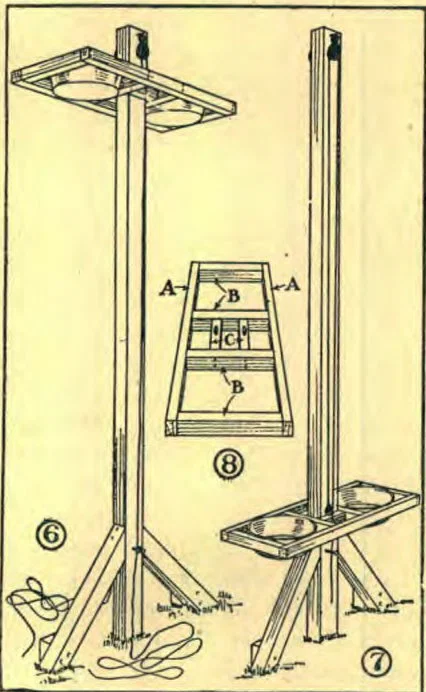
BIRD BATHS
BIRD BATHS

Kathleen’s Crown of Glory

GRANDMOTHER BATES was busily knitting out on the porch where the air was cool and where she could keep an interested eye on all that went on in the street below. Therefore she witnessed the parting between her granddaughter, Kathleen, and a group of her schoolmates, and heard Miriam Grant’s laughing words as she hurried on to rejoin her friends.
“That carroty poll of yours is too conspicuous, Kathie.”
Kathleen Bates came slowly up the steps, tossed her schoolbag into a corner of the wide porch, and seated herself on the top step in gloomy silence, her elbows on her knees and her chin buried in her cupped hands, frowning on the world in general.
Looking up at length, she caught a vanishing twinkle in Grandmother Bates’s understanding and kindly eyes. She edged nearer to the old lady and laid the “carroty poll” on her knee. The soft old hands dropped their knitting and stroked the offending locks which were as undeniably red as nature could make them.
The dear old grandmother was visiting her only son for the first time in many years, and this young granddaughter was rapidly becoming a favorite and very dear to one who saw with shrewd but kindly eyes the flaws in a high-spirited but generous-hearted young girl’s character, and who felt that this was a longed-for opportunity to give a word of counsel. Kathleen was daily becoming more and more interested in this grandmother who was so young in heart, in spite of her seventy-odd years, and who seemed so thoroughly to understand a girl’s troubles, and was more and more disposed to confide in her.
“It is just dreadful, grandmother. I don’t see why I had to have such furiously red hair. Everybody teases me about it, but today it was worse than ever. My mathematical exercises were not very good and I heard the principal read some of my mistakes to Miss Selkirk, and ask whose paper it was. Miss Selkirk said it was mine and when the principal asked her to point me out to her, she said I was the girl with fiery-red hair. She didn’t know I heard her, but I did, and all the girls laughed. I did so want the principal to think well of me,” continued the heartbroken voice; “you know she has not been long in the school, and really grandmother, she is the dearest thing; the girls all love her and I wanted her to think well of me, and now she will never think of me in any other way than as the girl with the fiery-red hair. I saw her looking at me half a dozen times this afternoon.”
Grandmother did not laugh. Instead, she wondered how best to show Kathie that her point of view was distorted.
“I don’t suppose the principal ever gave your hair a second thought,” was the gentle answer; “unless it was to admire it.”
There was an incredulous gasp at this astounding statement, but grandmother went on composedly. “I am afraid the principal will regard you as the disappointing girl who had prepared so poor a paper for her inspection.”
Kathleen flushed guiltily. “There was no excuse for me,” was her frank acknowledgment; “it was my best subject and I should have had a perfect paper. I can remedy that easily enough, grandmother,” she continued in a rueful tone, “but I can’t remedy the color of my hair. I don’t know why I have red hair—no person in the family has it but me.”
Grandmother laughed heartily.
“I am afraid you got it direct from your grandmother. Your hair is exactly what mine was at your age, and many a bitter tear I shed over it, too.”
The wrinkled hands smoothed the snowy white hair that crowned a peaceful and happy face.
“I was just like you, Kathie, I thought every person was thinking of my hideous hair, and how I hated to look in the glass! But I grew more sensible in time. I could hardly credit the fact, when I first heard that a famous painter always painted his beautiful women with red hair.”
Kathleen was listening now with deep interest.
“Did you ever notice, when you enter a roomful of girls, how one red head stands out in sharp contrast to all the others, and how the others pale into insignificance beside it? As that girl said at the gate, a red head is always conspicuous. But did you never think how much more conspicuous it might be made than it is already?”
The young girl looked her bewilderment.
“Suppose,” said grandmother, gently, “the principal had been able to say, ‘This is a paper of most unusual excellence; whose work is this?’ And the answer would have been, ‘It is the work of Kathleen Bates, the girl with the red hair,’ what then?”
A light of understanding dawned in the eager eyes watching her face so intently.
“I see what you mean, grandmother; my red head might have been to the principal a standard of excellence instead of a sign of conspicuous inferiority.”
“That is my idea of the matter. I think when you saw the principal watching you she was evidently thinking that it was a pity so bright a young girl should do such slovenly work.”
Her granddaughter did not resent the plain speaking. She was honest enough to admit that she had been careless and inattentive and was turning over in her own mind this new idea.
“You can work that out for yourself,” resumed the old lady. “And then there is another thing, my dear. Because you have always been teased about your hair is no proof that red hair is not attractive. The truth is, red hair is rarely unattractive. It usually has lights and shades which can be brought out by careful attention. Forgive me, Kathie, but you don’t take enough care of what the Lord has given you, or pay it enough attention.”
“I did not think it worth while,” said Kathleen flushing. “I thought it was so ugly that it did not matter.”
“Well,” said her grandmother softly, “I think it is beautiful. And it can be made very much more beautiful and a veritable crown of glory if you will keep it immaculate, brush it and brush it again, wear it in the most becoming fashion, and you will soon find your red head become a badge of distinction. Every girl should make herself as lovely as God intended her to be, and should make the most of her attractions. And remember, my dear, no beauty can compare with well-kept and carefully dressed hair. Try my beauty recipe, and see if the results are not worth while.”
An energetic hug rewarded the old lady, but her heart rejoiced at the earnest words which followed shyly.
“But I like best of all what you say about my red head appearing as the outward and visible sign of a well-ordered interior. I don’t believe it would hurt a bit if I should hear the principal say the girl with the red head was doing good work. That idea would work out with everything, wouldn’t it, grandmother?” she continued, her alert mind rapidly seizing the possibilities revealed.
“It surely would, little girl, and is worth thinking about, isn’t it?”
“Yes, and worth doing something about, too. Grandmother, if I should work hard and succeed in carrying off the mathematical prize, wouldn’t it please daddy though, and wouldn’t my head glow like a beacon light when I walked up to receive it? I really believe it is going to glow, even if it sets the school on fire.”
And the laughter which followed was so heart-whole and merry that the other members of the family came out on the porch to learn the cause.
But Kathleen and Grandmother Bates kept their own counsel.—Florence M. Kelly, in the Girls’ Companion.

Theory and Practice

A GROUP of boys, gathered in a corner of the library, were discussing the talk the principal of the school had given that morning in chapel.
“He exaggerates,” said one. “Why are little things so important?”
“That is what I say,” said another. “He would take all the fun out of life by such strictness. I can’t see any harm in lots of things he would call wrong.”
“And even if they are ‘wrong’! It can’t be so terrible to do once in a while a little thing that isn’t perfectly right.”
“I’m afraid the old fellow is a good deal of a fogy. He thinks we’re living in the time of Moses and the ten commandments.”
There was a laugh at this, and the boys separated. The next day the principal called them all into his study. “Unintentionally I overheard your talk yesterday,” he said. “I was in the alcove back of the reference shelves and could not help hearing all you said. Perhaps you are right. Perhaps I exaggerated the seriousness of a wrong action and its results. If I’m wrong about it, I’m ready to be convinced.
“Now, Judge Holt was in here this morning to see me on a matter of business. When he went out, he left his pocketbook on my desk. He laid it down here when he took out some papers and forgot to put it back. He is a curiously absent-minded man, and the chances are he will never remember where he left it. “I have looked into the book and I find it contains a hundred dollars in new bills. Now the judge is rich, and he doesn’t need the money. You boys take fifty dollars and I will take the other fifty. You can have a good time with your share, and I can pay one or two little bills I owe, and no one will be the wiser.”
The principal took out the money calmly, counted out fifty dollars, and held the bills out to one of the boys; but the boy started back in terror.
“But that is stealing!” he cried.
“Surely it is, but no one will ever find it out, and the judge will never miss the money. Where is the harm? Besides, it is old-fogyish to be too particular about an occasional piece of wrong-doing.”
The boy looked at the principal a moment and exchanged glances with his friends. Then he said gravely:—
“We have had our lesson, sir. We shall never forget it.”
“I thought so. Theory is one thing, and practice, you see, is quite another,” said the principal as he put the bills back into the pocketbook. “And the ten commandments are a pretty good chart to sail by even today.”—Youth’s Companion.

The Seventh Biscuit

I KNEW a boy who was a sophomore in college. He had been away from home just long enough to realize that the little house he came from was not very pretentious. And he began to be ashamed of the home where his mother sat, in a neat print frock, darning stockings; and where his father, dressed in blue overalls, fussed over the kitchen garden.
This boy made friends with a rich student who belonged to the same fraternity. Then, suddenly, at the beginning of the Easter holidays, the rich student walked into the boy’s room, and said: “Say, Dick, the mater’s giving a big party this week—and I’m tired of big parties. Can’t I go home with you?”
The boy, groaning inwardly, said as cheerfully as he could: “Why, certainly, old man, I’d be glad to have you.”
So Dick came home with his rich friend. The father, in overalls, met them at the station with a buggy. The rich friend drove home sitting on a soap box, for the buggy was small. He laughed and said it was fun, but the boy was strangely silent. The mother, in her freshest print dress, met them at the gate and kissed them both. “For,” she said, “I know I’ll love any of my son’s friends!”
The rich man’s son thought of his coldly formal home, and he kissed her while he winked, just a bit, because there was something in his eyes that bothered him. But Dick dragged him away worriedly, and led him to the guest chamber.
Then they had supper in the cool dining-room, and there was homemade strawberry jam to eat, and hot biscuits. As the rich student was eating his seventh biscuit he turned suddenly to the boy. “You’re lucky, Dick,” he said gruffly. “You don’t know how lucky you are!” And then Dick understood. And he wasn’t ashamed of his home any more.—Margaret E. Sangster, Jr., in the Christian Herald.

On Gratitude and the Duty of Giving

It is another’s fault if he be ungrateful, but it is mine if I do not give. To find one thankful man I will oblige many that are not so.— Seneca.
Continue reading: Our Words