It is now a little over seven months since my removal from Peru, South America, to this island field. On account of Mrs. Allen's health and school privileges for the children, my family are not yet with me. At this writing, Mrs. Allen is in the American hospital on the Canal Zone, Panama. The physicians in charge report favorable improvement, however, so I trust that before long we may be united in our work here in Cuba.
Since coming to Cuba I have found plenty to do, as the work is growing rapidly. We now have believers in nineteen places. There are some isolated members that I have not yet been able to visit, but all the churches and companies have been visited, and nearly all are of good courage, and are seeking to win other souls for the Master.
Since our workers' meeting in February, I have visited the believers in Habana, Guanajay, and San Claudio, and in Nueva Gerona, which is on the Isle of Pines. In all these places we have small but faithful companies. The company on the Isle of Pines is largely the fruit of the labors of Brother A. E. Wolfgram. This is an example of what God will do through those who are willing13to take up labor right where they live in an effort to win souls for Jesus. Shortly after receiving this message, Brother Wolfgram came to the Isle of Pines, and he soon felt a burden to give the message to his neighbors. After praying over the matter, he bought a house, secured some benches for seats, and announced meetings. Satan tried in every way to hinder, but in humility the victory was won. Today we have a loyal company of believers on this island, where otherwise we should probably have nothing. But this is not all. Brother Wolfgram has now learned sufficient Spanish to hold meetings with the native people, and each week a good company of these come together to study the message. Would that we had more such self-supporting workers. Elder Felter, in San Claudio, and Brother Holmes, in Las Minas, are also doing what they can, and God is blessing their efforts.
This year our colporteurs are selling religious books. As we now have the large message-filled books in Spanish, we look for a new experience in our work in these Catholic fields. We see no reason why the same results should not follow their circulation here as has been experienced in Europe. We hope to see men and women enter the ranks who can become pillars in the church, and who can bring in others.
The school work in Cuba is a live question. Our young people give me no peace. I wish you could read some of the letters which come in from those desiring to prepare for service. As God seems to be opening the way, I expect to see a few of the most promising brought together this coming fall for a few months' training. We hope to see this effort continue and develop into a humble training school where we can prepare workers.
Santa Clara, Cuba.
Workers’ Institutes in Central China
By R. F. Cottrell
R. F. COTTRELL
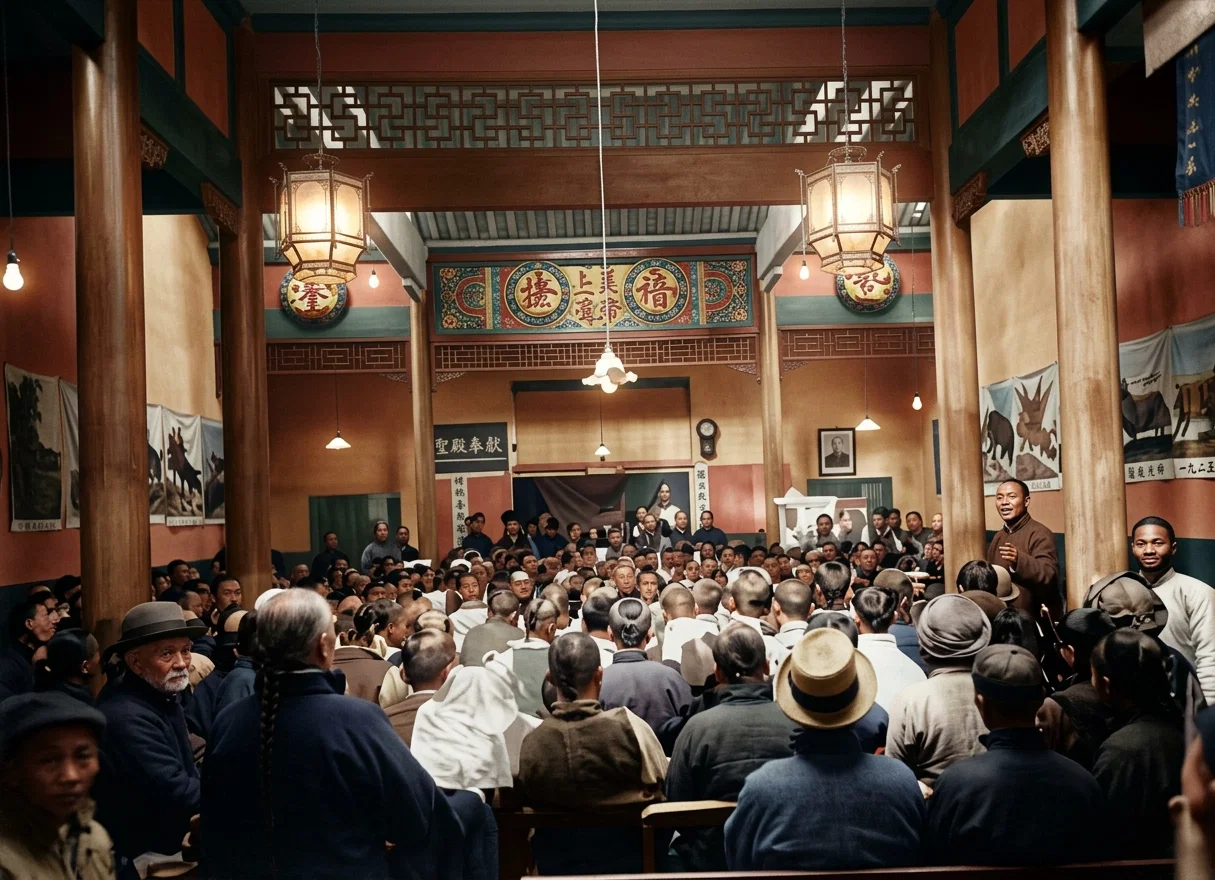
The workers’ institute for Hunan Province convened in Changsha, March 4-14, in our new chapel. This compound (group of buildings surrounded by a high wall) was purchased last December, and during January and February we repaired it to meet our needs as chapel, intermediate school, and headquarters for our native workers.
On the first Sabbath of the institute, the dedicatory services were held, followed by a prayer and testimony meeting, at which nearly every believer present rededicated his life and strength to God.
The evening services were conducted for the benefit of the public. Such large crowds attended that after the second night we divided our audience into three. The women met in the school chapel, special inquirers and those preparing for baptism met in the guest room, while the meetings in the main chapel were held the same as usual. In this way from three to five hundred people were given the opportunity of listening to the gospel each night. About two hundred persons entered their names as inquirers. Special arrangements were made to continue the evening meetings each night during the next few weeks, at least. The new inquirers will receive careful attention by visits to their homes. To this end, it was necessary to considerably strengthen the force of workers in the city of Changsha.
Forty-five native evangelists and canvassers attended this gathering. The foreign workers taking part were Elder and Mrs. C. P. Lillic, Mrs. Cottrell, and the writer.
The second institute in the series was held at Hankow, March 19-29. Last autumn a very suitable place located on one of the principal streets of the native city was rented at a cost of about $700 (United States gold) a year. The meeting was held in this building, and was attended by all the native Hupeh workers, and by Elder Frederick Lee, Dr. A. G. Larson, Brethren S. G. White and J. O. Ryd, and the writer.
Most encouraging reports came from the outstations. The Thirteenth Sabbath Offering in Hupeh amounted to about thirty dollars Mexican, which we considered most excellent. A number of new places sent in strong appeals to the mission to send men who could teach them this closing gospel message, and at the close of the meeting we made arrangements to answer these calls in the near future.
INTERIOR OF NEW CHAPEL RECENTLY PURCHASED AND DEDICATED AT CHANGSHA, HUNAN. A NATIVE BROTHER IS PREACHING
From Hankow we went to Yen-cheng, Honan. At this place Elder J. J. Westrup has conducted a Bible school during the winter months, at which the students have been thoroughly instructed in the great fundamentals of present truth. The Honan workers’ institute was held during the first week of April, and with this the Bible school was brought to a close.
Brother and Sister O. J. Gibson and Sister F. Lee, who are to be located there (Brother Lee joining them later), arrived in Yen-cheng just in time to participate in the labors and blessings of this gathering. Although this province has been passing through times of drought and general lawlessness, the third angel’s message has not stood still. It has continued to spread to some of the remote parts of Honan, and has even crossed into the province of Shen-si, where a little company is reaching forth for the light of life.
At each of the institutes, the keynote of the messages presented was the coming of Christ and the needful preparation in view of that event. Talks on true religion, the design of which was to elevate the standard of Christian attainment for the workers themselves as well as for those among whom they labor, were given. We also gave instruction upon methods of preaching to the heathen, how to conduct the work at outstations, and especial thought was given to the proper organization and work of our Sabbath schools throughout this mission.
The Holy Spirit came very near to us in all these general gatherings. At the close of each, a baptismal service was held, the total number thus received into church membership being sixty. We praise our Heavenly Father for the many tokens of his good hand upon us in all this work. For the next two months the foreign workers will devote much of their time to itineration, and hope to visit nearly all our forty-five outstations and companies.
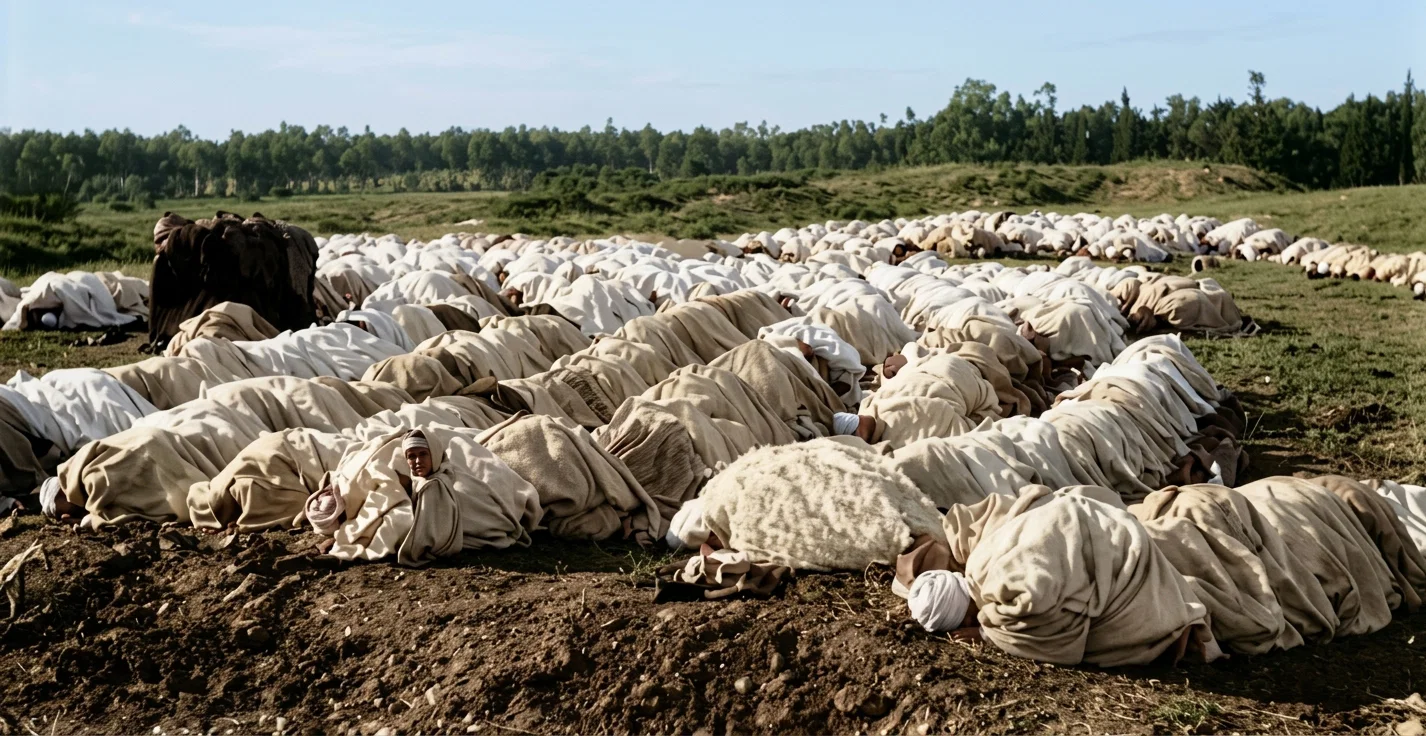
MOSLEMS WORSHIPPING THE FALSE PROPHET
The Barbary States of North Africa
By W. E. Hancock
W. E. HANCOCK
So little is known of the countries which are called in history the Barbary States that a little information regarding them will be both interesting and profitable in this our first report to the REVIEW since our arrival in North Africa last September.
We generally think of these countries as having derived their name, Barbary States, from the character of their inhabitants; for history shows that they well merit the term “barbarous” being applied to them. But the word is properly derived from the name of the original inhabitants of North Africa, the Berbers, or Barbars. The French still call them “les Berberes,” and they are represented today principally by the Kabyles, Chaouias, and the M’zabites. These tribes now speak different dialects, but it is recognized that they are derived from the same language,—a language entirely different from the Arabic, the prevailing tongue of the native population of the country.
The area comprised in this territory is nearly one fourth that of the United States (853,372 square miles), with a population one fifth as great. The number of inhabitants has not been ascertained with certainty in any of these countries, except in Algeria, which, according to the latest census, has a population of 5,069,522. A complete census, no doubt, would find between eighteen and twenty million inhabitants in the four countries. This population is entirely cosmopolitan, being divided among Berbers, Arabs, Negroes, Jews, Spaniards, Italians, Frenchmen, and a scattering representation of Germans, Englishmen, and other Europeans. Of course, the great bulk of the people are Arabs and Berbers. Arabic is the prevailing language of all these countries.
These facts and figures indicate to a large extent the religious needs of the people. The country is new and undeveloped from any point of view it may be considered, politically, economically, commercially, or religiously; that is, if considered from a European or Christian standpoint. Men of commerce recognize the opportunities that abound in North Africa, and are rushing in to develop the resources of these countries; but missionary societies are doing comparatively little to seize the opportunities which the conquest of this vast territory by European nations presents to them. Here we have the great northern gateway to the unknown millions of Moslems in Central Africa, the immense Sudan region. Yet up to the present time, only Algeria and Tunis have been entered by any organized society; and in these two countries missionary work among the Moslem people is barely begun. Surely missionaries should not be behind in pushing into this great Moslem field when the doors are thrown wide open.
Our own work was established here in 1905, and has touched five points in Algeria; namely, Algiers, Constantine, Relizane, Mostaganem, and Oran. The larger part of the work, however, has been done in Algiers, the capital of Algeria. Three years ago a French worker was placed in Oran, where we are now. The work has been done exclusively in French in Algiers, and also in Oran, except what we have done in Spanish during the last six months. In Mostaganem, and in Relizane, a town a short distance from Mostaganem, Brother Jose Abella has been working for more than a year, with the result that about a dozen faithful Spanish believers have been brought out. The believers in the message in all North Africa number about forty-five, and are French or Spanish.
What have we done for the 15,000,000 Mohammedans during these nine years? will perhaps be asked. We are sorry to be compelled to answer, Nothing. We certainly hope that will not be the report which we shall have to send from North Africa much longer. Now is the strategic time to enter these fields with means and workers enough to exert a perceptible influence. Men, for the sake of commerce, recognize the present opportunity. Why not we? Moslems, who have pointed with great pride to their conquering religion, see it being shorn of its glory as a victorious faith. Hundreds of Moslems are losing confidence in their old belief. Under French influence and French education, they have nothing to put in its place except atheism, freethinking, and infidelity—unless the missionary comes to them with a new message of hope and salvation through the gospel of Christ. Brethren, remember the Moslem problem in your prayers, in your plans, and in your offerings.
Rue Dumanoir, Maison Lauzin, Oran, Algeria.
Foreign Postage to Be Reduced
FOREIGN postage is to be made three cents instead of five at the triennial conference of the International Postal Union next September, according to a recent London announcement. A majority of the world's governments are in favor of three cents, though there is a strong movement, led by Sir Henniker Heaton, for universal penny (two-cent) postage, the rate which now prevails between the United States and Great Britain. The London Standard prophesies that the extra half penny will be dropped within a few years. The United States Senate has just ratified an agreement with practically all the nations of Europe for the purpose of closing the mails against obscene publications, particularly post cards.
Cross Bearing
By L. D. Santee
L. D. SANTEE
Bear well thy cross; ’tis but a little while Till Jesus comes to take his children home. Morning shall dawn, and all thy woes beguile, While joy shall banish every sorrow known.
Bear well thy cross; we are but waiting here The call of welcome from beyond the skies. What though the way is rough or path is drear, While just beyond are gleams of Paradise?
Bear well thy cross, nor lay the burden down Till Christ shall come to give the weary rest; When prayer shall turn to praise and cross to crown, And rest be long and sweet on Jesus’ breast.
Bear well thy cross, nor let the world dismay; Jesus knows all thy sorrows and thy care, Strength shall be given for each weary day, And thorns shall turn to blossoms sweet and rare.
Bear well thy cross; thy labors soon shall cease, And weary feet shall tread earth’s paths no more, But in the kingdom of eternal peace Find rest at last on heaven’s shining shore.
Riverside, Cal.
S. H. CARNAHAN
By S. H. Carnahan
Gossip
S. H. CARNAHAN
The apostle Paul admonishes the members of the church against being idle and going from house to house busilying themselves in tattling — speaking things which they ought not. 1 Tim. 5:13.
The apostle Peter counsels: “Let none of you suffer . . . as an evildoer, or as a meddler in other men's matters.” 1 Peter 4:15, R. V. And “speak evil of no man,” nor “speak evil of dignities.” See Titus 3:2; Jude 8.
Solomon says, in Prov. 10:18: “He that uttereth a slander, is a fool.” And the Lord tells us through David (Ps. 101:5, R. V.): “Whoso privily slandereth his neighbor, him will I destroy.” The prophet tells us not to imagine evil against any one. Zech. 7:10; 8:17.
And we are exhorted as Christians to lay aside all evil speaking and such things. 1 Peter 2:1.
The natural heart is “desperately wicked,” and the untamed tongue “a world of iniquity.” Jer. 17:9; James 3:6. Jesus says: “Out of the abundance of the heart the mouth speaketh.” Matt. 12:34. No man can purify or tame these. Compare James 3:8; Ps. 51:10; Eze. 36:26.
The habit of gossiping causes much mischief among neighbors, turning friends to enemies. In no other way can persons put lack of confidence and distrust in the Bible into the hearts of their sons and daughters, and into the minds of other children, so certainly as by criticizing the ministers and teachers in our churches and schools.
Many a home is even disrupted by one parent's taking part with the children against the action of the other parent, or by telling to neighbors or to relatives outside of the family some of the differences that arise. If the differences are such as to make our hearts ache, telling them to our friends and relatives will not relieve us, and will only rend their hearts also.
Neither sly innuendo nor insinuation should be made to misrepresent motives, blacken reputation, or dissect character. Such work is worse than cannibalism, says that grand book “Education.” See pages 235, 236.
Remember “thy friend hath a friend, and that friend a friend; therefore be discreet” in what you say. Again, “If there be a person of whom you cannot speak well, then of that one speak not at all.”
The apostle James says: “If any man among you seem to be religious, and bridleth not his tongue, but deceiveth his own heart, this man's religion is vain.” James 1:26.
These burdens are not to be cast upon our brethren and sisters and parents and neighbors; they have enough of their own. “Cast thy burden upon the Lord, and he shall sustain thee.” He will strengthen you and comfort you.
“Have we trials and temptations?
Is there trouble anywhere?
We should never be discouraged,
Take it to the Lord in prayer.”
“Are you weary, are you heavy-hearted? . . . Tell it to Jesus alone.”
“Surely he hath borne our griefs, and carried our sorrows,” and still continues to do so.
Gaston, Oregon.
Save the Boys
By Mrs. C. C. Lewis
MRS. C. C. LEWIS
“Where are the boys, the little boys
Who ran about our door?
With laughing eyes and merry tread
They come to us no more.”
With a sob in the heart we think of the boys who once were pure and trustful, who went to Sabbath school regularly, and faithfully learned the lessons. The hearts of their parents glowed with pride and expectation as they looked forward to the time when their boys would go forth to proclaim the gospel message. But as time went on, little by little the boys cared less and less for Sabbath school. It became irksome to them. They congregated in groups, and stole away to the woods. Then came friction in the home. Parents, not understanding the boy nature, tried to coerce the boy. Gradually the breach widened between parent and child just at the critical time when confidence and trust should be cemented more firmly than before. The conflict was kept up with varying results. Sometimes the boy attended Sabbath school, sometimes he stayed at home, miserable and unhappy. Gradually he found more satisfaction with the “fellows,” as he called the other boys. He was out more in the evening; home influences waned, and soon lost their hold altogether. The boy broke away entirely from the faith of his family, and went forth to make his way in the world.
Doubtless most of us can see in this description the history of many a dear boy whom we have known. Misunderstood, censured, he went out into the ways of evil to his own loss and the sorrow of his parents’ hearts.
How different it all might have been if the parents had at the critical time cultivated the friendship of the boy. By every reasonable means (and I almost said unreasonable) the parents should win and hold the boy’s confidence.
The father should study the boy to find out his special likes and dislikes. If the home is on the farm and the boy loves pets, give him a calf, a colt, or whatever seems to fit the case. It may be a pen of hens, but give him something for his own. Help him to care for it, plan with him as you would with Mr. Snell across the way. Recognize the embryo man that is growing up beside you, and you will be surprised how he will develop in manliness. Deal honestly with your boy.
The parent should honor the property rights of the child with as much regard as he would have the child regard the rights of others in later years. I remember a story that illustrates the point:—
The Story of Bob and Ponto
One fine morning in spring Bob went to the pasture to bring up the horses, when to his great delight he found an extra one. It was a beautiful little colt with long slender legs, fine mane and tail, and a pretty neck.
“My!” he said to himself. “I am going15to ask father to give me Meg’s colt for my very own.” He carefully drove the horses into the barnyard, going no faster than the youngest could travel, then eagerly hastened to his father to tell his story and make his request. Of course, the farmer was glad of the addition to his stock, and received Bob’s announcement with evident satisfaction.
Bob was all aquiver. He hardly dared to present his request, but he mustered up courage, and was not a little surprised that his father so promptly told him he might have the colt for his own. He almost stood on his head for joy. “My very own,” he said to himself, as he bounded out to the barn to admire his new-found treasure. “I’ll call him Ponto,” said Bob, to his mother at the breakfast table.
We cannot follow these two companions very closely for the next two or three years. It is sufficient to say Bob lost no opportunity to pet and caress his little friend, and the colt seemed to reciprocate the affection by rubbing his neck on the child’s arm, and following him everywhere in the pasture.
But one day a horse dealer came along. Farmer Brown was short of funds, and the dealer offered him a large sum of money for the handsome colt. The dealer drove Ponto away.
Late in the afternoon Bob came home from school, and, as usual, ran out to the meadow to have a frolic with Ponto. When, lo, he was nowhere to be found! Bob examined the fence to see if the colt had got out, and not finding any opening went to his father to make inquiry. “Papa, where is Ponto? I have hunted everywhere and I can’t find him.”
“O,” said his father lightly, “I needed some money! A man offered me a good price and I sold him, and he took him away.” Bob was stunned and dazed for a moment, then burst forth in uncontrolled grief. “He was mine. O, why did you sell him?” cried the broken-hearted child. By the force of his authority the father compelled Bob to hide his sorrow, but never in all the years that followed could he convince the boy of the justice of his father’s dealings with him.
This story forcibly illustrates the unwise course parents sometimes pursue with their children.
Avoid the discussion of points of conflict. Steer clear of them as you would a precipice. Chum with the boy, visit with him about the things he enjoys talking about. But you say, “He is foolish and unreasonable.” You may have been more foolish and more unreasonable yourself twenty years ago. Keep close to the boy as you would if he were in a real battle; for indeed he is,—a battle with himself. Pity him in your heart, and sympathize with him in his struggles, but do not censure him. Instruct him instead.
A boy in the early teens was overcome and did something he knew was against his parents’ wishes. It almost broke his mother’s heart, for the time being, as she realized the truth. But as she looked into his innocent, boyish face and saw his regret, she opened her arms to receive the little culprit, who fell sobbing on her breast. She saw the repentance in his face, and from her heart pitied him in his weakness, and did not cast him off. We must have the tender compassion of Christ for the boys, especially during the period of the early teens.
While it is our duty to hold the reins of government somewhat tightly, we must also mingle with every look and word tender sympathy. I am reminded here of the dealings of Christ with Peter. This self-confident, impetuous disciple needed much painstaking effort bestowed upon him. Many times the Master reminded him of his weakness, but ever and anon his self-esteem brought him into difficulty. Finally he denied his Lord. Christ had warned Peter many times, but while he condemned his faults he did not leave him wholly to despair. The author of “Education” expresses the thought beautifully. She says: “If the look that Jesus cast upon him had spoken condemnation instead of pity, if in foretelling the sin he had failed of speaking hope, how dense would have been the darkness that encompassed Peter!” Here is a lesson for parents.
The same author continues in the following earnest words:—
“Human beings, themselves given to evil, are prone to deal untenderly with the tempted and the erring. They cannot read the heart, they know not its struggles and pain. Of the rebuke that is love, of the blow that wounds to heal, of the warning that speaks hope, they have need to learn.”—“Education,” page 90.
Remember the pit from which you were digged. How often have you in an unguarded moment been overcome and disappointed your Heavenly Father! Then be patient with this small man who is for the first time traveling up the hill of life to manhood. Mr. Fiske in his “Boy Life” says:—
“But what will win is the appeal to the boy’s honor and self-respect, assuring him of your confidence in him and faith in his future. Overlook his crudities, and make him think you reckon him at several years older than he acts. This will bring him quickly up to your estimate of him, and his latent manliness will rapidly appear, at least in your presence. He will soon have a keen desire to win your approval and hold your respect. Trust him, and he will not disappoint you; for he will come to feel that you among all his friends understand him. Encourage his confidences, and he will soon confide in you freely, and at such times you may readily influence him by the power of suggestion, to which such boys are peculiarly susceptible. You can then arouse in him new purposes, higher standards of manliness, right ambitions for his own future, and perhaps a true ideal of usefulness. Now is the time when the boy is ripe for a sensible, manly Christian experience, which will exalt these new experiences and purposes and make them permanent; binding him, through your own friendship, to your Master, the manly Christ.”
Takoma Park, D. C.
The Punctual Girl
The punctual girl is always a thoughtful girl. She is the girl who does not delay in doing an errand; who never keeps the breakfast waiting while she repairs some forgotten damage to her clothes. No one is ever kept waiting while she sews a rip in her dress or a break in her glove. These things are all done in season. She never puts off doing a thing at the right time, because she has learned that when a thing has been attended to, and put away, there is no need to worry about that particular thing.
She is the girl who is at her desk on time if she is one of the great army of working girls. Her employer and her friends all know that she will be ready for business or pleasure at the appointed time.
This girl's nerves are in good order because she never has to hurry or worry to “catch up” some work that has been neglected at the proper time, and her life runs on smoothly and happily because no undone task or neglected appointment is worrying her, or making her restless. Character is not formed in a minute. The girl has been training herself for years to be punctual. She is ever ready for emergencies, for this habit of punctuality now touches her life in all its relations, and she is making her influence felt in her own family, at least, for they come to see the wonderful advantage of always being ready, always on time. The punctual girl, while she is earnest and womanly, has not lost any of her girlish charm. Her outlook is encouraging, new chances are constantly opening to her for advancement, because it is known that she can be relied upon.—Selected.
The Secret of Happiness in Married Life
“The great secret of happiness in married life is to be found in a myriad little tacts and compliances and surrenders upon both sides. Matrimony is an enormous compromise. Perfect courtesy, an incessant guard upon the temper that no irritability shall become a habit, and the constant conviction that where two have equal authority a harmonious decision can be always reached only by the utmost reasonableness,—these are little amulets that will banish the evil spirits and keep the home serene; and the touchstone to enable people to live thus is a sincere, deep, and fond love for each other.”
The Ministry of the Young
God delights in the young; God has made the young a ministry of instruction and comfort to old age. God keeps the world young by keeping children in it, and helplessness to help and be helped.—Joseph Parker.
Georgia
By Howard C. Chilson; Inita Chilson
NORTHEAST Georgia presents a great opportunity to those who wish to work in the South. The people of Franklin County, and no doubt many other counties, are entirely ignorant of the third angel's message. On account of their prejudice and simplicity, one has to work very tactfully.
We find the giving of literature often arouses prejudice; and we have many times been pointed out as Spiritualists or Mormons, because the people know as little about Spiritualism and Mormonism as they do about Seventh-day Adventism. We have even been denominated Roman Catholics, because the word Catholic was seen in the Watchman which we gave away. Many think the Mormons and Roman Catholics are the same.
The Baptist minister of one of the churches, who seemed to be a broader-minded man, offered us his pulpit for several Sundays for a series of lectures on Roman Catholicism. We accepted the opportunity to enlighten the people upon this subject, and spoke to them several Sundays. Some were so incensed that upon one occasion the doors of the church were locked to prevent our speaking. But others were very much interested, and several copies of “Daniel and the Revelation” were placed in their homes.
As there is preaching in the country churches only once a month, a Seventh-day Adventist residing here could, after finding favor in the eyes of the minister, often speak to the people on the other Sundays.
Although we have passed through trying experiences since coming here, we are truly thankful for them, and long to see the work grow here. We hope that many other self-supporting workers will come to this field. There is an excellent opportunity here for a consecrated doctor.
It is our prayer that others will come to live out the present truth in this needy field.
HOWARD C. CHILSON,
INITA CHILSON.
Baptismal Robes
By A. R. Ogden
“In every church baptismal robes should be provided for the candidates. This should not be regarded as a needless outlay of means. It is one of the things required in obedience to the injunction, ‘Let all things be done decently and in order.’ 1 Cor. 14: 40.
“It is not well for one church to depend upon borrowing robes from another. Often when the robes are needed, they are not to be found; some borrower has neglected to return them. Every church should provide for its own necessities in this line. Let a fund be raised for this purpose. If the whole church unite in this, it will not be a heavy burden.
“The robes should be made of substantial material, of some dark color that water will not injure, and they should be weighted at the bottom. Let them be neat, well-shaped garments, made after an approved pattern. There should be no attempt at ornamentation, no ruffling or trimming. All display, whether of trimming or ornaments, is wholly out of place. When the candidates have a sense of the meaning of the ordinance, they will have no desire for personal adornment. Yet there should be nothing shabby or unseemly, for this is an offense to God. Everything connected with this holy ordinance should reveal as perfect a preparation as possible.”—“Testimonies for the Church,” Vol. VI, pages 97, 98.
The quotation given above is clear and to the point. I am sure that the reasonableness and propriety of the suggestions appeal to all. As there are always a goodly number to be baptized at our camp meeting, I should like to ask our churches that are supplied with baptismal robes to bring the robes to the camp meeting, that we may have them to use in connection with this sacred service. It is surely more becoming, at our camp meeting especially, that the candidates be attired alike, in neat and tidy baptismal robes, than that each be attired in a different garb, sometimes unbecoming to the solemnity of the occasion.—A. R. Ogden, in Workers' Bulletin.
Commencement Week at Mount Vernon College
By E. G. Salisbury
The last two weeks at the college were very busy ones, owing to the examinations and closing exercises. The music graduates gave separate recitals, the first being given by Miss Bertha Hanger on the evening of May 16, followed by Miss Helen Daniels on Sunday night. The music students rendered a program on the night of May 18. On the evening after the Sabbath, May 23, the last music recital was given by Miss Ruth Robbins. The efforts of the graduates and students and of the music director, Miss Taylor, were appreciated. On each evening the chapel was well filled, and the audience thoroughly enjoyed the music.
Perhaps the most interesting feature of the week was the class day program. On Thursday evening many of the parents and friends residing in the village, together with guests from out of town, assembled in the auditorium in Hiawatha Park. The program was well rendered, but through it all there was a feeling of sadness, as there were two vacant chairs on the platform. Elder H. F. Benson had already sailed for his field of labor in Japan, while another member of the faculty, Mr. Paul Johnson, could not be present on account of sickness.
On Sabbath morning, Elder N. S. Ashton delivered the baccalaureate sermon, using as his text Matt. 7: 13, 14: “Enter ye in at the strait gate; for wide is the gate, and broad is the way, that leadeth to destruction, and many there be which go in thereat; because strait is the gate, and narrow is the way, which leadeth unto life, and few there be that find it.” He counseled the students to use the Bible as their guide. “Open your soul, and it will breathe into it a holy influence, and fill all its wants. Bind it close to your heart; it is a shield against the assaults of evil. Read it in the lonely hour of desertion; it will prove the best of companions. Open it when the voyage of life is troubled; it is a sure chart and a safe compass. Study it in poverty, and it will unhoard to you inexhaustible riches. Commune with it in sickness; it contains the medicine of the soul. Clasp it when dying; it is the charter of immortality.”
The closing exercises of the church school, conducted on Sunday evening, revealed that a good year’s work had been done in that department. No program was listened to with greater interest; and the patrons of the school expressed themselves as fully satisfied with the advancement made this year.
The commencement address was given on Monday evening by Prof. B. G. Wilkinson. He spoke to the motto, “Climb though the way be rugged.” All great things that have been accomplished in the world have been accomplished by climbing through rugged paths; all great characters have been developed by rugged effort. He cited many examples from the Bible and history of men who scaled the peaks of fame and glory. The goal toward which we are climbing is Mt. Zion. “And I looked, and lo, a Lamb stood on the mount Sion, and with17him an hundred forty and four thousand, having his Father’s name written in their foreheads.”
Following the address, President Salisbury conferred the degrees upon the college graduates, and presented diplomas to the others.
On Monday morning, for the closing chapel exercise, we were pleased to have with us Professor Wilkinson, Elder W. J. Tanner, of West Virginia, Elder F. H. Robbins, of West Pennsylvania, also Prof. M. L. Kelley, who is to take charge of our commercial department next year. A word of encouragement was given by each of them, and a large per cent of the students expressed their determination to return to Mount Vernon next fall. We believe the closing year has been a pleasant and profitable one to all, and we look forward to a good future.
Our student body is made up of a thrifty and energetic company of young men and women, who are in school for the purpose of preparing for positions of usefulness in the cause of God, and whenever an opportunity presents itself, they seek to improve it.
Five or six will go into the educational work from our normal department this year. One will take charge of the book work in one of our local conferences, and it is probable that another will be chosen from our school to take up book work in the West Indies Conference. Five or six will go into the Bible work, and about the same number of young men will be employed in tent endeavors during the summer. There will be, all told, between sixty-five and seventy-five young men and women engaged in the canvassing work in this union, some entering the work as a permanent employment, and others for the sake of the scholarship, to be applied here or in Washington College.
This, in brief, sums up the workers who are going out from this institution. It is impossible for me to give definite figures, but those I have given are not far from correct. We are proud that our students are devoted and anxious to enter the work. One member of our school is already on the Pacific Ocean, going to his work in Japan; another is under appointment, but has not yet been called to the field.