Review and Herald Publishing Assn. · Washington, D. C. · March 29, 1904
Radium: The Rarest and Most Valuable Element
Radium
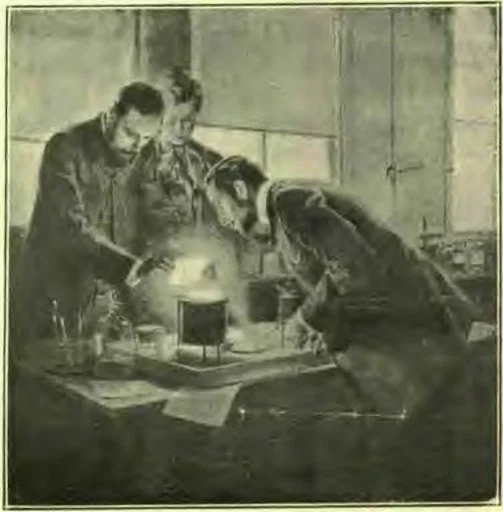
RADIUM is a word unknown to the dictionaries, even to the Century, yet it is a word familiar to many a schoolboy of to-day. The reason lies in the fact that only recently was radium discovered; Professor and Madame Curie, of Paris, having the honor. It looks much like our common table salt, yet it is worth three thousand times its weight in gold, being the rarest of the seventy elementary substances. Barium and uranium have long been known to possess the properties, though in a much less degree, that have given radium its unique position among the chemical elements. Only a few ounces of radium have been separated from the rock in which it is found; yet, it is said, there are indications that it exists in considerable quantities in the earth. The water from mineral springs, and the air from deep borings in the earth, are found to be radio-active.
Copyrighted, 1903, Mc Clure Co. Courtesy Mc Clure's Magazine
FINISHING PREPARATION OF RADIUM
As one picks up a rock or some earth, he little knows what valuable thing it conceals, only waiting to reveal its secret some day to a searching chemist's eye. The dull clay brick, it would seem, ought to brilliantly shine with its fifty per cent of aluminum, the human skeleton with its eighteen thousand three hundred dollars of calcium ought not to appear so unattractive, especially to the avaricious eye; the ocean water which hides, it is said, in its crystal depths all of earth's valuable chemicals, arouses but little thought of its worth as it surges, foams, and breaks upon the rocks at our feet.
Each year of this age of increasing knowledge serves to give a little more penetration to the eye; yet we shall, after all, only see as through a glass darkly until the eternal gates are opened to us.
An article that appeared last autumn in McClure's Magazine gives some figures showing the rarity of the metal. The article says that “France has about one third of an ounce, Germany possibly has about the same amount, America has hardly as much as these countries, and the rest of the world may have perhaps about one sixth of an ounce; an ounce and a third, therefore, would be a large estimate for the world's present output of radium. A teaspoon would hold it all.” The students of Princeton University consider themselves fortunate, since the university recently received a gift of twelve and one-half grains of the new metal in honor of Prof. A. H. Phillips, who first extracted radium from American ore. It is estimated that with the very cheapest methods now known of purifying the crude material, nearly one and three-quarter million dollars would be required to obtain two pounds of radium.
Professor Curie has a piece about the size of a buckshot, which he says is worth twenty thousand dollars, the price depending much upon the purity of the specimen. Besides the heat and light rays given off by this metal, there are three kinds of invisible rays that move with nearly the velocity of light. These rays, like electricity, may be helpful or harmful, may destroy life or stimulate it. The length of exposure affecting the result.
The medical world is looking with much interest toward radium, hoping it may prove a successful remedy for the dreaded maladies of lupus, cancer, and kindred diseases.
Radium maintains a temperature two and seventh-tenths degrees Fahrenheit warmer than the surrounding atmosphere. Professor Curie says: “One hundred ten pounds of radium would give out as much heat continuously as a stove would give out that burned twenty-two pounds of coal every twenty-four hours. Some have estimated that a given quantity of radium after throwing out heat, as I have stated, for one thousand million years, would have lost only one millionth part of its bulk. Others think the loss might be greater, an ounce, perhaps, to a ton in one thousand years.” The amount is at least too small for the most delicate instruments to measure; but the heat energy given off by a cold piece of radium is sufficient to produce definite results, even causing a piece of platinum wire to glow with a white heat.
Radium wrapped in thick paper and held to the closed eyelid, will give one the sensation of a soft diffused light outside the eye, the sensation caused by the penetrating of the rays into the eyeball. If the metal is placed on the forehead, and the eyes closed, a similar effect will be produced. This intense penetrating power of the rays makes it a dangerous substance to carry about, as it will cause serious burns without giving any personal inconvenience at the time of its evil working. Lead seems to be quite impervious to radium rays, making therefore a good case in which to carry the bit of metal.
The spinthariscope, recently invented by Sir William Crooks, is a small microscope that permits one to observe a tiny piece of radium, not more than one sixtieth of the millionth of an ounce. The fragment of the metal is supported on a wire over a screen spread with sulphide of zinc. To the eye made sensitive by a darkened room “and looking intensely through the lenses the screen appears like a heaven of flashing meteors among which stars shine forth suddenly and die away. These myriad bursting, blazing stars” are assumed to be the radium emanations. This vision, contained within the area of a two-cent piece, Professor Curie says, “was one of the most beautiful and impressive he had ever witnessed; it was as if he had been allowed to assist at the birth of a universe—or at the death of a molecule.”
The intensity of radium is measured by its power to render the air a better conductor of electricity. Uranium has been known for some time to possess this property, therefore its intensity is taken as the standard. The purer the radium, the greater is the intensity. As it comes from the purifying works, its intensity is about 2,000; and Mr. Curie prefers after that to give the finishing touches himself; so he treats it2until it is brought, perhaps, as high as 1,500,000. So complicated and laborious a process is the extraction of the metal, that a visit to the purifying works outside the city of Paris, reveals the fact that the true scientist is not daunted by prodigious undertakings, and that patience is allowed to have her perfect work, whatever the cost. For years the refuse powder from the uranium mines, after the metal had been removed, was regarded as worthless, and was left quite at the disposal of whoever wished to haul it away. Now this once worthless material is secured by the ton—eight tons being required to produce a gram of the metal—from Bohemia for the radium extraction; for it is this—that hides in itself in infinitesimal quantities this rarest of metals. One person has said hunting for radium in this refuse “is like searching for specks of dust hidden in a sand heap, or for drops of perfume scattered in a river.” Only recently “the news comes from Paris that the operation of extracting radium from the ores has been considerably shortened. The preliminary process, which reduces the material to laboratory dimensions, now occupies one month, whereas it has previously taken three months. It is estimated that up to the present about 730 tons of ore have been used to produce about one fifth of an ounce of radium.”
We shall look to the future to reveal greater wonders in regard to this interesting metal; for it is hardly to be expected that radium has even yet disclosed all its secret charms and powers.
A. GORDON RIDDOCH
By A. Gordon Riddoch
Somewhere
SOMEWHERE to-day the kindly sun is shining,
And fragrant flowers are opening into bloom,
And life and light and happiness are kissing
The darksome shadows from the face of gloom.
Somewhere to-day refreshing showers are falling,
Falling so gently on the fallow field,
And birds are chirping ’mong the dripping branches,
And nature’s myriad voices, homage yield.
Somewhere to-day the sweet and fragrant vespers
Are gently blowing o’er the sun-kissed lea,
And well-filled sails are gaily fluttering
Over the ships upon the billowy sea.
Somewhere, ah, yes, the choicest gifts of nature
Are ever dropping down, just like the dew,
And if, sad heart, you trust the Heavenly Father,
His choicest gifts will sometimes fall on you.
A. GORDON RIDDOCH
Our Trip to Central China
By H. W. Miller
In the great harvest field the Lord has a place for every worker; he is calling every believer to service. He gives to us the privilege of being the agents through whom he communicates this gospel of the kingdom. The Lord called us to the field where the needs seem the greatest. China, with its four hundred twenty-six millions of people, has been neglected all these years. The needs of China’s millions was a call we must obey; one man out of every four in the world is a Chinaman, and this message must go to “every creature.”
During the summer of 1903, six responded to China’s call for help: Dr. A. C. Selmon and wife, who were connected with the Sanitarium work in Battle Creek; Dr. Miller and wife, and two nurses, Miss Carrie Erickson and Miss Charlotte Simpson, who were connected with the medical work in Chicago. The Lord soon provided the way to go.
The party of six met in Seattle, Washington, October 3, and after a few hours’ ride northward, we bade farewell to our native land. Reaching Vancouver, we were joined by Mr. B. E. Reese and wife, who were on their way to Kobe, Japan, to join Dr. Lockwood in the work there.
About noon, October 5, our boat weighed anchor, and America soon vanished from sight. We were somewhat disappointed in the name Pacific, for the first two days out the ocean was anything but pacific. The sea soon calmed down, however, and after a week’s sailing we caught our first glimpse of land, some islands belonging to the Aleutian group. Their rocky, barren surface looked very uninviting, yet they are inhabited by a dwarfed race of people, the Aleutians.
Our boat, the “Empress of India,” is one of the Royal Mail steamers plying between America, Japan, and China. She has a length of four hundred eighty feet, and a tonnage of six thousand. The two triple-expansion engines have a total of ten-thousand-horsepower. The two sixteen-foot screw propellers will in a favorable sea give the boat a speed of three hundred ninety-four miles per day; our longest day’s run was four hundred six miles.
Occasionally off in the distance we saw a whale spouting, a stream of water being thrown up in the air about ten or twelve feet. The body of the whale lay just beneath the surface of the water.
As we went on from day to day with nothing in sight but ocean, ocean, ocean on every side of us, and miles of it beneath us, we sang the song, “There’s a wideness in God’s mercy like the wideness of the sea,” with a new and deeper meaning than it ever had for us before.
When we were in longitude about one hundred sixty degrees west, our boat ran into a dense fog; we were crossing the warm Japan current. While passing through this warm water we saw a very pretty display of phosphorescence. At the stern of the boat, where the water is churned up by the propellers, great patches of phosphorescent light appeared.
We retired Monday evening, October 12, and wakened Wednesday morning, October 14, since during the night run we had crossed the one hundred eightieth meridian, which marks the division between the Eastern and Western hemispheres. It is the exact antipode of Greenwich, and is almost midway in the course across the Pacific. In going out to Japan a day is dropped in the calendar, while in moving eastward the day is doubled.
A shoal of porpoises varied the scenery for one day of the trip, and as they raced ahead of us, leaping in and out of the water, they looked like a drove of pigs running over one another. There were thousands of them, stretching out in a line at right angles to the boat as far as one could see.
October 19 we saw a very beautiful oriental sunrise. We were in sight of the coast of Japan, and standing out in bold relief was Mount Fujiyama. After passing several strongly fortified points, we anchored at the lighthouse outside Yokohama breakwater for the quarantine inspection.
Two Japanese medical inspectors came aboard. The first- and second-class passengers are counted to see if all are able to be up in the cabin, and a statement of the ship’s officers relative to any of these passengers having a contagious disease, is taken. The multitude of steerage passengers are driven out on deck, and carefully looked over one at a time. As no evidences of a contagious disease were detected, we moved farther in, and cast anchor about one half of a mile from the city. No sooner had we cast anchor, than we were surrounded by every conceivable kind of Japanese craft, from a sampan to a modern steam launch.
Our boat swarmed with the energetic little Japs, every man bent on securing a passenger or a piece of baggage.
The sampans are small flat boats, propelled from the stern by one, two, or three oars, depending on the size of the boat. The Japanese learned their method of propelling boats from studying the shape and movements of a fish’s tail. The oars are moved from side to side in the water without being lifted.
Yokohama
At Yokohama we were expecting to meet our missionaries from Tokio, Professor Field and family, and Elder Burden and family. It was but a few minutes after we anchored until we caught sight of them on board our ship. Knowing we had but a few hours to stay, they had planned an instructive trip for us through the city of Yokohama.
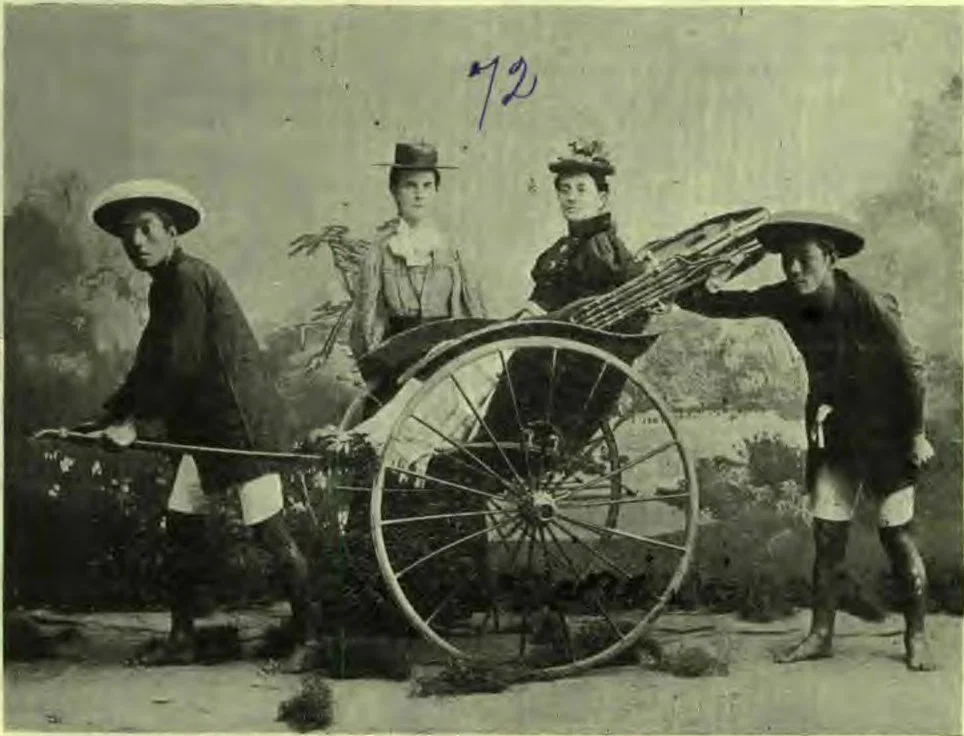
A JINRIKISHA
We all went ashore with them, and had no sooner struck land than we were surrounded by a score or more of jinrikishas, the coolies dropping the shafts in a circle around us, inviting us to take a seat in their comfortable, cushioned vehicle. This to us was a new mode of travel, but it was enjoyed, if only from its novelty. Stepping into the shafts, the wiry little man, in tights and mushroom hat, starts off at a trot down the narrow streets.
The jinrikisha is a two-wheeled vehicle, usually accommodating but one passenger. It has a cushioned seat and a top similar to that of an ordinary buggy. Very few other vehicles are used. In the city of Tokio fifty thousand jinrikishas are in use; they are to a Japanese city what cabs and street-cars are to an American city.
Having been accustomed to the sky-scrapers in Chicago, the one-story houses of the Japanese city seem to be veritable dwarfs. The streets have no sidewalks. Japanese shops are constructed in such a way that the front can be removed during business hours, and replaced at night. Inside upon a raised floor sits the merchant, surrounded by his goods. Along both sides of the street in front of the stores you will see a row of wooden sandals, having a check attached to each pair, as the customer is obliged to remove his sandals before he can enter the store to inspect and purchase goods.
Passing a carpenter shop, we saw the workmen sitting on the ground sawing with a square saw, which cuts on the up stroke instead of on the down. This is an illustration of many things203one sees in the Orient which appear upside down to those living in the West. In a restaurant the kitchen is in front and the dining-room in the rear; the fruit is picked several weeks before it is ripe; the women hang their washing in the front of the house; in building a house the roof is built before the walls.
Before leaving this little company of workers, Professor Field gave us a brief report of the work in Japan. They now have a church of fifty members. Ten were baptized last year, and already this year he has baptized twelve. They are publishing a paper in the Japanese language, and the native workers are selling a thousand copies each month. We are glad that the light is shining in this land of heathendom, and feel encouraged to continue our voyage to establish similar work in heathen China.
H. W. MILLER, M. D.
Sabbath Bells
By May Gilman Cole
SWEET Sabbath bells, sweet Sabbath bells,
What precious thoughts thy chiming tells,
Strains from the angel choir in heaven,
Foretaste of rest there to be given.
Ring in, sweet bells, a day of gladness,
Oh, bring the peace, the balm of sadness!
Ring out the thoughts of care and strife,
And help to form a nobler life.
MAY GILMAN COLE.
The Unmistakable King
By Clyde Lowry
Do something and be a king. Such is the real significance of the word as shown by its derivation from the German word “Koenig,” and the Danish word “Canning,” both of which signify: “The one who can,” or “The able man.” Since the dawn of history the world has been constantly engaged in bowing to the men of action who have come upon the stage of life at a crisis, and who, rightfully or wrongfully, have used the power which they have taken.
Recently I was discussing this subject with a class of street urchins in the Life Boat Mission Sunday-school, and they epitomized the entire subject in these terse words: “The leader of our bunch is a feller that can tell us how to do things, and lick us if we don’t.” In these coarse words the ragged philosophers expressed their version of the divine right of kings, and no scholarly dissertation ever came nearer the truth from the world’s standpoint. They had demonstrated the principle in their own lives, and therefore they were qualified to speak with authority.
The principle is as universal as humanity, and the world is full of uncrowned kings who have enthroned themselves by taking advantage of it. They are wide-awake men who saw Opportunity, and seized her, as she hurried along the road to fame and fortune; and they are able men who can use the power which they have assumed; for leadership belongs only to the men who have a goal, and a determination to reach it. Nothing happens by chance in this life or the life to come. Men reap what they sow, and the harvest is great or small according to the skill used in selecting the seed and propagating its growth. The stepping-stones to success are always tangible, and the successful man will invariably leave an indelible impression on his particular line of work.
At no time in the history of labor has there been such a demand for capable men. Tremendous vacancies are being made every day in business enterprises and professional ranks. These must be filled, and there is a constant call for men who are willing to work. In this age of unprecedented business activity we find men of thirty occupying positions that a generation ago could barely be held by men of double their age. The increased area of trade and numberless inventions have opened fields that were inaccessible, even undreamed of by our fathers and grandfathers. Never was the race for wealth and power more strenuously run than it is to-day, and its possibilities are unlimited, its end practically incomprehensible.
Holy Writ declares that “a man’s gifts maketh room for him,” and it is equally true that the world has no room for the man who has no inclination to use in some way his God-given gift. There are men whose lives consist of three epochs similar to those of the drones in a beehive. They are born and grow up with the conviction that the world owes them a living; they exist as long down as they can with the least possible amount of exertion; and they are finally stung to death by their industrious companions.
We experience no difficulty in finding men of this class. They comprise the population of scores of poor-farms and county workhouses, and our penal institutions absorb thousands of them every year. We find them tramping along the ties, or riding on the trucks of freight trains. Every barrel house and saloon will furnish a large quota, and in Chicago alone there are five thousand men who inhabit so-called “Workingmen’s Homes.” Few men of this class are working men, and most of them obtain their living by questionable means. Their only apparent ambition is to get what they want to eat and drink, and a place to sleep, with the least possible expenditure of energy.
The reason for such a state of affairs is obvious; these men are not disposed to do anything to help themselves or others. There seems to be no reason why men should be out of employment when work is so plentiful and so varied as it is at this time.
Like everything else in this world, success, as the term is often used, may be helpful or harmful, it may be legitimate or it may not, but the really successful or powerful man is he who accepts God’s words, “Without me ye can do nothing.”
The keynote of success is found in the command, “Whatsoever thy hand findeth to do, do it with thy might;” for the Word of God says that the man who is diligent in his business shall stand before the King. CLYDE LOWRY.
How People Lived in Rome
By Roy F. Cottrell
In our glances backward through the history of Rome, we have seen only a few things recorded which were beautiful or uplifting to contemplate; on the contrary the historian's pen seems to have attempted only to record the great and sinful deeds of war and warriors. It is therefore with a sense of joy and rest that we turn aside for a time from the vile and dreadful deeds of these men to acquaint ourselves more fully with the domestic life of the common people.
At first the Romans were farmers, simple in their customs, rising early, laboring hard, and living close to the heart of nature. As long as they followed this simple life, we find them as quiet, saving, and kind-hearted a people as one could wish. The stranger always received a welcome, and was treated to the best the home afforded. But as time went on, the trophies of war provided slaves, who were placed under an overseer, and given the work to do, while their masters congregated in cities to enjoy a life of ease, excitement, and wickedness. Slave-owning soon became so universal that a man's rank was estimated by the number of slaves he kept. This shows us how one sin leads to another; God's natural order was reversed as they left their quiet lives of toil, and sat down to “eat, drink, and be merry” in the great centers of population.
If we had visited the city of Rome as late as seven hundred years after its establishment, we should doubtless have been disappointed to find the streets so narrow and crooked that a carriage could only get about on two of the streets; yet this was the case. The city was in darkness at night for want of suitable lights, and robbers and wicked men caused all respectable people to stay in their homes until daylight.
The first houses built in Rome were extremely simple, having but one main room, which had neither windows nor chimney. The smoke, which arose from the fire on the hearth, after wandering about the room, found vent in a hole in the roof: this opening admitted both light and rain, the latter being caught in a cistern that was formed in the center of the room. It was in this one room that the meals were prepared, friends were entertained, sewing and spinning were done, and it was here that all retired for rest. The house was approached from the street by way of a small, open vestibule, leading to the entrance hall. It was in this vestibule that the gentleman of the house put on his “toga,” or principal outer garment, when he went into the street, but which he did not wear while in the house or field. The knowledge of this custom helps us better to understand what Christ meant when he commanded him that was in the field not to return to take his clothes. If there was potted cypress in the vestibule, it was known by this that there had been a death in the house; but if the doors were decorated with myrtle or laurel, a marriage was indicated. In his own home the man at the head of the household was both priest and king. Children were taught to honor and obey their parents in the early times, not alone until grown to manhood and womanhood, but all through life. The daughters were confined quite closely until their marriage, after which time they might attend the many amusements of the city.
One favorite exercise in later times was swimming and bathing. Public baths and swimming-pools were constructed, and, being free, were indulged in by both rich and poor alike. They also enlarged their houses by building “wings,” as they named the additions; and before the empire came, the houses were more like our own homes. Luxury and convenience both testified to the wealth of the owner; in the spacious saloons surrounded with galleries highly adorned; in the picture-rooms to delight the finer senses with art; in the book-rooms elegantly furnished with suitable cases and statuary; in the great dining-room; and lastly in the well-equipped bath-room. There were often as many as fifty rooms on a single floor, while above on the housetop terraces or gardens were constructed, where among their own shrubs, fruit-trees, or fish-ponds the owners might bask in the warm rays of the sun. The housetop seems to have been the favorite afternoon resort in our Saviour’s time, and hence the references to it in the Bible.
The diet in the early days consisted mostly of porridge made from the nutritious pulse, fruit and vegetables. As men departed farther and farther from the right, their appetites demanded instead of healthful food all sorts of meats, until the more unwholesome and unclean it was, the greater luxury it seemed to be. Fish, oysters, crabs, mussels, and snails were brought to the table alive to show that they were fresh. The emperors devoured so much swine’s flesh that it is said they were more like this animal than human beings. But as long as these unsavory things were served from massive gold and silver ware, their gluttony knew no bounds. Their dining-rooms were the largest rooms of the house, and the furniture was made of costly woods, inlaid with pearl and ivory. Around the table were placed couches, each accommodating three persons. On these couches, elevated above the table, the people reclined as they ate, each man lying almost flat on his breast, resting on his left elbow, and having his right hand free to use, thus putting the head of one near the breast of the man behind him, and making very natural the expression that he lay in the bosom of the other. This was similar to the custom which Christ and his disciples practised when John leaned on Jesus’ breast. It might be of interest, had we time, to speak of the games and festivals which took so much of the Roman’s time; for these things demonstrate what false principles in education lead to.
About ten years after the destruction of Jerusalem, there was a great eruption of Mt. Vesuvius, and the cities of Pompeii and Herculaneum were buried beneath ashes, cinders, and molten lava. So quickly and unexpectedly were they destroyed, that the inhabitants were entombed alive just as they were,—about their work, or engaging in the pleasures of these fashionable resorts. Even the4sites of these cities were forgotten until about one hundred fifty years ago some ruins were discovered by men who were digging a well. Since then a large part of Pompeii has been uncovered, and in this has been preserved a vivid picture of Roman life as it was eighteen centuries ago.
What Has Been Done. By the Leader. Review, February 18, January 21.
Field Study:—
Mission Work in Samoa. Review, February 25.
Korea, An Unentered Field. Review, March 3.
A Journey in Northwestern Rhodesia. Review, March 10, 17.
Three-Minute Reports:—
Call from Chile. Review, February 18.
The Mission at Buluwayo. Review, February 18.
Last Words from Brother Watson. Review, February 25.
Answer to China’s Call, and Its Meaning. Review, February 25.
5. Word from Fiji. Review, March 3.
Closing Exercises.
Suggestions
There is so much material in the recent Reviews that it is difficult to decide which to choose. The program may be varied, according to the company and their general information on the fields. It will be profitable to close with a season of prayer, in which a number take part. Our missionaries need our prayers, and we need the blessing that comes with knowing their needs so definitely that we shall enjoy talking to the Lord about them. In all the missionary meetings, make it a point to be definite. Arrange your program so that those who attend will always carry away definite information concerning the fields, and shall we not add—definite determination to share in the work until every nation, kindred, tongue, and people has been warned? E. H.
America and Australia Join Hands in a Good Work
By L. F. P.
THE Young People’s work in Australia is taking on definite form. A committee of five was recently appointed by the Union Conference to have charge of the work. Mrs. Anna L. Hindson, the secretary, writes: “We have been laying definite plans in harmony with the work in the States. We have our Membership Cards printed, and expect to take hold of the work in earnest. In a few of our larger churches Young People’s Societies are now successfully started, but we wish to extend the work to our smaller churches. In most cases the meetings are held on Sabbath afternoon, when various lines of instruction from the Bible are given, and reports received. The young people engage in various kinds of missionary work similar to what is being done in America. Hospital work, ship work, selling papers on the street and from house to house, missionary correspondence, and missionary gardening are all receiving attention. Useful articles are also made and sold, and the proceeds given to the mission field.
“One of our brethren who was interested in the children’s work gave a sum of money to two Societies, to be divided among the members, and to be known as ‘talents.’ The members were to trade with these talents, and give the increase to the Lord. This plan worked well, and all put forth earnest efforts to improve their talent. It was interesting to see the different ways that were devised by the members for increasing the original sum entrusted to them.” L. F. P.
Pennsylvania Young People's Society Reports
By Mrs. L. Flora Plummer
Pennsylvania
THE following summary of the work of the Societies reporting from Pennsylvania is of interest. The items are compiled from report blanks, and of necessity are brief:—
Williamsport.—Ten members. The sum of $5.81 has been collected during the last quarter, and used for benevolent purposes in the city. The study of the early Reformers as given in “Great Controversy” and the various missionary fields as presented in the INSTRUCTOR have occupied a large share of the time in the meetings. The members have been visiting the sick in hospitals and private houses, and distributing literature in some of the public institutions in the city.
Pittsburg.—Sixteen members. Weekly meetings are held, and the lessons in “Great Controversy” studied. The members have been selling literature. One girl sold twenty copies of the book “Story of Joseph;” another sold ten copies. Three barrels of clothing have been sent to the needy South. The secretary says, “The interest is good, and the young people are growing in their work.”
North Philadelphia.—Ten members. Weekly meetings are held, and the INSTRUCTOR lessons are used in the meetings. The following work is reported: four hundred four Signs sold, five given away, forty-six visits made, two Bible readings held, ten missionary letters written. The report states: “Our Society was organized October 24, and this is our first report. We feel that God has blessed us in the efforts put forth, and we are encouraged to go forward.”
East Philadelphia.—Fifteen members. Meetings are held each Sabbath afternoon. The sum of $5.30 has been spent in buying tracts for missionary purposes. Besides the distribution of tracts and papers, the members are visiting the sick, holding Bible readings, and engaging in different lines of missionary work.
Conneautville.—Five members. Although the Society is small, weekly meetings are held, and the regular studies taken up. The members are active in distributing literature.
Wrights.—Twelve members. These young people are only able to hold monthly meetings, yet they report an excellent interest. The secretary says: “I believe the young people of this church are improving their talents, and are awakening to the responsibility that rests upon them in this closing work.”
Lebanon.—Ten members. They have collected $4.25, a portion of which is reserved to build up a small library, and the remainder has been expended for tracts. Reading-matter is regularly distributed among the hospital patients, prisoners at the jail, in the stations, barber shops, and markets. The secretary writes: “We each take turns in leading our meetings. Our leader has asked each one to write a paper on the third angel’s message, to be read at our Society meeting.”
North Warren.—Eight members. Meetings are held every two weeks. The members are aiding the sewing circle in Christian Help work, and distributing reading-matter.
Kingston.—Eighteen members. Jail work, distribution of literature, Bible readings, and selling the Signs are the principal lines of missionary work carried on. “The members of the Society take a deep interest in the work, and the meetings are interesting and profitable.”
MRS. L. FLORA PLUMMER.
All Our Giving
By S. R. Wince
ALL our giving, all our loving,
Happy thoughts and tender words
Take their meaning, bear a blessing,
Just because of Christ, our Lord.
S. R. WINCE.
Young People's Work in Nebraska
By C. R. Kite
OUR Young People’s work is taking an advance step. We now have four Young People’s Societies fully organized, and there are five other companies which we hope soon to have ready for organization. The Societies organized are as follows: Omaha, thirty members; Decatur, twenty-three; Lincoln, twenty-one; College View, thirty-one, making a total membership of one hundred five. There are about fifty young people scattered throughout the State who have been brought in touch with the work by correspondence, and as I have the names of about two hundred seventy-five others, I hope that this phase of the work may be extended to many more. We are planning to reach every young person in our conference, either through the Societies or by personal correspondence.
A Young People’s convention was recently held at Blair. We had a good attendance from quite a number of the churches in eastern Nebraska. Practical topics were considered, and excellent thoughts presented.
The missionary work done by the Societies has not yet been very fully reported. At Omaha they have raised seventeen dollars for the support of a colored missionary in the South. This money was secured by the making and selling of gingham aprons and crocheted slippers. The members have also been doing quite a large amount of work in distributing and selling the Signs, in holding cottage meetings, and in Christian Help work. The young people at Decatur have sold a number of the Signs, and have also given quite a number of Bible readings. At Lincoln they have been working in a similar way. In College View they have been doing Christian Help work, making quilts, holding prayer-meetings, and engaging in general missionary work.
My interests are with the young people, and I pray that God will help us to enlist the talent bound up in their ranks in carrying forward the last message to the world.
C. R. KITE.
News From Other Societies
By Mrs. F. L. Plummer
EIGHT Young People's Societies in the California Conference reported for the quarter ending in December. The entire membership is two hundred eighty-one. During the quarter $184.19 was collected by these Societies. The money has been used to educate a Fiji missionary, to help the work in India, China, and other countries, and in home missionary work.
In a recent meeting of the Young People's Society at Battle Creek, Michigan, the question of the continual support of Dr. John Keichline in Egypt was considered. This brother was formerly a member of the Battle Creek Society, and the expense of his transportation to his chosen mission field was borne by that Society. When the young people were asked which they preferred to do, send for this worker to return home or increase their donations sufficiently to maintain him in Egypt, there was a hearty response given to the plan of continuing his support. A collection amounting to twenty-five dollars was taken, and over one hundred fifty persons signified their willingness to donate ten cents each week for missionary effort. MRS. F. L. PLUMMER.
The Error of a Moment
“THE error of a moment is often the sorrow of a whole life.”