Just outside the little village of Poultney, beyond the old mill, that clatters noisily all day long, is a quiet nook, where drooping willows bend low over the stream which flows quietly on its way, bathing the roots of stately trees, and refreshing hundreds of wild flowers that grow along its banks. Here the bright goldenrod hangs heavy with blossoms, and the curling pods of the touch-me-not snap as they are moved by the wind. Here, too, the bur marigold raises its leafy stem from the shallow water near the shore, the yellow flowers nodding to their own reflection in the stream. Reeds and rushes grow out into the river, and the blue sky and fleecy clouds are pictured on its tranquil waves. Tiny minnows are playing beneath the surface, and the occasional croak of a frog or hum of a bumblebee throws an air of sociability about the place.
On the trunk of a large beech tree a white-breasted nuthatch clambers up and down, pecking the bark for insects, and looking for nuts. He is a noted nut-cracker, wedging a nut into a crevice, and striking it with his dark beak until he breaks the shell. He is about six inches in length, and is a resident, braving the coldest weather with little apparent inconvenience. His back is of a gray-blue color, and the crown of his head and back of his neck are black. Beneath, he is a dull white, as are also his cheeks and breast. His wings are dark, with a light edge to many of the feathers; and the middle of his well-shaped tail is gray-blue, the outer feathers being marked with black and white. He climbs over the tree, sometimes head downward, hanging by his dark feet to the under side of a limb. Last spring he had a nest in an old stump up the stream, where his harsh, quick note was heard as he guarded his little ones.
Suddenly a loud, clear rattle is heard, with almost startling distinctness, coming nearer and nearer from the thicket up the stream. Sharper and clearer it comes, until a belted kingfisher emerges from a group of elms, and settles on the low branches of a willow that hang over the water from the opposite bank. He is about thirteen inches long. His back is an ashy-blue color, and a strip of the same forms a belt across his white breast. His square tail is spotted and banded with white, and there is a spot of white just in front of his full bright eye. He has a large crested head and dark feet.
He settles comfortably on a branch, and sits gazing downward into the water. One is almost beginning to wonder if he is admiring his beautiful crest in the mirror of the stream, when, like a flash, he darts into the water with a heavy splash, and comes up with a small fish in his long black beak. He returns again to his perch, and after beating the poor fish on the branch, proceeds to swallow it whole,—which feat he accomplishes after several vain attempts. Then away he flies with a shrill rattle, and perches near the steep bank where, not long ago, he had a nest of little ones in a hole dug in the dry sand. O tell us, pretty bird, why you eat the fish instead of the sweet fruits, ripe seed, and nuts, which your Creator provided for your food? Has the one who was a murderer from the beginning, who has darkened this fair world of ours, put it within your breast to kill and to eat your neighbors?
But suddenly a sharp cry of fear comes from the kingfisher. Ah, the tide has turned, and an enemy is pursuing him. Round and round over the stream flies the affrighted bird, with another, larger than himself, in close pursuit. At last the kingfisher escapes, and a large hawk, with heavy wings, a broad tail, and a murderous heart, sails steadily by just above the water, and alights on a fallen tree farther down the stream.
PANCHO IS A TEMPERANCE MONKEY
No wonder the whole creation groans to be delivered, when each creature is an enemy to those who are weaker than himself, and the most dreaded and bloodthirsty of them all is man. When will the Prince of Peace begin his reign, when “they shall not hurt nor destroy,” when “the earth shall be full of the knowledge of the Lord as the waters cover the sea”? Of his kingdom and “peace there shall be no end.” EVA A. JENKS.
Peculiar Things About Monkeys
By Arthur Fox
Did you ever notice how much like human beings monkeys are in many of their ways?
There are various species of monkeys, but the peculiar feature of each is the power of opposing the great toe to the other toes, thus making the hind feet become hands, and the animal quadrumanous, or four handed. The so-called sacred monkey of India receives divine honors from the people, and their laws provide that should one of these be killed, the crime is punishable by death, while a small fine compounds for the murder of a man. And so these sacred monkeys are permitted to do much damage to gardens and flowers without danger of molestation.
Then there is the Bear Howler and the Guenon. The former has the power of dilating the larynx to such an extent that its voice is louder than the roar of a lion, having been heard at a distance of two miles. The Guenon is considered the fop of the monkeys. Its cheek pouches will contain two days’ food. Sometimes, when they become very hungry, they descend into the fields and commit great havoc. Being of a docile nature, they are easily tamed, but are arrant thieves. While gratefully receiving caresses, they will pick the pockets of their admirers.
One way in which monkeys are sometimes captured may be interesting to you. The families are, as a rule, remarkably cunning. Pitfalls will take a lion, and the famished monarch will, after a few days’ starvation, dart into a cage containing food, and thus be secured. But how are monkeys caught? The ape family resembles man. Their vices are human. They have a fondness for liquor, and yield readily to the influences of the “cup.” In Darfour and Senor, the natives make a fermented beer, of which the monkeys are passionately fond. Aware of this, the natives go to the parts of the forest frequented by the monkeys, and set on the ground, calabashes full of enticing liquor. As soon as the monkey sees and tastes it, he utters loud cries of joy, that soon attract his comrades. Then an orgie begins, and then in a short time they show all degrees of intoxication. The negroes now appear. The few monkeys who came too late to get bewildered escape.
The drinkers are too far gone to distrust the negro, but apparently regard him as a larger species of their own genus. The negroes take some of them up, and the monkeys begin to weep and cover their captors with maudlin kisses. When a negro takes one by the hand to lead him off, the nearest monkey will cling to his misguided friend who is being enticed away, seemingly determined to share his coming joys or sorrows. Another will grasp at the second one, and so on, until the negro leads a straggling line of ten or a dozen tipsy monkeys.
When finally brought to the village, they are securely caged and sobered down; but for two or three days a gradually diminishing supply of liquor is given them, in order to reconcile them by degrees to their state of captivity.
ARTHUR FOX.
A Clergyman's Sermon and the Attentive Little Girl
“One thing helped me very much while I was preaching to-day,” said a clergyman.
“What was that?” inquired a friend.
“It was the attention of a little girl, who kept her eyes fixed on me, and seemed to try to understand every word I said. She was a great help to me.”
To a Nuthatch
By Edith M. Thomas
SHREWD little haunter of woods, all gray,
Whom I meet on my walk of a winter day:
You're busy inspecting each cranny and hole
In the ragged bark of yon hickory bole,—
You intent on your task, and I on the law
Of your wonderful head and gymnastic claw!
The woodpecker well may despair of this feat:
Only the fly with you can compete!
So much is clear; but I fain would know
How you can so reckless and fearless go,—
Head upward, head downward, all one to you,
Zenith and nadir the same in your view.
— Edith M. Thomas.
Power of Song
By Ellen G. White
THE melody of praise is the atmosphere of heaven; and when heaven comes in touch with the earth, there is music and song,—“thanksgiving, and the voice of melody.”
Above the new-created earth, as it lay, fair and unblemished, under the smile of God, “the morning stars sang together, and all the sons of God shouted for joy.” So human hearts, in sympathy with heaven, have responded to God’s goodness in notes of praise. Many of the events of human history have been linked with sacred song.
The history of the songs of the Bible is full of suggestion as to the uses and benefits of music and song. Music is often perverted to serve purposes of evil, and it thus becomes one of the most alluring agencies of temptation. But, rightly employed, it is a precious gift of God, designed to uplift the thoughts to high and noble themes, to inspire and elevate the soul. As the children of Israel, journeying through the wilderness, cheered their way by the music of sacred song, so God bids his children to-day gladden their pilgrim life. There are few means more effective for fixing his word in the memory than repeating them in song. And such song has wonderful power. It has power to subdue rude and uncultivated natures; power to quicken thought and to awaken sympathy, to promote harmony of action, and to banish the gloom and foreboding that destroy courage and weaken effort.
It is one of the most effective means of impressing the heart with spiritual truth. How often to the soul hard-pressed and ready to despair, memory recalls some word of God’s,—the long-forgotten burden of a childhood song,—and temptations lose their power, and courage and gladness are imparted to other souls!
The value of song as a means of education should never be lost sight of. Let there be singing in the home, of songs that are sweet and pure, and there will be fewer words of censure, and more of cheerfulness and hope and joy. Let there be singing in the schools, and the pupils will be drawn closer to God, to their teachers, and to one another.
As a part of religious service, singing is as much an act of worship as is prayer. Indeed, many a song is prayer. If the child is taught to realize this, he will think more of the meaning of the words he sings, and will be more susceptible to their power.
As our Redeemer leads us to the threshold of the Infinite, flushed with the glory of God, we may catch the themes of praise and thanksgiving from the heavenly choir round about the throne; and as the echo of the angels’ song is awakened in our earthly homes, hearts will be drawn closer to the heavenly singers. Heaven’s communion begins on earth. We learn here its keynote.
MRS. E. G. WHITE.
“In the Cross of Christ I Glory”
By Amos R. Wells
There are “no creeds in heaven,” as a popular poem teaches us. Certainly there are no creeds in song, for men of all forms of Christian faith sing with equal delight the hymns of a Wesleyan, a Calvinist, a Churchman, or a Unitarian. A conspicuous illustration of this is the hymn, “In the Cross of Christ I glory,” which, though it is one of the most evangelical of hymns, was nevertheless written by a Unitarian.
The author was a remarkable man, Sir John Bowring, LL. D., F. R. S., who was born at Exeter, England, in 1792, and died in 1872. He was a very learned man. He could speak fluently twenty-two languages, and converse in one hundred. He was pupil and literary executor of Jeremy Bentham, the philosopher and publicist. He edited at one time The Westminster Review. He was consul at Hongkong when the Opium War broke out, and was afterward governor of that colony. He was twice a Radical member of Parliament, and he negotiated treaties for Siam and Hawaii with six European countries. He was an ardent student of the songs of Europe, and published several volumes of translations from more than twenty languages. His little book, “Matins and Vespers,” is especially rich in devotional poems. He was apparently a sincere Christian, and lived a devoted, Christlike life. The words he wrote, “In the Cross of Christ I glory,” were no unmeaning words to him, and they are fittingly inscribed in bold characters upon his tombstone.
We owe to Bowring other hymns that are a part of the spiritual life of all Christians. Notable among these are: “God is love, his mercy brightens,” “From the recesses of a lowly spirit,” and “Watchman, tell us of the night.” The last-named was written in 1825, and Bowring did not know that it was used as a hymn till ten years later, when he heard it sung in a prayer-meeting of American missionaries in Asiatic Turkey. “No one,” says Horder, “can without prejudice read hymns like these and not feel that, beneath great diversities as to doctrine, there may be and often is a real unity of Christian spirit.”
But of course Bowring’s most famous hymn is the one we are to commit to memory this month:—
“In the Cross of Christ I glory:
Towering o’er the wrecks of time,
All the light of sacred story
Gathers round its head sublime.
“When the woes of life o’ertake me,
Hopes deceive and fears annoy,
Never shall the Cross forsake me:
Lo, it glows with peace and joy.
“When the sun of bliss is beaming
Light and love upon my way,
From the Cross the radiance streaming
Adds new luster to the day.
“Bane and blessing, pain and pleasure,
By the Cross are sanctified:
Peace is there that knows no measure,
Joys that through all time abide.
“In the Cross of Christ I glory:
Towering o’er the wrecks of time,
All the light of sacred story
Gathers round its head sublime.”
One noteworthy incident of the siege of Peking during the Boxer massacres illustrates the hold this hymn has upon the Christian church. After the raising of the siege, and the terrible strain was over, the missionaries gathered in the Temple of Heaven,—that mysterious shrine which no one but the emperor of China had been allowed to visit, and he only once a year. Around the royal marble altar in that heathen temple gathered the missionaries of the Cross, and sang the hymn which expressed the spirit that had sustained them during those dreadful weeks of suffering and danger—“In the Cross of Christ I glory.” Let us never again sing the second stanza without thinking of that inspiring scene—
“When the woes of life o’ertake me,
Hopes deceive and fears annoy,
Never shall the Cross forsake me;
Lo, it glows with peace and joy.”
—Amos R. Wells, in The S. S. Times.
A Favorite of Mr. Sankey
By Edison Driver
The whole world has sung the “Ninety and Nine,” and listened with pleasure and delight to the cheering words that tell of a Saviour’s care for the one that “was out on the hills away.” It only remains to tell the simple, strange little story of the song itself. Songs seem nearer and dearer when we know something of their history.
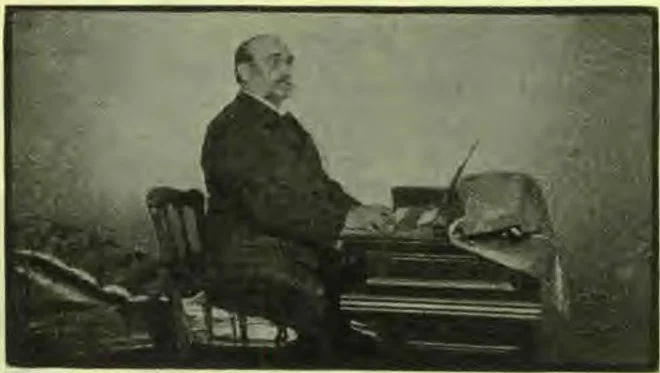
MR. SANKEY COMPOSING A HYMN
Thirty years ago those famous evangelists, Moody and Sankey, were preaching and singing together in old England. One day they were going from Glasgow, Scotland, to Edinburgh for a great meeting there, and Mr. Sankey as he stepped aboard the train, purchased a penny religious paper. As he settled down in the car to read, his eye caught the lines of a poem, away in an obscure corner of the paper,—
“There were ninety and nine
That safely lay
In the shelter of the fold.”
The great singer read on, till the entire poem had been perused, and then he exclaimed, with a note of triumph in his voice, “Mr. Moody, I have found the hymn I have been looking for years!”
“What is it?” asked Moody, looking up from the letter he was reading.
His friend explained that it was about the lost sheep.
“Read it to me,” said Mr. Moody, his eyes still fixed on the letter.
So Mr. Sankey read it, putting much expression into his voice, trying hard to do justice to the beauty of the sentiment. But alas! when he looked up, Mr. Moody was absorbed in meditation over his letter, and had heard scarcely a word.
“All right,” said Mr. Sankey to himself, with a smile, “you won’t get off so easy, my friend; you’ll hear this song later.” He cut out the poem, and stored it away in his pocket scrapbook.
So on their second day in Edinburgh before a great audience Mr. Moody had spoken eloquently and touchingly on the Good Shepherd, when he said, “Mr. Sankey, have you a solo to sing on this subject?”
The great singer was at a loss for once. Three times that day the congregation had sung the twenty-third psalm. So that would not do, and he could think of no other. And then those verses he had read on the train came before him like a flash, with the thought, “Sing those, by all means.” “But,” he objected, “how can I sing without a tune?” The audience was waiting. Mr. Sankey took the little scrap from his note-book, struck a full chord on the organ, and then, note by note, never sung before, came the first stanza. The thought flooded upon the singer, Could he remember to sing the second in the same way? But concentrating his mind, the second stanza, the third, and on through the fifth he sang, while the delighted audience sat still as death, little dreaming that the wonderful melody had never been heard before, even by the singer himself.
“Mr. Sankey,” exclaimed Moody, coming down where he sat, “where did you get that song? It’s wonderful! I never heard anything like it!”
“O, that,” said Mr. Sankey, to his friend’s evident confusion, “that is the hymn I read to you on the train the other day!”
MEMORY VERSE: “The sacrifice of the wicked is an abomination to the Lord: but the prayer of the upright is his delight.” Prov. 15:18.
The Lord had made Jeroboam ruler of Israel; but as soon as he had secured the kingdom, he began to plan how he might keep it by his own wisdom. The Bible tells us that the wisdom of men is foolishness with God; and it is certain that Jeroboam acted in a very foolish way.
He feared that if the people of Israel went to Jerusalem to worship, they would turn away from him, and join the kingdom of Judah. So he made two calves of gold, and said to the people: “It is too much for you to go up to Jerusalem: Behold thy gods, O Israel, which brought thee up out of the land of Egypt.”
Jeroboam put one of these golden calves in Bethel, and one in Dan. He chose men from the different tribes to serve as priests, and ordained a feast day. He himself offered sacrifices and burnt incense. Then the priests and the Levites left Jeroboam, and went to Jerusalem, with many other faithful ones from all the tribes who “set their hearts to know the Lord.” These good men made the kingdom of Judah strong.
One day when Jeroboam was standing by the altar in Bethel, to burn incense, there came to him a man of God out of Judah. “And he cried against the altar in the word of the Lord, and said, O altar, altar, thus saith the Lord; Behold, a child shall be born unto the house of David, Josiah by name; and upon thee shall he offer the priests of the high places that burn incense upon thee.” And he gave a sign, saying, “Behold, the altar shall be rent, and the ashes that are upon it shall be poured out.”
When the king heard these words, he put forth his hand, saying, “Lay hold on him. And his hand which he put forth against him, dried up, so that he could not pull it in again to him.”
The altar also was rent, and the ashes poured out, as the man of God had said. Jeroboam asked the man of God to pray that his hand might be healed; “and the man of God besought the Lord, and the king’s hand was restored him again, and became as it was before.”
“And the king said unto the man of God, Come home with me, and refresh thyself, and I will give thee a reward. And the man of God said unto the king, If thou wilt give me half thine house, I will not go in with thee, neither will I eat bread nor drink water in this place: for so was it charged me by the word of the Lord, saying, Eat no bread, nor drink water, nor turn again by the same way that thou camest. So he went another way, and returned not by the way that he came to Bethel.”
There was an old man living in Bethel, who had been a prophet. When he heard the things that had happened, he rode after the man of God, and overtook him. He found him sitting under an oak, no doubt spent and weary, and he said, “Come home with me, and eat bread.”
But the man of God answered as he had answered the king, that the Lord had charged him not to eat bread, nor drink water in that place. Then the old prophet said: “An angel spake unto me by the word of the Lord, saying, Bring him back with thee into thine house, that he may eat bread and drink water.”
This was a lie; but the man of God listened, and went back to Bethel. While he sat at the table, the word of the Lord came to him that because he had disobeyed the Lord, he should not return to Jerusalem alive. And when he set forth on his journey again, a lion met him in the way, and slew him.
The Lord has put the sad story of the disobedient prophet in his book to teach us once more how important it is to know for ourselves what his commands are, and then to obey them exactly.
Questions
1. Why did Jeroboam fear to have Israel go up to Jerusalem to worship? What did he make? Where did he set up these idols? What did he say to the people? Who had brought Israel up out of Egypt? Repeat Ex. 20:2.
2. What kind of men did Jeroboam choose for priests? What did he himself do? Where did the priests and the Levites go? Who else went to Jerusalem? What did these men do for the kingdom of Judah? Read 2 Chron. 11:16, 17.
3. Who is it that rules in the kingdom of men? Dan. 4:17, 25, 32. What are in his hand? 1 Chron. 29:12. What does he give to all? Can you tell why it was foolish as well as wicked for Jeroboam to lead his people to worship idols?
4. Who came to Jeroboam one day as he stood by the altar in Bethel? What did the man of God say? What sign did he say would be given to show that his words were true?
5. Tell what Jeroboam did and said when he heard these words. What happened to his hand? What to the altar? How was the king’s hand healed?
6. Where did Jeroboam invite the man of God to go? What did he say he would give him? Why did the man refuse to go home with the king?
7. Who rode after the man of God when he started home? What lying words did the old prophet speak? How did the man show that he believed them?
8. What word came to the man of God as he sat at the table? What dreadful thing happened when he had started again on his journey? Tell one lesson that we may learn from this story.
MEMORY VERSE: “To him that overcometh will I give to eat of the tree of life, which is in the midst of the paradise of God.”
Questions
1. Name the seven churches to whom the book of Revelation is addressed. Rev. 1:11. Why were just seven churches chosen? Note 1.
2. By what name was the first period of the church designated? Rev. 2:1. To about what time did this period extend? Note 2.
3. What is the meaning of the word “Ephesus”? What was there “desirable” at that period of the church? Note 3.
4. Who is the author of this message? Verse 1. What assurance have we that Jesus still walks among his people? Rev. 1:20, last part; Matt. 28:20.
5. For what is this church commended? Verses 2, 3.
6. Why is it reproved? Verse 4. What naturally follows the entrance into the heart of the first love for God and his truth? See John 1:43-46; Luke 8:38-40; 2 Peter 1:5-9.
7. What earnest appeal is sent to those who have left their first love? What will be the result if such do not repent? Verse 5; note 4.
8. What position had this church taken against wrong teaching? Verse 6; note 5.
9. What call is made to every one? What promise to him that overcometh? Verse 7; note 6.
10. By what term is the next church described? Verse 8. What is the meaning of the word “Smyrna”? Note 7.
11. Who is the author of the message to the church at Smyrna? Verse 8.
12. What does he know of this church? Verse 9.
13. What experience does he say awaits them? What comforting assurance is sent? Verse 10; note 8.
14. What promise is given not only to the church at Smyrna, but to all who have ears to hear the message of the Spirit to the churches? Verse 11.
15. What special period of time is covered by this second stage in the history of the church?—The time from early in the second century, through the days of pagan persecution, to the time of Constantine, whose professed conversion, in A. D. 323, opened a distinctly third era in the history of the church.
16. Where are those who have passed through great tribulation next seen by the prophet in vision? Rev. 7:13-17.
Notes
1. The number seven is used repeatedly in the Scriptures, evidently to denote fulness and completion. So just seven churches represent the complete history of God’s people from the time of the apostles to the close of probation.
2. The first period extends from the beginning of the early church to the time when the apostolic leaders had passed away, or about the closing of the first century and the early days of the second, the natural boundary of the first, or apostolic, era of the church, though no specific year may be given.
3. The word “Ephesus” means “desirable.” This well describes the character and condition of the first church. During the period of apostolic labor, they had received the doctrines of Christ in its purity. They had also enjoyed the blessings resulting from the outpouring of the Holy Spirit.
4. There is a warmth of affection and an earnest enthusiasm that is experienced when Jesus is first accepted as the Saviour, that sometimes fades out of the life after a while. The appeal to the church of Ephesus is for every soul who is passing through a similar experience. Our love may be renewed by coming to Jesus for the forgiveness of sin, and by the consecration of all to him. This must be done day by day, if we would live in the joy of his presence. Even now, if the way seems less desirable than when we first gave our hearts to him, he waits to renew his love in our hearts. Then labor for him will be pleasure. Still, we must guard against the tendency of the flesh to become careless. Just here was the failure of the early church.
5. The sect of Nicolaitanes was one of the first that sprang up within the church, undermining the truth by mysticism and fanciful teaching.
6. This and other references show that the garden of Eden, once on earth, has been transplanted to heaven.
7. “Smyrna” signifies “myrrh,” fit appellation for the church of God while passing through the fiery furnace of persecution and proving herself a “sweet-smelling savor” unto him.—“Thoughts on Revelation.”
8. The prophecy speaks of “ten days.” The last and severest persecution of this period was a sustained effort to suppress Christianity, lasting ten years. Ten days prophetic time—a day for a year—would be ten years literal time. “It was not till A. D. 311,” says Lecky, “ten years after the first measure against the Christians, that the Eastern persecution ceased. Galerius, the arch enemy of the Christians, was struck down by a fearful disease.” He suspended his edict, and besought Christians to pray for his recovery.
A New Book, “The Lover’s Love”
By Wm. P. Pearce
BY WM. P. PEARCE
In this day and age when the love of the world is increasing in the hearts of mankind, God has used the author of “The Lover’s Love” to portray anew his wonderful love to the world.
That fadeless, priceless gem of Scripture, John 3:16—“the gospel in miniature”—is the keynote through the entire volume. The object of the book is to deepen the love of the believer, and through its rich, forceful, convincing teaching, and touching incidents, to win souls to him who gave his life for us.
It contains an important message for this time. Every church-member should have a copy. The young people will like it, and it will bind their hearts to God. It is a trade book bound in a neat cloth binding. It has 176 large pages 5⅝ x 7⅝ inches, and it is 1¼ inches thick. Price, 75 cents, postpaid. Order of your State tract society.
A Sixty-Three Mile Fence
ACCORDING to the Kansas City Journal, one of the longest fences in the Northwest is being constructed, running entirely around the Lower Brule Indian Reservation, on the Missouri River, in the central portion of South Dakota. This remarkable fence will be sixty-three miles in length. It is composed of four wires placed on posts set a rod apart, cedar and ash posts alternating. In its construction 250 miles of wire will be used, or 76,000 pounds. To erect the fence required an aggregate of 19,000 posts. In this long fence there will be only three gateways, which will be guarded when the fence is completed.
The fence is being constructed by the Indians themselves under the direction of the agency authorities, the Indians receiving $2.50 per day for man and team and $1.25 per day for men. It is understood that next spring the government will issue stock cattle to the Indians, to be grazed inside this huge enclosure, the purpose of the government being to encourage the Indians in stock-raising, so that they can ultimately support themselves.—Scientific American.
Do a Little More than Duty
ANDREW CARNEGIE in an address to a graduating class at the Mechanics’ Institute in New York, said: “There are several classes of young men. There are those who do not do all their duty; there are those who profess to do their duty; and there is a third class, far better than the other two, that do their duty and a little more. There is a difference between talent and genius: Talent does what it can; genius what it must. But it is the little more that makes the difference. There are many great pianists, but Paderewski is at the head because he does a little more than the others. So it is with the young and the old men who do a little more than their duty. The youth who spends his night after his daily toil in improving himself is the one that succeeds. It is to encourage such that I am here to-night. Such youth as these are the salt of society and the salt of the nation. Now what do these graduates seek? I suppose some of them want to be millionaires. Others, I suppose, are looking for fame. The man who works for money alone will not find happiness, nor will he be a useful citizen. Money never buys satisfaction or happiness, but it does bring many disappointments and creates many jealousies. I believe it to be the duty of every young man to acquire a competence. But having secured this, his aim should not be to obtain additional wealth or fame, but to endeavor to see of what use he can be to his fellow beings. If he will do this, his reward will be ample. There is nothing more gratifying than self-approval. You may cheat others, but you can not cheat yourself. There are many who are lauded to-day who would be condemned by others if they were known by them as they know themselves. No one can cheat a young man out of success in life. You young men have begun well. Keep on. Don’t bother about the future. Do your duty and a little more, and the future will take care of itself.”—Selected.
St. Louis Expects Two Hundred Fifty World's Fair Conventions
St. Louis will have two hundred fifty conventions during the World's Fair, an average of two a day.
Catholic Population and Institutions in the United States
THE Catholic population of the United States is 11,877,317. There are 7 Catholic universities, 75 seminaries, 179 boys' colleges, 646 girls' colleges, and 4,000 parochial schools.
A Ship Cannot Sail Three Directions At Once
A SHIP, says Van Dyke, might as well try to sail north with her jib, east with her foresail, and south with her mainsail, as a man to go one way in conduct, and another way in character, and another way in destiny.
Russia and Korea Withdraw from St. Louis Fair
“THE American ambassador at St. Petersburg has cabled to the State Department at Washington that the Russian government has notified him of its intention to withdraw from participation in the St. Louis Fair. A similar notice of withdrawal has been sent by Korea.”
Plan to Raise Galveston Above Flood Levels
“To prevent further disasters, such as that which visited Galveston, Texas, in 1900, when three thousand houses were destroyed and eight thousand lives were lost in the floods, it is proposed to raise the whole of the city. According to the present plan, earth is to be brought from along the coasts of the Gulf and banked upon the site of the city, so that it shall be at level from seventeen to twenty feet above the sea.”
Mechanical Arms for Feeding Printing Presses at St. Louis Fair
“AMONG the exhibits intended for the St. Louis World’s Fair is a device for feeding and removing sheets to and from a platen job printing-press, which is described as a startlingly uncanny machine. It consists of two arms, which possess a reaching and retracting movement resembling that of a human arm, and each of which terminates in five long, crooked fingers, the grasping power of which depends upon an automatic suction force in the finger-tips. The arms work alternately; one delivers the blank sheets, and the other removes them as they are printed, and deposits them on a platform.”