Tsoan Chiu is a city situated about seventy miles north of Amoy, on the banks of a river near the seacoast. Last week Elder B. L. Anderson, Tan Khi,—a native worker,—and I took a trip to this place, where there are between twenty and thirty adult Sabbath-keepers. A trip of this kind is so different from a journey of seventy miles in the United States that it may be of interest to the readers of the Review to have a detailed account of it.
We packed our bedding, food, clothing, little kerosene stove, and cooking utensils in the evening, so were ready for an early start in the morning. At six o’clock, having eaten a hurried breakfast, we set out for the launch, and two hours later we were off for Tsoan Chiu, expecting to reach there before sunset that evening. But we met a strong headwind, and when we had gone about halfway, we were forced to turn back, and anchor in a sheltered bay. That night we made our bed on the open deck, preferring a night in the open air to one spent between the decks in company with about one hundred Chinese, most of whom were smoking tobacco or opium.
Although we were quite unprotected, and among almost utter strangers, we lay down to sleep that night, feeling sure of our Heavenly Father’s protecting care while we slept. The next morning at four o’clock, the wind having fallen, we started, and by eight o’clock reached the mouth of the river leading up to Tsoan Chiu. Here we transferred ourselves and belongings into a sailboat. But the tide being unfavorable, we found the boat could not go up the river until eleven o’clock; so we walked over to a neighboring village, where Tan Khi preached for about an hour to the people who gathered around to see the foreigners.
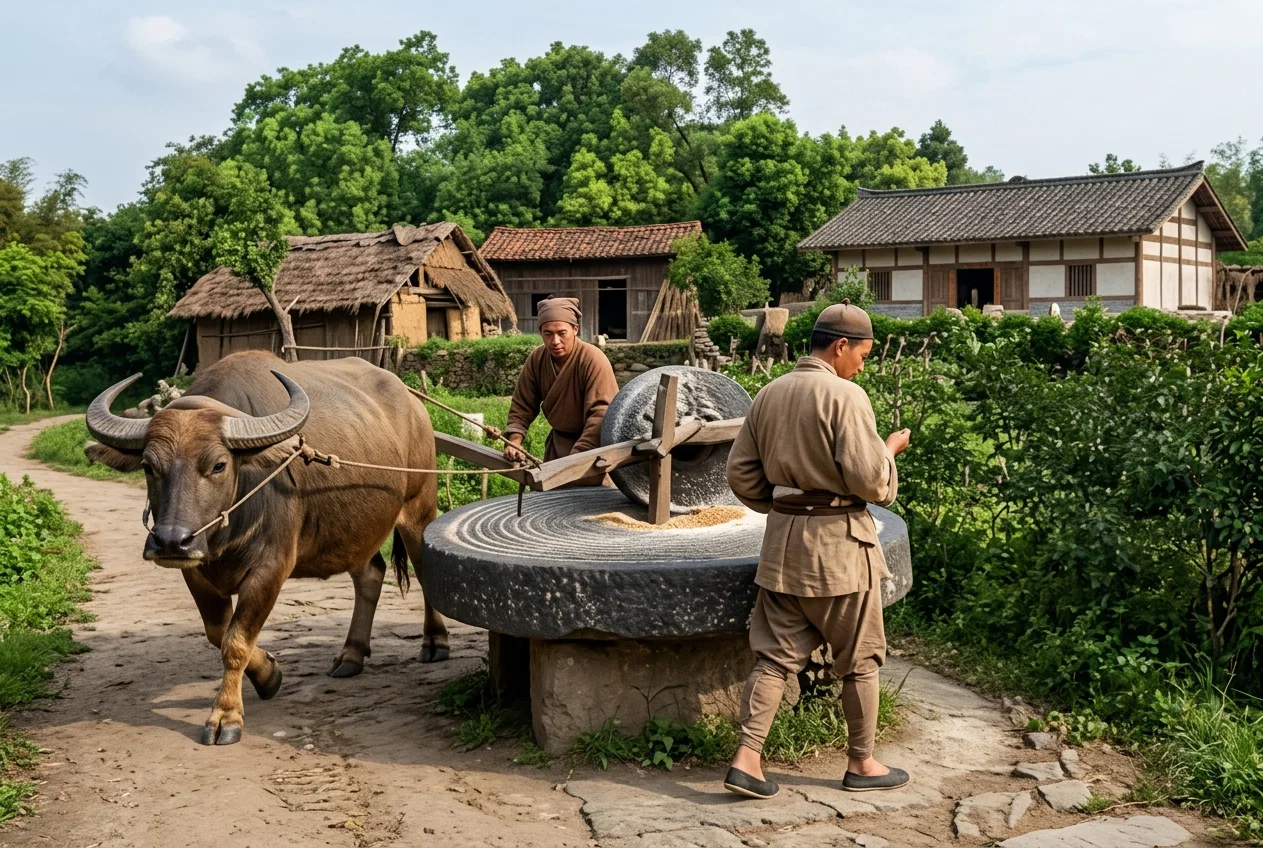
A CHINESE FLOUR MILL
About eleven o’clock our boat started for the city. But the tide was still very low, and we often stuck on a sand-bar. It was quite amusing to see how the boatmen would improve these opportunities to eat some rice, while they patiently waited for the incoming tide to lift the boat off the bars. If they finished eating before the boat was off the sand, they would take their long bamboo poles and push off.
We arrived in Tsoan Chiu at 3 P. M., almost twenty-four hours later than we had expected. Two coolies trotted off with our luggage fastened to the ends of their carrying-poles, and we followed as best we could.
Tsoan Chiu is a walled city of about one hundred thousand inhabitants. The walls are of stone, being about forty feet high on the outside, and over twelve feet thick at the top. The streets are exceptionally wide for a Chinese city, and, like all the other native cities I have seen, are paved with irregular stone flags. Some of these are long and quite broad, while others are almost like the cobble-stones, one sees in some of the cities in the United States. All these stones have been worn smooth and slippery by hundreds of years of constant use, and one must be very careful how and where he steps, or he may suddenly find himself lying on his back, in the midst of the dirt that is always inseparably connected with a Chinese street.
I wish that I could describe the queer shops, utensils, furniture, eatables, dogs, pigs, children, modes of dress, etc., that one always sees in walking through the streets of a city in this country, so that you might have some idea of what it is like; but they should be seen, to be appreciated, so I shall not attempt it. After a time these sights become so familiar to us that we no longer think them curious. But there is one thing that it is doubtful whether foreigners shall ever become accustomed to, and that is the odors. The Chinese are notably one of the most unsanitary people in the world, and one always feels like thoroughly disinfecting his nose and mouth after passing through the streets of one of these cities or villages.
After walking for about an hour, we arrived at the little house which we are using temporarily for chapel purposes. We were very tired. But washing our faces and hands revived us somewhat, and we soon had some rice cooking for dinner.
That night we made our bed on the soft side of some hardwood boards, which were arranged across two wooden benches, and, using a thick cotton comforter for a mattress, and another for cover, we slept the sleep of those who have spent the last thirty-six hours in the open air.
The next day was largely spent in talking business with our brethren, as we very much need a house which we can use permanently for chapel purposes, as well as for general headquarters for our work in that section. There is a house that is quite suitable to our needs, which can be bought for about four hundred dollars, and which could be put in nice condition for about two hundred dollars, making the total cost about six hundred dollars. But there is no money in the China Mission treasury that can be used for this purpose, so we must wait until our brethren in the States will help us to secure it.
There are thousands of large cities in China where we must establish stations, but often our hands are tied for lack of funds. It is almost always necessary to open a chapel, which must be leased or bought, and in either case it takes money. If leased, the rent must be paid several years in advance; and there is always a large bill for repairs.
At first our great need was consecrated young native workers, and the Lord is supplying these as we need them. Then we need money for their support, and the Lord has been impressing the hearts of our brethren at home to give toward supplying this. And now we must have means that can be used for securing chapels, and we feel sure that the Lord will impress the hearts of our loyal brethren in the United States to supply the necessary funds.17
We who are at the front are trying hard to press the battle to the very gates of the enemy, but we must look to our brethren in the home land to supply the munitions of war. It will not be long now until the victory is ours, and then we can all be mustered out, and go home.
Having finished our business at Tsoan Chiu, we prepared to return, and about four o’clock the next morning we arose, and packed our luggage while the two young workers who were coming back with us ate a light breakfast. The launch we were to take had entered the river, and lay at anchor just outside the city, so that shortly after six o’clock found us on board, and homeward bound.
As we entered the open seas, we were met by a strong wind from the north, and a very heavy sea. For more than an hour after we left the harbor, the wind and waves struck the launch on the side, and many times it seemed as if they would succeed in capsizing her. It was all the more dangerous as this launch was very old and quite rotten. But God’s protecting care was ever with us, and brought us through in safety, very much shaken up, but very, very thankful to our Heavenly Father for his loving care.
And even as we reached home safely, at the end of this short journey of ours, and were given a glad and loving welcome by our families, so shall we all, if faithful, soon be welcomed to our eternal home by our Saviour. True, we must first pass through trials and dangers; but trusting in him, we shall pass them safely, and at last, weary, footsore, seasick, perhaps, on life’s rough sea, but triumphant, and singing the “song of Moses and the Lamb,” we shall reach home.
Amoy, China.
Progress in Chile
By Millie E. Steele
VALPARAISO.—It may seem late at this time to write any thing of the great earthquake of August 16, and yet to us here it has not grown very old. In fact the temblores continue frequently enough to keep us from forgetting. Only the night after the Sabbath, or rather Sunday morning at about two o'clock, we had a quite heavy shock which made the house crack, and after that it continued to rock for some seconds. It is reported that in Santiago some buildings were thrown down by the force of it. Again on Sunday evening about eight o'clock came another one, much more modified. Neither does the condition of the house in which we live permit us to forget. It has not yet been repaired, and therefore has many cracks in the walls. It seems that one wall will have to be partly pulled down in order to repair it, for it is very badly cracked. Although the house has not yet been repaired, the landlord has not forgotten to raise the rent, but he has been more reasonable than many others. Rents have raised in all parts from twenty to fifty per cent, and all other things accordingly. We have been greatly favored in many ways since the earthquake, and are truly convinced that the Lord cares for those who put their trust in him.
We thought we might be obliged to leave here because of the lack of houses, but without any search or inquiry a house containing as many things as we had need of was offered to us, so that as yet many of the things we lost have not needed to be replaced. Some friends of ours decided to take a trip to Scotland for a year or more after the terremoto, and desired to leave in our care the best of their furniture with the privilege of using it as we desired. It looks like what some would call a piece of good fortune, but we know that the Lord was instrumental in having it so.
Among the ruins of the great earthquake zinc houses are growing up like mushrooms, and walls that remain standing are roofed, doors and windows are placed, and we behold a store. Repairing of houses is being rapidly carried on. Labor is very much in demand, and is very high. For the first three nights after the terremoto we slept in the street, in fact lived in the street without shelter of any kind, our food was blown full of dirt before we could eat it, but we were glad to have it even in that condition. At the end of that time we lived in one small room for nearly a month. Now we have a fairly good house, and are comfortable. Thanks be to God “who giveth to all men liberally, and upbraideth not.” We are not discouraged, for we know that all these fearful happenings foretell the soon coming of our Lord. The work is going forward, and in these four months since the terremoto more has been done for the truth than could have been done in two years under ordinary circumstances, and so we go on our way, rejoicing; for we know that soon the truth will gloriously triumph. To God be all the praise, for he is worthy.
MILLIE E. STEELE.
Central America
By A. N. Allen
LA CEIBA, SPANISH HONDURAS.—After two and one-half months' absence in New Orleans, for rest and study, I am glad to get back to Honduras and resume work. I am again enjoying good health, even better than when I first came to Central America nearly six years ago.
While this is called the Central American mission field, our work so far has been confined almost entirely to the English-speaking people of the coast and small islands just off the mainland. Brother Peebles and I are the only laborers in Spanish, and neither of us has a perfect use of the language. But I am now devoting a portion of each day18to studying Spanish, and hope soon to be able to speak in the language of the people we are working for.
Last Friday, February 8, Brother and Sister Moncada were buried in baptism by Elder H. C. Goodrich, in the beautiful Congrehey River, about two miles above its mouth, where nature speaks of the divine. The lofty mountains to the back, the beautiful blue sky overhead, the sparkling rock-bed river beneath, and the tropical verdure overhanging the banks, with the stillness of the morning, combined in forming one great mirror of divinity. God came very near; and as we saw these faithful believers, the first-fruits of the message among the Spanish people, rise from their watery grave to walk with God, we felt that a new era in our work here had been ushered in.
Among the Spanish-speaking people the outlook this year is the best it has ever been in Honduras. We have a good supply of books on hand, two good mules with which to travel, and Brother Peebles is going to push the book work, while I follow up the interest already created. We also hope to erect a church building here this year.
A. N. ALLEN.
Mission Notes
In India they teach that “he who contemplates the Ganges, while walking, sitting, sleeping, etc., is delivered from all sins.”
The great problem that missionaries are trying to solve is the conversion of Mohammedans to Christianity. The Mohammedan is a fatalist. His religion ministers to pride and self-sufficiency. The Mohammedan will tell you that a Mohammedan never becomes a Christian, that it is impossible. But there must be power in the third angel’s message to accomplish that which other missionary societies have not accomplished.
The greatest number of baptisms reported in any one conference in the European field during the third quarter of 1906 is seventy, in the Eastern German Conference. In the Western German Conference forty-three were baptized, and forty in the Southern. In the Northern Russian Mission field, amid its revolution and strife, twenty-five were baptized into the faith, with twenty-eight added in central Russia, and eighteen in the southern part of that great empire.
The Canvassing Work in Minnesota
By FRANK F. FRY
The canvassing work has been steadily onward in Minnesota during the past year. Sixteen agents have been at work in various sections of the State. They have not all worked as regular agents, and some have worked comparatively a short time. The leading books have been “Great Controversy,” “Daniel and the Revelation,” and “Coming King.” These have been introduced principally in the cities and towns in the northern half of the State. Orders were taken for about four thousand dollars’ worth of books. As usual, however, the value of the books delivered was somewhat less. Most of the workers, gained some remarkable experiences while in the field. It has been encouraging to see the interest that Catholic people have manifested in our literature, and how eager they are to learn the truth. In the city of Duluth one of our agents has had some remarkable experiences with the Catholics. She has been privileged to meet many of her subscribers (some of them Catholics) after they had read the book, and has heard words of praise and commendation for it.
There are good prospects for a strong force of workers to enter the field again next spring. The students from our school, Maplewood Academy, are deeply interested in the progress of the canvassing work, and quite a number each year take advantage of the scholarship offer and spend their vacation in earning a scholarship by selling one hundred and sixty dollars’ worth of books.
There is much good territory in the State, and plenty of room for a large corps of workers. If there are those who would like to choose territory here and work in this part of the Lord’s vineyard I should be pleased to hear from them. My post-office address is Box 989, Minneapolis, Minn. Pray for the success of the book work in this field.
FRANK F. FRY.
Mexico
By Mrs. M. C. McCulloch
TAMPICO.—I went up to Mexico City last month, to attend the meeting, and after almost four years' absence, I was very much encouraged to see the progress of the work. From all sides comes the cry for more helpers. Right here in Tampico our need is as great as anywhere else.
My daughter, on account of illness, was obliged to give up her work, and go into the country. Her father went with her, and I am keeping up the shipwork here as well as I can, but it is impossible for me to open a mission room alone.
There seems to be an opening in this place for a doctor and nurse, to do self-supporting work. There is also great demand for an American restaurant and I think a Bible worker could support herself, by giving lessons in English part of the time, while doing house-to-house work. I could have twice the amount of work that I can do. Of course, if a worker could be sent here and supported, the work would go much faster.
Will not some of our good brethren and sisters feel it their duty to come down here to help us give the last message of warning to the people of Mexico? We are hoping and praying for help. I should not advise those without any means to come, as it is hard to get a start, and living is expensive; but those who have a little that they want to use in spreading the truth, could surely use it in no better way. If any feel inclined to "come over and help us," I shall be glad to give any help or information I can.
One brother, who came here last spring, bought a small tract of land in the country, and is doing all he can, by living the truth, to spread it among his neighbors. There is room for many more such. Land is cheap, crops are sure and there is good market. The climate is better than in southern Texas.
Let us all work and pray as never before for the finishing of the work in righteousness.
MRS. M. C. McCULLOCH.
An Open Letter
By Charles H. Jones
MOUNTAIN VIEW, CAL.,
March 14, 1907.
To All of Like Precious Faith:
Dear Brethren and Sisters,—
The past year has been an eventful one, and 1907 promises to be even more so. Calamities are multiplying on land and sea, earthquakes continue in divers places, capital and labor are still at war, our large cities are fast becoming like Sodom and Gomorrah, nations are arming for the last great struggle, and everything goes to show that we are nearing the end.
On the other hand, the Lord has set his hand to the work of giving his last message of mercy to the world. Rapidly he is preparing the harvest-field; rapidly, also, he is selecting and sending forth laborers into the harvest. In his good providence he has given the world prosperous times so that his people may have favorable opportunity just now to get the printed page before the people, and his Spirit is calling for laborers, and hundreds and hundreds of devoted workers are responding to the call.
During 1906 the sale of our publications increased about one third. Never before in the history of our work have agents sold so many books each; and this onward movement is not confined to canvassing agents. The word has gone out to all the people, inviting them at this eleventh hour to work in the vineyard. The motto has been, “Something for each one to do.”
Since the beginning of the present year many reports have come to us from conference laborers, stating that never before in their experience have they observed such a readiness on the part of the people to take hold and work. Men and women of mature years are volunteering to give their entire time to the circulation of our literature. Scores are voluntarily offering themselves where a few years ago recruits were secured with the greatest difficulty. This is one of the greatest evidences we have that the Lord is about to do a mighty work, and enlighten the earth with his glory.
The Lord has placed upon the Seventh-day Adventists the responsibility of giving the last warning message to the world, and now he is giving the spirit of labor. But we are often troubled as to what we should select to place in the hands of our friends and neighbors which will give them the most comprehensive view possible of the third angel’s message. The need of such a means is keenly felt by our brethren and sisters everywhere.
In response to this demand we have decided to publish a special series of the Signs of the Times. Beginning May 1, we will issue a series of twenty-six special numbers, in which the truth will be taken up in about the same general order as is followed by our ministers in tent-meetings. These subjects will be well illustrated, supplemented by Bible readings, and presented in such a thorough, systematic, progressive way that they can not fail to interest and convince the honest in heart, and bring them to a saving knowledge of the truth.
The subscription price for the series will be as follows: The 26 Special Numbers, post-paid, 75 cents; five or more copies to one address, each 50 cents.
Should you want to send the paper for one year, which would include these 26 special numbers, also the special Missions number to be published in November, the price would be as follows: Single subscriptions, one year, post-paid, $1.50; four or more to single names and addresses, if sent by one person, each $1.
We are asking our people—every one of them, from the Atlantic to the Pacific—to subscribe for two, five, ten, fifty, or even one hundred copies each, of this series, and in a systematic way sell, give away, loan, or mail these papers to their friends and neighbors. Thus we hope to introduce a national movement which will mean the placing of at least one hundred thousand copies of the Signs of the Times each week in the homes of the people.
The methods by which this work may be carried on are so varied that every one, from the oldest to the youngest, can have some little opportunity to work:—
1. There are hundreds of our people who are so situated that they can give either the whole of their time or one, two, or three days a week to this work as agents. What a grand thing it would be for any one who can spare the time to take the responsibility of putting this series of papers in all the homes of a certain town or district! Many who have longed to do something effective for the Master, but who have not been able to leave home, or who have not the talent to preach the gospel, can by this means put a complete series of sermons on the third angel’s message into many homes. By selling the papers at regular prices as agents, the work can be made nearly, if not wholly, self-supporting.
2. There are thousands of busy people who feel that they can not spare much time for the work, but who can select one or two evenings of each week, or Saturday night of each week, for selling, loaning, or giving away ten papers. It would not require a great effort to sell that number. If given away or loaned, the cost to the giver would not be great, and who knows what blessings might follow such a systematic effort?
3. There are others, yes, great numbers of them, who have felt a keen burden of soul for certain intimate friends and neighbors. Why not take two, three, five, or ten copies of this series of the Signs, and undertake to get the truth19very fully before these friends and relatives during the six months covered by this series? This will afford us a wonderful opportunity for doing what we have so many times longed to do.
4. There are many people who have friends far away who would like to have these papers mailed directly from the Signs of the Times office. By following up this work with tactful, Christian correspondence, we may be the means under God of saving many.
5. There are also hundreds of invalids, members of the great “shut-in” society, upon whom God has permitted the hand of affliction to rest. These dear children of God have often felt that their hands were tied, that they could do nothing for the Master; but here is an opportunity. They can mail a few of these papers each week to relatives or friends in whom they are particularly interested. One dear sister who was confined to her bed secured the assistance of young people each week, and sent out regularly one hundred copies of the Signs of the Times. In this way, at the time of her death she had the satisfaction of knowing definitely that at least one hundred persons had accepted the truth through the papers which she sent, and the letters accompanying them.
The expense will not be heavy; and the results will be great. One brother whose attention was called to this plan stated that he wanted seventy-five copies of each number to send to his friends. Wherever presented, the plan has met with general favor. It will help to revive the old-time missionary spirit, for which we are all praying.
If you can not do great things, do a little. Everybody must have a part in this missionary movement, which, we trust, will be one of God’s means for enlisting every child of his in this blessed service.
It has been suggested that Sabbath, March 30, be set apart as the day on which to introduce this campaign in all our churches in the United States. But no one need wait for that. Send in your orders at once to your tract society, or to the Signs of the Times, Mountain View, Cal. Cash must accompany the order if sent to the publishers.
Our time to labor is short. What we do must be done quickly. We hope that every Seventh-day Adventist will embrace this opportunity to place the truth in the hands of the people.
C. H. JONES.
Virginia
By B. H. Welch
ALEXANDRIA.—For several weeks I have been loaning our publications in this place to forty or fifty different families, meeting them regularly at their homes each week. This has led to Bible readings and other personal labor with them. One lady is now rejoicing in the truth. Several others are at the deciding point, and others are much interested, and say that they desire to know what is right. Two began keeping the Sabbath, but opposition from the popular ministers led them to give it up, and we were requested to stop coming to their homes. They afterward invited us to continue our instruction with them, saying they wanted to know what was right.
We feel truly thankful to God for the success he has given thus far, and earnestly hope and pray that many will accept the truth. B. H. Welch.
W. H. SEBASTIAN
By W. H. Sebastian
Georgia
ATLANTA.—In January we entered the Gate City of the South to begin labor for a long and much-neglected field. It was sad, indeed, as we looked over our new field to realize that about sixty-five thousand of my race in the city and over a million in the State are groping in darkness. We recalled the text, “Darkness shall cover the earth, and in darkness the people.”
There is not one building in the State to which these poor souls can be invited to be taught the word of truth. House-to-house work alone is too slow for much progress in so large a city, although the attendance at our cottage meetings ranges from five to nineteen.
On the third of January I spoke to about fifty persons at the Evangelical Christian church. About sixty-four counties have not yet been entered. If memorials are not erected that these thousands can hear the word, what excuse can we give for our neglect of Georgia, when it faces us in the judgment?
We are glad to say that the Southern Missionary Society at North Station, Nashville, Tenn., has undertaken to raise money for a building at this place. The Southern Missionary Society is also helping the Georgia Conference in the way of supporting the work. We are glad to see Ps. 133:1 being fulfilled. “Behold, how good and how pleasant it is for brethren to dwell together in unity.”
Who will add to their treasure in heaven by lending a helping hand and sacrificing of their means to help with a building in this great city of darkness and sin?
Address all contributions to the Southern Missionary Society, or Mrs. W. H. Sebastian, church treasurer, 401 Chapel St., Atlanta, Ga., stating that they are for the building in Atlanta.
W. H. SEBASTIAN
In the County of Dorset, England
By Hugh S. Pierce
The county of Dorset has a population of 202,936. This is an average of 204 persons to the square mile—a number far below the average for the whole country. Dorset is essentially hilly; but though several hills approach, none exceed one thousand feet in height. Its surface falls into three well-marked areas, or bands, of country, running northeast and southwest. The central area is swelling uplands, bare of trees, often bleak, wild, and precipitous, and only partially under cultivation, but affording good sheep-runs.
The coast is varied, and extremely picturesque, especially where the Chalk and Purbeck Cliffs approach the sea between Studland and Portland, Lulworth Cove and Durdle Door being localities noted for beautiful scenery.
The county is almost wholly agricultural and pastoral, and is especially famous for its dairy products. The dairy and stock farms and the arable land lie principally in, though they are not confined to, the Vale of Blackmoor, while the upland districts afford grazing for large numbers of sheep. Besides the usual cereal crops, hemp and flax are raised for rope and for sail-making.
The Lord has blessed Brother and Sister Yarrow, Brother Henry Yeates, and the writer, with about one thousand orders in Dorset for “Great Controversy,” besides quite a number of orders for smaller books. At Canford Manor, the country seat of Lady Wimborne, we took sixteen orders for “Great Controversy.” At Crichel, the seat of Lord Arlington, thirty copies were ordered. At Bryanston House, Lord Portman’s country seat, thirty-three of the books were ordered. In others of these great country seats, of which Dorset has many, we were enabled to place this book. We have been blessed in our work in the past, and thank our Heavenly Father for his goodness and care over us. And we desire the prayers of our brethren and sisters for our success in Wiltshire, the county which we are now to work.
HUGH S. PIERCE.
Hungarian Literature
By J. F. HUENERGARDT
Much of the success attending our Hungarian work is due to the efforts of the canvasser. We are sorry we can not send out more colporteurs, on account of the great difficulty we have in getting the permission from the government. In other respects, we enjoy more religious liberty than most of our brethren on the Continent.
There are hundreds and hundreds of Hungarians who go to various large cities, like New York, Philadelphia, Cincinnati, St. Louis, Chicago, Milwaukee, Denver, San Francisco, and Portland, and I would be glad to furnish addresses in these various places, to our workers in the States, and also to send copies of our missionary paper, Az Arato, for missionary purposes among the Hungarians. We will gladly correspond with any of our brethren as to terms, and furnish them with addresses in the neighborhoods mentioned above. For further correspondence and information, write me at Rakosszentmihaly, Rakoczy utcza 17sz., Hungaria.
J. F. HUENERGARDT.
Review Day
By Lee S. Wheeler
SABBATH, March 2, a REVIEW testimony meeting was held in the Boston church. Copies of the REVIEW had been distributed the Sabbath before to families not already taking the paper.
All were requested to read it through during the week, and at the testimony meeting the following Sabbath speak of whatever impressed them most.
It was indeed an inspiring meeting, and one calculated to deepen the interest of the church in the leading organ of the denomination.
One member testified to having been most impressed with “the rapidity with which the message is going.” Another, with “the reports of our missionaries, and the progress of the book work.” Several spoke of Sister White’s article. One brother had been touched most strongly by reading that “now is the time to warn the great cities of the coming of the Lord, before calamities overtake the inhabitants.” The death of Dr. George and Brother Enoch was feelingly spoken of, and the need of consecrated laborers to fill the places made vacant by those who fall in the service.
Some of the other testimonies were: “I always welcome the REVIEW as a dear friend;” “Praise the Lord for our papers;” “Our papers are the best religious papers published.”
One sister said she had read the REVIEW from childhood, even from those early years when the mind could not easily grasp more than the interesting little stories the paper contained. One referred to Sister White’s account of the gifts of money presented to Elder Haskell and his wife in Oakland by those not of our faith, as showing how God’s Spirit is impressing others with our work, moving them to fulfil Isa. 60:10. “The sons of strangers shall build up thy walls, and their kings shall minister unto thee.”
After the testimonies, blanks were distributed for subscriptions, though it was understood that nearly all were already receiving the paper.
LEE S. WHEELER.
Field Notes
Two persons were baptized, and joined the church at Ames, Iowa, February 23.
BROTHER W. M. CUBLEY reports that ten have accepted the truth near Corpus Christi, Tex.
A CHURCH of ten members was recently organized at Mabelvale, Ark., by Brother H. Clay Griffin.
IN connection with meetings in other places, one or two meetings a week have been held in Genoa, Nev., for about five months, by Brethren A. J. Osborne and B. E. Beddoe. They report fourteen to be now keeping the true Sabbath, and that the Signs of the Times is going regularly into nearly one half of the homes in town. Two yearly subscriptions for our foreign papers have been taken.
FROM Humboldt and Dakota City, Iowa, Brother R. E. Burke reports three more to have accepted the message. From thirty to thirty-five attend the Sabbath services.
BROTHER E. B. HOPKINS reports the baptism of four persons at Sherry, Tex., where he held meetings for a week following interest created by Bible readings conducted by Sister Bertie Stagner.
QUITE a number of new Sabbath-keepers are the result of faithful Bible work done by Sister Parker, in Shawnee, Okla. Brother Andrew Nelson has recently organized a church of twelve members, and the prospects are good for others to join in the future.
REPORTING from Watertown, N. Y., Brother John S. Wightman says: “As a result of the city-hall public lectures given by Mrs. Wightman and myself, ten persons have accepted the present-truth messages, and will shortly unite with the church here. After eleven weeks of almost nightly meetings, the attendance is still good, and the interest and desire to hear is better now than at any time. So much for the power of the message.”
ALTHOUGH the breaking out of smallpox at Sergeant Bluff, Iowa, obliged Brother O. M. Kittle to close his meetings when in the midst of presenting the Sabbath question, three persons have accepted the truth, and he hopes for more when he shall be permitted to return and finish the work. Meanwhile he has been laboring at Newell to finish the work begun by Brethren P. E. Brothersen and W. H. Sherrig. As a result of the combined efforts, a company of ten have accepted the truth and are ready for organization.
Current Mention
— Within a week two fast trains of the Pennsylvania Railroad have been maliciously derailed.
— By the formation of a new trust the prices of paper are to be raised twenty-five per cent.
— Native Costa Ricans have started an agitation in favor of annexation to the United States, as a relief from the wars of Central America.
— For some days a strike of 45,000 railroad employees has threatened. Unless the differences are adjusted, it will affect all roads west of Chicago.
— A fast train on the Southern Pacific was wrecked at Colton, Cal., March 28. Twenty-six persons were killed outright, and over 100 injured, many of whom may die.
— Matters in Central America have been more quiet during the week. Salvadoreans have appealed to Mexico and the United States to intervene to end the trouble, but so far no progress has been made. President Bonilla of Honduras is thought to be collecting his scattered forces for another attack. A revolution against him has gained some headway, and Nicaragua has aided in establishing a provisional government.
— Serious disorders have broken out in Sebzewar, Persia, in which two Russians were killed, and others are said to be in danger. Russian troops are being sent to the scene of trouble.
— Twice recently Wall Street money market has approached a panic. But so far the losses have been sustained principally by the multimillionaires. It has given rise to much speculation as to the ultimate effect on the present prosperity of the country.
— Hiram Maxim reports having so perfected an automatic fuse that it will explode a shell at any regulated distance after passing through the thickest armor plate. He also claims to have so perfected smokeless powder that it will not deteriorate with age, thereby effecting a great saving and diminishing the likelihood of disastrous explosions.
— A cobbler of Altoona, Pa., claims to have mixed an inexpensive compound, which, poured upon wet coal ashes causes them to burn equally as long as the coal did, and give out even more heat. He is at present experimenting with one of the large blast furnaces at Pittsburg. He says for three years past he burned only one half the coal formerly used.
— The uprising of the Rumanian peasants grows in seriousness. A force of 4,000 insurgents is marching on the capital. Fully 1,500 have been killed in the clashes with the troops. The government has proposed some reform measures, such as the suppression of some of the heavy taxes, the cultivation of the farm lands by the state, or their lease directly to the peasants.
— The famine-stricken Chinese have been practising cannibalism in some parts. Slight riots have also occurred, and the ruling dynasty is seriously alarmed lest seditious societies create an uprising by causing the people to believe that their suffering might be relieved by the government but for its lack of sympathy for the poor people. Provisions are being hurried forward, for the life of every white person in China would be jeopardized if the present dynasty should be overthrown.
— Because of the increasing insolence of the Moors, France decided to occupy Oudja, and so compel the sultan to restore order, and respect French rights. Germany and Spain approve of the action taken, but are alert to see that France does not go beyond this outlined policy. Three thousand men occupied the town, being met by the governor and a number of Moorish officers. Already the sultan has given assurance that abuses will be corrected, and after some occupation by the whole force it will be gradually diminished.
— After six months’ probing into the municipal affairs of San Francisco by the Assistant District Attorney, the grand jury has filed sixty-five indictments for bribery against Abraham Ruef, leading politician of San Francisco, and ten indictments against T. V. Halsey. These men are charged with bribing fourteen members of the board of supervisors to grant franchises to certain public utility corporations, as street railway, telephone, gas, and electric companies. No less than $800,000 has been thus used, and it is said that franchises worth $1,000,000 have been granted for $25,000.