Operate daily between principal Eastern points and California. The route of the Overland Limited.
S. F. BOOTH, General Agent,
San Francisco, Cal.
E. L. LOMAX, G. P. A.
Omaha, Neb.
Bank of Mountain View
By Editor
If you haven't already done so, why don't you drop us a postal asking us to send you a copy of our monthly paper, "The Bank of Mountain View Journal." It is very interesting. It is full of good ideas, and it is free to you for the asking. If you live in the East, send for a copy and see how we do it in California. We still hold ourselves ready to furnish you with information about Mountain View. Write us.
Address
Bank of Mountain View
Mountain View, Santa Clara County, California
Single Comb Buff Orpingtons
SINGLE COMB BUFF ORPINGTONS.—We breed nothing else, for we believe them to be the best. Hens, pullets, and cockerels, $2 each. Trio, $5. Eggs in season, $1.50 per fifteen. Satisfaction guaranteed. Union College Poultry Yards, College View, Neb.
Help Wanted
HELP WANTED.—Carpenter to do light work and take treatment, also mason or man handy with trowel, and common laborers. Address, GARDEN CITY SANITARIUM, San Jose, Cal.
II. JAPAN AS A MILITARY POWER.
By F. W. Field
THE success of Japan in the recent war, both on land and sea, has been quite phenomenal; and various opinions have been expressed by those who have sought to account for this success. Some writers, seeking support for a favorite theory, have given undue importance to those features of the case that seemed in harmony with their theory. An unbiased view will bring to light several causes that together account for the excellence of the Japanese arms.
Prominent among these is the intense patriotism of the Japanese people, which has its origin in the earliest traditions of the nations. Their emperor is unlike any other ruler in the world, in that he is descended from the gods; and hence rules, not simply by "divine right," but by divine descent. Loyalty and obedience to the emperor are instilled into the minds of children from their earliest years. With a great many of the people, the emperor is put in the place of God in the minds of their children. As Christian parents teach their children that they must live to please the Lord, who created them, so Japanese children are taught that they must live to please the emperor. This is the incentive placed before Japanese boys and girls to restrain them when they are naughty, and to encourage them in right ways.
One result of this early education is that the boys are miniature soldiers from the time they can toddle about. Swords, guns, drums, and flags are favorite toys, and military movements enter largely into their play. This line of education is continued in the public schools; and ere the boy has become a man, he has no higher ideal than to be a soldier, and fight for his emperor and his country, should occasion require. And when war actually does ensue, the soldier who goes to the front, to all intents and purposes actually gives his life for the emperor and the country. As another has tersely expressed it, "He goes into service determined that, if even the smallest good to his emperor can result, he will die willingly and gladly."
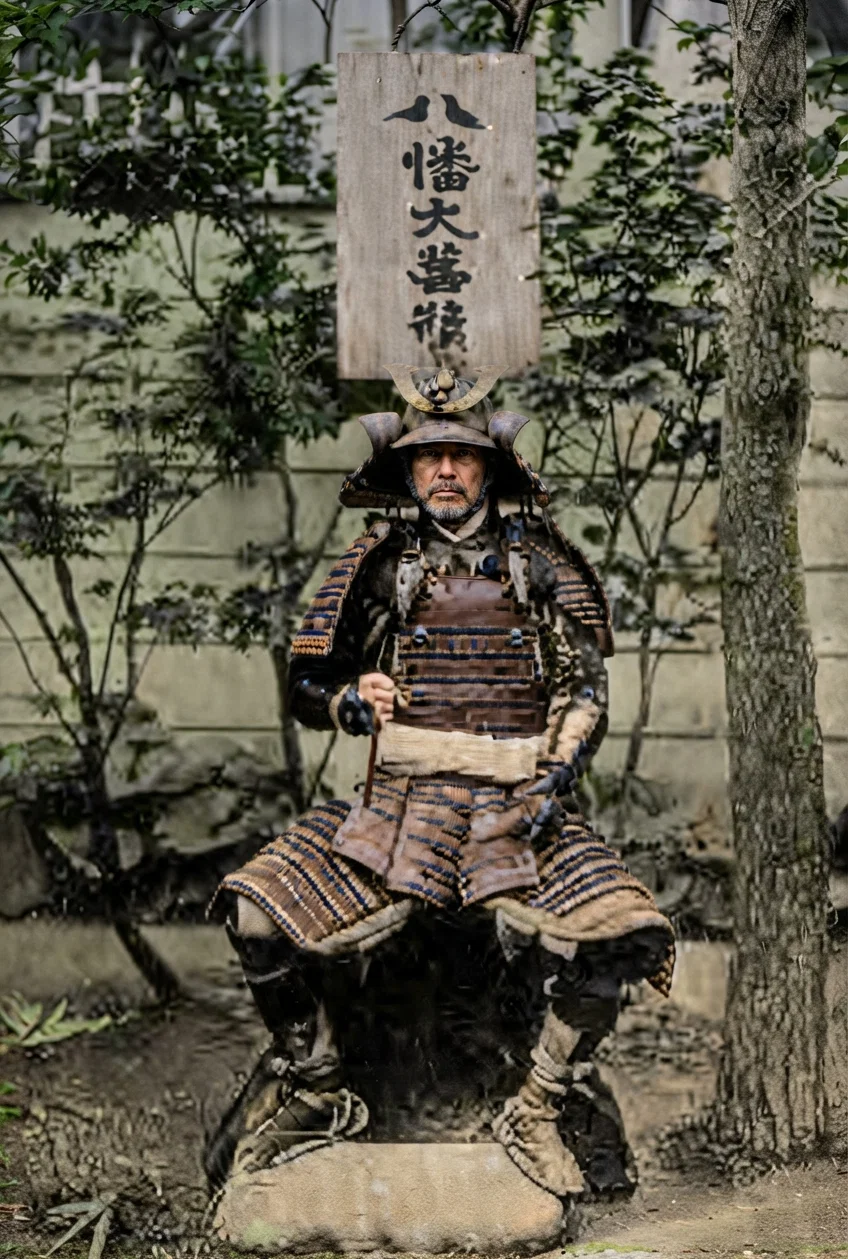
Warrior in Ancient Armor.
With an understanding of this ideal of the Japanese mind, it is not so difficult to appreciate the reckless daring shown in such actions as the frontal attacks on Nanshan Hill, where whole battalions were swept away. Yes, such intense patriotism certainly does make good soldiers, as the world reckons. Would that the soldiers of the cross were always equally brave and self-sacrificing.
But an efficient soldier, be he ever so patriotic, must have the physical stamina that will enable him to endure the hardships and privations of war. And the Japanese soldier has shown himself to be not wanting in this respect. To what causes or conditions does he owe his fine physique and great endurance? It is to the answer of this question especially that writers with theories to support have addressed themselves. One finds an answer in the vegetarian diet of the Japanese. Another in ju-jit-su, a peculiar system of physical training, in which the Japanese excel. It is granted that a vegetarian diet is ideal; and that the Japanese have a fine system of physical training. But it would seem that some have built large conclusions on a somewhat narrow foundation of facts.
It is true that the rations of the Japanese soldiers consisted largely of rice, and that very little animal food was furnished them. But boiled rice was not the whole staff of the soldier’s life. Large quantities of a kind of hard-tack were also used. These biscuits are made of wheat flour, sweetened a little, and contain a few oily sessamum seeds. The results prove that an army can be maintained on a practically vegetarian diet. But it seems too much to claim that this is the principal cause of Japan’s success in the war; or to conclude that the Japanese as a nation possess an ideal dietary.
Entrance to Imperial Residence, Tokyo.
If the Japanese are to any extent vegetarians, it is by compulsion and not from principle. The country is so nearly devoid of natural pasturage that one may travel for hundreds of miles without seeing a single herd of cattle or flock of sheep. The bright green herbage covering the hillsides is found to consist largely of bamboo grass, so tough and siliceous as to be wholly unfit for fodder. So the few cattle found are used as beasts of burden, and sheep are practically unknown. But while mutton and beef are scarce and dear, the waters by which the country is surrounded yield an abundance of fish. And almost every living thing in the sea is used for food, from the whale and shark, to the mollusk, squid, and devil-fish. And yet even fish is comparatively so expensive, that most people use but little.
A word further concerning the diet of the common people of Japan will not be out of order. It is well recognized that even a vegetarian diet may be deficient in nutriment, or the food may be poorly prepared, or improperly eaten. For example, the dietary of the Japanese is almost entirely lacking in bread stuffs that require thorough mastication. Rice, their "staff of life," is simply boiled in water; and this, with other food quite as soft, is very hastily eaten. Ten minutes, or even five, is a common period for the eating of an ordinary meal. After observing the dietetic habits of the people, one is not surprised to learn that fully seventy per cent of them have some form of stomach trouble.13In view of these facts it seems more reasonable to conclude that the physical efficiency of the Japanese soldiers is due rather to the care with which the men are chosen, and then provided for while in service. There is a strict conscript law in Japan; and whether in war or peace, every young man, upon reaching the age of twenty, must take an examination for the military service. By this means the Japanese army is composed of the very flower of the country so far as physical fitness goes. The addition to the soldiers' bill of fare of the hard-tack already mentioned would supply one deficiency in the ordinary diet of the people. And it must not be supposed that the Japanese would be averse to the use of meat in the army, as far as they might be able to supply it. It would be interesting to know what use was made of a cargo of 9,500 barrels of corned beef that was confiscated while en route to Vladivostok during the war.
As to training in the art of ju-jit-su, I have it on good authority that not more than one Japanese in thirty or forty is so trained. Under the old feudal regime every samurai was versed in the art. At present it forms no part of a soldier's training. But policemen generally learn the art, and practise it as occasion requires.
A correct estimate of the Japanese army can not fail to take account of the masterful way in which the Japanese military authorities have taken advantage of everything that is known of the science of war. Much might be said on this subject, but the whole history of the war bears testimony. It may be sufficient to notice the remarkable results of the measures taken for the care of the soldiers' health. The statistics of the war show that the number of killed and wounded exceeded the number thrown out of action by disease. This is recognized by all military experts as a very remarkable and unprecedented record.
Thus the secular historian studies and weighs the various events of human history, and seeks for their causes. But, too often, no account is taken of the Power behind these earthly scenes. But the eye of faith sees an omnipotent Hand directing and restraining amid all the confusion and apparent uncertainty of results. It is still true that 'the Most High ruleth in the kingdom of men, and giveth it to whomsoever He will.' With Russia restrained in her unscrupulous aggressive policy in the far East, and with her borders torn by internal strife, let us hope that there will come out of this chastisement a greater degree of civil and religious liberty, that the closing message of the everlasting Gospel may speedily be carried to her people.
The student of prophecy sees also, in the unexpected conclusion of peace, the controlling hand of God. The circumstances seemed very unfavorable for an early close of the war; and when peace was finally concluded, it came as a surprise to the whole world. We see in this another evidence that the angels are still holding the winds of war till the work of God is accomplished in the earth.
But the final struggle will not be much longer deferred. The prophecy of Joel is being fulfilled, as it is written: 'Proclaim ye this among the Gentiles: Prepare war, wake up the mighty men, let all the men of war draw near; let them come up. Beat your plowshares into swords, and your pruning-hooks into spears; let the weak say, I am strong. Assemble yourselves, and come, all ye heathen, and gather yourselves together round about; thither cause thy mighty ones to come down, O Lord.' Joel 3:9-11. The rise of Japan as a military power is one of the wonders of modern times. And now China, profiting by the example and success of her island neighbor, is beginning to arouse, and will doubtless be ready to take an important part in the coming conflict long foretold. But it is not merely 'the yellow peril' that threatens the peace of the world. There is anger and distress of nations, with perplexity, the world over. And all these things are but signs of the soon coming of Him whose right it is to reign. And when the kingdoms of this world become the kingdoms of our Lord and of His Christ, then shall be ushered in the everlasting reign of peace and righteousness. 'Even so, come, Lord Jesus.'
F. W. FIELD.
Tokyo, Japan.
OUR WORK AND WORKERS.
By Editor
A CHURCH of nineteen members has been organized at Shattuck, Okla.
AT the camp-meeting held at Darby, Mont., last month, six persons were baptized. Seventeen subscriptions were taken for the SIGNS.
EIGHT persons were baptized at Flagstaff, A. T., October 6, by Brother J. E. Bond. As many more were expecting to be baptized soon afterward.
FROM Mabelvale, Ark., Brother H. Clay Griffin reports the baptism of four converts in connection with meetings in that place, and the interest was still encouraging.
IN the Pacific Union Recorder, Brother Marcial Serna reports the baptism of two candidates at Clifton, A. T., and one at Globe. The labors of Brother Serna are among Spanish-speaking people.
SOME of the sisters of our home church have forwarded a box of clothing, bedding, and table linen to the Oakwood Manual Training School, at Huntsville, Ala., whose main building was recently destroyed by fire.
A NOTE from Brother Warren Latham, of Lakeside, Wash., reports the baptism of ten persons on the 14th ult. In connection with his work there, he has secured the publication of fourteen Bible readings in the local paper.
BROTHER J. N. LOUGHBOROUGH arrived in Mountain View, October 26, from a visit to Battle Creek, Mich., where he had been called to some special labor for a few weeks. His brother, W. K. Loughborough, whose son is employed in this office, accompanied him.
WRITING to the Union Reaper from Thief River Falls, Minn., Brother J. F. Anderson reports that as a result of tent labors in that place, thirteen persons have been baptized. Several others have accepted the truths presented who have not been baptized as yet.
AT Arecibo, Porto Rico, a man and his wife were baptized September 29, by Brother J. C. Brower, who, with his wife, had arrived there two days before from Michigan. A meeting was held on the river bank. The following day a church of twelve members was organized, and the ordinances were celebrated.
OUR monthly journal, El Centinela de Verdad, published in Porto Rico, has a monthly circulation of between 4,000 and 5,000. The paper is edited by Brother B. E. Connerly, and a gentleman recently told him that these papers are passed around from one to another until they are read by 9,000 or 10,000 people.
FROM the Northern Union Reaper we learn that the brethren of the Minneapolis church have commenced an active campaign with the SIGNS and Liberty, our religious liberty periodical. October 14 they ordered 2,360 copies of Liberty and sixty yearly subscriptions to the SIGNS. This, however, was designed only as a beginning.
A NOTE from Brethren H. Shultz, C. M. Gardner, and — Taphouse, engaged in tent work at Mount Bullion, Cal., says they have had good attendance, and that so far ten had decided to "keep the commandments of God, and the faith of Jesus." They were also holding some meetings at Snow Creek, where two persons had accepted the faith.
THE Missionary News Letter says: "On Sunday, October 14, eight persons were baptized in the First Baptist church, at Pleasantville, N. J., preparatory to uniting with the Atlantic City church. Elder Jayne officiated. The pastor of the church was very kind, attending himself and inviting his people to attend. Others in Atlantic City are now awaiting baptism."
IN the Nebraska Reporter, Brother L. Johnson notes the addition of five members to the churches in Omaha, Neb. One of them is a sister seventy-nine years of age. Two united with the English church, and three with the Scandinavian. In the same paper Brother C. Swenson reports the addition of two converts to the church at Gothenburg. Two others were to unite soon after.
WRITING to the Wisconsin Reporter from Amoy, China, under date of September 13, Brother B. L. Anderson says: "The message is onward in Fookin Province. Just recently five persons were baptized; three here in Amoy and two up at Chin Chew—a city of one hundred thousand inhabitants and about seventy miles from Amoy. From the reading of Brother Keh's tract on the Sabbath and other sources, eight or ten souls are now keeping all the commandments of God at Chin Chew. A mission will be opened there in a few days and the Third Angel's Message permanently established.
"Tobacco and the Sabbath have no more fellowship in China than in the States. Two old men of sixty-five and seventy-six years have thrown away their tobacco. We are looking forward to September 22 with a great deal of anticipation, for on that Sabbath day, the Lord willing, we shall organize a Chinese Seventh-day Adventist church here in Amoy. This will be our first church in Fookin Province."
AN EFFORT IN CHILE.
By Ed. W. Thomann
SINCE the earthquake of the 16th of August, which ruined so many thousands of the costliest buildings and destroyed many human lives, the people, at least some of them, seem to be a little more willing to hear something of a place where one will be surer than on this earth. Making the best of the opportunity, we had 30,000 copies of an earthquake special of Las Señales de los Tiempos (Spanish, the Signs of the Times). Our people and many others took hold of the work, and are selling them. One brother took 10,000, another sold 740 in one day, others sold 500 and more in a day; so we see we need a second special, which, with the Lord's help, we will issue, hoping that much good will be done among the people by these papers.
Our office was reached by the fire the morning after the earthquake. About $500 worth of books were lost, yet we are of good courage and see already that the loss in money will be repaid by souls. If only one soul may be saved because of the earthquake that will be a million times better than having had no financial loss.
ED. W. THOMANN.
[From Brother Westphal's letter the second edition of their paper, 20,000 in number, seems to have been issued. ED. S. OF T.]
WANTED FOR MISSIONARY WORK.
(Always prepay postage.)
Good, clean copies of Bible Training School, Life and Health, Life Boat, and Liberty. Address, Chas. H. A. Brooke, Alcatraz Light Station, San Francisco Bay, Cal.
SUNDAY ENFORCEMENT BY CONSTITUTIONAL AMENDMENT.
A FAR-REACHING project for securing a Sunday law in California has been prepared for presentation to the next Legislature. It is designed to plant the principle of enforced Sunday observance in the State Constitution, and to this end the following proposed amendment will be submitted to the Legislature for reference to the people:
"The necessity of encouraging and fostering the observance of one day in seven as a day of rest, is hereby recognized as essential to the welfare of the State, and to that end it is hereby provided—
"1. That the keeping open of bars, saloons, race-courses, and coursing-grounds on the first day of the week is prohibited, and the Legislature shall provide penalties for the violation of this provision, and for the proper enforcement of the same.
"2. That the Legislature may provide that stores, workshops, banking houses, and other places of business of all classes or calling, shall not keep open on the first day of the week, and shall provide penalties for the violation thereof.
"3. That the legislative body of any city, city and county, or county, may provide by ordinance that stores, workshops, banking-houses, and other places of business of any class or calling, shall not keep open on the first day of the week, and shall provide penalties for the violation thereof; provided, that such ordinance may enlarge, but can not restrict or limit, the scope or penalties of any provision enacted by the Legislature on the same subject; provided further, that whenever a petition is presented to the legislative body of any city, city and county, or county by ten per cent. of the voters thereof, asking that any ordinance authorized under this subdivision to be passed by such legislative body set forth in said petition be submitted to the qualified voters of said city, city and county, or county for their approval or rejection, the said legislative body must submit the same to the voters of said city, city and county, or county for their approval or rejection at the next general election held therein, or at a special election called by such legislative body for that purpose. At least two weeks' notice shall be given of such election by publication in some newspaper published in said city, city and county, or county. If approved by a majority vote of the voters, voting therein, the same is thereby adopted and becomes binding as a valid ordinance of said city, city and county, or county as the case may be, and supersedes any ordinance in conflict therewith, and can only be modified or repealed by a majority vote of the voters of said city, city and county, or county voting upon the question of the modification or repeal thereof.
"4. Provided, however, that any law or ordinance passed or adopted under the second or third subdivision of this (article or section) shall not apply to persons who conscientiously believe that the seventh day of the week should be observed as the Sabbath, and who actually refrain from opening their places of business on that day."
We are informed that this proposed amendment was drawn up by a prominent attorney of Sacramento, and favorably passed upon by Judge Waste, of the Superior Court of Alameda County. Also that it has been endorsed by the California M. E. Conference, by the Southern California M. E. Conference, by Bishop Moreland of the Protestant Episcopal Church, and by the Lay Convention of the California M. E. Conference, and by the State Convention of the Woman's Christian Temperance Union.
THE EARTHQUAKE IN CHILE.
By Editor
[Further news comes from the great earthquake in Chile, in a letter from Pastor F. H. Westphal of Valparaiso, from which we take the following. We also thankfully acknowledge the receipt of three photographs from Pastor Westphal, and two from Pastor Wm. Steele. As the latter came first we have not time to use the former in this article. Will give them next week. Ed. S. of T.]
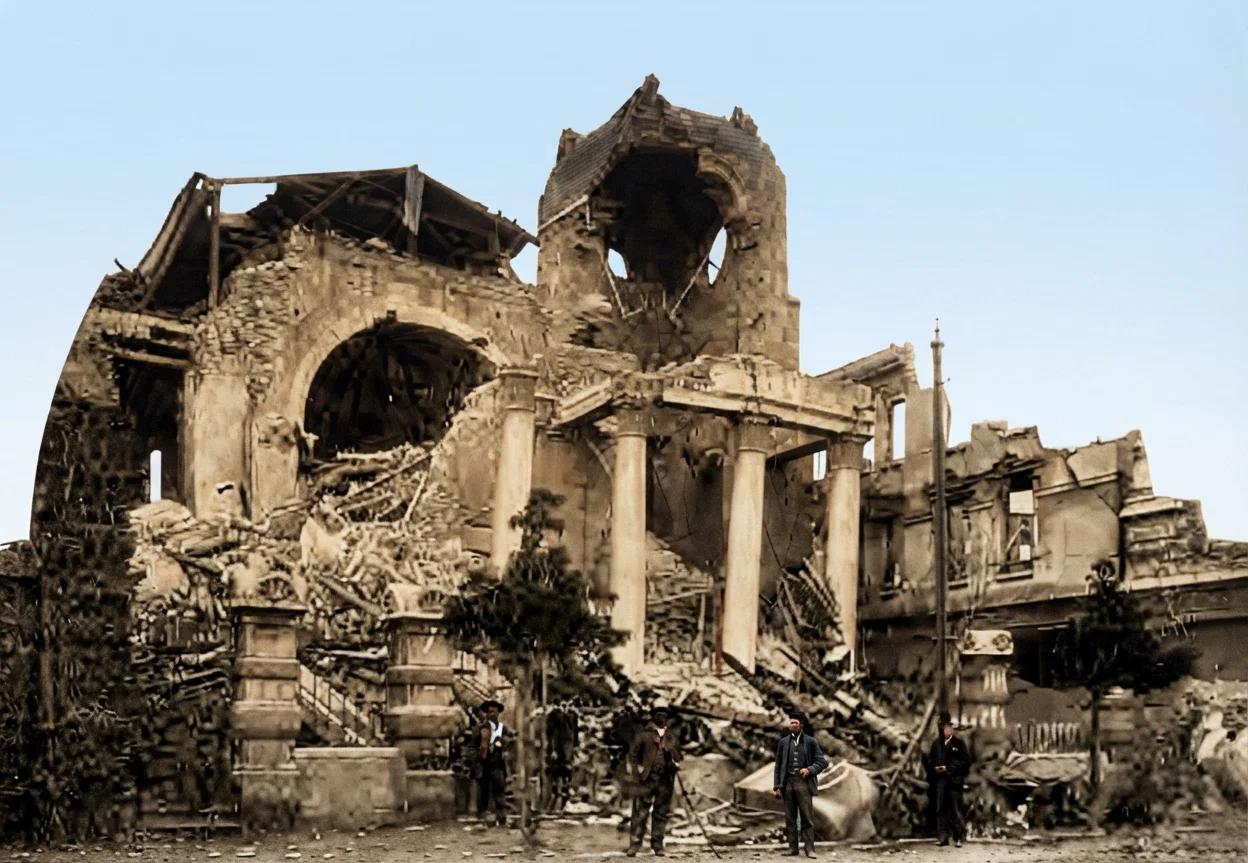
Front View of the Church of the Mercedes, Valparaiso, Chile.
WHILE you, intimately connected with the Pacific Press, have had a great loss, because in our eyes there was much to lose, we in Chile have had a little loss, because apparently we had little to lose. You have evidently read of the great disaster in Valparaiso. Valparaiso was not the only place that was shaken by the earthquake, but a large portion of Chile and also of Argentine. The entire range of the Andes that stretch between Chile and Argentine, and from the Pacific Ocean, and we know not how far within the ocean, eastward through the mountains to Rosario in Argentine, was shaken.
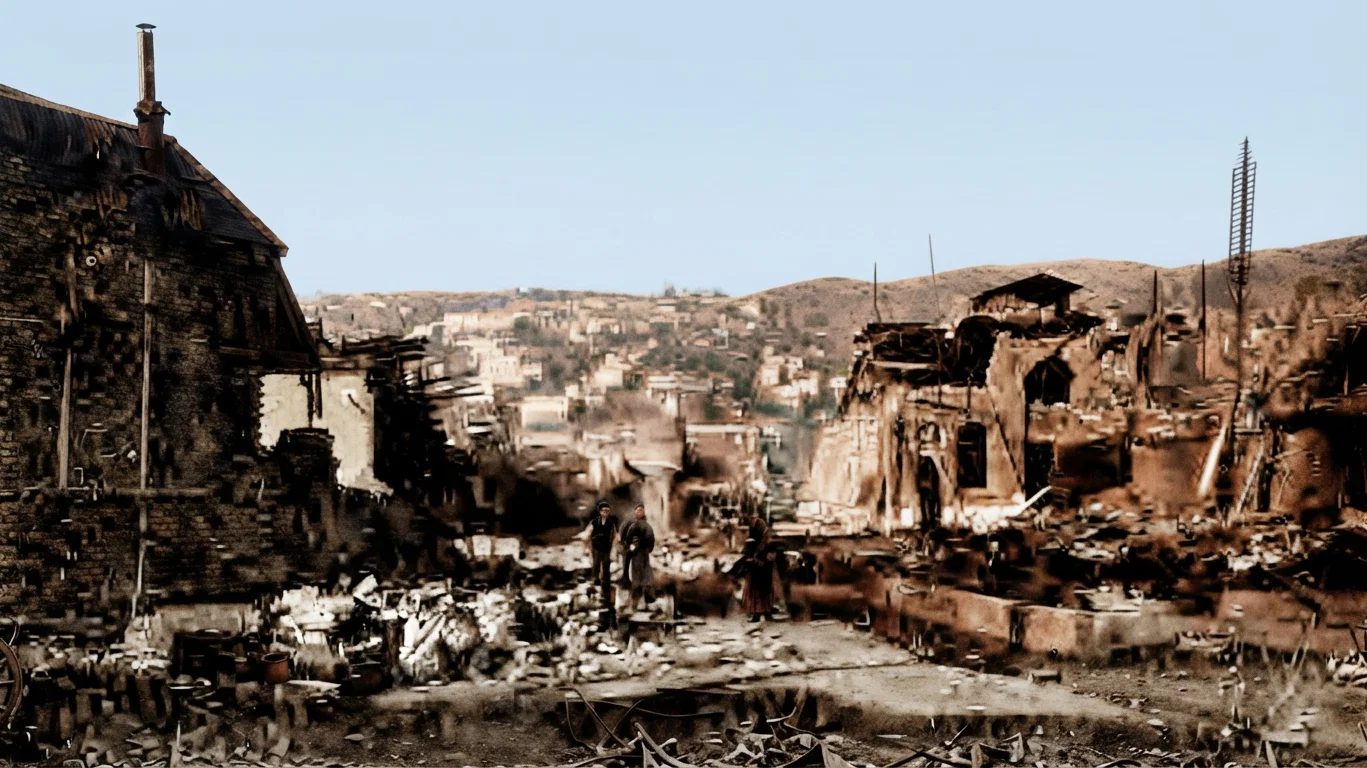
I read with deep interest your descriptions of the catastrophe in San Francisco, and they brought some things vividly to my mind, but the real thing itself produces still more profound impressions. I was not in the fury of the disaster directly, but was much farther south, near the southern limits of the earthquake. The shocks were, nevertheless, so severe that many of the people ran out of their houses, but no material damage was done. To reach Valparaiso I had to travel over a stretch of country of about one thousand miles. As I proceeded on the journey little by little I could see how the force of the earthquake had been more severe. The first indications of damage done were the ruin of some heavy walls made of sun-dried bricks, and next the cracks made in many houses. After that the inner walls of houses were caved in, and then parts of the outer walls and roofs of houses thrown down. This was followed by lives lost, and next came sections where the earth had been cracked, and in one place it was cracked in furrows resembling very much a field of ground that had been newly plowed.
I forward three illustrations to you. There is such a call for pictures that the photographers can not produce them fast enough to supply the demand. One of these illustrations is of the Republican Street of Limache, a city between Valparaiso and Santiago, and another of Veña del Mar, about three miles from Valparaiso, the other of the back part of the Catholic Church de la Merced in Valparaiso. You can get some idea of what I saw on the way to Valparaiso by these illustrations. Viña del Mar is a place where many of the wealthy people of Valparaiso have their dwellings, and these were mostly ruined and many lives lost.
When I neared Talca, a city much farther south of Santiago, there was almost a panic in a coach of the train. Some spoke of an earthquake, and the train made several severe movements because of the roughness of the track caused by the shaking of the earth a few days before, when the people began to scream and beat their breasts and cry for mercy. When we came to the station some of the ladies had almost fainted and others were still crying very sorrowfully. Surely "the hearts of men are failing them for fear and for looking after the things that are coming on the earth."
In a store, while talking with a merchant about the cause of the earthquake, he said that the real cause was the many Protestants and Masons in the land. In various places the priests are teaching this. The merchant was surprised when I read to him Isaiah 24, and Hosea 4 where the real cause is named, which is, summed up in a few words, the transgression of God's law of Ten Commandments.
It is now springtime in this southern zone, and the beautiful blossoms of the fruit trees and the flowers are sweetly spreading their fragrance everywhere. All the trees join in putting forth their buds beside the ruined buildings, but the fearful and sad hearts of the people tell us that the end is nearing. The Saviour said: "There shall be signs, in the sun, and in the moon, and in the stars, and upon the earth distress of nations, with perplexity; the sea and the waves roaring; men's hearts failing them for fear, and for looking after those things which are coming upon the earth." Luke 21:25-27. "Now learn a parable of the fig-tree; when his branch is yet tender, and putteth15forth leaves, ye know that summer is nigh; so likewise ye, when ye shall see all these things, know that it [He] is near, even at the doors." Matt. 24:32, 33. "Watchman, what of the night?" "The morning cometh, and also the night." The everlasting night of despair and death to the wicked is at hand; also the never-ceasing glorious morning of life, joy, and happiness to the pure and the faithful. The Saviour is coming soon.
The needs of the people are many, and the work to be done great. We ought to have had workers stationed in various cities and villages for some time in the past. What a work might have been done, and what a work we now might do, if the cities and the outposts were well supplied with workers.
When the earthquake occurred, thousands and thousands of voices were heard crying in despair for succor to the Virgin Mary, Saint Antonio, and other saints. How few, how very few, know their Saviour! Many, very many, are returning to the confessional, and thousands are inquiring, What do these things mean? We have published a special number of Las Señales los de Tiempos (Signs of the Times) of fifty thousand, with one of the headings of articles, "What Do These Things Mean?" In a very few days about ten thousand were sold in Valparaiso by our little company there. They passed some into the hands of the newsboys who sold them freely. A blind man not of our faith, possibly a Catholic, sold our paper readily, and another man with but one foot hobbled through the street selling Señales de los Tiempos. We published more of this special number than we usually publish during an entire year. We could not send any papers away from Valparaiso through the mails, because of the destruction caused by the earthquake. We shall have to send various workers to our churches and companies with thousands of these silent messengers of truth, and set the brethren to work.
The bright light of present truth ought to shine in clear, bright rays upon the moral darkness of the world. What a work could be done if all who profess to believe it were at work and stationed in various places in this world! The people know not a loving Saviour. Pamphlets are being sold by the clergy calling upon the people to offer prayers for the souls in purgatory, and the people are doing so. I bought one the other day to see what it contained; and the description of purgatory is horrible. It is presented as a place where the sun, moon, and stars never break the intense darkness by their rays of light, and the sufferings of the souls is intense beyond all description. It is said that one day in purgatory appears as long to the souls there as one hundred thousand years in the world would be to us if we should live so long. The terrible things taking place in this world and the horror of purgatory after death has stamped a hellish fear in the hearts of thousands upon thousands of people. They are afraid to live and they are afraid to die. Hearts of men are failing them for fear.
I wish that I could impress upon the minds of all the readers of this letter how important it is that we know our Saviour and His pardoning love, and then make Him known to those who know Him not. The favorable time to work in the cities is fast passing. Strikes, famines, pestilences, earthquakes, fire, and severe persecution face us. A Bible colporteur was attacked and beaten and cast into prison twice for selling Bibles in the city of Santiago, the capital city of Chile. The judge was a liberal-minded man and so the colporteur was set at liberty each time. What we have failed to do in favorable times we must now do under very unfavorable circumstances and trying times. Let us therefore buckle on the armor, and do under unfavorable circumstances a quick and successful work.
F. H. WESTPHAL.
Casilla 787, Valparaiso, Chile.
The Behring Strait Railroad Scheme
The famous scheme to tunnel Behring Strait and so connect the Eastern and Western continents by rail seems at last to be developed far enough to include the promoters. The Trans-Siberian Railroad Company was incorporated at Trenton, N. J., October 24, with a capital of $6,000,000, including telephone and telegraph systems along the route. The incorporators are Loicq Don Lobel, of Paris, France, general delegate of the French, Russian, and American syndicates of the railway; J. A. L. Waddell, of Kansas City, delegate of the advisory board of consulting engineers of the railway; John Healy, of Seattle, delegate of the western syndicate; William H. Black, of Jersey City, and John R. Turner, of New York. The plan is to make connecting links so as to have one extended line of railroad from the Cape of Good Hope, by the way of the Isthmus of Suez, and Behring Strait tunnel, to Cape Horn. It is said that a few thousand miles only need building to connect railroads already constructed.
The Crumpacker Bill and Evil Beasts
One of the bills before Congress, called the "Crumpacker Bill," introduced by Judge Crumpacker of Valparaiso, Indiana, provides that any person or institution secretly accused shall have the right to be heard in their own defense in open court, know the accusers, and know what their charges are. This is to overthrow the secret spy system which has been used by some of the great trusts and combines against individuals. Surely it would seem as tho Congress would be willing to grant as small a thing as that, and one in perfect harmony with the principles of democracy.
One of the great causes of death among mankind mentioned in the Bible is said to be "evil beasts." Eze. 14:21; Rev. 6:8. A special cable despatch from India, September 20, gives the following official statistics: 21,380 killed by snakes in India in the year 1904; 796 by tigers; 399 by leopards, and enough by other animals to make the total 24,034 persons. There were 48,482 cattle killed. There were killed of snakes, 65,146; other wild animals, 16,121.
Labor Agitation and San Francisco Improvements
One of the reasons for urging at this time the building of a great government establishment in San Francisco—with wharves, warehouses, and other extensive improvements—was to help out the struggling city by the expenditure of a large sum of money. But the demands of the labor-union agitators have become so extravagant that it is found that the work can not be done within the appropriation. While the times are propitious for good wages and plenty of work, they are also favorable for strikes and idleness, on account of the large sum of relief money on hand.
A POOR SUNDAY-LAW ARGUMENT.
By Editor
A PROMINENT lawyer, who is a candidate for representative in the next Legislature of California, has publicly expressed the opinion that the growing corruption in the state is due to disregard of Sunday. Therefore he is booked for a strong advocate of proposed Sunday legislation the coming winter. The argument that a stricter Sunday observance would work a cure of the many evils now extant is not new; it has been advanced for years in this state; but a new stress is laid upon it because a prominent legal light and prominent politician—not noted as a religious man—has given it utterance.
It is somewhat strange that one so well posted on the political history and condition of the country as this same attorney and politician should advance such an argument. He certainly is not ignorant of the reputed character of political conditions in Pennsylvania. The situation in political circles in the Keystone State have been a byword for twenty years or more. Not a state in the Union has a more unsavory political record; and business conditions, especially concerning great corporate interests, are always affected by the political atmosphere, and vice versa. In fact, it has been through the corrupt business methods of the trusts that the political corruption of the country has been more especially realized.
A Street Scene in Valparaiso after the Earthquake of August 16, looking toward the hills.
But Pennsylvania is a special object-lesson illustrating the futility of the argument for a Sunday law in California. Why that state especially?—Because it has the most stringent Sunday law of any of the states; and that Sunday law has been in force for more than a hundred years.
Dr. Plumacher’s Studies of Leprosy
Dr. Eugene H. Plumacher, American consul at Maracaibo, Venezuela, has devoted a lifetime study to leprosy, and has come to the conclusion that this dread disease is not contagious, but is to a great degree hereditary. He has given personal attention to lepers afflicted in the most revolting form, and believes that the disease is curable. One of the special remedies used by him is the tuatua plant. His investigations have been among people having both classes of the disease, the dry class, as well as the wet or soft leprosy, where the parts rot away. The most of his experiments have been at his own expense.
Million-Dollar Hotel for Yosemite Valley
A concession to build a million-dollar hotel in Yosemite Valley, California, has been granted by the general government to Frank A. Miller, of Riverside. In giving out the news, after returning from Washington, D. C., he says that the Southern Pacific, Santa Fe, and Salt Lake Valley railroad companies are all interested in the project.