DURING the winter of 1900 it became evident that some effort must be made to interest the youth of our church, and help them to feel that God required them to share in the responsibility of carrying this message to the people. A council was called, consisting of the elders of the church, the missionary secretary, the Sabbath-school superintendent, a few State officers, and a number of young people. The subject was thoroughly discussed, and resulted in the organization of our Young People’s Society in January, 1901.
We assembled each Sunday evening to study the message and discuss plans of labor; but “Satan came also,” and succeeded in making molehills appear as mountains to such an extent that practical missionary work was abandoned. It looked for a time as if our meetings would have to be discontinued; but at last all seemed to realize that the trouble was in our own hearts, and that before we could do anything for Christ, we ourselves must be converted. From the time this conclusion was reached, there was a marked change in the spirit of the meetings. A thorough determination to do good, practical service for the Lord was manifested, and all seemed willing to work to the best of their ability.
From the first, the church-members have shown their interest in the movement by their kind counsel and advice, and also by their liberal gifts to assist in the work planned and executed by the young people.
Several branch Sabbath-schools have been organized during the winter, one of which has proved very interesting. It is held in the heart of one of the poor districts. As the young people went from house to house gathering up the children, they found many opportunities for Christian Help work. These cases were reported to the sisters of the Christian Help Band, who investigated them, and provided for their temporal wants. In a short time it was learned that many of the children who attended the Sabbath-school were not attending any of the public schools in the city. The matter was placed before the church, and it was at once decided to maintain a church school in the district for the benefit of those children. A Sunday-evening meeting was begun, with the hope of interesting the parents; but as the interest lagged, the older workers thought it not worth while to continue it. The young people were not willing to abandon the effort, however, and the meetings have now been carried on for some time by them. We feel that the souls of these people are just as precious in God’s sight as are those who have been placed under more favorable circumstances, and that their hearts need the refining influence of the Spirit of God as well as our own.
Many lines of work have been begun by our Society, such as distributing literature, visiting the sick, and singing and reading to them, holding cottage meetings, etc. Just now we are planning to take up the work of selling “Christ’s Object Lessons.”
Our instruction in Bible study, missionary work, and the treatment of common diseases has been very practical. The doctors and nurses from the sanitarium have given a number of illustrated talks on the subject of caring for the sick.
We, with the other young people of Iowa, are now putting forth every effort to raise the thousand dollars required to start a training-school for the young people of France. Our interest in foreign fields is increasing constantly. One of our members will soon be on his way to China to bear the message of truth to those in the darkness of heathenism; while another who has been interested in our work from its very inception, will plant the banner of Christ in far-away India. So it is. The burden is placed upon one here, and another there. God grant that many who are now members of the Des Moines Society may yet be found holding up the light of life in some foreign field, strengthened by the prayers of those remaining at home, and supported by their willing contributions.
DELLA WALLACE.
Give Me a Faithful Heart
“Give me a faithful heart,
Likeness to Thee,
That each departing day
Henceforth may see
Some work of love begun,
Some deed of kindness done,
Some wand'rer sought and won,
Something for thee.”
Battles between Truth and Falsehood
Lesson IX — Christ “Honored” or “Profaned” in the Sabbath
(June 1–7)
How to Study These Lessons.—(1) Read the lesson story; (2) try to recall or find scriptures in proof of each statement; (3) study the texts; (4) see how many missing links you can supply; (5) give the lesson to some one else. You will keep only what you give away.
Because Jesus himself is in the seventh day, it is therefore certain that our treatment of that day is our treatment of him. Only a few recognize him in the seventh day; nevertheless he is there. Very few knew him in the Babe of Bethlehem; but a blessed few knew and worshiped. Blessed indeed are they who recognize the loving Lord and Redeemer in the holy seventh day. When we honor the Sabbath, we honor the God of the Sabbath. When we trample upon it, we are trampling him underfoot. We profane God, and make him common, when we treat the Sabbath lightly, or in a common way. The people of every age have crucified the Son of God in the Sabbath; and they are doing the same thing to-day.
Outline
The seventh day is the Sabbath of the Lord. Ex. 20:10.
We honor the Lord when we honor the Sabbath. Isa. 58:13.
We delight in the Lord when we delight in the Sabbath. Isa. 58:13, 14.
When we hide our eyes from God’s Sabbaths, and profane them, we profane him. Eze. 22:26.
The Young People's Work at Kingston, Jamaica
By Linton Rashford
WE began work early in August, 1900, not then knowing that there were societies connected with our faith. Ever since we began, we have been distributing tracts, loaning books, papers, etc.; also loaning tracts on the envelope plan, exchanging them each week. God has blessed our work abundantly. Over eighteen thousand pages of tracts have been given away, and about twenty-six thousand loaned, also a goodly number of Signs. We hold Bible readings with those who become interested, and meet every Sunday evening to study the prophecies of Daniel and the Revelation, the coming of Christ, etc. Our numbers are few, but we are of good courage, working with the Lord, trusting soon to see many souls in the kingdom as a result. Let us all be faithful.
LINTON RASHFORD, Cor. Sec.
Clinging to Jesus' Pierced Feet
“If you can not speak to Jesus, yet cling to his pierced feet.”
Umaduna, the Little Christian
By Estella Houser
THE little black African boys can be taught to love Jesus just as easily as the little white children. In many parts of the great dark continent of Africa they grow up like wild animals; and, indeed, many of their mothers are regarded as of less value than an animal, for a cow is worth more than a woman, they say.
Some of these boys and girls have learned to love Jesus as their Saviour, and their willingness to sacrifice for his sake is sweet and inspiring.
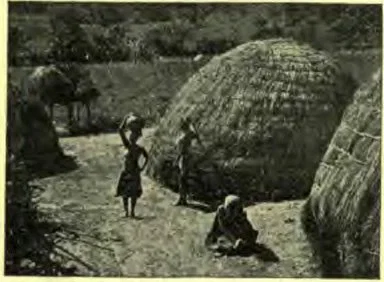
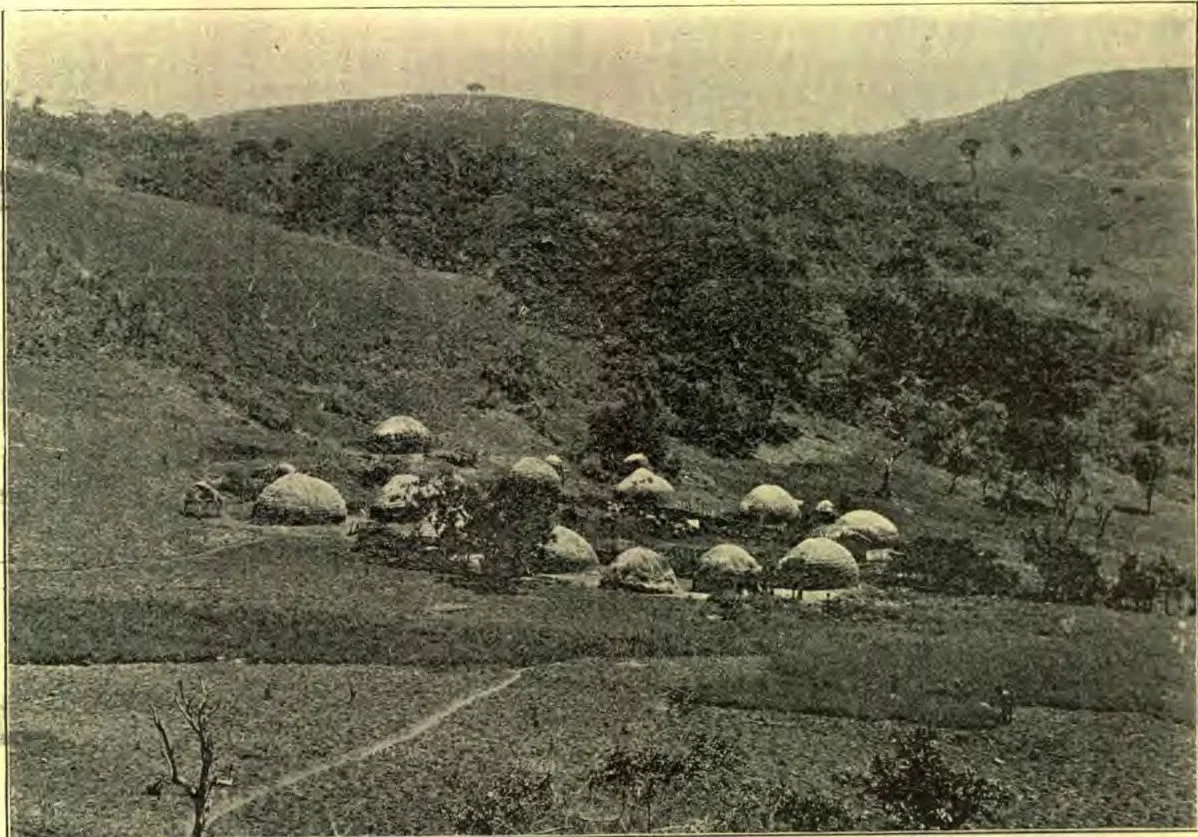
A missionary who has labored in South Africa tells the following story of a little African Christian whose name was Umaduna. The missionary for some months had been visiting different heathen kraals. A kraal is a village, or group of native huts. At each kraal he inquired if there were any Christians among them. Coming to one kraal larger than the rest,—as about three hundred persons lived there,—he asked this question of different ones, and from all he received the same reply: “Yes, there is one Christian in this kraal. He is a little one, but he is a wonderful man. He has been persecuted, many times beaten, and threatened with death if he did not quit praying to Christ; but he prays and sings all the more.”
The missionary was indeed pleased to hear that such an earnest Christian was letting his light shine so brightly in such a dark region, and he sought diligently until he found the wonderful man of whom he had heard so much. And what do you think he found?—Not a great man, but a little black boy about twelve years old.
On becoming acquainted with the little fellow, and learning more about him from his heathen neighbors, he learned that all he had heard was true. Umaduna had been one of the many naked Kafir children that were in his audience every day, and little did he think that he was talking to one who so truly loved Jesus.
He sent for this boy, as he wished to discover, if possible, how he had learned about Jesus, and why he was so willing to suffer for him. The boy hesitated to come at first; but after some persuasion he came. He was small for his age, and had no clothing except an old sheepskin thrown over his shoulders. He was very black, but had a serious, pleasant face. He was very quiet, and not disposed to talk, but he gave in modest but distinct tones of voice prompt and intelligent answers to the questions that were asked him. The missionary said to him, through an interpreter, “Umaduna, how long have you been acquainted with Jesus?”
“About three years.”
“How did you learn about him, and know how to come to him?”
“I went to preaching at Heald Town, and learned about Jesus, and that he wanted the little children to come to him. Then I took Jesus for my Saviour, and got all my sins forgiven, and my heart filled with the love of God.” He did not remain long at Heald Town, but returned to his people, with whom he emigrated to Fingoland.
“Was your father willing that you should be a servant of Jesus Christ?”
“Nay; he told me that I should not pray to God any more, and that I must give up Jesus. I kept praying to God more and more.”
“What did your father do then?”
“He beat me a great many times.”
“Well, when he found he could not beat Jesus out of you, what did he do next?”
“He got a great many boys to come and dance round me, and laugh at me, and try to get me to dance.”
“And wouldn’t you dance?”
“No; I just sat down, and would not say anything.”
“What did your father do then?”
“He fastened me up in the hut, and said I must give up Jesus, or he would kill me. He left me in the hut all day.”
“And what did you do there?”
“I kept praying, and sticking to Jesus.”
“Did you think your father would kill you?”
“Yes, if God would let him. He fastened me in the hut many times, and said he would kill me.”
“Umaduna, are you sure you would be willing to die for Jesus?”
“Oh, yes, if he wants me to.”
“Are you not afraid to die?”
“No; I would be glad to die, if he wants me to,” answered this brave little Christian.
A SOUTH AFRICAN KRAAL
The missionary gave Umaduna a copy of the New Testament in Kafir, which he was very glad to receive, although he must first learn to read before he could read Jesus’ loving words to him.
Shall we not share in this good work, by praying that God will help the few black boys and girls who have learned of him to be faithful, and let their little lights shine in the darkness with which they are surrounded? There are millions who have never heard of Jesus; but before he comes, every little one will have that privilege, and every Seventh-day Adventist boy and girl who reads this paper may help in sending the gospel to them.
Take a piece of paper and a pencil, and write down every way by which you think little children may help give the gospel in this dark land, and then begin to-day to do some of the things you have written down. ESTELLA HOUSER.
Mission Board Office.
The Truth about Baby Tumblebug
BABY TUMBLEBUG was tucked away in an egg, sound asleep. Father Tumblebug and Mother Tumblebug, his parents, were two black beetles who lived in the barnyard. Of course they talked Tumblebug talk, and no one can be sure of exactly what they said. It seemed to be something like this:—
Said Mother Tumblebug, “Do you suppose the baby is warm enough?”
Said Father Tumblebug: “Put some more blankets on him, if you think he isn’t. Here, I’ll help you. We must roll him up snug and warm.”
Then they rolled Baby Tumblebug in so many blankets that he was entirely hidden among them; indeed, he was wrapped in a regular ball of blankets,—a ball bigger than his father and mother put together. The blankets were nothing but dirt. The Tumblebug family have always used that kind. Thousands of years ago, in Egypt, their ancestors set the fashion.
It was a lucky thing for Baby Tumblebug that he was sound asleep, or he might have been frightened when his father and mother began rolling him over the hills and the valleys on the way to his nursery.
“It seems to me,” said Mother Tumblebug, “that under that tall grass by the fence is just the place that will suit us.”
They were looking for a spot in which to bury Baby Tumblebug. He was too young to be left on top of the ground, exposed to the hot sun and possible enemies. All Tumblebugs spend their baby days in underground nurseries.174
“Just as you think best,” replied Father Tumblebug, standing on his head and getting in position to push the ball, while Mother Tumblebug climbed on top of it.
“Now I’m ready, Father Tumblebug,” said she, leaning all her weight toward the front of the ball. Father Tumblebug, walking on his hands, kicked with his hind feet. Mother Tumblebug pulled, and over went the ball. This was done again and again. Often as the ball went over, Mother Tumblebug climbed to the top, ready for another start.
Not for an instant did she leave Baby Tumblebug. Even when Father Tumblebug gave a mighty kick at the top of a hill, she kept tight hold of the precious bundle, rolling over and over with it until the ball stopped.
“Are you hurt?” he asked, running to her assistance.
“No, thank you,” replied Mrs. Tumblebug. “I bumped my head a little, that is all.”
Mother Tumblebug’s head was flat,—oh! ever so flat.
“I was afraid the baby would get uncovered,—but he is safe, the little darling. You must be more careful, Father Tumblebug. I told you we should have gone the other way. I almost knew we were on a hill.”
Father Tumblebug did not say a word, but he looked cross as a bear. It was not so easy as it seemed to help roll that ball, by standing on his head and kicking with his hind legs. She ought to have told him of the danger.
At last a place was found to put the baby; it exactly suited Mother Tumblebug, so she and Father Tumblebug shoveled away the earth beneath the ball.
“Now run away, Father Tumblebug, run away. I can get the baby into the nursery without any more help, thank you.”
Father Tumblebug was only too glad to be excused.
Mother Tumblebug was a great worker. She was not a bit afraid of spoiling her hands or her clothes. Upside down she went beneath that precious bundle of hers, digging into the earth with her hands and feet, and tossing it above the ball. Slowly Baby Tumblebug, cradle and all, went into his down-cellar nursery. Mother Tumblebug had a middle pair of legs with which she clung to Baby Tumblebug’s bundle of blankets, at the same time pulling it downward.
In a little while she was out of sight, and how ever she managed to dig deeper into the darkness of the ground is something known only to Tumblebugs. When her work was finished, Mother Tumblebug climbed through the loosened earth into the daylight. That was the last she ever knew of Baby Tumblebug.
When he awoke, he crept out of his egg, and ate everything he found among the blankets. He outgrew his baby clothes in no time, and finally, when he was big enough to wear the same kind of suit that his father and mother wore, he left the nursery, poking his queer flat head out of the earth,—a baby Tumblebug no longer.—Sunday School Times.
Mr. and Mrs. Eider
By D. V. Farley
Not long ago I saw four wee white rabbits cuddled together in a comfortable fur-lined nest. Curious to know where so much fur came from, I picked up “Mother Bunny,” and found that she had almost bared her breast in order to provide such a soft, warm bed for her babies. Of course you agree with me in thinking her a very thoughtful, self-sacrificing mother.
Mother Bunny’s mode of preparing a nest made me think of the eider-duck, a bird that lives away up in the arctic regions. The eider-duck is quite a little larger than the common duck. Its prevailing color is white; but the tail, quills, and stripes above the eyes are black. It is a very shy bird; but when the time comes that a nest is wanted for the little eiders, Mrs. Eider grows friendly, and ventures close to inhabited places, much against the will and advice of the cautious Mr. Eider. But she pays no attention to him, and soon builds herself a nest of fine mosses, twigs, and leaves. In this nest she lays from five to seven eggs about three inches long, two inches broad, and of a light-green color. Ere the eggs hatch, she prepares a snug bed for her babies by plucking feathers from her own breast, and using them for nest lining. Now her troubles begin; for from the eider-duck the expensive, celebrated eider-down of commerce is obtained. So while the eider-down lining is fresh and clean, it is carefully removed from the nest by some landowner, who wants it for the money it will bring.
Greatly distressed, Mrs. Eider flies out to sea, and joins Mr. Eider, and I suspect he says to her with much satisfaction: “I told you so. Now see what you got by not taking my advice.”
However, after a while Mrs. Eider ceases to grieve over her misfortunes, returns to land, and builds a second nest, which, I am glad to tell you, no one disturbs; for the landowners have no desire to drive the eiders away altogether.
She lines the second nest just as carefully as she did the first one; and the funny part of it is, she this time plucks the down from the breast of the unwilling Mr. Eider—at least, that is what I have many times been told.
Mrs. Eider broods faithfully, and hatches her second lot of eggs in peace and happiness, and the pretty baby eiders greatly enjoy their downy home.—D. V. Farley, in Children’s Visitor.
A Vest Chain
By J. Edgar Ross
A vest chain is more conventional than the watch-guard already described, and is quite as simple to make.
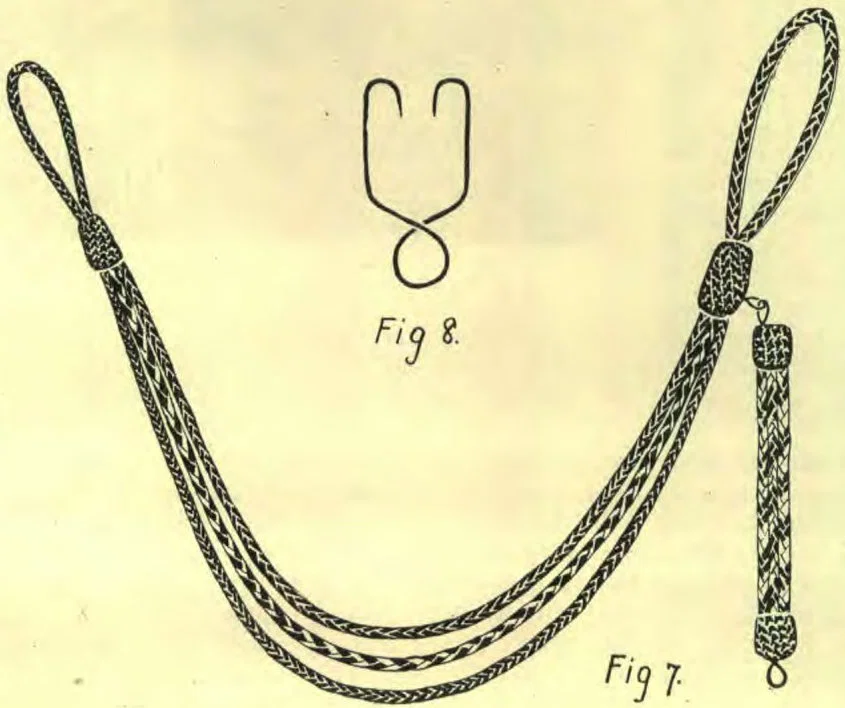
Three eight-strand square braids will be required. The strands used for the braids that are to make the main body of the chain should contain eight or ten hairs each, and the braids should be long enough to make the chain measure from eleven to twelve inches from the end of one loop to the end of the other. The way these braids are to be put together will be seen at a glance by referring to Fig. 7. In the central portion of the chain the upper braid should be the shortest, the middle one three eighths of an inch longer, and the lower one should have another three eighths of an inch added to it. This is necessary in order that the chain may have the appearance of hanging down just as a chain made of links will. Horsehair is so stiff that its own weight is not sufficient to make it hang gracefully.
The short, pendent part of the chain, on which a charm is usually worn, is made of a smaller braid. The strands in it need not contain more than five or six hairs. The one here shown is made of threefold braid, but a double braid would look quite as well. It need not exceed two inches in length. When the ends of the short pieces of braid that make this part of the chain are sewed together , there is sewed to each end a piece of small wire (a pin will do if you haven't a wire small enough), bent in the form shown in Fig. 8. The round loops of these wires are left projecting, one at each end, when the ends of the piece are covered with woven needlework. One of these loops serves to attach the short piece to a similar loop in the main part of the chain (see again Fig. 7), while to the other a charm may be fastened, if one is worn.
Fig 9.
The chain from which the illustration was made contained, in the chain proper, one long black braid, and a short one made of black and white hairs. The black braid makes both loops, and the upper and lower braids in the central part of the chain. This is rather a pleasing arrangement, but no more so than others would be.
Fig 7. Fig 8.
Indeed, none of the articles that have been and will be illustrated are given as patterns to be arbitrarily followed. They are intended rather as suggestions, which the reader will adopt, modify, or reject, as suits his taste or requirements.
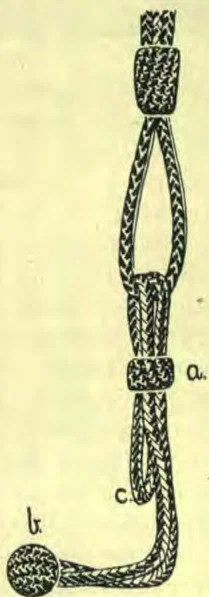
One of the loops of this chain is intended to be worn on the vest button, while the watch is attached to the other. If the ring of the watch is sprung, and passed through the loop, as recommended for the watch-guard, the chain will stand out instead of hanging like a link chain. For that reason it is best175to add a loop such as shown in Fig. 9. This is made of a piece of braid eight inches long. Double it, and sew the ends together. Then wrap twine or thread around the ends that have been sewed till you have a ball about a quarter of an inch in diameter, and sew this securely also. Next cover the ball with woven needlework. Now pass one end of this doubled braid through the loop in the chain, and put a sliding ring of needlework around the doubled portion, as shown at a. It is now ready to put on the watch. Pass the ball, b, through the ring of the watch, and then through the loop, c. Then slide the ring, a, down as close to c as it will go, and it is done. J. EDGAR ROSS.
Watch the Corners
By Companion
WHEN you wake up in the morning of a chill and cheerless day,
And feel inclined to grumble, pout, or frown,
Just glance into your mirror, and you will quickly see
It's just because the corners of your mouth turn down.
Then take this simple rime,
Remember all the time,
It's always dreary weather in countryside or town
When you wake and find the corners of your mouth turned down.
If you wake up in the morning full of bright and happy thoughts,
And begin to count the blessings in your cup,
Then glance into your mirror, and you will quickly see
It's all because the corners of your mouth turn up.
Then take this little rime,
Remember all the time,
There's joy a-plenty in this world to fill life's cup,
If you'll only keep the corners of your mouth turned up.
— Companion.
THE INTERMEDIATE LESSON
X — The Sabbath
(June 7) *
“AND God saw everything that he had made, and, behold, it was very good. And the evening and the morning were the sixth day. Thus the heavens and the earth were finished, and all the host of them. And on the seventh day God ended his work which he had made; and he rested on the seventh day from all his work which he had made. And God blessed the seventh day, and sanctified it: because that in it he had rested from all his work which God created and made.” Gen. 1:31; 2:1–3.
“Remember the Sabbath day, to keep it holy. Six days shalt thou labor, and do all thy work: but the seventh day is the Sabbath of the Lord thy God: in it thou shalt not do any work: . . . for in six days the Lord made heaven and earth, the sea, and all that in them is, and rested the seventh day: wherefore the Lord blessed the Sabbath day, and hallowed it.”
(The Scripture texts are the lesson to be studied. Go over these carefully every day, until you know just what each one teaches. Then the following notes will help to a fuller understanding of the lesson. Read them carefully several times. Lastly go over all the questions, and be sure you can answer each one in the words of Scripture.)
When the work of the sixth day of creation was ended, God’s work was finished. The earth and everything in it was perfect, and God rested. He did not rest because he was weary; for in him is “everlasting strength.” “The Lord, the Creator of the ends of the earth, fainteth not, neither is weary.” He rested because his work was done.
The Hebrew word for rest is “Sabbath,” and the seventh day is God’s Sabbath, because it is the day on which he rested.
God made the Sabbath for man. It was to point him to the Creator, to teach him of the power of God that made heaven and earth, so that he might rest in him.
The Sabbath was to be a day when man should rest from his work, and worship God and think of the works of his hands. The sun, moon, and stars, and the earth itself, hung upon nothing, would speak to him of the power that upholds and guides them. The flowers that adorn the earth would show him something of the matchless loveliness of their Maker. The birds, fishes, beasts, and insects, all tell of the wisdom of him who formed them, and whose loving care provides for them.
All this would call forth grateful, happy praise to the Creator, and make men joyful in him. The knowledge of his wisdom, power, and love would keep them ever trusting, resting in him.
By resting on the seventh day, God set the seal upon all the work that he had done during the six days. He showed that it was all perfect. But now we see it not as it was in the beginning. The fair face of nature is marred, and God’s image is but dimly seen in it.
Yet the Sabbath still remains, telling that God made the world perfect. It comes down to us from Eden, telling of its purity and beauty; and it is the pledge—the sign—that God gives us that all things shall be brought back to that perfect state.
But there is only one way that this can be done. It is by the cross of Jesus Christ. The curse of death has come upon man and upon the earth through sin, but the power of Jesus, who made the Sabbath, is greater than the power of death. He has given his own life to save us, to wash us from sin and make us new creatures, as Adam and Eve were when they kept the first Sabbath in Eden. His death on the cross has also redeemed the earth from the curse, so that it also may be made new again.
The last words of Jesus before he closed his eyes in death upon the cross were, “It is finished.” He has finished all the work of our salvation, and of the redemption of the earth, and he says, “Come unto me, . . . and I will give you rest.”
We could have no rest if God did not give it to us. But in giving us the Sabbath, he has given us his own rest. He rested on the first seventh day, because he knew that nothing could undo his work nor alter his purpose. God knows the end from the beginning, so he knew that Satan would bring the curse of sin into the earth, but he rested in the knowledge of his own power to restore all things through the cross. And he gave us his Sabbath—his rest—that we, too, might find rest by believing in Jesus.
The word “Eden” means “delight,” and God tells us to call the Sabbath “a delight.” It is a little piece of Eden that remains to us in this sin-cursed earth. The blessing of God is upon it, and he says that all who keep it holy shall delight themselves in the Lord, and he will bring them back to Eden. In that glad day, the Lord’s holy Sabbath will not be despised and broken by most people, as it now is, but “from one Sabbath to another, shall all flesh come to worship before me, saith the Lord.” May we all be among that blessed company.
Questions
How did all God’s work appear to him on the sixth day?
How did he show that his work was finished?
On what day did God rest? What did he thus make the seventh day? What does the word “Sabbath” mean?
What did God do to the seventh day? Why did he bless and sanctify it? Why did he rest upon it?
What does he tell us to do? Why are we to rest on the seventh day?
For whom was the Sabbath made? How should we use the Sabbath day?
Where was the Sabbath made and given to man?
What does “Eden” mean? What does God tell us to call the Sabbath? Of what is it meant to remind us? Of what is this remnant of Eden a pledge to us?
In giving us the Sabbath, what does God give to us?
In whom do we find rest? Why?
What will every one in the new earth do on the Sabbath day?
X — The Promises to David
(June 7)
MEMORY VERSE: “I have found David, the son of Jesse, a man after mine own heart, which shall fulfill all my will.” Acts 13: 22.
For some time we have been studying the promises to Abraham, and we shall next consider the promises to David. His reign marks a pivot in the history of the children of Israel. Matt. 1: 17. His experience has been recorded in the seventh chapter of 2 Samuel, and the primary object in this and the next lesson is to learn exactly what is said in this chapter.
The main thought in this chapter is the house of David; that is, his kingdom.
Questions
Under what circumstances do we find King David sitting in his house?
Who also was near him?
In what kind of house did David dwell?
Where was the ark of God at this time?
What did David say to Nathan?
Why did the prophet encourage him to go and do what he had in mind?
Who else had somewhat to say about this?
What question was Nathan instructed to ask the Lord’s servant?
For how long a time had the Lord been dwelling in a tent?
During all this experience what had he not asked of any of the tribes of Israel?
What word in verse 8 shows that what follows is a conclusion?
From what occupation was David called? To what position?
Who went with him in all his work?
What had the Lord done for him? In this connection notice Psalms 60 and 108.
What promise does he make David concerning the people Israel? Why?
What affliction does he promise to remove from them?
From what time had these troubles existed?
What had the Lord been able to do for Israel through his servant David?
What promise does he therefore make him?
When David’s life should be ended, then who was to take up his work?
What was this one to do for the Lord’s name?
For how long should his kingdom last?
What should be his relation to God?
What would be the result of disobedience?
Whose experience would not be repeated?
In what threefold promise to David does the Lord conclude Nathan’s vision?
How fully did Nathan make the vision known to David?
Beyond the City
PENT in the city’s dull, resistless round,
The rage of traffic and the greed of trade,
My fancy leaps the barriers men have made,
And wanders far, urged onward by the sound
Of winding silver brooks, like ribbons bound
To slender stems of cowslips. Here the shade
Lies cool as blessing hands upon the glade,
And here at last my cheek may press the ground!
Ah, sweet the pine tree’s lullaby! It stills
The restless longing of my rebel heart;
And sweet the sound of waters, for it thrills
My soul to sudden joy, and heals its smart;
But sweeter far the silence of the hills,
For in that holy hush the tear-drops start!
— Selected.
Shorthand by Mail
YOUR spare time can be well improved by studying shorthand, and this may be done at small expense to you by taking a mail course at your home. We are using “The Rogers Compendium of the Graham System of Shorthand,” a method arranged especially for home study, and giving an epitome of a system of shorthand acknowledged to be the best, the briefest, and the most complete. The only presentation of Standard Phonography in which all shorthand outlines are written as first learned, thus greatly abbreviating the work on the part of the student. A complete course in thirty lessons, illustrated by facsimile notes, with key. The correction of all students’ papers given special attention by experts. Reasonable tuition rates. If interested, write for full particulars. Practicing stenographers wishing to prepare for rapid reporting work should secure the last twenty lessons.
FIRESIDE CORRESPONDENCE SCHOOL, Battle Creek, Mich.