The Youth’s Instructor, Vol. 32, No. 49.

HANNAH MORE

The Youth’s Instructor

Dec 3, 1884

S. D. A. Publishing Association · Battle Creek, Mich. · Dec 3, 1884

HANNAH MORE.

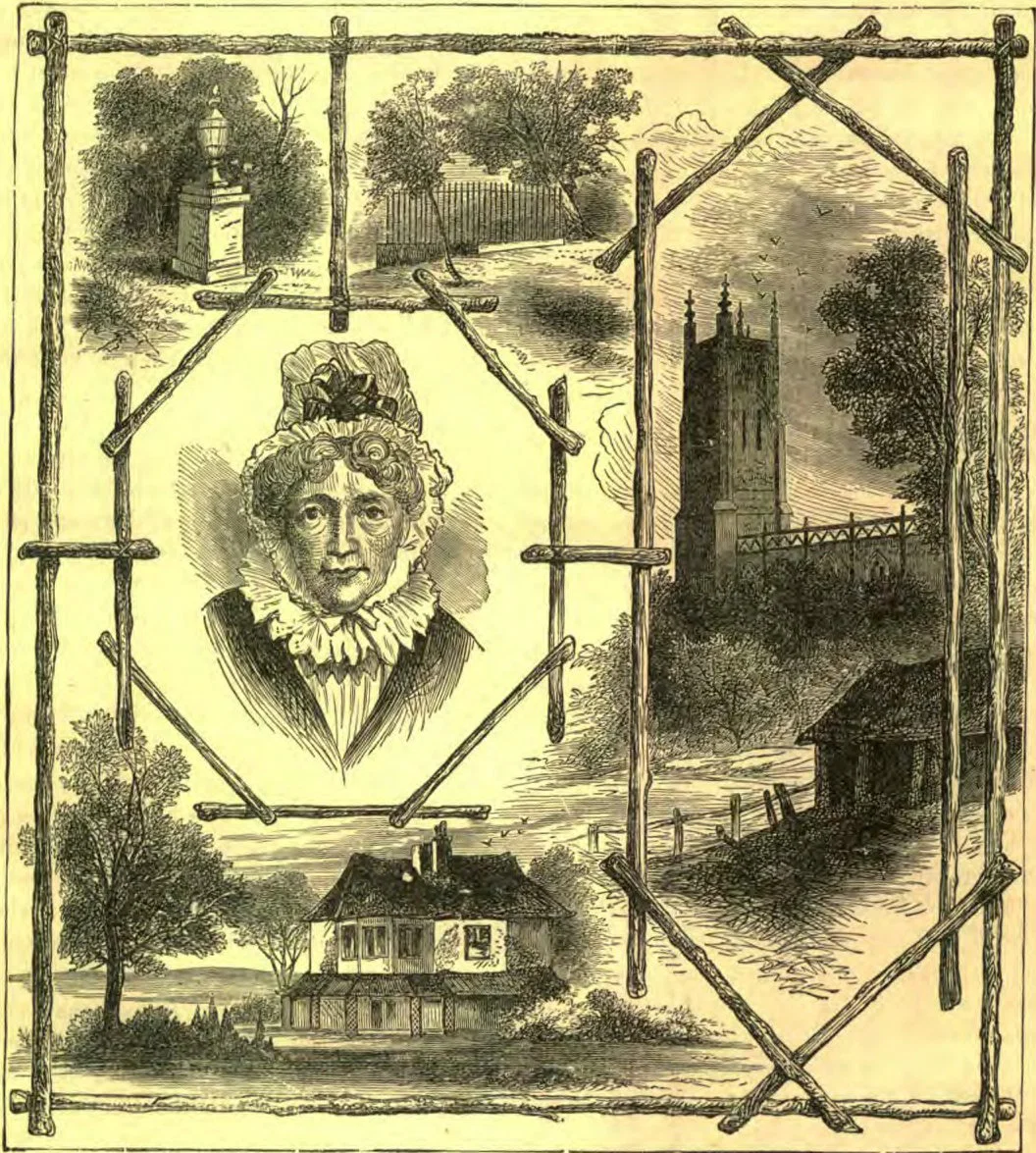
HANNAH MORE was born in a pleasant rural home in Stapleton, England, February 2, 1745. She was the fourth of five girls. Her father, a well-educated man, was at one time wealthy; but he lost all his property in a suit at law. He then taught the parish school in Stapleton, and here Hannah was born. Mr. More was very proud of his five daughters, and took great pains to give them a classical education, and to arrange a select course of reading for them. This, you see, was over a hundred years ago, when women, as a general thing, were considered educated if they were well versed in the external accomplishments of the day. The girls were, indeed, fortunate in having such a good chance to get an education.
The three oldest girls opened a school in Bristol. When twelve years old, Hannah was sent to this school. She was a brilliant scholar, and attracted the attention of the best cultivated people in the city. She afterward became the intimate friend of the most learned and scholarly men of that age. Her writings met with great favor, and her books sold rapidly. She was admired, praised, and petted in a way that would have turned many another person’s head. But she does not seem to have been affected by it. She was always simple and natural.
The more she mingled with the fashionable society of that day, the less she cared for it; and she at last made up her mind to move out of town into a home of her own. She bought a little cottage in Cowslip Green, ten miles from Bristol, and here she began her life’s great work.
She now wrote almost wholly on religious subjects, and in this way exerted a great influence upon the people. Her writings met with an unusually large sale.
The French Revolution had at this time affected to a great degree the minds of the English people. Under the name of reform, the social as well as the civil institutions of the country were threatened with ruin. People trembled for the safety of the realm. Just then a little work called “Village Politics, by Will Chip,” appeared. Everybody bought it and read it, and recommended everybody else to get it. In a little while, no less than one hundred thousand copies were sold. It was a book written for the people by one of the people, and it did more to quiet down the rising rebellion than anything else could have done. After a time, it was found that “Village Politics” was written by a woman. That woman was Hannah More.
But she was something more than a literary woman. She was a philanthropist. Ten miles from Cowslip Green rose the tall, romantic limestone cliffs of Cheddar, one of the most picturesque spots in England. The mountainous region itself was rocky and barren, but the plain around was rich and fertile. It was not the beauty of the place, however, that engaged the attention of Hannah More. The inhabitants were in sad need of missionary labor. In a letter to a friend, she writes: “We found more than two thousand people in the parish, almost all very poor; no gentry; a dozen wealthy farmers, hard, brutal, and ignorant. We saw but one Bible in all the parish, and that was used to prop a flower-pot. No clergyman had resided in it for forty years. One rode over, three miles from Wells, to preach once on a Sunday, but no weekly duty was done, or sick persons visited; and children were often buried without any funeral service. Eight persons in the morning, and twenty in the afternoon, were considered a good congregation.”
Twelve times she visited this neglected region before she could get the land-holders and the people to consent to have a Sunday-school. At last she succeeded in conquering their prejudice. Her youngest sister, Patty, was not a whit behind her in this good work. Together they visited other neglected parishes, and started other schools. By and by, day schools were held. Noble Christian women joined them, and great good was accomplished. Hannah often rode thirty miles a Sunday, usually visiting three parishes.
No good work was ever carried forward without meeting opposition. And these women did not have an easy time. One school was broken up in the height of its usefulness, because its leader, Mr. Bere, encouraged extemporaneous praying and speaking in a meeting of ten or twelve neighbors. This, the clergy thought, was encouraging Methodism; and as the Methodists were then a new sect, little known, and despised, no opportunity was lost to cast contempt upon them.
They were not content with breaking up the school, but went so far as to post bills against the sisters in the public highway. The following is a fair specimen of these bills: “Just imported from Barbary, by Baron Munchausen, a large collection of strange beasts, which the Baron has had the honor of exhibiting before the Bishop of London and his party with great applause, and may be seen at any time of the day at a new-built caravan at the sign of the Green Cowslip, in the parish of Wrington, at 13½ pence each. The collection consists of five female savages [the Misses More] of the most desperate kind, one black bear, [Mr. Bere,] which they wounded with a poisoned dart while he was guarding his little ones.”
All this was very hard to bear, but they did not give up their work. Miss More writes to a friend, “In Blagdon is ‘still a voice heard, lamentation and mourning,’ and at Cowslip ‘Rachel is still weeping for her children, and refuses to be comforted because they are not ‘instructed.’ This heavy blow has almost bowed me to the ground. . . . Patty behaves nobly, and only works the harder for these attacks.”
She had made quite a fortune by her writings, and so had her sisters in their work of teaching. At last they all came to dwell together in an estate that they had purchased near Wrington. Here they lived to a beautiful old age. Lovely and pleasant were they in their lives, and in death they were not divided.
They lie side by side beneath a yew and a willow in the churchyard at Wrington; and above them is placed a stone, bearing their names and the simple inscription, “All these died in faith, accepted in the Beloved.”
W. E. L.

BROKEN TOYS.

“Come, Bertha!” called her father from the foot of the stairs; “if you expect to help me tend store any to-day, come now.”
Very unwillingly Bertha laid down her book. “Tending store” was not always a pleasant duty. Her father kept a shop on a back street, selling cheap books, papers, toys, and candy. His customers were few, but on Saturdays there were so many children in, that, on that day, Bertha had to be in the store, which was really only the front part of the house in which they lived. As Bertha passed through the large sitting-room just back of the store, her mother said,—
“Come, daughter, your father has called you twice. He says the customers are as thick as blackberries in August, and they must be waited on.”
Without making any answer, Bertha passed into the store, and took her place at the end of the counter devoted to toys, these being her charge; then she rather ungraciously said,—
“Can I do anything for you?”
Before the counter stood two poorly-clad children. A little abashed at Bertha’s question, they did not answer.
“Do you want to buy anything?”
“We want to, please, but I don’t know whether there is anything here we can buy. We haven’t much money,” said the elder of the two, as she sighed and turned away.
“Oh, yes! there must be,” said Bertha, instantly growing sympathetic at the sight of a disappointed face.
“Well,” said the little stranger, “I’ve got seven cents, and I want to buy something very nice. I brought Jamie along to help me choose it; he wanted so much to come.”
“But the money is all Sue’s,” explained Jamie.
“Yes, all my own!” said the girl, a little proudly. “I earned three cents taking care of the baby on Saturdays—mother pays me, you know; two cents going on an errand, and two cents I got on my birthday.”
“And now you want to buy a present for your little brother?” said Bertha, becoming interested in her customer.
“Why, no! not for me,” exclaimed Jamie; “for Tom Wright, who broke his leg, and had to stay in bed weeks and weeks.”
“Yes,” explained Sue, “Tom lives just back of our house. He fell one day, trying to jump on the street cars the way the big boys do; he broke his leg, and has to stay alone all day, ’cause his mother has gone out washing. We lent him all the things we’ve got, but he is tired of them, and yesterday he cried ’most all day; so I’m going to buy him something nice. Jamie thought of it first.”
“Well,” said Bertha, as she turned toward the shelf, “seven cents will buy something nice, but not anything very fine, of course. Here’s a jumper for six cents, and a trumpet for seven; which do you like best?”
This was a hard question to decide. Then there were balls, marbles, and many other nice things to be considered. At last, after many wistful glances at the larger playthings, they agreed that a trumpet was the best, because, as Jamie said, “When he gets lonesome, he can blow for company.”
“Do you have many playthings of your own?” asked Bertha, as she tied up the trumpet in a very gay piece of paper.
“Oh, yes!” said Sue. “We’re quite well off for things; but there’s ever so many children on our street who haven’t anything at all, and some sick children too. I do wish I could just take a basket of these things around, and make ever so many poor children glad for once.”
“Glad for once,” echoed Jamie.
With promises to come next Saturday and tell how Tom liked his present, Sue and Jamie started for home, leaving Bertha wondering how she could do something for the little sufferer, and she shared Sue’s wish that she could once have a basket of toys to scatter among poor children. It was not until evening, as she was helping her father clear up the store, that she thought of a plan. Seeing the box where they threw the toys which were broken beyond all hope of mending, she exclaimed: “O father, may I have these?”
“Why, of course; they are only broken toys.”
Only broken toys! How little did he imagine what good use Bertha was going to make of them; but with the help of mother’s advice, with some glue, with needle and thread, the toys were so changed at the end of the week that they could hardly be recognized. And when Saturday came, Bertha had her reward in Sue’s pleasure.
“What! all for me to give to any of the sick children? Oh, how happy they will be!”
Bertha never knew just how many little hearts were made happy by her thoughtful kindness, although Sue tried to tell her; for we cannot estimate the value of one act of kindness toward others. One happy heart makes others glad, and so the happiness goes on, growing and spreading.
—Truth-Seekers.

HOMEWARD BOUND

FOREIGN TRAVEL.—NO. 22.

HOMEWARD BOUND.

At last the happy time is reached when we can begin to look homeward. The days of our traveling here and there, from country to country, and from city to city, are finished; and we can now think of the land of our birth, and the friends and scenes of home. We have visited many interesting scenes in the old world. Many pleasant acquaintances have been formed, and we have enjoyed the society of dear friends much. It seems hard to break the pleasant ties that connect us to them; but after all, there is no place like home.
Our ride homeward from Bâle lies through Strasburg, Belgium, Calais, Dover, London, and Liverpool. In passing through Belgium on the swiftly flying train, we had very little opportunity to visit its places of interest.
Belgium is a very level country, and is the most thickly settled of any country in Europe. It is highly cultivated, and many important cities are located along its railroads. Most of the people speak the French language, and the country resembles some parts of France very much. When we reached Calais, we took a steamer across the English Channel to Dover, a distance of about twenty-seven miles.
The English Channel, which is usually quite rough, was very quiet, and we had no feelings of seasickness. Many times those who have crossed the ocean in quiet will have a severe attack of seasickness in crossing the channel between England and France. The ocean steamers being large, while the channel steamers are usually very small, they toss about when the sea is not very rough, often making this the most uncomfortable part of the voyage. Our vessel was really a double one, decked over and made into one. The hull was in two separate parts. This made a very steady-running boat.
The readers of the INSTRUCTOR may have read of the white chalk hills of Dover, from which crayons are made. These form the bluffs along the eastern coast of England, and are of a peculiar formation. Though being very dingy, they look like snow-drifts, lying many miles in long windrows. There is much of this deposit in various parts of England. Perhaps some of the younger readers of the INSTRUCTOR do not know that the chalk they use on the blackboard is a certain kind of rock stored in the earth in vast quantities.
The railroad from Dover to London is excellent, and the country is very pleasant. Fine groves and parks, villages, cities, and beautiful landscapes and scenery are visible in many directions. We spent but little time in London, being anxious to hasten on our homeward voyage. The whole route through England was also very interesting.
There is no country in Europe that presents more large, green, lovely forests in the summer season than England. Vegetation here is very backward compared with the Continent. Great Britain being surrounded by the ocean, it is cool in summer and warm in the winter. Very little snow ever remains on the ground at any time. The climate is quite cool and moist. This gives a depth of green to the vegetation which is not seen in many countries. England also has many beautiful groves and parks of timber, a great many more than the Continent has. This is largely due to the fact that after William the Conqueror, with his Norman-French followers, obtained the sovereignty of England, they converted large portions of the territory into hunting grounds, letting the timber remain. In these, deer and other animals are allowed to run unmolested, and serve as game for the rich lords and nobles of England. Vast tracts of land have been thus kept from cultivation. They are held by the nobility, and could not be purchased at any price. A small number of persons hold much of the land of England, which they rent out to parties for cultivation, for town lots, etc. This arrangement, though oppressive to the poor, laboring class, who always have to pay rent for the land, serves to make the general appearance of the country very attractive.
England is full of large cities. It is in fact the center of the political, commercial, and financial world. Protected on all sides by the waters of the ocean, the march of foreign troops is never heard within its borders. Great Britain’s ships enter the harbor of every nation on the globe, and the sun never sets on her possessions. It has been many centuries since any foreign force of enemies has trodden the shores of England, unless called there by the British themselves under some civil war. England is a rich country. Its flag floats in every clime, and on every sea.
We spent one day in Liverpool. This is, next to London, the most important city in the world of commerce; indeed, it exceeds London in its amount of shipping. Many miles of docks are here seen along the shores of the River Mersey. The largest ships cannot come into the docks, but anchor out in the broad stream. Passengers and freight are conveyed to them by smaller vessels; but all through the city, docks are constructed, and canals are formed with sufficient depth of water to admit moderately sized vessels, which are unloaded of their burdens from every part of the known world. Liverpool lies on one side of the river, and Birkenhead on the other. Both are large places, and very busy.
The time to leave the dock to take our steamer was 4 P. M. The small steamer which took the passengers from the wharf to the big ocean steamer, Oregon, lying anchored in the stream, was crowded to its utmost capacity with passengers, while another took the baggage over. From the little vessel, men, women, and children had to climb up a long ladder to reach the top of the great monster ocean steamer, nearly 50 feet above. This took considerable time. Then there was rushing to and fro to look after the baggage, find our berths, and get nicely located for the night. It was four hours from the time we left the dock in the little steamer before the great anchor was hove up and we set sail on our homeward voyage.
We were fortunate in securing a passage on the Oregon, one of the fastest ships that ever crossed the ocean. The best time she has ever made from Queenstown to Sandyhook was six days and ten hours. This is at the rate of from 450 to 500 miles per day. The ship rated 7,500 tons burden, and was about 650 feet long and 50 wide, with immense engines. It was said that they sometimes burned as much as 300 tons of coal per day.
It would carry, when well filled with passengers, as many as one thousand persons, which, with the hands on board, would make quite a little city of people. With such a monstrous ship rushing through the water at the rate of eighteen or nineteen miles per hour, as fast as many trains run, the readers of the INSTRUCTOR can see that it would take enormous engines of immense power; yet it went along so quietly that you would hardly realize you were moving, unless you passed the land or some stationary object.
Leaving Liverpool at 8 P. M., we reached Queenstown, Ireland, at 10 A. M., next morning, where we stopped about three hours to take on the United States mail and provisions for the voyage. Many of the passengers went on shore. The ship was anchored a mile or two from land.
It was astonishing to see the amount of mail matter which came aboard this ship. As nearly as we could judge, from fifteen to twenty tons were taken on. There was an immense pile of large, well-filled sacks, each of which was a good load for a man. All this was on just one steamer. In two or three days another batch would be taken. What an immense amount of letters and papers it would take to make so many tons of mail matter!
Our voyage was very pleasant, much more so than the one in February, when we crossed in the other direction. We saw two or three small icebergs on the way. Had very little seasickness. Saw the spouting of a few whales as they threw the water high in the air every few moments, though we could not see the creatures themselves. We were six days and eight hours crossing from Queenstown, where we last beheld land, till we reached Sandyhook, and commenced to enter the harbor of New York. We waited seven or eight hours for the tide to come in to enable us to cross the sandbars, then we ran up to New York City, though we had to stop on the way for the health officers to examine the passengers to see whether there was any contagious disease on board. Finally, our huge ship went into the dock, and then came the hurrying to and fro, getting through the perils of the custom-house, securing our baggage, etc., etc. At last we placed our feet once more on our native soil; our long journey was ended, and we were under the folds of the stars and stripes, in the land of the free and the home of the brave.
UNCLE IDE.

DECEMBER

The wind-blown snow is drifting drearily Across deserted pastures white and still; The mournful wind comes grieving wearily From lonesome woodlands, silent now and chill. No sign of life nor labor, save the shrill, Blithe whistle of the herd-boy at his round Among the shivering flocks; or, fainter still, Through the keen, frosty air, a lingering sound Of some fast-falling ax. Half frozen, round His summer haunts the rabbit strays; in more Than one tree-hollow of the wood, drift bound, The thrifty squirrel craunches at his store, And this is all—no life nor labor more; Nature's numb heart is frozen to the core.
—Arthur's Magazine.

Trusting God When Provisions Run Out

To trust in God when our warehouses and bags are full, and our tables are spread, is no hard thing; but to trust him when our purses are empty, and there is but a handful of meal and a cruise of oil left,—herein lies the wisdom of a Christian’s grace.

THE ORIOLES' INGENUITY.

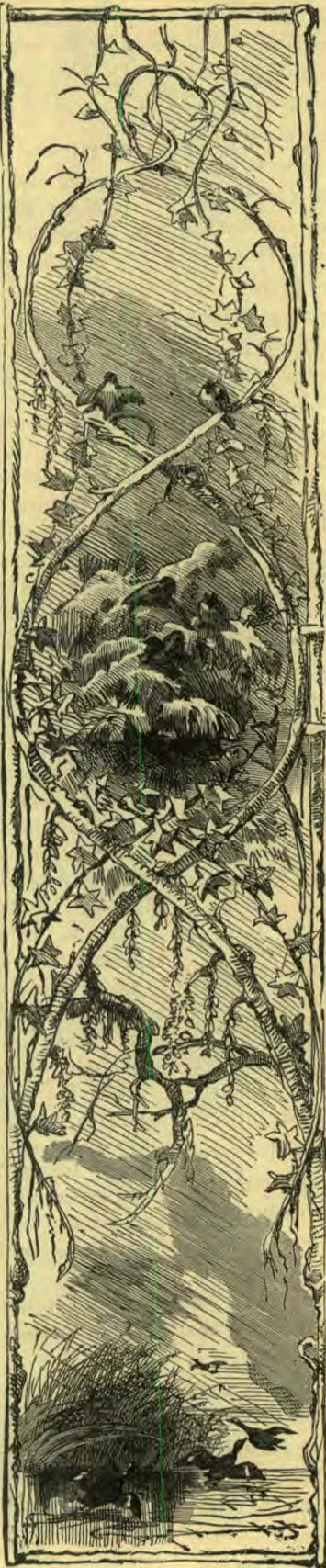
On the western side of Central Park, near the upper end, stands a row of elm-trees, difficult to approach on account of a heavy growth of syringa bushes around them. On a branch of one of the trees, about sixteen feet from the ground, a pair of Baltimore orioles set to building a nest. They chose the extreme end of the bough, with evident intention of making it a hazardous experiment for any bird-nester to attempt to molest them. But in their excess of caution they appeared not to observe what the few persons whose eyes were keen enough to see the first labors of the little architects saw,—that the branch was much too slender to support so large a nest as an oriole builds.
When the nest was about two-thirds finished, the birds saw their mistake. The branch had bent so low that it was getting perilously near the grass. Work was at once stopped, and the builders sat close together for a long time, and seemed to be discussing the situation. Finally they flew side by side to a bough about fifteen inches over the one on which their nest was, and, leaning over, inspected the distance. They seemed to be satisfied, and, though it was growing rapidly dusk, the birds flew away in opposite directions. In the morning it was found that they had firmly secured their habitation, and prevented the branch from bending lower by passing a piece of white string, which they had found somewhere in the park, over the upper bough, and fastening both ends of it securely to the edges of the nest. The building then went rapidly on, and the orioles hatched their eggs, and have gone to warmer regions long ago.
There are two things I want to say as to the teachings of this story. One is, that no one—man, woman, or child—ought willfully and wantonly to injure or harm these little creatures. Be kind to all living things, unless they are harmful.
And the other thing is, that we ought to reverence the great wisdom of God, who can put such instinct into even the little birds that fly and sing in our trees. The book of nature, as well as the Bible, tells us that God is wise and good. The little bird cannot recognize the One who teaches him to build his nest and to sing. But we know how good God is to us, and we ought to love and serve him.—The Child's Paper.

IMPORTANT BIBLE SUBJECTS.

LESSON 23.—THE RICH MAN AND LAZARUS.

[NOTE TO THE STUDENT.—Do not consider the lesson learned until you can give at least the substance of every text, with the correct reference for each. The references in black letters indicate those texts that should be committed to memory. A little diligent application each day will enable you to do this.]
  1. Relate what is stated in the 16th of Luke concerning the rich man and the beggar.
  2. What happened to them both?
  3. To what place have we learned that they both went?
  4. Do you know of any people who are exempt from going into the grave?
  5. What does the psalmist say about all men going into the grave? Ps. 89:48.
  6. Of what was “man” formed? Gen. 2:7.
  7. What did he afterward become? Ib.
  8. What was imparted to him to bring about this change? Ib.
  9. Does the breath have life and consciousness in itself?
  10. How does the wise man describe the death of man? Eccl. 12:7.
  11. Since there is nothing to man but that which is formed of dust, and the breath, can there be any conscious entity when the dust returns to the earth?
  12. Give a brief summary of the Scripture statements concerning the dead—their place and condition.
  13. Since both Lazarus and the rich man are represented in Luke 16 as dead, could the conversation ascribed to them have been real?
  14. What other instances can you cite of inanimate objects represented as talking? Gen. 4:10; Hab. 2:10; James 5:4.
  15. What are such representations called? See Webster’s definition of “apologue.”
  16. What important lesson is taught by this apologue?
  17. With what precious statement of Christ is it in harmony? Luke 16:11–13.
  18. What action of the Pharisees made its recital necessary? Luke 16:14.
  19. Why is human judgment as to the comparative worth of men liable to be at fault? 1 Sam. 16:7.
  20. When will every man be judged according to his real merit? 1 Cor. 4:5.
  21. What will the righteous Judge give to those who love his appearing? 2 Tim. 4:8.
  22. How will the despised, humble, poor man stand then? James 2:5.
  23. When is it that the angels actually take the righteous to the mansions of rest? Matt. 24:30, 31.
  24. When will the wicked be tormented? Matt. 13:40–42.
  25. When the separation is thus made, what fixes the gulf between the righteous and the wicked? Rev. 22:11.

NOTES.

“APOLOGUE: A story or relation of fictitious events, intended to convey useful truths; a moral fable.
“An apologue differs from a parable in this: The parable is drawn from events which take place among mankind, and therefore requires probability in the narrative; the apologue is founded on the supposed actions of brutes or inanimate things, and therefore is not limited by strict rules of probability.”—Webster.
The important lesson taught by this narrative is the impossibility of estimating human character by the outward appearance. The Pharisees were covetous, and thought that the possession of riches was an indication of the express favor of God; consequently, when Jesus said, “Ye cannot serve God and mammon,” and taught that the one who is faithful to God in even the smallest affairs is the one whom God regards, they derided him. He then taught them still more plainly that to live only for self, and to have one’s good things in this life, is to forfeit the favor of God, and lose the good things of the life to come.

WHAT ARE YOU DOING?

MY DEAR YOUNG FRIENDS: When I think how large the INSTRUCTOR family has grown, and how many bright eyes watch for our dear paper every week, my heart goes out in love to you all, and I think what a pleasure it would be to see you gathered together in one congregation. Although this glad sight can never greet my eyes here, yet I hope by and by we shall meet in the kingdom of God, and together view those grand new mansions Jesus has gone to prepare. In the meanwhile, how are you spending your time? Are you getting ready to meet our returning Lord, and trying to get others interested in the good news of his soon coming?
Now I think you are saying to yourselves, “We would like, oh, so much, to work in His cause, but there is nothing that children can do.”
Let me tell you what a small class, whose ages range from ten to fifteen years, have been doing the past year. They formed themselves into a little Missionary Society, and said, “There are only a few of us; if we cannot do much, we will do what we can. No one of us alone earns enough to be worth giving to the missions, but if we work as hard as we can, perhaps all of us together can do something.”
They went to work with a will, the teacher acting as treasurer. They chose as the object of their labors the ship work connected with the English Mission. They met to talk with, and encourage each other, and they held little missionary prayer meetings, where they tried to draw near to God, and learn the spirit of self-sacrifice for Christ’s sake. As a result of their efforts, at the end of the Conference year, they were able to give to the mission $9.10. Last year they gave $6.33. Thus they have this year earned $2.77 more than last year; and hope to do even better in the future.
We have more than thirty Sabbath-schools in our State (Illinois). If only one class in each of these schools would form a like society and raise $5.00, we would have $150.00. If each would raise $10.00, we would have $300.00, which might be put into the work in our own State.
My young friends, what are you doing? Do you not see much that you can do? The Lord will bless you in working for him. You may thus be laying up treasure in heaven, and you may be co-laborers with Christ. Oh, what an honor!
JENNIE E. OWEN.

AUTUMN

Summer day! sultry day! Hotly burns the noontide ray; Gentle drops of summer showers Fall on thirsty trees and flowers; On the cornfield rain doth pour, Ripening grain for winter store. Child, to God thy thanks should be, Who in summer thinks of thee.

AUTUMN

Autumn day! fruitful day! See what God hath given away! Orchard trees with fruit are bending, Harvest wains are homeward wending, And the Lord o’er all the land Opens wide his bounteous hand. Children, gathering fruits that fall, Think of God, who gives them all.

WINTER.

Winter day! frosty day! God a cloak on all doth lay; On the earth the snow he sheddeth, O’er the lamb a fleece he spreadeth, Gives the bird a coat of feather To protect it from the weather, Gives the children home and food— Let us praise him—God is good!
—Selected.

THANKSGIVING ALL THE YEAR.

THAT is a pretty custom the Pilgrim Fathers introduced,—Thanksgiving Day,—when it is rightly observed. But this day, so welcome to the boys and girls, is now in the past. The rhyme says,
“It is a day to be glad in,”
and so we suppose you made it a happy day by feeling glad and thankful to God for all the good things he gives you; and what is better still, we hope many of your glad feelings came from making other hearts glad. Did you fail in any respect to do for others upon that day all you might and should have done, you can begin right here, and make happy hearts every day. You may have Thanksgiving Day all the year round, if you will search out the needy, and share your blessings with them. If you have a tender pity for the sorrowing and distressed, and help them all you can, God will surely bless you, in basket and in store, and make it the gladdest year you ever knew.
There is another way in which, by making others happy, your own hearts may be made glad. It is by getting subscribers for the INSTRUCTOR. With the Lord to help us, we mean to make it the best paper for children and youth that is printed, and we want you to encourage us by getting all the boys and girls you know do not take it to become readers of it. During the last year the subscription list of this paper has been larger by several hundred than ever before, but at the close of the year 1885, we want to be able to report that we have added several thousand to it. What better work can you do than this? You know not how much bread you may thus cast upon the waters, to return to you after many days. Will you not put forth your best efforts in the interest of the INSTRUCTOR for the next few weeks?
M. J. C.

Letter Budget.

David Vessey writes from Stutsman Co., Dakota. He says: “I have lived here three years; was formerly from Minnesota. I have an uncle, aunt, and two cousins living in Battle Creek, and I hope I may see them before long. We have taken the INSTRUCTOR seven years, and like it much. It is so interesting, I wish it came oftener. I am nine years old. This is my first letter to the Budget, and I hope you will print it. We expect a minister here soon.”
Probably the INSTRUCTOR began to visit David’s home before he can remember, as he was but two years old seven years ago. He would hardly know how to get along without it now.
Here is a letter from two little sisters in McLeod Co., Minn. They write: “We are two little girls, named Winnie and Maudie Arnold, aged seven and five years. We have been to Sabbath-school every Sabbath but one this summer. Our mother is the superintendent. We want to be good little girls, so that when Jesus comes, he will take us to live with him. We are too small to write ourselves, so mamma writes this for us.”
If Winnie and Maudie are as faithful in their studies as they are in their attendance at the Sabbath-school, they will soon be able to write or print their own letters.
Eva Jones writes from San Francisco, Cal. She says: “I have wanted to write to you for a long time, but thought I would wait until I could write my letter all myself. I am seven years old. I used to live in Battle Creek, and go to Sabbath-school in the Tabernacle. I see my dear teacher’s name in the INSTRUCTOR almost every week. I wish I could be in her class now; but I like my teacher here too. I had a nice book given me by the superintendent last New Years. I am trying to be a good girl, and mind my teacher and parents, that I may see Jesus when he comes, and go to heaven. I send my love to the editors and all.”
We are sorry, dear Eva, that your letter was hidden away so long. When your mother’s letter was taken out of the envelope, by some mishap yours was overlooked. Your letter was written very plain.
Besides the above letters, we also give the names of some that have been waiting a long time for a place in the Budget. These have written so nearly like the others that we will not hold them longer. When something happens in your daily life which you think will add interest to the Budget, note it down in the scratch book we recommended you to keep; and then, by the time you write another letter, you will have something new to write, and it will help you in becoming good letter writers. The names are as follows: Viola Parshall, Lillie Shrock, Olive B. Hogle, Charlie Blake, Moses Nelson, Cora Wilson Adsit, Ora and Willie Parker, Ollie Wood, Agnes M. Davidson, and Rosa E. Wright.

You have reached the end of this edition.

The Youth’s Instructor · Dec 3, 1884