Your ShelfYour Projects

Review and Herald, Vol. 92, No. 47.

What Then?
Earlier text: He Knoweth

Mission Policy and Methods

J. C. ROGERS
PREACHING, teaching, and healing are the three prominent things to be done by the missionary. In two records of our Lord's commission, preaching is spoken of first. In the two records which mention healing, it follows preaching and teaching.
From the example of Christ and the apostles we learn that every legitimate means is to be used in the execution of the mighty commission. An attempt at classifying some of the methods of reaching the heathen with the gospel message will be useful, I think. We shall place first of all,—

Preaching the Word

None will question, I presume, the paramount importance of this means so fully employed in the early church. The convincing certainty of the simple gospel can be depended upon in season and out of season. It reaches the heart. It converts. It saves. No man can deny nor escape its power. No man will soon forget its convicting appeals brought home to his needy heart by the Spirit's power.
“The testimony of living men has advantages, many and great, over that of the written or printed word. The printed book certainly brings a sure and authoritative knowledge, but it lacks the support of a trustworthy witness, staking his life on the truth of his message. Among uncivilized peoples a personal offer of the gospel is the necessary thing. The written or printed word is ineffective for the most part, at least, in purely heathen regions.”—“Living Forces of the Gospel,” by Warneck.
Publishing the word finds its place close beside preaching, and embraces every means of printing and circulating the Bible itself and all profitable literature growing out of it. Publishing introduces the manual or industrial feature which might be classed under the educational department of missionary effort.

Teaching

Here the education of converts, as well as of the unconverted, and the training of the former for gospel service and Christian living, claim our attention. In the mission field, teaching often appears more prominent than preaching. But preaching to the missionary means living, working, and dying among his people. That is, it means far more than to stand in the pulpit and preach in that particular way.
“The preacher must, at all times, be ready to lay down his life for what he preaches. . . . He has, by the purity of his life, shown himself to be trustworthy, and has led the heathen to put faith in his words.”—Ib.
First in education comes book training. Often this begins with the making of simple charts on wrapping paper or on a box cover, or printing words on the sand. This latter method is largely used on the Tanganyika plateau, where native teachers hold their schools in an open space near a village. The bare ground is the schoolroom, with no seats, except perhaps a pole resting on two forked stakes, for the teacher. The classes stand before the teacher's seat while reciting, and sit on the ground while studying. I often see boys and girls doing sums and writing lessons in this way on the sand.
Next in education comes work training. When the village lads are able to read in their vernacular and write a little, they must go to the mission, or station school, for further teaching. The moment these lads reach the station, the real problem of native education begins. In the village they have had one or two hours' teaching each day, often irregularly, with frequent breaks for going visiting, for work, or for this, that, or the other. An hour or two daily, and no more, is the rule. The remainder of the day has been spent in play or work, usually the former. They cannot be kept in the schoolroom all day, nor even half a day profitably. Three hours are about as much as can be spent to advantage by these beginners. What shall be done with the other nine?
The missionary is trying to teach regular habits of study and work, of which his pupils know nothing whatever. It would be folly to leave them to themselves for a large part of the day. They must be cared for. Thus the imperative necessity of some kind of manual work connected with the mission,—an industry. It should be suited to the people requiring it. In China it may be one thing, in Australia or Africa another. India may require something different still. But among missionaries there is a very general agreement as to the necessity of some kind of manual work.
In our mission work it has always been our policy to encourage manual work as an essential part of educational training. For the most part, other missionaries have followed the same policy. And I believe it has worked well. If this policy were to be abandoned, what better could be found to replace it? How shall the student's time out of school hours be employed, especially in sparsely populated places where there are no cities, and no opportunity for students to find employment except on the station?
It may cost a little more in some cases to produce a thing on a mission, or in a school, than to buy it. But the educational value of the work is worth more to the native than the amount saved would be to the mission. I know of such a situation in one of our large African missions. It costs a trifle more to hoe the ground, to plant and cultivate and harvest the food supplies for the two or three hundred natives living on the station, than to buy of the surrounding villagers. But to buy this large supply of food would have a bad effect on the
villagers themselves. It would give them the idea that those who go to the mission are rising above work; that lazy boys can find a refuge there and learn to get on without working. And the effect upon the student is worse still. These unlearned people are inclined to avoid work as they would the plague.
For these and other reasons, the missionary holds to the policy of work for his students. I believe we should, at least, use the students' time to produce the food required on the station when possible; and if the conditions are favorable to some industry that will bring in funds to buy what cannot be produced in the way of food and clothing, can there be any proper objection to such an industry?
The missionary's time should be free for his great work of preaching and teaching the gospel, as well as ministering to the sick and suffering. He should not be under the necessity of exhausting his energies in manual labor, nor in carrying the heavy responsibilities of industrial enterprises. He should be assisted by others qualified for that part of the work. I think we are in a time requiring careful and wise plans of operation, as well as policies and methods. It is not wise to abandon suddenly what has proved useful and successful.
Mporokoso, Northern Rhodesia.

Viru Mission, Solomon Islands

G. F. JONES
THIS is our first mission station in the Solomon Islands. It is on the mainland of New Georgia, about midway between the Marovo and Roviana lagoons, on a beautiful, peaceful harbor, into which three fairly large rivers run. It was after many prayers, and with much caution, that we were led to decide on starting at Viru; and we believe we have evidences that the move was for the best. This is the mission where Brother and Sister Hellestrand are now located. They will remain to carry on the mission work and learn the Ulusagi language, the language of Viru and other parts of the lagoon.
From fifteen miles around, the people come to our school and meetings. The average attendance at the school for the last few days has been about forty, while over fifty names are enrolled on the school record. These are nearly all bright, earnest, promising young people, who have already learned to sing in English, and to repeat four hymns, and one or two stanzas of eight others. They have also learned the alphabet,—one of our own making,—and can write all the letters, both small and capitals. Several of the young men can now write a good sound hand, and spell correctly any words in their own language. The alphabet is, of course, phonetic, and so it is easy for them.
They can also answer questions on the creation work of each day of the week, and tell why the seventh day is the Sabbath. They can tell about the fall of our first parents, the birth and work of the Saviour, and his soon coming to restore all things.
The Sabbath meeting and the Sabbath school have reached an attendance of about seventy, which promises to be regular, and all seem very attentive, reverent, and in earnest. Even the aged people who have been bush savages, and some who are spiritualistic mediums and witch doctors, now come every Sabbath dressed in anything they can get hold of, in honor of the day; whereas on all other days they wear no clothes at all in their homes.
The people who live at a distance are planning to come and live on the mission land, build their huts, and make the mission station their home, just as our people in America build their homes around the school campus. Some of the ground has been planted with native foods, and we expect soon to fill it all with tropical fruits as well.
I fully believe that the Lord has sent us to neglected Viru, and it is not difficult for us to see our first native missionaries among these dear people. May the Lord help us to be faithful to him and to them in fitting them for godliness and work here, and heaven hereafter.

Teaching Self-Government

MRS. D. A. FITCH
Does it make a child honest or less meddlesome to hide from him the thing he covets, or to put it out of his reach?
Edward had been told many times that he was not to go to the shop. Having never been taught self-control, he did not obey. Then the door was locked to keep him in, but he learned to unlock it. A fastener was put on so high he could not reach it, but what boy could not overcome this difficulty? Soon he had mastered the fastener, and would triumphantly march to his father’s shop. Dainties and other things he ought to leave alone were hidden. Did he secure them?—Almost invariably. Did he grow up to be a man of self-control?—By no means.
Quite a different course was taken with his little cousin. When just a baby, she would creep to the water pail to play in it. The pail was not put out of her reach, but she was taught to stay away from it. She delighted in picking the plaster from a place where it was broken. Did her mother paste paper or cloth over it, or set a piece of furniture against it?—No. A little discipline sufficed to teach the child it was best to keep a proper distance from the spot. When once instructed that fire would burn, she was allowed to play with the stove until her burned fingers served as a reminder that mamma was right in her requirements.
Judiciously to permit children to have their own way often teaches them lessons of obedience, as well as of respect for the judgment of their parents.

Para-Dichlorobenzene

THIS is not the name of a country in South America, but of a new insecticide, which is declared by the United States Department of Agriculture to possess several advantages over other well-known fumigants. First and greatest of these is its noninflammability; its vapor is also, under ordinary conditions, harmless to human beings, domestic animals, and plant life, while at the same time it is a deadly poison to many insects; its odor does not cling to fabrics submitted to its fumes, but rapidly disappears when they are exposed to the open air; and it is low in price.
Para-dichlorobenzene, is “a colorless, crystalline substance, which volatilizes very readily as a colorless vapor, with a peculiar ether-like odor.” Those who have conducted a series of careful tests and experiments with it recommend it for ridding warehouses of undesirable forms of insect life. It is also of practical value to the housewife in freeing the house of well-known pests of this nature.
About sixteen ounces of para-dichlorobenzene to one hundred cubic feet of space is recommended. To be effective, its vapors must be closely confined, and in a temperature higher than 74° F. “At temperatures between 75° and 85° an exposure of at least thirty-six hours is necessary for best results. Temperatures above 85° F. require only twenty-four hours’ exposure, due to the fact that heat facilitates the diffusion of the vapors.” Moths, flies, mosquitoes, carpet beetles, ants, and other insects are easily exterminated by this method. It is especially useful in fumigating closets, cupboards, etc.
Bulletin No. 167 of the United States Department of Agriculture is devoted to this fumigant. A copy may be obtained on request from that department, Washington, D. C.
MRS. I. H. E.

The Soul's Cry for Help

R. D. BENHAM
As through life's wilderness I wander, Tangled maze on every side, Darkening shadows growing longer. Jesus, Master, be my guide.
When my weary footsteps falter. And I seek a place of rest, As I kneel beside thine altar. Blessed Master, be my guest.
When the world turns coldly from me, None on whom I may depend, Those I trusted frown upon me, Saviour! Saviour! be my friend.
When the mountain path before me Proves too narrow for retreat, And the storm cloud hovers o'er me, Then, dear Saviour, stay my feet.
Whether tossed on life's wild ocean, Or, if crossing desert sands, Fear or anguish be my portion, O my Saviour, hold my hands!
When my courage well-nigh fails me, And faith's cable seems to part, And no earthly help avails me, Jesus, strengthen thou my heart.
When the river dark I'm wading, And I find earth's last long rest, When the day's last beam is fading, Clasp me, Jesus, to thy breast.
Cornelius, Oregon.

Christ Meets the Soul’s Need

CHRIST comes only to the want of the soul. We shall know him, love him, feel his saving power, the glory and the blessedness of his birth in our souls, only when we heartily desire him.—Baptist Commonwealth.

Sup Thou With Me

MRS. ALICE M. AVERY-HARPER
WHEN softly sinks the sun at night, And evening's somber shades appear, When earth is hushed in peaceful sleep, Then may the angels hover near; And come thou, Lord, and sup with me, And I with thee.
Be thou my stay and portion, Lord, Through all life's weary toil and strain, And cheer me with thy precious word, Bind up each wound, and soothe the pain. Then sup with me, and I with thee, Dear Lord, with thee.
When seems my weary lot but dread, And oft beset with daily care, I'll trust thee to supply my bread; My sorrows thou dost ever share. Thou lovest me, and I love thee; Then sup with me.
And may I not draw near, my Lord, And hide me safely in thy love? Forgive my waywardness, I plead, And may I all thy mercy prove. Then sup with me, my Lord, with me, And I with thee.
Though friends forsake, and prove untrue, And look on me in cruel scorn, O help me, Lord, to patient be, Although my heart may be forlorn! Come, sup with me, and I with thee, Saviour, with thee.
I'm weary, Lord. I long for thee; Then let me rest upon thy breast, O blessed Lamb of Calvary, With seraphs sing among the blest, And ever be, dear Lord, with thee, Thy face to see.

Conducted by Mrs. I. H. Evans, Takoma Park, Washington D. C

Assisted by Miss Lora E. Clement
Through the columns of this department, hints will be given on all matters pertaining to the home life. Short articles and letters are solicited from home makers, telling of their everyday experiences,—their joys and sorrows, their failures and successes.

Reaching the Child Heart

So much is said and written nowadays on the training of the young that it seems almost presumptuous for any one to attempt to add to the mass of advice to parents,—to the suggestions as to how and when one should punish, if at all; to the counsel as to the various modes of restraining the child, of making an obedient creature of him, or allowing him to ‘exercise his own individuality.’
It is, of course, useless to attempt to make any one rule fit every case. In one family the first child needed stern discipline, while the second was hardened by the very process that had succeeded admirably with her sister. To study the character of the little one, and to decide what course to pursue in each case, is the by-no-means-easy task laid out for parents.
One little girl had a violent temper, which punishments of various kinds failed to subdue or control. The loving mother prayed about it, thought about it, asked advice of her family, cooperated with her husband in his efforts to find a way to teach the little one that she must not fly into a rage, and kick and scream. Then, when almost discouraged, the mother hit upon the happy idea of taking the advice of the child herself.
The mother called the little one’s attention to the fact that she, the child, was very truthful, and that therefore the mother would not be blamed for producing a deceitful woman. She praised other good qualities, such as neatness and prompt obedience. Lastly, she reminded her gently that there was one thing in which she, as a mother, had failed, and that was in teaching her little girl self-control. She warned her listener that this temper would grow with her growth until at last it would become her master, not her servant.
“And now,” the wise parent said, “I am going to ask you to help me get the best of this fault. When you were a baby, you were not wise enough to help me in this work that God has given us to do. But now he wants you and me to see just how good a child we can make of you, just what we can do with that temper of yours. Will you help me, darling?”
The small girl promised, and kept the promise. This compact was a little secret between the two. Of course there were times when anger would get the best of good resolutions, but a loving reminder from the mother would abate the storm of passion. The scream would cease suddenly as the words, “Please help me, darling!” were spoken. And in a few years the victory was won; not that the temper was banished, but it was controlled.
The same plan proved successful in the case of a child who found it difficult to tell the truth. Punishment of various kinds availed nothing. At last one day, when he was detected in a falsehood, his mother did not even scold him. He looked at her surprised.
“Aren’t you going to punish me?” he asked.
“No, dear,” she said, sadly. “You are old enough now to know that I cannot conquer this evil without your help. When you were little, the blame for your naughtiness rested with me. Now you have sense enough to know that a lie is a sin, and that it is a sin that injures your own soul. All the punishment in the world won’t break you of the habit of untruthfulness unless you are willing to help God and me in our aim to make a good, honorable man of you.”
“I will help God and you, mother,” the boy declared.
Of course such a plan as has been suggested must be considered confidential between mother and child while the little one is young. The knowledge that the parent has trusted him enough to confide to him the secret of the great work intrusted to her impresses the child, and brings out all that is best in him.
One cannot expect any sudden change in the development of the normal boy or girl, and one must not despise the days of small beginnings, nor be discouraged at many “lapses from grace.” But if the desire is present to assist in the lofty purpose of forming a noble, self-controlled, honorable man or woman, the child will do its share in a way that will make the mother thank God and take courage.—Virginia Terhune Van de Water.

The Children's Supper

WHAT to give the children for supper may seem of trifling account, but it is really a most important matter. A child's rest at night depends largely upon what it has eaten for its supper. It is safe to follow two rules: Never give a heavy supper, and avoid, if possible, giving it later than five or half past five o'clock, at least until a child is six years old. Thus an intervening hour and a half is left before the nightly sponge bath, which is exceedingly refreshing before bedtime, especially in hot weather, and which, with a well-selected supper, induces sleep in defiance of the heat, however oppressive. I emphasize this early hour for supper because it is not unusual to find mothers who, for their own convenience, give the evening meal to their little ones as late as half past six or seven o'clock. Such mothers visit physicians regularly, and ask advice as to what should be done to make their children sleep soundly, complaining that they are restless, wakeful, and easily disturbed. A child who has had a simple and early supper, if he is in good health, will be found to protest against being disturbed, and will want to sleep. Even in the case of a little baby, it is possible and very desirable not to wake him thoroughly for his ten or eleven o'clock bottle. He can be trained to take it while he sleeps, and this encourages the habit of continuous slumber from seven to seven, which is the greatest boon that a tired mother can ask, and is of equal benefit to the child.
Sleeplessness or disturbed sleep in a child points either to a faulty regimen or is the forerunner of disease, and it invariably needs attention and correction. To the mother who is watchful of the health of her child it is one of the safest indications that something is wrong, and it should be the only warning necessary to bring about a calling of the family physician, with a view, particularly, of looking into the child's diet—the cause of so large a per cent of infant ailments.—Mrs. Louise Hogan, in Good Housekeeping for July.

Take Time for the Bible

In these days people are fond of complaining rather helplessly about the pace and pressure of modern life. The spirit of the age is rushing faster every year. Business was never so exacting, nor pleasure so elaborate. We work and play under conditions of mental and physical tension. Often we sigh for some antidote to the hurry that is in the world. For, after all, any society must stand condemned which has lost its leisure.
From the very nature of the case, nothing great or enduring can ever be done in a hurry. People rush to be rich, and gamble for the fortune which they will not wait to earn. But even they are hardly absurd enough to rush to be wise. They understand that education, if it deserves its name, must needs be a deliberate and gradual thing. Nature herself rebukes our human feverishness with the example of her inexhaustible patience.
The greatest naturalist of our time devoted eight whole years almost entirely to a monograph on barnacles, and summed up a course of observations which had gone on through more than thirty years, in his book on earthworms. The like temper is characteristic of the artist. Genius cannot afford to be driven.
And this principle, which is justified in education and science and art, holds good even more absolutely in religion. We need to remember it today, when Christian work has so multiplied its activities and become so fatiguing in its demands, and the spirit of strain and hurry and competition even creeps into our devotion, and infects our very worship of God. And in particular we must take time for the Bible. It is true, indeed, that a hasty glance at a single verse can bring grace to the soul. Often to a jaded Christian in the midst of his busiest labor, the word is fulfilled, “He shall drink of the brook in the way: therefore shall he lift up the head.” But how many modern Christians are there who systematically give as much time to the Bible in a week as they give to magazines and newspapers? They open it at odd moments, they read it in fragments and snatches, or in some cases they hurry mechanically through an allotted number of verses. But do they steadily and habitually steep their spirits in the spirit of Holy Scripture?
Yet the Bible itself is a book of tranquillity. The peace of God rests upon its pages like sunshine on the summer hills. The record of our Lord’s life is full of serene leisure. His Father’s business was done for thirty patient years at Nazareth. And afterwards, when he became the vortex of eddying multitudes, through all those crowded days of healing and controversy, he never knew what it was to be feverish or hurried or distraught. He moved like a king in his own realm, and passed deliberately on to his appointed and accepted end. And so also his everlasting gospel has no fellowship with hurry. It cannot even be understood, except by those who will take time to understand it.
The Bible unfolds its secrets only to the disciples who brood over its pages. Not until we study it book by book do we grasp the divine inner unity which lies hidden beneath its manifold outward diversities. We can never fathom the profound meaning of redemption until we have possessed our own minds with the thoughts of the New Testament. And then, as we take time for the Bible, we rise above the spirit of hurry. The peace of Holy Scripture delivers from the weariness, the fever, and the fret which spoil so much of modern religion. The heart which believes becomes the heart at leisure, and the saints obtain at last their share in God’s timeless beatitude, wherein one day is as a thousand years, and a thousand years as one day. —T. H. Darlow, M. A., in the Bible in the World.

Maine Camp Meeting

The annual camp meeting was held in the twin towns of Dover and Foxcroft, August 26 to September 5. Preceding the camp meeting a tent effort had been conducted in Foxcroft, by Elders H. W. Carr and E. E. Osborne, with good results; quite a number had decided to keep the Sabbath before the camp meeting began.
Elder I. H. Evans was present during most of the meeting, and his help was greatly appreciated. Elder R. D. Quinn, president of the Atlantic Union Conference, Dr. D. H. Kress, Prof. B. F. Machlan, and Brethren L. W. Graham and V. O. Cole were present during a portion of the time.
Elder A. E. Sanderson's report of the work in Portland gave courage and life to the meeting. The Lord has greatly blessed the work in Portland; about eighty have been added to the church. Not only has the old debt on the meeting-house been paid, but an annex has been built and dedicated free from all debt. The Portland brethren have passed the twenty-cent-a-week goal for the year, and in every respect God is honoring the birthplace of the message.
The business meetings of the camp were of a most encouraging character. Repeatedly all proceedings were interrupted by expressions of praise and thanksgiving. Several times the audience arose in the midst of a business meeting and sang “Praise God, from whom all blessings flow.” It was more like a praise service than a business meeting.
The various resolutions were passed in a novel and uplifting manner. When resolutions on the colporteur work were presented, the canvassing agent gave his report and hung up a prepared chart, showing the wonderful advancement of the colporteur work during the past year. The company of colporteurs included all ages, from a white-haired woman past sixty years of age to young men and women. Some of the young people had earned two or three scholarships. The audience was prepared to vote without further discussion, and many of them in their hearts decided that what that company had done they, with God's help, would do the coming year.
The resolution to give hearty support to foreign missions was quickly responded to by many pledging one dollar a week for the year, and others fifty cents or twenty-five cents a week, until the sum of $1,747.20 was pledged.
When the resolution to carry forward the Harvest Ingathering work was read, many of the people responded by becoming individually responsible for the raising of different sums, ranging from two dollars to one hundred dollars. In a few minutes $1,169 was promised.
The minutes of the conference business were a “book of acts,” rather than a discussion and voting upon resolutions.
The need of home missionary work was made prominent throughout the meeting. I had attended many meetings where the people bought large quantities of literature, but I had never seen so large an amount taken by so small a company as at this meeting. It was a common sight to see brethren and sisters returning to their living tents with their arms full of literature which they had bought to use in missionary work in their home fields. About $2,500 worth of literature was sold on the camp ground. The last day of the meeting the book tent was empty, not even a Bible or a songbook being left. The sign, “All sold out,” was put up over the counters; but the people continued to come to the book tent, giving their orders for literature to be sent to their homes. Thirty-eight sets of “Testimonies for the Church” were sold.
The Sabbath schools in the State averaged twenty cents a week for each member. The first seven months of 1915 showed a gain in Sabbath school offerings of $1,690.16 over the first seven months of 1914. During the same period there was a gain in tithe of $2,377.34 over the first seven months of 1914.
The young people's meeting conducted by Sister Jennie Bates, and the parents' meeting by Elder and Sister Carr, were strong features in the camp.
The hour devoted each morning to Bible study passed so quickly that the people unanimously voted to meet at 5:30 A. M. instead of six o'clock, thus giving an hour and a half to study God's Word; and of all the services of the camp, none was better attended than the early morning Bible study.
In their whole-hearted service, Elder Carr and his wife have won the confidence of the brethren, and he was unanimously elected president of the conference for the coming year.
The Spirit of God was present in a marked degree from the first meeting. Many gave their hearts to God for the first time, while others who had wandered were reclaimed. Thirty-two persons were buried with their Lord in baptism the last Sunday of the meeting. The interest will be carefully followed up, and it is hoped soon to have another baptism and to organize a church in Foxcroft.
The liberality of the people surpassed all our expectations; the literature sales, offerings, etc., amounted to about $6,500. We were forcibly reminded of the efforts put forth to secure literature when we, at the suggestion of Sister White, went to Maine four years ago. Then, on account of the “deep poverty” of the brethren in Maine, our people from the Atlantic to the Pacific donated money to pay for over 50,000 Temperance Instructors, and hundreds of dollars' worth of tracts, periodicals, and books, which were distributed throughout the State. Over $6,000 worth of literature was placed in the State as the result of these donations.
The same people who were then so very “poor” could at this one camp meeting raise that amount, with no more wealth among them than they had four years ago. One brother explained the change by saying, “We used to think if we gave a quarter, we did well; now we have found there is a blessing in giving dollars.” There was no excitement; it was a voluntary gift by all. The only regret I heard expressed was that they did not have more to give. How the change was wrought is explained in 2 Cor. 8: 1-3: “We do you to wit of the grace of God bestowed on the churches of Macedonia [Maine]. . . . For to their power, I bear record, yea, and beyond their power they were willing of themselves.” If the people continue in this grace, all will be fulfilled which the Lord has spoken concerning the old Pine Tree State.
Truly the Lord is returning with power in a marked manner to the cities of the East, and the result of sowing literature like the leaves of autumn is being demonstrated. God's power is in the seed of truth contained in the message-filled literature. We cannot make it grow, but we can plant the seed and leave the results with God.
God is not partial; but in every conference in any part of the earth the truth will have the same power if faithful effort is put forth to scatter the books, as well as tracts and periodicals, “like the leaves of autumn.” May God hasten the time when the earth will be filled with the glory of God as the waters cover the sea.
S. N. HASKELL.

For This One Day

For this one day — Grant us sight to see the road, Creep plainly on our winding way, And grant us strength to bear the load For this one day.
For this one day — Guide our feet the road along, Let not our weary footsteps stray, Help us to lift a stave of song, For this one day.
For this one day — Let us not see the mud beneath, But know the gold above the gray, And smell the wind from off the heath, For this one day.
For this one day — When bowed at eve for benison, Grant that upon the uphill way Our passing smile has gladdened one, On this one day.
—Edna S. Valentine.

A Thought for the Week

Do not look on your work as a dull duty. If you choose, you can make it interesting. Throw your heart into it, master its meaning, trace out its causes and previous history, consider it in all its bearings, think how many even the humblest labor may benefit, and there is scarcely one of our duties which we may not look to with enthusiasm. You will get to love your work; and if you do it with delight, you will do it with ease. Even if at first you find this impossible, if for a time it seems mere drudgery, this may be just what you require; it may be good, like mountain air, to brace up your character.—Lord Avebury.

Doers Who Bless the World

“THE men who do things; and not the men who merely talk about things, are those who bless the world.”

In the Highlands of the South

I AM glad to report that I have enjoyed good health, and that the Lord has blessed me since coming to Virginia. I spent seven weeks in the Blue Ridge Mountains, in Page County, visiting our station. In Lucas Hollow, near Stanley, there was a spiritual awakening among the mountain people, which greatly encouraged me. Men who used to chew or smoke tobacco and swear are now Christians, and have requested Bible studies and that a Sunday school be organized. When I went there four years ago, only a few children knew their letters. With the instruction I gave them and that obtained in the district school, which I stirred up the directors to continue, the children can now read the Bible. The parents seem burdened for the salvation of their families. And hearing of the terrible war in Europe and of the great storms and disasters in our own land, they desire to learn from the Word of God what they must do to be ready to meet the Lord when he comes.
SEWELLTON (KY.) CHURCH
The fourth of July was observed for the second time in the history of the settlement, and those sturdy mountaineers appreciated my talk on religious liberty. The children gave a very interesting program, which consisted of patriotic readings and a temperance chart exercise.
I desire to thank my friends everywhere for sending so promptly our good papers and magazines for distribution on that occasion. At least a barrelful came, and I gave away over four hundred copies that day. The rest I gave to dear old Mrs. Cubbage, the mother in Israel of that region, to give out during the coming winter.
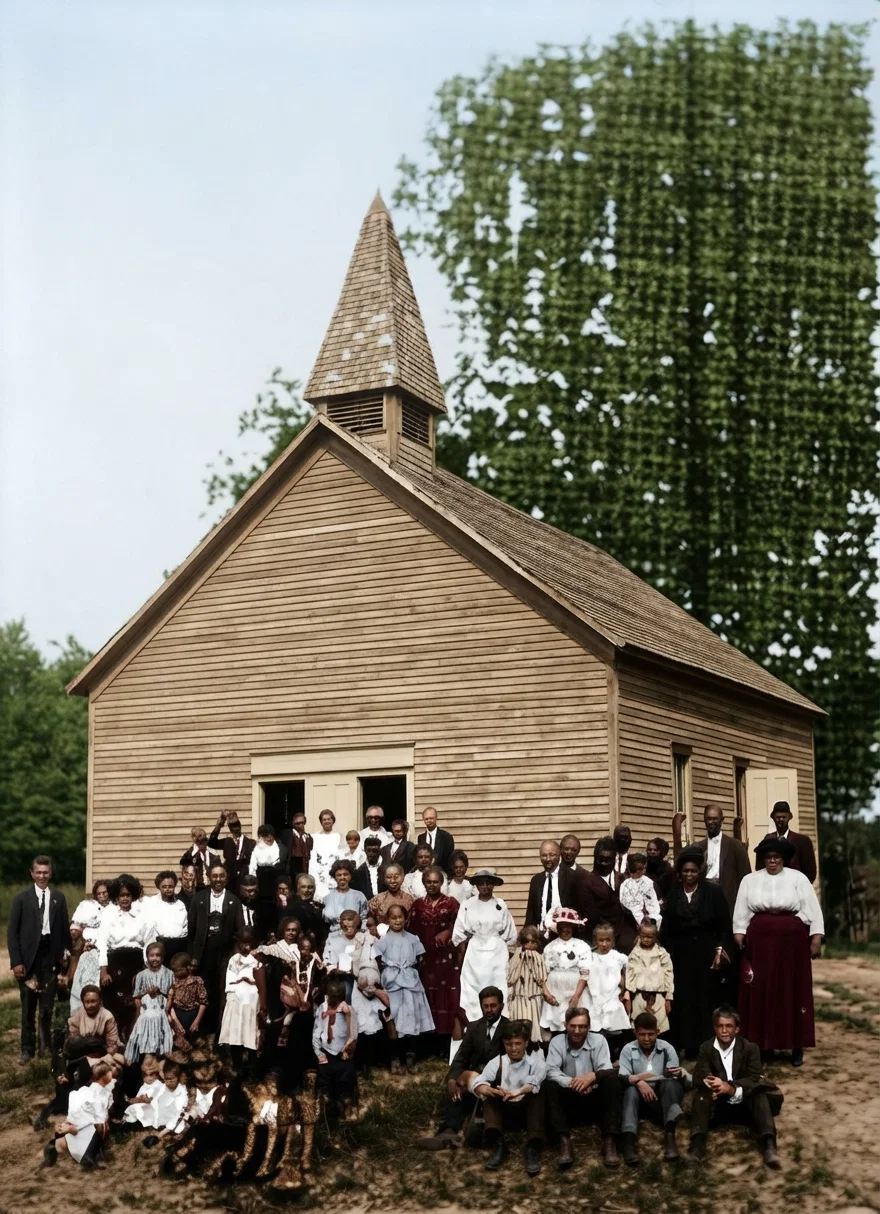
There are several denominations represented in Lucas Hollow, but there is no church building. Quite a number of the people said, “If the Adventists will help build a union meetinghouse, we will work on it free, and join that faith; for the Seventh-day Adventists preach the whole Bible.” I hope that the conference will consider this appeal.
At Rileyville I found our little Adventist church of good courage. They have bought the old schoolhouse from the county, and have a church school. To pay off the seventy-eight dollars still remaining on the building, the sisters are piecing and selling quilts. If any of our people or sanitariums need quilts, I hope they will buy of these noble sisters who are so bravely holding up the truth in these isolated regions. This would be helping in a good work. These sisters would also appreciate quilt patches — pieces of calico, worsted, or silk — to use in making other quilts. Mrs. Lula Hill is the president of the Mothers’ Aid and Missionary Society, and an order for a quilt or the gift of a package of pieces sent to her at Rileyville, Page Co., Va., will receive due attention from the society.
At present I am assisting in the tent effort at Charlottesville. During the camp meeting recently held at this place, so deep an interest was manifested by many of the residents that the big tent was left and a series of meetings planned.
Elder Stewart Kime, Elder Armstrong and wife, and Brethren Farley and Craft were given charge. The lady Bible reader selected was ill, so I was asked to take her place. This is an important city, as the University of Virginia, which is the pride of the South, is located here. “Monticello,” the old homestead of Thomas Jefferson, is near by. The people attending the meetings seem to appreciate present truth. They say they never heard the Bible explained so clearly before. No doubt a church will soon be organized here, and I am happy to have a little part in this work.
When the meetings close, I expect to go up into a mountain near by, called Ragged Mountain, where I shall open a new station among the needy mountaineers, and try to do something to better their condition, and to give them the message of a soon-coming Saviour.
I ask a share in the prayers of our people, as this is a needed work among a people that have been long neglected.
MATTIE HAMILTON WELCH. Charlottesville, Va.
Continue reading: Kentucky