FOLLOWING Jesus Christ from their nets, the apostle band had come face to face with a most terrific difficulty. The people were hungry; they had come from far; they had nothing to eat. There were only a few little hamlets scattered upon this the eastern side of the lake, which were totally unfit to supply the need of such a crowd of men.
It was a difficult problem, and Christ let them face it. He did not hurry to tell them what he was going to do. A weaker nature than his could not have endured to see the perplexity of his friends. Halfway through the morning, or the afternoon, when the sun began to sink in the west, he would have halted amid his address, called them around him, and whispered: Do not be anxious about the evening meal; I will see to it. But, instead, he brought them face to face with the almost insuperable difficulty, and said, Now, what are we to do? He even suggested an expedient, which they probably would entertain, and even had already discussed, but which he was not about to adopt. He said, How shall we buy bread?
That is always God’s method. Before he shows us what he is going to do, he brings us face to face with our own absolute incompetence. He must reduce us to nothingness; he must bring us down to the two hundred pennyworth of bread, to the five barley loaves and two small fishes, which is all we can produce. He must bring Abraham and his seed into slavery, before he can raise up Moses as deliverer. He must bring Moses to the edge of the Red Sea, with the mighty breakers at his feet and all the people murmuring behind him, before he will open the way. He must bring them into the wilderness and permit them to hunger, that he may rain down the manna, and strew the desert floor with their breakfast, morning by morning.
Jesus Christ is always bringing us face to face with almost insuperable difficulties, that we may learn to trust him more, and that he may have the opportunity of revealing himself to us, and the Father as well—for what are we but children, with our barley loaves and fishes? And if the world shall see how Christ can use our poor resources, it induces greater and more adoring conceptions of what Jesus is.
In following the Lord Jesus, when he calls you away from your ordinary association, you may be of good courage. At this very hour you may have come face to face with a most tremendous need, and Christ stands beside you looking at it, and questioning you about it. He says: How are you going to meet it? But you must not think he wants your advice. He is scrutinizing you. He has got his fingers on your pulse, and his eye upon your face. He is watching you with a gentle, tender sympathy.
You might say, Lord, why put me in this position? He answers, For the trying of your faith, which is more precious than of silver or gold, that it may emerge from the furnace cleansed of dross.
How many of us have failed in that test! We have taken out our pencil and paper, and begun to figure out the two hundred pennyworth of bread; or we have gone round with our hat, asking for a collection; or we have run off hither and thither to strong and wealthy friends to extricate us; or we have sat down in utter despondency wringing our hands; or we have murmured against him for bringing us into such a position; or we have said, with Moses, Have I begotten all this people that I should carry them as a nursing father? Ah! we have very often failed in the test; we have been proved and found wanting. We have not turned a sunny face back to Christ, and said: Thou hast a plan; it is not my business, it is thine; thine is the responsibility, and thou must tell me what to do. We do not find that Philip or Andrew answered thus. Theirs was the averted face, with the shadow of the evening upon it, instead of the bright hue of dawn.
Never mind your difficulty; do not run away from it, do not want to die, do not try to burrow under the earth, and say, I wish I could fall through the earth, to get away from it; but stand still, hand in hand with Christ, and look at it. He knows what he will do, and he will do that which is so infinitely satisfactory that you will be glad you ever came into the difficulty.
God let men sin, because he knew what he would do; he allowed the whole history of time to unfold, because he knew what he would do; he allowed the devil to tempt men, because he knew what he would do. He permits sad and trying things to come, but he has a reserve, and will show us the way out, or make the way by his outstretched hand.—Life of Faith.
Just Where We Are
By Geo. D. Gelwicks
It is somewhat difficult for us to realize that the very best place for us in life, the place where we can render the most acceptable service to our Lord, is just where we are.
We must conclude that this is true when we remember that it was not by chance that we were placed in the world. The Lord could have placed us in the very position that we would choose for ourselves if he had seen fit to do so. But “knowing our frame,” he knew where we were most needed.
Is it not a helpful thought that just here, right where we find ourselves, we can for the present best serve the Master? How it illuminates the most unattractive duties when we remember that by properly performing our humble, every-day tasks, we are serving him just as surely as is the man who is doing great and noble things for him.— Geo. D. Gelwicks, in New York Observer.
Confirmed in the Truth
By H. A. Owen
H. A. OWEN
Over in the village church the priests are waiting to confirm the children of this district. The bishop is here, and all who have not received the service are expected to go with their pennies or dollars and receive the ribbon of confirmation.
There are a number of bright girls and boys who are not to be confirmed for some time to come. Their parents have told them to wait until they have studied a “year or two” in our school, and are able to decide for themselves whether they wish to become confirmed Roman Catholics or not.
THE VILLAGE CHURCH
Precious indeed is the opportunity of teaching the gospel to these youth. The blood of souls will stain our garments if we turn away lightly from the calls that are pressing upon us to save the youth of this place.
Here is a polluted land. Children learn the ways of sin because there is no better way shown them. Must we snatch the brands from the burning, and then drop them back into the fire again? — No; we must take them apart, and shield them for a time, that the Spirit of God may do a sealing work upon their souls.
Daily we seek to confirm our pupils for the kingdom. Our school is a daily Sabbath school. More time is devoted to teaching the principles of salvation than is devoted to the common branches. In other words, the great Teacher is helping us to make the common branches full of light to these youth.
To-day the tinkling of a bell was heard at our gate. I asked the children what it meant. They answered that a procession from the church was passing, bearing an image of the virgin, and begging pennies. Then the children listened while I told them of the heathen who in olden times cut down trees, and made images out of part of the wood, and warmed themselves by burning another part; and they agreed with me that “the stock is a doctrine of vanities.”
The Lord has greatly blessed us in providing a base of operations such as we need not only for school work, but as a center for operations in this peculiar land, without railroads, wagons, or regular conveyance of any kind. We have four good mules and two yoke of oxen.
We are planting gardens and growing some of the natural health foods. Some of our brethren who are farming in North America would like to help us if they knew more about our conditions and needs here.
Alfalfa does well here, as our land is well drained, and we have water for irrigation. Alfalfa seed done up in from one to five pound packages, and sent to us by parcel post, would be greatly appreciated, and the postage would cost no more than the freight per pound if prepaid.
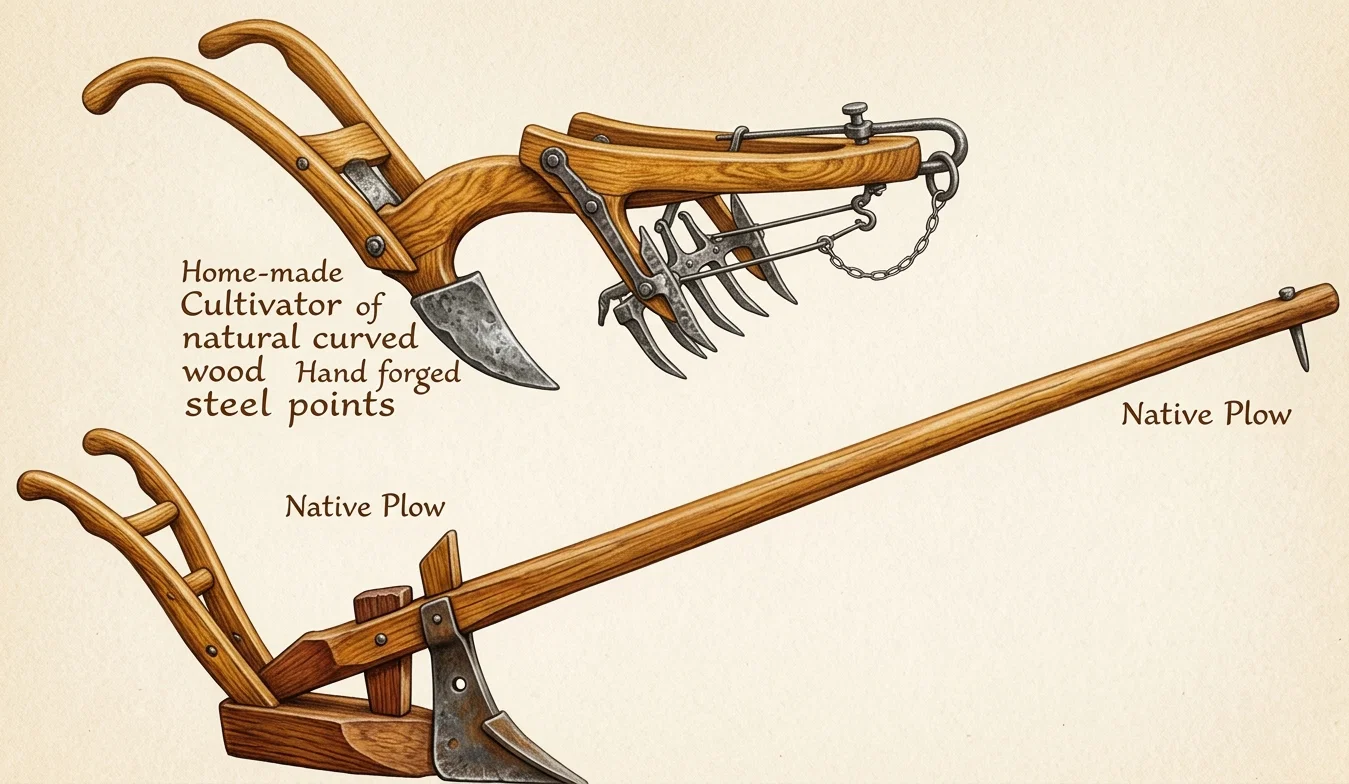
Our school farm should be a model farm — a gospel farm. We should show the people here, who plow with a crooked stick and milk their cows with the calves tied to the cows’ foreleg, better ways of doing things. Brethren, if you could see what tools we are trying to farm with, some of you — yes, many — would divide with us, that our work might be more representative.
There are those among our farmers who have known what it is to do without a grindstone, or to have only a poor one. Now as you grind your tools on your easy-turning stone this week, think of our boys rubbing an edge on their tools by long and tiresome effort. The stones they use are taken from the bed of the river at the foot of this mountain.
You see we are looking forward to the season of gift giving for some of the necessaries for this field. We would be indeed thankful for a grindstone. Others of our needs you can imagine from the sketches of our native farm outfit.
The Mission Board will take pleasure in ordering and shipping us implements as gifts come in to their office.
We trust that our hopes will be confirmed.
Tegucigalpa, Spanish Honduras.
Glimpses of India
By Mrs. D. A. Robinson
MRS. D. A. ROBINSON
At the present day, caste is regarded by other nations of the world as the characteristic feature of the Hindus. The word itself is derived from a Portuguese word, “casta,” race, and as used by Europeans denotes the different classes into which Hindu society is divided. Indian caste is different from the civil and social distinctions of other nations in this respect; it is derived by birth alone. “It cannot be transferred from one class to another; neither can it be gained as a reward for the highest merit, nor bestowed as an honorary title by the most powerful monarch.” There are many stories as to its origin, but probably the first cause was the difference of race, then difference of employment was another cause, and difference of place a third cause.
There are four main divisions: (1) the Brahman, or priest; (2) the Rajput, or warrior; (3) the Vaisya, or husbandman; (4) and the Sudra, or servant caste. These have been subdivided into almost innumerable classes, or castes. The Brahman is the highest caste, and15among these about two thousand subdivisions are enumerated, which keep nearly as much aloof from one another as if they were distinct castes. There are “a thousand and one” regulations, nearly all childish and frivolous, and some of them leading to much suffering. Suppose a Brahman wishes to dine with a man of another caste; however good friends they may be, caste says, No, you must not do that, or you will be excommunicated. If a Brahman is thirsty and has no water but what is brought by a Sudra near him, he cannot drink it. He must not drink from a glass that has been used by a European, or even take a glass of pure water from the hands of a European. During famine, people dying of hunger have refused food offered by Europeans. Should the shadow of a European fall upon the food prepared for him, it must not be eaten.
The high caste man is defiled by the low caste man, but the low caste man is not defiled by contact with any one. So the higher one ascends in the scale, the more difficult does it become to keep from being polluted. For this reason, the Brahman, who is the highest of all, must cook his own food, and draw his own water. Brahman cooks are much sought after for the army, as there are some high caste men among the soldiers. A Brahman will even turn aside and spit if a low caste man should pass him on the street. The low caste man therefore has the advantage in some respects; for him he can go carelessly about the street without fear of some one touching him, or some one's shadow falling upon him; for he cannot be polluted. High caste does not imply wealth. Indeed, a low caste man, may, if wealthy, hire a high caste man as a servant; and under foreign rulers, being of low caste does not prevent one, if otherwise qualified, from rising to high power. Some of the native princes, it is said, are of low caste. The proudest rajah will do homage, though, to the man wearing the sacred thread, or bearing other marks of belonging to the sacred order of the Brahmans; for the poorest Brahman in all India is the superior of any man not of his own caste.
It would be a hopelessly long task to go into a description of the endless castes in India, so I will speak only of some in the servant class. Among the Sudras, the subdivisions are no less numerous. “Every trade or occupation in India is in reality a caste hereditary in certain families.” Hence, in a household it is necessary to have many servants. You must not think that the man who does your marketing and cooks for you will bring water or wood for you, or care for your lamps; and as for sweeping the floor, you could not offer him a greater insult than to ask him to do such a thing. So we have a bearer who takes care of the lamps, dusts the house, washes dishes, etc. Many also have a man, called a khitmagar, who assists the cook in preparing the meals, preparing the table, waiting on the table, washing dishes, etc. But none of these would sweep the floor; this must be done by a man of the sweeper caste, which is considered the lowest class. He is supposed to be willing to do the most menial work, and no other servant will touch utensils that he touches. He is the only one of the servants who will eat any food that has been upon the table of a European.
The washing for the family is done by a man belonging to the dhobee caste, who comes to the house for the soiled clothes, and after counting the pieces in your presence, takes them away, perhaps to some tank where others do the same work, washes and dries them, then takes them to his home, and after they are ironed, returns them to you; and you may think yourself very fortunate if on looking them over, you do not find that in some way articles bearing some name not your own be found among them, though the number may be correct. He cannot understand why one handkerchief is not as good as another, nor why you should insist on having your own towels or sheets.
Then there is the mali, or gardener, who sees that the table is supplied with flowers, and gathers whatever vegetables may be wanted, if you have ground sufficient to raise them. Each morning you will receive a visit from him to get your order; for he does not like to have any one else gather what he has tended, and besides, while he is picking peas or beans for you, why should he not gather a few handfuls for himself, to be taken to his own family when he returns? Surely he will enjoy them as much as the sahib, and is he not one of the sahib’s children?
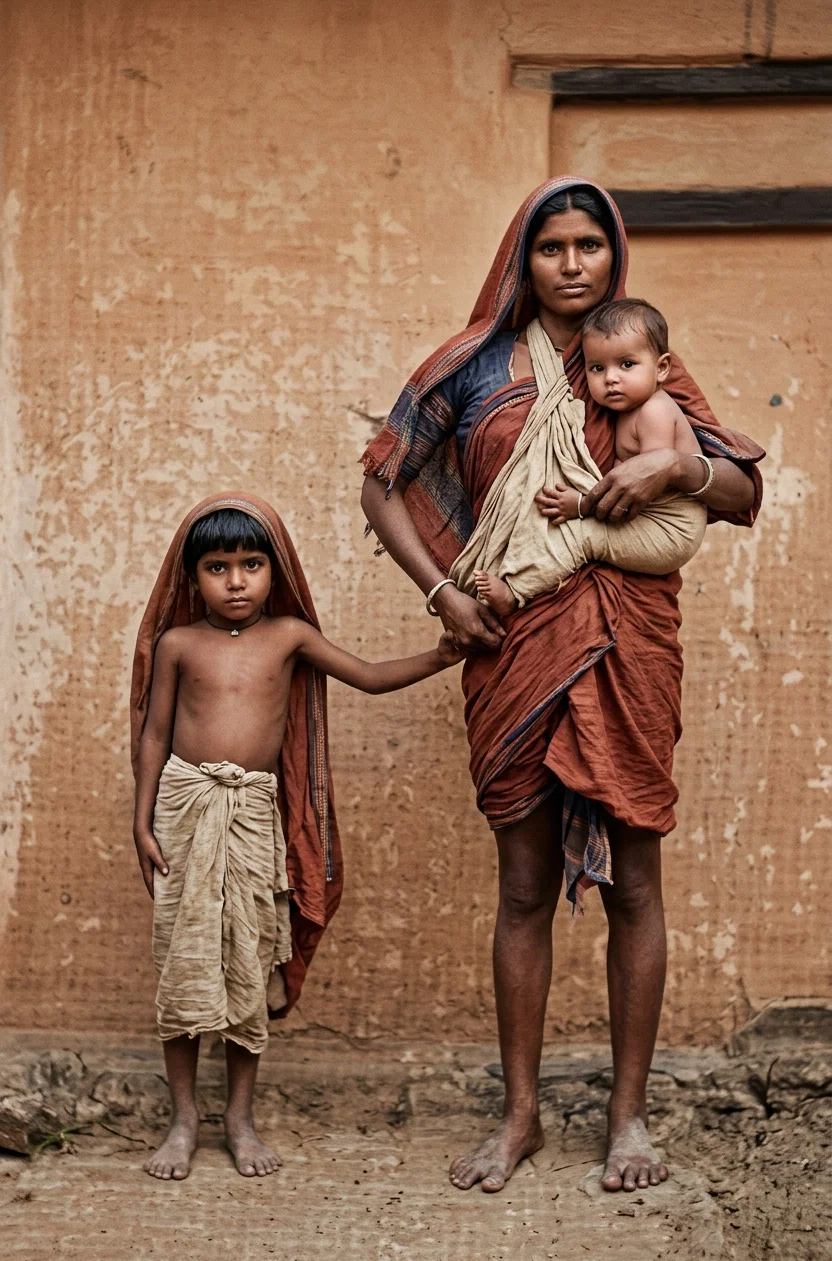
LOW. CASTE NATIVES OF RAJPUTANA
Should you wish to have sewing done, you would call in a dhurzie, or tailor, who will take your measure, give you a Butterick’s pattern book to choose a pattern from, then if you give him an old garment that fits you perfectly, he will take the work home, and in a few days bring your garment ready to wear, and rarely will it have to be altered if you have a good dhurzie. For family sewing you can hire a man by the month, to sit on the veranda and sew for you, which is a cheaper way.
People who wish to keep a horse and carriage, must have a groom, who will care for the horse, feed, harness, and drive it; but he could not cut the grass for it without breaking his caste, so a cooly is hired to go out and cut the grass, and bring it to the stable.
Many ladies have a maidservant, called an ayah, who takes care of the children, waits upon the mistress, etc. In many families where an ayah is kept, the young children speak and understand the language of the ayah before they do that of the mother.
If living in a city, a durwan, or gate keeper, is necessary, to protect you from thieves and disagreeable visitors. It is said that every durwan is a thief, who keeps away all other thieves. He is supposed not to let any one carry away things from the house, belonging to any one living there. In other words, he is responsible for the safe keeping of everything inside the gate.
A SERVANT
I have spoken only of the house servants. As I said before, every trade or occupation is a caste by itself. There are the carpenters, furniture makers, workers in brass, copper, iron, etc., weavers of mats, straw carpets, etc., dealers in grain, shopkeepers of every kind imaginable, besides the almost innumerable company that work on the land. And among all this great number of human beings, very, very few of them have ever heard of the Saviour, or that “God so loved the world, that he gave his only begotten Son, that whosoever believeth in him should not perish, but have ever lasting life.” They have not been told that “God is no respecter of persons: but in every nation he that feareth him, and worketh righteousness, is accepted with him.” What can you do to help send this good news to them?
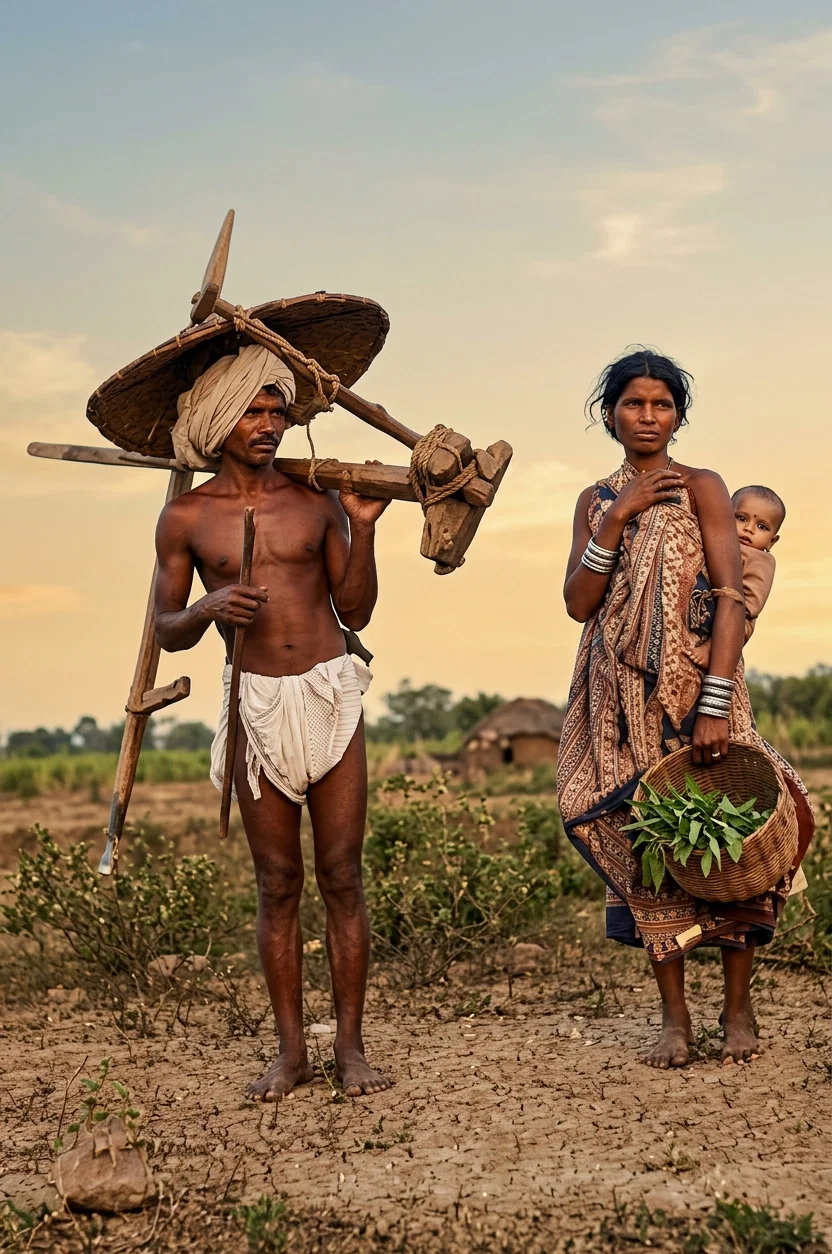
FARMERS WITH PLOW
Tennessee
By F. T. Wales
THE Lord is working for his precious cause in Memphis. He has blessed my efforts since I came here. My soul rejoices to see some noble precious souls accept all the truth of the third angel's message. Some influential and wealthy persons have nobly taken their stand for the whole truth. Others are being deeply convicted of their duty to observe the Sabbath, and to unite with God's people in these last days. I am now devoting most of my time to Bible work, from early morning until late at night. My health is excellent. I am in my seventy-third year, and I am not afflicted with a pain or an ache. Most of the past two years I have been canvassing for Good Health, but I saw such an urgent need of Bible work among the people with whom I was canvassing that I could not forbear to take my Bible, with my Saviour, and teach the people more fully of what they had been reading.17There are more excellent openings presented to me than I can possibly fill. Some of the brightest and most precious souls have been led to accept the whole truth by just giving them one small tract which called their attention to the prophecies of Daniel and Revelation. Paul said, “I have planted, Apollos watered: but God gave the increase.” So we must plant and water, but the Lord must give the increase. And I thank the Lord that he does give a rich increase when we claim his promise. It is not only our duty to believe what God has promised, but it is a great privilege to trust him always to fulfill his promise. He has said that if we will plant and water, in faith, he will give the desired increase to the seed sown.
These precious souls in Memphis who have recently accepted the truth are reaching out after their friends and relatives, to gather them also into the truth. They are doing active missionary work by distributing our literature, and also by their daily walk and pure conversation. Such exemplary lives as these are much prized among God's people.
May we who have been a long time in the truth be examples of true perfection of character. We must possess the spotless character of our dear Saviour. The truth is onward to final victory. Let us all take courage. The battle will soon be over. F. T. WALES.
The Macedonian Cry
By W. R. PATTERSON
W. R. PATTERSON
ADOWN the rolling years of time,
So swiftly passing one by one,
From many a land and distant clime,
Parched by the heat of summer sun
Or bound by fetters of ice and snow,
Is heard the plaintive, earnest cry,
(Who will heed it? who will go?)
“Come over now and help us.”
The Master bids his servants go
And gather in the sheaves of wheat;
To frigid zone of ice and snow
And tropic clime of summer heat
The message of redemption give.
Tell of the Christ, the Saviour, King
(Bid the dying “look and live”),
And to his name new trophies bring.
With outstretched hands their plaintive cries,
That echo through the dismal years,
Entreat for help, with weeping eyes;
Their voices reach our listening ears.
They groan beneath sin’s direful load;
They look for light, but look in vain;
Despair mocks hope, and fear’s the goad
And scepter of sin’s dark domain.
Go now, ye messengers of peace,
Swift as the light, ye heralds, go;
Dream not of pleasure, gain, or ease,
Work till the Master calls for you.
Bear, ye winds, the gladsome sound;
Proclaim, ye waves, the joyful story,
Till from east to west, the earth around
Shall reverberate the story.
Barbados
By W. A. Sweeney
BRIDGETOWN N.—The recent epidemic of smallpox is slowly abating, but conditions are not improving, and cannot, since the quarantine, with its consequent suffering, will continue as long as there is a case in the island. There have been fourteen hundred cases, with over one hundred deaths.
Our work is onward, despite forbidding conditions. The interest is deeper than at any previous time. Quite a number have recently begun to obey the truth. The church is not only filled, but is surrounded on Sunday night, and a large number attend our Sabbath and midweek services. Some who have recently come to a knowledge of the truth, through cottage meetings are keeping the Sabbath. There are twelve candidates for baptism at the coming quarterly meeting. W. A. SWEANEY.
India
By J. L. Shaw
CALCUTTA.—The interest is growing in Burma. A Burmese brother has recently given up his government employment to keep the Sabbath. I understand that he is an intelligent man of good address, and has a burden for his own people. He is a brother to the sister who had kept the Sabbath for some time. What a grand thing it will be to have a worker from home, filled with the Spirit, to go to Burma to help those people, and be the means of getting the work established in that field. The assurance that help is forthcoming rejoices my heart. These great cities of the East must be entered as soon as men and means can be found. The truth should be shining forth at Bombay, Colombo, and Madras. I shall say nothing about the two latter places this year if we can only get a man for Bombay, and some one to help us in the canvassing work. We need help in circulating our paper. We are praying and trusting that the Lord will send us help, so that this work shall not be diminished.
It does our hearts good to hear of the liberality of our people toward the foreign fields. I am glad that the Lord is pressing home this work upon the people. I never felt of better courage in the work. We have been sorely pressed for helpers, but the Lord knows all about it, and I am sure that our prayers and your efforts will not be in vain. The work will go as we learn how to meet the people and get the truth before them. It is hard to stir the East. But there is power in this message to do that very thing; and when it gets a foothold, it will sweep from coast to coast. J. L. SHAW.
France
By B. G. Wilkinson
PARIS.—We have just completed a compilation of statistics of the field since I came here, and find that in July, 1901, when I arrived at this place, there were 451 Sabbath keepers. The report for the last quarter gives 571. Our tithe for this year is 25,000 francs. Our school now numbers seventeen. The canvassing work is the most encouraging feature in this field. Two years ago, when a general agent and two canvassers came to Paris, they could not sell a thing; but we were delighted two or three days ago when one of our students sold four copies of the paper. They are now selling as high as twelve or thirteen a day. Yesterday my wife, with her limited knowledge of French, sold twelve copies. Our meetings open to-morrow night. We have the promise of a large attendance. B. G. WILKINSON.
J. A. LELAND
By J. A. Leland
Mexico
GUADALAJARA.—Two weeks ago we had baptism. Two persons went forward in the sacred rite, and three others are waiting to do so. Besides, there are some others who are much interested.
Last week a priest who lives near the mission sent out a printed notice that all who came to the mission or even walked on the sidewalk by the building, were by that act excommunicated. There are four different periodicals published in this city, and distributed gratuitously, warning the people, and advising them to tear and burn every Protestant paper they receive. Still there never were so many interested as now.
J. A. LELAND
England
By M. A. Altman
LEEDS.— Our work in Leeds is steadily advancing, and the prospects for a good church are very promising. There are at present between twenty-five and thirty new Sabbath keepers. Nearly half of them are working with Present Truth. We are taking a club of four hundred, and expect to increase the number again next week. Over thirty pounds has been paid in tithe by this company, besides liberal offerings. Last Friday night I baptized seven persons, and there are about six to be baptized in three weeks, when we hope to organize a church.
It is with glad hearts that we see the enthusiastic response of our people in the States to the earnest calls from other lands. I believe that it will do the home field more good than any other thing that could be done. The workers here are of good courage, and the work is prospering in all the conferences.
M. A. ALTMAN.
C. P. WHITFORD
By C. P. Whitford
Florida
A good degree of success has attended the efforts put forth in new fields during the past year. Last fall a short series of meetings was held at Orlando. A Bible worker remained, holding four meetings each week. As a result, nine persons accepted the truth. As far as I know, all remain faithful but one, and she is very unhappy.
A five weeks’ series of meetings was held at Ward last spring, which resulted in bringing into the truth about twenty persons. A Sabbath school of forty-five members was organized, and a new church building erected.
A camp meeting was held at Bartow, October 10-20. This meeting was followed by a course of lectures; and as a result, eight accepted the truth there.
November 26 a series of meetings was begun in a new church building at Wauchula, and up to date the attendance and interest are excellent. On Sunday night the house would not hold the people, and many stood outside. By invitation of the teacher of the select school, we shall hold our service to-day and Monday night in a large upper room in the school building. This gentleman is not only a school-teacher, but a Baptist minister. He will advertise the subject for our service next Monday evening—that of the Millennium.
It is too early to predict the result of this series of meetings, but we trust that some will yield to the Lord, and serve him.
C. P. WHITFORD
German Switzerland
By J. T. Boettcher
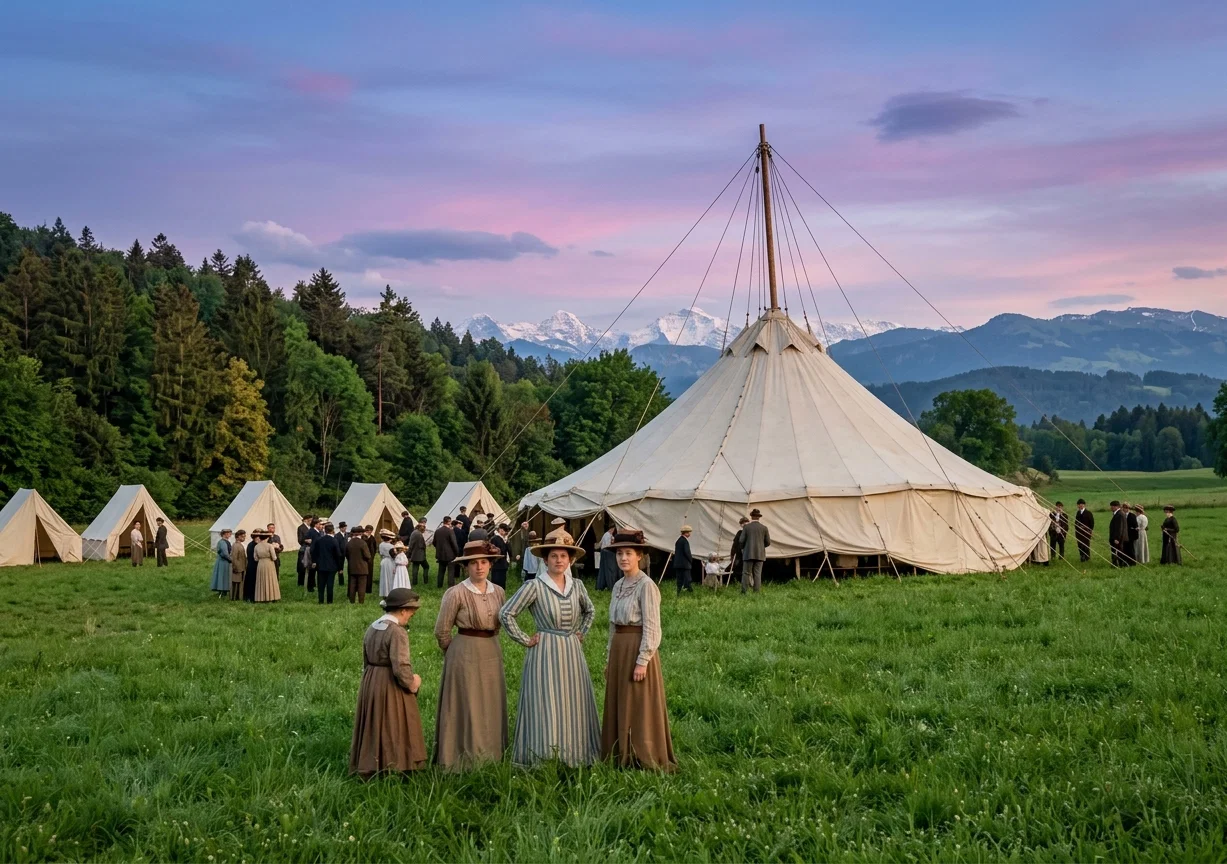
AFTER our union conference in Friedensau, I returned to my field, and found the tents pitched, and the workers on the ground ready to begin the tent meetings in Winterthur. We selected this city because the Lord opened the way for us in a marked manner. It is difficult in these European countries to get permission to hold outdoor meetings. The authorities are afraid of demonstrations, and so prohibit all they possibly can, but the Lord favored us here. The accompanying picture shows the beautiful location of the camp, just within the city limits, but away from its noise and bustle. We had our large tent pitched, and thirteen small ones for the workers and visiting brethren. On the surrounding hills were the great pine forests, and from the top of these hills can be seen the Alps, covered with snow. We felt deeply grateful to God for providing us with such a quiet spot, where, unmolested, we could teach the people the word of God, and know that they would be benefited both spiritually and physically.
Meetings were held every evening and three times on Sunday, and from the first they were well attended. The weather was often not very pleasant, and at times it rained in torrents. One afternoon our large tent was blown down, but nothing was damaged except the center pole, which was broken. The tent meetings were continued six weeks, and then, the weather being too cool, we removed to a hall in the city. October 18 fifteen persons were baptized, and the following Sabbath a church of twenty-five members was organized, twenty of these being new members, and five joining from other churches. The meetings are still continuing with a good interest, and we hope that others will accept the truth.
The enemy of souls has made it very hard for God's people in these countries. Men lose their positions in the factories, and then comes the question of how to support their families of little children. It requires a living faith in God. One young man, a soldier, who refused to serve in the army on the Sabbath, was sentenced to ten weeks' imprisonment. This is what our young men must take into account when they will serve God in this country. Yet they trust in him who doeth all things well. The trial of this young man before the military court was published in a great many papers all through Switzerland, and thus the truth was proclaimed by its enemies.
During the past year about eighty members have been added to this conference, and we hope by New Year's, with the help of the Lord, to have the number raised to one hundred.
Elder J. Erzenberger has labored in the canton of Bern with good success. In the city of Bern, a church of twenty-two has been organized, and the prospects are that others will unite with them.
THE TENT MEETING IN GERMAN SWITZERLAND
It is hard to secure halls in our large cities, and some of them are not fit to hold meetings in. We always have to take halls that are connected with saloons, therefore Elder Erzenberger has not been able to hold public meetings in Bern. We are obliged to rent our hall here in Winterthur from a saloon keeper, and the owner of the house sued him for allowing us to hold meetings in the hall, claiming that it would injure the business. The case came before the court, but the house owner lost the suit, and had to pay the cost. It was all over before we knew anything about it. In this hall there is a dance held every Sunday afternoon, so as soon as our meeting is over, Satan and his host take possession. This seems hard, but there is no other way that we know of; therefore we think that the summer will be the best season for us to work, as we can then use our tents.
Brother David Voth is conducting meetings in Herrisau, and reports a good interest.
Our general meeting will be held in the city of Zürich, December 24-28. Here we have a church of about seventy members.
We are thankful that God is drawing souls to him with his good Spirit. May the prayers of God's people unite with us for the success of the cause in this field.