If you will keep the faith, the faith will keep you.
SUPERSTITION points us to the past and to the dead; faith points us to the future and to the living.
You cannot win people from the world to Christ by lowering the standard of Christian living. The standard must be exalted; the Saviour must be “lifted up.”
LOOKING toward the Christian’s country, the view is the same in all countries. Hence the Christian can feel as much at home in one part of the earth as in another.
THE proof that you are a free man does not consist in the fact that you reside in a “free country.” It is not geographical boundaries, but the truth, that makes men free.
Do not try to “beat down” the price of admission into the New Jerusalem. Heaven will be infinitely cheap at the highest price you can pay, and you will only deceive yourself if you think to make any compromise with God.
It is surprising how small an amount of Scripture will suffice to convince a person of something he wants to believe, and what a large amount is required to convince him of a plain truth which he does not relish.
FROM God’s standpoint, there are but two great classes of people in the world, which are, not the rich and the poor, nor the respectable and the non-respectable, nor any others recognized in worldly society; but the righteous, or those who believe on the Lord Jesus Christ, and the wicked, or those who believe not on Him.
An old monk is credited with the pertinent observation touching the Bible, that “whoso seeketh an interpretation from this book shall get an answer from God; whoso bringeth an interpretation to it shall get an answer from the devil.”
“THE noblest weapon is the sword, and the noblest uniform is the uniform of the Prussian soldier,” Emperor William is quoted as saying on the occasion of his second son’s entrance upon military duties at Potsdam. “The finest thing I can imagine,” he continued, “is the earnest soldier, inflexible as iron in everything which constitutes the chivalry of an officer; hard toward himself, upholding with rigid self-discipline the traditions of his house and regiment; indifferent to the opinion of others, and with one goal before his eyes—responsible only to his God and his father.”
While men talk about a coming millennium of peace, it is a fact that war is glorified much more than peace by earthly rulers.
For a long time lovers of peace and prosperity have been hoping that the time would come when workingmen and employers, realizing the folly of conflicts that have so repeatedly brought distress and the paralysis of industry upon large sections of the country, would find some way to obviate strikes, boycotts, and lockouts, and establish peaceful relations between themselves. But how long will that time be in coming, when workingmen will strike for such frivolous reasons as that they cannot have lemonade served to them by their employers, instead of cold water? Here is the instance:—
“PITTSBURG, PA., July 23 [Special]: Because the George A. Fuller Company would not permit them to drink lemonade, instead of common ice water, fifty carpenters and others employed on the new two-million-dollar twenty-two story H. C. Frick office building struck work to-day. The company furnished filtered water, in which oatmeal was placed. The meal prevents cramps in the stomach. The men wanted lemonade, and formed a pool to get it. Each was to ‘chip in’ ten cents a week. Yesterday was the first day lemonade was served. The men all wanted to get their money’s worth, and drank so much that Superintendent Clark thought they would make themselves ill. He shut off their drinks, and a strike resulted. Work was stopped to-day; and as this is a ‘rush’ contract, the odd strike is costing the company considerable money.”
The following comment, made by Superintendent Clark, is to the point:—
“This strike is about the limit. Lemonade is injurious, and will knock a man out quicker than anything else. About an hour and a half after they quit, some of them came to me and said that they would go to work if I paid them for the hour and a half they loafed. What do you think of that?
“If I had given in, I might as well have a caterer at the building, and have ice cream, ices, and lady fingers served at regular intervals.”
THE Catholic Mirror informs us that the “relic of St. Anne” (consisting of a piece of bone claimed to have come from one of the arms of the mother of the Virgin Mary) is to be placed in “a four-thousand-dollar crypt, which will be the only one of its kind in America.” This “relic” has for a long time been kept in a church in New York City, to which, whenever the relic was exposed to public view, thousands of Catholics resorted in order to be healed of various bodily afflictions. As a source of revenue for the Church the relic has been a decided success.
“Over the relic altar,” says the Mirror, “will be a statue of St. Anne. A large collection of crutches, spectacles, bandages, splints, and other articles discarded by the afflicted who have been healed will be placed in the new sanctuary.”
These discarded implements, testifying to the great cures wrought by the relic, prove (?) that saint worship is a part of the Christian religion, just as the like tokens in Dowie’s Chicago tabernacle prove that Dowie, who denounces saint worship and the Catholic Church in general, is a disciple of Christ.
The Christian religion does not feed people on relics, but on the fresh bread of life, which is the Word of God. True faith does not point people to the dead, but to the living, even to Him who now “liveth to make intercession for us.” Time does not affect the realities of Christianity; they never cease to be. By faith the divine Healer is discerned as a living, present Saviour, touching and healing the sick just as in the days of old. Faith has nothing to do with looking backward; it points us in another direction. It points us to the “author and finisher of faith,” to whom we are ever to look as we run the race that is set before us. No one will succeed who tries to run that race with his face turned back to the past.
WHAT IS BEING ACCOMPLISHED.
By S. H. Lane
The readers of the Review are aware of the fact that, through the kindness of Mrs. E. G. White, the book “Christ’s Object Lessons” has been donated for the liquidation of the debts on our educational institutions. The work of printing three hundred thousand copies was to be given by the Review and Herald and the Pacific Press Publishing Associations. These associations have together so far printed one hundred thousand copies. Our brethren and sisters have taken hold well to sell these books. In order that they might come almost entirely free to the schools, a fund of nearly thirty thousand dollars has already been raised, which has paid thus far for the material used in the books, and there is money on hand to print others. It is the desire of the Relief Committee to raise at least twenty-five thousand dollars more, so that these books can be sold everywhere, and the proceeds be given to our schools and colleges.
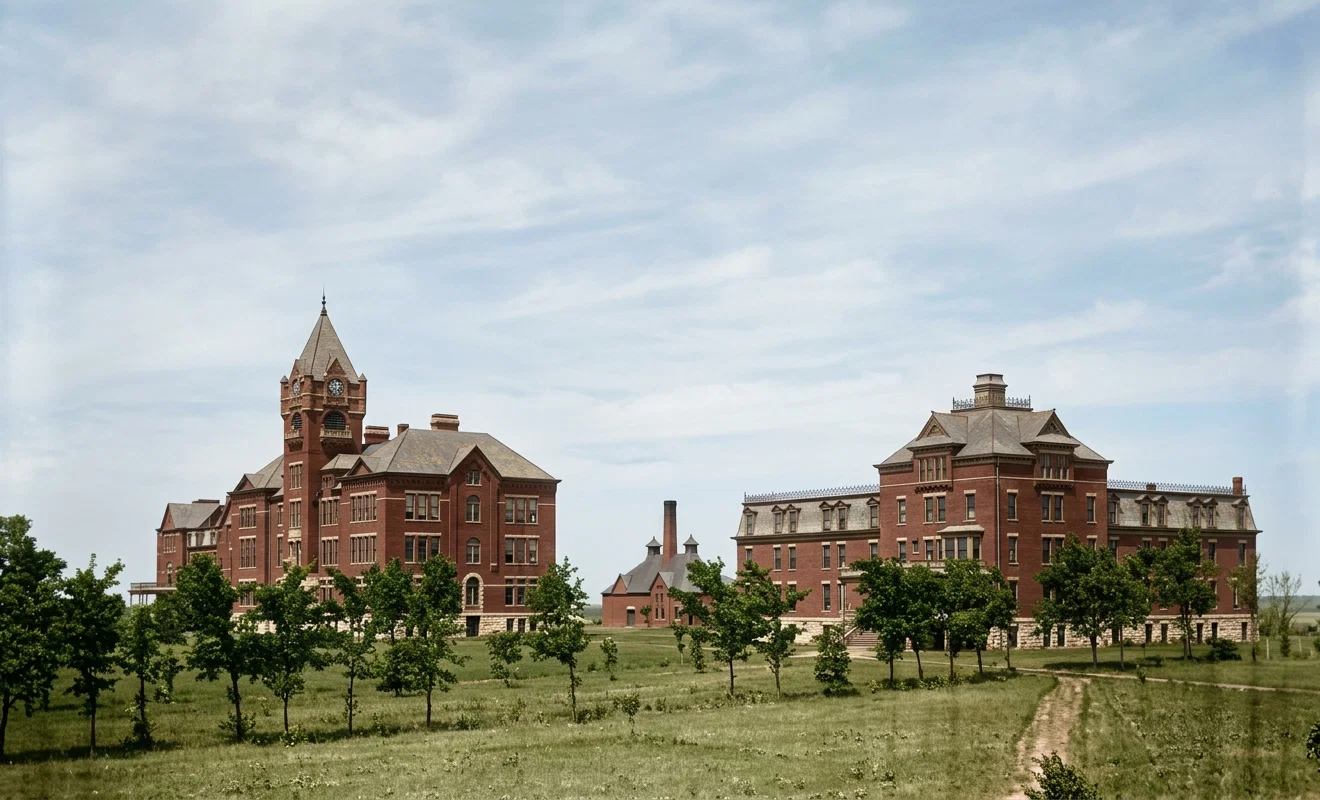
We herewith give a picture of Union College, the largest of our educational institutions. The illustration represents Union College standing at the left, the ladies’ dormitory to the right. These buildings face the west, the power house and bakery appearing between the buildings, in the rear of the college. The gentlemen’s dormitory stands to the left of the college, but is not shown in the illustration. It is occupied at the present time partly by the gentlemen who attend the college, and partly by the sanitarium, which stands still farther to the left of the college building. The college is well equipped, and its attendance runs from two hundred to four hundred each year. It is the central school for Manitoba, and the States of Minnesota, Iowa, North and South Dakota, Nebraska, Colorado, Kansas, and Missouri.
Connected with the college is a productive farm, which is in a high state of cultivation, worked principally by the students. The college has been self-supporting from the first, possibly with the exception of one or two years, in which the crops were cut short in the country surrounding it. The college and its dormitories, when completed, were in debt over eighty thousand dollars. Had all the plans been successfully carried out, the college would not have been in debt. When first planned and erected, a large piece of land was purchased and donated to it by friends. Part of this land was sold at good prices, and had the purchasers been able to pay the price, there would have been no debt, at least only a small one, but the panic of 1893–96 depreciated the value of real estate. Times became hard, and the money market so stringent that many of those who purchased land were not able to pay for it, and in many instances the college very kindly took the land back. Some paid for parcels at a sacrifice, losing heavily; yet they do not regard it as loss, from the fact that the money went into the institution, which is a noble one, and has done a good work in the education of the young who have attended it.
Before the sale of “Christ’s Object Lessons” the great debt had been reduced two or three thousand dollars, but the reduction was very slow.
When “Christ’s Object Lessons” was placed upon the market, the friends of the institution in the district took hold nobly in the sale of the book. Through its sale Manitoba has sent to Union College, for the reduction of its debt, $100, Missouri $300, the Dakotas $593.85, Minnesota $865.37, Colorado $2,000, Kansas $3,000, Nebraska $4,000, and Iowa $6,000, making a total of $16,859.22. As this matter has been introduced in the district, some have felt moved upon to give personal donations to the college, and some have surrendered notes which they held against it. This they have done of their own free will, so that from this source the college has received $1,129.30. Last year Kansas was prospered with fine crops, and through the liberality of the brethren in that good State, they were enabled to pay $694.59 on an old pledge which had been made to the college. Thus through the sale of “Christ’s Object Lessons,” personal donations, and the payment of a pledge on the part of Kansas, the college has received and applied on its debt $18,683.11, reducing her once large debt of over $80,000 to $60,417.
UNION COLLEGE (College View, Neb.)
We feel sure that our brethren will read in regard to this reduction with delight, and we give these figures not only as an item of interest, but to encourage every one in that district to take hold anew at the present time, and prosecute the work of selling “Christ’s Object Lessons” more rapidly during the soon-coming fall and winter than ever before. The book has been on the market only about eight months. The rush of the season will soon be over, and will not our brethren and sisters everywhere in that district, as well as in every other one, press this work as never before?
Iowa has been the banner State in selling “Christ’s Object Lessons.” The officers of the Conference realized the importance of the work, and saw that the opportune time for the reduction of the debt of Union College had come. All have done wonderfully well, yet only a beginning has been made, but it should be a brilliant index to all our brethren in these Conferences and elsewhere, pointing to what may be accomplished in the future. And if every one in that district will take hold for the year to come, and work as some have in the past, Union College may be free from debt before the first day of January, 1903. The Lord has blessed the work of the institution, and will bless it more abundantly as teachers and pupils approach nearer and nearer to the true standard of Christian education.
We trust that all in the district will not only see the necessity of selling “Christ’s Object Lessons,” but will also realize the importance of sending the children to school. A few months’ schooling in one of our excellent institutions may give bent to the life of a child which will influence him through time and eternity. Although our institutions and their teachings are improving, and will yet be what we think God desires them to be, we trust none will depend simply upon an education given by or through an institution, but remember that a humble heart and consecrated life can do more than an education without consecration; but if the two can be combined, the work will be a grand success, and the life and achievements of the soul thus prepared through the grace of God and a Christian education can be measured only in eternity. Shall not all Seventh-day Adventists throughout the country take hold now and work for the liquidation of the debt of every institution that is in debt? May God grant it. S. H. Lane.
NEW YORK CITY WORK.
By E. E. Franke
INASMUCH as I have left New York City for a time to labor in the city of Trenton, it is but right that I should report what has been done there. A little over four years ago there was no Seventh-day Adventist church in New York City, and only a few Sabbath-keepers, mostly connected with the office of the Pacific Press Pub. Co., who attended meeting in the city of Brooklyn. There are now three churches—two quite large ones, and one small one. During this time I have labored almost entirely alone in that large city, with the exception of one year when I labored in Brooklyn, and last summer, which I spent in Chicago. Besides more than fifty who accepted the truth in Brooklyn, more than two hundred and forty have come into the truth as a direct result of the work in New York City. Some have joined other churches throughout the Conference, and over two hundred of these have become active, working and paying members of the New York churches.
A few facts will help us to see what has been done there. I will compare the work in New York with the work in this entire eastern district, that we may the easier understand the situation. This eastern district known as the Eastern Union Conference, is composed of eighteen States and provinces, or ten Conferences and two mission fields, employing in all one hundred and sixty-two laborers. The district superintendent reported at the last General Conference an increase of eight hundred and forty members in the entire district during the two years. See General Conference Bulletin, page 51. One fifth of this number are the result of the work in New York, with only the writer and a tent-master employed in the same time, besides the fact that one entire summer of that time was spent in Chicago. Thus it is a fact that one fifth of all who came into the truth in these ten Conferences in two years are the result of one and a half years'508work in New York City. In the last tent effort held in that city over one hundred accepted the truth. Thirteen of these had been Roman Catholics. This we say to the praise and glory of God, who gave these results.
During my stay in New York I held meetings in two of the largest and most popular halls, “Chickering” and “Carnegie,” paying fifty and twenty-five dollars each night for rent, and raising the money from those not of our faith. It is needless to say more, these facts speak for themselves.
Three churches, with a total membership of over two hundred and twenty-five, paying almost three thousand dollars each year in tithes, besides liberal donations running up into the hundreds of dollars, is a standing monument to the glory of God in this large city, and the facts are more eloquent than anything that can possibly be said.
When I left New York City to open the work in Trenton, N. J., all was peace and harmony in the churches, and there are more people interested through our Carnegie hall work on 57th Street than we have ever known before in New York. Hundreds of names and addresses of those interested ones are in my possession, and I am receiving interesting and inquiring communications from many, both in and out of the city. Many of these should be added to the church this summer. The harvest in New York truly is ripe, as we were told in the General Conference Bulletin.
At a recent meeting of the churches in New York they donated about three hundred dollars toward my tent work in Trenton, N. J. Let us praise God for what He has done in New York, and look forward to still greater results.
E. E. FRANKE.
Items from the Regions Beyond.
By A. J. B.
The Pacific Union Conference has taken the Hawaiian Island Mission field as a part of its work. This Conference has also added Alaska as another mission field.
Other Union Conferences are reaching out to help in the fields just beyond their borders. The Northwestern Union Conference desires to aid in the great Northwest of Canada, and the Southwestern Union Conference takes a special interest in the Mexican field.
Since the General Conference, workers have been going to Europe, Asia, Africa, South America, and the islands. The message begets the spirit of devotion in the hearts of those who receive it in distant lands. Many instances might be reported, but here is one paragraph from a letter which Brother Ellery Robinson writes from India, which may serve as an illustration: —
“Brother Watson, our new Sabbath-keeper, called yesterday, and paid me five hundred and ninety-four rupees (about two hundred dollars) tithe, which was one tenth of all the property he owns, as near as he could estimate it. He had already paid me a tithe on his last month’s wages, the last month that he worked, for he lost his position in the firm in which he worked, owing to his refusal to work on the Sabbath.”
Another brother, who received the truth in the Himalaya Mountains of Upper India, and who has long been paying a tithe monthly, has had some property turned over to him, on which he pays about two hundred dollars tithe.
After a tent-meeting at Grove Town, on the south side of the island of Jamaica, twenty were baptized. Ten of these had been keeping the Sabbath before the meetings. At the time of writing, ten more were awaiting baptism, making in all a company of thirty. They were already planning to build a church. This means much more in Jamaica than in the States, where all the material is prepared to one’s hands. There the stone for the foundation and walls must be carried through the bush on the heads of those who are willing to help. The lime must be burned. The sills and all the framework must be felled with an ax, hewed with an adz, and then carried out of the woods and mountains to the road, where it can be conveyed to the place of building. The shingles must be split and dressed by hand, and the boards sawed out of the logs with a large handsaw. Added to this is the still greater difficulty of securing means to pay the few dollars that are required for the work. The wages of laborers scarcely reach twenty-four cents a day, and money is scarce. Notwithstanding this, the company was of good courage, and had already gathered most of the material for their building.
From India the encouraging message comes that a lady who was formerly an independent missionary has accepted the truth. She is a consecrated woman, and as a governess for European and native families, has opportunity to carry the message where she probably could not carry it were she a regular laborer in the employ of our mission.
Two families at Mussoorie, a mountain resort in the northwest province of India, are living the truth. They meet on Sabbath for Bible study.
In Jerusalem, Palestine, the treatment-rooms are doing much to acquaint the people with the health principles, thus creating an interest. Although there has been an attempt to stop their work, the Pasha of Jerusalem has permitted it to continue. Their patients number from six to sixteen daily.
One of the students in the school at Honolulu, Hawaii, was baptized a few weeks ago, notwithstanding the strong opposition of his father.509
A Sabbath-school of more than twenty children has been organized in Mexico, as a result of the day-school. Many of the little ones are members of families that would not have permitted their children to attend services where the Bible was taught, before our day-school was conducted there.
In Basutoland, South Africa, meetings are being conducted on Sabbath and Sunday, with eighteen or twenty regular attendants. On Sunday often as many as one hundred are present. At the time of the report, several had visited the mission, men who desired Bible instruction on points of present truth. A young man who had been a teacher in a primary school, gave up his work, that he might become a laborer in the closing message.
A note has been received from the son of a South African village chief who, having heard of our work, desires to be instructed on the Sabbath question. Besides the regular meetings at the mission in Basutoland, services are held once a week at Mafeteng. The average attendance last reported was ten.
The field in our Central American Mission, South, is everywhere ripe for the harvest. At Bocas del Toro six were baptized, as the result of the canvassing work. Several became interested through the baptismal service, and one, a tailor, after a few readings, accepted the truth.
At Port Limon, Costa Rica, nine are keeping the Sabbath, six of whom were the harvest of the canvassing work. One woman who heard of our workers just as they had reached the city where she resided, was invited to attend the meetings, and before our laborers left, she was baptized.
At Principaulca six persons were, according to latest reports, awaiting baptism. All of these had learned of the truth through the printed page.
Four have accepted the truth at Wakamatsu, Japan. Another is paying tithe, but does not yet see his way clear to accept the Sabbath.
Eight or ten good, substantial persons have recently accepted the truth in the country a short distance from Bridgetown, Barbadoes.
One native woman has accepted the truth in Paraguay.
A company of Sabbath-keeping Indians in British Guiana will soon be organized into a church.
A brother, the local elder of two churches, who was a Bible student, became interested through Bible readings, and began to keep the Sabbath, at Tocopilla, Chile. He took his stand on the side of truth when almost all his friends were bitterly opposed to it.
A young lady from Lahore, India, writes that she and her mother have recently begun to observe the Sabbath, and desire to do something to lead others to know the joy they find in this truth. She has already disposed of a number of small publications, and secured several subscriptions for the Oriental Watchman.
Brother A. LaRue, our faithful brother in Hongkong, China, sends over forty dollars tithe from Sabbath-keepers with whom he has labored in that far-away field.
From Natal, South Africa, Brother Hyatt writes that the Lord has been especially blessing in forgiving sin and in healing disease. There are now over thirty adult Sabbath-keepers there, and a school of almost fifty.
At Durban, South Africa, a brother, who was a prisoner of war on parole, has been canvassing and otherwise laboring, and seven Sabbath-keepers were found there, one family who had kept but three or four Sabbaths. About twenty-five adults began to keep the Sabbath, in the same place, as the result of the labor of a Bible worker, and the Sabbath-school numbers forty.
As a result of the tent-meetings held in a booth at Sherwood Forest, Jamaica, twenty-three are keeping the Sabbath. They are preparing to build a chapel.
These progress items are gleaned from news received from all parts of the harvest field, by the Secretary of our Mission Board located at Battle Creek. These are items such as we would be pleased to receive from all our laborers, both in the United States and abroad. We wish to supplement our appeal on the last page of the Review of July 9, 1901, by again asking our ministers, licentiates, Bible workers, canvassers, teachers,—any and every worker in the missionary field,—as and us brief, newsy reports, telling, in a few words, what has actually been accomplished in the work. It will take the co-operation of every worker in the field to make our Progress of the Cause department of the Review what it should be—a digest of Seventh-day Adventist news the world over. A. J. B.
THE EDUCATIONAL CONFERENCE AND EDUCATIONAL REFORM.
By P. T. Magan
Just ten years ago this summer, when the precious light of righteousness by faith was breaking in the fullness of the glory of God upon the Seventh-day Adventist people, and when God, through this, was taking away the reproach which the world had hurled against us, that we were “a Christless church,” there was held at Harbor Springs, in the northern part of Michigan, the first general gathering of Seventh-day Adventist teachers for the purpose of studying Christian education:
At that time the words “Christian education” were unknown, but the germ, the seed of the blessed thing itself, was all there. And the thought was developed that, hand in hand with righteousness by faith, there must also be education by faith. The meeting was a remarkable one, and the definite beginnings of the work of an educational reformatory movement owe their birth to this gathering. In those days the subjects of reform which were for the most part studied and discussed were the elimination of pagan and infidel authors from our schools, the dropping out of long courses in the Latin and Greek classics, and the substitution of the teaching of the Bible and the teaching of history from the standpoint of the prophecies.
Sister White was present, and I remember well that she read Testimonies relative to our schools and their work which she had written at the time of the conception of our first college. Elder A. T. Jones, Prof. W. W. Prescott, and Elder E. J. Waggoner were among the leading instructors. This gathering closed with a song of triumph, and in the hearts of many has ever since been inscribed on the walls of the chamber of joy in the temple of their souls.
In our first love of this new light, and in the joy begotten by the brightness of its radiance, we fondly thought that the work of educational reform would be gladly grasped by our educators, our ministers, our students, and our people everywhere. Since then ten long years have rolled away, and during the whole of them the precious principles of Christian education have been struggling for recognition and the occupancy of their rightful place in the hearts of ministers, teachers, and people, as well as in the organic system of this great work.
To-day we are met together again for the second general gathering of this kind. The educators and ministers are met in the beautiful woods at Berrien Springs, Mich., where, alone and in the quiet, the lessons of the Great Teacher on teaching can be received in just such a temple as He loved to teach in in the days when He walked on earth. His platform was on the hillside, His shade the leafy bowers of the giant trees, and the music of the rivers and streams and the soft singing and whisperings of the winds mingled with His voice as He taught, and with the voices of His disciples as they received His gracious instruction.
And God still calls for educational reform. When in time of battle a squadron of cavalry is scattered by the missiles of the enemy, when the chargers have broken out of their lines, and are galloping aimlessly in every direction, then the bugle sounds, “REFORM!” This simply means to form again, to come together again in solid order, so that a charge can be made on the foe. This is what God means when He calls upon us to reform. We are to get together again and array ourselves solidly in gospel lines, and charge forward beneath the blood-stained banner of Prince Immanuel. God has promised that if we do this, by giving power and miracles He will restore to us the wasted years.
The meeting really opened on the morning of Thursday, the 11th, Professor Sutherland giving a Bible study of God’s promise concerning the salvation of our children. This was followed by a study concerning the support of our church schools. Thus far the church schools have been supported by the tuitions paid for the children by their parents, and by voluntary contributions. Where there was harmony and good feeling in a church, it was comparatively easy to get up a church school. But in the very churches where a church school is needed the most, it has been impossible, on account of this financial system, to have church schools at all.
The psalmist says: “Children are an heritage of the Lord; and the fruit of the womb is His reward.” The thought was developed in this that the children of Sabbath-keeping parents God looks upon as His heritage. He looks upon them, in a certain sense, as the property of the Church, to be trained for the work of God and for the work of the Church in the earth. When Seventh-day Adventists realize the fullness of the meaning of this precious scripture, there will be no question but what our church schools should be liberally and systematically supported.
A committee was appointed to take into consideration the matter of the substantial and systematic support of church schools, the idea being presented that the second tithe might be used for this purpose.
On Friday morning, July 12, Sister M. B. DeGraw read a paper, “The Scope of the Work of Primary and Intermediate Church Schools.” After this Elder Daniells spoke at length on the dearth of missionaries, and the great need of training our children from the very beginning of their lives to be workers in the cause of God. He showed that we must not only have church schools and intermediate schools, but that there must be a school where the finishing work for missionaries could be done, and from which they can go forth into the fields of labor all over the world.
Friday evening Elder W. A. Spicer, the Secretary of the Foreign Mission Board, gave a most touching and helpful sermon on the necessity of the love of God. A tender spirit more than before began to come among the people of the camp.
At the forenoon service on Sabbath, Elder A. T. Jones spoke at length on the priesthood and the ordination of priests in the olden time, showing how this people as well as Israel are a chosen generation, a royal priesthood, an holy nation, and a peculiar people. The Spirit of God rested down upon those present, and many arose and asked for prayers for their fathers and mothers, brothers and sisters, and children. There was indeed a turning of heart toward heart, and soul toward soul. The service lasted until dinner-time; and at half-past three the work was taken up again. This was the beginning of a wonderful meeting. It lasted all the afternoon, continued during the lengthening shadows of the evening, and until long after the lamps of heaven had been hung out, and night was upon us. Elder Jones spoke feelingly and at length on the necessity of every priest having somewhat to offer. He was followed by Elder Daniells, and then the meeting became general, a large number speaking of their past experiences in regard to the educational work and the glory of the precious light which God is now casting upon us. The meeting was a long one, and one long to be remembered.
Ministers and teachers are still arriving, and altogether there are in the neighborhood of one hundred and fifty on the grounds.
P. T. MAGAN,
Sec. Educational Dept. Gen. Conf.
KIMBERLEY, SOUTH AFRICA.
By J. V. Willson; Mrs. J. V. Willson
The work connected with the Diamond Fields Benevolent Home has been prosperous since the siege. We have labored under peculiar difficulties, owing to the country being in a state of war, and everything under martial law, prices high, and supplies hard to get.
The home was under serious financial difficulties, which threatened at one time to close it up, but the South African Conference assumed the liabilities, and that relieved us.
The walls to our bath-rooms, being made of brick only sun dried, became softened by heavy rains, and began to fall; so we had to rebuild with liberal donations, and sustained us in the enterprise. The wealthy and influential class of people in the city are becoming interested in our work as never before.
Sister Amelia Webster is here, and is having good success in selling health literature, holding Bible readings, and visiting and treating the sick.
Kimberley is already beginning to experience a tide of prosperity, and we are getting our bath-rooms ready to take advantage of the circumstances. We rejoice in having a part in gathering in the harvest of souls, and hope our work here will now be established on a solid basis. J. V. WILLSON,
June 23, 1901.
MRS. J. V. WILLSON.
DENMARK ANNUAL CONFERENCE.
By L. R. Conradi; O. A. Olsen
After our good meeting in Orebro, Sweden, we attended the Conference in Odense, Denmark, June 27 to July 7. We were favored with most excellent weather; and from the beginning, the conditions and surroundings were all that could be desired. As the result of a series of meetings that had been conducted by Brother Raft, a number had recently accepted the truth in Odense, and there was considerable interest.
Denmark, in common with the two other countries of the Scandinavian Conference, has been passing through a trying experience the past two years, on account of the financial crisis that overtook the Christiania publishing house; then, too, it has been burdened with the perplexities connected with the Skodsborg Sanitarium. But the Lord did not leave His people in discouragement in the midst of it all; for these trials have led to self-examination, humility of heart, and a more earnest seeking of the Lord: and these will always bring good results.
One year ago, Elder P. A. Hansen, of Iowa, was elected to the presidency of the Denmark Conference. He was not then present, and he did not arrive in Denmark until December. He found a large amount of work and many perplexing questions awaiting him, but he has taken hold in good earnest, and in the fear of God, and the Lord has blessed him in a signal manner. The condition of the Conference has improved during the year.
As the Spirit of the Lord was present at the meeting, all the business of the delegates passed off harmoniously, and all hearts were filled with joy and renewed courage and confidence in the message. The various departments of the work were freely talked over and considered, and the brethren and sisters received a better understanding of the general condition and needs of the cause than at any previous time. This led them to sense their own responsibility more fully.
We were glad to note the prosperity attending the health work. The Skodsborg Sanitarium has had a favorable year. The Lord has greatly blessed them, and the influence of the institution is extending rapidly. At present all their rooms are full of patients. This condition of things was a source of much encouragement to our brethren and sisters at the Conference.
Friday afternoon, July 5, the whole congregation repaired to the river, some distance from the city, to attend the ordinance of baptism, Brethren Clausen and Raft baptizing twenty-three candidates. The day was a most perfect one, warm and delightful. Hundreds of people assembled to witness the ceremony, and everybody showed the greatest respect and deference. This was a rare occasion to the inhabitants of Odense. Representatives of a number of city papers were there, and gave excellent reports of the baptism; and some of the prominent citizens, desiring to learn more of us and of our work, inquired where the meetings were being conducted. Elder Raft will continue to labor in Odense, and we see no reason why a large church should not be established in that city.
The officers chosen for the coming year are as follows: President, P. A. Hansen; Secretary and Treasurer of the Conference and Secretary of the Sabbath-school and Tract Society departments, Jens Olsen; the remaining members of the Conference Committee are J. C. Raft, P. Hansen, John P. Hansen.
In each of the Scandinavian meetings we have been pleased to see the same spirit that characterized the late General Conference, and we believe that God is truly visiting His people.