Your ShelfYour Projects

Review and Herald, Vol. 93, No. 22.

If I Should Die Tonight
Earlier text: Early Experiences of the Advent Believers, as They Entered upon the Time of the Saints’ Patience

Personal Labor in St. Clement's Camp, Malta
W. C. ISING
[As most REVIEW readers will probably remember, Brother Ising, being a German, and laboring in Egypt, was made a prisoner soon after the war broke out, and placed with many others in the detention camp at Malta.]
It was thirteen months, January 1, since I arrived in this detention camp. The following are some condensed notes on my work during this long period:—
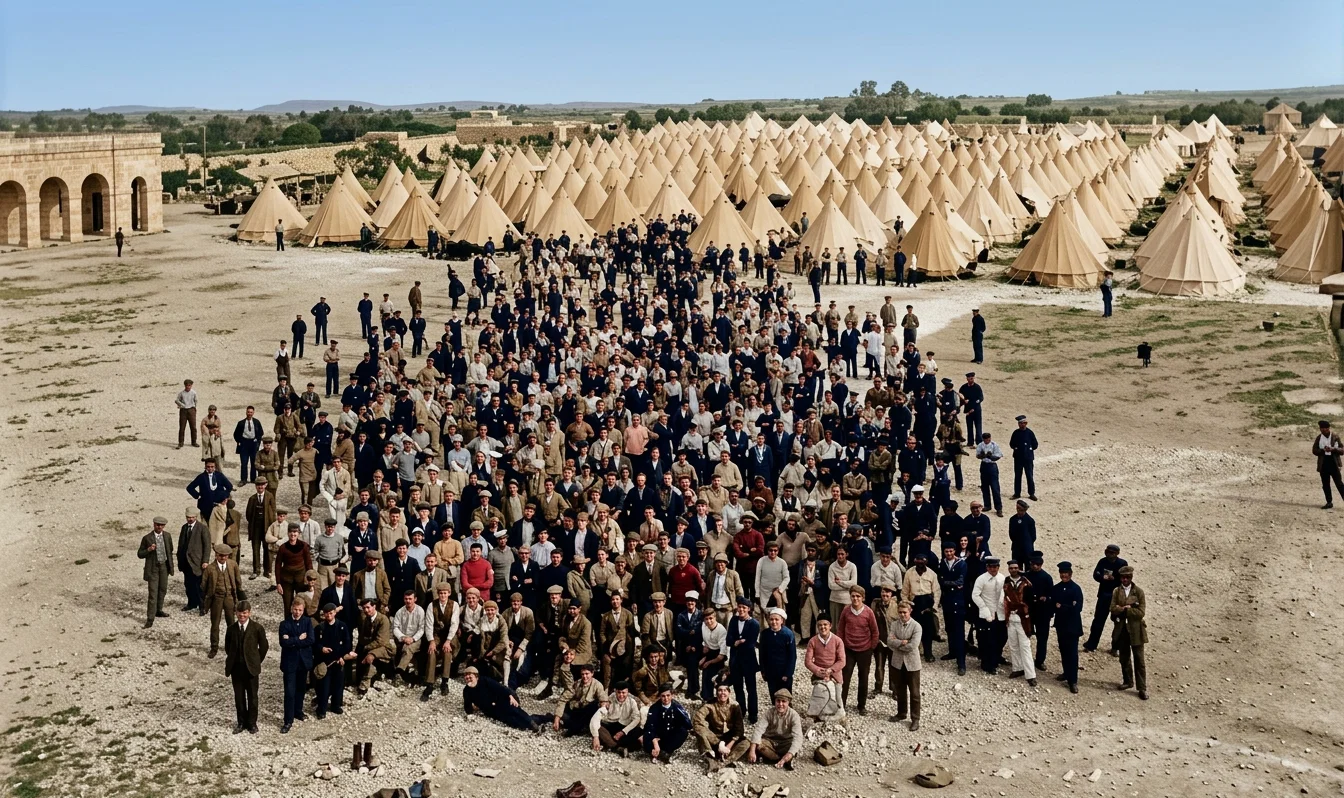
Our camp contains some eight hundred and fifty persons, a motley company from the standpoint of nationality and language, as well as regards trades and occupations. While German is the principal language spoken, there are about ten others used, the predominant ones being Italian, French, Arabic, Turkish, Hungarian, and English. This diversity of speech hinders social intercourse, and is an impediment to evangelistic effort. The great majority, having lived many years in the Orient, have assimilated its peculiar customs and characteristics, much to their spiritual detriment; and the seamen, who are well represented, believe it to be their duty, in view of their socialistic aspirations, to stand aloof from everything that in any way savors of religion. Nevertheless, through the personal touch, many have been found with whom spiritual topics can be discussed with mutual profit. Some of these have attended faithfully the weekly divine services, which it is my privilege to conduct alternately with a missionary friend.
Early last year I distributed 300 German Gospels, and also some whole Testaments which were sent for that purpose by some kind Christian friend. Soon afterward I began a little Bible class with a few persons, in which we studied the books of Daniel and the Revelation, and also some topics of present truth.
VIEW OF ST. CLEMENT'S CAMP, MALTA, EGYPT
MINIATURE SHIPS MADE BY PRISONERS IN ST. CLEMENT'S CAMP, MALTA, EGYPT
A young sailor, well-educated, one morning dropped into my tent to inquire if I could tell him where he could buy the German book, “The Coming King,” a part of which he had read, with much interest, on the bark “Bertha,” in 1914, while homeward bound from Pisagua. The book was so highly prized by his Norwegian captain that he only reluctantly allowed the young man to read it, lest it become soiled. In Hamburg, he searched for it unsuccessfully in a number of bookstores, and now, having read some copies of the Christlicher Hausfreund, Harold der Wahrheit, and Die Zeichen der Zeit, which I had left with a friend of his, he felt directed to me to learn the proper address. He secured the book, paying for it with the last fifteen shillings he had. The result of our studies was that he soon felt the need of being reconciled with his parents, with whom he had broken off all correspondence after a quarrel some years ago, which had driven him to sea. A reconciliation, and a monthly remittance from them, is the happy sequel to his new spiritual experience.
It has been quite surprising to come across a number of persons who have been in close contact with our cause in widely separated places. My neighbor at table had lived for some time in our old Jerusalem institution; another was a good friend of the new institution, where I often met him. One had attended my tent meetings at Haifa, and another had attended Brother E. E. Frauchiger's meetings at Constantinople. One gentleman remembered visiting, in company with his grandfather, at Weiherweg, Basel; and another with his sister had visited our More Light Societies in Austria; while still another aged gentleman has a cousin in our Chicago church, who wrote me on his behalf. Finally, I was pleased to meet, after twelve years, a schoolmate from our Friedensau School.
For the last two months I have been gathering a group of six semiweekly for a Bible class, and our evening studies in my tent are among the pleasantest hours spent here, when our thoughts are directed heavenward, beyond the things perishable to those of abiding, eternal moment.
Although statistically my evangelistic activity may be reduced to these dry figures,—20 sermons, 171 Bible studies, 68 other gatherings, and 679 visits,—I am confident that in the course of time it will please God to cause some lasting good to spring from these modest efforts, and that his promise as given in Isa. 55: 8-11 will again be proved true.
Besides this work, I have endeavored to make the best use of my time for personal study. Early in April I completed the last ten exercises of New Testament Greek II, but unfortunately nine, with about ninety pages of manuscript, were lost en route. I have been reviewing Arabic, and have practiced for some time with an Egyptian teacher, whom I in turn assisted in the compilation of a small dictionary and a textbook for the study of German in his school. I also touched up my use of German stenography, reading such literature, and at the same time working through a course in English shorthand. In addition I have read extensively German and English literature, forty volumes, including the books of the Ministerial Reading Course for 1914 and 1915, the former of which I had missed because of my travels in Mesopotamia. The other books were standard works by such authors as Haeckel, Milton, Drummond, Reynolds; General Bernhardi's “Germany and the Next War,” Rohrbach's “Bismarck u. War,” Lord Avebury's “The Pleasures of Life,” Walter Bloem's works on the Franco-Prussian War of 1870-71; also Professor Price's “Fundamentals of Geology,” and “Modern Science and Modern Christianity.”
Some work of a different character has been done in connection with the Relief Committees, of which I have been a member seven months, and recently as chairman of a newly formed committee of five. In the new year I have also started to give English lessons daily to some promising and aspiring young seamen, who are preparing for a higher career. For a change in this routine, I have joined the gymnasium and a male choir. Information on the political issues is supplied in Reuter's telegrams and some papers, and I am a careful reader of the London Daily Times.
It will be seen from these notes that I do not suffer as so many do who find it difficult to fill their time with anything more productive than the discussion of the problematic future. I consider it fortunate to have escaped being elected president of the camp committee a month ago, when the other candidate received the majority of votes, to the satisfaction of the Socialists, who, as they amusingly said, would always prefer a Jew to a parson (Pfaffen), a moralist, for they had no desire to be prayed into heaven.
The general condition in the camp is steadily improving. We enjoy a fair amount of liberty and freedom of action in the camp, which is conspicuous on special occasions, such as festivals and seasons of sporting. August 18 was a notable day in this respect, being the birthday of Emperor Francis Joseph. Besides outdoor tournaments and parading of our young recruits, the main feature of the day was the opening of an exhibition of the most varied artistic productions of the camp, which, considering the rude implements and materials often employed, called forth the praise and admiration of all. His Excellency, the governor of Malta, honored this occasion with a visit. On the occasion of the kaiser's birthday, January 27, there will be a similar celebration, permission for which has been already kindly granted by the authorities. The proceeds from these flow into the camp relief fund.
Jan. 8, 1916.

Why I Love God's Book

MATILDA ERICKSON
I AM learning to love the Bible because it has never failed to meet the needs of my own personal experience; and as I learn what it has done for others, I am persuaded that it meets all the needs of every human heart.
In heathen lands or in civilized countries, in prisons or in palaces, in times of famine or in days of feasting, in poverty or in prosperity, that precious Book speaks to the human heart. When enjoying the comforts of peace or when suffering the calamities of war; while absorbed in the things of this world or while meditating on the glories of the next; when thrilling with exuberant health or when languishing on beds of sickness; when rejoicing over the cradle or when weeping over the casket; when all doubt, perplexity, and fear struggle for possession, or when pleasure, wealth, and popularity lead to forgetfulness; yes, under all circumstances, as many have testified, the Book of books has a message for the human heart—just the message that it needs.
And I love the Bible reverently because it is true. Monuments and history, friends and foes, are telling in their own way that the inspired Word is “true and righteous altogether.” The perfect harmony that prevails throughout the many books of the Bible, written by men of very different type, testifies to its truthfulness. Gladstone said of the Bible, “The historical development of our religion is one of the most wonderful parts of human history, and in my opinion affords one of the strongest demonstrations of its [the Bible's] truth.”
And I love the Bible because it shows me the way of salvation. From Genesis to Revelation its pages, in symbol and in fact, tell the story of the victorious life, and demonstrates how to live it. Its teachings are so simple that the ignorant may understand, and yet so deep that the most learned pore over its pages in adoration and wonder. Daniel Webster said, “I have read the Bible through many times. It is the book of all others for lawyers as well as divines, and I pity the man who cannot find in it a rich supply of thought and rule for conduct.”
Goethe testifies, “It is a belief in the Bible, the fruit of deep meditation, that has served me as a guide of my moral and literary life.” Woodrow Wilson, speaking of the Bible, said, “Here is the way of life. . . . Walk ye in it, and it will lead you to the city of light.”
I love the Bible because it inspires me with courage and determination to press on. The men and women on its pages are so human; they did not always succeed; sometimes they, too, failed. The Bible record shows me how patiently and sympathetically God dealt with his erring children, and reminds me that “he knoweth our frame; he remembereth that we are dust.” It is so comforting to know that the Father understands me, and I know he does; for the pages of his Book mirror my own heart and meet its hidden needs. Why should I not love the Book that tells of God's wonderful love, of his constant care, and of his unquenchable desire to save me?
But I think I love the Bible most of all because it makes Jesus more real to me than any earthly friend. He is always near. He always has time to visit. There is nothing I cannot talk over with him, and he always understands, sympathizes, and gives the counsel needed. You and I may have him walk so close beside us that he can hear our thoughts and feel our heartaches. He is the one Friend we can always keep. He is the one Friend we cannot spare; for truly, as he has said, “Without Me ye can do nothing.” He is the one Friend through whom you and I can do all things we should do to be true Christians, and the Bible is the book that will bring him into our lives and make him the closest and most real of all Friends.
Do you love the Bible? If you do not, there is only one explanation. You do not know the Book. You have not been drinking deeply enough of its living waters to wash the dust of common things out of your throat. Drink deeply, and you will long for it as the “hart panteth after the water brooks.” Drink deeply, and you will seek it as the desert traveler seeks the cooling spring. Drink deeply, and you will find it the panacea for all human needs.

Comfort in the Book

SAE weary was I wi' my burden o' care, With failures sae mony, wi' sorrows sae sair, No strength in my heart to attempt ony mair; And I sat doon in tears in a heavy despair.
But, oh, as I wept for the Shepherd's ain crook, I reached up my hand and got hold o' the Book.
“My wee ones,” I read, through my tear-blinded look, And sic comfort my heart in this utterance took,— “He shall carry the lambs in his bosom.”
And I read o' the sheep that went wanderin' away, And the Shepherd left a' for the one gone astray, And he toiled over rocks wi' bruised feet night and day, Till he found the puir lamb, and it quivering lay, To be carried safe home in his bosom.
It's meself! It's meself! It's nane ither than me! I'm one o' his little ones, weak as I'm wee; And I'm bleatin' for him, and he's comin' to see The puir lamb wha has strayed, and he's sayin' sae free, How he'll carry me up in his bosom.
Oh, up in the breast o' the Shepherd! his breast Is athrob wi' sic love! It's a weary bird's nest; It's mair than a mither's compassion, sae blest; It's a place where a puir weary lammie may rest And be carried along in his bosom.
— Fannie Bolton.

The Echo of Loving Words

“TAKE time to speak a loving word Where loving words are seldom heard; And it will linger in thy mind, And gather others of its kind, Till loving words will echo where Erstwhile the heart was poor and 'bare; And somewhere on thy heavenward track Their music will come echoing back.”

Share Your Joy, But Not Your Grief

“You cannot share your joy too much, nor your grief too little.”

Home Life Department

Conducted by Mrs. I. H. Evans, Takoma Park, Washington D. C.
Assisted by Miss Lora E. Clement
Through the columns of this department, hints will be given on all matters pertaining to the home life. Short articles and letters are solicited from home makers, telling of their everyday experiences,—their joys and sorrows, their failures and successes.

Getting Children to Love the Book

Merely telling a Bible story does not necessarily do a child any good at all. It may be told so as to give him no truth. It may convey an unsuitable truth; it may teach an untruth; or it may convey to him a truth suited to his needs, and so become a vital help to his life. Here are some instances of the various results of telling Bible stories to children:—
AN UNTRUTH.—A tiny hunchback boy with a nasal, treble voice sat on a pile of boards in the big new church next to his home. A primary teacher who was there on some errands in regard to finishing the rooms, sat down to rest and talk with the boy. “No,” he said, “I never went to Sunday school ’cause I can’t walk far, but I am coming to this Sunday school the first day ’cause it’s near. But I know lots of Bible stories. Grandma, who takes care of me, tells ’em. Once there was a boy, and he slept in the church, and he was just a little boy. God spoke to him one night, and he was scared and didn’t answer. Then God spoke again, and the little boy was scared, and didn’t answer. Then God spoke again, and the boy answered, and God said, ‘It’s a good thing you answered me this time, or I would have done something awful to you and this whole house.’”
The teacher listened attentively, and said, “Do you know any more Bible stories?”
“Oh, yes, ’bout when God was mad at Moses, and made him go up a mountain and die. And I know another, ’bout when God was mad at the Egyptians, and drowned ’em ’cause they tried to walk in a wide path he had made through the Red Sea.”
So this shrinking, frightened soul rambled on like a little heathen, telling of a powerful, vindictive god like an ogre, whose main attribute was wrath. The Bible stories had told him nothing of a loving heavenly Father, who is a friend to little children.
NO TRUTH.—A sturdy, round-faced seven-year-old came and sat down to join this story-telling group of two. Yes, he knew Bible stories, too. His Sunday-school teacher had told him a great many. “Once there was a boy named Davis, and he took care of sheep. All around the hills were lions and bears. The bears were worser than the lions, and the lions were the meanest kind. One day Davis saw a lion with a lamb in his mouth, and Davis came along and jerked the lamb out of the lion’s mouth. And he took that lion and flung him down.”
His voice trailed off with the satisfied tone of having finished a good story.
“Well, what then?” asked the primary teacher.
“That’s all,” answered the boy.
David the shepherd and the beautiful shepherd psalm were strangers to him. He had got no truth. He only knew “Davis,” who could fight a lion like a modern animal trainer in the circus.
UNSUITABLE TRUTH.—Harry is five years old, and goes to a small Sunday school in the neighborhood. The children of varying ages all listen to one story told by a woman who knows her Bible, but does not know the nature and needs of children.
Harry’s mother said to a caller one Wednesday afternoon, “What do you suppose Harry could have heard at Sunday school to have frightened him? For three nights he has wakened from his sleep trembling and sobbing, and each time he has said, ‘Mamma, mamma, I don’t want to die, I don’t want to die.’”
The visitor, who was deeply interested in children’s problems, took the trouble to find out what story had been told the class that Sunday. The little children under six had heard all the harrowing details of the beheading of John the Baptist and the carrying of his head on a tray into the banquet hall.
The story of a great hero who gave his life for his Master would have stirred the admiration in boys of the teen age, but only frightened a little five-year-old. The truth the story conveys was unsuited to the needs of a little child.
SUITABLE TRUTH.—A little girl was walking across a vacant lot where many flowers were bending in the wind. She picked a golden yellow poppy, and held it at arm’s length while the sun made it look like silk. “This is Jesus’ little poppy. He sent the bright spring sun to make the flowers grow. I love him. Don’t you?”
Those were the happy, loving thoughts of Jesus which the bright spring day brought to this child who had been given the truths and the stories suited to her needs by a wise teacher.
To tell a good story requires knowledge of the needs of the child, knowledge of the story material, and then one definite aim in telling the story. One who will master the simple fundamental principles of story-telling will be more than repaid for her trouble.—Mrs. T. H. Hageman, in the Sunday School Times.

Different Ways

MARTHA E. WARNER
“Now for a good visit,” said May to auntie, who was playing with little Mildred. As she finished speaking, a neighbor was ushered in, who, after being seated, held out her arms to the child, saying, “Come here, my honey, and let me love you.”
As soon as the child was in her arms, she said, “What beautiful eyes Mildred has. She will break somebody’s heart with them some day.”
“A year from now it will not do to tell Mildred she has beautiful eyes,” said auntie.
“Nonsense,” the caller answered, “when my girl was three years old, I began to tell her how pretty she was, and how beautiful her eyes were. She has always heard it, and now when others tell her she is pretty, she knows it, and it does not turn her head.”
In another home auntie was visiting with the mother, when a little boy, who had just returned from a trip with his father, marched up to them, and said, “Look at my eyes, please.” The mother looked long and steadily into his eyes, and said, “Why, they seem all right, dear.”
Stamping his little foot, he said, “Look again! Every one, ’cept you, tells me I have pretty eyes. One lady said I had the beautifulest eyes of any boy in the whole world. Now I want you to look at my beautiful eyes!”
Auntie was much surprised to hear the mother say, “Son, will you fetch the hand glass and the box of buttons to mother?” The child obeyed promptly. The mother took a button, and held it near the child’s eye, saying, “Look in the glass, son, and tell me whether that is the color of your eye.” At a glance he saw that it was not, and so they tried many buttons of different colors. Finally a blue one was found, which was almost a perfect match. “We have it now, mother!” the child exclaimed. “Yes,” answered the mother, “I think we have. That button was a dark blue, but repeated washings have faded it until the color matches your eyes. I always liked that button, but I never thought it was beautiful. You put it in your pocket; then you can see at any time the color of your eyes.”
The child put the button in his pocket. He was very quiet the rest of the day. At different times he was seen with the glass, looking first at his eyes, then at the button. At bedtime he said, “Say, mamma, eyes like a faded button are not so very beautiful, after all. I guess God made our eyes different colors so we wouldn’t look alike. I’m going to thank him ’cause he gives me my eyes, and I don’t care what color they are.”
“Remember, my son,” the mother answered, “if you would have beautiful eyes, you must keep your heart pure.”
Only once after that did the mother ever hear the child refer to his eyes. At a reception a woman said to him, “Do you know what beautiful eyes you have? I wish I had such pretty eyes. “My eyes,” the child answered, “are the color of this,” and he held the button in his hand; “and if you want pretty eyes, you must think pure things in your heart. My mamma says so.”

Wide-Awake Newspaper Work in South America

A MOST encouraging account of the way in which the first session of the newly organized South American Division Conference was advertised through the newspapers of La Plata, Argentina, where the session was held, has recently been received from Elder R. T. Baer, president of the Argentine Conference. He says:—
“I must tell you about our press bureau work during the conference. We had taken the matter up weeks before the meeting, and worked up quite an interest. We had a committee of our ministers who attended to this work, but we had the speakers write out their sermons pretty well, and then the committee would get them in shape for the editors. We held forty evening services covering some of the strong features of our faith, and forty reports of our sermons appeared in the daily newspapers of La Plata.
“One of the leading dailies, La Argentina, became very friendly toward us, and gave us liberal space. I have forty copies of this paper containing our reports, more than half of them being a column and a half in length. Pictures of the delegates also appeared.
“When our people called at the newspaper office to get copies to take home, the men in charge said that they were not able to keep many of the papers on hand since the reports of our meetings appeared in print, as the demand had increased beyond their expectation. This interest was not simply on the part of our people, but interested persons from all over the city asked for the papers containing our reports. I think this is wonderful, when one thinks of this being Catholic South America, and yet our doctrines appeared day after day. After the conference had closed, the editors said that they had enjoyed the association of our brethren, and hoped that they would send reports after they arrived home.
“I have a complete set of the papers containing reports, which will be kept on file in the Argentine Conference for reference, and to show what has been done in this line. The workers went home with the determination to write for the press, and thus help to spread the great truths for this time.
“In addition to this publicity, Protestant missionaries sent shorthand reporters to our meetings to get what they could. We did not understand it at first. We thought that the Catholics were sending these reporters, for we had heard of some opposition springing up against us; but we learned that the young men who reported the sermons were interested. Only a few days ago while I was speaking in another part of the city, these reporters were there taking down what was being said. The Lord alone knows what this publicity will bring forth.”
La Plata, where the conference was held, is a city of about 123,000 inhabitants, and Elder Baer describes it as being as up to date as any city of its size in the United States.
Surely, the Lord is going before his servants in opening avenues for a wider proclamation of his message for this hour. This ringing testimonial on what can be accomplished through the newspapers of Spanish Argentina, whose editors, no doubt, are saturated with Catholicism, ought to encourage our workers in the homeland to put forth renewed efforts to give the message through the agency that reaches more people than any other medium we have at our command to spread the light of the gospel.
Now that the tent season is soon to begin in North America, those who expect to engage in such efforts ought to make it a very important part of their program to plan to give the newspapers daily extracts of their sermons, and also let the people know that the meetings are to be held, by submitting news announcements of the program which will be followed during such evangelistic campaigns. Those who are to work in the cities ought to use the advertising columns of the newspapers to arouse the people to become interested in hearing the message, and incidentally encourage the editors to give liberally of their space for the publication of extracts of sermons.
WALTER L. BURGAN.

The Family Altar

THE true home must have God as its center and foundation. What we need today for the betterment of our family life is not primarily better laws to regulate marriage and divorce, not better industrial conditions, though all these are earnestly to be prayed for, not better housing of our people and the making possible for them of a greater privacy, not more permanency in the rooftree, not more history of family, but the greater enthronement of God by the fireside. The home without God in it, and worship in it, in which Christ’s Spirit is not welcome, is more empty and hollow than the most desolate deserted house that is open to the winter winds.—J. T. Stocking, in “The Dearest Spot on Earth.”

Alberta, Canada

CALGARY.—Mrs. Hansen and I have labored here for the past few months, and find it a very interesting place in which to work. Calgary feels the effects of the war more than most of the country. Much of the regular business is suspended, and men are urged to take up arms. Every day the very flower of the young men may be seen marching in large companies, in the streets, preparing for the ordeal across the sea.
It is surprising how willing these men are to give their very lives for the country, and their great sacrifices in earthly goods is surely an example for many who are engaged in the warfare against Satan and his host.
Our work has made some progress, for which we are thankful. Last Sunday we baptized seven adults, and there are others who are preparing for baptism.
We have found the people anxious to read our books, and we have placed quite a number of volumes in the homes of interested ones. The city newspapers have also shown their willingness to aid our cause by publishing the sermons delivered Sunday evenings.
We feel that a great work needs to be done for Calgary, and it should be done as soon as possible. We also are greatly in need of a church building, which we trust may soon be provided. We ask an interest in the prayers of God's people for the work in this important commercial center of western Canada.
C. A. HANSEN.

A Square Deal for the Boy

I WOULD not make a household drudge of a boy, but I would have him feel that he has certain duties to perform, and that these are expected of him. But in establishing this rule, one must grant him the same privileges that one grants a girl.
One of such privileges is open house for his friends. The girl's chums run in freely, they take meals, spend the night, and are almost as daughters of the house. Why may not such conditions exist with the boy?
For instance, let Jack bring his chum home from school. Let him entertain him in his room, if it is large enough. If not, put the living-room at his disposal.
Yes, I mean this. You would let Mary bring her dearest friend into the living-room; the pair would sit there hour after hour. Then why not show the same indulgence to Jack?
“But boys are so careless!” do you exclaim?
If Jack is careless, it may be because you have not taught him to be careful—have not developed his sense of responsibility as part owner of the house. Have you consulted him as to what color he thinks would be pretty for the chair you are buying for your parlor? He may say “bright blue;” yet, if so, it is easy for you to suggest tactfully that blue would not harmonize with the furniture you already possess. But do make him realize that he is consulted. Ask his opinion as to where the new rug would look best; get him to lend you a hand in arranging the books in the new bookcase; take his taste and wishes into consideration as much as you take into consideration his sister’s ideas. He may not always be correct in his judgments, but neither is the girl. Both have to be guided and trained to like the best in art and literature; but surely the boy has as good a right to be deferred to as the girl has.—Virginia T. Van de Water, in the Mother’s Magazine.

Church Dedication in Burlington, N. J.

A LITTLE more than a quarter of a century ago Elder D. E. Lindsey held a series of meetings in Burlington, N. J., and a small company of believers was raised up, and later organized into a Seventh-day Adventist church. Some time afterward another effort was held, which resulted in increasing the membership of the church. Last summer, following the annual camp meeting, Elder A. R. Sandborn, though carrying the burdens of a growing conference, held a strong tent effort, and twenty-two persons were baptized and added to the church. Further additions have since been made, until the membership is now upwards of sixty.
CHURCH BUILDING AT BURLINGTON, N. J.
The need of a comfortable and permanent place of worship, such as would properly represent the message, was felt, and the church took hold of this matter in an energetic way, determined if possible to erect a church. Capt. B. W. Lear generously gave a valuable lot in a good part of the town, and his wife donated a bell. All the other members of the church manifested the spirit of sacrifice, and gave according to their ability. Some funds were also collected from the citizens of the place. Most of the work on the building was contributed by members of the church. As a result of this earnest spirit, a neat and attractive church, well lighted, and seated with pews, has been erected, and is estimated to be worth about five thousand dollars. While some debt is on the building, it is arranged in such a way that the church can handle it.
The rear of the church is separated from the auditorium by sliding doors, and in this way arrangement is made for a church school.
The dedicatory services were held Sunday afternoon, April 23. Elder H. M. J. Richards, president of the Eastern Pennsylvania Conference, Elder A. R. Sandborn, president of the New Jersey Conference, and some other conference laborers took part in the services. The sermon was preached by the writer.
The Lord blessed in the Sabbath services, and the members of the church were much encouraged by seeing three baptized and added to their number.
The Lord is blessing the work in the New Jersey Conference. There is a steady growth in membership, and the tithe, offerings, and other funds are increasing. G. B. THOMPSON.

The Southwestern Union Conference

THE Southwestern Union Conference held its eighth biennial session in Oklahoma City, Okla., April 6-13. The workers and delegates were so prompt in attendance that the meeting began one day earlier than scheduled, thus enabling it to close a day sooner than originally planned.
The committee on arrangements provided excellent accommodations. This added materially to the good cheer on the part of all.
Many a meeting has been spoiled by niggardly preparations, delegates and visitors feeling a revulsion against the conditions. In this case every delegate was provided with a warm room, and it was said repeatedly that there was not a dissatisfied person in attendance. This made it possible to start in with a good spirit, and from the beginning, unity and cooperation prevailed.
The reports from the different presidents and departmental secretaries showed growth and progress in every line of work. The past two years 1,020 persons were baptized, and the tithe and offerings to missions showed a marked increase. During this period the book sales passed all previous records. The past four years the Southwestern Union Conference sold $250,000 worth of books, besides other literature. The church school work showed strong growth, and the Missionary Volunteer department had greatly increased in membership and in the amount of work done.
Elder G. F. Watson has faithfully served the union conference as president for six years. He felt that it would be well to call another man to take the work, and J. W. Christian was elected president for the ensuing term. Elder Watson will remain in the union for some time, attending general meetings.
Elders G. B. Thompson, C. B. Stephenson, and R. A. Underwood, and Prof. F. Griggs attended the meeting part of the time, each contributing to the interest and helpfulness of the services.
Many thought this conference was the best ever held in the Southwest. I am sure the results will prove a real blessing if the workers carry out their good resolves. It was unanimously agreed to pay off the indebtedness of the union, and raise the full quota of mission funds.
There is real promise of rapid growth in membership and greatly increased strength along financial lines in this union during the next four years. Courage, hope, and faith characterized the meeting, and we believe that God will so bless the Southwestern Union Conference that it will soon rank among our stronger conferences. To this end we shall ever pray. I. H. EVANS.
Continue reading: Pittsburgh (Pa.) Meeting