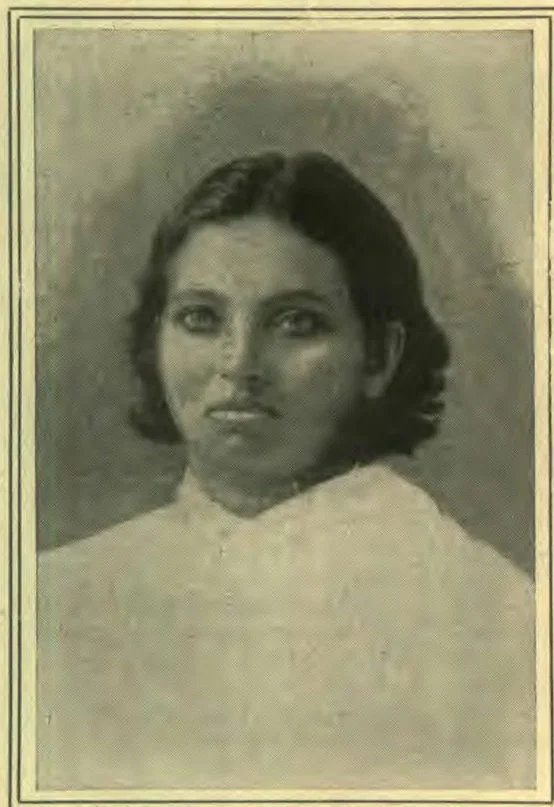
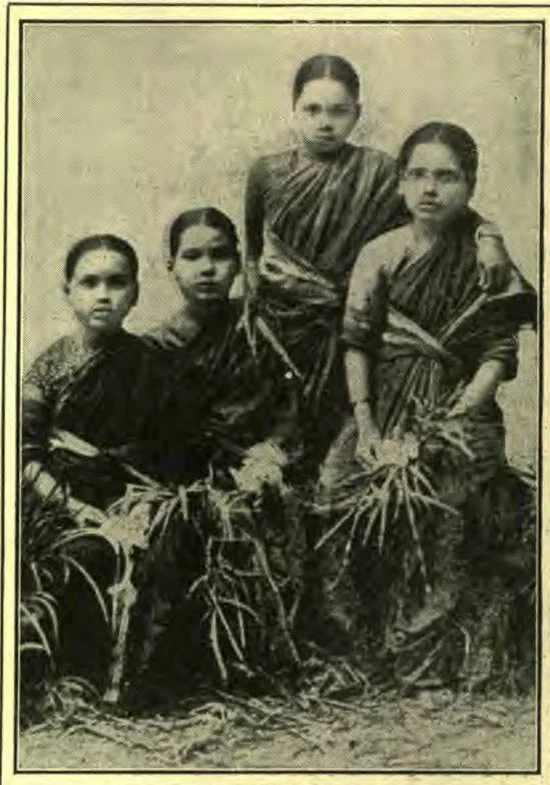
The Story of the Most Remarkable Woman of India, and Her Heroic Work for the Hindu Child-Widows
FAR away in the dark jungles of the Western Ghats of India lived a Hindu hermit, Ananta Shastri by name, a Brahman of great renown for his piety and learning. Pilgrims and students came from far and near to sit at the feet of this dark-skinned, half-clad Socrates and drink in wisdom from his lips. With Ananta lived his child-wife, whom he had bought from her father one morning as they bathed in the sacred river Godavari. The meeting, the bargain, and the wedding all took place within an hour, and it was not a runaway match, either.
Ananta and his little bride of nine summers lived in a rude hut on simple fare, but they were happy. The wise man, unlike many Hindu husbands, was kind to the child, and taught her Sanskrit and all the wisdom of the Hindus, certainly an unwarranted and unheard-of proceeding in the land where two leading articles of faith are the "depravity of woman and the sanctity of the cow." But Ananta Shastri had a mind and will of his own and was not wholly bound by the customs of his countrymen.
Her Forest Home.
Into this family, about fifty years ago, were born a son and two daughters, the youngest of whom was to become famous the world over. Ramabai, as her parents called her, grew up in this jungle home a playmate of the birds and beasts of the forest. Her father and mother taught her from the shastras, and even the pilgrims who flocked to drink of her father's fountain of wisdom, and who were not loath to eat of the holy man's bread, found her not beneath their notice. The girl developed a remarkable mind and memory, and before she was twelve years of age could repeat twenty-three thousand verses from the sacred books, an amount equal to our entire Bible.
Then came the days of famine. No rain had fallen for months, and Ananta's supply of food was exhausted. The little family left their jungle home and began to wander to the sacred shrines in search of relief. Money, jewels, brass cooking-vessels, everything was gradually offered at the temples to propitiate the gods. For seven years the hungry family went about seeking relief, and finding none. At last they had nothing left wherewith to buy food. As descendants of the great god Brahm, they could not work, since that would break their caste; to beg they were ashamed. They determined to go into the great forest and die. For eleven days they lived on water and leaves and a handful of dates. Weaker and weaker grew the feeble old father, while the pangs of hunger griped them sore. The wild beasts' roar had lost all terror for them. They even wished that some fierce tiger or venomous reptile would put a speedy end to their existence. At last the father could bear his sufferings no longer, and announced his determination to cast himself into the sacred tank. This he was determined to do not as an act of suicide, but as an offering to the gods, and the whole family prepared to follow his lead. Wearily they wended their way into the village, the children supporting their aged father with their feeble strength. Mile after mile they dragged their emaciated limbs, until the parents sank exhausted. It seemed that they must die on the spot. The son could not bear to see them suffering, and determined to seek employment, even tho he must lose his caste, [[FIGURE]] which meant more to him than life. But he could find little to do. They sought refuge from the cold and from prowling beasts in one of the temples, but since they could not pay, were driven away by the heartless priests.
Four days they lodged in an old ruin, the accustomed haunt of leopards and jackals. Then the father died of fever. In vain they searched the city for some one of their own caste who would help to dig his grave and lay his body away. The brother and sister themselves were compelled to perform these last sacred rites, and instead of a burial worthy of the dignity of so famous a teacher, these two children carried the body outside the city and laid it tenderly in the earth.
Soon after the mother also entered the great unknown, and the three young orphans were left to fight the world, the flesh, and the devil for themselves. Up and down the land they wandered in search of friends and food. Starvation carried away the older sister, and then only Rama and her brother were left. These two set out on foot to make a pilgrimage to the sacred cities of the north. Their hardships were almost without number, but counted for little compared with the snares which were laid for them by evil men. At times the brother would secure work at four cents a day, but again for weeks they would be compelled to go almost without food or live on a handful of grain a day, soaked in water. Each clad in a single tattered garment, they traveled miles, walking barefoot over hot, dusty roads. At night they lay down on the earth under the sheltering arms of some friendly tree, but with no blanket or other covering to keep off the cold. When the winds blew and chilled them to the bone, they dug graves in the sand with their hands, and covered themselves with earth, leaving their heads above the ground. Thus planted they must have presented a peculiar sight.
Losing Faith in the Brahmans.
Gradually Rama and her brother lost faith in the teaching of the Brahmans. Had they not fasted and prayed and given alms to the holy men? Had they not made pilgrimages to the sacred shrines and bathed in the holy waters? Yet what help had the Brahmans given them or what blessing had come to them from their religion? They resolved to test the teachings of the sacred books, and did so in many ways. In their wanderings they came to the borders of a famous lake renowned for its seven floating mountains. These were said to be seven mahatmas, who had taken this form to receive the homage of the faithful. The priests told the pilgrims that these wonderful mountains would respond to the prayers of the sinless by floating toward the shore on which the suppliant stood. For sinners they remained immovable. All were warned against entering the water, on account of the many fierce crocodiles that guarded the mahatmas.
Rama and her brother stood on the shore of the lake and prayed, but the islands moved not. The priest hinted that they had not made an offering to propitiate the spirits; alas, they had nothing to give. Rama's brother determined to learn for himself the truth of the priests' claims, and early one morning, before others were stirring, he dived into the lake and swam out to the islands. Imagine his surprise when he discovered these to be made of mud and rocks and small trees, all built upon huge rafts. Behind were boats, which, when the representatives of the gods were properly propitiated, propelled the floating miniature mountains toward the shore. Thus were Rama and her brother further disillusioned, and another tie was severed which had bound them to the faith of their fathers.
13### Teaching in Calcutta.
After a few years of wanderings the brother and sister arrived at Calcutta, the great human maelstrom of India. Ramabai was then twenty-two years of age. She had developed a memory which was most remarkable, and her knowledge of the shastras and other sacred books put the Hindu pundits to shame. Her experience, too, had taught her to understand men and women as few of her age and sex know them, either in India or elsewhere. Her ideas of female education inherited from her father and mother were radically opposed to the customs of the country, but she fearlessly advocated them in public and in private. Soon the fame of this remarkable young woman spread throughout the city. People exclaimed that Sarrasveti (the goddess of eloquence) had come again to visit the earth. She was called upon to give lectures to select audiences, and an assembly of pundits (Hindu doctors of philosophy and religion), after a brief examination, conferred on her the title Pandita, a distinction won by no other Hindu woman.
Ramabai's brother died in Calcutta, broken down by years of hardship and the practise of severe austerities. Ramabai's parents had permitted her to remain a maiden long after the usual age of marriage, that she might devote herself to study, so that now most of her countrymen would have thought her ineligible. A Bengali gentleman discovered her worth and won her love. Their wedded life was brief but happy, the husband dying of cholera nineteen months after their marriage. He left Ramabai with a baby girl, whom she called Manorama (Heartsease).
English Law Saved Her.
Had Ramabai lived before the reign of English law in India, the young widow would have been obliged to end her life on the funeral pyre of her husband. Even now in many places the suttee is suppressed only by force of British arms. A few months ago, in this twentieth century, a Hindu widow in Bihar was burned to death in broad daylight, merely because she had committed the crime of having outlived her husband. Her struggles and screams were drowned by the shouts of the crowd and the chanting of Hindu hymns, while strong men kept the wretched woman from fleeing from the flames.
Ramabai escaped this awful death only because the British law has placed some restrictions on Hindu religious and social customs, but she did not escape being despised and cast out by her Brahman friends as the cause of her husband's death, due to her sins in a former life.
Hundreds of thousands of child-widows in India endure a living death because they have had the misfortune to outlive their husbands. Most of them have been married in infancy or as children of six, eight, or ten years of age, many times to men white-haired, black-hearted, decrepit, and diseased. They have never known the joy of marriage with a husband's love, and at his death are made the household scapegoat and drudge. Their heads are shaved, their jewels and clothes are taken away, and clad in one coarse garment, fed on bread and water, cursed by every one on whom their shadow falls, they toil at menial tasks until their life is crushed out of their frail bodies. It is against their religion for them to marry again, but they may go to a heathen temple and be "married to god." The depth of depravity that is involved in such a life can not be described. But this life of shame has the sanction of their religion, for did not even their gods do the same? Is it any wonder that hundreds of young widows, in a strait betwixt two evils, beat out their lives on the stones or drown themselves in wells and rivers?
Pandita Ramabai.
Ramabai was left without home and relatives. In her widowhood this was a real blessing, for there were none to abuse or control her. Thrown upon her own resources, the Pandita once more entered the arena as a lecturer and reformer. She determined to use her wide experience and deep learning in Hindu lore to fight for the emancipation of her sex. She longed to set them free from the chains of ignorance and the horrors of child marriage.
With this purpose in mind she then journeyed westward and settled in Puna, a city near Bombay. Here she began to lecture, and succeeded in forming a society of more enlightened Hindus, who were advocates of female education. Still Ramabai felt that she must do something. Lectures would never remedy the evils which she saw on every hand. She longed to rescue some of the oppressed girls who bemoaned their birth and cursed the day of their marriage.
One day, while passing thru the streets, a young widow appealed to her for protection against the vile creatures who pass for men and who were seeking her ruin. Ramabai took her home, and thus began the work for widows which has since grown to such vast proportions. This young girl, the first to be rescued, is now a valued helper in Ramabai's home for widows at Mukti.
Journey to England and Conversion to Christ.
The Pandita's fame soon spread throughout India and reached even to England. But she was not satisfied. A longing possessed her soul to know more of Western ideals and methods of life. In poverty and scarcely knowing whither she went, she set out with her little daughter and journeyed to England. There she became a Christian, and later was made lecturer on Sanskrit in Cheltenham College, Oxford University. She passed over to America, where she made many friends for the widows of India, and formed "Ramabai Circles," which gave her substantial financial support. She returned to India, and in 1889 opened a school, which she called Sharada Sadan (Home of Wisdom). Two young widows were enrolled as pupils. One of these had been bent on committing suicide, but was prevented by the fear that she might once more be born a woman and undergo still greater suffering than was involved in her widowhood. The Hindu pundits were shocked and maddened when they heard that their famous Pandita had become a Christian, but could only vent their rage in amazement and curses.
Storm of Opposition to Her School.
The school caused a storm of opposition from the Brahmins, for it was intended for high-caste widows, but all this served only to advertise it. Young girls in their dreary confinement heard of the "Scandalous School," where young widows were taken and taught to read and write—an unheard-of proceeding—and those who had any life and ambition left longed to take refuge there. Many unfortunates fled from their bondage to find a home with Ramabai, the widow's friend, and so the school grew. Not satisfied with this, Ramabai went out into the streets and villages round about and gathered in filthy, diseased, and starving girls, for high-caste does not mean wealthy. She cleansed them, healed them, fed them, taught them, loved them. A new life dawned for hundreds who had been trodden underfoot by relatives and neighbors. No religious instruction was given at first, but many came to inquire about Ramabai's God, and asked to be taught the Christian religion. Other girls were not so easily dispossessed of their demons. They wanted everything but would give nothing.
In the latter part of the year 1896, when dire famine again raged in central India, Ramabai heard the wail of thousands of homeless widows who had been turned adrift in the world by death or destitution of family and friends. Many of them wandered off into forests and jungles in search of food; hundreds died of starvation and disease, and others sold themselves to evil men or entered into the vile service of heathen temples. Ramabai determined to visit some of the temples and villages of the famine district in order that she might rescue, if possible, at least three hundred girls. She had not money enough to support those already in the school, but she believed that the Father who had called her to the work would supply the needs. Putting on the garb of a Mahar pilgrim and taking only eight cents in her hand, she started out to visit the famous, or infamous, shrines of Brindaban and other cities. Everywhere she found unspeakable suffering and distress. On some poor-farms, multitudes of all sorts and conditions were huddled together—men and women, boys and girls, clothed and unclothed, diseased and healthy, pure and impure, living under the blue canopy of heaven and eating their dry flour and salt. It was the devil's stamping ground. Is it any wonder that many girls yielded to the allurements of tempters who had money but no morals, or entered the service of the gods, who were like the men who made them?
14### Pandita Ramabai—A Heroine of the Hindus.
(Continued from Page 13.)
In these temples she found hundreds of girls. She talked with them and persuaded many to leave these surroundings for the shelter of her home. Her work in opposition to the devices of evil men brought her into much personal danger, but she heeded it not. Into the very lion's jaws she would go, in hope of rescuing some young girl.
Over three hundred were persuaded to go to Sharada Sadan for food and shelter and education. Temporary grass huts were built and filled to overflowing. Then friends in America and England heard of Ramabai's noble work, and sent money for new buildings and needed supplies. For many years the widow's cause has not failed, altho at times her faith has been sorely tried. A farm was bought at Kedgaon, not far from Puna, and a new home was erected, called Mukti (Salvation). More helpers were engaged, and the widows were taught all the necessary domestic arts. She started kindergarten classes for the little tots, and higher education was given to the older girls. The Bible came to have a place in the curriculum, and many have already gone out from the home as Christian Bible teachers to the sisters in the zenanas. During subsequent famines the numbers have increased, until at times Ramabai has been caring for as many as eighteen hundred widows. A Christian church, the most unique in the world, has been established, a widows' church of over one thousand members, and out of their poverty have sent money to the Armenian orphans and the Chinese Christians after the Boxer rebellion. In order to do this, the girls volunteered to give up meat and a portion of their rice at each meal. Sometimes, when food is scarce and funds are low, they go without rice and milk and butter altogether, and live on coarser grains, with bread and water. There is a Bible Training School for the young women, and a Woman's Foreign Missionary Society was started in 1899. Perhaps they will yet be sending missionaries to America!
Ramabai's school has now a splendid campus and acres of farm land, with wells and reservoirs against another famine. There are comfortable dormitories of brick and stone capable of accommodating over fifteen hundred pupils. There are large dining-rooms, kitchens, storehouses, grinding rooms (where sixty hand mills for grinding wheat are at work); then there is the oil room, the bakery, hospital, schoolrooms, workshops, where various kinds of industrial arts are taught; also simple dwellings for Ramabai and her assistants, offices, guest rooms, and the large church, with a seating capacity on the floor for four thousand. Six years ago all this was nothing but an open field. If you ask Ramabai how all this has been brought about she will tell you that the money and workers have come in answer to prayer.—Delavan L. Pierson.
Child-Widows of India.
The Building of a Home
By Mrs. L. D. Avery-Stuttle
By Mrs. L. D. Avery-Stuttle
Duties of the Father.
WHEN is the true Christian gentleman seen at the best advantage? "Well," you answer, "if he be a clergyman, he is at his best in the pulpit; if he be a lawyer, it is before his judge and jury that he is seen at his very best; a doctor or a nurse is seen at best advantage in a hospital; the business man at his office; the teacher before his classes, and the student at his lessons; while I suppose the mechanic or the workman might be seen at best advantage while engaged in his daily toil."
Thus you reply. But let me tell you where and only where the true Christian gentleman of whatever business is seen at his best. There can be but one answer: In his own home and in the presence of his own family,—and this is true of women as well as of men.
"But," you object, "it is at home that we throw off all restraint. What! am I obliged to keep up my company manners even at home?"
But there should be no such thing as two sets of manners. Home manners ought to be good enough for company, and company manners are surely none too good for the home. Why, man, don't you love your own wife and your own sons and daughters better far than any one else in all the wide world? Well, then, ought you not to be as pleasant and obliging toward them as to mere acquaintances or to strangers?
"Perhaps so," you reply, "but I was hoping you would tell us some, at least, of our important duties as fathers."
Well, but this is the very thing I am doing just now,—nay, do not look grieved nor disappointed; for I assure you that there is no more imperative duty devolving upon any Christian gentleman than the one already mentioned; namely, that of all places on earth, the home should be the one where true courtesy is shown, and where, instead of harsh words and bitter tones, only words of love and tenderness are heard. As far as etiquette is concerned, real, true politeness comes easy to a heart fully determined to battle with its own selfishness, and constantly to put into practise the Golden Rule.
"Well, what about the children?" you ask. "Isn't it entirely within the province of the mother to teach them manners?"
No, indeed, it is not. Of what avail is it for your sons and daughters to be taught the principles of good manners by the mother, so long as they have constantly before them the example of a clownish father? I tell you the influence of example is stronger than all the abstract rules in the world.
Do you remember how ashamed you were of your son the other evening when you took him with you to the pleasant home of Mr. Blank? You were so upset that you did not have the courage to mention your real errand. You felt convinced that it would be quite useless, for surely he would never give a position in his store to such an ill-mannered boy as your John. You were quite overwhelmed with embarrassment as you witnessed his ill-mannered conduct. When Mrs. Blank presented him with a luscious peach, he accepted her kindness with not even a simple "thank you." And I can tell you the reason the lad forgot to remove his cap even when he entered the sitting-room. It is only because he is not accustomed to doing this at home. Indeed, you had almost forgotten to remove your own hat. Perhaps some day you may be made to realize that your hard-working wife should not be expected to assume all the responsibility in the teaching and bringing up of your children, but I hope it will not be too late when you have learned this fact.
It is almost always the case that the father is the ideal of his little son. If the father is ill-bred, if he smokes, chews, or guzzles his beer at the corner grocery or grog-shop, he has no right to expect anything better from his son, tho it is sometimes the case, thank God, that the father's awful example serves to warn his young son off the shoals of dissipation and destruction.
But suppose the father is sincerely trying to set an example worthy of imitation, and, in spite of the vigilance of both parents, the sons have gotten into bad company and learned bad habits, what is to be done then?
The other day my eye caught a little item in a paper in which the author addressed the parents of young lads who had learned card-playing, and who from fear of father and mother had a habit of meeting with their chums in some secret and out-of-the-way place. This author actually advised the parents to open the doors of the house to the young gamblers and their chums, and cordially invite them to play their games in the family sitting-room; being careful only to impress upon their boys the fact that it is not sportsmanlike to cheat at cards! And the paper in which I read this foolish logic was presented to the public under the delusive title of The Home-maker.
As well might we say: "If my son has become tired of life, and contemplates suicide by poisoning, let him bring his cup of horror into the family sitting-room and drink it there!" Think you the poison would be any the less deadly or the results any the less horrible?—Nay, verily.
"But," you say, "you are only telling fathers what not to do. Can you tell us what we are to do under these circumstances?"
Let me reply by giving an opposite example: A young lad had become so unruly and unmanageable that in spite of father's threats and mother's tears he became more and more rebellious, choosing the company of the reckless and profane, until it almost seemed that there was no hope. But did those godly parents give up the battle?—A thousand times, no! What did they do?—They prayed. But had they not prayed before?—Certainly they had; but they remembered in their soul-anguish that man's extremity is God's opportunity; and so, in bitter tears, night and day, without ceasing, they besieged the throne of grace for their erring son. When they saw no apparent change, did they give up praying, satisfied to allow the ungrateful youth to go to destruction?—Not so. They considered the soul of their son of greater value than that. Finally, one night as the father lay prone upon the floor of his room, pleading in an agony of spirit that would not be refused, the lad entered, threw himself upon the floor at his father's side, and with tears of contrition raining down his cheeks, begged the pitying Christ for mercy and forgiveness.
O the ear of Him who is mighty to save is never closed to such prayers as these. What a victory was that! O ye fathers whose sons are on the broad road to destruction, how many such prayers do you offer?
Well, then, let us sum up a few of the most important duties of the father: Let him teach his children, by the power of his own example, courtesy, kindness, and modesty; and let him never cease to present them each before the throne of God in the arms of an all-prevailing and never-doubting faith. Then, as stars in his crown of rejoicing, he may bring them to the Master at last, and say, "Here am I and the children whom Thou hast given me."
Confidence in Father.
'Twas when the sea's tremendous roar
A little bark assailed;
And pallid fear, with awful power,
O'er each on board prevailed.
Save one, the captain's darling son,
Who fearless viewed the storm,
And playful, with composure smiled
At danger's threatening form.
"Why sporting thus," a seaman cried,
"Whilst dangers overwhelm?"
"Why yield to grief?" the boy replied,
"My father's at the helm."
—Anon.
For Religious Liberty.
THERE is a Religious Liberty Bureau in Washington, D. C., composed of earnest, devoted, liberty-loving Christian men, who are devoting their time to educating the nation on the great questions of religious liberty. They publish a live, interesting journal called Liberty.
This year bids fair to give them enough to do. Already three Sunday bills have been introduced into the present session of Congress. A special campaign has been started in Washington by the Protestant ministers and the Roman Catholic clergy to secure a Sunday law for the District of Columbia. The Religious Liberty Bureau is planning a most vigorous counter-campaign to the one referred to above for the purpose of placing literature concerning religious liberty in the homes of the citizens of the capital of the nation.
Apart from the local agitation in Washington there is a widespread agitation for Sunday-law enforcement thruout the country, which demands earnest work on the part of those who love liberty.
The Religious Liberty Bureau is not made up of many men or wealthy men. They need help in the way of funds to scatter literature, in the prayers of Christians.
Any disposed to assist in offerings however small may send them to Mr. K. C. Russell, chairman of the Religious Liberty Bureau, Takoma Park, Washington, D. C., or may send them to the SIGNS OF THE TIMES, and we will forward them to the Bureau. If sent thru us, always designate the purpose of the offering. We hope there will be a generous response and noble work done.
Story of the Seer of Patmos. By S. N. Haskell. The author's latest book is on the thrilling prophecies of the book of Revelation. It presents no vague, new theories, but in simple narrative style portrays the story of the prophet John's life, and traces his prophecies and their wonderful fulfilment.
Illustrated with original engravings made especially for this work. The text of the entire book of Revelation is printed in the margins, and accompanying it are thousands of Scripture references elucidating the text; and besides all this, the explanatory comment of the author on each chapter. It is a companion volume to "Story of Daniel the Prophet," by the same author, and is written in the same style.
The two books are uniform in size and style, and treat two of the most important and least understood books of the Bible. Fully illustrated. Contains 424 pages. Half cloth, $1.25.
Address this office.
Steps to Christ. This little work, by Mrs. E. G. White, presents in a simple and attractive manner the steps by which the sinner may be made complete in Christ. While the book is an excellent guide for inquirers and young converts, it also contains a wealth of counsel and encouragement for those who are laboring with the difficulties that beset a growing experience. Paper covers, 25 cents; cloth, plain edges, 50 cents; cloth, gilt edges, 85 cents. Address this office.
A GREAT WINTER RESORT.
Do you know that Colorado, and especially the valley in which is situated the Boulder-Colorado Sanitarium, is a most delightful winter climate, equal in every respect to that of California or the sunny South?
The Boulder-Colorado Sanitarium is a well-equipped medical institution, employing the very best and most approved methods of treatment.
The medical staff comprises four physicians—two men and two women—graduates of leading medical schools, together with a large corps of nurses of both sexes.
No tubercular or consumptive patients received.
Special reduced rates are afforded during the winter months. Write to-day for large illustrated catalog, with card of rates. Address, Boulder-Colorado Sanitarium, Boulder, Colorado.
Daniel and the Revelation.—Revised edition. By U. Smith. A history of the rise and fall of nations, being an exposition, verse by verse, of the important prophecies of Daniel and John, comparing Scripture predictions with historical facts. It follows in the track of no other commentary; but, guided by the obvious rule that the Bible should be its own interpreter, it aims to arrive at the exact meaning of the sacred writers in harmony with the great plan of redemption as presented thruout the Scriptures. The author has devoted over thirty years to the study of the Bible, and believes that the prophecies of Daniel and John were written for our admonition, and that the subjects they unfold are the coming themes for the religious world, destined to engage the attention of all thoughtful minds. Over 900 pages, with illustrations, beautifully bound. Cloth, marbled edges, $2.75. Address this office.
Bible-Readings for the Home Circle. This book comprises 162 readings for public and private study, and answers nearly 3,000 questions on religious topics—practical, historical, and prophetical. It contains 600 octavo pages, printed on a superior quality of tinted paper, embellished with 57 full-page engravings and 170 ornamental headings, together with 10 full-page Scriptural and prophetic diagrams, 3 colored plates, and other attractive features. The bindings are elegant and substantial, the styles and prices being as follows: Cloth, gilt side title, marbled edges, $2.75; library, marbled edges, $3.75; full leather, marbled edges, $4.75. Cheap edition, 400 pages, solid type, no illustrations or colored plates, no poetry, thin paper, brown cloth, plain edges, $1.25. Address this office.
DATE OF EXPIRATION.
THE SIGNS wrapper bears date of last issue due on your subscription. Unless renewed in advance, paper stops with expiration date.
If herewith is an order-blank, you will know you have overlooked sending renewal. You will not wish to miss a single issue. Back numbers often can not be furnished.
Christ Our Advocate
A clear, the brief setting forth of the Bible types and symbols, the services in connection with the earthly sanctuary, the effectual sacrifice and priesthood of our Lord, to which all these types pointed, and the great prophetic period of Dan. 8:14.
# CHRIST OUR ADVOCATE
Contains 112 pages and is illustrated. Price ten cents.
PACIFIC PRESS
Mountain View, Cal.
WE do not undertake to harmonize any expositions of Scripture outside of the SIGNS OF THE TIMES. To illustrate: One Band member writes that such a book says that a text means this, another book teaches that it means that; now with which does the SIGNS agree? To settle such questions is not our province or purpose. When we can help our readers to a better understanding of the Bible we are glad to do so, but such questions as the above must be answered by mail or not at all. These notes and our question page are for Bible and historical questions pertaining thereto.
Some of our readers have been amazed and alarmed in reading Genesis to find that some of the noted characters there named were very imperfect, that they did not always tell the truth, yet God greatly blessed them, and did not seem to reprove them for their sins. These thoughts may help them: (1) The book of Genesis is not a record of law, but of God's providential care and guarding of the channel of the promised Seed for more than 2,500 years, despite all the efforts of Satan to overthrow His plan. From the implication of the promise in Gen. 3:15 to Israel in Egypt God preserved them thru whom the Seed should come. (2) God takes people as they are, and He weighs them, not according to outward appearance nor specific knowledge, but according to the purpose of their lives. 2 Chron. 16:9. They may be very imperfect, but the perfect purpose rules, gradually molding their lives to its high standard. God works with us poor mortals only as we will and choose to let Him; for the awful responsibility of choice is left with us. (3) We do not know how often God reproved and rebuked sins simply from this brief record. He doubtless did reprove, and He has shown us the working out of this. He reveals the sin, He also reveals the consequences. Note this emphatically in Jacob's life.
Religion and the Selfish Heart
In Lisbon, Ohio, December 3, a man by the name of Webber shot his bride of four weeks, on the threshold of the Disciples Church, saying, "She chose between her religion and me." He then killed himself. If the bride had been a communicant of some small, unpopular church, the whole blame would have been laid at the door of that church. Of course, it was not the church at all; the cause was the selfishness of the human heart. If the man had had good sense he would have known that if his wife was a true Christian, she would make a great deal better wife than tho she were not.
Prophetic Charts
Prophetic Charts.—It is but justice to ourselves as well as to the author of the Prophetic Charts which have been advertised in the SIGNS to say that the department "W," does not refer to Wilcox. We are not a painter, could not paint as good charts as these if we were to try. The charts are excellent for lecturing on the prophecies, and are worth, in our judgment, all that Brother Wierts is asking for them; but the editor is in no way responsible for the advertisement nor the charts.
Anarchy and Unrest in Rome
A despatch from Rome under date of December 23 to the New York World declares that conditions at present are causing the greatest anxiety of all thinking men; Socialists and Anarchists are playing havoc with the discipline of the army, and the conditions of society are such that the Anarchists have plenty of matter to work on. Since the earthquakes in Calabria, many are in sore need; the needy ones are discontented and among these the Anarchists are reaping their harvest.
Prohibition and Sunday Legislation
Two excellent tracts have come to our table from Washington, D. C. One is "The Liquor Traffic and Prohibition; a Vital Institution to the Nation—Should the Liquor Traffic Be Legalized By Law?" A frank open discussion of the question. The other tract is entitled: "Prohibition and Sunday Legislation, Two Important Issues Before the People of the National Capital." Copies may be obtained from the Review and Herald, Takoma Park Station, Washington, D. C.