Review and Herald Publishing Company · Battle Creek, Mich. · Feb 8, 1900
PLAYING ESKIMO TWO MILES ABOVE THE SEA
By J. Edgar Ross
If your home were in the twentieth story of a modern “sky scraper” in some of our large cities, you would be likely to use the elevator in going up and down. If you were compelled to climb the stairs, you would think it a terrible task; but when you reached the top, you would be only about one fourth the height of Mt. Hood. How insignificant appear the great buildings of men, when compared with some of the buildings of God!
THE CREVASSE.
Mt. Hood owes its fame more to its situation, and its slender, graceful outline, than to its height. Standing almost on the banks of the mighty Columbia, about sixty miles east of Portland, Ore., it looks down on the vast plains of eastern Oregon on one side and the mighty Pacific Ocean on the other.
Geologists tell us that, ages ago, Mt. Hood was much higher than it is at the present time, the top and one side of the mountain having been blown off by a volcanic explosion. The explosion left the crater about two thousand feet below the summit, on the south side of the mountain, where it is now found. This theory is undoubtedly correct, but we know that geological ages do not cover as many years as so-called science often teaches. Before the flood there were no volcanoes, and God has told us quite definitely when the flood occurred. We may, therefore, safely conclude that the explosion that reduced the height of Mt. Hood was of comparatively recent date.
The ascent of Mt. Hood is not usually considered either difficult or dangerous; but one unaccustomed to mountain climbing may find it both. Scores of persons climb to its summit each year; and whenever an accident has occurred, it has been because of the reckless daring of some one whose courage was greater than either his caution or experience.
It was principally a desire to do something unusual that led the writer and another young man to climb Mt. Hood, and spend a night on the summit. Years before, a guide had been compelled to remain on the summit overnight, with the result that he came near losing his life; but we thought we were prepared for the ordeal, and had no fear for the outcome.
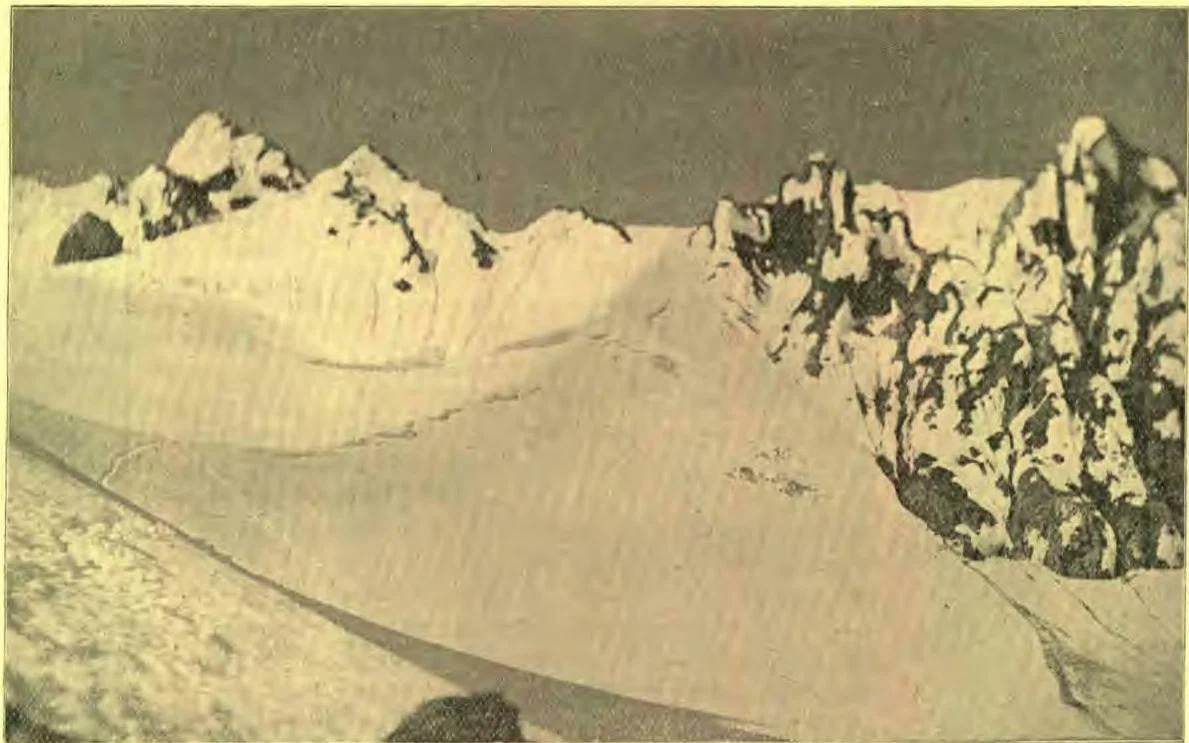
Early one July morning we left our camp at timber line on the south side of the mountain, and began to tramp up over the snow fields. We carried two pairs of blankets, a mackintosh, a camera, a large canteen of water, and a generous lunch. That made a rather heavy load for amateur mountaineers; but we took our time, and reached the crater without difficulty, a little before noon. Here we took a short rest, and ate a lunch before continuing the ascent to the summit. One crevasse, and only one, blocked our way. By making a long detour to the left, we were able to cross this on an ice bridge.
The photograph here reproduced shows this crevasse at the end of the long ridge of snow. It was taken from the crater, looking toward the summit.
Beyond the crevasse we struggled, step by step, up the steep banks of ice and snow, until about three o’clock, when we reached the very top. The last part of the ascent was hard work. We were sheltered from the wind, but not from the sun, so the climb was almost like taking a Turkish bath. On the summit we were greeted by a strong wind, so bitterly cold that it chilled us in a moment, and effectually took away our appetite for scenery. We accordingly lost no time in searching out a sheltered spot, and at once began to dig a cave in the snow.
The spot selected for our Eskimo house was on the north side of the peak, where an almost perpendicular wall of snow reached from a narrow shelf of rock to the very top of the mountain. The entrance to our cave was perhaps ten or twelve feet from the actual summit. We dug through about a foot of snow, and then struck solid ice. In this the round, blunt points of our alpenstocks made little impression, and it was nearly sundown before we finished the cave, which was long enough to sleep in, high enough to stretch in, and wide enough for two to lie side by side. Of course we expected to sleep. Eskimos sleep in snow houses. Why shouldn’t we?
We spread the mackintosh on the floor, and on top of this laid one pair of blankets, reserving the other for covering. Then we partly blocked the entrance of our snug little cave, and went out to see the sunset.
A few clouds were drifting about in the mountains below; but in the distant west the sky was clear. For a moment we caught the reflection of the sun’s parting rays on the restless waters of the distant Pacific; then twilight fell. Twilight lingers a long time on the mountain tops; so for more than an hour we stood in a sheltered nook out toward the western extremity of the summit, and gazed on the scene spread out before us. We saw the lights of Portland and the gleam of an occasional campfire, but the clouds grew thicker and blacker until we could see nothing but a dark, rolling mass of vapor. The wind had redoubled its fury, until it was no longer possible to stand against it. We crawled back to the cave, blockaded the entrance so as to leave only a small airhole, and prepared to—shiver.
We slept very little that night. Long before morning we had doubled up the second pair of blankets to put under us, in a vain endeavor to keep down the terrible cold. We mutually agreed that Eskimos have more than a mackintosh42and two pairs of blankets to sleep on when they make their bed on a floor of ice.
All things have their end; and when morning came, there ended one of the most miserable nights the writer ever spent. But despite our night of suffering, we were able to appreciate the beauty of the glorious sunrise. No pen can describe the rich and varied tints of crimson and gold scattered lavishly upon the dark clouds hiding the earth from view.
We were so numb and stiff from the cold that we dared not attempt the descent until after eleven o’clock, when the sun had softened the crust of the snow sufficiently for us to pierce it with our alpenstocks. Even then we proceeded with great caution, until we had safely crossed the crevasse. Then all caution was thrown to the winds, and we went down with long strides, sometimes venturing a short glissade.
Below the crater we found a homemade toboggan, which some one had left on the rocks. It was a rough affair, but we thought it would be a time-saver in the descent, and this it certainly proved. It carried us from the crater to within a few rods of our camp,—a distance of three miles,—in so short a time that it is scarcely worth mentioning.
When we looked back at the peak, it was covered with clouds. We had descended just in time, and were heartily glad that our novel, and not altogether unenjoyable, adventure was over. J. EDGAR ROSS.
CHRIST BEFORE HEROD
By Ellen G. White
FROM Pilate, Christ was hurried to the judgment hall of Herod. Herod had never met Jesus, but he had long desired to see him, and witness his marvelous power. As the Saviour was brought forth, the multitude surged and pressed about him. Herod commanded silence, for he wished to question Christ. He desired to have his curiosity gratified, and thought that Christ would do anything he asked, if he was given a prospect of release.
Herod ordered the fetters of Christ to be unloosed. He looked with curiosity into the serene face of the world's Redeemer, but he read there only innocence and noble purity. He was satisfied, as Pilate had been, that Christ had been brought there from motives of malice and envy. He urged Jesus to perform one of his wonderful miracles before him. At his command the decrepit and maimed were brought into the presence of Christ, and he was ordered to prove his claims by demonstrating his power before them. Men say that thou canst heal the sick, Herod said; I am anxious to see that thy wide-spread fame has not been belied. If thou canst work miracles for others, work them now; and it shall serve thee a good purpose.
But the Saviour stood before the king as one who neither saw nor heard. Herod felt that he was mocked. Again he commanded Jesus to work a miracle. Show us a sign, he said, that thou hast the power with which rumor hath accredited thee. He promised Christ that if he would perform some miracle in his presence, he would release him. But Christ preserved alike his silence and his godlike majesty. That ear that had ever been open to human woe had no room for Herod's words. Those eyes that had ever rested upon the sinner in pitying, forgiving love, had no look to bestow upon Herod. Those lips that had uttered the most impressive truths, that had ever pleaded in tones of tenderest entreaty, that had ever been ready to speak pardon to the most hardened sinner, were closed to him.
Some of Christ's accusers had seen with their own eyes the mighty works wrought by his power. Their ears had heard him command the grave to give up its dead. They had seen the grave obey his command, and fear seized them lest Christ should work a miracle and thus defeat their purposes. In great anxiety they raised their voices, declaring, He is a traitor, a blasphemer. He works his miracles through Beelzebub, the prince of the devils. He claims to be the Son of God, the king of Israel. The hall was one scene of confusion, some crying one thing, and some another.
Herod interpreted the silence of Christ as an insult to himself, a contempt for his power. Turning to him, he said: If you will not work a miracle, if you will give no proof of your claims, I will give you up to the soldiers and the people. They may succeed in making you speak. If you are an impostor, death at their hands is only what you merit; if you are the Son of God, save yourself.
No sooner were these words spoken than a rush was made for Christ. The Saviour was mocked, and dragged this way and that, Herod making suggestions as to how they could best humiliate him. And all this against a man who had been pronounced faultless. No accusation could be proved against him. He was the victim of the malice and jealousy of the people who had been the chosen of God.
Satan led the cruel mob in their abuse of the Saviour. It was his purpose to provoke him to retaliation, if possible, or to drive him to perform a miracle to release himself, and thus break up the plan of salvation. One stain upon his human life, one failure of his humanity to bear the terrible test, and the Lamb of God would have been an imperfect offering, and the redemption of man a failure. But he who by a command could bring the heavenly host to his aid, he who could have driven that mob in terror from his sight by one look of divinity, submitted to the coarsest insult and outrage with dignified composure. The crown of thorns encircling his brow was the symbol of his anointing as the great High Priest.
As Herod saw Jesus accepting all this indignity in silence, he was moved with a sudden fear that this was no common man before him. He was perplexed by the thought that his prisoner might be a god come down to the earth. He dared not ratify the condemnation of the Jews. He wished to relieve himself of the terrible responsibility, and so sent Jesus back to Pilate.
1. Tabernacle and Sanctuary.—These words are used interchangeably in referring to the wonderful structure that God caused the children of Israel to erect in the wilderness, that he might dwell among them; but its prominent and permanent name was “sanctuary.”
2. The Temple.—When the necessity for a movable structure ceased to exist, the sanctuary took a more permanent form, and was built on Mt. Moriah in Jerusalem. The pattern of this structure was given to David. Each of the apartments was twice the size of those of the tabernacle built in the wilderness. The vessels were also enlarged and multiplied for the service. Unto Solomon was committed the erection of the building, and seven and one-half years was required for its completion. As the glory of the Lord filled the tabernacle in the wilderness (Ex. 40:34), just so he took possession of the temple. I Kings 8:10, 11.
3. The Temple Despoiled.—Thirty-four years after the dedication, Shishak, king of Egypt, conquered Jerusalem, and carried away the treasures of the temple. The rule of Egypt was but temporary; and, later, restoration was made of some of the losses.
4. The Temple Destroyed.—When Nebuchadnezzar conquered Jerusalem, B. C. 606, he removed the sacred vessels to Babylon. After the third siege of the city, B. C. 588, the temple, with the whole city, was set on fire, and nothing was left but an unconsumable pile of rubbish.
5. The Temple Rebuilt.—After the expiration of the seventy years of Israel’s captivity in Babylon, multitudes of the Jews returned to the site of Jerusalem, to rebuild the house of the Lord. The sacred vessels were also restored. Fifty-two years after the first temple was destroyed, Zerubbabel laid the foundation of the second. Hindrances were encountered, and it was not completed until twenty-one years later.
6. Some Things Lacking.—The house was of the same dimensions as the former one, but those things that constituted the glory of the first temple were missing; namely, the ark, which contained the tables of the law; the shekinah, or glory of the divine presence manifest between the cherubim over the ark; the urim and thummim; and the holy fire on the altar.
7. Again Rebuilt.—After five hundred years the temple was in need of many repairs. Herod the Great, to court the favor of the Jews, proposed tearing it down and rebuilding. This was done. Forty-six years was required to build it, and it was completed A. D. 27, the very year in which Christ began his public ministry. The magnificence and splendor of this building excited the admiration of the world.43
8. Final Destruction.—In A. D. 70 the armies of Rome encompassed Jerusalem, and the city fell. A Roman soldier climbed upon the shoulders of a comrade, and thrust a firebrand into the gilded lattice of the temple porch. The magnificent structure was leveled to the ground. This destruction came in the same month, and upon the same day of the month, that the destruction of Solomon’s temple occurred, six hundred and fifty-eight years before.
9. What Became of the Ark?—It, with other large furniture of the sanctuary, was not taken to Babylon, else it would have been returned with the other sacred treasures carried there. Some have thought that it was hidden by Jeremiah. A passage in the book of Maccabees is doubtless the authority for this. The quotation reads that Jeremy the prophet, “being warned of God, commanded the tabernacle and the ark to go with him, as he went forth into the mountain where Moses climbed up, and saw the heritage of God. And when Jeremy came thither, he found an hollow cave, wherein he laid the tabernacle and the ark, and the altar of incense, and so stopped the door. And some of those that followed him came to mark the way, but they could not find it. Which, when Jeremy perceived, he blamed them, saying, As for that place, it shall be unknown until the time that God gather his people again together, and receive them unto mercy.” From this latter expression some have thought that before the end of time, the ark will be discovered.
FOR ME
UNDER an Eastern sky,
Amid the rabble's cry,
A Man went forth to die
For me.
Thorn-crowned his blessed head;
Blood-stained his every tread;
Cross-laden, on he sped
For me.
Pierced were his hands and feet;
Three hours did o'er him beat
Fierce rays of noontide heat
For me.
Thus wert thou made all mine.
Lord, make me wholly thine;
Grant grace and strength divine
For me.
In thought and word and deed
Thy will to do. O lead
My soul, e'en though it bleed,
To thee!
— Selected.
FEBRUARY STUDY OF THE FIELD
PART II: GEOGRAPHY OF CHINA
(February 11–17)
1. Basis of Study.—For Part II of the February study, read “Geography of China,” in the February issue of the Missionary Magazine.
2. Family Boats.—The population of many of China’s cities is so dense that large numbers of the people live in boats on the rivers and lakes. These boats ply between the shore and the various ships, taking passengers whenever they may be obtained. They are called “sampans,” and are generally long, with a small awning near the stern, under which the passengers sit. Of the four or five rowers, but one or two are men; the rest are women or young girls, who are as strong and active as the men. Each boat is the home of a family; where a family is not sufficiently large, two sometimes occupy one boat. The dwellers on these boats naturally become expert in rowing and handling their craft. Little skill is required in good weather, but there are times when the sea is so rough that boats can not be obtained at any price, and passengers desiring transportation in them may be delayed for several days.
3. Life in a Sampan.—While she rows, the mother may have her infant strapped to her back; and the little fellow’s head, which is unsupported, travels from side to side with every movement she makes. Often the baby is handed over to a child—boy or girl—of nine or ten years, who, with the burden on his back, moves about freely, not seeming to mind it at all. Children old enough to toddle about, but still young enough to require attention, are often tied by a string to the middle of the boat; or they may have gourds fastened about their bodies, so that if they fall overboard, as is sometimes the case, they will float until picked up.
4. Other Boats.—Besides the sampans, there are many other boats. Some are floating palaces, which at night are brilliantly lighted, and busy waiters may be seen moving about among the feasting men and painted women. Not infrequently these are gambling-houses and places of debauch. The large house-boats, two stories high, are richly decorated and ornamented, and used as excursion boats. Many of the vessels moored by the river-side are places of entertainment and refreshment. Some are even hotels.
5. Joss-Houses.—A joss is a Chinese idol. There may be a number of these idols in a joss-house, or temple. One of these temples is described as having thirty or forty idols. Among other offerings to joss were some large model-ships, representing three-deckers; these were made of paper, stretched upon frames of wood, and showed that the Chinese desired joss to cast some barbarian (foreign) ships upon the shore, that they might plunder them. Joss-paper is used in worship. It is made of gold or silver paper, cut in the shape of coin, and burned before the god.
6. Sacred Lily.—The Chinese, or sacred, lily, is the national flower. The Chinese call it the “Shui Sin Far,” or Water Fairy Flower; and the “Joss Flower,” or Flower of the Gods. It is a variety of the narcissus, and bears white flowers with golden-yellow cups. The bulb is placed in a bowl of water, with pebbles and shells, at such a date that it will bloom by New-year’s day, being regarded as a symbol of good luck. At this time there is scarcely a family that has not one or more of these plants in bloom, and the majority have a number. They are also seen in the shops and stores.
7. Chinese New Year.—The Chinese new year is a movable festival, and may fall on any date between January 21 and February 19. It is held in particular honor, and is ushered in with the noise of firecrackers. Great numbers are fastened together upon a string in such a way that, when ignited, the rest explode in regular succession.
8. New-Year’s Customs.—New-year’s day is a universal holiday. Every shop and place of business is entirely closed; and for a week or ten days, and sometimes even two weeks, business is more or less suspended, every one taking as long a holiday as his money will allow. Worshipers crowd the joss-houses. Little rectangular pieces of perforated gilt paper decorate the door of every dwelling. A tiny niche in the entrance is adorned in like manner, and lighted with small tapers, serving as a small shrine. A great deal of visiting is done. The streets are crowded with people on their way to make calls. Those who stay at home and receive visitors do their calling by proxy, in the persons of their servants or clerks, who leave red paper cards, with complimentary messages, at the houses of their masters’ acquaintances. All try to be well dressed on the first day of the year. The poor man will obtain for this occasion a passable costume, which is usually a long coat reaching down to his heels. It does not matter if he has to leave it in pawn for the remainder of the year; it is enough that he has it to wear on New-year’s day. Those not able to buy will borrow a dress for the occasion. Sometimes the servants are garbed so finely then that they are not recognized by their masters. The children of both sexes are dressed in bright colors. Every man is clean-shaven. Presents are freely exchanged.
9. Character of the Chinese.—Those who have lived among the people of this nation differ as to their character. They have a great respect for age. Often after a son marries, he lives with his father, and obeys him as he did before marriage. The head of the family, the oldest male, exercises supreme authority. The Chinese are superstitious. They place no value upon truth, thinking nothing of lying and cheating. They are great gamblers, even the children indulging in this vice. Death is not feared by the Chinese, and they place a slight regard upon human life. On the other hand, they are sober, industrious, and economical. A reeling Chinaman is rarely seen on the street.
Verses on Truth and Divine Constancy
By Arthur Hugh Clough
It fortifies my soul to know
That, though I perish, truth is so:
That, howsoe’er I stray and range,
Whate’er I do, Thou dost not change.
I steadier step when I recall
That, if I slip, thou dost not fall.
— Arthur Hugh Clough.
A READING CIRCLE EXPERIENCE
By Wm. S. Hopkins
It may be of interest to some to know how the Lord led me, after making the matter a subject of much study and prayer, to the home of two lonely widows, mother and daughter. The mother is a paralytic, and has been confined to the house for nearly eleven years. After I had given a description of the book, “The Coming King,” the daughter told me she had just bought a book from an agent (“Thoughts on Daniel and the Revelation”) and, not being a Bible student, she could not understand it. I asked if she would not like to have some of us call and read the book with her, and explain it. She gave a willing assent, and her mother said, “Oh, I am so glad!” You will better appreciate why she was glad when I tell you that notwithstanding she was once fairly well educated, her mind had become almost a blank, through suffering. We have held several readings with these friends, and have asked the Lord to quicken their minds, and he is answering our prayers. This experience has done us all good, and called forth praise to God from all concerned.
Wm. S. Hopkins.
PLANS
“THERE are three sets of plans for our lives,” said a gray-haired lady—“those we make for ourselves, those our friends make for us, and God’s, which finally overrule all. We are so sure, when life is young, that we know what we want, and have an undoubted right to secure it, that it is a surprise to find that our friends think they know better than we, and that if we pursue our chosen course, we must disappoint those who love us. ‘Why can’t they let us be happy in our own way, so long as it isn’t a wrong way?’ we say; and it takes us long to learn tenderness, for love’s sake, with these kindly plannings that we can not follow. But when we have fought our way to our own path, it is not what we thought it. We are hurt with the hurts we have given, and the zest is gone.
“Then, as the years slip by, we find that we might have been at peace; for not what human affection planned for us, nor what we chose for ourselves, has come to pass; but slowly God’s great purpose has changed and overruled all, bringing about, not what love feared nor hope dreamed, but his own will. Oh, what heartaches we might spare ourselves and our dear ones, if only we realized that over all our plannings runs his perfect, gracious purpose!”—Well-Spring.
ROOTED
MARY LESTER was one of the most brilliant and earnest of the college girls, and teachers and classmates alike sympathized with her in the heavy affliction that brought her school-life to an abrupt termination.
Just at the opening of her junior year, her mother suddenly died, and she was summoned home to assume the management of the household, and the care of a number of younger brothers and sisters. Though overwhelmed with grief, she bade us all a brave good-by. The little room, whose belongings had been so characteristic of her bright individuality, was taken by a “new girl,” and the stream of student-life closed behind her, almost as the larger current of world-life is wont to close again when some one drops out of sight forever.
But though we seldom heard of Mary, we could not forget her. So it happened that when Mrs. Warrington, our dearest teacher, and I, were taking a short vacation-journey together, we stopped, one day, at the country railway station nearest the Lester farm. Engaging passage in the old-fashioned mail-coach, which plied between the station and two or three small villages off the railway line, we were driven for five miles “up hill and down dale,” until our lumbering equipage drew up in front of a low-roofed, red farmhouse, half hidden by clustering trees and clambering vines.
Mary was expecting us, and came swiftly down the path. Her face was glowing with welcome. “It is so lovely of you both to come to see me!” she said. “And you must have had a warm, disagreeable ride. The children have been watching, the last hour, for the stage.”
She spoke laughingly, but a slight tremor in her voice seemed to show that the lightness was assumed to hide an almost uncontrollable rush of feeling. The children came forward to be presented to us,—two sturdy boys, of fourteen and sixteen respectively, and a pair of twin girls, ten years old. Directly her father entered, a kindly faced man, whose bronzed cheeks and hardened hands told the story of a farmer’s life of toil and exposure.
At the supper table, which was daintily though plainly spread, Mrs. Warrington praised the lightness of the rolls and the sweetness of the butter.
“Yes,” said Mr. Lester, “Mary’s getting to be as good a cook and butter-maker as her mother was,” and he glanced at his daughter with a smile which seemed to say that approval could go no further.
When the meal was over, the little girls began to clear away the dishes, and Mary led the way to the garden, where we sat down together upon a bench under a spreading cherry tree.
“Now, my dear,” said Mrs. Warrington, taking Mary’s hand in her own, “tell me all about yourself.”
Mary colored almost painfully.
“There is not much to tell, dear Mrs. Warrington,” she answered, trying to speak playfully. “You see it all.”
“But I see only the outside.”
“There is nothing else worth seeing!” Mary began, but her voice broke, and she went on impetuously. “Please don’t think me ungrateful; for, indeed, I could never tell you what it is to me to have you here! But the sight of your faces brings back to me so much that I ought to forget.”
“What, Mary?”
“All my hopes and plans, the things I meant to do in the world, and—I may as well confess it—for the world. I must have been very foolish and ambitious, for I really thought I could do some special work. I longed to achieve—to be of use in some broad sense. Of course that is no longer possible.”
“Why?”
Mary looked surprised, but she answered, gently: “I could never be spared from home. Poor father has had losses, and needs all the help that I can give him. The children depend upon me. We must begin to plan already for the boys’ education. Indeed, I am not repining—I would not leave them, if I could. But you see how it is,—I am rooted here.”
“Ah! I have just made a discovery!” said Mrs. Warrington, with such apparent irrelevance and lack of sympathy that I could only gaze at her in astonishment. “That sweet-brier yonder is the source of the delicious fragrance that I have been breathing ever since I came, even before I was out of the coach.”
The color mounted again to Mary’s cheeks, but she said nothing.
“Others have found it out before me,” Mrs. Warrington went on. “Only see the butterflies—how they hover and sip! And the bees—dusty fellows!—they will have their honey flavored with roses. And look! yonder darts a humming-bird! What a profusion of blossoms! Such a harvest as there will be of the little scarlet hips by and by!”
“Yes,” said Mary, “the bush is covered with berries every fall, and they hang upon it long after the snow comes. The children call it ‘the snow-birds’ granary,’ for the little creatures come from far and near to feast. It almost seems as if they must have couriers to pass on the good news of plenty. We are always very sorry when the last berry has disappeared.”
“The bush is indeed a wonderful purveyor. Beauty for all eyes, fragrance borne on every breeze, sweetness and food for all comers—these are its gifts. Yet, Mary, from spring to spring again, year after year, it never once stirs from its corner of the garden: it is ‘rooted’!”
Tears sprang to Mary’s eyes.
“O Mrs. Warrington!” she cried, “I see—I understand.”
The teacher laid a tender arm about the young girl’s shoulders.
“The rose-tree,” she said, “draws that which it gives from the warm heart of the earth. The moisture and richness of the soil flow upward through its veins, and are transformed into beauty and blessing. And the soul which is ‘rooted and grounded in love,’ knows the love of Christ, ‘which passeth knowledge,’ and is ‘filled with all the fullness of God.’”—Young People’s Weekly.
PLAYMATES
By Edith H. Thomas
Two little puppies, full of play,
With a bone to worry and toss,
Were sporting together the livelong day,
And they never seemed vexed or cross.
Three little squirrels, gray and wee,
And spry and light as a bird,
Played all day long in the old oak tree,
And they never said one sharp word.
Four tiny pussies, the little dears,
Climbed up on the garden wall;
They played with each other's tails and ears,
And never quarreled at all.
Five little birds, such a very tight fit,
In oh, such a tiny nest!
Never crowded nor shoved nor pushed one bit
For the place that each liked best.
Six little chicks in the grass so green,
Seven little ducks in the brook,
Never gave one another, as I have seen,
An angry or unkind look.
Eight little lambs went to frolic and feed
In the meadows broad and bright,
And the dear little things never once disagreed,
From the dawn of day till night.
Nine little boys were playing ball,
But they made such a fuss,—oh, dear!—
And wrangled and scolded and screamed and all,
That it tired my ears to hear.
And that is the way, I am sorry to say,—
For wasn't it just too bad?—
That they lost, on this pleasant summer day,
All the fun that they might have had.
— Edith H. Thomas.
QUERIES AND QUESTIONS
By W. S. Chapman
If the reader will use a dictionary in the effort to answer, more may be seen in the following queries and questions than appears on the surface:—
Has a heathen a creed?
Do we, or do we not, make a noise in craunching food?
What is the relation between each and other?
Is the language of the Bible an idiom?
Is a cut finger lacerated?
Is coal pabulum; if so, how and why?
Is one necessarily lacking who is in want?
Will a daisy grow on a dais?
What is the difference between a story and a gag?
Is a hen a grallatory bird?
Is a man who is hung, suspended or hanged?
Is his death accidental?
W. S. CHAPMAN.
Ostentation Is Never a Sign of True Success
“OSTENTATION is never typical of true success. It is always well to remember that the vast majority of successful men are never heard of.”
A SONG IN THE NIGHT
By Minnie Rosilla Stevens
Night had fallen on the prairie,—
Chill and misty winter's night,—
In the quiet house I, lonely,
Sat me down to think and write.
But the day, by friends made pleasant,
Other friends had marred with pain.
Faces fair had smiled upon me;
Dark ones, proud, had frowned disdain.
And as pebbles in still water
Start the wavelet's circling play,
So my thoughts, in quick succession,
Rippled, rippled, far away,—
Thoughts of work for me awaiting,
Thoughts of errors in the past,
Future worry, present trouble,
Pleasure, sorrow, crowding fast,—
Till my mind refused to reason,
And my hand refused to write;
While I listened to the chill wind
Sighing through the winter night.
Silently I sat, till softly,
Through the mist and fog, I heard
Some one singing, though I could not
Clearly understand a word.
But the air was sweet and tender,
And the voice was true and strong;
Rapt, I listened, as the breezes
Bore the liquid notes along.
What is music, that it thrills us—
Makes us sorrow or rejoice?
What the power that oft lies hidden
In a few notes of a voice?
We know not; but though we love it
When in sunny hours we list,
Sweeter is a song at midnight,
Borne upon the winter's mist.
And when future days are troubled,
And dark shadows gloom the light,
I will call to my remembrance
That sweet song heard in the night.